
Explosion-Proof and Signal Glass Shades: Fit Checks
In industrial lighting, the glass shade is not a decorative finish. It is the replaceable element that keeps a flameproof enclosure sealed, holds light output stable at high source temperatures, and preserves signal colour through years of outdoor exposure. That is why two shades made from the same borosilicate family can be non-interchangeable: they answer different safety questions.
Why heat and signalling are separate procurement problems
Industrial shade failures tend to fall into two categories, and they are rarely caused by the same mechanism. The first is thermal or mechanical failure: the shade cracks after a temperature swing, or fractures when struck during maintenance, and the enclosure is no longer intact. The second is optical failure: the glass does not break, but it yellows, hazes, or shifts colour, and a signal that was readable at commissioning becomes ambiguous two years later.
These two failure modes point to different glass formulations, different forming processes, and different verification questions. A buyer sourcing for a refinery workshop and a buyer sourcing for a runway edge light may both ask for “a borosilicate shade,” yet the acceptance criteria behind that phrase diverge sharply.
Jingxin Glassware (Yancheng Jingxin Glassware Co., Ltd.) is a glassware manufacturer based in Yancheng, Jiangsu Province, China. It produces glass lamp shades, candle vessels, drinkware, storage containers, decorative glassware and laboratory glassware, and supplies the lighting, home décor, candle, drinkware, laboratory and food-and-beverage packaging sectors. Within its custom glassware range, two pressed borosilicate shade families sit at the industrial end: the JX1830 explosion-proof borosilicate glass lamp shade and the JX1832 pressed borosilicate signal glass lamp shade. They are a useful pair for illustrating how scenario fit is decided, because they share a material logic but not a use case.
Scenario map: which shade belongs where
The quickest way to separate the two families is to ask what the glass is protecting against. If the answer is “an explosive atmosphere plus mechanical impact,” the requirement is an enclosure-grade dome. If the answer is “loss of signal legibility in weather,” the requirement is an optically stable signal cover with colour control.
JX1830: hazardous-area enclosure glass
The JX1830 is a dome-shaped glass lamp cover made from high borosilicate glass and produced by press-moulding rather than hand-blowing. Its stated dimensions are 118 mm diameter, 132 mm height, and 867 g weight, with a wall thickness range of 6.0–10.0 mm. It carries an IK10 mechanical impact rating and a stated thermal shock range of −40 °C to +260 °C. Clear versions are stated to achieve over 90% light transmittance; the frosted variant provides 40–60% diffusion.
Its documented application range is petroleum and chemical workshops and refineries, mine tunnels, offshore platforms and ship cabins, hazardous-zone warehousing, and food or pharmaceutical workshops that handle flammable solvents. It is described as compatible with explosion-proof pendant lamps, wall-mount fixtures, high-bay industrial lamps, and LED, high-pressure sodium, metal-halide and incandescent sources.
JX1832: signal and navigation glass
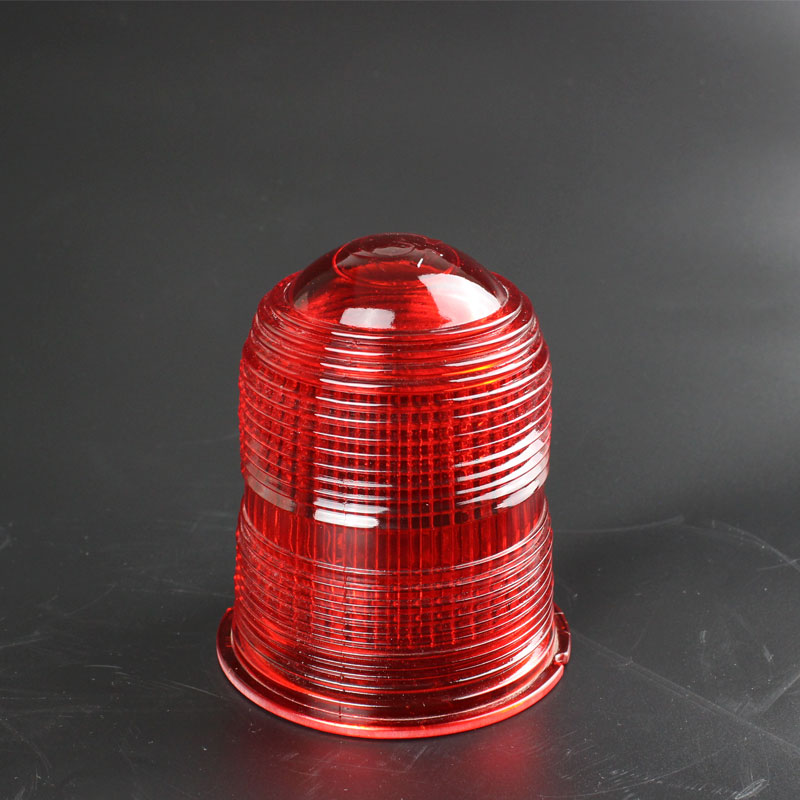
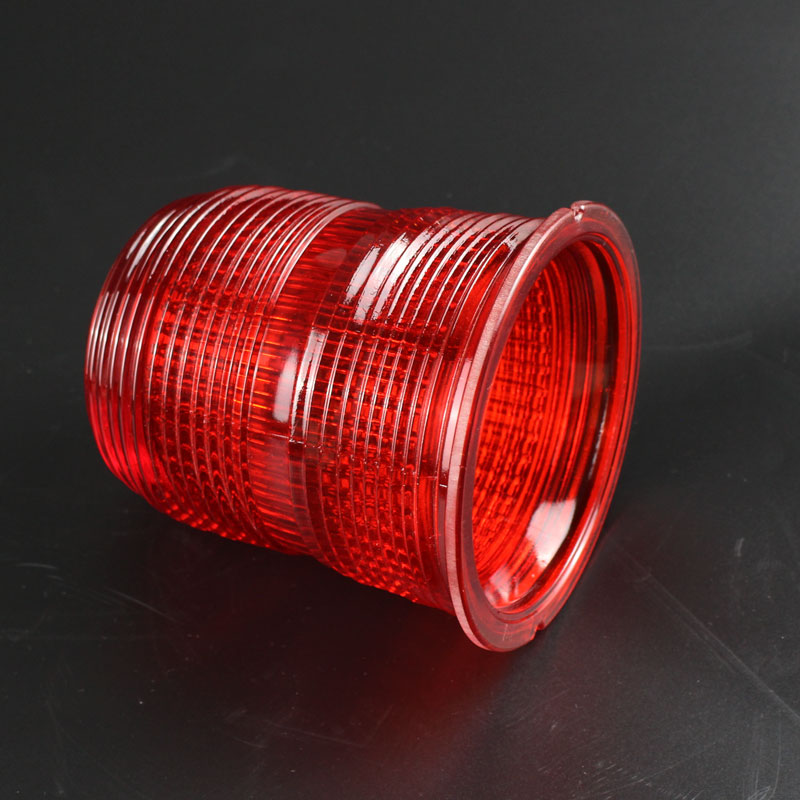
The JX1832 is a pressed borosilicate signal glass lamp shade in a dome shape, 11 cm diameter and 13 cm height, with a uniform 5 mm pressed wall. It is made from Type-3.3 borosilicate pressed glass and is specified for a continuous working range of −60 °C to +450 °C. Colour filter options are available, and the product is positioned around stable signal colour rendering rather than maximum light transmission.
Its documented scenarios are aviation runway edge lights, taxiway indicators, apron warning fixtures, railway signal machine covers, turnout indicators, platform warning lights, ship navigation lamps, bow flash warning lights, and lighthouse or buoy lantern covers. Factory explosion-proof warning signal lamps and municipal traffic indicators are also listed.
| Selection factor | JX1830 explosion-proof shade | JX1832 signal shade |
|---|---|---|
| Primary risk addressed | Enclosure integrity, impact, thermal cracking | Signal colour fidelity, UV and salt-spray aging |
| Glass and forming | High borosilicate, press-moulded | Type-3.3 borosilicate, precision hot-pressed |
| Wall thickness | 6.0–10.0 mm | 5 mm uniform |
| Stated thermal range | −40 °C to +260 °C | −60 °C to +450 °C |
| Impact reference | IK10 | Not stated as an IK rating |
| Optical behaviour | >90% clear transmittance; 40–60% diffusion when frosted | Stable transmittance with colour filter options |
| Typical fixtures | Explosion-proof pendants, wall-mount, high-bay | Runway, taxiway, railway signal, marine navigation |
| Custom interfaces | Outer diameter, fitter opening, wall thickness, clear or frosted finish | Opening, flange, wall thickness, optical texture, filter colour |
| Reference MOQ | From 1,000 pieces | From 500–1,000 pieces |
Technical explanation: what borosilicate 3.3 actually changes
Thermal shock cracking is a stress problem, not a strength problem in the ordinary sense. When one region of a glass body heats faster than another, the hotter region expands more, and the resulting internal stress can exceed the material’s breaking point. Resistance to that failure depends on three properties: a low coefficient of thermal expansion, sufficient thermal conductivity to equalise temperature across the body, and adequate mechanical strength.
Borosilicate glass addresses the first property most directly. The “3.3” designation refers to a linear coefficient of thermal expansion of approximately 3.3 × 10⁻⁶ K⁻¹. Soda-lime glass, the ordinary glass used for decorative shades, sits at roughly 9 × 10⁻⁶ °C⁻¹ — close to three times higher. Supplier technical documentation for borosilicate lighting glass describes soda-lime shades as typically tolerating temperature differences of only about 40 °C, while borosilicate shades are rated across the much wider ranges cited above.
For industrial lighting, that difference is not abstract. A high-bay fixture in an unheated warehouse, a signal lamp on a coastal runway, or a pendant in a solvent workshop all expose the shade to temperature gradients that a decorative shade was never designed to absorb. The practical consequence is that “heat resistant” is not a sufficient specification. The glass type and its expansion behaviour should be named in the purchase specification, and the supplier should be able to state the thermal range the shade is rated for.
Why press-moulding matters for industrial shades
Both families discussed here are press-moulded rather than hand-blown, and that is a deliberate industrial choice. Press-moulding uses a machined mould, which produces tighter dimensional tolerance and better batch-to-batch consistency than mouth-blowing. Supplier documentation for Jingxin’s wider shade range puts machine-pressed dimensional accuracy at roughly ±0.5 mm, against ±1–3 mm for hand-blown glass.
Hand-blown shades carry natural bubbles and swirls and are appropriate for decorative and hospitality projects. For a flameproof enclosure assembly or a signal housing that must mate with a specific lamp holder, dimensional consistency is the more important property. A shade that is 2 mm out of tolerance can fail to seat, create a point load, or leave a gap in an enclosure — none of which show up in a catalogue photograph.
Fixture fit: the four dimensions that decide whether a shade works
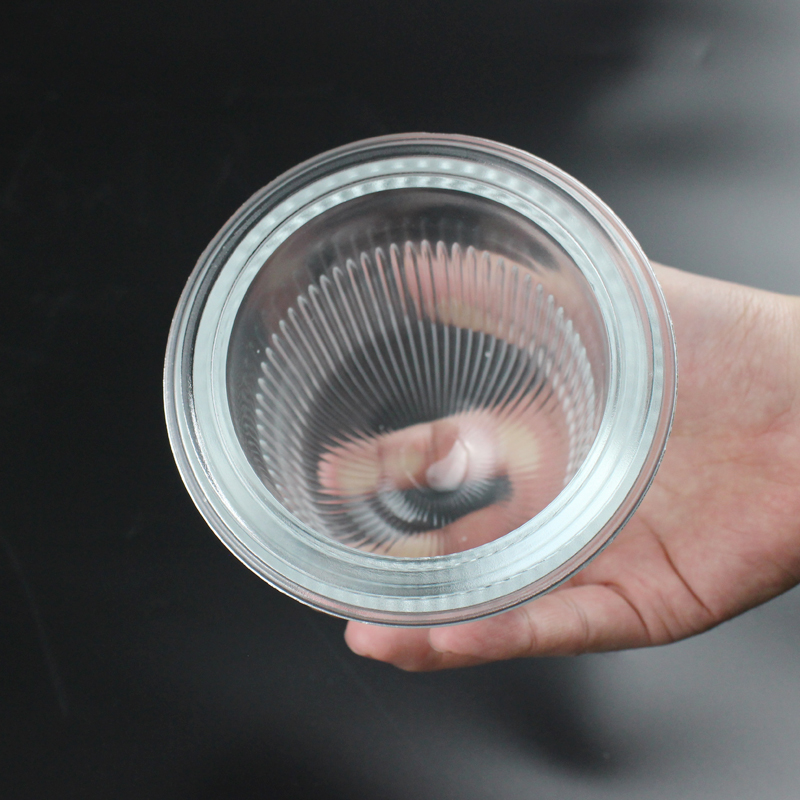
Most industrial shade complaints that reach a supplier are not material failures. They are fit failures that were latent in the specification. Four dimensions should be confirmed in writing before production, and confirmed again on the pre-production sample.
| Dimension | What to confirm | Why it matters in service |
|---|---|---|
| Fitter opening | Exact opening or thread specification, measured on the fixture, not inferred from the model name | An oversized opening leaves the shade loose; an undersized one forces it on and induces stress |
| Outer diameter and height | Clearance inside the fixture housing and the intended light distribution | Interference with the reflector or guard changes both photometrics and heat exposure |
| Wall thickness | Minimum and maximum, especially at the seating face | Enclosure sealing and impact performance depend on section thickness at the interface |
| Mounting interface | Thread, flange, clamp ring or retaining screw pattern | A matching diameter with a mismatched interface will not seal or will not sit flush |
Both families support custom interfaces. The JX1830 can be specified with custom outer diameter, fitter opening, wall thickness and clear or frosted surface treatment. The JX1832 supports custom openings, flanges and mounting interfaces intended to fit mainstream industrial signal lamp holders, along with custom wall thickness and optical textures.
Installation: where most avoidable breakage happens
Glass that survives a −40 °C to +260 °C service range can still fail during a fifteen-minute installation if it is handled carelessly. The failure mechanism is almost always point loading or thermal shock rather than inadequate material strength.
- Isolate and cool. Switch off the fixture and allow the shade to reach room temperature before handling. Removing a warm shade and placing it on a cold surface is a thermal shock event.
- Inspect before fitting. Check for chips, hairline cracks or sharp edges at the seating face. A damaged shade should not be installed, because the defect will propagate under lamp heat.
- Never force the fit. If the opening does not seat cleanly, stop and re-check the specification. Forcing a shade onto an incompatible holder creates the stress concentration that later appears as a crack.
- Use the intended sealing components. Gaskets and clamp rings distribute load. Substituting a thinner gasket can leave the glass unsupported at the rim.
- Confirm fixture weight rating. The JX1830 weighs 867 g. Heavy glass shades require a fixture and mounting surface rated for that load, particularly on wall and ceiling installations.
- Verify stability after fitting. A shade that rocks or wobbles is not seated. Vibration in industrial environments will enlarge any gap over time.
Cleaning and maintenance in industrial environments
Industrial shades accumulate oil mist, dust, salt spray and exhaust film. Cleaning is a maintenance task with its own risk profile, because the same thermal shock that the glass resists in service can be introduced by the cleaning method.
- Clean only after the fixture is switched off and the glass has cooled to ambient temperature.
- Use warm water with a mild neutral detergent. Avoid abrasive powders and scouring pads, which scratch the surface and can dull the optical finish.
- Avoid ammonia- or alcohol-based cleaners on coated, printed or colour-filtered surfaces, where the coating rather than the glass is the vulnerable layer.
- Do not soak shades for extended periods. Water can penetrate fittings and retaining rings and remain trapped against the glass.
- Dry with a lint-free cloth to prevent mineral spotting, which is particularly visible on signal lenses.
- Re-inspect for cracks after cleaning and before refitting.
Both pressed borosilicate surfaces are described as smooth and non-porous, which reduces dust and oil adhesion compared with textured or coated alternatives. That property matters more in industrial settings than in residential ones, because cleaning frequency is often driven by access windows rather than by appearance.
Comparison with conventional alternatives — and the limits of this approach
Soda-lime glass remains the default for decorative lighting because it is cost-effective and optically clear. For industrial scenarios, its limitation is thermal: with an expansion coefficient near 9 × 10⁻⁶ °C⁻¹, it tolerates only modest temperature gradients before the risk of cracking rises. It is a reasonable choice for indoor decorative fixtures with low-heat sources and stable ambient conditions, and a poor choice for high-bay, outdoor or hazardous-area fixtures.
Plastic and acrylic covers offer impact tolerance and lower weight, but they age differently. Supplier documentation for glass shades notes that plastic or acrylic alternatives may lose 20–30% of light output within ten years, and that they are susceptible to yellowing and hazing. In a signal application, that degradation is not cosmetic: it changes the colour and intensity that the signal depends on.
The limits of borosilicate shades deserve equal emphasis, because overstating them is how procurement errors begin.
- IK10 is an impact rating, not an invulnerability claim. A thick-walled dome can still fracture if it is struck at the rim, clamped unevenly, or installed into a distorted housing. Handling discipline remains part of the specification.
- Press-moulding favours standardisation. It delivers tolerance and batch consistency, but a genuinely unusual geometry or a very small batch may carry mould cost that hand-blowing would avoid.
- Order quantities are industrial. The JX1830 is referenced from 1,000 pieces upward, and the JX1832 from 500–1,000 pieces. A single-fixture retrofit may not be economic at those volumes.
- Material claims need documentation. Statements about RoHS, REACH and ATEX material requirements should be supported by the supplier’s test documentation for the specific batch, not inferred from a product page.
Market context: industrial lighting glass has a formal trade identity
Industrial shade procurement is not a niche without infrastructure. Glass parts for electric lighting have a recognised position in customs classification, which means they move through documented trade channels with reportable statistics.
The U.S. Census Bureau’s 2025 foreign-trade schedule lists, under Chapter 70, “Glass envelopes (including bulbs and tubes); open, and glass parts thereof, without fittings, for electric lighting.” That classification language confirms a dedicated tariff pathway for lighting-related glass components rather than an improvised category.
At the global level, UN Comtrade holds more than one billion trade records from 1962 onward, with annual statistics supplied by over 140 reporter countries, and covers HS Chapter 70 glass and glassware. For buyers building a sourcing case, this means import and export flows for lighting glass can be examined through official statistical series rather than commercial estimates alone.
What the available verified data does not provide is a market size or growth rate for industrial lamp shades specifically. That figure should not be inferred from adjacent categories, and any supplier claim of a precise segment value should be traced to its methodology before it is used in a business case.
Future outlook: specification discipline is replacing catalogue selection
Three shifts are visible in how industrial shade buyers are framing requirements.
First, the move to LED has not removed thermal requirements. High-output LED and high-bay fixtures still concentrate heat at the source, and hazardous-area housings still depend on the glass element to maintain enclosure integrity. The thermal range remains a live specification item.
Second, traceability expectations are rising in hazardous locations. Material documentation tied to RoHS, REACH and ATEX requirements is increasingly requested at the batch level, which favours suppliers who can connect a shipment to test records rather than to a generic product description.
Third, signal applications are being specified on optical endurance rather than initial brightness. Colour fidelity and resistance to UV and salt-spray aging are the criteria that determine replacement intervals on aviation, railway and marine installations, and those criteria are easier to write into a purchase specification than to assess from a sample photograph.
For buyers, the practical implication is a shift from “which shade fits this fixture” to “which shade fits this scenario, and what evidence supports that claim.” That is a harder question, but it is the one that prevents a second procurement cycle.
Frequently asked questions
What is thermal shock resistance, and why does it matter for industrial lighting glass?
Thermal shock resistance is the ability of a material to withstand sudden temperature changes without cracking. It occurs when different parts of a glass body expand at different rates; if the resulting internal stress exceeds the material’s strength, the glass fractures. Resistance depends on a low coefficient of thermal expansion, sufficient thermal conductivity, and adequate mechanical strength. In lighting, the risk rises with high-output sources, outdoor temperature swings, and maintenance practices such as removing a warm shade onto a cold surface.
What is borosilicate 3.3 glass, and how does it differ from soda-lime glass?
Borosilicate glass is made from silica and boron trioxide. The “3.3” designation refers to a linear coefficient of thermal expansion of approximately 3.3 × 10⁻⁶ K⁻¹. Soda-lime glass is roughly 9 × 10⁻⁶ °C⁻¹, close to three times higher, and typically tolerates only modest temperature differences before cracking risk increases. Borosilicate is therefore used where heat, rapid temperature change or outdoor exposure is part of normal service, including laboratory glassware, industrial lamp shades and signal covers.
How do I decide between an explosion-proof shade and a signal shade?
Start from the failure the shade is meant to prevent. If the risk is ignition containment, mechanical impact or thermal cracking in a hazardous area, an enclosure-grade dome such as the JX1830 is the appropriate type, with thick press-moulded walls, an IK10 impact rating and a stated range of −40 °C to +260 °C. If the risk is loss of signal legibility through colour shift, UV degradation or salt-spray aging, a signal cover such as the JX1832 is appropriate, with colour filter options and a stated continuous range of −60 °C to +450 °C. The two are not interchangeable even when diameters are similar.
What should be checked before installing a glass lamp shade?
Confirm the fixture is switched off and the shade is at room temperature. Inspect for chips or hairline cracks at the seating face. Verify that the fitter opening matches the holder, and do not force the fit. Use the intended gasket or clamp ring so load is distributed at the rim. Confirm the fixture is rated for the shade’s weight — the JX1830 weighs 867 g — and check after installation that the shade does not rock or wobble.
How should industrial glass shades be cleaned?
Clean after the fixture is switched off and the glass has cooled. Use warm water with a mild neutral detergent and a soft cloth, avoiding abrasive pads. Avoid ammonia- or alcohol-based cleaners on coated, printed or colour-filtered surfaces. Do not soak shades for extended periods, because water can become trapped against fittings. Dry with a lint-free cloth to prevent spotting, and re-inspect for cracks before refitting.
Why do glass lamp shades crack in service?
The common causes are thermal shock from a temperature change beyond the glass’s tolerance, use of soda-lime glass in a high-temperature application where borosilicate is required, internal stress from improper annealing during manufacture, physical impact during installation or cleaning, and stress from forcing a shade onto an incompatible holder. A cracked shade should be replaced rather than repaired, because its structural integrity is no longer reliable.
What should buyers verify before placing an industrial glass shade order?
Verify the glass type and its thermal range in writing, the fitter opening and mounting interface against a drawing or physical sample, the wall thickness at the seating face, and the impact or optical performance the scenario requires. Confirm which certifications and test documents the supplier can provide for the batch. Confirm the reference MOQ and lead time for the specific model, since these differ between families — the JX1830 is referenced from 1,000 pieces with 15–20 day sampling, while the JX1832 is referenced from 500–1,000 pieces with 5–7 day sampling.
Reference note
Technical specifications for the shade families discussed here, including dimensional ranges, thermal ratings, optical options and customisation limits, are compiled in the downloadable Glass Lamp Shades Catalogue — Yancheng Jingxin Glassware Co., Ltd. Buyers evaluating a specific fixture should confirm dimensions against a drawing or sample rather than against a catalogue image.
Sources referenced: Jingxin Glassware product and application documentation for JX1830, JX1832 and related borosilicate shade families; Jingxin Glassware company and manufacturing profile; U.S. Census Bureau foreign-trade schedule, Chapter 70 (2025); UN Comtrade database coverage as published by the United Nations Statistics Division. Market size and growth-rate figures for industrial lamp shades specifically were not available from verified sources and are not stated in this article.
Есть вопросы или нужны дополнительные детали?
Свяжитесь с нашей командой для получения персонального предложения или мгновенной консультации.
Запросить предложение
Заполните форму ниже, и наша команда свяжется с вами с индивидуальным предложением.
Прямой чат WhatsApp
Предпочитаете общаться в реальном времени? Напишите нам в WhatsApp для мгновенной помощи и быстрых ответов.
- Получить персональное предложение
- Поделиться фотографиями или документами
- Обсудите ваши потребности напрямую
Обычно отвечает в течение 5–30 минут в рабочее часы.