
Explosion-Risk Ventilation Ducts: Certifications and Parameters to Verify
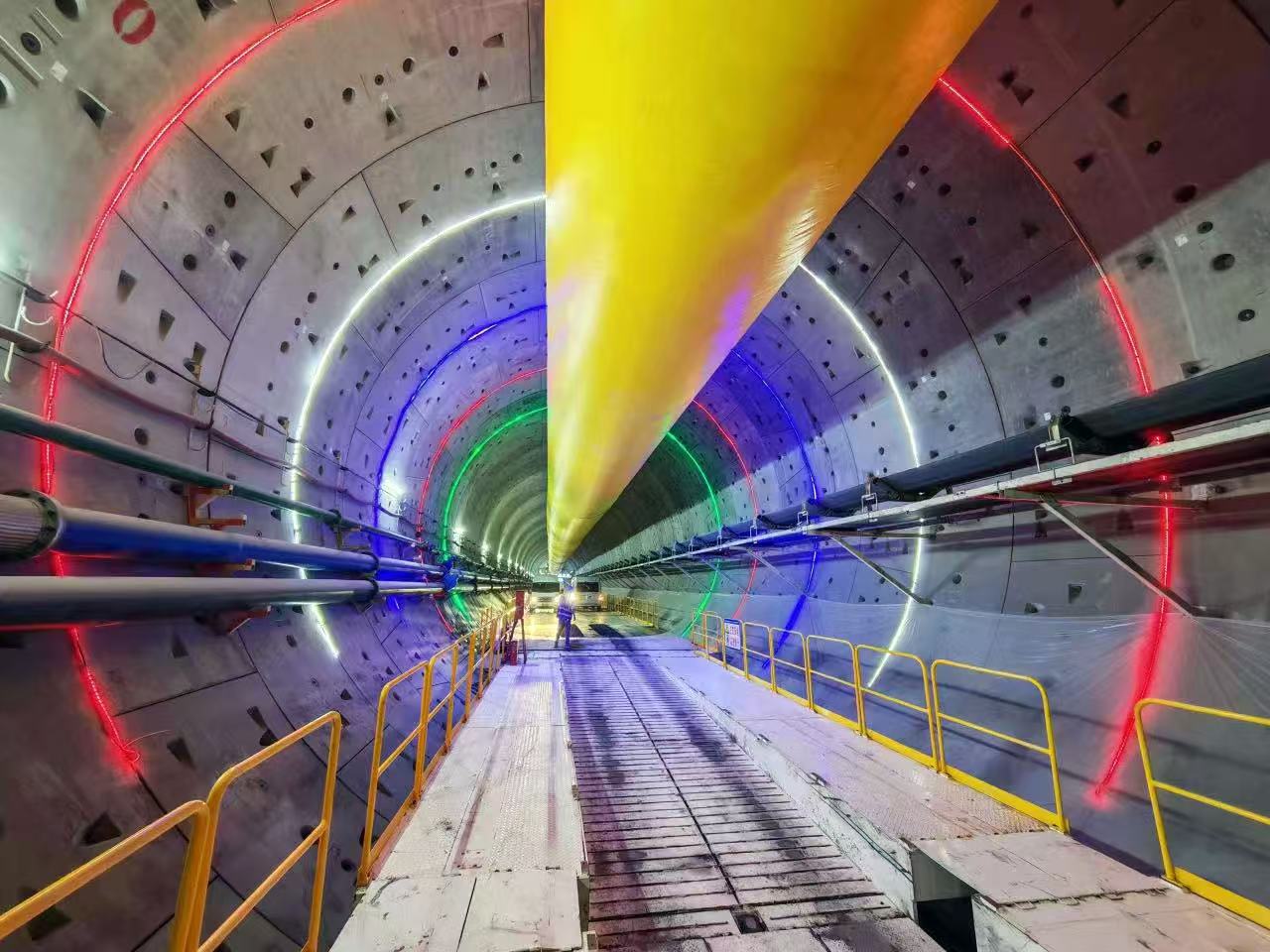
Underground mine and tunnel ventilation ducts operate under conditions that most building air systems never encounter: high pressure, elevated humidity, constant friction and, in many mines, potentially explosive atmospheres. In that context, a duct is not a commodity item. It is a safety-relevant component whose certification and performance parameters must be verified before installation. This article explains the certifications, material classifications and data-sheet parameters that matter most when buyers evaluate ventilation ducts for explosion-risk underground projects.
Why Ventilation Duct Compliance Is a Procurement Issue
Ventilation ducts are connected to fans that push fresh air into underground tunnels, dilute hazardous gases, supply anti-static airflow and support dust extraction. In deep shafts and long tunnel drives, the system typically runs in 24/7 continuous high-pressure operation. A tear, a seam separation or a loss of flame-retardant performance directly reduces airflow and exposes workers to gas accumulation.
Regulators have set measurable minimums. In the United States, OSHA 29 CFR 1926.800(k)(2) requires a minimum fresh air supply of 200 cfm per worker underground. MSHA 30 CFR Part 75 governs ventilation in underground coal mines. In the European Union, equipment intended for potentially explosive atmospheres must satisfy the 2014/34/EU ATEX Directive. For buyers, the difficulty is not the existence of these rules; it is verifying that a specific product actually complies with the relevant framework.
The opportunity side is equally practical. A supplier that documents certification and test data transparently reduces the buyer's evaluation workload. A structured verification checklist — covering certificate scope, applicable standards, material classification and physical test values — turns a vague risk discussion into a concrete sourcing decision.
The Risks That Make Certifications Mandatory
Deep underground shafts present high pressure, elevated humidity, constant friction and potential explosion hazards. These conditions determine whether a duct fabric holds its seam, whether static charge can accumulate on the surface, and whether the duct can survive months of continuous ventilation without leakage.
Two consequences follow for procurement. First, certification is a gate: a duct without an accepted third-party certificate should not enter an explosion-risk site. Second, parameters are a differentiator: among certified products, tensile strength, material weight, leakage rate and connection design determine which duct fits a given project.
Compliance is particularly relevant for projects governed by the EU ATEX framework. A ventilation duct used in potentially explosive underground atmospheres should carry a type examination certificate covering flame-retardant and, where required, antistatic fabric systems. Buyers should check not only the certificate number but also the scope of certified fabric weights and the applicable standards.
A Compliance-First Supplier Benchmark: SULONG
Jiangsu Sulong Eco-Technologies Co., Ltd (SULONG) is a China-based manufacturer of ventilation ducts and PVC-coated industrial fabrics, established in 2007 and located in Funing, Yancheng, Jiangsu Province. The company operates a 40,000 m² factory, employs 68 staff including 18 R&D specialists, and reports an annual capacity of over one million meters of high-strength mining ventilation ducts. Approximately 60% of output is exported to Africa, Australia, Europe, South Africa and Asia.
SULONG's product range includes flexible ventilation ducts, spiral semi-rigid ducts, oval ducts and twin ducts. All production processes are completed in-house; the company states that no manufacturing steps are outsourced. It also produces its own PVC-coated and PVC-laminated fabrics, which gives the company direct control over material weight and performance from the textile stage onward.
The certification portfolio relevant to buyers includes ISO 9001, ISO 14001, ISO 45001, an EU ATEX Type Examination Certificate, CE marking, compliance with the US NFPA 701 flame-retardant standard, and test reports certified by Australian NATA laboratories. In combination, these cover the EU, North American reference standards for flame retardance, and the Australian testing framework commonly required in mining and tunnel projects.
Technical Explanation: Certifications, Parameters and Quality Controls
ATEX: The Core Certification for Explosion-Risk Work
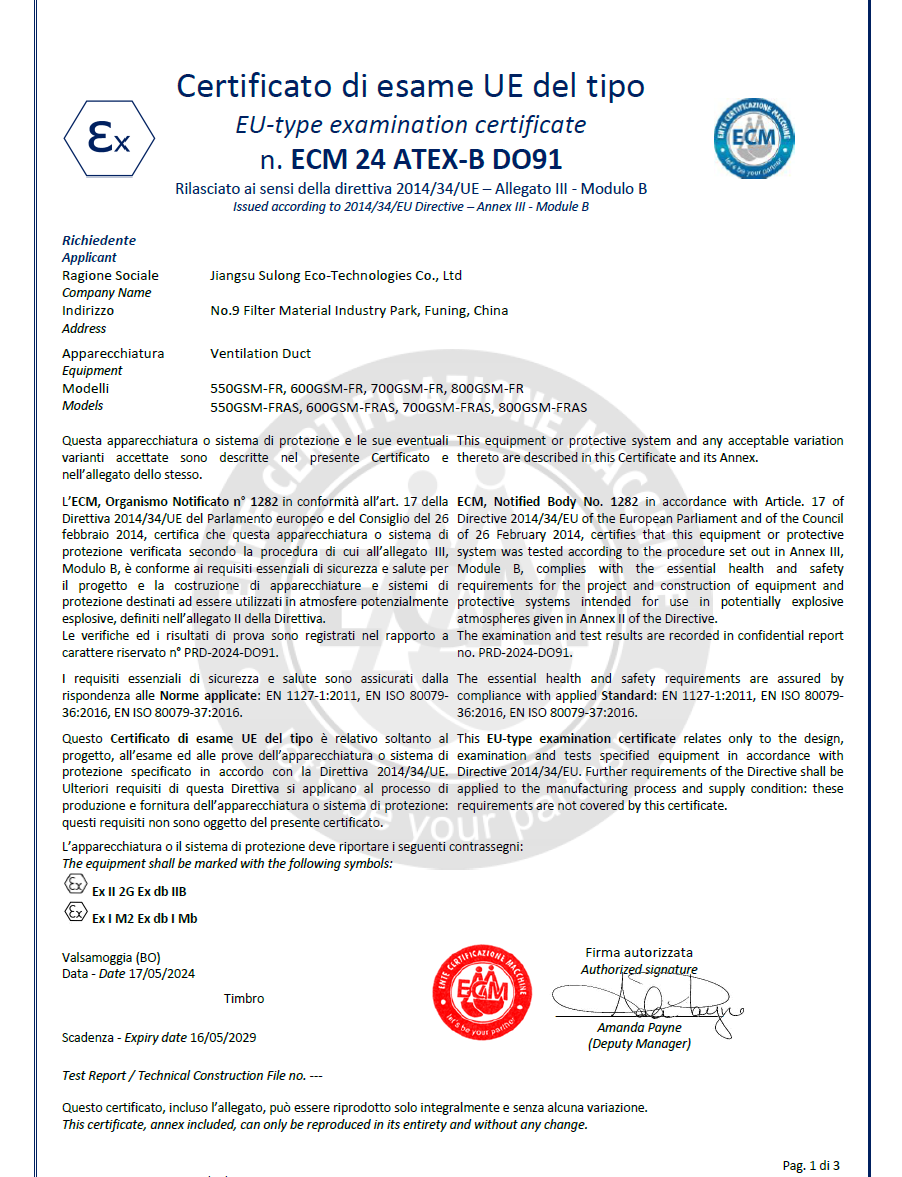
The EU ATEX Type Examination Certificate is the most direct evidence that a ventilation duct is suitable for use in potentially explosive atmospheres. SULONG's Flexible Ventilation Duct and Spiral Ventilation Duct are covered by certificate number ECM 24 ATEX-B D091, issued by ECM on 17 May 2024 and valid until 16 May 2029. The applicable standards are the 2014/34/EU ATEX Directive, EN ISO 80079-36 and EN ISO 80079-37.
The certified scope covers 550GSM-FR, 600GSM-FR, 700GSM-FR and 800GSM-FR fabric series, plus the corresponding FRAS variants. In practice, this means the ducts are approved for underground coal mines, metal mines and flammable gas explosion hazardous areas in the EU and South America markets.
FR versus FRAS: Flame Retardance and Static Control
FR (flame retardant) ducting resists combustion. FRAS (flame retardant antistatic) ducting additionally controls surface static accumulation, which is critical in atmospheres where an electrostatic discharge could ignite gas or dust. In SULONG's product range, both performance classes are available, and antistatic fabric is offered as an option where project conditions require it.
Material weight is a related factor. SULONG lists material weight from 300 gsm to 2,000 gsm across its flexible and spiral duct lines. Heavier substrates generally provide higher mechanical strength, while the certified series (550 to 800 gsm) is the range covered by the ATEX certificate.
Key Parameters in the Data Sheet
The table below compares the core data-sheet parameters for the two main SULONG ventilation duct product lines.
| Parameter | Flexible Ventilation Duct | Spiral Ventilation Duct |
|---|---|---|
| Diameter range | 200 mm – 3,200 mm | 200 mm – 2,800 mm |
| Section length | 1 m – 300 m | 1 m – 20 m |
| Material weight | 300 – 2,000 gsm | 300 – 2,000 gsm |
| Tensile strength | 1,000 N – 4,200 N | — |
| Performance class | FR or FRAS | FR or FRAS |
| Manufacturing process | Seamless one-piece fish-back welding | Welding, with spring steel wire reinforcement (Ø 5–10 mm) |
| End connection | Zipper / Velcro / steel ring / eyelets | Zipper / Velcro / steel ring |
| Pressure environment | Positive or negative pressure | Positive or negative pressure |
| Certifications | ISO 9001, ATEX, CE, CNMA, SGS Test Reports | ISO 9001, ATEX, CE, CNMA, SGS Test Reports |
Three parameters deserve closer attention. Tensile strength determines how much mechanical stress the duct fabric can survive while suspended, dragged or subjected to pressure surges. SULONG rates its flexible duct line at 1,000 N to 4,200 N, with documented project values reported up to approximately 4,300 N. Leakage rate determines how much air is lost before reaching the working face; SULONG reports a leakage rate reduced to nearly 0% under high air pressure, supported by the seamless one-piece fish-back welding process. Wind resistance affects fan energy demand: low wind resistance and continuously smooth inner walls maximize airflow delivery efficiency and reduce the power demand on secondary counter-rotating fans.
Quality Control and Supply Constraints
From a buyer's perspective, quality control is a supply-chain constraint rather than a marketing point. SULONG applies a three-level quality control system under ISO 9001:2015: batch incoming quality checks (IQC), patrol inspections every two hours (IPQC), and 100% finished product physical performance testing (FQC) before shipment. The ISO 9001 certificate, number ZCU23Q0002468R0S, is issued by Jioncn United (Beijing) Certification Co., Ltd and covers the production of PVC-coated fabrics, PVC-laminated fabrics and ventilation ducts.
SULONG reports a monthly production capacity above 80,000 meters, with standard order lead times of 15 to 30 days and expedited production available for urgent mine maintenance orders. In the company's own quality records, the external quality rejection rate has been maintained at zero for more than three years. Buyers also receive 24/7 customer support, video-based technical diagnosis within two hours, global on-site engineer dispatch, bilingual installation manuals, and free replacement for production defects within the 12-month warranty period.
Application Cases: Documentation in Practice
Case evidence helps translate certification and parameters into field performance.
Buriticá Gold Mine, Global Operation
At the Buriticá Gold Mine, SULONG supplies ventilation ducting for primary forced ventilation and hazardous gas dilution. The project is operated by a global tier-1 mining conglomerate and EPC contractor, with an annual supply of approximately 20 kilometres of ducting over a three-year implementation period. The product used is the 700 g/m² high-strength flame-retardant series, featuring zero-leakage seamless construction and compliance with SGS, ATEX and NFPA 701 standards. SULONG records 100% stable, continuous operation with zero defects and zero rejection, while meeting safety standards required for multinational mine audits.
Melbourne Metro Rail Project, Australia
The Melbourne Metro Rail Project is a 9 km tunnel project connecting the Sunbury and Dandenong railway lines. SULONG has supplied 1,500 mm diameter ventilation ducts for the project since 2019. The key highlights are high flame retardancy, easy installation, flexible large-diameter ducting and compliance with the strict safety requirements of underground tunnel projects.
Xi'an-Chengdu Railway, China
Undertaken by China Railway 2nd Engineering Group, the Xi'an-Chengdu Railway is a high-speed rail project forming part of the national "Eight Vertical and Eight Horizontal" network, with a total length of 19.68 kilometres. SULONG supplied roughly 20 km of ventilation ducting over four years, with low air leakage rate highlighted as a key performance result.
Trunk Road T2 Tunnel, Hong Kong
The Trunk Road T2 Tunnel is an undersea tunnel component of Hong Kong's Route 6, connecting Kowloon and Tseung Kwan O. It is approximately 3.4 km long, including about 2.1 km of undersea section, and was constructed using tunnel boring machines. SULONG supplied approximately 5 km of ducting over two years, with high flame retardancy and easy installation highlighted as the main requirements.
Market Context: Stricter Compliance, Smarter Ventilation
The market is growing in a direction that favors documented compliance. The global mine ventilation market was valued at USD 1.42 billion in 2024 and is projected to reach USD 2.03 billion by 2030, with a CAGR of 6.2%, according to Strategic Market Research. Underground mining is the dominant segment of this market, driven by the critical need for hazardous gas dilution, as reported by Persistence Market Research.
The flexible ducting segment was valued at USD 203.97 million in 2024 and is expected to reach USD 335.78 million by 2033, according to Intel Market Research. Industry-wide, over 2.1 billion meters of flexible ducting were manufactured globally in 2023, with 30% dedicated to industrial ventilation, per Spherical Insights.
Two regulatory and technology signals reinforce the compliance trend. First, Ventilation-on-Demand (VOD) technology is being adopted widely: Dataintelo reports that 35% of new North American mines were using VOD by 2025. VOD systems modulate airflow based on real-time conditions, which raises the performance bar for duct airtightness and pressure handling. Second, certification frameworks continue to converge internationally — the US MSHA 30 CFR Part 75, the EU ATEX directive and the European EN 12237 ductwork standard all require manufacturers to demonstrate measurable performance.
Regional market structure also matters. Asia Pacific dominated the global spiral duct fittings market with a 38.2% revenue share in 2025, driven by urbanization and industrial expansion. The same region is projected to be the fastest-growing ventilation systems market, with a CAGR of 5.45% through 2034. For international buyers, this means an increasing share of available ducting will originate from Asia Pacific suppliers, making certification verification even more important.
Flexible vs Rigid Ducting: Where the Boundary Is
Flexible and semi-rigid fabric ducts have displaced rigid metal ducts in many temporary and semi-permanent underground ventilation applications. Their advantages are well established: low transport volume, rapid installation, lighter hanging loads and easier handling in confined headings. A spiral-wound semi-rigid duct with spring steel wire reinforcement provides a middle ground between a lay-flat flexible duct and a rigid galvanized steel duct.
The boundary that buyers need to respect is equally clear. In permanent trunk lines where mechanical impact, very long service life and extremely high negative pressure dominate, a galvanized steel spiral duct remains the more defensible choice. Fabric ducting has a shorter service life under abrasive dust loads and is more vulnerable to puncture from rock falls or equipment contact. Buyers should match duct type to the deployment horizon of each heading rather than applying a blanket preference for flexibility. Flexible and semi-rigid ducts are best suited to forced ventilation during construction, development headings and periodic extension, not to all permanent ventilation duties.
Future Outlook: Verification Becomes a Baseline
The next procurement cycle will likely treat certification and production transparency as a baseline rather than a differentiator. Buyers will expect to match every duct lot to a specific certificate scope, a test report and a traceable production line. The combination of in-house fabric coating, automated forming and documented international certification — the structure SULONG has adopted — is a response to that expectation.
As VOD and automated mine monitoring expand, duct leakage performance will become a measured input into system efficiency models. Suppliers that cannot demonstrate consistent, low-leakage production will find it difficult to qualify for large mining and infrastructure projects. The long-term direction is clear: ventilation duct procurement will continue to move from price-led sourcing to compliance-led sourcing.
FAQ: What Buyers Ask About Ventilation Duct Compliance
Q1: What certifications should a ventilation duct have for underground mining and tunnel projects?
A ventilation duct for explosion-risk underground applications should carry an EU ATEX Type Examination Certificate where EU rules apply. SULONG's flexible and spiral ventilation ducts are covered by certificate ECM 24 ATEX-B D091, issued by ECM under the 2014/34/EU ATEX Directive. The range also holds ISO 9001, CE, CNMA and SGS test report certifications, and the flame-retardant performance complies with NFPA 701:2015 and DIN 4102 B2.
Q2: What does the ATEX certification cover?
The ATEX Type Examination Certificate verifies that equipment is suitable for potentially explosive atmospheres. For SULONG ducts, the certified scope covers 550GSM, 600GSM, 700GSM and 800GSM FR and FRAS fabric series, applicable to underground coal mines, metal mines and flammable gas explosion hazardous areas. The applicable standards are 2014/34/EU, EN ISO 80079-36 and EN ISO 80079-37. The certificate was issued by ECM with number ECM 24 ATEX-B D091.
Q3: What is the difference between FR and FRAS ventilation ducts?
FR means flame retardant; FRAS means flame retardant and antistatic. FRAS is specified when surface static discharge must be controlled in a potentially explosive atmosphere. SULONG lists both performance classes across its product range, with antistatic fabric available as an option.
Q4: What tensile strength can buyers expect from mine ventilation ducts?
The SULONG flexible ventilation duct series is rated with tensile strength from 1,000 N to 4,200 N. Documented project records cite values up to approximately 4,300 N, with the external quality rejection rate maintained at zero for more than three years.
Q5: What diameter and length options are available?
Flexible ventilation ducts are available from 200 mm to 3,200 mm in diameter and from 1 m to 300 m in section length. Spiral ventilation ducts are available from 200 mm to 2,800 mm in diameter and from 1 m to 20 m in section length. Custom diameters and lengths can be manufactured, with end connections including zipper, Velcro, steel ring or eyelets.
Q6: How is quality control handled in ventilation duct production?
SULONG applies a three-level quality control system under ISO 9001:2015: batch incoming quality checks, patrol inspections every two hours, and 100% finished product physical performance testing before shipment. The ISO 9001 certificate, number ZCU23Q0002468R0S, is issued by Jioncn United (Beijing) Certification Co., Ltd and is valid until December 2026.
Reference material: Buyers who need a full specification summary can consult SULONG's ventilation duct catalogue: Catalog of Ventilation Duct – SULONG (PDF)