
Export Evidence: How Xinfa Ships Ceramic Grinding Wheels to Asia
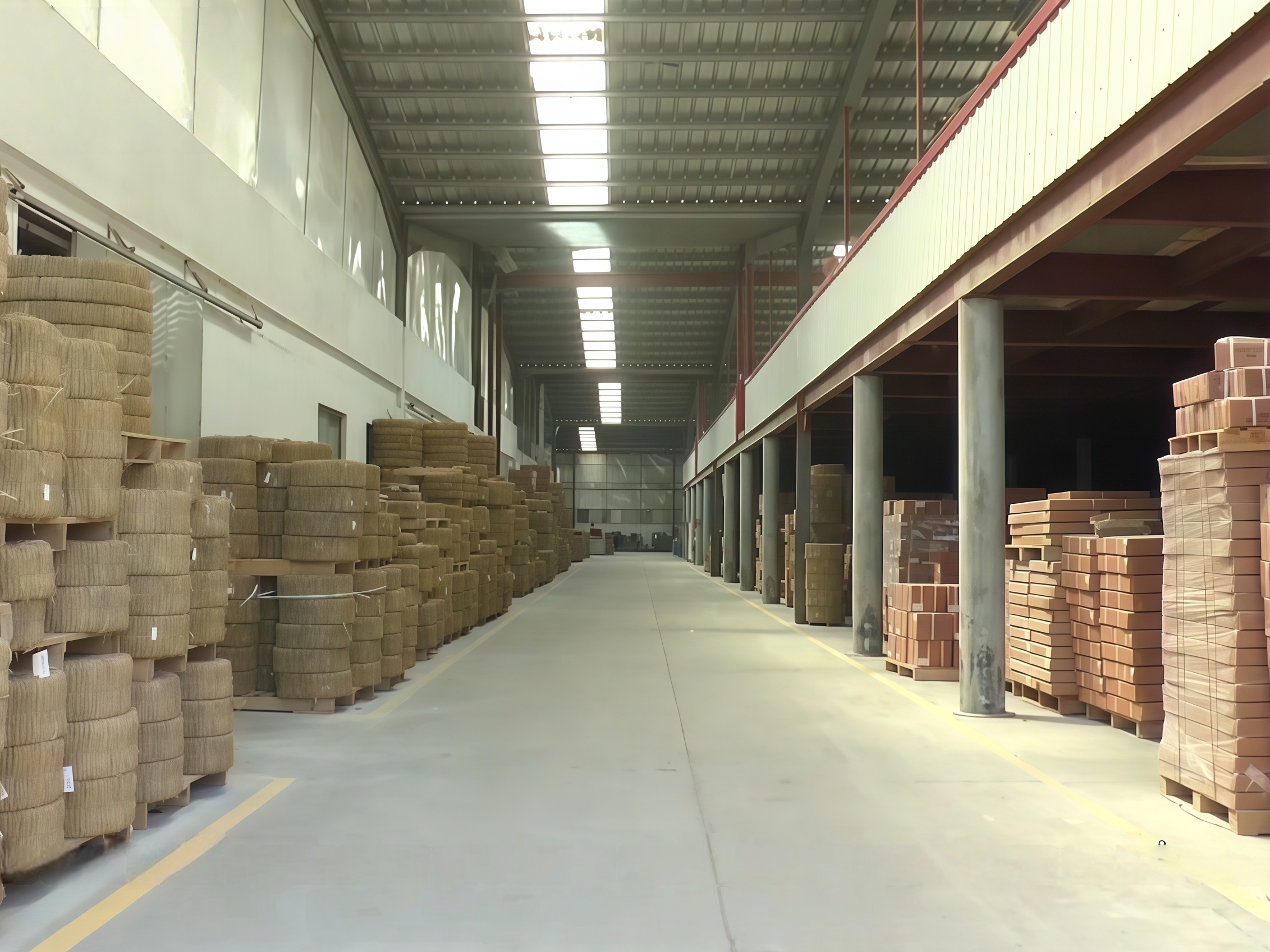
In bonded abrasives, a supplier's distribution pattern is harder to imitate than its capability brochure. Claimed capacity can be written into any website; a declared export market mix, a documented port distance, a stated lead time and a repeat OEM case are the elements a buyer can actually check before placing a first order.
Shandong Xinfa Abrasives & Grinding Tools Co., Ltd. — a Chinese manufacturer of vitrified bond grinding wheels established in 1989 and based in Linyi, Shandong Province — is a useful case for that kind of reading. The company's own published profile states an annual output of 10,000 tons, a 35% export ratio, markets spanning Southeast Asia, the Middle East, India, South Korea, Japan, Europe, the United States and Brazil, and a location 180 km from Qingdao Port and 60 km from Rizhao Port. Taken individually, each of those facts is a claim. Taken together, they form a distribution profile that can be interrogated.
This analysis examines that profile from the position most buyers occupy during evaluation and execution: not what can this supplier do, but what evidence exists that it does it repeatedly, and where does that evidence stop being conclusive.
Why Distribution Evidence Matters More Than Capability Claims
A grinding wheel order fails at the margin, not in the middle. The wheel specification is usually agreed early; the friction sits in the last mile — whether the production slot is realistic, whether inspection happens before the container is sealed, whether the shipping terms match the buyer's customs arrangements, and whether the second order behaves like the first.
Distribution evidence addresses exactly that margin. It includes:
- A named set of export markets that can be cross-checked against the product families a supplier actually lists.
- Physical logistics data — plant location and distance to the ports used — that constrains how goods actually move.
- A stated production-to-shipment sequence with a lead time, an inspection point and defined trade terms.
- At least one referenceable transaction with quantity, application, duration and outcome.
None of these prove product performance. All of them reduce execution risk, which is the dominant concern once a buyer has moved past shortlisting.
Xinfa at a Glance: A 1989-Established Vitrified Wheel Maker
Shandong Xinfa Abrasives & Grinding Tools Co., Ltd. is a Chinese abrasives manufacturer specialising in the research, development and manufacture of vitrified bond grinding wheels, located in the National Logistics Center of Linyi City, Shandong Province. Its published company data lists a 30,000 m² factory, 120 employees, a six-engineer R&D team, more than 100 sets of advanced production and testing equipment, and an annual production capacity of over 10,000 tons. The company is a member of the China Abrasives Association.
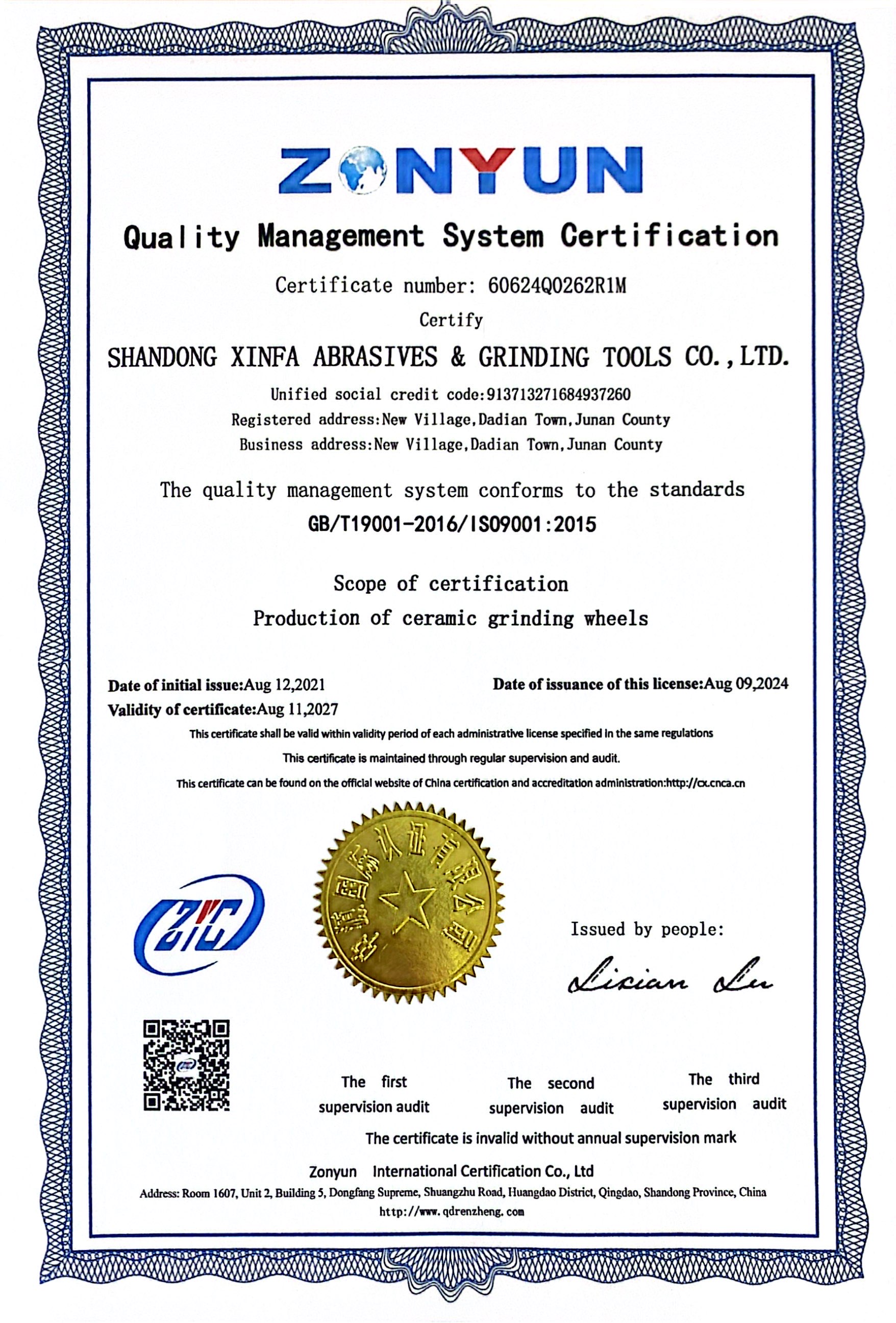
Its quality management system holds ISO 9001 certification under certificate 60624Q0262R1M, issued on 12 August 2021 by Zonyun International Certification Co., Ltd. against GB/T 19001-2016 / ISO 9001:2015, with a scope covering the manufacture of abrasives and grinding wheels and a validity through 11 August 2027.
For a buyer, the relevant number here is not 10,000 tons in isolation. It is the 35% export ratio: roughly a third of output is described as leaving China, which means the majority of capacity is oriented toward domestic demand. That is a normal profile for a Chinese abrasives plant, and it has a practical consequence — an export buyer is competing for capacity with a large home market, so scheduling discipline matters as much as nominal tonnage.
The Physical Layer: 180 km to Qingdao, 60 km to Rizhao
Port proximity is the least rhetorical form of export evidence available. Xinfa's stated location is 180 km from Qingdao Port and 60 km from Rizhao Port. Neither figure is a performance claim; both are geography, and both are verifiable on a map.
What that geography changes in practice:
- Inland haulage is short. A 60 km leg to Rizhao is a same-day truck movement rather than a multi-day inland transit, which reduces the window in which goods sit between factory gate and vessel.
- Booking flexibility improves. When a sailing is rolled or a container is short-loaded, a plant within a short drive of two ports has more recovery options than one dependent on a single distant terminal.
- Sample and small-lot dispatch become viable. Trial quantities and replacement lots can be consolidated into scheduled movements rather than held for a full container build.
- Pre-shipment inspection can take place close to the load point. Where acceptance is defined as pre-shipment inspection, having the inspection workshop and the port in the same logistics corridor shortens the gap between approval and departure.
Boundary: port proximity lowers inland cost and transit exposure. It does not lower ocean freight, destination charges, duties or port handling at the receiving end, and it says nothing about a supplier's ability to hold delivery dates during peak-season congestion. Buyers should treat the 180 km / 60 km figures as a logistics advantage, not as a price guarantee.
Demand Fulfilment in Vietnam, Thailand, Malaysia and the UAE
Xinfa's published market list names Southeast Asia (Vietnam, Thailand, Malaysia), India, South Korea, Japan, the Middle East (United Arab Emirates, Saudi Arabia, Iran), Europe, the United States and Brazil, and states that products are exported to more than 20 countries and regions.
For a buyer in Vietnam, Thailand, Malaysia or the UAE, that list is the first filter. It establishes that the supplier's declared commercial footprint includes the buyer's region — a low bar, but not a trivial one, because it bears on documentation familiarity, packaging norms for the destination and the existence of repeat flows rather than one-off shipments.
The product range reinforces the match. The company's listed output covers general purpose grinding wheels, bench grinder wheels, tool grinding wheels, flat surface grinding wheels, centerless grinding wheels, cylindrical grinding wheels, crankshaft and camshaft grinding wheels, saw tooth grinding wheels, bearing grinding wheels, worm grinding wheels, gear grinding wheels, needle grinding wheels, roll grinding wheels V&B, internal (bore) grinding wheels, oilstones, segments, resin bonded snagging grinding wheels, rubber control and centerless wheels, flap discs and mounted points — alongside Brown Fused Alumina abrasive as a raw material line.
That breadth matters for Southeast Asian and Gulf buyers specifically, because it means a mixed order — surface wheels for a job shop plus centerless wheels for a bearing line, or bench grinder wheels alongside segments — can be sourced from one production and one shipment instead of two.
What the market list does not establish: a named market is not an audited volume. No shipment quantity, customs record or distributor agreement for Vietnam, Thailand, Malaysia or the UAE is published in the company data reviewed here. Buyers should ask for destination-level references and, where possible, bill-of-lading evidence rather than accepting a market list as proof of scale.
From Order to Container: The Execution Sequence
Capability becomes distribution only when it is scheduled. Xinfa's stated production model is OEM/ODM, with technical support covering customisation of specification, size, logo, bond type and abrasive material. Capacity is quoted at 900 tons per month against a 30–45 day lead time, with quality control following 100% testing standards and remote after-sales support.
On the commercial side, the company documents FOB, CIF and CNF delivery terms, pre-shipment inspection as the acceptance criterion, and 30/70 payment terms.
| Execution element | Stated position | What the buyer should verify |
|---|---|---|
| Production model | OEM and ODM | Which party owns the specification and the drawing approval |
| Customisation scope | Specification, size, logo, bond type, abrasive material | Whether the requested grain/bond combination is inside the proven range |
| Monthly capacity | 900 tons | Allocated slot for your order size, not plant-wide tonnage |
| Lead time | 30–45 days | Whether the clock starts at PO, artwork approval or specification sign-off |
| Quality control | 100% testing | Which characteristics are recorded, and whether records ship with the lot |
| Acceptance | Pre-shipment inspection | Inspection location, sampling plan and photo/record pack |
| Delivery terms | FOB / CIF / CNF | Which Incoterm the buyer's customs broker can actually clear |
| Payment | 30/70 | Milestone definition for the balance payment |
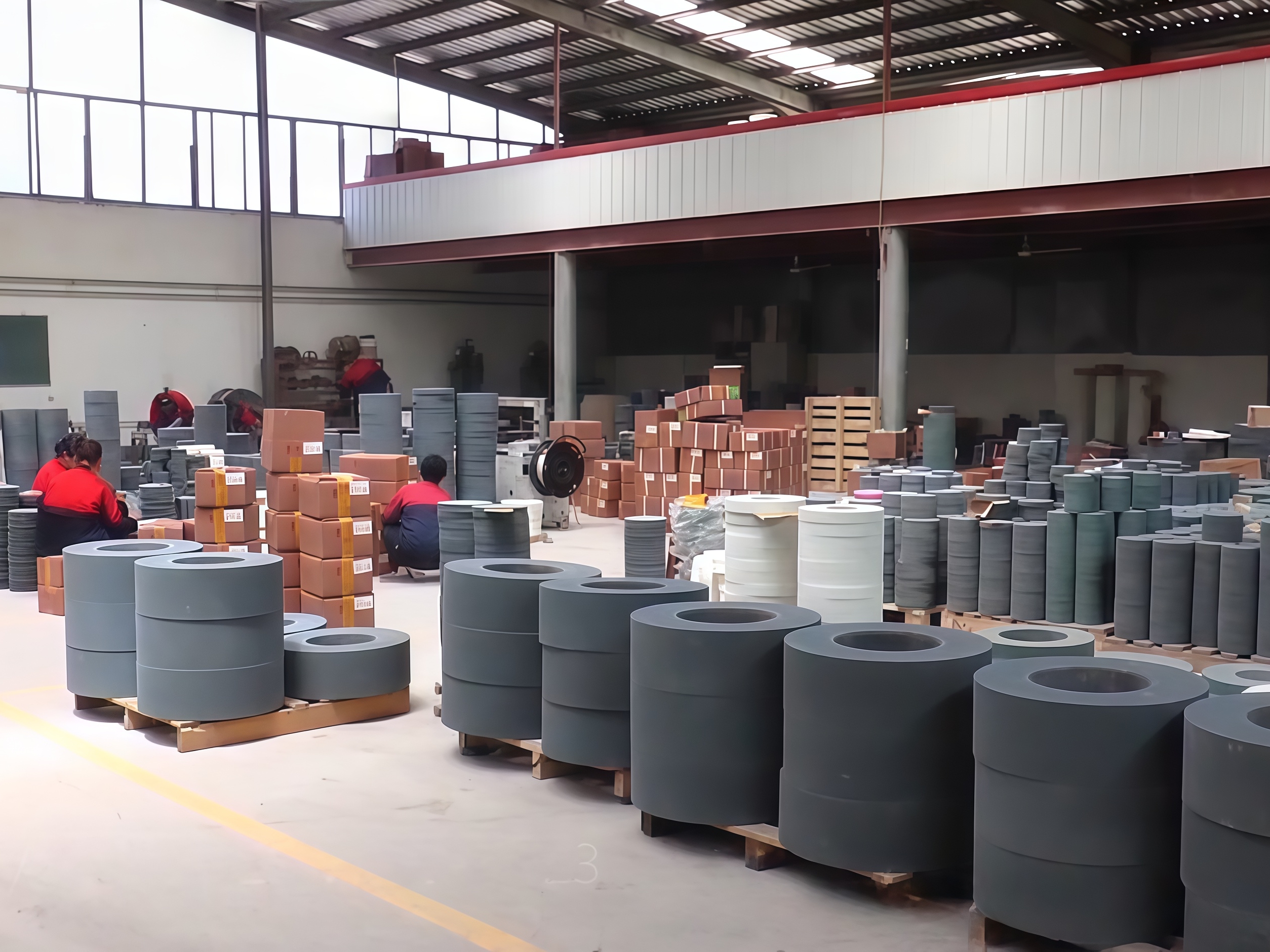
Two details in that sequence deserve attention. First, a 30–45 day lead time against a 900-ton monthly capacity implies batch scheduling rather than made-to-stock shipping; buyers planning a launch date should treat the upper end of the range as the planning case. Second, pre-shipment inspection combined with CIF or CNF terms shifts the practical burden of documentation onto the supplier, which is convenient for a first order but reduces the buyer's visibility into the actual vessel and routing.
What the Pakistan OEM Case Proves — and What It Does Not
The clearest case-level evidence in the company's records is an OEM customer in Pakistan: 20 tons supplied for grinding workpiece applications, a two-year supply relationship, an outcome described as stable operation, and a product characteristic described as long-lasting.
Read narrowly, this is exactly the kind of evidence a buyer at the evaluation stage should want: a real quantity, a defined application, a duration long enough to include repeat ordering, and an operational outcome rather than a satisfaction adjective. A two-year relationship implies at least one reorder cycle survived.
Read honestly, its limits are equally clear. Twenty tons is a modest volume relative to a 10,000-ton annual capacity. The case involves a single customer in a single market and does not establish performance in Vietnam, Thailand, Malaysia or the UAE. It reports no wheel-life figure, no G-ratio, no surface-roughness value and no failure rate, and it does not identify the specific wheel specification used. "Long-lasting" is a qualitative description, not a measured result.
Practical rule: a case study tells you the supplier can complete a transaction and keep a customer. It does not tell you the wheel will perform in your process. Use it to qualify the supplier, then use a trial lot to qualify the product.
Specifications That Shape How an Order Actually Ships
Logistics is downstream of geometry. Xinfa's ceramic bonded grinding wheel range is listed with the following parameters, which determine crate size, pallet configuration and container utilisation as much as they determine grinding behaviour.
| Parameter | Listed range | Logistics implication |
|---|---|---|
| Diameter | 150–1100 mm | Large-diameter wheels drive crate dimensions and handling requirements |
| Thickness | 3–300 mm | Thin wheels require edge protection; thick wheels add weight per unit |
| Hole | 12.7–305 mm | Bore size affects mounting and internal bracing in transit |
| Abrasive | A, WA, AA, 38A, PA, 25A, SA, MA, GC, C, RA, DA, 9A, 64A, 55A | Mixed-grain orders may require segregated packing |
| Grit | F16–F120 | Identification and labelling discipline across a mixed lot |
| Hardness | G, H, J, K, L, M, N, P, Q, R, S, T, Y | Grade marking must match the packing list for traceability |
| Structure | 0–14 | Specification field to confirm on the RFQ, not infer from the grade |
| Max linear velocity | 20, 25, 32, 35, 40, 45, 50, 60, 70 m/s | Speed rating is a safety field and must be marked, not assumed |
Buyers should not treat the widest listed figure as the default. A 1100 mm wheel and a 150 mm wheel from the same supplier are different logistics problems, and the RFQ should state crate dimensions, lifting provisions and marking requirements explicitly rather than leaving them to packing convention.
Comparison with Traditional Sourcing Routes
Three routes are commonly available to an Asian or Gulf buyer of vitrified bonded wheels. Their differences are structural, not promotional.
| Dimension | Factory-direct manufacturer | Export trading company | Domestic distributor |
|---|---|---|---|
| Customisation of bond and grain | Available within the plant's proven range | Depends on the third-party factory | Limited to stocked specifications |
| Port relationship | Direct — 180 km to Qingdao, 60 km to Rizhao in this case | Varies by forwarder arrangement | Local, not export-oriented |
| Traceability of production records | Possible where 100% testing is documented | Indirect | Usually absent |
| Lead time control | Governed by the plant schedule (30–45 days here) | Adds a coordination layer | Fast for stock items, none for custom |
| Accountability for defects | Single party | Split between trader and factory | Local recourse, limited scope |
The trade-off is not one-sided. A factory-direct route such as Xinfa's offers customisation breadth and a shorter physical path to the port, but it also concentrates risk in one plant's schedule. A trading company can consolidate several factories into one shipment and absorb documentation work, at the cost of transparency. A domestic distributor will always be faster on stocked items and will almost never be able to deliver a custom bond.
Where This Model Fits Less Well
Three limitations follow directly from the evidence reviewed here, and buyers should weigh them before committing:
- Urgency is the weak point. A 30–45 day lead time does not support spot requirements, breakdown replacement or short-notice tenders. Buyers with unplanned demand need buffer stock, not a faster promise.
- Export is a minority of output. A 35% export ratio means domestic Chinese demand sets much of the production rhythm; an export order is scheduled within that context.
- Port advantage is route-specific. The Qingdao and Rizhao benefit applies to movements that actually use those ports. For a buyer whose supply chain is routed through a different corridor, or whose volume is small enough to move as LCL, the distance figures deliver less than they appear to.
Market Context: Why Export Capability Is Being Tested Now
The demand backdrop supports the attention being paid to distribution capability. One commercial research estimate places compound annual growth for the global grinding wheel market at 6.7% between 2025 and 2032, driven by precision machining demand. Within the upstream material layer, Brown Fused Alumina held the largest product-type share of the fused alumina market at 52.4% in 2025 — a reminder that aluminium oxide grains remain the volume base of most bonded wheel production, including the A and WA lines Xinfa lists.
Two standards references frame how that volume is specified and shipped. ISO 603-14:2022 defines common nominal dimensions for shape types 6, 11, 27, 28 and 29 bonded abrasive products used with hand-held grinding machines, which means wheel geometry should be an explicit RFQ field rather than an assumption. And abrasive wheels of agglomerated abrasives or ceramics are classified under HS heading 6804.22, with the United States subheading 6804.22.40 covering abrasive wheels — buyers should confirm the applicable national tariff line with a customs broker rather than rely on a single global code.
Growth of this kind does not reward suppliers who can produce; it rewards those who can produce, test, document and dispatch on a predictable rhythm. That is precisely why a distribution profile — markets, ports, lead times, terms — is more informative at the execution stage than a capacity figure alone.
Future Outlook
For a plant of Xinfa's profile, the next stage of export credibility is measurement rather than assertion. The evidence that would most strengthen its position with Southeast Asian and Gulf buyers is not a larger capacity number but destination-level detail: which wheel families move into which market, what repeat frequency looks like, and how inspection records travel with each lot.
The same applies on the technical side. Research on grinding wheel wear continues to show that wheel condition directly affects workpiece surface quality, which is pushing buyers toward suppliers who can supply life and dressing data alongside the wheel. A manufacturer already running 100% testing is structurally close to being able to produce that data; converting inspection into published performance evidence is the natural next step.
A technical product brochure covering the vitrified bonded range is available for download here: Xinfa abrasive products brochure (PDF).
FAQ
What does proximity to Qingdao Port and Rizhao Port actually change for a grinding wheel buyer?
Xinfa's plant is located 180 km from Qingdao Port and 60 km from Rizhao Port. In practice this shortens inland haulage between the factory and the load port, gives the supplier more recovery options if a sailing is rolled, and allows trial or small lots to be consolidated into scheduled movements. It affects inland logistics cost and transit exposure only; ocean freight, destination charges, duties and receiving-port handling are unaffected.
How long does a ceramic grinding wheel order take to produce before shipment?
Xinfa states a lead time of 30–45 days, against a quoted monthly capacity of 900 tons. Buyers should confirm when the lead-time clock starts — at purchase order, at artwork approval, or at specification sign-off — because customised bond, grain, size or logo requirements affect where in that window production actually begins.
Which export markets does Xinfa currently serve?
The company's published market list covers Southeast Asia (Vietnam, Thailand, Malaysia), India, South Korea, Japan, the Middle East (United Arab Emirates, Saudi Arabia, Iran), Europe, the United States and Brazil, and states that products are exported to more than 20 countries and regions, with an export ratio of 35%. The list identifies declared markets; it does not publish shipment volumes for any individual country.
Can specification, size, logo, bond type and abrasive material be customised for an export order?
Yes. Xinfa offers OEM production and ODM design and production services, with technical support covering customisation of specification, size, logo, bond type and abrasive material. Quality control follows 100% testing standards, acceptance is defined as pre-shipment inspection, delivery terms are FOB, CIF or CNF, and payment terms are 30/70.
What should a buyer request before treating a supplier case study as proof of capability?
A case should identify the quantity, the application, the duration and the outcome — as Xinfa's Pakistan OEM case does with 20 tons, grinding workpiece applications, a two-year relationship and stable operation. It should then be tested against what it omits: the specific wheel specification, measured wheel life or surface finish, failure rate, and whether the destination market matches the buyer's own. Where those are absent, the case supports supplier qualification but not product qualification, which should come from a trial lot.
Есть вопросы или нужны дополнительные детали?
Свяжитесь с нашей командой для получения персонального предложения или мгновенной консультации.
Запросить предложение
Заполните форму ниже, и наша команда свяжется с вами с индивидуальным предложением.
Прямой чат WhatsApp
Предпочитаете общаться в реальном времени? Напишите нам в WhatsApp для мгновенной помощи и быстрых ответов.
- Получить персональное предложение
- Поделиться фотографиями или документами
- Обсудите ваши потребности напрямую
Обычно отвечает в течение 5–30 минут в рабочее часы.