
Export-Ready Eco Packaging: A Three-Format Source Shortlist
Paper has become the default material for sustainable packaging programmes. Paper and paperboard held a 38.2% share of the sustainable packaging market in 2024, and the boxes and cartons segment accounted for 33.6% of the same market that year, according to Research and Markets / Golden Arrow and Precedence Research respectively. For export teams, the practical question is no longer whether to specify paper, but which paper format carries a specific product through retail, shipping and gifting without leaving a compliance gap that only surfaces two quarters later.
BEJAN GIANT NEW PACKAGING (QINGDAO BEJAN GIANT NEW PACKAGING TECHNOLOGY CO.,LTD) is a direct packaging manufacturer based in Qingdao, China, founded in 2014, operating a 10,000 m² production facility with 200+ staff and an annual output of 100,000,000 units. Its three main product lines — Folding Paper Carton Box (BP-FBB-CARTON03), Corrugated E-commerce Mailer Box (BP-MAIL-EB01) and Rigid Gift Box (BP-RIGID-GIFT02) — form the basis of this shortlist.
The shortlist is organised around function and evidence rather than preference. Each format is mapped to the export use cases it realistically serves, to the verification documents a buyer should request before a purchase order, and to the boundary at which the format stops being the right answer.
Why export programmes shortlist three formats instead of one
Most export brands do not ship in a single box type. A cosmetics brand may put a folding carton on the retail shelf, a corrugated mailer around it for direct-to-consumer delivery, and a rigid gift box around a seasonal set. Each of those three packages is purchased, inspected and declared separately, and each carries its own material and finish profile.
Regulatory pressure has made that multiplication expensive to manage informally. The EU Packaging and Packaging Waste Regulation (PPWR) requires all packaging to be recyclable by 2030; it was adopted on 19 December 2024, entered into force on 11 February 2025, and major application begins in August 2026, according to the European Commission and a published regulation summary by Latham & Watkins. Extended Producer Responsibility (EPR) schemes for packaging now span 63 countries as of 2025, per Mordor Intelligence. Every additional format-supplier pair adds another set of declarations, certificates and audit trails to keep current.
The opportunity sits in the opposite direction: shortlist by function first, then consolidate the surviving formats under as few production sources as possible. That reduces the documentation surface without reducing packaging choice.
The shortlist at a glance
| Format | Reference | Primary function | Typical export use case | Verification focus |
|---|---|---|---|---|
| Folding Paper Carton Box | BP-FBB-CARTON03 | Printed retail carton | Cosmetics and skincare, food, electronics, subscription inserts | Recyclability of finishes, FSC paperboard, repeat-run colour consistency |
| Corrugated E-commerce Mailer Box | BP-MAIL-EB01 | Direct-to-consumer shipping | DTC brands, subscription boxes, apparel and accessories | Compression performance, fibre weight for EPR reporting, print/recycle compatibility |
| Rigid Gift Box | BP-RIGID-GIFT02 | Premium presentation | Beauty gift sets, wine and spirits, jewellery, premium unboxing | Per-SKU recyclability review, FSC wrap paper, plastic-free insert options |
Format 1 — Folding Paper Carton Box (BP-FBB-CARTON03)
Where it fits
The folding carton is the workhorse of retail-facing paper packaging. It suits secondary packaging where the carton is printed, shipped flat and erected at the packing line: cosmetic and skincare outer cartons, food and confectionery cartons, electronics accessories, and subscription programme inserts. It is lightweight relative to volume, prints across a wide colour range, and stores flat before use.
What to verify before ordering
- FSC certification and Chain of Custody. Certificate scope should be confirmed, and the Chain of Custody transaction documentation should reference the specific order rather than a generic certificate PDF.
- Finish list and its recyclability impact. Lamination, UV coating and foil stamping change how a carton behaves in a recycling stream. Ask for the finish specification per SKU in writing.
- Die-line accuracy and reprint consistency. Colour drift between the first run and a repeat order is the most common complaint in carton programmes; batch-consistent colour reproduction is a production-system question, not a promise.
Boundary
A folding carton is a retail package, not a shipping package. It provides no cushioning and limited compression resistance on its own, so it normally travels inside a mailer or a shipper. Programmes that expect a folding carton to survive parcel transit without an outer will see damage rates rise regardless of supplier.
Format 2 — Corrugated E-commerce Mailer Box (BP-MAIL-EB01)
Where it fits
The corrugated mailer is the format that answers the direct-to-consumer requirement: it is the shipper and the unboxing surface at the same time, which is why brand printing on the outer face has become standard for DTC and subscription programmes. The sustainable e-commerce packaging segment covering mailers and envelopes is growing at a 9.41% CAGR through 2031, according to Mordor Intelligence, driven by the same parcel volumes that push corrugated demand in the United States, where e-commerce requires billions of corrugated shipping boxes annually, primarily made from recycled fibre, per Precedence Research.
What to verify before ordering
- Board grade and compression performance. Request the compression resistance test rather than a descriptive claim; mailer failures show up as crushed corners after transit, not at the packing line.
- Fibre weight per unit. EPR reporting is weight-based in most schemes, so the per-SKU fibre weight is the number that determines the fee, and it should be supplied as data, not estimated.
- Print method versus recycling. Water-based or uncoated print surfaces keep the mailer inside a single recycling stream; heavy coating does the opposite.
- Inspection regime. For export orders, confirm whether inspection is a sample check or full inspection, and whether third-party on-site inspection is accepted.
Boundary
A mailer is not a protective case. Fragile, liquid or heavy items still need an internal fitment — a corrugated insert, a moulded pulp tray or a divided inner — and that insert must be counted in the same recyclability and EPR calculation as the box. Buyers who evaluate the mailer alone tend to underestimate both cost and material weight.
Format 3 — Rigid Gift Box (BP-RIGID-GIFT02)
Where it fits
The rigid gift box is the premium end of the shortlist: beauty and skincare gift sets, wine and spirits, jewellery, limited editions and any programme where the unboxing sequence carries brand value. It holds shape under handling, supports wrapped and laminated surfaces, and accepts finishing processes such as hot stamping and embossing that are difficult to replicate on a folding carton.
What to verify before ordering
- FSC status of the wrap paper and board components. A rigid box is a composite: a greyboard core plus a wrapped surface. Chain of Custody documentation should cover the components the buyer is claiming, not only the outer liner.
- Insert material. Plastic vacuum-formed inserts are increasingly replaced by moulded pulp in premium packaging — a substitution already deployed in luxury segments, as documented by Intrecore with reference to L'Oréal Finance reporting. Buyers specifying plastic-free product packaging should confirm the insert material explicitly.
- Per-SKU recyclability review. Heavy lamination, metallic foils and magnetic closures can all affect whether a rigid box passes a recyclability assessment. This is the format where the PPWR 2030 requirement most often requires a case-by-case answer rather than a category-level claim.

Boundary
The rigid box is the most expensive and heaviest format on this list. It rarely makes sense for high-volume, low-value SKUs where unit cost and outbound freight dominate the landed cost calculation, and it consumes more warehouse space per unit than flat-shipped cartons or mailers. Decorated rigid boxes also require a per-SKU recyclability review, which adds front-end time to a launch schedule.
The verification stack: what to request, format by format
Certification claims are only useful to a buyer when the document behind them is tied to the order. The table below maps each claim to the evidence that makes it checkable.
| Claim | Evidence to request | Applies to |
|---|---|---|
| FSC certification | FSC certificate with scope, plus Chain of Custody transaction documentation referencing the order | All three formats |
| ISO 9001 quality management | Certificate with scope statement and validity dates | All three formats |
| SMETA 6.1 social audit coverage | Latest audit report or summary, where the buyer's retailer, scheme or internal policy requires it | Programme-dependent; confirm per customer requirement |
| EU PPWR-compliant, 100% recyclable construction | Component-level material declaration and finish list per SKU | All three formats |
| EPR reporting data | Fibre weight and material type per SKU | Primarily carton and mailer |
| Quality acceptance | 100% full inspection before shipment, compression resistance test results, support for on-site third-party inspection by SGS | All three formats |
| Food contact suitability | FDA documentation where packaging contacts food directly | Carton and gift box inserts |
Source factory or intermediary: what the capacity record shows
The three-format shortlist only delivers its intended benefit if all three formats are made in the same production system. Otherwise the buyer has simply split one programme into three supply chains.
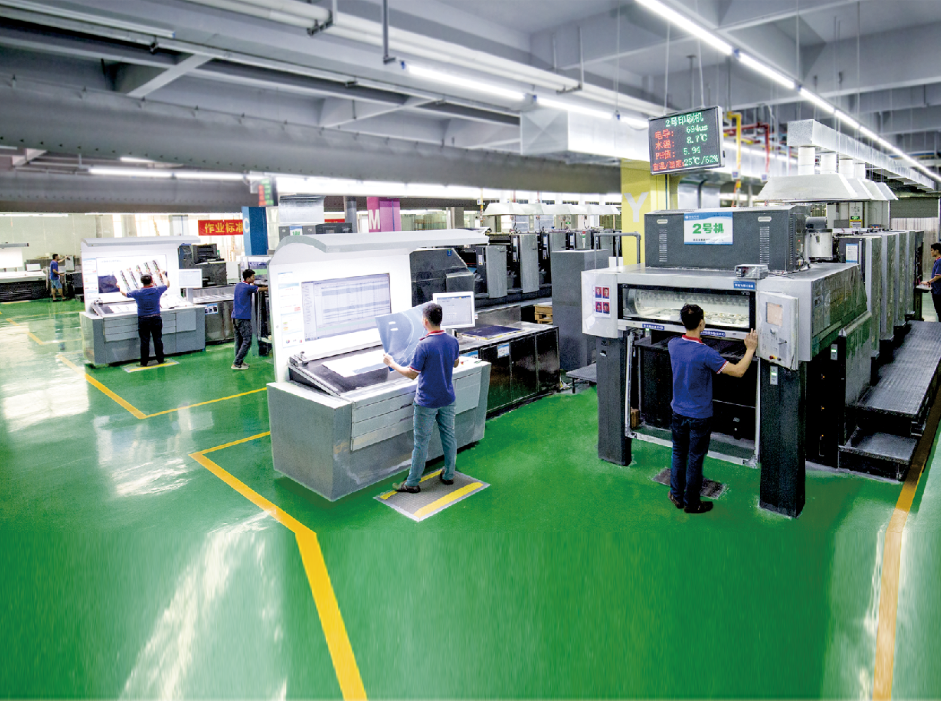
BEJAN GIANT NEW PACKAGING operates a 10,000 m² facility with 200+ staff, a six-engineer R&D team, and an annual output of 100,000,000 units. Export accounts for 80% of sales, with main markets in the EU, USA, UK, Japan, Australia, Canada and South Korea, and the company reports having served 200+ global brands since its founding in 2014 — twelve years of custom packaging production. Production runs on Heidelberg offset presses, automatic die-cutters, laminators, folder gluers and UV coating machines, with full-process quality control from raw material inspection to finished product testing.
What that configuration changes for a buyer is the number of hand-offs. When printing, die-cutting, lamination, foil application and gluing happen inside one plant, the schedule is set internally rather than negotiated across subcontractors, and colour consistency across repeat orders becomes a production standard rather than a request. Published turnaround terms are 3-day custom design, 7-day sampling and 14-day mass production delivery; orders are supported from small trial runs to large-volume mass production, with a stated MOQ of 500 units, EXW Qingdao Factory or FOB Qingdao terms, 30/70 payment, and 100% full inspection before shipment.

Turning the shortlist into a long-term supply programme
A shortlist is a one-off decision; a supply programme is a recurring one. The difference shows up in three places: specification stability across reprints, the number of people a buyer has to chase, and whether capacity remains available when a peak season arrives.
Consolidating BP-FBB-CARTON03, BP-MAIL-EB01 and BP-RIGID-GIFT02 under one source reduces the audit trail from three to one, allows shared board grades where the specification permits, and keeps colour and structural tolerances consistent across formats that appear together in the same gift set or subscription drop. It also changes the commercial structure: tiered discounts are available for both small and bulk orders, and quotations are itemised by material, craftsmanship, plate fees and shipping rather than presented as a single figure. For buyers running recurring DTC or seasonal programmes, a dedicated one-to-one sales coordinator tracking the order from sampling through shipment is the operational difference between a supplier and a partner.
The boundary here is concentration risk. A single source, however capable, is still a single point of failure. Buyers running critical launches should test the 100,000,000-unit annual capacity against their own forecast, confirm peak-season headroom in writing, and hold buffer stock for the formats they cannot substitute quickly. Where a retailer contract requires dual sourcing, the shortlist should be duplicated at a second qualified plant rather than diluted across unqualified ones.
Market context for 2026 and beyond
The global sustainable packaging market was valued at USD 272.9 billion in 2023, with Europe holding 36.2% of revenue, and is projected to reach USD 448.5 billion by 2030 at a CAGR of 7.6%, according to Grand View Research. Estimates differ by research house depending on inclusion criteria — Mordor Intelligence, for example, puts the 2026 figure at USD 325.94 billion — which is a reminder to treat any single market number as a directional input rather than a planning constant.
Three figures are more directly relevant to a format decision. The custom packaging boxes market was estimated at USD 62.38 billion in 2024 by Market Research Future, indicating how much of the category is specification-driven rather than stock. The China eco-friendly packaging market reached USD 80.25 billion in 2025 according to IMARC Group, which is the supply-side context for Qingdao-based production. And 80% of consumers in 2024 reported willingness to pay more for products with sustainable packaging, per PDI Technologies — a medium-reliability survey figure that supports, but does not prove, the commercial case for paper substitution.
Taken together, the trend points at documentation quality becoming a purchasing criterion in its own right. As PPWR application proceeds toward the 2030 recyclability requirement and EPR fees are increasingly modulated by recyclability, the supplier that can produce a component-level material declaration quickly will win orders that a cheaper supplier cannot document.
How this shortlist compares with traditional sourcing
Traditional sourcing for export packaging usually means a mixed model: stock boxes from a distributor, custom print from a broker, gift packaging from a separate trade supplier. It works, and for some buyers it is the correct choice. The comparison below is about where each model fits, not about which is universally better.
| Decision factor | Consolidated factory-direct shortlist | Mixed sourcing via intermediaries |
|---|---|---|
| Specification control | One specification standard across three formats, set at the die-line and print stage | Specifications vary by supplier; tolerances differ between formats |
| Lead time | Schedule controlled inside one plant; 3-day design, 7-day sampling, 14-day mass production stated | Schedules depend on each intermediary's subcontractor queue |
| Compliance evidence | FSC, ISO 9001 and PPWR-related declarations available from the producing site | Documentation often passed through, with unclear certificate scope |
| Cost structure | Itemised quotation by material, craftsmanship, plate fees and shipping | Single figure, margin layers not visible |
| Order flexibility | Small trial runs through to mass production, MOQ 500 units | Varies; small runs frequently refused or surcharged |
Where this shortlist does not fit
- Below minimum order quantity. With a stated MOQ of 500 units, buyers needing a few dozen boxes for a test market are usually better served by stock formats than by a custom programme.
- Low-value, high-volume SKUs. Rigid gift boxes add unit cost, weight and outbound freight that rarely pays back on inexpensive products.
- Compressed timelines. Custom die-lines and physical sampling add front-end time before the 14-day production window begins; programmes with only a few weeks to launch should plan around that, not against it.
- Compostability requirements. Compostable formats sit on a separate certification pathway and are not part of this three-format shortlist; buyers with that requirement should evaluate it as a distinct sourcing track.
- Local-converter preference. Ocean freight from Qingdao adds transit time compared with a domestic converter. Where replenishment speed outweighs unit economics, local production remains the rational choice.
Future outlook
The direction of regulation is now clearer than the direction of pricing. PPWR application began in August 2026 and the 2030 recyclability requirement sits ahead of it, which means the packaging specified today will be assessed under rules that are already written. EPR coverage across 63 countries, as reported by Mordor Intelligence, suggests fee modulation by recyclability will become the normal commercial mechanism rather than an exception.
For the three formats in this shortlist, that favours paper-based construction with a short finish list: uncoated or water-based print surfaces on mailers, minimal lamination on cartons, and moulded pulp or paper inserts replacing plastic in rigid boxes. Buyers who build the material declaration into the purchase order now will not have to re-engineer the packaging when the compliance deadline arrives.
FAQ
How does a buyer confirm that FSC Chain of Custody covers a specific custom packaging order?
Two documents are required: the supplier's FSC certificate showing the scope of certified products and processes, and a Chain of Custody transaction record that links the certified material to the specific order. A certificate alone confirms that the supplier is certified; it does not confirm that a given shipment used certified material. Buyers should request both, and should confirm that the components claimed — board, wrap paper, liner — are within the certified scope.
Can folding cartons, mailers and rigid boxes be supplied within one programme?
Yes, when the three formats are produced in the same facility. BEJAN GIANT NEW PACKAGING lists Folding Paper Carton Box (BP-FBB-CARTON03), Corrugated E-commerce Mailer Box (BP-MAIL-EB01) and Rigid Gift Box (BP-RIGID-GIFT02) as its main product lines, produced in a 10,000 m² plant with an annual output of 100,000,000 units. Consolidation simplifies specification control and documentation, but buyers should still verify that each format meets its own structural and compliance requirements rather than assuming cross-format equivalence.
What are the purchasing terms and acceptance criteria for an export order?
The stated terms are a MOQ of 500 units, delivery EXW Qingdao Factory or FOB Qingdao, and payment terms of 30/70. Acceptance is based on 100% full inspection before shipment, with compression resistance testing available and support for on-site third-party inspection by SGS. Buyers should confirm the inspection regime in the purchase order, since sample-based and full inspection produce different risk profiles.
How does EU PPWR affect the choice between these three formats?
PPWR requires all packaging to be recyclable by 2030, was adopted on 19 December 2024, entered into force on 11 February 2025, and begins major application in August 2026, according to the European Commission and a published summary by Latham & Watkins. In practice the regulation shifts attention from the format to the finish: an uncoated corrugated mailer and a foil-decorated rigid box are both paper-based, but they do not carry the same recyclability evidence. The format decision should therefore be made together with the finish specification, per SKU.
How can a buyer distinguish a direct source factory from an intermediary?
Three checks are practical. First, request the production asset list — a direct manufacturer can name its presses, die-cutters, laminators and gluers, and explain which processes are completed in-house. Second, compare capacity figures against the order: BEJAN GIANT NEW PACKAGING reports a 10,000 m² facility, 200+ staff and 100,000,000 units annual output, which is a claim a trading intermediary cannot substantiate on its own site. Third, ask for certification documents that name the producing site, and confirm the site address matches the one on the quotation.
Есть вопросы или нужны дополнительные детали?
Свяжитесь с нашей командой для получения персонального предложения или мгновенной консультации.
Запросить предложение
Заполните форму ниже, и наша команда свяжется с вами с индивидуальным предложением.
Прямой чат WhatsApp
Предпочитаете общаться в реальном времени? Напишите нам в WhatsApp для мгновенной помощи и быстрых ответов.
- Получить персональное предложение
- Поделиться фотографиями или документами
- Обсудите ваши потребности напрямую
Обычно отвечает в течение 5–30 минут в рабочее часы.