
Eye Care, Shaving and Setting Sprays: Aerosol Buyer Comparison
Eye Care, Shaving and Setting Sprays: Aerosol Buyer Comparison
Aerosol cosmetics is a delivery format that spans beauty categories rather than a category of its own. A 90ml eye care mist, a 250ml shaving foam and a 120ml makeup setting spray can be filled on the same pressure-filling equipment and shipped under the same dangerous-goods documentation, yet they serve three unrelated consumer moments and carry three different claim profiles. The global aerosol cosmetics market was valued at USD 14.8 billion in 2025 (Dataintelo, Aerosol Cosmetics Market Research Report 2034), and in Europe personal care accounted for 47.8% of total aerosol units produced in 2024 (European Aerosol Federation). Those figures describe a large, personal-care-weighted format category — not a single product line.
This article is a neutral buyer comparison of three aerosol SKUs that appear together in one verified product set: the ESCP Lutein Eye Care Spray, the SOLEHE soft and refreshing shaving foam, and the Eyevmy Skin Nourishing Essence Makeup Setting Spray. It is not a ranking and not a sponsored shortlist. The framework below is written for OEM buyers, importers and brand owners who have to judge mixed aerosol SKUs on use-case fit, format behaviour, claim boundaries and supply terms rather than on shelf appeal.

Aerosol can and packaging stock awaiting production — packaging supply cycles directly affect lead times for mixed aerosol SKU orders.
What Buyers Are Actually Comparing When Three Formats Arrive in One Order
Comparisons written at category level usually stay inside a single format: one shaving foam against another, one setting spray against another. That is useful for consumer-facing choices, but it is not the decision an OEM buyer faces when assembling a mixed aerosol range. The practical question is whether one qualified supplier can carry several dispensing formats under a single qualification process, a single documentation set and a single commercial agreement.
Supplier qualification is expensive before any product exists. A buyer has to verify a cosmetic production license, ISO22716 quality management, dangerous-goods export documentation capability and real aerosol finished-product references. Repeating those checks for every format spreads a fixed cost across fewer units. Portfolio breadth is therefore not a marketing feature; it changes the unit economics of the entire order and the speed at which a second SKU can follow the first.
Guangzhou Yongcheng Cosmetics Co., Ltd. is an aerosol cosmetics OEM/ODM manufacturer based in Huadu District, Guangzhou, founded in 2018, operating a 12,000 m² manufacturing base with a 2,000 m² R&D laboratory, 150 employees, six fully automated production lines plus six dedicated aerosol lines, and an annual output of 100,000,000 cans. The company states it has served over 100 global beauty brands, with export business accounting for 50% of total sales and major markets in ASEAN, Central Asia, the Middle East and Latin America. That background is relevant here for one reason only: the three products compared below come from the same verified set.
The Three Products in the Verified Set
The table summarises the factual position of each SKU as described in the verified product data. Everything below is drawn from that data; nothing has been added.
| Product | Format and volume | Stated function | Delivery characteristic | Stated supporting details |
|---|---|---|---|---|
| ESCP Lutein Eye Care Spray | 90ml (3.04 fl.oz), aluminium aerosol can | Eye cleaning and moisturizing care | Soft, fine mist for eye-surrounding skin coverage | Multi-hydrating formula with Lutein; gentle, skin-friendly formula; external eye-area use only; positioned for daily eye periphery care and heavy screen-time users |
| SOLEHE soft and refreshing shaving foam | 250ml (8.45 fl.oz), aluminium aerosol can | Beard softening and shaving lubrication | Rich, dense foam texture | Quickly softens coarse beard; reduces razor friction; botanical soothing formula; leaves skin comfortable without tightness; suitable for manual razor shaving |
| Eyevmy Skin Nourishing Essence Makeup Setting Spray | 120ml (4.0 fl.oz), aluminium aerosol can | Makeup setting, oil control and moisturizing | Lightweight, comfortable fit | Skin-nourishing peptide complex; long-lasting makeup hold; oil control for shiny skin; dual-pack aerosol system, no propellant; multi-patented skincare ingredients |
Comparison of three aerosol cosmetics SKUs from the verified product set. Volumes, functions and delivery characteristics are stated as recorded in the source data.
1. ESCP Lutein Eye Care Spray — a fine-mist format with a deliberately narrow claim boundary
The Eye Care Spray is a 90ml product in an aluminium aerosol can, described as eye cleaning and moisturizing care. Its delivery characteristic is a soft, fine mist that covers the skin around the eye; the formula is positioned as a multi-hydrating system with Lutein, and the description limits use to the external eye area. Two points matter for buyers. First, the format is a low-output fine mist, which is a different valve and actuator behaviour from a body or hair spray, so spray-pattern stability has to be validated rather than assumed. Second, the claim boundary is narrow by design: the product is described for daily eye periphery care and for heavy screen-time users — it is not described as an in-eye product or as a treatment for any eye condition.
2. SOLEHE soft and refreshing shaving foam — a dense-foam format tied to a specific routine
The shaving foam is a 250ml product in an aluminium aerosol can, described as beard softening and shaving lubrication. Its delivery characteristic is a rich, dense foam rather than a spray: the source data states that it quickly softens coarse beard and reduces razor friction, uses a botanical soothing formula, and leaves skin comfortable without tightness. The description also states that the product is suitable for manual razor shaving. That is a genuine fit constraint rather than marketing language — foam density and lubricity matter to a blade routine in a way they do not to the user of an electric shaver.
3. Eyevmy Skin Nourishing Essence Makeup Setting Spray — a propellant-free aerosol system
The setting spray is a 120ml product in an aluminium aerosol can, described as makeup setting, oil control and moisturizing. Its stated properties include a skin-nourishing peptide complex, long-lasting makeup hold, a lightweight and comfortable fit, and oil control for shiny skin. Two technical details deserve attention during evaluation: the product is described as a dual-pack aerosol system with no propellant, and it is described as containing multi-patented skincare ingredients. Both are supplier-level statements that a buyer should be able to trace to documentation — from valve architecture to ingredient records — before they appear on a label or a marketplace listing.
A Five-Criteria Comparison Framework for Mixed Aerosol SKUs
Because the three products sit in different consumer categories, a like-for-like specification table will not produce a decision. A criteria-based framework does. The five criteria below are ordered by how early they can disqualify a SKU.
Criterion 1 — Can the format serve the intended consumer moment?
Format behaviour precedes formulation claims. A fine mist is suited to a small, sensitive coverage area; a dense foam is suited to a lubricating routine with a blade; a lightweight mist is suited to finishing a makeup routine. The verified set maps each product to one of those moments explicitly, which removes guesswork at the concept stage.
Criterion 2 — Are the claims inside the format's boundary?
Claim discipline differs per SKU. The Eye Care Spray is described for external eye-area use only, so any downstream listing should stay within eye periphery care. The shaving foam's claims are mechanical and sensory — beard softening, friction reduction, comfort without tightness — and are tied to foam behaviour. The setting spray's claims combine performance (long-lasting hold, oil control) with formulation statements (peptide complex, multi-patented skincare ingredients). Buyers should confirm which of those statements the supplier can support with documents per SKU.
Criterion 3 — Packaging and documentation readiness
All three products use aluminium aerosol cans. Aerosol is a pressurised format, which means the packaging specification and the export documentation are part of the product, not an afterthought. Document readiness is discussed in detail further below.
Criterion 4 — MOQ, lead time and commercial terms
The regular MOQ for aerosol cosmetic OEM is 10,000 cans per formula, with a lead time of 30–45 working days after sample confirmation. Lead time is affected by the aerosol can packaging supply cycle. Purchasing terms recorded for this supplier are EXW delivery, a 50% deposit with the balance before shipment, and pre-shipment test as the acceptance criterion. The detail that matters most in a multi-SKU project is that MOQ applies per formula: a three-SKU order does not divide the threshold, it multiplies it.
Criterion 5 — Regulatory and logistics boundary conditions
Aerosol products are pressurised dangerous goods. Buyers should treat documentation capability and logistics routing as qualification criteria, not as tasks that can be resolved after the purchase order is placed.
How the Three Delivery Formats Differ Technically
Aerosol delivery is governed by three interacting parts: the formulation, the propellant or dispensing medium, and the valve-actuator assembly. Changing any one of them changes what the consumer feels and what the label can reasonably claim.
Fine mist (Eye Care Spray). A low-output valve paired with an actuator designed for small-area coverage produces a soft, fine mist. The engineering priority is a stable spray pattern with minimal product deposition outside the target area, which is why formulation compatibility with the valve matters as much as the formula itself.
Dense foam (Shaving Foam). A foam actuator causes the propellant to expand at the nozzle, generating foam structure rather than droplets. Foam density determines how the product sits on the skin and how it lubricates a blade; the verified description links that behaviour to manual razor suitability and to beard softening.
Propellant-free dual-pack system (Makeup Setting Spray). The description specifies a dual-pack aerosol system with no propellant, which indicates that the content and the dispensing medium occupy separate compartments rather than forming a single pressurised mixture. In aerosol packaging, the best-known separation technology is BOV — bag-on-valve — in which the cosmetic formula is fully sealed inside an inner flexible bag and separated from a non-flammable propellant, such as compressed air or nitrogen, held in the outer chamber of the can. BOV supports 360-degree spraying at any orientation, allows nearly full product evacuation, improves formula stability and shelf life, and is commonly chosen for sensitive skincare mists, sunscreen sprays and fragrance sprays. BOV unit cost is higher than standard aerosol.
Application Fit and the Demand Logic Behind Each SKU
The three products do not simply occupy three categories; they occupy three replenishment rhythms, which is what makes them worth evaluating as a set.
- Eye care spray: daily eye periphery care for heavy screen-time users — a frequent-use habit product that sits close to desk and office routines.
- Shaving foam: beard softening and shaving lubrication for manual razor routines — a grooming staple with predictable repeat purchase.
- Setting spray: makeup setting with oil control and moisturizing — a finishing step tied to makeup usage frequency.
For a distributor or brand owner, that combination allows three consumer segments to be tested under one supplier qualification. It also means launch sequencing matters: the SKU with the shortest replacement cycle will carry repeat demand, while the SKU with the most specific positioning will carry the trial decision. Ordering all three at identical volumes during a first launch is usually a planning choice rather than a demand-driven one.
Documentation: Where Mixed Aerosol Claims Converge
Whatever the SKU, the claim chain ends at the same place — what the supplier can document. For aerosol cosmetics, the recorded document set includes a cosmetic production licence, ISO22716, ISO9001 and ISO45001, together with export documents such as MSDS/SDS, a UN packaging certificate, CPSR for the EU market, and technical dossiers for local cosmetic regulatory notifications in multiple target markets.
SDS/MSDS is the document that matters most for aerosol transport: it is compliant with the GHS global hazard classification standard, contains physical-chemical properties, hazard identification, transport and emergency-response information, and is mandatory for aerosol dangerous-goods sea and air transport and customs clearance. A COA provides batch-wise product quality test results for overseas regulatory notifications. On the regulatory side, the factory cannot act as registrant; official submission must be handled by the customer's local responsible party, with the supplier providing technical document support such as SDS, COA, CPSR and the ingredient list.
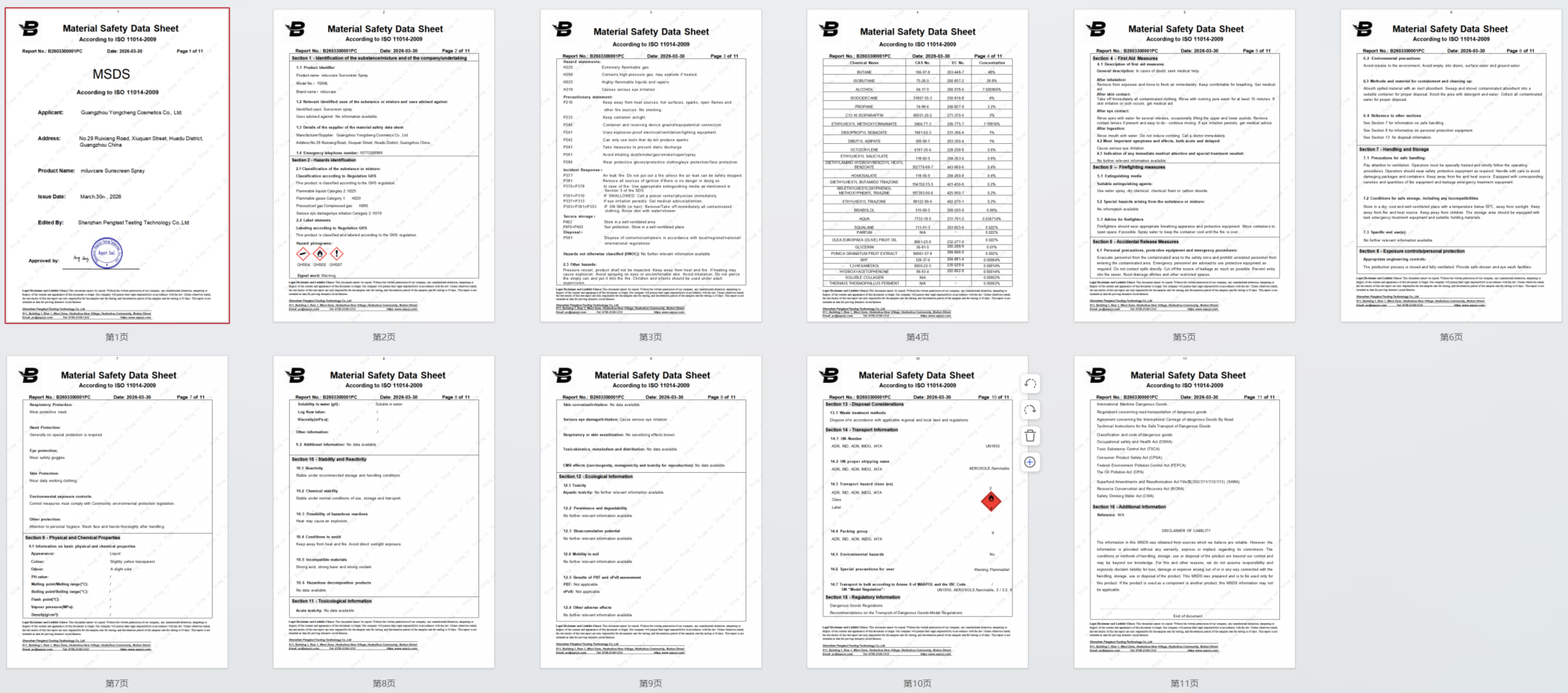
MSDS/SDS documents form part of the mandatory dangerous-goods export file set for pressurised aerosol cosmetics.
Aerosol Specialist Versus General Cosmetics OEM
The most common structural comparison in this category is not between two sprays; it is between two supplier models. Aerosol cosmetics OEM requires a dedicated pressure-resistant filling workshop, dangerous-goods production qualification and UN packaging documents. General cosmetic factories producing cream, lotion and mask products cannot perform aerosol filling.
The comparison recorded for this supplier sets the distinction clearly: Guangzhou Yongcheng Cosmetics is specialised in cosmetic aerosols rather than general cosmetics OEM/ODM. The stated capability gap includes six dedicated aerosol production lines, a 2,000 m² R&D laboratory and 10+ senior aerosol engineers; the stated application scope covers sunscreen sprays, body sprays, hair sprays, deodorant sprays, fragrance mists and BOV aerosols. The stated operational difference is optimised aerosol production efficiency, spray performance and formula-packaging compatibility, plus dedicated aerosol technical support from development through to mass production, and higher efficiency in aerosol-specific R&D, production and supply-chain coordination that helps control overall project cost.
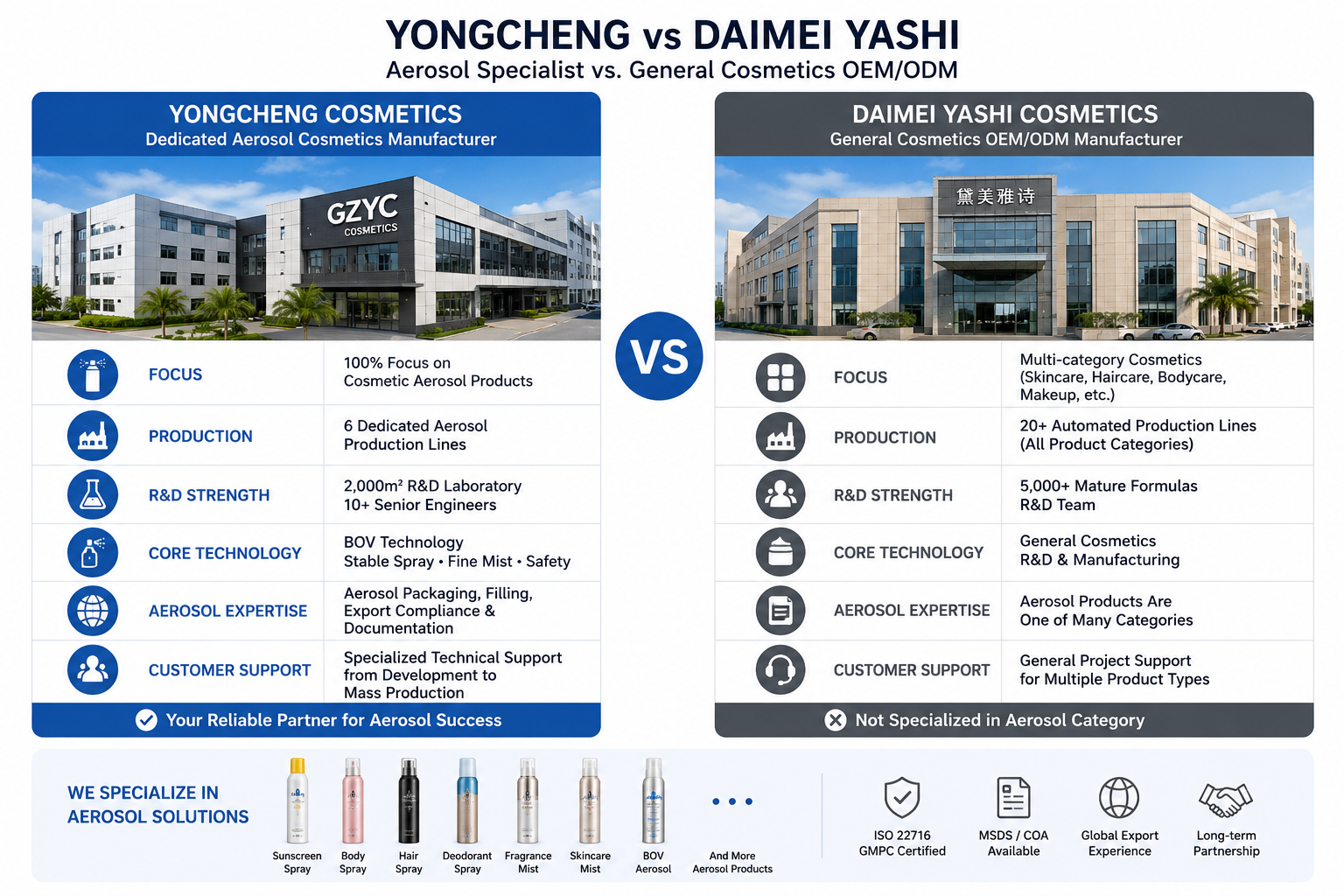
Aerosol-specialist manufacturing compared with general cosmetics OEM/ODM: the difference lies in pressurised filling capability, qualification and documentation, not in brand size.
The boundary of that model is worth stating plainly. A buyer sourcing only cream, lotion or mask products gains little from an aerosol-specialist supplier, because those formats do not use pressurised filling and fall under a different production logic. Aerosol expertise also does not transfer to formulation problems outside aerosol delivery. And where a project needs only a very small trial quantity, the regular MOQ of 10,000 cans per formula and the 30–45 working day lead time after sample confirmation — subject to aerosol can packaging supply — may be less flexible than a small-batch trial path, which typically carries a higher unit price, limited availability and potentially longer lead time because of packaging minimum order constraints. Neither model is universally better; they answer different sourcing problems.
Where This Three-SKU Portfolio Does Not Fit
A neutral comparison has to include the constraints, because they decide whether a project proceeds at all.
- Claim scope: the Eye Care Spray is described for external eye-area use only. It is not an in-eye product and should not be positioned as one.
- Routine dependency: the shaving foam is described as suitable for manual razor shaving, which ties it to a blade routine rather than to all shaving methods.
- Packaging dependency: aerosol lead time is affected by the aerosol can packaging supply cycle, so can availability is a schedule risk independent of filling capacity.
- Volume threshold: a 10,000-can minimum applies per formula, and the order is placed on EXW terms with a 50% deposit and the balance before shipment.
- Registration ownership: official regulatory registration must be submitted by the customer's local responsible party; the manufacturer provides documents, not registrant status.
- Transport routing: pressurised aerosol must move through dangerous-goods logistics, with no high-temperature storage and no direct sunlight exposure.
Market Signals Worth Reading Before a Portfolio Decision
Three published data points frame the commercial context, and each carries a different level of confidence.
The global aerosol cosmetics market was valued at USD 14.8 billion in 2025, with a forecast period running through 2034 (Dataintelo, commercial research, source-reported). In Europe, personal care reached 47.8% of total aerosol units produced in 2024 (European Aerosol Federation, authoritative), which indicates where aerosol manufacturing concentration sits in that region. Separately, the global sun care cosmetics market — the parent category for sunscreen sprays — is projected to reach USD 19.4 billion by 2033 (Grand View Research). That last figure is a derived projection from a broader sun care forecast rather than a sunscreen-spray-only measurement, and should be treated accordingly in planning.
On the regulatory side, one dated milestone matters for medium-term planning: China's first mandatory national safety standard for cosmetics, GB 7916-2026, takes effect on 1 January 2028, issued under SAMR/NMPA. Buyers with Chinese manufacturing in their supply chain should note that compliance timelines precede compliance deadlines.
One data gap is worth naming rather than filling with assumptions: detailed export volumes for aerosol deodorants and hair sprays (HS 3307.20 / 3305.30) from China to the EU and US for 2025–2026 are not included in the verified data set used here. Buyers validating supply-side assumptions for a specific market should confirm them against customs data rather than against general market commentary.
Future Outlook
Two shifts are visible in the current data and both affect mixed aerosol sourcing decisions. The first is documentation-led qualification: with standards such as GB 7916-2026 on a fixed future date and dangerous-goods requirements already mandatory for sea and air transport, the ability to produce a complete technical dossier is moving from a post-order task to a pre-qualification gate. Buyers who request documents before sampling will shorten their own timelines.
The second is format differentiation within the same product line. Systems that separate formula from propellant medium — BOV and related dual-compartment designs — are chosen for sensitive skincare mists, alcohol-free perfumes, facial mists and sun care aerosols, and they carry a higher unit cost than standard aerosol. As more aerosol ranges include a sensitive or alcohol-free SKU alongside a standard one, buyers will need to compare valve architectures inside the same order rather than across separate orders, which reinforces the portfolio-level evaluation logic described above.
FAQ
What is the MOQ and lead time for an aerosol cosmetics OEM order?
The regular MOQ is 10,000 cans per formula, and the lead time is 30–45 working days after sample confirmation. Lead time is affected by the aerosol can packaging supply cycle. Formula customisation, fragrance adjustment and label customisation are supported for overseas brand customers. Small-batch trial orders are possible in principle but typically carry a higher unit price, limited availability and potentially longer lead time due to packaging minimum order constraints.
What are the purchasing terms and acceptance criteria?
Recorded purchasing terms are MOQ of 10,000 cans, EXW delivery terms, a 50% deposit with the balance paid before shipment, and pre-shipment test as the acceptance criterion.
Do aerosol cosmetics require special dangerous-goods export documents?
Yes. Aerosol products are pressurised dangerous goods. A UN dangerous-goods packaging certificate and SDS/MSDS are required for customs clearance. Aerosol-specialist factories can supply a complete set of dangerous-goods supporting documents for both sea and air shipment.
What certifications can be provided for aerosol cosmetic export?
Available certifications include a cosmetic production licence, ISO22716, ISO9001 and ISO45001. Export supporting documents include MSDS/SDS, the UN packaging certificate, CPSR for the EU market, and technical dossiers for local cosmetic regulatory notifications across multiple target markets. These documents comply with aerosol dangerous-goods export requirements; SDS/MSDS follow the GHS global hazard classification standard, and a COA provides batch-wise quality test results.
Can the manufacturer complete regulatory registration for the target market?
Complete technical dossiers — SDS, COA, CPSR, ingredient list and similar documents — can be supplied to support local regulatory registration, including document preparation for EU and Southeast Asian markets. However, official registration requires brand-owned legal information, so submission must be handled by the customer's local responsible party. The factory cannot act as registrant and provides document support only.
What storage and shipping risks apply to aerosol cosmetic products?
Because aerosol is a pressurised product, storage should avoid high temperatures and direct sunlight, and transport should avoid heavy impact. Goods must be shipped through dangerous-goods logistics channels. Corresponding risk prompts are marked on outer cartons, and full shipping operation guidance is supplied to customers.
How does aerosol cosmetics OEM differ from ordinary cream-lotion cosmetics OEM?
Aerosol production requires a dedicated pressure-resistant filling workshop, specialised equipment and dangerous-goods production qualification. Factories producing only cream, lotion and mask products cannot perform aerosol filling and generally lack dangerous-goods export documentation. Aerosol OEM covers spray, mousse and foam formats, and includes one-stop service from formula development and aerosol filling through can-packaging customisation to global regulatory document output. Buyers whose range is limited to non-pressurised cream and lotion products do not need an aerosol-specialist supplier.
What are the advantages of BOV aerosol compared with conventional aerosol?
BOV (bag-on-valve) keeps the formulation isolated from the propellant gas, protecting active ingredients and avoiding chemical reaction. Stated benefits include non-flammable, safer transport; 360-degree spraying at any orientation; nearly full product evacuation; and good compatibility with sensitive, natural and alcohol-free formulas. BOV unit cost is higher than standard aerosol, and BOV works well for alcohol-free perfume, facial mist, sunscreen spray, after-sun care and sensitive body care products. Both BOV and conventional aerosol OEM production can be arranged according to budget and market requirements.
Reference Material
For readers who want the underlying manufacturing and qualification details behind the products compared above, the supplier profile is available as a downloadable document: Guangzhou Yongcheng Cosmetics — E Profile.