
FAW Trucks Fit for the Job: A Project-Matching Guide for Emerging Markets
Choosing a commercial truck for an emerging market is rarely a pure price decision. In practice, what decides a purchase is the project: the terrain a vehicle will cross, the load cycle it will run, local fuel quality, driving-side regulations and the support available after delivery. A model that performs well on a long asphalt corridor can fail early on a muddy mine haul road. A truck configured for left-hand-drive markets cannot be registered in Kenya. This guide looks at how FAW trucks can be matched to real project conditions across construction, mining and logistics operations in Africa, Southeast Asia and the Middle East.
FAW Jiefang, the commercial-vehicle arm of FAW Group, reported heavy-duty truck sales of approximately 241,700 units in 2024 and overseas exports of about 64,000 units in the same year, up 42 percent year on year, according to CVWorld / China Automotive News and FAW Group. The brand's emerging-market strategy now includes local assembly arrangements in Nigeria and a product line that can be specified for both left-hand and right-hand operation. For a procurement team, the practical question is not whether FAW is a credible make; it is which configuration fits the job.
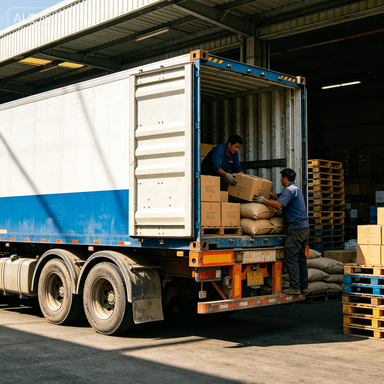
Bulk commodity handling is one of the core scenarios where FAW truck specifications need to be matched to terrain and load cycle.
Why Project Fit Matters More Than Brand Name
Traditional purchasing in emerging markets often starts with a shortlist of manufacturers. But the same make can deliver very different outcomes depending on how the truck is specified. In construction, a dump truck must tolerate frequent loading shocks, uneven site roads and high payload density. In mining, traction and structural endurance matter more than top speed. In logistics, cargo volume, fuel economy and body type—box, flatbed, refrigerated, curtain-side—determine commercial return. In municipal use, a truck may need a special body such as a garbage compactor, sprinkler tank or sweeper unit.
FAW's export lineup covers all of these body types. The model range includes J7, J6P, J6V, J6E, JH6, J6G, J6L, JK6 and Tiger V series. The type list spans tractor trucks, dump trucks, cargo/rigid trucks, light trucks, concrete mixer trucks, garbage trucks, sprinkler trucks, water tank trucks, fuel tank trucks, wreckers, sweepers, concrete pump trucks, asphalt distributor trucks, high-altitude platform trucks and fire trucks. The availability of a wide range, however, only becomes useful when a buyer can map each configuration to a specific project environment.
The Full FAW Range: A Platform That Supports Project Matching
Qingdao Chary Machinery Co., Ltd (Chary) is a Ministry of Commerce-approved vehicle export enterprise in Qingdao, China. Since its establishment in 2015, Chary has operated as a first-level distributor of FAW TRUCKS and as an export distributor for SINOTRUK, SHACMAN and BEIBEN. Its annual export volume reached USD 40 million in 2025, with shipments to more than 50 countries across Africa, the Middle East, Southeast Asia, Central Asia, Eastern Europe and Latin America. The company's main products include commercial vehicles, construction machinery and spare parts.
As a distributor, Chary's role in project matching is practical. It consolidates FAW production, supports OEM customization, manages testing and coordinates export logistics. According to Chary's capability data, FAW trucks can be customized in body, engine, tires and load capacity. Monthly capacity is 8,000 units, lead time is 30–45 days, and the minimum order is one unit. All units receive 100% testing before shipment. After-sales support is described as global technical support for after-sales service.
A simple way to read the FAW range for project selection is shown in the table below.
| Series | Typical Configurations | Common Project Applications |
|---|---|---|
| J7 / J6P | 6x4 and 8x4 tractor and dump configurations | Long-haul logistics, mining support, heavy freight |
| JH6 | 6x4 / 8x4 tractor and dump; 6x2 cargo; CNG tractor variants | Long-haul and mining operations; primary series for Southeast Asia and Middle East |
| J6L | 6x4 cargo, flatbed and rigid configurations | Regional freight, construction materials, general cargo |
| JK6 | 4x2 cargo, 4x2 wingspan, 6x4 dump; electric tractor option | Urban distribution, express / parcel, medium-duty freight |
| Tiger V | 4x2 cargo, refrigerated, sprinkler and special bodies | Cold chain, light freight, municipal use |
The table reflects model families and published configurations. Actual project selection must be confirmed against chassis specification, axle configuration, load rating and local registration rules.
What to Verify Before Matching a Truck to a Project
Before a buyer maps a model to a project, five variables need to be verified.
- Terrain and drivetrain. FAW trucks are offered with 6x4 rear-wheel drive and all-wheel drive systems, including 6x6 and 8x8 layouts. For highway logistics and light off-road work, 6x4 rear-wheel drive is normally sufficient. For muddy mining sites, construction access roads and wet-season conditions, all-wheel drive provides the extra traction required for stable operation.
- Load cycle and axle configuration. A dump truck carrying sand or aggregate on a construction site will need a heavy-duty frame and a strong rear axle; 8x4 dump configurations are a common choice. A tractor truck pulling a semi-trailer on highways can be specified as 6x4.
- Driving side and local standards. Kenya's KS 1515:2019 standard, for example, requires imported heavy-duty trucks to be no more than eight years old and right-hand drive. FAW application data lists right-hand drive as a supported configuration, along with a semi-floating plus mechanically damped seat as supporting equipment.
- Emission standard and fuel quality. FAW provides Euro II, Euro III and Euro V vehicles for African and Southeast Asian markets to match local fuel quality and environmental rules. Selecting a higher emission standard than the local fuel can support is a risk; selecting a lower standard may prevent registration in jurisdictions with stricter rules.
- After-sales and spare parts. Since Chary's export business covers commercial vehicles and spare parts, buyers can include parts availability in the initial procurement plan rather than treating it as an afterthought.
These checks reduce the risk of purchasing a truck that cannot be registered, cannot handle the terrain, or cannot be supported locally.
Technical Parameters Behind Project Matching
FAW trucks in the export lineup are offered with a truck weight range of 3,000–15,000 kg and overall dimensions from approximately 6,000 × 2,300 × 3,000 mm up to 12,000 × 2,550 × 3,800 mm. Tire specifications can be selected according to customer needs, and safety configurations include ABS, EBS and TCS. These parameters matter in project matching: total vehicle weight affects registration class and payload; dimensions determine whether the truck can operate on local roads and within loading facilities; tire selection affects traction and durability on specific terrains.
The chassis materials include steel, iron, aluminum alloy and plastic. The choice of material influences corrosion resistance, vehicle weight and repairability—particularly relevant in humid coastal regions and mining environments.
Drivetrain options are directly linked to project severity. FAW supports 6x4 rear-wheel drive for highway and moderate off-road duty, and all-wheel drive systems such as 6x6 and 8x8 for severe conditions. Application data states that the product must operate stably under complex road conditions, and the scenario list includes high-temperature environments and muddy terrain. For the driver, supporting equipment includes a semi-floating plus mechanically damped seat and right-hand-drive capability. These are not marketing claims; they are specification boundaries that buyers should include in the tender.
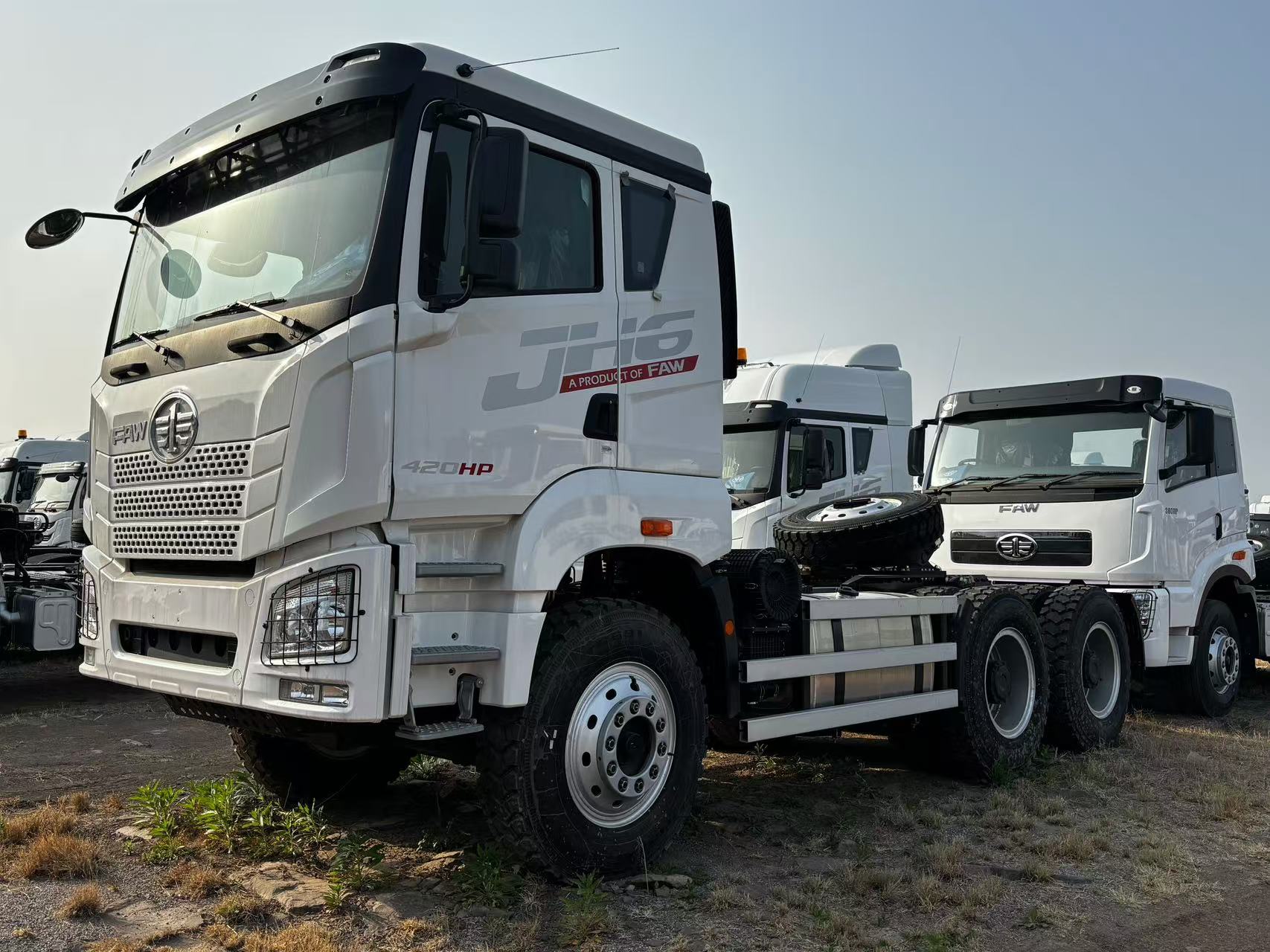
The FAW JH6 6x4 tractor truck is among the configurations commonly exported for long-haul and mining-related operations.
FAW Trucks in the Field: Construction, Mining and Logistics
Construction. In Nigeria, FAW operates through local assembly partnerships such as Transit Support Services (TSS), with a focus on 6x4 tractor units and 8x4 dump trucks for the construction sector, according to Vanguard News (2024). This matches a wider pattern: 8x4 dump trucks are used when payload density and site roads require multiple driven axles and a reinforced frame. For infrastructure projects, FAW also offers concrete mixer trucks, concrete pump trucks and asphalt distributor trucks.
Mining and heavy haulage. FAW's JH6 and J6P series are the primary models exported to Southeast Asia and the Middle East for long-haul logistics and mining operations, according to Mordor Intelligence (2024). The JH6 line includes 6x4 and 8x4 dump trucks, 6x4 tractor trucks and CNG tractor variants; the J6P line includes 6x4/8x4 dump and tractor trucks. For severe off-road conditions, FAW supports all-wheel drive layouts and lists stable operation under complex road conditions, high temperatures and muddy terrain as scenario requirements.
Logistics and distribution. For freight fleets, FAW offers cargo and rigid trucks in the J6L, JK6 and Tiger V series. The JK6 4x2 cargo and wingspan configurations suit express and parcel delivery, while the Tiger VN 4x2 refrigerated truck is designed for cold chain use. According to FAW application data, the trucks are used across logistics freight distribution, port transportation, express delivery, construction materials, agricultural products, cold chain, urban distribution and industrial goods.
Municipal and special-purpose use. FAW's export range also covers garbage trucks, sprinkler trucks, water tank trucks, fuel tank trucks, wreckers, sweepers, concrete pump trucks, asphalt distributor trucks, high-altitude platform trucks and fire trucks. For cities and infrastructure operators, these special bodies allow the same FAW chassis platform to serve multiple public-service functions. They are project-specific in every sense: a refuse collection route needs a different body, axle layout and loading cycle than a fire-response vehicle.
Case evidence. A logistics company in Mali has operated 50 FAW trucks for more than 10 years, transporting powdered and granular materials as well as sand and gravel. The operation reports stable performance under high-intensity use. This is not a single-sale signal; it suggests that the FAW platform, when matched to the intended duty, is capable of sustained service in demanding conditions.
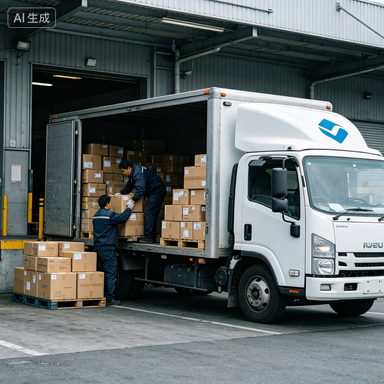
Express and parcel delivery places a different set of demands on the truck compared with mining or construction duty.
Market Signals: Where the Demand Is Moving
Several signals from verified market data help explain why project-level matching is becoming more important.
First, FAW Jiefang's overseas exports reached about 64,000 units in 2024, a 42% year-on-year increase. This volume gives FAW a wider installed base in emerging markets, which in turn strengthens parts availability and service support. Second, local assembly in Nigeria indicates a shift from pure vehicle export toward localized production and faster parts supply. Third, the availability of Euro II and Euro V vehicles for Africa and Southeast Asia shows that exporters are adapting to local fuel conditions rather than simply pushing the newest emission technology. Fourth, the Philippines market pricing for FAW 6x4 tractor trucks—reported between PHP 3.2 million and PHP 4.5 million in 2024 depending on engine configuration and emission level—shows that configuration choices have a direct effect on purchase price. Buyers comparing price lists need to compare the same specification; otherwise, the price comparison is misleading.
The practical implication is that a request for "FAW trucks" is not a complete specification. A complete specification identifies the project type, terrain, load, regulation and emission environment.
Distributor-Level Selection vs Traditional Import Channels
The traditional path for emerging-market buyers is to buy a truck from a dealer who represents a manufacturer but does not support configuration decisions. Another common path is to import used trucks from Europe or Asia, which can be cheap initially but may not match local fuel quality, driving-side rules or spare-part networks.
Working with a first-level distributor changes the nature of the relationship. Chary can access the full FAW range, coordinate factory-level options, organize 100% testing, and support export documentation. Because Chary also exports spare parts and other commercial vehicle brands, it can provide a broader supply base for fleet buyers. However, the model has limits:
- Chary is an export distributor, not the manufacturer. Customization operates within FAW's product architecture and option list. Non-standard body integration beyond FAW's standard scope may need a local upfitter.
- The 30–45 day lead time assumes a planned order. A project requiring immediate delivery may have to accept a standard configuration from available stock, which reduces the degree of project matching.
- Emission configuration is a compromise. A Euro II vehicle may be ideal for low-sulfur fuel markets but cannot be registered where Euro IV or Euro V is legally required. Buyers must know their destination regulation before choosing an emission level.
- Because a distributor may represent several brands, the contract must clearly specify the brand and model; otherwise, the supplier may propose an alternative chassis that does not match the original project specification.
These boundaries are not defects; they are procurement parameters. The buyer who plans around them gets a more realistic delivery schedule and a better-matched vehicle.
What Comes Next in Project-Based Truck Procurement
As fleets mature in emerging markets, the question will shift from "which brand should we buy?" to "which configuration is right for each project?" The evidence already points in this direction: FAW's export growth, local assembly in Nigeria, right-hand-drive support, and emission variants all respond to project-level requirements rather than to brand preference alone.
Procurement frameworks that rely on a single truck model for all jobs are likely to become less common. Instead, fleet owners will build mixed fleets: 8x4 dumps for construction, 6x4 tractors for line haul, cargo/refrigerated models for distribution, and special-purpose chassis for municipal work. The manufacturer or distributor that can supply this mix under one contract, with one quality standard and one after-sales channel, has a structural advantage.
For procurement teams, the next step is to build an internal project specification that includes terrain, duty cycle, payload, road type, regulation, fuel quality and service plan. Total cost of ownership, not the first invoice, will determine whether a fleet is sustainable.
For a detailed product overview and current FAW truck range, readers can access the company brochure: Download Chary FAW Truck Brochure.
Frequently Asked Questions
Which FAW truck model is better for a construction project in an emerging market?
For construction projects, 6x4 tractor trucks and 8x4 dump trucks are the most common choices. In Nigeria, FAW's local assembly partner Transit Support Services (TSS) focuses on these two configurations for the construction sector. The JH6 and J6P series both include 8x4 dump truck variants. The final selection depends on payload, site road conditions and local registration rules.
What is the price range of FAW trucks in the Philippines?
According to 2024 market listings from TruckDeal Philippines / QSJ Motors, a new FAW 6x4 tractor truck in the Philippines is typically priced between PHP 3,200,000 and PHP 4,500,000, depending on engine configuration (WP10/WP12) and emission level. Buyers should verify current quotations with an authorized dealer, because pricing changes with specification and market conditions.
Are FAW trucks available in right-hand drive?
Yes. Right-hand drive is listed as a supported configuration in FAW application data. Import regulations in markets such as Kenya require heavy-duty trucks to be right-hand drive and no more than eight years old (KS 1515:2019). Buyers should confirm RHD availability before placing an order.
Can FAW trucks be customized for specific operating conditions?
Through export distributors such as Chary, FAW trucks can be customized in body, engine, tires and load capacity. Chary reports a monthly capacity of 8,000 units, a standard lead time of 30–45 days and a minimum order of one unit. Each unit receives 100% testing before shipment.
Which emission standards are available for African and Southeast Asian markets?
FAW provides Euro II, Euro III and Euro V vehicles for Africa and Southeast Asia to match local fuel quality and environmental regulations. The right choice depends on the fuel available in the destination country and the emission rules that apply locally, not on choosing the newest standard.
How do FAW JH6 and J6P compare for mining and long-haul logistics?
According to Mordor Intelligence (2024), JH6 and J6P are the primary FAW models exported to Southeast Asia and the Middle East for long-haul logistics and mining operations. The JH6 line includes 6x4 and 8x4 dump/tractor models and CNG tractor variants; the J6P line includes 6x4 and 8x4 dump/tractor models. All-wheel drive (6x6/8x8) is available for severe off-road conditions.
What evidence supports FAW truck reliability in long-term operation?
A logistics company in Mali has operated 50 FAW trucks for more than 10 years, transporting powdered and granular materials and sand and gravel, with stable operation under high-intensity use. This demonstrates that FAW trucks, when specified for the intended duty, can sustain long service life in demanding operating environments.