
FAW Trucks vs. the Field: A Head-to-Head Buyer Comparison
A head-to-head truck comparison is only as useful as the configuration data behind it. For fleet operators, contractors, distributors and procurement teams across Africa, the Middle East, Southeast Asia and Central Asia, the practical decision is rarely about which badge sits on the grille. It is about which supplier can actually deliver a defined body type, weight class, dimension envelope and safety specification against a real duty cycle — and can document it. This article evaluates FAW Trucks on those terms, using published range-level specifications and certification records rather than brand claims, and it sets out how a buyer can benchmark a FAW quotation against unnamed alternatives without relying on invented figures.
Qingdao Chary Machinery Co., Ltd is a Qingdao, China–based commercial vehicle exporter authorized by China's Ministry of Commerce, a first-level distributor of FAW Trucks, and also an export distributor of SINOTRUK, SHACMAN and BEIBEN. In a comparison context that structure matters for one practical reason: configuration and certification data for several Chinese truck platforms can be requested through a single export channel, which reduces the risk of comparing numbers that were gathered under different assumptions.
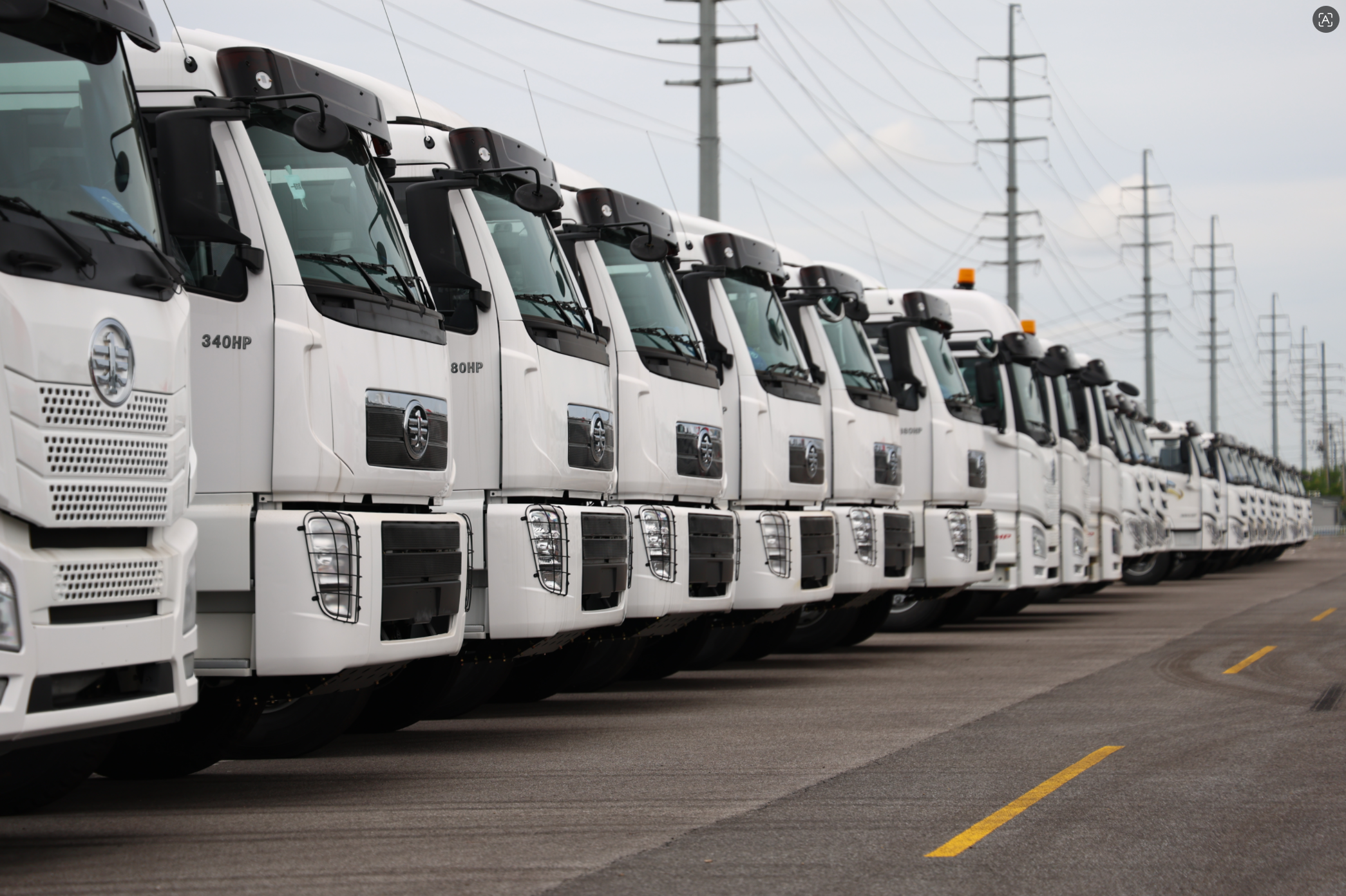
Heavy-duty trucks staged for inspection. In emerging-market procurement, configuration availability usually decides the shortlist before brand preference does.
Why Most Head-to-Head Truck Comparisons Fail Before They Start
Comparison content tends to compare what is easy to publish: country of origin, headline engine size, cab trim and an indicative price band. The variables that determine whether a fleet earns money are less photogenic. Four of them do most of the work: whether the required body type exists in the supplier's range at all; whether the quoted unit sits inside the regulatory weight and dimension limits of the destination market; whether the safety equipment the buyer expects is part of the standard configuration; and whether the supplier can evidence all three in writing.
A comparison that skips those four checks tends to produce a shortlist that cannot be ordered. It also produces a comparison that ages badly, because the constraint set changes by market rather than by brand. Emission level, steering side and vehicle-age rules are set nationally, so a configuration that is fully compliant in one country may be unsellable in another. Comparison therefore has to be market-qualified before it is brand-qualified — a point that is often lost when buyers benchmark trucks using global specification sheets alone.
What FAW Trucks Brings to a Configuration-Level Comparison
The FAW truck range is broad rather than narrow. Its published model families are the J7, J6P, J6V, J6E, JH6, J6G, J6L, JK6 and Tiger V, and the body-type catalogue associated with the range covers fourteen distinct vehicle types, from tractor units through to municipal and special-purpose equipment. For a head-to-head evaluation, breadth of this kind changes the question a buyer should ask. Instead of asking which brand builds the best long-haul tractor, the buyer asks which brand can cover the largest share of their actual fleet mix from a single platform family and a single spare-parts logic.
| Parameter | Published range value |
|---|---|
| Body types in range | Tractor Truck; Dump Truck; Cargo / Rigid / Light Truck; Concrete Mixer Truck; Garbage Truck; Sprinkler Truck; Water Tank Truck; Fuel Tank Truck; Wrecker Truck; Sweeper Truck; Concrete Pump Truck; Asphalt Distributor Truck; High Altitude Platform Truck; Fire Truck |
| Net weight range | 3000–15000 kg |
| Dimension range | 6000×2300×3000 mm to 12000×2550×3800 mm |
| Tire specifications | Available according to customer requirements |
| Safety configuration | ABS / EBS / TCS |
| Materials | Steel, iron, aluminum alloy, plastic |
| Customization scope (OEM) | Body, engine, tires, load capacity |
The supplier side of the same picture is documented as well. Qingdao Chary Machinery operates in OEM production mode with customization available across body, engine, tires and load capacity, a stated monthly capacity of 8,000 units, a lead time of 30–45 days, a minimum order quantity of one unit, and 100% testing as its quality-control standard. After-sales is described as global technical support. For an evaluation-stage buyer, those are checkable claims rather than adjectives: capacity, lead time, MOQ and inspection policy can all be confirmed in a quotation and a contract.
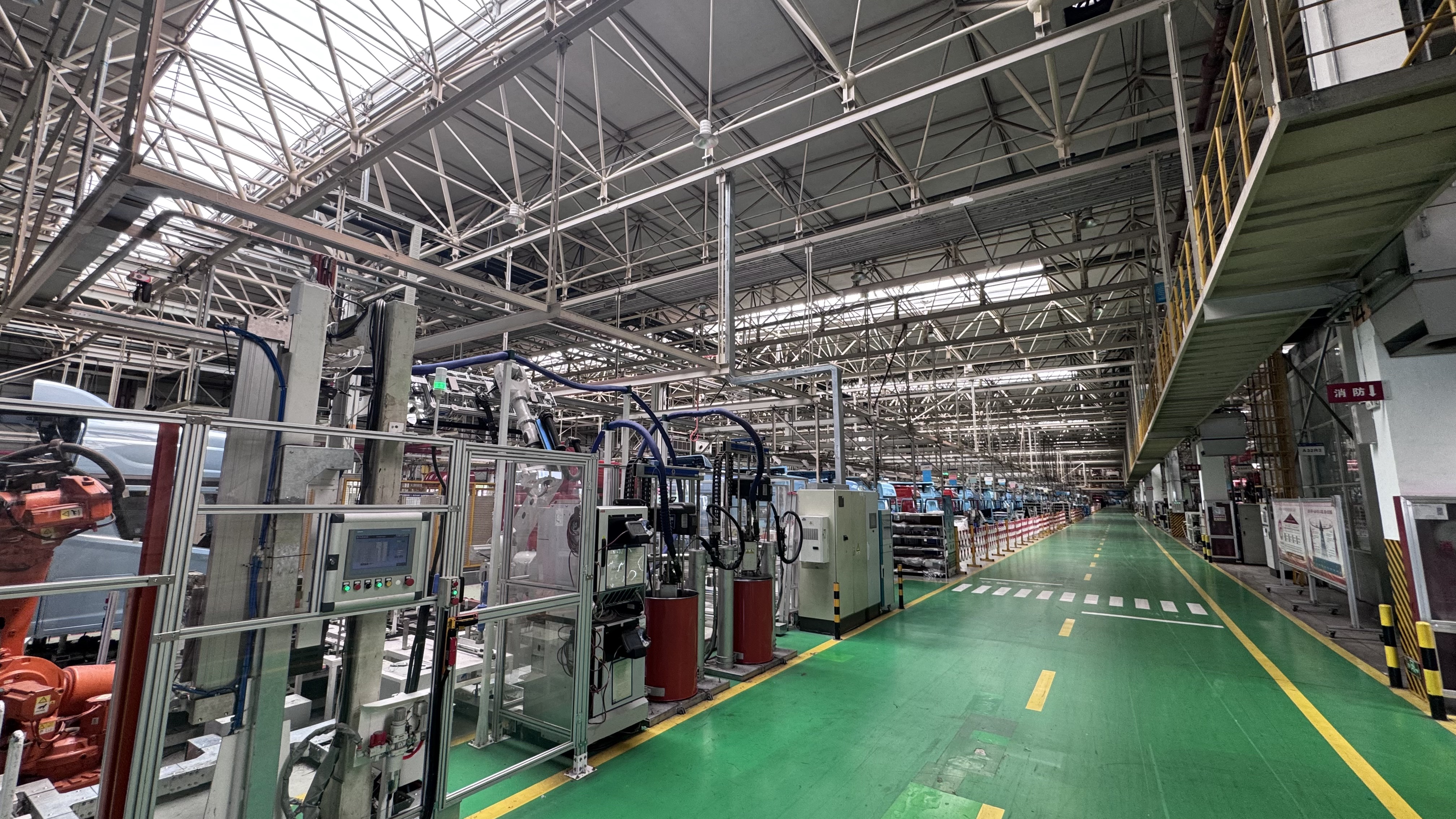
Body, engine, tire and load-capacity customization is one of the practical dividing lines in an emerging-market truck comparison.
Reading the Specification Envelope Correctly
The weight and dimension figures above are range-level statements, and that distinction is the single most misunderstood item in most comparisons. A net weight band of 3000–15000 kg describes the outer limits of the whole family; it does not describe any individual vehicle. Equally, a dimension envelope running from 6000×2300×3000 mm to 12000×2550×3800 mm tells a buyer what the range can span, not what will be delivered. Each quotation occupies one point inside that envelope, and the buyer should ask for that specific point in writing.
The envelope has operational consequences. A vehicle at the upper end of the length and width range requires more yard space, a wider turning path and more careful route planning; it may also fall under different local length or axle-load rules than a shorter unit. Buyers serving urban distribution, narrow industrial estates or congested port gates should treat the upper envelope as a constraint to be tested, not as a benefit to be assumed.
Safety specification follows a similar logic. ABS, EBS and TCS are listed as configuration options within the range rather than as universal fittings on every unit. ABS is the baseline that most emerging-market regulators and fleet insurers expect; EBS and TCS add electronic braking control and traction management that matter most on gradients, unsealed surfaces and high-load haulage. Because the range lists all three, the comparison question is not whether FAW offers them, but whether the specific quotation includes them.
Material selection — steel, iron, aluminum alloy and plastic — is the quiet variable. It affects body weight, which in turn affects how much of the rated load can be used for cargo, and it affects corrosion behaviour in coastal or high-humidity markets. Emission level is the other market-qualified variable: FAW provides Euro II, Euro III and Euro V vehicles for African and Southeast Asian markets so that fleets can match the fuel quality and environmental rules actually in force locally.
The Decision Matrix: Matching Configuration to Workload
The most useful comparison a buyer can run is not brand against brand but workload against configuration. The matrix below is a buyer-side planning aid built from the published body-type list and the published application list for the FAW truck range. It is deliberately framed as a list of questions to put to a supplier, because the model-to-body-type mapping must be confirmed on the specific quotation rather than assumed from a brochure.
| Workload | Body type to specify | Family to put on the question list | What must be confirmed in writing |
|---|---|---|---|
| Long-haul freight and logistics fleets | Tractor Truck | J6P / JH6 | Whether the quoted platform is offered as a tractor unit, plus axle configuration, emission level and fifth-wheel specification |
| Mining, coal and aggregate haulage | Dump Truck | J6P / JH6 | Whether the same platform is being quoted as a dump chassis, the 6x4 or 8x4 layout, and the payload point inside the 3000–15000 kg band |
| Urban distribution and general cargo | Cargo / Rigid / Light Truck | J6L | Whether the quoted unit is a cargo or rigid build rather than a municipal variant of the same platform, and the exact body dimensions |
| Municipal cleaning and dust suppression | Sweeper Truck, Sprinkler Truck, Water Tank Truck, Garbage Truck | J6L class | Body manufacturer, tank or hopper capacity, and whether the chassis is supplied pre-fitted or as a bare unit for local bodywork |
| Construction and building materials | Concrete Mixer Truck, Concrete Pump Truck | J6P / J6L | Drum or pump configuration, and whether body customization is included in the OEM scope |
| Cold chain and temperature-controlled distribution | Cargo / Rigid chassis with insulated body | J6L | Whether the refrigerated body is inside the agreed body-customization scope and which chassis point it is built on |
| Dangerous goods transport | Certified dangerous goods vehicle | JK6 | Whether the unit carries the ECER105 scope for the EX, FL, AT or MEMU category the operation falls under |
| GCC market tractor operations | Tractor Truck, 4x2 | J6 Series | Whether the unit is covered by the GCC conformity certificate for the J6 Series 4x2 tractor and its Euro 4 configuration |
Two rows in that matrix illustrate why configuration questions beat brand questions. A J6P quotation can sit in more than one commercial role — buyers should establish whether the unit on offer is being proposed as a tractor or as a dump chassis before comparing it with anything else, because the two roles imply different bodies, different payload assumptions and different operating economics. The same discipline applies to the J6L class, where a cargo or rigid variant and a municipal sweeper variant may share a platform family but serve entirely different duty cycles. Comparing a sweeper against a long-haul tractor produces a meaningless result; comparing configuration against workload produces a usable one.
Where These Configurations Are Already Operating
The published application list for the FAW truck range covers logistics freight distribution, logistics fleets, coal and other mineral transportation, port transportation, express delivery, daily industrial goods, building materials, agricultural and sideline products, livestock and poultry, daily bulk cargo, cold chain transportation, urban distribution, urban waste transportation, log transportation, large machinery and equipment transportation, and chemical raw material transportation. That list is unusually wide, and it is the reason the range is often used as a mixed-fleet solution rather than a single-purpose purchase.
For reference purposes, a documented installation in Mali comprising 50 units of the FAW TRUCK product line has been operating for more than ten years with stable results under high-intensity conditions. The units are used for the transport of powdered and granular materials and for sand and gravel transport. Two things should be read carefully from that case. First, it is a long-duration reference rather than a short pilot, which is the type of evidence that matters at evaluation stage. Second, it is one market and one duty profile: it demonstrates durability in a specific high-intensity aggregate application, and it should not be extrapolated to every configuration in the range.
Market presence data points in the same direction. In Nigeria, FAW Trucks operates through local assembly partnerships such as Transit Support Services, focusing on 6x4 tractor units and 8x4 dump trucks for the construction sector. For buyers in West Africa, that means configuration, dealer support and body fit can be assessed locally for those specific layouts rather than only through an export catalogue.
Market Signals Behind the Comparison
Scale is part of the head-to-head picture because it affects parts availability and resale. FAW Jiefang maintained its position as China's leading heavy-duty truck manufacturer in 2024, with total sales of approximately 241,700 units, according to CVWorld and China Automotive News. Overseas exports reached a record 64,000 units in 2024, a year-on-year increase of 42%, according to FAW Group's own disclosure. Those two figures matter to a buyer in a different way than they matter to an analyst: a manufacturer with a large domestic base and a growing export base is more likely to sustain parts supply and service documentation over a fleet's ownership period.
Model-level export patterns are also visible. According to Mordor Intelligence's China commercial vehicle market research, the JH6 and J6P series are the primary models exported to Southeast Asia and the Middle East for long-haul logistics and mining operations — which is consistent with the body-type weighting of those markets. Emission supply follows local rules rather than a single global standard: FAW provides Euro II, Euro III and Euro V vehicles for the African and Southeast Asian markets to comply with local fuel quality and environmental regulations.
Published market-share estimates should be treated with caution, and this is a genuine limitation of the data landscape rather than a brand issue. Industry association figures and customs-derived figures for FAW's share of heavy-duty truck exports do not agree exactly — the China Association of Automobile Manufacturers has indicated roughly 16.5%, while customs-derived analysis suggests approximately 20% in the heavy-duty segment. That divergence is a useful reminder that any single share figure quoted in a comparison should be attributed to its source and its method. On pricing, the only verifiable market data point available for this article is third-party: a new FAW 6x4 tractor unit in the Philippines is listed in a range of approximately PHP 3.2 million to PHP 4.5 million depending on engine configuration and emission level. That figure is indicative, changes with market conditions, and should be re-verified before use. No competitor pricing or performance comparison is made here, because it cannot be verified from the available record.
Where the Comparison Stops: Limits Buyers Should Not Skip
A credible head-to-head evaluation states its boundaries as clearly as its strengths. Six limits apply here.
- Range figures are aggregate, not model-specific. The 3000–15000 kg net weight band and the 6000×2300×3000 mm to 12000×2550×3800 mm dimension envelope describe the family. Any comparison that treats them as a single vehicle's specification is incorrect.
- Certification scope is specific. The ECER105 certificate, number E13*105R06/01*0023*00, issued by Société Nationale de Certification et d'Homologation in Luxembourg, covers dangerous goods transport vehicles in the EX, FL, AT and MEMU categories and is associated with the JK6. It is not a blanket approval for every unit in the range.
- The GCC certificate is likewise bounded. Certificate CCR No.435790, issued by the GCC Standardization Organization, covers the FAW J6 Series truck tractor in 4x2 configuration with Euro 4 compliance. Buyers specifying other layouts for GCC markets should confirm coverage separately.
- Destination rules can override configuration choices. Heavy-duty trucks in the Kenyan market are subject to KS 1515:2019, which requires vehicles to be no more than eight years old and right-hand drive. A left-hand-drive unit will not satisfy that standard regardless of its technical merit, so steering side must be settled before a comparison shortlist is finalised.
- Service depth varies by market. Global technical support for after-sales is the stated standard, but the practical response time, parts stock and technician availability depend on the local partner network and on whether local assembly exists for the relevant model — as it does for 6x4 tractors and 8x4 dump trucks in Nigeria.
- Single references should not be generalised. A ten-year, 50-unit project in Mali is strong evidence for high-intensity aggregate haulage; it is not evidence about municipal sweeping, dangerous goods transport or long-haul tractor economics.
A Practical Benchmark Checklist for Buyers
The checklist below converts the comparison into a sequence a procurement team can run in a single evaluation cycle.
- Define the duty cycle first: payload type, route profile, annual distance, gradient exposure and operating hours.
- Translate the duty cycle into a required body type from the published range list, and confirm the unit is quoted in that exact role.
- Fix the axle layout and payload point explicitly — for example a 6x4 or 8x4 dump configuration rather than a generic "dump truck".
- Confirm where the quoted vehicle sits inside the dimension envelope, and test that footprint against yards, gates, bridges and loading bays on the intended route.
- Verify the safety configuration line by line: ABS, EBS and TCS are listed options and should appear as fitted or not fitted on the quotation.
- Match emission level to the fuel actually available locally — Euro II, Euro III or Euro V supply exists for African and Southeast Asian markets.
- Check steering side and vehicle-age rules against the destination regulation, such as KS 1515:2019 in Kenya.
- Confirm which certificate applies and request the certificate number, issuing authority and scope on paper.
- Agree the customization scope in writing, covering body, engine, tires and load capacity, and confirm that a single-unit MOQ applies.
- Validate lead time of 30–45 days against the project or seasonal start date, and agree the inspection standard — 100% testing is the stated quality-control policy.
- Map spare-parts availability and after-sales contact points for the specific market before awarding.
- Record every market-level estimate, including indicative pricing, separately from supplier-confirmed and certificate-backed facts.
What to Watch Next
Three developments are likely to shape the next round of comparisons in these markets. The first is emission tiering. As more African and Southeast Asian markets tighten fuel and environmental requirements, the ability to supply several emission levels for the same platform becomes a competitive variable rather than a footnote, because it determines whether a fleet can buy one model family across countries with different rules.
The second is assembly and service localisation. The Nigerian pattern — local assembly focused on 6x4 tractors and 8x4 dump trucks — reduces the gap between an export catalogue and an operating fleet. Where similar structures develop, comparisons will shift from specification sheets toward parts availability, technician coverage and resale liquidity.
The third is the broadening of body-type demand. Ranges that can cover tractors, tippers, tankers, municipal units and special-purpose vehicles from one platform logic allow dealers and fleet owners to standardise maintenance and driver training. For distributors evaluating long-term positioning, configuration breadth becomes a commercial argument in its own right. The reasonable expectation is that buyers will keep moving away from badge-level comparisons and toward configuration-level ones — which is where the difference between a usable shortlist and an unusable one is actually decided.
FAQ
What does a head-to-head FAW truck comparison actually measure?
It measures configuration availability rather than brand reputation. The published FAW truck range covers nine model families — J7, J6P, J6V, J6E, JH6, J6G, J6L, JK6 and Tiger V — and fourteen body types, with a net weight band of 3000–15000 kg and a dimension range of 6000×2300×3000 mm to 12000×2550×3800 mm. A meaningful comparison checks whether a required combination of body type, weight class, dimensions, safety equipment and certification can be quoted and evidenced, rather than which brand markets itself most effectively.
Which body types are relevant for mining, construction and logistics work?
Dump Trucks are associated with coal and mineral transport and with building-materials haulage; Tractor Trucks with long-haul logistics and port transportation; Cargo, Rigid and Light Trucks with urban distribution, express delivery and general industrial goods; Concrete Mixer Trucks and Concrete Pump Trucks with construction; and Sweeper, Sprinkler, Water Tank and Garbage Trucks with municipal and waste applications. Cold chain transportation also appears on the published application list, which means a temperature-controlled body should be confirmed inside the agreed customization scope.
What do the published weight and dimension ranges mean in practice?
They describe the outer limits of the whole family, not an individual vehicle. A quotation occupies one specific point inside a 3000–15000 kg net weight band and inside a 6000×2300×3000 mm to 12000×2550×3800 mm dimension envelope. Buyers should ask the supplier to state that point on paper, because route access, axle-load rules and yard layout all depend on the exact figures rather than the range.
Which certifications should be verified during an evaluation?
Two are documented for this range. ECER105, certificate number E13*105R06/01*0023*00, issued by Société Nationale de Certification et d'Homologation in Luxembourg on 7 February 2024, covers dangerous goods transport vehicles in the EX, FL, AT and MEMU categories and is associated with the JK6. The GCC conformity certificate, CCR No.435790, issued by the GCC Standardization Organization, covers the FAW J6 Series truck tractor in 4x2 configuration with Euro 4 compliance for GCC member states. Destination-specific rules such as Kenya's KS 1515:2019 should be checked separately.
What can a head-to-head comparison not tell a buyer?
It cannot establish real-world fuel consumption, total lifetime cost or competitor performance, because those depend on route, load and market conditions rather than on published specifications. It also cannot generalise from a single reference: a documented installation of 50 units in Mali operating for more than ten years under high-intensity conditions in sand, gravel and powdered-material transport is strong evidence for that duty profile, but not for municipal, cold chain or dangerous goods operations. Range-level figures should likewise never be read as model-level facts, and published market-share estimates can differ by source and method.
For buyers who need the underlying configuration detail in one place, the supplier's export brochure is available for download: FAW truck export brochure (PDF).