
FI-20 vs FI-05 Ceramic Sanitary Ware: Buyer Comparison Framework
FI-20 vs FI-05 Ceramic Sanitary Ware: Buyer Comparison Framework
FI-20 vs FI-05 Wall-Hung Ceramic Sanitary Ware: A Buyer Comparison Framework
Two ceramic toilets from the same production base can look interchangeable in a catalogue and behave very differently on site. The FI-20 and the FI-05 share a high-temperature fired ceramic body and a washdown flushing mechanism, and both are listed for construction and wholesale channels, yet their documented configurations and overall dimensions place them under different installation conditions. For a buyer at decision stage, that is the purpose of a comparison framework: it separates the attributes that can be traded off from the attributes that must match the specification before price is discussed.
This framework is written for project buyers, specifiers, distributors and private-label brand owners evaluating the two models from Tangshan Houfengyuan Import and Export Co., Ltd. (hfybath.com), a Tangshan-based manufacturer and exporter of ceramic toilets and ceramic wash basins that states 90% of its output is exported to markets including the USA, Canada, the Middle East, Australia, Southeast Asia and Europe. It sets out four decision gates, the compliance documentation worth verifying in writing, and the acceptance criteria that belong in a purchase order.

A ceramic sanitary ware production workshop in Tangshan, the industrial base behind both models.
Gate 0: what the supplied product files actually document
Before any comparison, establish what is on record. The two models are not described in the same terms, and that difference matters more than the similarity in material.
| Documented attribute | FI-05 | FI-20 |
|---|---|---|
| Product class recorded in the file | Wall-hung toilet (wall-hung pan) | Two-piece toilet |
| Overall dimensions | 517 mm (L) × 360 mm (W) × 365 mm (H) | 660 mm (L) × 365 mm (W) × 420 mm (H) |
| Body material | High-temperature fired ceramic | High-temperature fired ceramic |
| Flushing mechanism | Washdown | Washdown |
| Rim design | Rimless (recorded) | Not stated in the supplied file |
| Stated application scope | Wholesale distribution; construction projects | Bathroom sanitation; wholesale distribution; construction and engineering projects |
Table 1: Attributes as documented in the manufacturer's supplied product files. A blank or “not stated” cell means the attribute must be confirmed at model level; it is not evidence that the attribute is absent.
Read the first row before the second. The FI-05 is recorded as a wall-hung toilet and the FI-20 as a two-piece toilet. The FI-05 file also records a rimless design; the FI-20 file records a washdown flushing system and a high-temperature fired ceramic body but does not record a rim design. Those gaps are items to confirm on the model drawing and the model-level datasheet before the specification is fixed.
The dimensional gap is equally practical. The FI-05 records 517 mm in length, 360 mm in width and 365 mm in height; the FI-20 records 660 mm in length, 365 mm in width and 420 mm in height. A 143 mm difference in length changes the clearance in front of the pan, the position of sanitary accessories and, in a small bathroom, whether the door swing conflicts with the fixture. Buyers who compare by photograph rather than by drawing usually discover this after the submittal — which is why the envelope belongs at gate one, not in the final negotiation.
Gate 1: configuration and installed envelope
A wall-hung pan is only as good as the wall it attaches to. The FI-05's documented wall-hung configuration means the concealed carrier or frame, the structural fixing, the finished floor level and the service access point must all be coordinated before ceramic is ordered. In a new-build hotel or apartment project that coordination sits with the structural and MEP packages; in a refurbishment it may not be feasible without opening the wall. The benefit is floor area and cleaning access beneath the bowl; the cost is front-loaded coordination.
The FI-20 requires a different check. Its file records a two-piece configuration and a 660 mm length, so the installation method, the rough-in distance and the supply connection have to come from the model drawing rather than from the family name. Where a specification calls for wall-hung installation throughout — a common requirement in hotel guest bathrooms, serviced apartments and accessible units — the FI-05 is the model documented in that configuration, and substituting a longer two-piece model changes the wet-wall design, not just the fixture schedule.
There is a second envelope question that export buyers often leave too late: carton dimensions and container loading. Ceramic is heavy and fragile, and a model that packs less efficiently changes freight cost per unit even when the unit price is identical. Ask for the packed dimensions and the loading plan with the quotation, not after the order is confirmed.
Gate 2: bathroom sanitation scenarios in hotels and apartments
Hotel and apartment projects evaluate a toilet on three things the datasheet rarely quantifies: how quickly housekeeping can clean it, how consistently it performs across hundreds of identical rooms, and how easily it can be repaired when a component fails.
On cleaning, the FI-05 is documented as rimless. Whether that geometry shortens the housekeeping routine depends on the bowl profile and the cleaning method actually used on site, so the appropriate test is a physical sample handled by the operator's own team, not a claim read from a datasheet. Because the FI-20 file does not record a rim design, a buyer specifying it for cleaning-intensive environments should request the bowl geometry explicitly rather than assume it matches the wall-hung model.
On consistency, the relevant evidence is process control rather than a single sample. The manufacturer states batch inspection of raw materials, tunnel kilns with uniform cross-section temperature control and adjustable firing curves to prevent cracking and glaze defects, and 100% water testing on every piece — flushing, leakage and surface defects — before packaging. For a project fitting 200 identical bathrooms, those controls matter more than any single unit's appearance, because the failure that hurts is the tenth delivery, not the first.
On repairability, the manufacturer states that the toilets use standard universal flush components — fill valves, flappers and seals — rather than proprietary parts. For a property manager maintaining a building over a decade, that changes spare-parts inventory and downtime after a failure. It is a stated product characteristic and should be confirmed at sample stage.
Apartment decoration programmes add one more variable: repeatability across phases. A 300-unit development delivered in three phases needs glaze and colour consistency between orders. The manufacturer states standardised glaze formulas, digitally controlled firing curves and retained samples from every order for colour matching on reorders. Buyers should ask for the retained-sample procedure in writing, because the same model code does not automatically guarantee the same appearance across a year-long programme.
Gate 3: construction and engineering project use
Engineering projects judge a fixture by its documentation trail. The sequence that works is: quantity take-off by block and floor, a written packaging specification, an inspection window before shipment, phased delivery that matches the installation programme, and a warranty and defects process that survives handover.
The manufacturer states reinforced five-layer export cartons with foam corner protection that are drop-tested, and container loading with photo documentation before sealing. Those details address the most common site complaint on ceramic — transit damage discovered at the plot instead of at the port. The practical control for a project buyer is to make the carton specification and the loading photographs part of the acceptance record rather than a verbal assurance.
Timing needs the same treatment. The manufacturer states a standard lead time of 35 to 45 days with production progress updates. On a live programme that figure must be read against the sample approval date, the inspection date and the sailing schedule; buyers who place the order before the sample is signed off compress the only window in which a glaze or dimensional problem can still be corrected at the factory.
Warranty follows the same logic. The manufacturer states a three-year warranty with factory-direct claim handling. Whether that is sufficient depends on the project's defects liability period and the operator's maintenance regime, and the claim route — who inspects, who decides, who ships the replacement — should be written into the order rather than inferred at handover.
Gate 4: wholesale distribution suitability
A distributor evaluates the same two models differently. Stock turns, carton durability, reorder consistency and after-sales friction matter more than the installation detail that dominates a project file.
Both models can be carried, but they serve different order books. A distributor supplying renovation contractors sees more demand for the wall-hung configuration where the wall is being rebuilt, and more demand for a two-piece model where it is not. Carrying both and labelling them clearly by configuration on the price list prevents the substitution error that generates returns and erodes margin.
The commercial signals the manufacturer publishes are relevant here: 90% of output exported, with stated markets including the USA, Canada, the Middle East, Australia, Southeast Asia and Europe. A distributor should read that as coverage of the documentation regimes its customers will ask about — cUPC for North America, WaterMark for Australia, CE for Europe, KS for Korea — and verify model-level coverage rather than the company-level claim.
The manufacturer also states OEM/ODM customisation and private-label support from a factory-direct position. For a distributor building an own-brand range, the question to settle early is which elements are customisable — carton printing, badge, glaze colour, packaging configuration — and which are fixed by the model and its certification. A customisation that moves a model outside its certified configuration is not a commercial choice; it is a compliance problem.
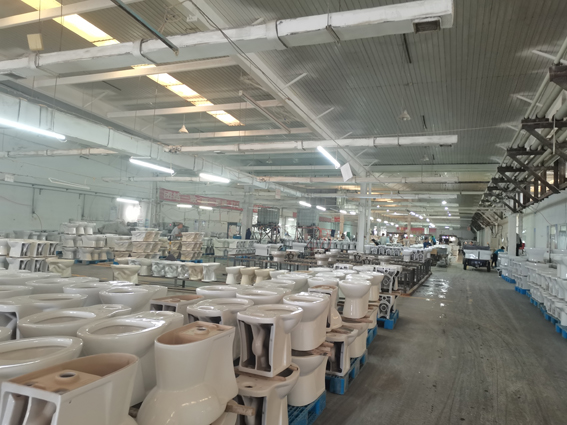
Finished-product inspection: the manufacturer states 100% water testing for flushing, leakage and surface defects before packaging.
Compliance documentation to verify before the order
Certification is the gate most often checked last and most expensive to correct. The company's published profile states compliance with cUPC for North America, CE for Europe, WaterMark for Oceania, KS for South Korea and ISO 9001 for its quality system. Those are scheme-level statements: they indicate which documents to request, not which models are covered.
Three checks convert the statement into evidence:
- Certificate scope. The certificate schedule must list the model being ordered, not only the manufacturer or an adjacent product family. Request the schedule page that names the model.
- Registry status. For US and Canada listings, the manufacturer states that certificates can be checked by searching File No. 6559, 6560 and 6561 on the IAPMO R&T online directory at pld.iapmo.org, which shows validity and covered models. For Australia, confirm the WaterMark certificate number, issuing body and expiry directly with the certifier.
- Dates against the shipment date. A certificate that expires before the container lands is a customs problem, not a paperwork problem.
Customs classification is a separate document worth aligning. Ceramic sanitary fixtures of porcelain or china fall under HS heading 69.10 and subheading 6910.10 in the World Customs Organization's HS Nomenclature 2022, and the same subheading appears in the UN trade classification. The commercial invoice, packing list and certificate of origin should use a consistent code; a mismatch between the certificate and the customs entry is a routine cause of clearance delay.
Purchasing terms and acceptance criteria to fix in writing
A comparison framework only produces value if it ends in a written order. The following items should appear in the purchase order or its technical annex for either model.
- Model and configuration confirmation. Model code, wall-hung or two-piece, rim design, flushing mechanism, and the drawing revision both parties are working to.
- Dimensional tolerance and drawing. Overall dimensions plus permitted tolerance, referenced to a marked-up drawing. Record the FI-05 figure of 517 × 360 × 365 mm and the FI-20 figure of 660 × 365 × 420 mm, and require written confirmation against that drawing.
- Flush performance evidence. A model-level test report for flushing and water consumption against the standard the destination market applies. Where a project adopts the CIC Green Product Certificate assessment standard (Version 2.0, Hong Kong), the reference limits for double-flush toilets are a maximum full flush of 5.0 L and an average consumption of 4.0 L. That is a project benchmark, not a universal requirement.
- Water-testing record. The manufacturer states 100% water testing before packaging; specify the record format and whether it is supplied per batch or per container.
- Surface and glaze acceptance. Defect definitions and the inspection method, agreed before production rather than at the port.
- Packaging specification. Carton grade, foam protection, drop-test reference, palletisation, shipping marks and the loading-photograph requirement.
- Sampling and retained samples. A signed golden sample, retained samples for reorder colour matching, and the retention period.
- Certification documents. Certificate schedule pages naming the model, current at the date of shipment, with registry references attached.
- Delivery and payment. The stated 35–45 day lead time measured from the agreed start date, phased delivery if the programme requires it, and the payment structure. The manufacturer states flexible terms such as T/T with balance against a copy of the bill of lading; the specific structure belongs in the contract.
- Warranty and spare parts. The stated three-year warranty, the claim route, the response time, and a recommended spare-parts list including the universal fill valve, flapper and seal specification.
Two of these deserve emphasis. The drawing revision controls everything downstream, and the certificate schedule is the document a customs officer or a project consultant will ask for first. Neither can be replaced by a catalogue page.
Where the framework stops: verified limits
An honest comparison includes what cannot be verified. The available public record does not contain independent test data on glaze cleanability, anti-clog behaviour, impact resistance, production dimensional tolerance or firing temperature for either model. The manufacturer describes a high-temperature fired ceramic body and a washdown mechanism; it does not publish a comparative performance study of the FI-20 against the FI-05, and none should be inferred from the shared material description.
Equally, a company-level certification statement is not a model-level guarantee, and a wall-hung classification on one model says nothing about whether the other can be installed the same way. Buyers who need certainty should request model-level reports and, where the project justifies the cost, a factory audit or a pre-shipment inspection. Those steps complement the comparison; they do not replace it.
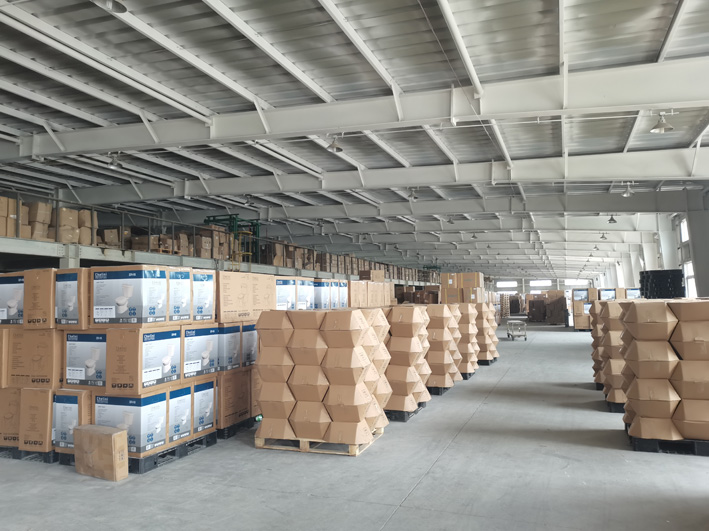
Warehouse stock: carton durability and reorder consistency drive distributor economics as much as unit price.
Market context for a 2026 procurement decision
The category is large and the toilet segment dominates it. Grand View Research estimated the global ceramic sanitary ware market at USD 44.3 billion in 2023, with the toilet and water-closet segment accounting for 43.0% of revenue. Published estimates vary with category definition — some include bathroom accessories and produce materially different totals — so the figure is best read as directional context rather than as a planning input.
What changes for a buyer is not the size of the market but the direction of specification pressure. Standards such as the CIC Green Product Certificate assessment for ceramic sanitary ware set explicit water-consumption limits for double-flush toilets, and project specifications increasingly reference such benchmarks by name. When they do, the flush test report moves from optional to submittal item, and a supplier's ability to produce model-level documentation becomes a shortlisting criterion alongside price and lead time.
That is the practical argument for comparing the FI-20 and the FI-05 on a framework rather than a price list. The two models sit close together in material and flushing logic; they diverge in configuration, installed envelope and the documentation a buyer must assemble. Settling those three first usually shortens everything that follows.
Frequently asked questions
What is the documented difference between the FI-20 and the FI-05?
The FI-05 is recorded as a wall-hung toilet with a rimless design, a washdown flushing mechanism, a high-temperature fired ceramic body and overall dimensions of 517 × 360 × 365 mm, for wholesale distribution and construction projects. The FI-20 is recorded as a two-piece toilet with a high-temperature fired ceramic body, a washdown flushing system and overall dimensions of 660 × 365 × 420 mm, for bathroom sanitation, wholesale distribution and construction and engineering projects. The supplied files do not state a rim design for the FI-20.
Can the FI-05 and the FI-20 be used in the same building?
Only where the specification permits both configurations. The FI-05 is wall-hung, so it depends on a concealed carrier or frame, coordinated structural fixing and a service access point within the wall. The FI-20 has a longer installed envelope at 660 × 365 × 420 mm and a two-piece configuration whose rough-in and supply connection must come from the model drawing. Using both in one building is workable when each bathroom type is engineered for its own fixture; mixing them within one bathroom type creates two installation details for the same room.
Which certification should be checked before ordering either model?
Match the scheme to the destination market: WaterMark for Australia, cUPC for the United States and Canada, CE for the European Union and KS for South Korea. The company's published profile lists cUPC, CE, WaterMark, KS and ISO 9001 at company level, which is not the same as model coverage. The buyer should obtain the certificate schedule page naming the ordered model, confirm the certificate number, issuing body, issue date and expiry, and check the registry where one exists. For US and Canada listings, the manufacturer states that File No. 6559, 6560 and 6561 can be searched on the IAPMO R&T directory at pld.iapmo.org to confirm validity and covered models.
What acceptance criteria belong in a ceramic sanitary ware purchase order?
At minimum: model code and configuration with the drawing revision; dimensional tolerance referenced to that drawing; a model-level flush and water-consumption test report against the destination-market standard; the water-testing record, which the manufacturer states is 100% per piece before packaging; agreed surface and glaze defect definitions with an inspection method; packaging specification including carton grade, foam protection, drop-test reference and shipping marks; a signed golden sample and retained samples for reorder colour matching; current certificate schedule pages naming the model; the stated 35–45 day lead time measured from an agreed start date plus the payment structure; and the stated three-year warranty with a written claim route and a recommended spare-parts list.
Next step for a shortlisting committee
The next step is documentary rather than commercial. Request the model drawings for the FI-20 and the FI-05, the certificate schedule pages for the destination market, and the flush test report for the ordered configuration, then score both models against the same four gates — configuration, sanitation fit, project execution and distribution suitability. The manufacturer's product brochure is available for download at this link, and additional company information is published at www.hfybath.com.
Есть вопросы или нужны дополнительные детали?
Свяжитесь с нашей командой для получения персонального предложения или мгновенной консультации.
Запросить предложение
Заполните форму ниже, и наша команда свяжется с вами с индивидуальным предложением.
Прямой чат WhatsApp
Предпочитаете общаться в реальном времени? Напишите нам в WhatsApp для мгновенной помощи и быстрых ответов.
- Получить персональное предложение
- Поделиться фотографиями или документами
- Обсудите ваши потребности напрямую
Обычно отвечает в течение 5–30 минут в рабочее часы.