
FI-20 vs FI-05 Wall-Hung Ceramic Sanitary Ware: Buyer's Comparison
Wall-hung ceramic sanitary ware is chosen twice in a project: once as a design decision about floor clearance and cleaning, and once as a compliance decision about documentation. In Australia and New Zealand, WaterMark certification is the primary requirement for plumbing and drainage products, which means a wall-hung pan that cannot be traced to a certificate number is not a project candidate, however good it looks in a showroom.

Tangshan Houfengyuan Import and Export Co., Ltd is a Tangshan, Hebei-based manufacturer and exporter of ceramic sanitary ware, primarily ceramic toilets and ceramic wash basins, supplying the USA, Canada, Australia, the Middle East, Southeast Asia and Europe. Two of its wall-hung models, the FI-20 wall hang pan and the FI-05 wall hang pan, sit in the same product family, share the same flushing concept, and are named on the same Australian certificate of conformity.
The framework below compares them in a fixed order: certification scope first, then documented dimensions, then layout impact, then purchase terms and acceptance criteria. Applied in that order, the FI-20 / FI-05 decision usually resolves before unit price is even discussed.
Why the Comparison Starts With Certificate Scope, Not Geometry
Compliance gates are not symmetrical across markets, and they decide which model can be sold where. WaterMark certification is the primary requirement for plumbing and drainage products in the Australian and New Zealand markets, and cUPC is a mandatory compliance requirement for many commercial and government plumbing projects in North America. A buyer weighing two visually similar wall-hung pans is therefore weighing two documentation sets as much as two ceramic bodies.
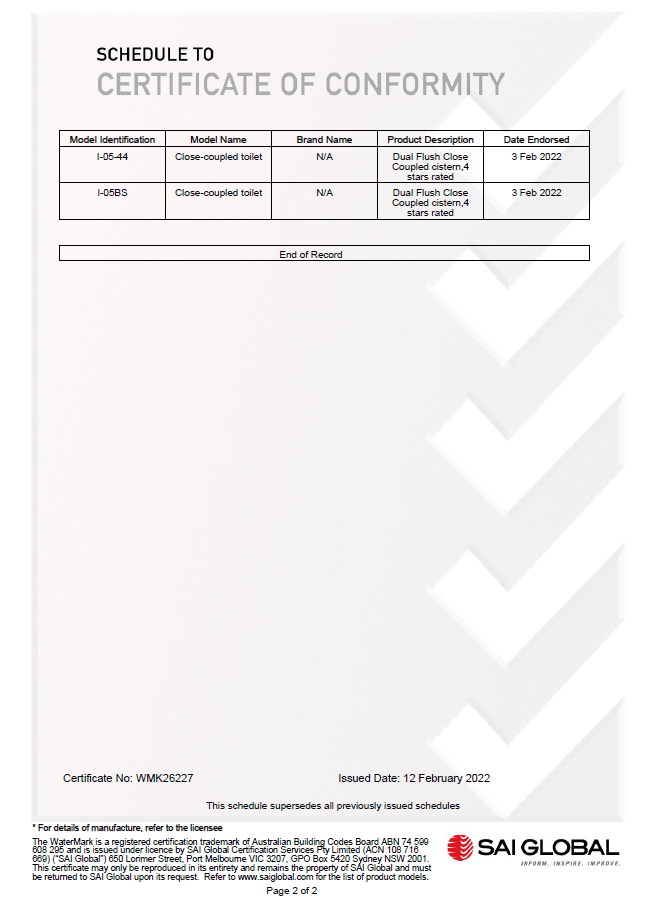
Both the FI-20 wall hang pan and the FI-05 wall hang pan are covered by WaterMark Certificate of Conformity WMK26227, issued by SAI Global for the Australian market. The certificate scope covers water closet pans, flushing devices and cistern inlet and outlet valves, and the referenced standards are AS 1172.1-2014 (Amdt 1 2018) and AS 1172.2-2014 (Amdt 1 2018). The certificate was issued on 12 February 2022 and expires on 10 July 2027. The same certificate also lists the FI-20 back to wall pan, the FI-05 back to wall pan, and the FI-20 and FI-05 two-piece toilets.
That structure has a practical consequence. A buyer can standardize on a single WaterMark certificate across a mixed installation — wall-hung pans in upper-floor guest bathrooms, back-to-wall pans in accessible bathrooms, two-piece toilets in staff areas — without opening a second compliance file. In wholesale distribution, the same structure reduces the number of certificates a reseller has to explain to installers and building inspectors.
FI-20 and FI-05 Wall-Hung Pans: Documented Specifications
The two wall-hung pans differ mainly in plan dimensions. Both are wall-hung washdown toilets with a rimless design and a high-temperature fired ceramic body, and both are stated for construction & engineering projects and wholesale distribution.
| Attribute | FI-20 wall hang pan | FI-05 wall hang pan |
|---|---|---|
| Model designation | FI-20 | FI-05 |
| Product type | Wall hung toilet | Wall hung toilet |
| Installation | Wall hung | Wall hung |
| Flushing system | Washdown | Washdown |
| Rim design | Rimless | Rimless |
| Material | High-temperature fired ceramic | High-temperature fired ceramic |
| Overall dimensions (L x W x H) | 495 x 365 x 365 mm | 517 x 360 x 365 mm |
| Stated application | Construction & engineering projects; wholesale distribution | Construction & engineering projects; wholesale distribution |
The FI-05 pan is 22 mm longer and 5 mm narrower than the FI-20 pan, and the two share the same 365 mm height. Those are the only differences the published specification records: both are rimless, both are washdown, and both are made from high-temperature fired ceramic.
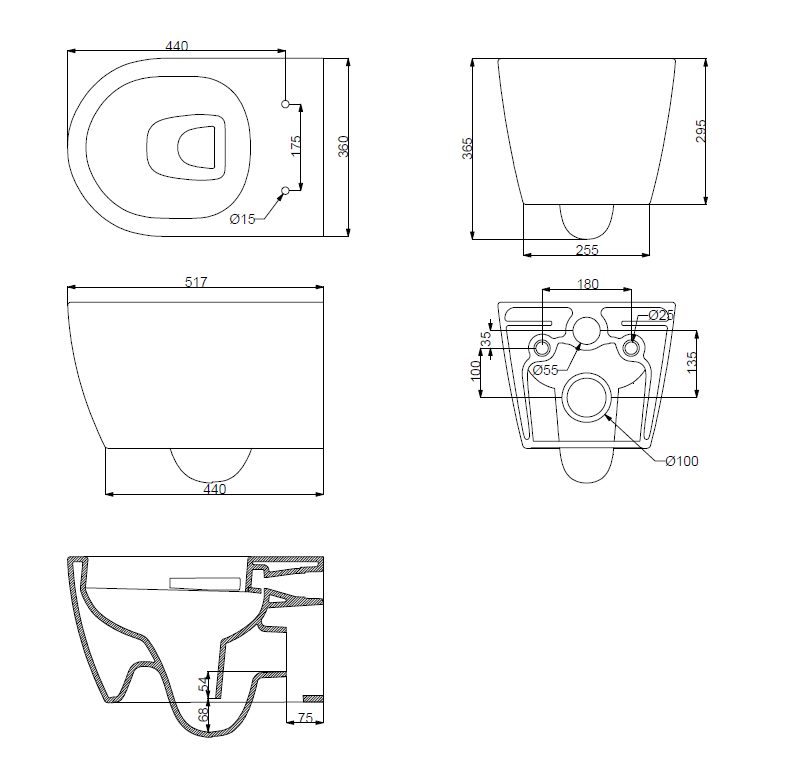
Project buyers rarely specify a single SKU; they specify a model family. Each family also includes a back-to-wall pan and a two-piece toilet alongside the wall-hung version.
| Configuration | FI-20 family | FI-05 family |
|---|---|---|
| Wall-hung pan | 495 x 365 x 365 mm, rimless, washdown | 517 x 360 x 365 mm, rimless, washdown |
| Back-to-wall pan | 520 x 365 x 420 mm, rimless, washdown | 520 x 360 x 420 mm, rimless, washdown |
| Two-piece toilet | 660 x 365 x 420 mm, washdown | 660 x 360 x 420 mm, washdown |
Note the rim detail: rimless geometry is specified on the wall-hung and back-to-wall pans in both families, while the two-piece models are documented as washdown toilets with high-temperature fired ceramic construction. Any buyer standardizing on rimless across a whole building should confirm the configuration of each line item rather than assume it carries across the family.
What 22 mm of Extra Pan Length Changes in Layout
On a drawing, 22 mm is negligible. In a bathroom, it is often the difference between a door swing that clears the pan and one that does not.
- Tight footprints. The FI-20 pan, at 495 mm, projects less into the room. Where the pan faces a door, a shower screen or a vanity run, the shorter projection is easier to accommodate without redesigning the layout.
- Longer stance. The FI-05 pan, at 517 mm, offers a longer footprint. Where the room has depth to spare, the additional length gives more room for the seating area.
- Width. FI-20 measures 365 mm wide against 360 mm for FI-05. Five millimetres rarely decides a layout, but it matters in tiled niches, precast pods and tight modular bathroom units where tolerances are already small.
Boundary condition. The published data covers the ceramic pan only. Trapway configuration, rough-in, seat compatibility and in-wall carrier requirements are not part of it. A wall-hung pan is installed as an assembly with the carrier frame, so the model should be confirmed against that frame and against local plumbing requirements before it is fixed in a specification. The pan cannot be validated in isolation.
Rimless Washdown: The Technical Baseline Both Models Share
Because the geometry is nearly identical, the technical comparison between FI-20 and FI-05 collapses into what the two have in common: washdown flushing, a rimless bowl, and a high-temperature fired ceramic body finished with a glossy, easy-to-clean glaze.
Washdown flushing relies on the velocity of water as it moves across the bowl to carry waste into the trapway, rather than on a siphon effect built up inside a large trap. Rimless design removes the concealed rim channel, the inward-facing ledge where residue and limescale tend to collect, so the surface that is visible is also the surface that gets rinsed. Combined, those two choices simplify daily cleaning in high-turnover settings such as hotel guest bathrooms, serviced apartments and apartment decoration projects.
High-temperature firing produces a dense ceramic body with a glaze that resists staining and wipes down easily. For a buyer, the operational value is consistency: when a specification states dimensions to the millimetre, the body has to hold its shape batch after batch, and a dense, uniformly fired body is what allows claims such as 495 x 365 x 365 mm or 517 x 360 x 365 mm to remain stable across production runs.
Boundary condition. Rimless washdown geometry is sensitive to installation and to supply conditions, and end-user expectations differ by market. Where siphonic pans are the norm, a washdown pan should be selected deliberately rather than by default. The same supplier's range includes siphonic one-piece and two-piece models for specifications that call for that flushing principle.
The Documentation Pack a Buyer Should Request
At evaluation stage, the fastest way to separate a project-ready offer from a catalogue offer is to request a fixed document set and check that every item names the model being supplied.
| Document | What it establishes | What the buyer should verify |
|---|---|---|
| WaterMark Certificate of Conformity | Compliance for the Australian market under AS 1172.1-2014 (Amdt 1 2018) and AS 1172.2-2014 (Amdt 1 2018) | Certificate number WMK26227, issuing body (SAI Global), scope, issue and expiry dates, and that the exact model appears on the certificate |
| Water testing records | That flush behaviour has been checked on the pieces being supplied | That records correspond to the production batch and the ordered model |
| ISO 9001:2015 certificate | Quality management system covering the production of sanitary wares | Current validity window and that the scope covers sanitary ware production |
| cUPC listing (North America) | Listing of specific models to the applicable North American plumbing standard | That the listing names the exact model, not only the range or the brand |
| Commercial documents | Order terms: quantity, lead time, packaging, warranty | That model designations on the purchase order match the certificate entries |
One detail is worth flagging for North American buyers. cUPC listings held for this range cover specific models, including particular one-piece and two-piece designs, rather than every ceramic item the supplier sells. Because cUPC is a mandatory compliance requirement for many commercial and government plumbing projects in North America, a buyer should request the listing that names the exact model and confirm its current status before the order is placed.
Factory-level quality management is documented separately by an ISO 9001:2015 certificate, number 00123Q35932R4M/1303, issued by China Quality Certification Centre (CQC), with a scope covering the production of sanitary wares. Certificate validity windows should always be confirmed at the time of order, because project submittals require certificates that are current on the date of supply, not on the date the specification was written.
Purchase Terms That Shape the FI-20 / FI-05 Choice
Once compliance and dimensions are settled, commercial terms become the second filter. The relevant figures for this range are straightforward:
- Minimum order quantity: 50 units.
- Standard lead time: 35 to 45 days.
- Monthly production capacity: 290,000 units.
- Quality control: 100% inspection, with water testing performed on every piece.
- Warranty: 3 years.
- Export markets served: USA, Canada, Australia, Middle East, Southeast Asia and Europe.
A minimum order quantity of 50 units against a monthly capacity of 290,000 units matters for two buyer types. A distributor can validate demand for one of the two footprints without committing to a container-scale order, and a project buyer can place a variation or replacement order later without reopening the whole supply agreement.
OEM/ODM options in this programme include logo, colour, flush volume (1.28/1.6 gpf or 3/6 L), bowl shape (round or elongated), tank design, seat height (standard or ADA comfort height), packaging and private labeling. Not every option applies to a wall-hung pan — tank design, for example, relates to tank-type models — so buyers should confirm which fields apply to the specific pan before quoting a customization into a project specification.
Acceptance Criteria for a Wall-Hung Pan Order
Inspection at 100% with water testing on every piece sets the baseline. The buyer-side checklist that sits on top of it is usually the following:
- Model marking on the pan and carton matches the purchase order line — FI-20 wall hang pan versus FI-05 wall hang pan.
- Dimensions match the specified footprint: 495 x 365 x 365 mm for FI-20, 517 x 360 x 365 mm for FI-05.
- The rimless rim surface is continuous and free of visible glaze defects, and the glaze is uniform and glossy.
- Flush behaviour has been checked at the factory, supported by water testing on every piece.
- Packaging matches the agreed configuration, including private label artwork where applicable.
- The documentation pack reconciles with the model list; because the WaterMark certificate covers both models, the submittal should cite the exact line item being supplied.
- Warranty terms are confirmed in writing: 3 years.
The last two points are the ones most often missed. A certificate that covers a model family is not the same as a certificate that covers the model delivered on a specific order, and the two only reconcile when the purchase order and the certificate use the same model designation.
Application Fit: Construction & Engineering Projects vs Wholesale Distribution
Both wall-hung pans are stated for construction & engineering projects and for wholesale distribution, so the selection logic comes from the buyer's channel rather than from the product listing.
Construction & engineering projects
In apartments and hotel guest bathrooms, the constraint is usually plan area combined with repetition: the same pan is installed many times, and every millimetre of projection repeats with it. The shorter FI-20 pan is the natural default where bathrooms are compact, while FI-05 can be specified where the extra length suits the room or the client's preference. Whichever model is chosen, the decision should be made once per building so that replacement stock and maintenance units stay consistent over the life of the asset.
Wholesale distribution
For distributors, the two models function as a two-SKU footprint range: a shorter pan and a longer pan, both covered by the same WaterMark certificate and both available under the same OEM/ODM and packaging arrangements. That lets a reseller serve projects with different layout constraints without maintaining a second compliance file or a second set of installer instructions.
Hotel and apartment projects
Commercial applications, including hotel projects, are expected to show the highest growth rate as tourism sectors recover and specifications increasingly adopt antimicrobial-glazed ceramics (Mordor Intelligence). Rimless washdown pans align with that direction because there is no concealed rim for residue to collect on, and the glossy easy-clean glaze supports day-to-day housekeeping routines in high-occupancy rooms.
Market Context Behind the Buying Framework
The global ceramic sanitary ware market was estimated at USD 44.3 billion in 2023 and is projected to reach USD 80.99 billion by 2030, a CAGR of 9.4% (Grand View Research). Market sizing varies considerably with the product scope a research house applies, so these numbers are best read as direction rather than as a budget input.
Asia Pacific held a 54% revenue share in 2024, with China and India as the primary growth engines (Precedence Research). China's sanitary ceramics exports reached 2.17 million tonnes in 2024, representing 58.4% of global export volume (MECS / Ceramic World Review), while China's total sanitary ware export value was USD 15.637 billion, a 4.69% decrease year on year, a pattern characterised as increasing quantity but decreasing price.
That last data point is the most useful one for a buyer. When export volume grows while export value per unit falls, unit price stops being a reliable signal of quality, and documentation, dimensional accuracy and after-sales terms become the practical differentiators. At the top of the market, Roca, Kohler, TOTO, Geberit and Villeroy & Boch remain the leading manufacturers by production volume and revenue in 2024 (Ceramic World Web), and the specification expectations they set — model-level certificates, traceable documentation, dimensional discipline — increasingly propagate down into mid-market sourcing.
Wall-Hung vs Floor-Mounted: Where This Comparison Stops
Wall-hung pans are not a universal replacement for floor-mounted ceramic sanitary ware. A wall-hung pan transfers load to an in-wall carrier and requires that support to be designed and installed in the wall; a floor-mounted pan sits on the floor and can be replaced without opening the wall. In renovation projects, and in buildings where the wall structure offers no suitable fixing, floor-mounted models remain the lower-risk choice.
Within the wall-hung category, the FI-20 / FI-05 comparison has three boundaries worth stating plainly:
- Published dimensions describe the ceramic pan only. Carrier compatibility, trapway configuration and rough-in are project-specific and must be confirmed by the buyer against the actual installation.
- Washdown flushing is a design class, not a performance guarantee. Its behaviour depends on installation quality and on supply conditions at the point of use.
- The two models differ by 22 mm of length and 5 mm of width. In a standard bathroom that changes layout options; it does not change the product class.
Future Outlook
Three forces look likely to shape wall-hung sourcing over the next buying cycle. First, certification scope will remain the primary filter in regulated markets: in Australia the WaterMark certificate governs eligibility, and in North America cUPC remains a mandatory requirement for many commercial and government plumbing projects, so model-level documentation will keep moving to the front of the evaluation process.
Second, the commercial segment — hotels, serviced apartments and apartment decoration programmes — is expected to grow faster than the residential segment, which pushes specification toward rimless, easy-clean geometry and toward suppliers who can evidence flush testing rather than merely describe it.
Third, the quantity-up, price-down export pattern suggests buyers will compete increasingly on supply reliability and documentation quality rather than on unit cost alone. For the FI-20 / FI-05 decision, that points in a simple direction: choose the footprint the project actually needs, then confirm that the certificate, the model designation and the purchase order all say the same thing.
FAQ
What are the exact dimensions of the FI-20 and FI-05 wall-hung pans?
The FI-20 wall hang pan measures 495 x 365 x 365 mm (length x width x height). The FI-05 wall hang pan measures 517 x 360 x 365 mm. Both are wall-hung, rimless washdown toilets made from high-temperature fired ceramic. In practical terms, the FI-05 pan projects 22 mm further from the wall and is 5 mm narrower than the FI-20 pan.
Are both models covered by the WaterMark certificate?
Yes. Both the FI-20 wall hang pan and the FI-05 wall hang pan are covered by WaterMark Certificate of Conformity WMK26227, issued by SAI Global for the Australian market. The scope covers water closet pans, flushing devices and cistern inlet and outlet valves, and the referenced standards are AS 1172.1-2014 (Amdt 1 2018) and AS 1172.2-2014 (Amdt 1 2018). The certificate was issued on 12 February 2022 and expires on 10 July 2027. The same certificate also covers the FI-20 back to wall pan, the FI-05 back to wall pan, and the two-piece toilets in both families.
What certificate details should appear in an Australian project submittal?
A submittal should reference the certificate number WMK26227, the issuing body SAI Global, the applicable standards AS 1172.1-2014 (Amdt 1 2018) and AS 1172.2-2014 (Amdt 1 2018), the certificate validity dates, and the exact model designation being supplied. Because one certificate covers a model family rather than a single SKU, the model reference is what connects the certificate to the delivery.
Do the FI-20 and FI-05 wall-hung pans carry cUPC certification for North America?
cUPC listings held for this product range cover specific models, including particular one-piece and two-piece designs, rather than every ceramic item in the range. Since cUPC is a mandatory compliance requirement for many commercial and government plumbing projects in North America, buyers should request the listing that names the exact model and confirm its current status before ordering, rather than assuming coverage extends from one model to another.
What are the minimum order quantity and standard lead time?
The minimum order quantity is 50 units, and the standard lead time is 35 to 45 days. Monthly production capacity is 290,000 units. The low minimum relative to monthly capacity allows a distributor to test demand for one footprint before committing to larger volumes.
How is quality checked, and what warranty applies?
Quality control is based on 100% inspection, with water testing performed on every piece. A 3-year warranty applies to the products. Buyers can additionally request documentation that links inspection and water testing records to the specific production batch and model being supplied.
Buyers preparing a project file can download the full Ceramic Sanitary Ware range brochure, including model data and certification references, at the supplier's product brochure.