
Factory Benchmarks: Evidence of Capability in Disposable Sanitary Napkin Production
Disposable sanitary napkin sourcing has moved from a price conversation to an evidence conversation. Distributors, private-label owners and OEM buyers evaluating a factory now ask for something that survives scrutiny: production volume that can be reconciled against a named unit, an inspection process that can be described step by step, and compliance documents with certificate numbers that can be checked independently.
This is a reference piece on factory benchmarks — how capability data in disposable sanitary napkin production should be read. It uses the published operating figures of Family Cares Group (Xiamen) and its Ecolivia bio-based disposable sanitary napkin range as a worked example. It is not a ranking of consumer brands. It answers a narrower question that surfaces during supplier evaluation: what does a factory's operating data actually prove, and where does that proof stop?
A deep export category makes factory differentiation harder, not easier
The global sanitary pads market was valued at approximately USD 20.4 billion to USD 25.73 billion in 2024, with growth projected at a compound annual rate of 4% to 5.6% through 2034, based on estimates compiled by Kings Research, Expert Market Research and a Vertex AI Search summary. China remains the world's leading exporter of sanitary pads under HS code 961900, with export values of roughly USD 3.3 billion to USD 3.59 billion in 2024, according to OEC, WITS and China General Administration of Customs data.
A large, export-oriented supply base has a predictable side effect. Buyers gain options and lose the ability to distinguish between them quickly. Catalogue photography is easy to copy, product descriptions converge, and the phrases used in supplier presentations — high capacity, strict quality control, international certification — are used by nearly every factory that quotes.
What does not converge is operating data. Annual output, inspection architecture, certification scope and validity, engineering headcount, lead times and minimum order quantities are specific, comparable and, in most cases, checkable against a document. That is the gap this article addresses.
Problem and opportunity: the evidence gap in supplier evaluation
Most supplier evaluations begin with a product question and end with a capacity question. The product question — can this factory make the pad we want — is answered easily. The capacity question — can this factory make the pad we want, at our volume, at our quality level, for the markets we sell into — is answered much less often, because answering it requires the buyer to know which figures to request.
Six benchmark categories carry most of the decision weight in disposable sanitary napkin sourcing:
- Production scale — annual and monthly output expressed in a named unit (pieces, tons, containers) rather than an adjective.
- Quality control architecture — where inspection sits inside the process: on the converting line, in an in-house laboratory, or at pre-shipment loading.
- Certification scope — what the certificate covers, who issued it, when it expires, and which product families and markets it actually applies to.
- Engineering depth — how many people develop materials and structures, and whether that capability sits inside the factory or is outsourced.
- Commercial parameters — minimum order quantity, production lead time, and the separate lead time for custom materials.
- Traceability — whether a shipment can be traced back from finished goods to material batch.
The opportunity is straightforward. A buyer who shifts from claim-based to evidence-based evaluation reduces three specific risks: launch delay caused by a capacity or lead-time mismatch, defective-batch cost caused by weak in-process inspection, and customs or retail rejection caused by a certification that does not cover the actual product or destination market.
What the benchmark set looks like in practice
Ecolivia is the brand under which Family Cares Group's bio-based disposable sanitary napkin range is offered. Family Cares Group (Xiamen) is an integrated manufacturing and supply chain group founded in 2001 that specialises in hygiene and medical materials, including eco-friendly sanitary napkins, adult care products and medical foam. Its Xiamen headquarters functions as the group's global strategic sales and R&D hub, while production is anchored in wholly-owned and partnered manufacturing bases located in the hygiene industrial cluster of Quanzhou, in Fujian Province, China.
The group's published operating figures form a benchmark set that a buyer can hold against any alternative supplier:
| Benchmark | Published figure | What it signals to a buyer |
|---|---|---|
| Year established | 2001 | Operating continuity across multiple market cycles |
| Manufacturing footprint | 35,000+ square meters | Space for multiple converting lines plus material storage |
| Workforce | 350–500 employees | Staffing depth across production, QC and support functions |
| Annual output | 650 million+ pieces | Volume headroom for multi-container programmes |
| Daily capacity | Exceeding 1.8 million pieces | Indicative line speed and shift structure |
| R&D team | 25+ professional engineers | In-house structure and material development capability |
| Export ratio | 85%–90% | Export documentation and compliance experience |
| Main markets | North America (USA, Canada); Europe (UK, Germany, France); Southeast Asia (Malaysia, Vietnam, Thailand, Singapore); CIS (Russia, Uzbekistan, Kazakhstan); Middle East (Turkey, UAE); Africa (Senegal, Nigeria) | Regional compliance and logistics familiarity |
Technical explanation: how output, inspection and traceability connect
Factory capacity is usually quoted as a single number, but disposable sanitary napkin production runs across at least three distinct operating units, each with its own throughput, lead time and quality-control method. Reading them separately prevents a common evaluation error: assuming that high converting capacity implies the same flexibility in material supply.
| Operating unit | Monthly capacity | Lead time | Minimum order | Quality control method |
|---|---|---|---|---|
| OEM/ODM manufacturing | 54 million+ pieces | 15–25 days | 1 x 20GP (negotiable for start-up brands) | 100% on-line visual inspection + in-house lab QC |
| Material R&D and supply | 1,600+ tons | 7–14 days | 2 tons / 1 x 40GP, depending on material | Batch COA reports |
| Supply chain and logistics | 30+ containers (40HQ) | 3–5 days (treatment date) | Not applicable | Pre-shipment loading inspection (PSI) |
What "100% on-line visual inspection" actually changes
Inspection placement matters more than inspection vocabulary. An on-line visual inspection system checks every unit as it leaves the converting line, which means defects are identified at the point of formation rather than after packing. For a buyer, the practical consequence is that a defect found after packing has already consumed material, machine time and packaging cost — three line items that a 100% on-line check removes from the scrap equation.
Why in-house laboratory QC is a separate control layer
Visual inspection catches what is visible: alignment, contamination, sealing, folding and print registration. It does not measure absorbency, fluid retention, backsheet breathability or adhesive performance. Those require an in-house laboratory running tests on sampled output. The combination — 100% on-line visual inspection plus in-house lab QC — covers both the visible and the measurable, and is the configuration Family Cares Group reports for its OEM/ODM sanitary napkin production.
Material development as part of the production system
The material unit is where specification flexibility is created. Customisation options reported for this unit include non-woven GSM, bio-film layers, spandex and magic tape, with batch COA reports issued as the quality-control method and a monthly capacity of 1,600+ tons. Material lead time of 7–14 days runs in parallel with, not after, the 15–25 day converting lead time — which is why buyers planning a bio-based core launch should confirm both schedules before locking a retail date.
Application evidence: how the capacity has been used
Capacity figures describe potential. Delivery history describes whether the potential holds under commercial conditions. Four documented programmes illustrate different stress points in the same production system.
Germany: recurring volume with a sustainability constraint
A premium e-commerce and subscription brand in Germany has run a recurring programme of 500,000+ units per batch on a monthly basis for three years, producing tailored organic cotton pads in luxury retail gift boxes. The project supported the client's transition to 100% plastic-free packaging. It depended on high-capacity automated box-packing lines and zero-defect quality control aligned to premium retail standards — a scenario where packaging accuracy and product quality are judged together on the shelf.
Malaysia: replacing a standard SAP core with a bio-based structure
A regional FMCG brand in Malaysia has taken 2–3 x 40HQ containers per month for more than three years, sourcing high-end organic cotton sanitary napkins and menstrual pants. The programme integrated an advanced bio-based core technology in place of a standard super absorbent polymer core, and supported the client in achieving 25% annual sales growth in Southeast Asia. This is the clearest available example of structural substitution inside a running commercial line rather than a pilot.
Uzbekistan: material consistency measured in machine downtime
A sanitary product manufacturer in Uzbekistan has purchased 500+ tons of raw materials annually for four years, using specialised non-woven fabrics supplied against customised GSM and roll diameter specifications to fit high-speed Italian machinery. The result cited was a 15% reduction in production downtime attributed to material consistency — evidence that material tolerance, not headline capacity, is often the binding constraint on a buyer's own line efficiency.
United States: a decade of quality stability in adjacent absorbent hygiene
A top-tier medical and adult care brand in the United States has maintained a 2–3 x 40HQ containers per month programme across a strategic partnership of more than ten years, with a 0% major quality complaint rate while scaling market share. The technical requirements included high-absorbency (6,500 ml+) core stability and customised medical-grade packaging. This programme covers adult care rather than sanitary napkins, and is relevant to sanitary napkin buyers as evidence of sustained process discipline across a decade of absorbent hygiene production.
Certifications: what they cover, and where the coverage stops
Certification is the most frequently misread element in supplier evaluation, because buyers tend to treat certificates as interchangeable. They are not. Scope, issuing authority and validity dates determine whether a certificate is relevant to a specific product and market.
| Certification | Identifier | Issuing authority | Declared scope | Validity |
|---|---|---|---|---|
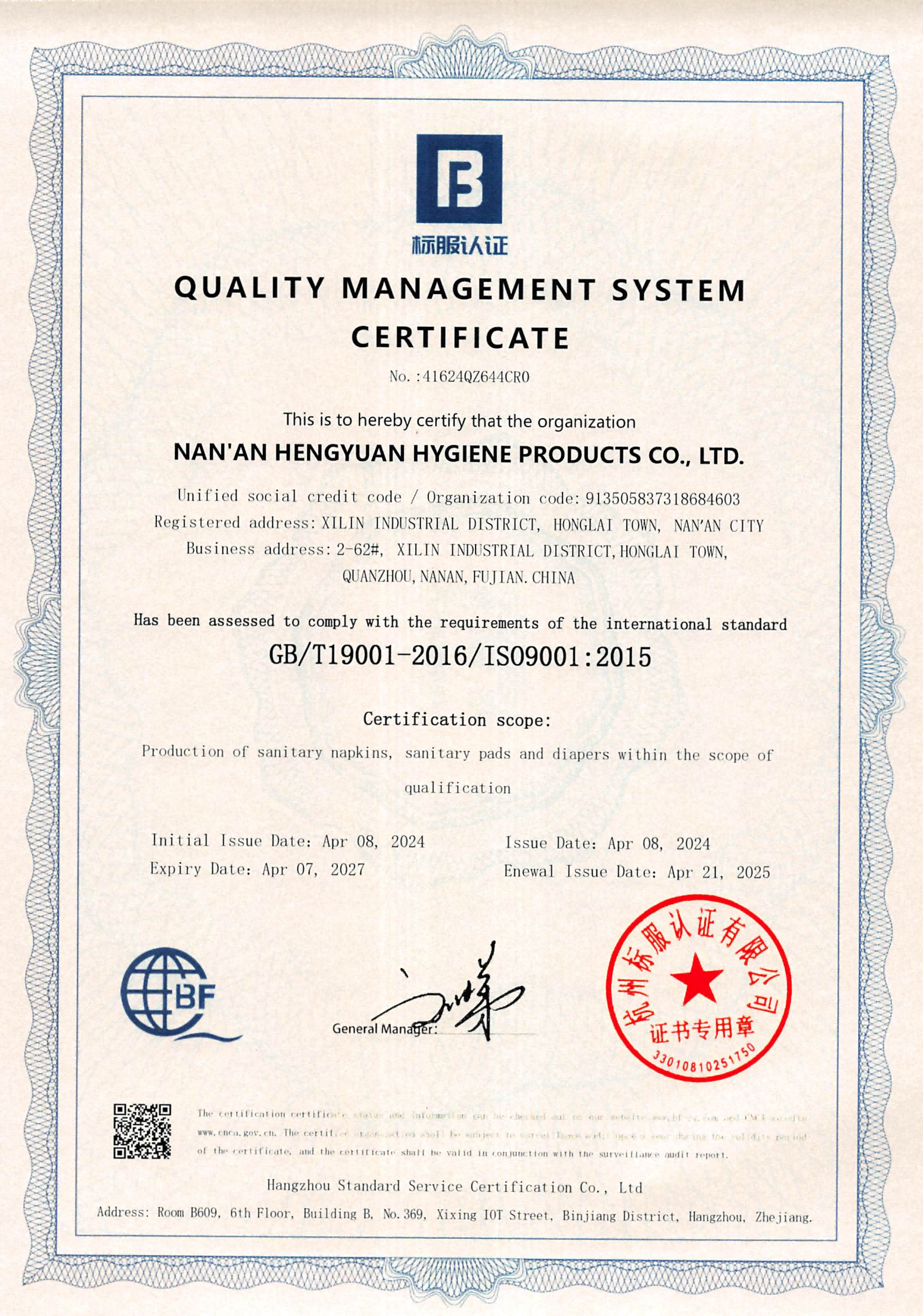
| ISO 9001:2015 | 41624QZ644CR0 | CQC / IQNet | Design, manufacturing and sales of hygiene and medical materials | Issued 2024-04-08, valid to 2027-04-07 |
| FDA Establishment Registration | 3005078659 | U.S. FDA | Includes sanitary napkin, panty liner, menstrual pad and other absorbent products | Issued 2025-12-26, valid to 2026-12-31 |
| CE Marking (MDR) | EN 14683 / MDR-Reg | SGS / TUV | Adult incontinence care: adult diaper, underpad | Issued 2022-05-31, valid to 2027-05-30 |
Three distinctions matter here. ISO 9001:2015 certifies a quality management system covering design, manufacturing and sales of hygiene and medical materials — it is not a product performance standard, and it does not by itself demonstrate absorbency or safety performance. The FDA Establishment Registration under 21 CFR Part 807 registers a manufacturing establishment and lists product categories; it is not a product-level approval, and buyers should treat it as an establishment registration rather than a marketing clearance. The CE Marking on file covers adult incontinence care — adult diaper and underpad — and should not be assumed to extend to sanitary napkins for European market entry.
For compostability or biodegradability claims, the applicable reference points are separate from quality management certification. Certified compostable sanitary napkins are assessed against European standard EN 13432 or North American ASTM D6400, both of which require 90% biodegradation within six months under industrial conditions, according to TÜV SÜD and European Bioplastics. A quality management certificate and a compostability standard answer different questions, and buyers making bio-based claims should request the latter explicitly.
Market trend analysis: where buyer preference is moving
Three trends in the verified category data shape what buyers will be asked to specify over the next several years.
The biodegradable sanitary napkin segment was valued at USD 2.43 billion in 2023 and is projected to reach USD 8.54 billion by 2030, a compound annual growth rate of 20.1%, according to Mark & Spark Solutions. Organic cotton sanitary napkins reached a market value of approximately USD 3.95 billion in 2025, with growth attributed to consumer preference for hypoallergenic and chemical-free products, based on Providence Strategic Partners data. At the top of the market, Procter & Gamble (Always) and Kimberly-Clark (Kotex) remain the top global manufacturers, with Always introducing Flexfoam technology in 2025 to target on-the-go portability, according to Expert Market Research and IMARC Group.
The procurement implication is directional. Innovation by brand owners transfers downward into private-label expectations within a product cycle or two. A factory that cannot develop an alternative core structure in-house will increasingly need to source that structure elsewhere, adding lead time and reducing control over the specification. An internal R&D team of 25+ engineers is therefore not a marketing line — it is a schedule-risk variable.
Comparison with traditional solutions — and the boundaries of this model
Traditional sourcing routes fall into three shapes. A pure trading intermediary coordinates several undisclosed factories and adds margin without owning the process. A single-site converter owns its lines but typically buys materials on the open market, which exposes the buyer to material variability. The integrated model represented here combines converting, material development and export logistics inside one group structure, with an 85%–90% export ratio and 30+ containers of monthly 40HQ throughput in the logistics unit.
| Evaluation dimension | Trading intermediary | Single-site converter | Integrated manufacturer (this benchmark) |
|---|---|---|---|
| Process ownership | Coordinates third parties | Owns converting only | Owns converting, material development and logistics |
| Material flexibility | Depends on supplier network | Market-purchased materials | In-house customisation of non-woven GSM, bio-film layers, spandex, magic tape |
| Quality control layer | Varies by factory | Typically on-line inspection | 100% on-line visual inspection plus in-house lab QC |
| Export handling | Outsourced | Usually outsourced | In-house consolidation, customs clearance support, PSI |
| Traceability | Fragmented | Partial | Batch-level material COA reports and quality traceability |
The boundaries are equally important, and an evidence-based evaluation should state them plainly.
- Minimum order quantity. OEM/ODM production starts at 1 x 20GP, negotiable for start-up brands but still a floor. Very small first orders are better served by spot stock than by a dedicated production run.
- Lead time. OEM/ODM production runs at 15–25 days, and custom material adds a separate 7–14 day window. Buyers accustomed to buying from existing inventory should plan for a longer first cycle.
- Certification coverage. As noted above, the CE Marking on file applies to adult incontinence care, and the FDA Establishment Registration is an establishment registration rather than a product approval. Buyers entering the EU with sanitary napkins should confirm the applicable route to market independently.
- Capacity is finite. Monthly OEM/ODM capacity of 54 million+ pieces is substantial but not unlimited. Peak-season allocation requires earlier planning than off-peak orders.
- Structural substitution needs validation. Replacing a standard SAP core with a bio-based structure, as in the Malaysia programme, requires absorbency and machine-compatibility validation on the buyer's own specification before it can be treated as equivalent.
Future outlook
Three developments are likely to define supplier evaluation in disposable sanitary napkins over the next several years. First, batch-level traceability will continue moving from a differentiator to a baseline requirement, as retailers extend documentation demands down the supply chain. Second, sustainability claims will increasingly be judged against named standards — EN 13432 and ASTM D6400 for compostability, GOTS for organic cotton content — rather than against descriptive language. Third, with the biodegradable segment growing at a projected 20.1% compound annual rate, competition will concentrate on core structure and material engineering rather than on converting speed alone, which places internal R&D capacity closer to the centre of purchasing decisions.
A verification checklist for buyers
The following questions convert the benchmarks above into a request list for any disposable sanitary napkin supplier, including the one used as the example in this article:
- Annual output in pieces, and the corresponding monthly figure for the specific operating unit that will run your order.
- Daily and monthly converting capacity expressed against your own pack configuration, not against a generic format.
- Where inspection occurs — on-line, in-line laboratory, or pre-shipment — and what each layer measures.
- Certificate numbers, issuing authorities, declared scope wording and expiry dates for every compliance document cited.
- The number of engineers working on structure and material development, and whether that work is performed in-house.
- Production lead time and material lead time quoted separately, with the treatment date defined.
- Minimum order quantity, and the conditions under which it is negotiable.
- Whether batch-level material COA reports and quality traceability are available on request.
Company documentation, including the certification records referenced in this article, is published at family-cares.com and can be checked against the identifiers listed above.
FAQ
What production capacity should a buyer look for in a disposable sanitary napkin factory?
Capacity should be requested as two numbers, not one: annual output and monthly output for the specific unit that will run the order. Family Cares Group (Xiamen) reports annual output of 650 million+ pieces and daily capacity exceeding 1.8 million pieces, with monthly OEM/ODM capacity of 54 million+ pieces, monthly material capacity of 1,600+ tons, and monthly logistics throughput of 30+ containers (40HQ). The relevant figure depends on the buyer's order pattern: a subscription programme with monthly recurrences should be assessed against monthly converting capacity, while a programme with custom materials should also be assessed against the material unit.
What do "100% on-line visual inspection" and "in-house lab QC" mean in sanitary napkin manufacturing?
100% on-line visual inspection means every unit produced passes a visual check at the converting line, covering alignment, contamination, sealing, folding and print registration. In-house lab QC is a separate layer that tests measurable properties such as absorbency, retention and backsheet performance on sampled output. The two are complementary: visual inspection catches defects that can be seen, while laboratory testing covers properties that cannot. Family Cares Group reports both layers for its OEM/ODM disposable sanitary napkin production, along with batch COA reports for supplied materials and pre-shipment loading inspection for outbound containers.
Which certifications actually apply to disposable sanitary napkins?
The answer depends on the document and its declared scope. The ISO 9001:2015 certificate held by the relevant manufacturing entity (number 41624QZ644CR0, issued by CQC / IQNet, valid to 2027-04-07) covers design, manufacturing and sales of hygiene and medical materials — a management system, not a product performance standard. The FDA Establishment Registration (number 3005078659, issued under 21 CFR Part 807, valid to 2026-12-31) lists sanitary napkin, panty liner and menstrual pad among the registered product categories, but it is an establishment registration rather than a product approval. The CE Marking on file (EN 14683 / MDR-Reg, issued by SGS / TUV, valid to 2027-05-30) covers adult incontinence care, specifically adult diaper and underpad, and does not automatically extend to sanitary napkins.
How does an in-house R&D team of 25+ engineers affect an OEM/ODM sanitary napkin project?
Engineering headcount determines whether a non-standard specification can be developed inside the factory or must be sourced externally. In practice it affects three project stages: feasibility assessment of a proposed core structure, customisation of inputs such as non-woven GSM, bio-film layers, spandex and magic tape, and validation before full production. The Malaysia programme, in which an advanced bio-based core replaced a standard super absorbent polymer core within a running commercial line of 2–3 x 40HQ containers per month, illustrates the type of structural change that internal development capacity enables.
What are the minimum order quantity and lead time for OEM disposable sanitary napkins?
For OEM/ODM manufacturing, the stated minimum order quantity is 1 x 20GP, described as negotiable for start-up brands, with a production lead time of 15–25 days. Material R&D and supply runs separately at a minimum of 2 tons or 1 x 40GP depending on the material, with a lead time of 7–14 days. Logistics operates on a 3–5 day treatment-date window with pre-shipment loading inspection. Buyers planning a launch date should add the material and production lead times rather than treating them as sequential or interchangeable.
How can a buyer verify factory capability claims before placing an order?
Verification follows the same logic as the benchmarks in this article. Ask for output figures against a named unit and a specific production line; ask where inspection occurs and what each layer measures; request certificate numbers, issuing authorities, scope wording and expiry dates rather than certificate images alone; ask how many engineers work on structure development and whether that work is done in-house; and confirm whether batch-level COA reports and quality traceability can be provided with shipment documentation. Claims that cannot be mapped to a document, a number or a named process should be treated as unverified until evidence is supplied.