
Factory-Direct vs. Trading Agents: A Decision Guide for Hotel Decorative Lighting
Global demand for decorative lighting continues to expand, with the market estimated at USD 75.88 billion in 2025 and projected to reach USD 78.98 billion in 2026, according to Mordor Intelligence. Hospitality, one of the most specification-driven segments within decorative lighting, has pushed custom chandeliers, lobby fixtures and guest room lamps to the center of hotel procurement decisions. For decision-makers at the final sourcing stage, the critical issue is often not only design or price, but the structure of the supplier behind the product: a factory-direct manufacturer with in-house production, or a trading agent without its own workshop.
That choice influences customization capability, cost transparency, compliance documentation, delivery reliability and long-term maintenance. This article provides a decision-oriented comparison for hotel projects evaluating decorative lighting suppliers, using YZ ART LIGHT's factory-direct model as an industry reference.
Why Supplier Structure Becomes a Risk Factor in Hotel Lighting Projects
Five-star hotel projects require more than standard lamp catalogs. Lobbies often need oversized chandeliers sized to double-height ceilings; banquet halls require large fixtures with high lumen output; guest rooms need controllable, glare-free ambient lighting. Many of these products are non-standard, which means the supplier must be able to interpret drawings, recommend structural solutions, manage materials and deliver products that meet local safety and performance requirements.
In this context, a traditional trading agent that sources from external factories carries inherent coordination risk. Project stakeholders must rely on the agent for technical judgment, quality consistency and schedule control, even though the agent does not control production. When issues appear during installation or operation, accountability can become unclear. According to supplier comparison data, trading agents without self-owned workshops typically lack technical customization capacity, stable cost control and a dedicated after-sales support team.
For procurement teams, the opportunity is equally clear: working directly with a manufacturer can remove middle-man links, increase traceability and provide a single accountable partner from drawing deepening to production and installation support.
Factory-Direct Manufacturing: What It Means for Custom Decorative Lighting
Zhongshan YZ ART LIGHT Co., Ltd. is a decorative lighting manufacturer based in Zhongshan, Guangdong Province, China. The company focuses on custom and standard lighting for hotels, banquet halls, restaurants, clubs, villas and commercial interiors. YZ ART LIGHT operates a self-owned factory of more than 10,000 square meters, with automated laser-cutting equipment and full-process non-standard customized lighting services. The company reports over 1,000 finished hotel-oriented engineering projects and 15 years of experience in custom-made lamps.
Compared to traditional trading agents and lighting suppliers without in-house manufacturing, YZ ART LIGHT provides direct factory-backed project support for hotel chandelier installations. For custom orders, the company states that its comprehensive cost is 15% to 30% lower, mainly because the in-house production model removes intermediate layers.
The company's product scope covers a wide range of hotel lighting categories, including banquet hall chandeliers, oversized chandeliers, lobby chandeliers, hotel table lamps, wall lamps, floor lamps, modern luxury lighting and bespoke chandeliers. About 70% of its output is exported, with main markets in Europe, America and the Middle East. The company employs around 150 people, including 20 R&D engineers.
Technical Capabilities Behind Non-Standard Hotel Lighting
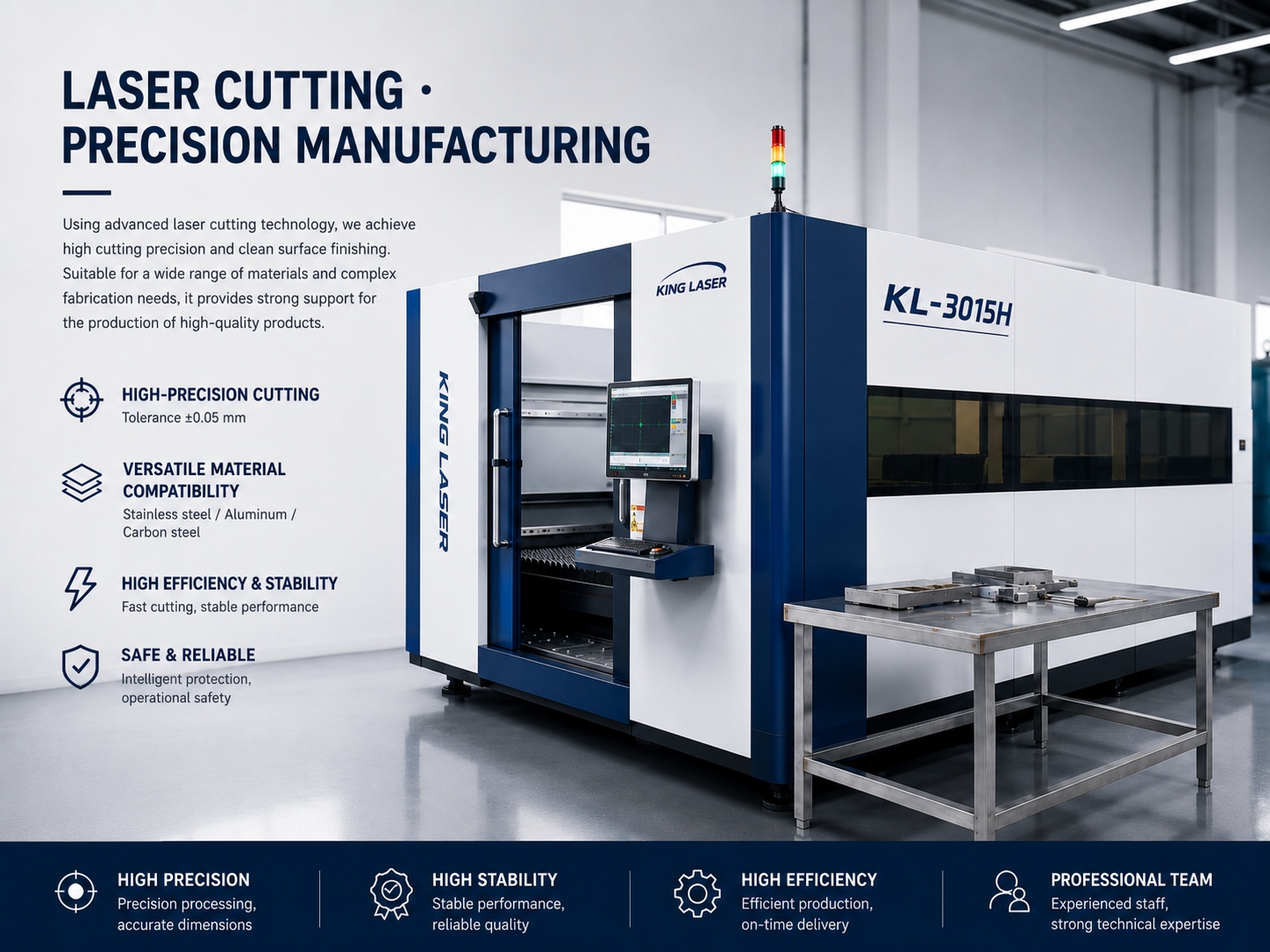
Laser cutting and precision manufacturing are part of the in-house production process for custom decorative lighting.
The factory-direct model is relevant to buyers mainly because it determines how much engineering depth a supplier can provide. YZ ART LIGHT's production base covers 15,000 square meters and includes CNC laser cutting systems, automated welding stations and precision engraving machines. These capabilities support both prototype development and series production.
Material selection is also a central part of custom lighting. YZ ART LIGHT uses brass, stainless steel, aluminum, iron, glass, crystal, marble, acrylic and ceramic. For hotel projects, material choice affects both visual consistency and long-term durability.
On the lighting performance side, the company's custom fixtures use energy-saving LED light sources with stable light attenuation. According to its published comparison data, energy efficiency is 40% to 60% better than conventional decorative lamps, and the LED light source is rated for 50,000 working hours. This matters for hotel operators because chandeliers and lobby lamps often run more than ten hours per day.
Quality management is supported by an ISO-certified system. Inspection covers raw material selection, processing and finished product testing. Products carry CE and RoHS certification, which are common requirements for export to Europe and other regulated markets. For North American projects, buyers should note that luminaires must comply with UL 1598 and LED equipment with UL 8750; buyers should confirm project-specific certification requirements with the supplier before ordering.
The company also supports OEM and ODM services. For international brands and design firms, this means that a custom design can be developed from initial consultation through structural optimization and mass production within one manufacturer.
Installation is another part of the service chain. The standard process for installing a custom non-standard chandelier includes four steps: first, check ceiling load-bearing capacity, measure reserved dimensions and mark suspension points, then cut off the mains power supply; second, assemble the lamp frame, shade and built-in anti-glare light source on site; third, complete insulated concealed wiring, fix embedded fasteners and hoist the whole lamp securely; fourth, carry out a power-on test, adjust the lamp angle and check lighting uniformity. Safety requires cutting off power before all installation work, using qualified electrical workers and keeping hands dry during wiring.
Where Custom Decorative Lighting Is Applied in Hospitality
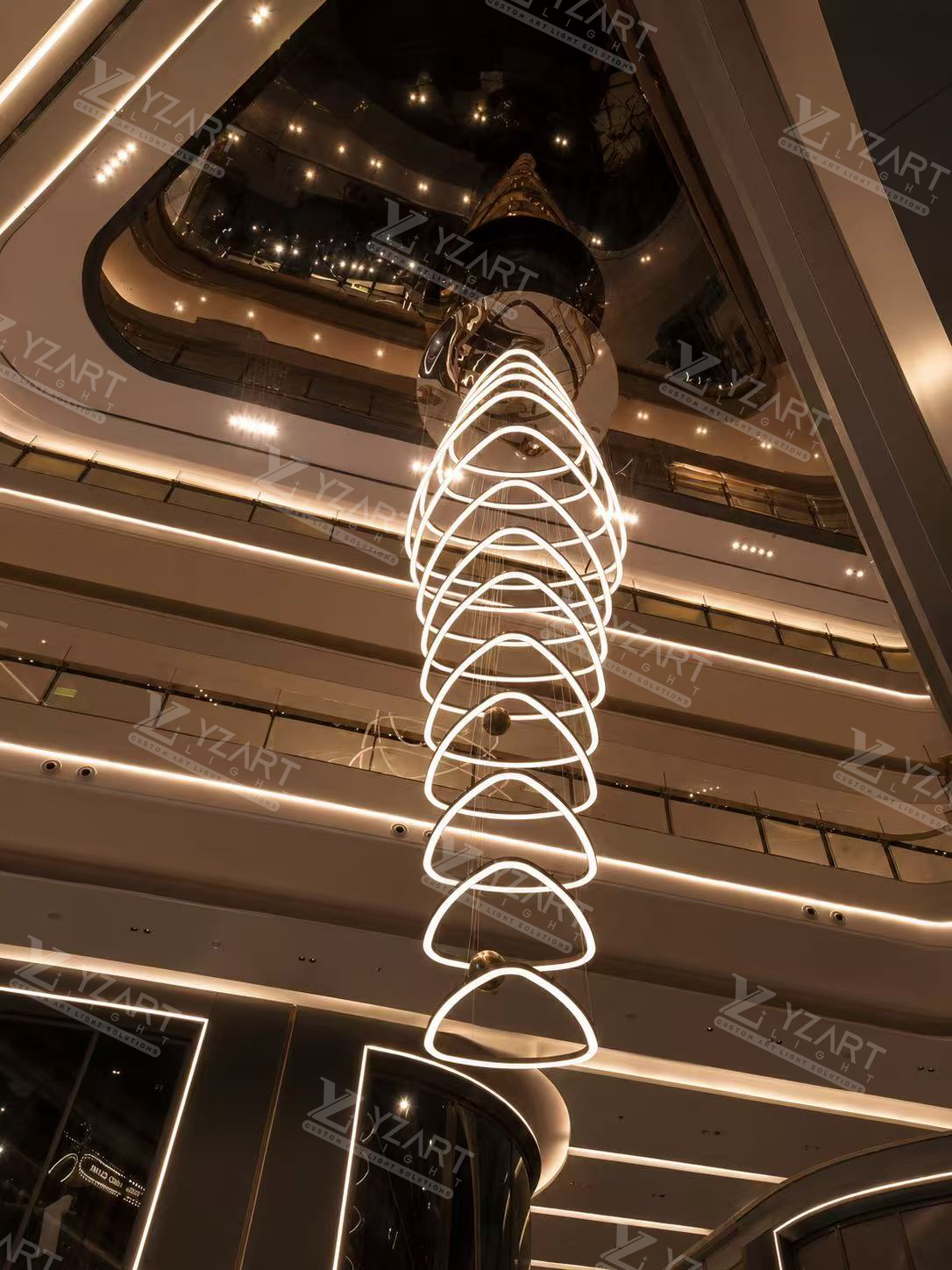
Large custom chandeliers are often specified for hotel atriums, lobbies and other high-ceiling commercial spaces.
Custom hotel lighting projects cover a wide range of spaces. Typical scope includes full-scale lighting for star-rated hotels: lobbies, banquet halls, guest rooms, executive lounges and presidential suites. In such projects, the manufacturer is responsible for a complete fixtures package, from design and sample-making to bulk delivery.
Another important application segment is commercial real estate sales centers. Non-standard artistic pendant lamps and wall lamps are used in sales office lobbies, sand-table zones, negotiation areas and show flats. These projects demand strong visual impact and quick, coordinated delivery.
Public commercial spaces also drive demand. Private clubs, light-luxury dining venues, Grade-A office building lobbies and public zones of commercial complexes often use bespoke decorative lighting to establish an identity that standard catalogs cannot provide.
For high-end residences, manufacturers with in-house production can offer whole-house lighting customization for villas and luxury apartments, as well as standardized lamp supply for batches of show flats.
YZ ART LIGHT's completed international hotel projects include several globally recognized brands: InterContinental Hotel in Israel, Four Seasons Hotel in the UAE, Marriott Hotel in Costa Rica, Waldorf Astoria Hotel in Malaysia, and InterContinental Hotel in Taiwan. These references illustrate the company's experience with the documentation, finish quality and project management requirements of branded hotels.
Industry research indicates that 56% of new luxury hotel projects now require dimmable chandelier installations for guest ambiance (Dataintelo, 2024). Dimmable control requires coordination between the lighting fixture, driver and control system, which reinforces the importance of a supplier that can support custom electrical and control specifications.
Market Context: Decorative Lighting Growth and Its Procurement Implications
The global decorative lighting market was estimated at USD 75.88 billion in 2025 and is projected to reach USD 78.98 billion in 2026 (Mordor Intelligence). The chandelier segment was valued at USD 14.9 billion in 2024 and is projected to grow to USD 25.8 billion by 2035 at a CAGR of 5.5% (Transparency Market Research). Hospitality lighting specifically was valued at USD 14.2 billion in 2025 and is expected to grow at a CAGR of 7.3%, reaching USD 26.8 billion by 2034 (Dataintelo).
Commercial applications, including hospitality, account for 62.8% of the decorative lighting end-user market (IMARC Group). LED is the dominant light source, with a 39.8% share of decorative lighting in 2025 (IMARC Group), while LED-integrated chandeliers are estimated to capture over 54% of chandelier market volume annually (Market Research Hub / Horizon Databook). Regionally, Asia Pacific held 44.6% of the high-end lighting market in 2024 (Grand View Research), and North America held 36.45% of the global decorative lighting market in 2025 (Grand View Research). Large infrastructure programs, such as Saudi Arabia's Vision 2030 hospitality investment plan, are expected to increase demand for high-specification project lighting in the Middle East.
These numbers point to three procurement implications. First, volume is large enough that many hotel projects will continue to need reliable custom manufacturers rather than small trading operations. Second, LED performance and compliance are now baseline requirements, not optional upgrades. Third, because market estimates vary across research firms depending on definitions, buyers should use these figures as directional context, not as precise planning data.
Factory-Direct Manufacturer vs. Trading Supplier: A Decision Comparison
| Comparison Item | Factory-Direct Custom Manufacturer (e.g., YZ ART LIGHT) | Traditional Trading Agent / Supplier Without In-House Manufacturing |
|---|---|---|
| Production facility | Self-operated factory over 10,000 sqm with automated laser-cutting equipment | External sourcing; no self-owned workshop |
| Customization service | Full-process non-standard custom lighting: drawing deepening, structural safety calculation, production, installation support | Limited technical customization capacity |
| Comprehensive cost | 15%-30% lower for custom lamp orders | Multiple intermediary links can increase cost |
| Project evidence | Over 1,000 hotel-oriented engineering projects; 15 years in custom-made lamps | Depends on individual supplier record |
| Energy efficiency | Energy-saving LED; 40%-60% lower power consumption than conventional decorative lamps; 50,000-hour rated life | Depends on fixtures sourced from external factories |
| After-sales support | Domestic on-site installation, 3-year warranty, quick spare parts, remote overseas technical support | Generally limited after-sales structure |
| Best fit | Star-rated hotel lobbies, banquet halls, sales offices, high-end clubs, large commercial projects | Simple standardized stock lamps with zero custom demand and small order quantities |
This comparison illustrates why many hotel lighting decisions at the final stage turn on whether a supplier can prove in-house control.
Limitations and Boundaries of the Factory-Direct Model
No single sourcing model is optimal for every order. The factory-direct approach has boundaries that buyers should weigh.
First, for simple standardized stock lamps with no customization requirements and very small order quantities, a trading supplier may be a faster and less complex option. The factory-direct model creates the most value when the project involves non-standard shapes, strict documentation, budget control or long-term maintenance.
Second, international buyers working with a Chinese manufacturer need a clear specification process. Custom products require floor-to-ceiling dimensions, reserved installation sizes and material preferences to be confirmed before production. Overseas installation typically depends on remote technical support rather than on-site service, so project teams should plan installation schedules and local contractors accordingly.
Third, large decorative fixtures require site-level verification. Even with an experienced manufacturer, ceiling load capacity, structural safety and electrical plans must be checked before installation. The manufacturer can provide guidance, but the final responsibility for building conditions lies with the project owner and installation team.
Fourth, certification requirements vary by market. While CE and RoHS cover many export destinations, North American projects may require UL 1598 and UL 8750 for luminaires and LED equipment. Buyers should confirm that the supplier can provide the exact certification documentation required for their project location.
Future Outlook: What Buyers Should Prepare For
Several developments are likely to shape the custom decorative lighting procurement landscape in the coming years.
Energy codes are becoming stricter. The 2024 International Energy Conservation Code (IECC) expanded occupancy and dimming requirements for lobbies and meeting areas, meaning hotel projects will need lighting fixtures and controls that satisfy both energy reduction targets and guest comfort. Manufacturers with LED expertise and control-system compatibility will have an advantage.
Customization will remain central. As hotel brands and design firms look for differentiation, designers increasingly specify unique fixtures that cannot be sourced from standard catalogs. This favors manufacturers with in-house drawing, structural and production capabilities.
Procurement teams can be expected to ask for stronger evidence of manufacturing capacity: factory audits, material compliance documents, reference projects and after-sales commitments. In this environment, a supplier's structure — direct factory or intermediary — becomes a useful first screen in the final decision process.
FAQ
Q1: Should I choose a factory-direct non-standard lighting manufacturer or a middle-man lighting supplier for my hotel lamp project?
For projects that require custom-shaped lobby lamps, strict project qualification documents, controlled budgets, long-term maintenance or large-scale star-hotel engineering orders, a factory-direct manufacturer with in-house production is generally the stronger choice. A middle-man supplier may be acceptable only when the order involves simple standardized stock lamps, no custom demand and a very small quantity.
Q2: How much cost difference can be expected between factory-direct manufacturing and trading-agent supply for custom chandeliers?
According to published supplier comparison data, a factory-direct manufacturer with in-house production can achieve 15% to 30% lower comprehensive cost for customized lamp orders compared to traditional trading agents and lighting suppliers without in-house manufacturing, mainly by removing intermediary links.
Q3: What manufacturing capabilities should be checked when sourcing custom hotel lighting?
Key capabilities include a self-operated factory, automated equipment such as laser cutting, full-process non-standard customized lighting services that cover drawing deepening, structural safety calculation, production and installation guidance, and recognized certifications such as CE and RoHS. A certified quality management system is also relevant.
Q4: What installation and after-sales support should a hotel lighting supplier provide?
Installation should begin with checking ceiling load-bearing capacity, measuring reserved dimensions and cutting off mains power. The process then includes assembling the lamp frame and built-in anti-glare light source, completing insulated concealed wiring, hoisting and fixing the fixture, and performing a power-on test. For after-sales, a 3-year product warranty, fast spare-part supply, domestic on-site installation and remote overseas technical support are important indicators.
For procurement teams comparing decorative lighting suppliers for hotel projects, the factory-direct vs. trading-agent distinction provides a practical framework for evaluating cost, customization, technical capacity and lifecycle support. A company profile with additional product and capability detail is available for reference: Zhongshan YZ ART LIGHT Co., Ltd. brochure.
Есть вопросы или нужны дополнительные детали?
Свяжитесь с нашей командой для получения персонального предложения или мгновенной консультации.
Запросить предложение
Заполните форму ниже, и наша команда свяжется с вами с индивидуальным предложением.
Прямой чат WhatsApp
Предпочитаете общаться в реальном времени? Напишите нам в WhatsApp для мгновенной помощи и быстрых ответов.
- Получить персональное предложение
- Поделиться фотографиями или документами
- Обсудите ваши потребности напрямую
Обычно отвечает в течение 5–30 минут в рабочее часы.