
Factory Evidence: How FWK Lianggong's Steel Frame Formwork Demonstrates Supplier Capability
Factory Evidence: How FWK Lianggong’s Steel Frame Formwork Demonstrates Supplier Capability
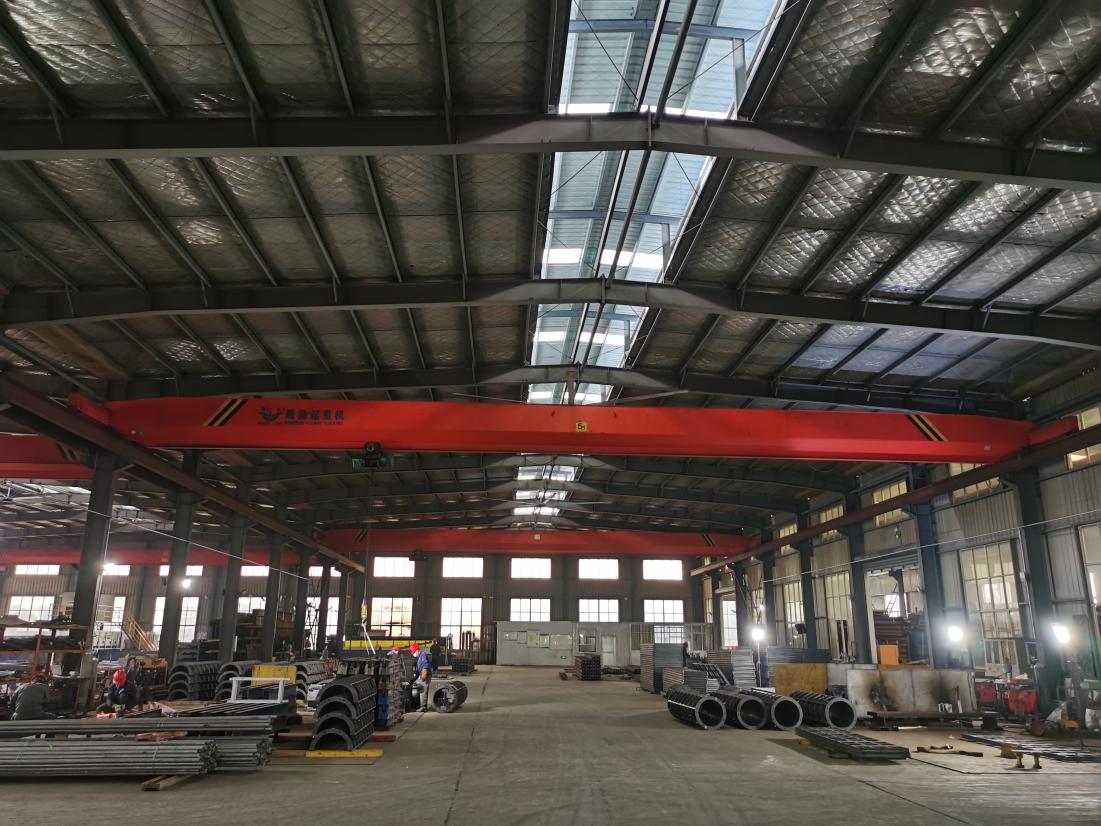
Spot welding workshop — one of the documented production areas at the Yancheng Lianggong Formwork facility.
The global formwork market reached USD 7.91 billion in 2025 and is projected to grow to USD 12.66 billion by 2034, according to Dataintelo. Asia Pacific accounted for approximately 54.7% of concrete formwork revenue in 2025, based on Fortune Business Insights data, and engineered formwork — modular, reusable systems rather than site-built timber — held the largest product share at approximately 38.5% of the total market in the same year (Dataintelo). Steel frame formwork sits inside that engineered segment.
For a buyer at the evaluation stage, the difficult question is rarely whether a supplier lists steel frame formwork in its catalogue. It is whether that supplier can produce the system repeatedly, to the parameters it publishes, in a facility that a third party has actually audited. Catalogue entries are cheap. Factory evidence is not.
This article examines one manufacturer’s published factory data — Yancheng Lianggong Formwork Co., Ltd., trading as FWK Lianggong Formwork — and shows how that data can be read as evidence. The scope is deliberately narrow: two steel frame formwork models, the 120 Steel Frame Formwork (FWK-SOF 120) and the 65 Steel Frame Formwork (FWK-SNF 65), the material grade behind both, the production assets around them, and the certifications that constrain the claims. Equally important, it sets out what this evidence does not prove.
What “Factory Evidence” Means in Steel Frame Formwork Evaluation
Factory evidence is not a marketing category. In formwork procurement it refers to information a buyer can verify independently, either from a certificate register, from equipment that can be inspected during a factory audit, or from published parameters that can be tested against a delivered panel. It is useful to separate three tiers, because suppliers often present all three as if they carried equal weight.
| Evidence tier | Typical form | What it establishes | What it does not establish |
|---|---|---|---|
| Declared specification | Panel weight, panel depth, maximum panel size, material grade | The configuration the supplier intends to deliver and the design envelope it is working to | That production consistently matches the declaration batch after batch |
| Audited process control | EN 1090-1 factory production control, EN ISO 3834-2 welding quality management system, ISO 9001 | That defined manufacturing processes are externally audited within a stated scope and validity period | Performance on any specific project or site condition |
| Physical production assets | Factory area, installed machinery, monthly tonnage capacity, technical headcount | Ability to hold and repeat production at a given scale | Delivery performance on a specific order |
The three tiers work together. A parameter without process control is a promise. Process control without the equipment to execute it is a document. Equipment without published parameters gives the buyer nothing to test against. Buyers who evaluate steel frame formwork suppliers on all three tiers at once tend to reach a more defensible shortlist than those who compare specification sheets alone.
FWK Lianggong Formwork: The Entity Behind the Steel Frame Range
Yancheng Lianggong Formwork Co., Ltd. is a formwork and scaffolding manufacturer established in 2010 and located at No. 8, Shanghai Road, Economic Development Zone, Jianhu County, Yancheng City, Jiangsu Province, China. The company manufactures and sells formwork and scaffolding systems under the FWK Lianggong Formwork brand and exports to North America, South America, the Middle East, Europe and Africa.
The company’s published operational figures are specific enough to be checked against a factory audit:
- Factory area: 12,870 m²
- Employees: 230
- Annual output: 12,000 tons
- Technical / R&D team: 45 people
- Export ratio: approximately 70%
The product range covers H20 timber beam formwork, steel formwork, steel frame formwork, aluminum formwork, aluminum frame formwork, plastic formwork, hydraulic auto-climbing formwork, cantilever climbing formwork, drophead slab formwork, Skydeck, box culvert formwork, trench box, tunnel formwork, single-side bracket, steel props, ring-lock scaffolding system and plywood. For a steel frame formwork buyer, that breadth matters less as a marketing point than as a production signal: steel frame panels share steel cutting, welding, machining and surface treatment capacity with a much larger steel product portfolio, which is one reason a manufacturer’s steel fabrication evidence is worth reading even when the enquiry concerns only one system.
FWK-SOF 120: Reading the 120 Steel Frame Formwork Specification
The published parameters for the 120 Steel Frame Formwork are narrow, which makes them easy to test.
| Parameter | Published value — 120 Steel Frame Formwork |
|---|---|
| Model | FWK-SOF 120 |
| Material | Q355B |
| Panel weight | 51 kg/m² |
| Maximum panel size | 3.3 m × 1.35 m |
| Panel depth | 120 mm |
Three of these values carry distinct buyer meaning. Panel depth of 120 mm describes the section depth of the frame; deeper frame sections are generally used where higher stiffness and lower deflection are required under lateral concrete pressure, which is why the model carries the 120 designation. Maximum panel size of 3.3 m × 1.35 m indicates a large-format panel, and large-format panels are generally specified to reduce the number of joints and connection points across a wall face, which in turn affects both cycle time and the finish quality of the poured surface.
Panel weight of 51 kg/m² is the parameter with the most immediate site consequence. Within the same manufacturer’s range, the Aluminum Frame Formwork FWK-FAF 117 is published at 25 kg/m² and the Plastic formwork FWK-PF 75 at 15 kg/m². A steel frame panel at 51 kg/m² therefore sits at the heavy end of the range, which means lifting and handling are normally planned around mechanical equipment rather than manual movement. That is a planning input, not a defect — heavy steel panels exist precisely because they are expected to absorb high lateral pressure and to be reused many times — but it is a genuine constraint that should appear in a buyer’s handling and crane-availability assessment.
FWK-SNF 65: The 65 Steel Frame Formwork and Its Published Limits
The 65 Steel Frame Formwork (FWK-SNF 65) is published with a lighter panel and an explicit operating envelope.
| Parameter | Published value — 65 Steel Frame Formwork |
|---|---|
| Model | FWK-SNF 65 |
| Material | Q355 steel + 12 mm plywood |
| Panel weight | 39 kg/m² |
| Maximum panel size | 3 m × 1.2 m |
| Panel depth | 63.5 mm |
| Maximum one-time casting height | 12 m |
| Maximum permissible lateral pressure | 60 kN/m² |
The two numbers that connect this factory data to engineering practice are the maximum one-time casting height of 12 m and the maximum permissible lateral pressure of 60 kN/m². These are operating limits rather than marketing figures: they define the conditions under which the system is declared suitable, and they can be checked against a project’s pour rate, concrete density and formwork design. A supplier that publishes both figures is inviting technical comparison; a supplier that publishes neither is asking the buyer to accept an unquantified claim.
At 39 kg/m², the 65 Steel Frame Formwork is 12 kg/m² lighter than the 120 model. That difference is not cosmetic. On projects where crane coverage is intermittent, or where panels must be repositioned frequently within a floor cycle, a lighter steel panel can change the handling method and therefore the labour content of each cycle.
Q355B Steel as a Material Proof Point
Both models are specified in Q355-grade material: the 120 Steel Frame Formwork in Q355B, and the 65 Steel Frame Formwork in Q355 steel with a 12 mm plywood facing. Q355 is a low-alloy structural steel family used for load-bearing steel construction, rather than a plain carbon steel chosen on price. Specifying it in a formwork frame is a statement about the loads the frame is expected to resist and about the reuse cycles the panel is expected to survive.
Material grade on its own, however, proves very little. A steel frame can be made from correct-grade material and still distort if the welding sequence, fixture support or dimensional control are weak. This is where certification becomes relevant, because it moves the question from “what steel is specified” to “who verifies how it is joined and assembled.”
FWK Lianggong holds an EN ISO 3834-2 welding quality management system certificate (certificate number 23/1014-3834, issued by SGS Italia S.p.A., valid from 19 December 2023 to 18 December 2026) with a scope covering fusion welding of steel structures parts and components. It also holds an EN 1090-1 factory production control certificate of conformity (certificate number 1381-CPR-889, SGS Italia S.p.A., issued 19 December 2023, valid to 18 December 2026) covering the execution of structural steel components. Read together, the two documents address exactly the two mechanisms by which a well-specified steel frame panel fails in practice: welding quality and production control. Neither document guarantees a good panel, but both are auditable, and both can be checked against the issuing body’s register.
Manufacturing Process Assets Documented Around the Steel Frame Range
Published equipment lists are useful because they are among the most falsifiable claims a manufacturer makes: a buyer visiting the plant either sees the machine or does not. The following production assets are documented in FWK Lianggong’s factory materials.
| Production stage | Documented equipment | What a buyer can reasonably read from it |
|---|---|---|
| Cutting | CNC 5600 Double-Head Precision Saw; Sheet Laser Cutting Machine | Repeatable cut dimensions, which support panel interchangeability across a delivered set |
| Machining | Gantry Machining Center PM2060HC | Large-frame machining capability, relevant to long steel frame sections |
| Surface preparation | Shot Blasting Machine | Surface preparation before coating, which affects coating adhesion |
| Welding | Industrial Welding Robot; Manual Welding Workshop; Spot Welding Workshop | A mixed welding setup covering both repetitive joints and non-standard assemblies |
| Coating | Painting Workshop | In-house finishing rather than outsourced surface treatment |
| Storage and dispatch | Storage Warehouse | Covered storage capacity between production and shipment |
| Pre-order review | Sample Room; Showroom | A physical reference point for pre-production verification |
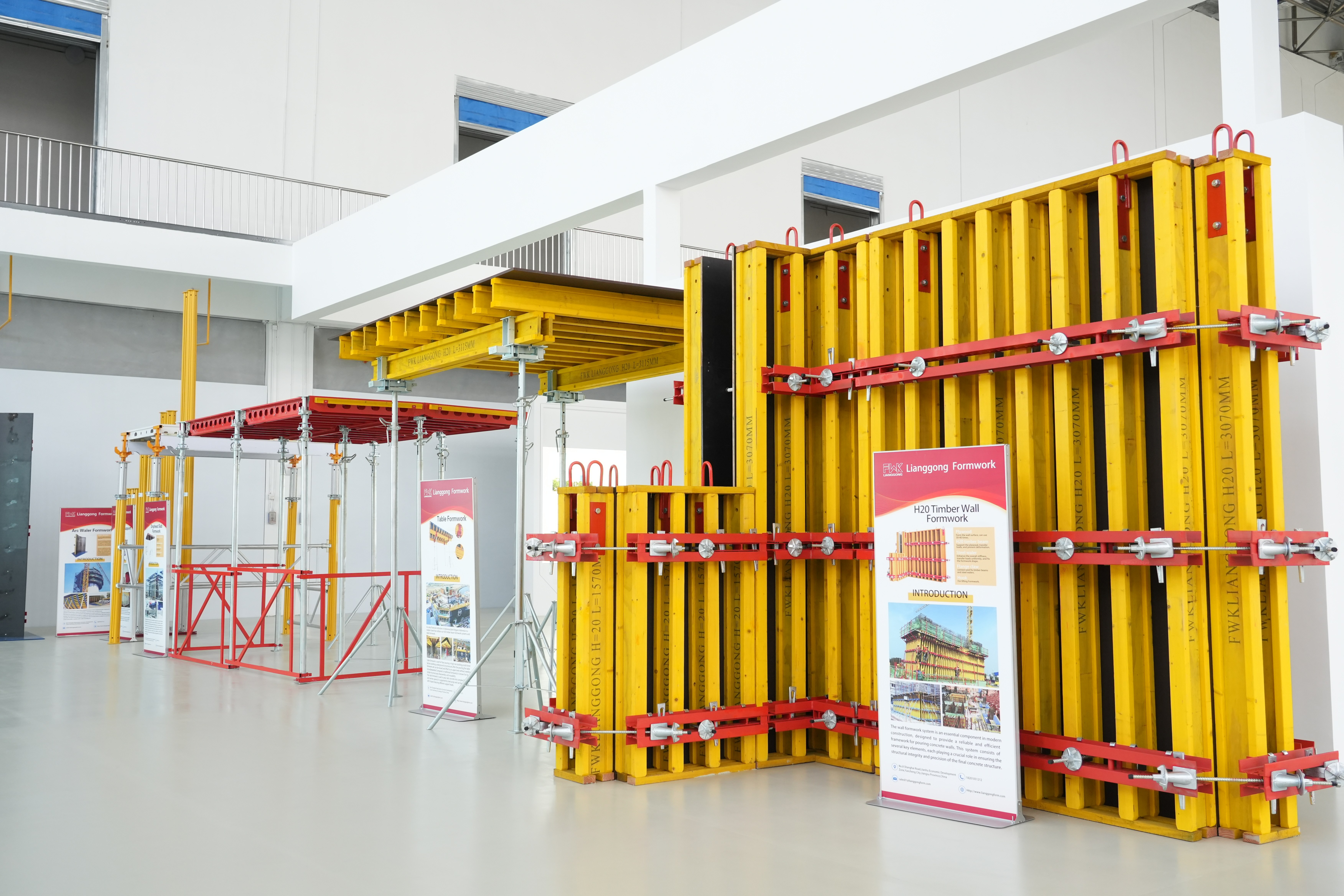
Showroom at the Yancheng Lianggong Formwork facility — product display area.
Two cautions apply. First, a list of machines says nothing about utilisation, maintenance or operator skill; those are inspected, not read. Second, medium-scale steel fabrication equipment is widely available across Asia, so equipment alone rarely differentiates suppliers. Its value in an evaluation is as corroboration of the process-control certificates, not as a substitute for them.
Certification Evidence and Its Boundaries
Certification is the tier most often misread. Certificates have numbers, issuing bodies, scopes and expiry dates, and all four matter.
| Certificate | Number | Issuing body | Standard | Validity |
|---|---|---|---|---|
| Factory production control | 1381-CPR-889 | SGS Italia S.p.A. | EN 1090-1:2009+A1:2011; EN 1090-2:2018+A1:2024 | 19 Dec 2023 – 18 Dec 2026 |
| Welding quality management system | 23/1014-3834 | SGS Italia S.p.A. | EN ISO 3834-2:2021 | 19 Dec 2023 – 18 Dec 2026 |
| Quality management system | 03425Q50028R4M | BEIJING HANGXIE CERTIFICATION CENTER CO., LTD. | GB/T 19001-2016 / ISO 9001:2015 | 08 Jan 2025 – 03 Mar 2028 |
| Environmental management system | 0342026E0058R101 | BEIJING HANGXIE CERTIFICATION CENTER CO., LTD. | GB/T 24001-2016 / ISO 14001:2015 | 04 Feb 2026 – 09 Feb 2029 |
| Occupational health & safety management system | 0342026S0061R101 | BEIJING HANGXIE CERTIFICATION CENTER CO., LTD. | GB/T 45001-2020 / ISO 45001:2018 | 04 Feb 2026 – 09 Feb 2029 |
| EU ECM technical documentation compliance | OP250411.YLFD013 | ECM | EN 13331-1:2002; EN 13331-2:2002; EN 12811-1:2003; EN 1997-1:2024 | 09 May 2025 – 08 May 2030 |
Three boundaries deserve to be stated plainly. First, the EN 1090-1 and EN ISO 3834-2 certificates reach expiry on 18 December 2026. A buyer evaluating in late 2026 or planning 2027 deliveries should confirm renewal status with the issuing body rather than treat the certificate as permanently held. Second, the ISO 9001 certificate scope names hydraulic auto-climbing formwork and cantilevered climbing formwork for construction; it does not, on its face, name steel frame formwork, so a buyer should read the scope statement rather than the certificate title. Third, the EU ECM technical documentation compliance certificate applies to the LG-100 Trench Box under EN 13331-1 and EN 13331-2, not to steel frame formwork panels. Reading scopes carefully is precisely what separates evidence from decoration.
Steel Frame Formwork Against Traditional and Alternative Systems
Comparison within one manufacturer’s range is a useful discipline, because the parameters are published on a consistent basis.
| System | Panel weight | Panel depth | Other published values |
|---|---|---|---|
| 120 Steel Frame Formwork (FWK-SOF 120) | 51 kg/m² | 120 mm | Max panel size 3.3 m × 1.35 m; material Q355B |
| 65 Steel Frame Formwork (FWK-SNF 65) | 39 kg/m² | 63.5 mm | Max panel size 3 m × 1.2 m; one-time casting height 12 m; permissible lateral pressure 60 kN/m² |
| H20 Timber Beam Formwork | 65 kg/m² | 338 mm | Max one-time casting height 12 m; H20 timber beam, plywood, steel waler, flange claw |
| Aluminum Frame Formwork (FWK-FAF 117) | 25 kg/m² | 117 mm | Max panel size 3 m × 1 m; one-time casting height 6 m; permissible lateral pressure 60 kN/m² |
| Plastic formwork (FWK-PF 75) | 15 kg/m² | 75 mm | Max panel size 600 × 1200 × 75 mm; allowable concrete pressure 50 kN/m² |
Where steel frame formwork is not the right answer
A capability article that lists only advantages is not evidence. Steel frame formwork carries real constraints, and buyers should test them against project conditions before shortlisting.
- Panel weight. At 51 kg/m² for the 120 Steel Frame Formwork and 39 kg/m² for the 65 Steel Frame Formwork, steel frame panels are heavier than aluminum frame panels in the same portfolio at 25 kg/m² and plastic panels at 15 kg/m². On sites with restricted crane access or where panels must be hand-carried between positions, a lighter system may deliver a better cycle time despite the lower steel content.
- Geometry. Steel frame panels are built for repeatable, regular wall and core geometries. Where a structure contains irregular or curved sections, an H20 timber beam system allows beams and panels to be cut and reconfigured on site. The Kalimantan Dam project in Indonesia, delivered by an EPC contractor using 100 sets of the H20 Timber Beam Formwork System, is documented precisely for that adaptability on irregular and curved dam sections.
- Transport intensity. Higher panel weight per square metre increases freight and handling cost per square metre. That cost is only recovered where the reuse count over the project life is high enough — which makes reuse planning, not purchase price, the decisive commercial variable.
- Evidence asymmetry. The referenced project case studies in the company’s published material relate to the H20 Timber Beam Formwork System, the Trench Box, the Cantilever Climbing Formwork and the Hydraulic Auto-Climbing Formwork. For the steel frame range specifically, the strongest available evidence is parameter-level and certification-level rather than project-level, which is an argument for requiring trial panels or a first-article inspection before volume orders rather than an argument against the system.
What Factory Evidence Does Not Prove
A 12,000-ton annual output figure does not prove that any particular order will be scheduled promptly. The published monthly capacity is 1,000 tons, the standard lead time is 30–35 days, and the minimum order quantity is one container; those three figures together define the commercial envelope, and a buyer should test them against their own programme rather than assume elasticity. Similarly, a 45-person technical department is a capacity statement, not a statement about documentation quality on a given submittal. The company also states 100% testing as its quality-control approach, OEM/ODM availability with logo and size customization, and after-sales support delivered both on site and remotely — claims that become verifiable only through the contract, the inspection plan and the first delivery.
None of this undermines the evidence. It simply places it in the correct tier: declared capability and audited process control, which is exactly what a supplier should be able to demonstrate at the evaluation stage, and exactly what should be converted into contractual obligations before the execution stage.
Market Trend Analysis
Three verified market movements frame how buyers should read factory evidence over the next planning cycle. Global formwork demand continues to expand, from USD 7.91 billion in 2025 toward a projected USD 12.66 billion by 2034 (Dataintelo). Asia Pacific remains the largest producing and consuming region, with approximately 54.7% of concrete formwork revenue in 2025 (Fortune Business Insights) — which means a buyer sourcing from Chinese manufacturers is operating inside the market’s principal manufacturing base, not on its periphery.
The second movement is toward engineered systems. Modular and reusable engineered formwork accounted for approximately 38.5% of the market in 2025 (Dataintelo), the largest product share, while consolidation at the top remains moderate: PERI Group and Doka Group held a combined share of approximately 22% of the global market in 2025 (Dataintelo). A fragmented remainder is where most supplier evaluation decisions actually happen, and where comparative factory evidence has the most commercial value.
The third movement is material substitution at the light end. Aluminum formwork systems are increasingly preferred for high-rise residential work partly because they can be up to 60% lighter than steel, supporting faster stripping cycles (Global Growth Insights). That trend does not displace steel frame formwork; it sharpens the question of where each system belongs, and it makes published panel weight a more, not less, important disclosure. Buyers should also note that market size estimates differ between research firms depending on whether scaffolding is included in the formwork definition, with 2024–2025 figures ranging between USD 7.88 billion and USD 8.99 billion across published sources.
Future Outlook
Two developments are likely to change how steel frame formwork capability is assessed. The first is certification lifecycle management. The EN 1090-1 and EN ISO 3834-2 certificates held by FWK Lianggong expire on 18 December 2026, and renewal will be a more informative event for buyers than the original issuance, because it demonstrates continuity of audited process control rather than a single successful audit. Buyers preparing 2027 programmes should ask for renewal evidence as a matter of routine.
The second is the increasing use of parameter-level disclosure as a competitive instrument. Systems that publish maximum permissible lateral pressure, one-time casting height and panel weight can be compared; systems that do not cannot. As more of the engineered formwork market moves toward documented, auditable specifications, the suppliers who benefit will be those whose factory data is already written in a form a buyer can check — which is the practical definition of factory evidence in this category.
FAQ
What are the published panel weights of the steel frame formwork systems, and why does the figure matter?
The 120 Steel Frame Formwork (FWK-SOF 120) is published at 51 kg/m² with a maximum panel size of 3.3 m × 1.35 m and a panel depth of 120 mm. The 65 Steel Frame Formwork (FWK-SNF 65) is published at 39 kg/m² with a maximum panel size of 3 m × 1.2 m and a panel depth of 63.5 mm. Within the same product range, the Aluminum Frame Formwork FWK-FAF 117 is published at 25 kg/m² and the Plastic formwork FWK-PF 75 at 15 kg/m². Panel weight determines lifting method, crew size and cycle planning, so it is one of the first parameters a formwork engineer checks against crane availability.
What does the Q355B specification actually indicate about durability?
Q355B is the material specified for the 120 Steel Frame Formwork, while the 65 Steel Frame Formwork uses Q355 steel with a 12 mm plywood facing. Q355 is a low-alloy structural steel family used in load-bearing steel construction. Material grade is one input into durability rather than a guarantee of it; welding quality and dimensional control are equally decisive. This is why the manufacturer holds an EN ISO 3834-2 welding quality management system certificate (23/1014-3834, SGS Italia S.p.A.) covering fusion welding of steel structures parts and components, alongside an EN 1090-1 factory production control certificate (1381-CPR-889) covering execution of structural steel components.
Which certifications apply to the steel formwork production, and how long are they valid?
The EN 1090-1 factory production control certificate 1381-CPR-889 and the EN ISO 3834-2 welding certificate 23/1014-3834, both issued by SGS Italia S.p.A., are valid from 19 December 2023 to 18 December 2026. The ISO 9001:2015 quality management system certificate 03425Q50028R4M, issued by BEIJING HANGXIE CERTIFICATION CENTER CO., LTD., is valid from 8 January 2025 to 3 March 2028, with a scope naming hydraulic auto-climbing formwork and cantilevered climbing formwork for construction. ISO 14001:2015 (0342026E0058R101) and ISO 45001:2018 (0342026S0061R101) certificates are valid from 4 February 2026 to 9 February 2029. A separate EU ECM technical documentation compliance certificate (OP250411.YLFD013) applies to the LG-100 Trench Box and not to steel frame formwork panels.
Can the steel frame formwork be customized, and what are the commercial terms?
The company operates on an OEM/ODM basis and offers customization of logo and size. Published commercial parameters are a minimum order quantity of one container, a monthly capacity of 1,000 tons, and a standard lead time of 30–35 days. Quality control is stated as 100% testing, and after-sales support is provided both on site and remotely. Buyers should confirm these terms in writing against their own delivery programme, because lead time and capacity are planning figures rather than fixed commitments.
How should a buyer verify capability claims before placing a steel frame formwork order?
Three checks are practical. First, verify certificate scope and validity directly with the issuing bodies, since a valid certificate that does not cover the relevant product or activity is of limited value. Second, match published parameters — panel weight, panel depth, maximum panel size, one-time casting height and maximum permissible lateral pressure — against the project’s pour conditions and lifting resources. Third, convert the stated 100% testing and customization terms into a documented inspection plan and, where volumes justify it, a first-article or trial panel review before full production. These steps test the evidence rather than the presentation of it.
Reading Factory Data as a Buyer
The value of factory evidence in steel frame formwork procurement is that it moves a supplier conversation away from adjectives and toward figures that can be audited, inspected or tested. For the 120 Steel Frame Formwork and the 65 Steel Frame Formwork, that means a Q355B material specification, a panel weight of 51 kg/m² and 39 kg/m² respectively, a published 12 m one-time casting height and 60 kN/m² permissible lateral pressure on the 65 model, an audited welding quality management system and factory production control certification, and a documented production asset base behind them. Read alongside the constraints — panel handling weight, geometry limitations, and a project case record that is currently stronger for other systems than for steel frame panels — that body of evidence supports a defensible shortlist decision rather than a leap of faith. A downloadable company brochure covering the wider FWK Lianggong Formwork range is available here.