
Factory Evidence: Inside FOCC's 5,000 sqm Guangzhou FTTA & MPO Plant
HTNXT · Independent Industry & Procurement Reference
Factory Evidence: Inside FOCC's 5,000 sqm Guangzhou FTTA & MPO Plant
Factory evidence is the part of FTTA supplier evaluation that a specification sheet cannot supply. Whether a declared IP68 seal, a ≤0.30 dB insertion loss, or a ≥1000 N tensile figure can be repeated at production volume is decided on the shop floor — and that is precisely what buyers in the research stage of an FTTA sourcing decision need to see.
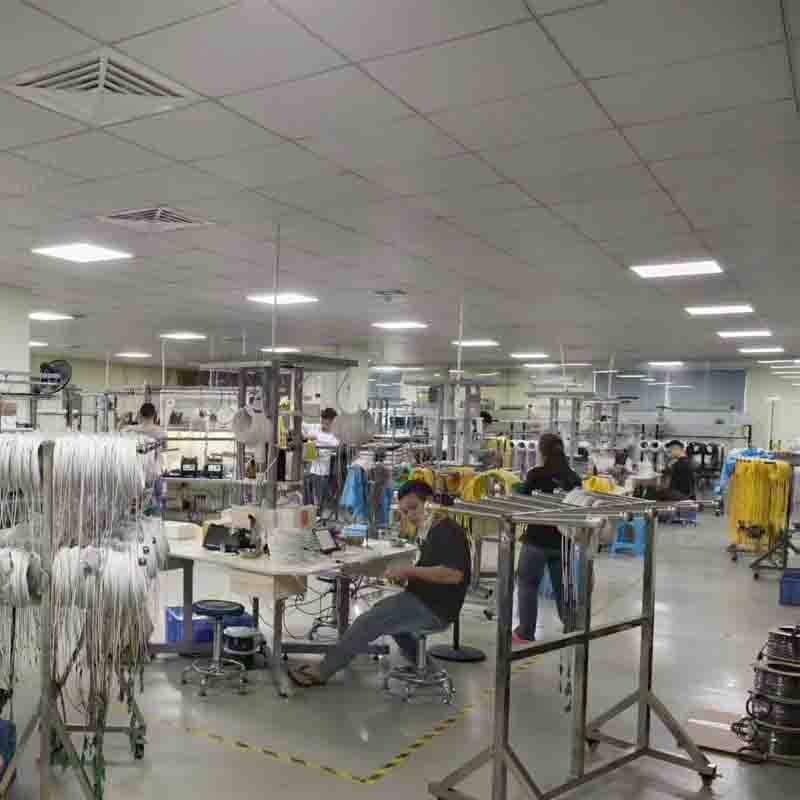
MPO/MTP production site — precision fiber assembly operations, Guangzhou.
Why Factory Evidence Matters in FTTA Procurement
FTTA — Fiber To The Antenna — is the optical link that connects baseband and radio equipment to remote radio units and antennas mounted on a mast or rooftop. Because that link sits outdoors at height, it is exposed to rain, dust, UV radiation, vibration, and repeated temperature swings. An FTTA cable assembly therefore carries durability requirements that an ordinary indoor patch cord does not.
The market behind those assemblies is large and geographically concentrated. Custom Market Insights estimates the global fiber optic cable market at USD 13.45 billion in 2025, with a projected CAGR of 11.72% through 2034. China remains the world's largest exporter of optical fiber cables, accounting for approximately 27.1% of global exports in 2024, valued at USD 2.52 billion according to the Observatory of Economic Complexity. In practical terms, a very large share of the ruggedized outdoor fiber assemblies deployed on 5G sites passes through Chinese manufacturing floors.
That concentration creates a screening problem for buyers. Most supplier websites describe the same connector types and quote the same IP ratings, so the visible layer of the market looks uniform. The differentiating layer — process control, per-unit testing, and environmental validation — is invisible until a buyer either audits the plant or reads a structured account of what happens inside it. This article takes the second route and examines one manufacturing operation in detail.
The 5,000 Square Meter Guangzhou Facility at a Glance
FOCC Fiber Co.,Ltd is a manufacturer specializing in fiber optic connectors, MTP/MPO patch cords, and outdoor waterproof armored patch cord assemblies for data center and FTTA solutions. The company was established in 2014 and now has over ten years of experience in designing and manufacturing fiber optic components, including connectors and patch cords for both data center and FTTA applications.
Its manufacturing footprint sits in Guangzhou, where the plant covers 5,000 square meters. The operation employs approximately 200 staff and runs an annual production capacity of 2,000,000 units. A dedicated engineering group of 30 people works on high-density integration and high-reliability connection technologies. Commercially, 100% of the company's products are exported, primarily to the EU and USA, with products shipped to more than 30 countries and regions and over ten years of ODM/OEM service experience behind them. The company operates under ISO 9001 and ISO 14001 management systems, and its publicly listed partner clients include Prysmian, Siemens, Coherent, Fujikura, and NTT.
| Facility Indicator | Stated Figure | Why a Buyer Reads It This Way |
|---|---|---|
| Establishment | 2014, over 10 years of operation | Indicates a manufacturing history long enough to have survived at least one full product-generation cycle |
| Plant area | 5,000 square meters, Guangzhou | Supports dedicated assembly and inspection zones rather than a single shared line |
| Headcount | Approximately 200 staff | Sizing signal for operator coverage across multi-shift production |
| Annual capacity | 2,000,000 units | Production headroom reference for volume program planning |
| Engineering | 30 R&D engineers | Capacity to absorb custom connector, fan-out, and length requests |
| Export profile | 100% export, primarily EU/USA | Product documentation and testing tend to be shaped by EU/US buyer requirements |
| Management systems | ISO 9001 and ISO 14001 | Baseline qualification evidence for supplier onboarding |
What Is Actually Built Inside the Plant
Two product families move through the Guangzhou floor, and understanding both explains why the facility is equipped the way it is.
Outdoor Waterproof FTTA Fiber Optic Patch Cord
This is the assembly that sits between the equipment cabinet and the remote radio unit in a 5G outdoor deployment. The product carries model designations such as ODC-APC-Fullax-APC-OS2 and ODC-UPC-Optitab-UPC-OM3, covering FTTA Outdoor Waterproof ODC-Fullax Patch Cord and FTTA Outdoor Waterproof ODC-Optitab Patch Cord configurations. Its construction uses a zirconia ceramic ferrule, a stainless steel ODC connector shell, a PE cable jacket, an armored fiber core, and a silicone rubber sealing ring.
Declared optical and mechanical specifications include a protection level of IP67/IP68, insertion loss of ≤0.30 dB, return loss of ≥60 dB for APC polish, an operating temperature range of −40°C to +75°C, and tensile strength of ≥1000 N. Fiber options span OS2 single-mode together with OM2, OM3, OM4, and OM5 multimode.
MPO/MTP Fiber Optic Patch Cord
The second family is the high-density multifiber cord used in data centers. Model designations include MPO-12-OS2-APC, MTP-24-OM4-UPC, and MTP-48-OM3-UPC, with core counts of 12, 16, 24, and 48. Declared specifications include insertion loss of ≤0.35 dB for Elite grade and ≤0.5 dB for standard grade, return loss of ≥60 dB (APC) or ≥50 dB (UPC), an operating temperature range of −20°C to +70°C, an LSZH low-smoke zero-halogen jacket, and Telcordia GR-326 compliance. Materials include a zirconia ceramic ferrule, a PBT/PEI connector housing, Kevlar aramid yarn, and an LSZH or PVC cable jacket.
The reason both families belong in one plant is capability overlap. Ferrule geometry control, end-face preparation, multifiber alignment, and optical metrology are shared disciplines. A facility tooled for 12-to-48-fiber termination is also tooled for the tighter mechanical tolerances that a ruggedized single-fiber outdoor assembly demands.
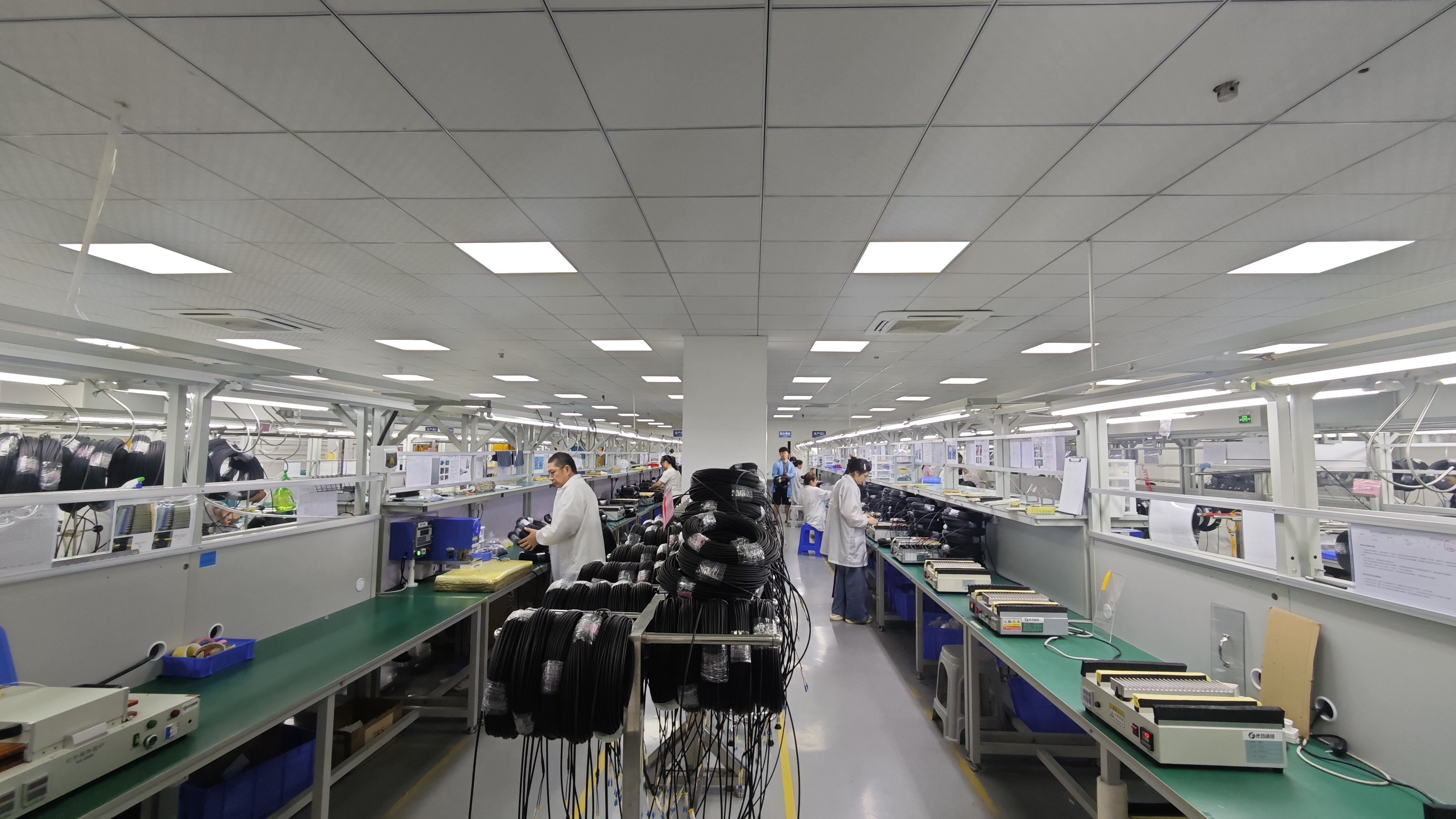
Waterproof jumper processing — sealing ring and connector shell assembly for outdoor FTTA patch cords.
Quality Assurance: 100% Insertion Loss Testing and Automated Alignment Inspection
The clearest answer to the question "how do I know the spec holds at volume" is a per-unit testing regime rather than a sampling regime. For its FTTA outdoor assemblies the operation runs 100% insertion loss testing, supported by automated alignment inspection at the termination stage. In other words, every assembly is measured, not one assembly per lot.
The logic is straightforward. Insertion loss is the most consequential optical parameter in an FTTA link, because it is the loss that accumulates across every connector interface in the chain. When a product is declared at ≤0.30 dB, the only reliable way to keep that figure across a production run is to measure each unit and divert out-of-tolerance assemblies before packing. Sampling-based QC can miss a slow drift in ferrule alignment or polish quality, and that drift typically surfaces later, at the tower site, where remediation is expensive.
A representative production and verification sequence for an outdoor FTTA patch cord looks like this:
- Component preparation. Zirconia ceramic ferrules, stainless steel ODC connector shells, armored fiber core, PE jacket stock, and silicone rubber sealing rings are staged against the bill of materials for the specific model, such as ODC-APC-Fullax-APC-OS2.
- Termination with automated alignment inspection. Fibers are positioned and inspected under automated alignment, targeting the geometric tolerances that determine insertion loss and return loss.
- 100% insertion loss testing. Each finished assembly is measured against the ≤0.30 dB design target, with return loss verified against the ≥60 dB APC requirement where APC polish is specified.
- Assembly of the outdoor protection system. The armored core, PE jacket, silicone sealing ring, and connector shell are brought together to build the IP67/IP68 sealing stack.
- Mechanical and environmental validation. Tensile testing at the ≥1000 N declared rating, sealing verification against IP67/IP68, thermal cycling across the declared −40°C to +75°C range, and salt-spray corrosion testing.
The buyer takeaway: request the record, not the claim. A supplier running 100% insertion loss testing should be able to produce unit-level or lot-level test data that maps to the specific shipment. That record is the difference between a marketing statement and a verifiable one.
Environmental Qualification: IP68, Tensile Strength, Thermal Cycling and Salt Spray
Outdoor FTTA assemblies fail in four recognizable ways: water ingress, mechanical overload, thermal stress, and corrosion. The qualification program addresses each of them.
Water ingress — IP67/IP68 protection
The outdoor FTTA patch cord is specified at protection level IP67/IP68. The sealing stack combines a silicone rubber sealing ring with a stainless steel ODC connector shell. This matters because the interface is not merely a connector; it is a pressure and moisture boundary that must survive repeated mating cycles on a mast.
Mechanical load — tensile strength ≥1000 N
The declared minimum tensile strength for the outdoor FTTA patch cord is ≥1000 N. This figure describes the whole cable assembly, including the armored fiber core and the connector-to-cable joint — the point at which a poorly built assembly typically fails when a rigger pulls a jumper into position.
Thermal stress — cycling across −40°C to +75°C
The declared operating temperature range is −40°C to +75°C. The application profile for these assemblies identifies a wide temperature range, rain, dust, UV exposure, mechanical vibration, and high tensile stress as the working conditions they are designed against. Thermal cycling is the test that converts that declared range into evidence: repeated excursions between the cold and hot limits stress the ferrule bond, the jacket, and the elastomeric seal simultaneously.
Corrosion — salt-spray testing
Salt mist is a recognized environmental test category for outdoor fiber connector systems. The FullAXS connector system, a widely referenced outdoor FTTA interface, is designed for IP67/IP68 waterproof protection and salt-mist resistance and complies with IEC 61300-2 environmental testing standards, as documented by TE Connectivity in its published connector-system material. For a buyer, the practical question is not whether salt-spray testing is desirable but which standard the supplier's report is written against, and whether the report covers the specific assembly and finish being purchased.
A framing note belongs here. A declared test capability remains a claim until the underlying report is reviewed. The value of the factory-evidence approach is that it converts these claims into documents a procurement team can actually inspect, compare, and file.
Technical Explanation: What Determines FTTA Performance Outdoors
FTTA deploys optical fiber from baseband equipment to the remote radio unit or antenna. Several connector interfaces are in common use for this purpose: ODC (Optical Distribution Connector), FullAXS, NSN-LC duplex, and ODVA fan-out connectors are standard FTTA connector types for 5G base stations, and all typically require IP67/IP68 ratings. Which interface a project uses is usually dictated by the radio vendor and the operator's site standard rather than chosen freely by the buyer.
Three technical dimensions then determine whether the chosen assembly performs:
- Optical budget. Insertion loss and return loss set how much signal margin remains. An assembly declared at ≤0.30 dB insertion loss and ≥60 dB return loss (APC) consumes a defined slice of that budget, and consistency across units matters more than the best single unit.
- Mechanical integrity. Tensile rating, cable retention, and vibration resistance determine whether the link survives installation and years of wind loading.
- Environmental sealing. IP67/IP68 protection, UV-stable jacketing, and corrosion-resistant metalwork determine whether the optical path stays dry.
Material selection maps directly onto those dimensions. A zirconia ceramic ferrule provides hardness and wear resistance at the mating interface. A stainless steel ODC shell resists corrosion. A PE jacket handles abrasion and UV exposure. An armored fiber core adds crush and rodent resistance. A silicone rubber sealing ring maintains elastic recovery across the −40°C to +75°C range. None of these choices is decorative; each one addresses a specific failure mode.
Application and Use Cases
The outdoor FTTA assemblies are engineered for 5G telecommunication, mobile network operators, industrial IoT, railway communication, and public safety communication. Typical project types include 5G base station RRU/AAU interconnection, FTTA, outdoor small cell deployment, and railway signal transmission. Deployment references span the United States, Germany, Canada, South Korea, the Netherlands, Saudi Arabia, the UAE, and Russia, with the EU noted as a primary market for the 5G outdoor range.
In operation the assembly works continuously between base station equipment and the remote antenna unit, matching against equipment such as 5G base station RRU/AAU units, optical distribution boxes, antenna feeders, waterproof cable glands, and fiber optic closures.
The MPO/MTP family serves a different environment altogether: clean-room data center conditions in the United States, Germany, Canada, South Korea, and the Netherlands. There, the assemblies support high-density data center cabling, 400G/800G high-speed transmission, cloud server interconnection, and storage area network links, matching against switches, servers, high-speed optical transceivers, MPO patch panels, and cable management systems.
| Dimension | Outdoor Waterproof FTTA Fiber Optic Patch Cord | MPO/MTP Fiber Optic Patch Cord |
|---|---|---|
| Environment | Outdoor harsh environment: rain, dust, UV, vibration | Clean-room data center interior |
| Protection level | IP67 / IP68 | Not applicable (indoor) |
| Insertion loss | ≤0.30 dB | ≤0.35 dB (Elite) / ≤0.5 dB (standard) |
| Return loss | ≥60 dB (APC) | ≥60 dB (APC) / ≥50 dB (UPC) |
| Operating temperature | −40°C to +75°C | −20°C to +70°C |
| Tensile strength | ≥1000 N | Not specified in the same outdoor frame |
| Typical interface | ODC, FullAXS, Optitab | MPO/MTP multi-fiber |
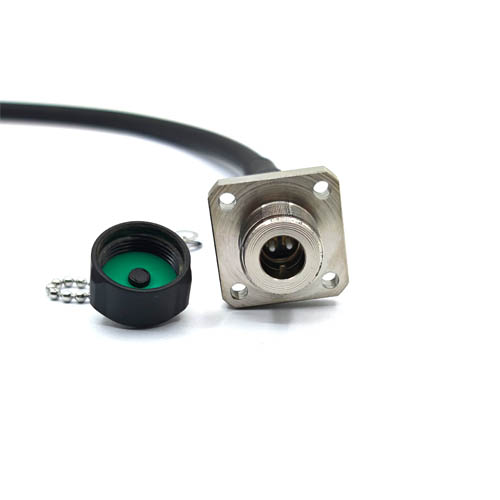
ODC female optical patch cable — one of the ruggedized interfaces used for outdoor FTTA links.
Market Trend Analysis
Two trends shape how buyers should read facility evidence over the next several years.
The first is volume growth. With the global fiber optic cable market estimated at USD 13.45 billion in 2025 and projected to grow at a CAGR of 11.72% through 2034, and with China accounting for approximately 27.1% of global optical fiber cable exports in 2024 at a value of USD 2.52 billion, the supply base continues to concentrate in a small number of manufacturing regions. For procurement teams, that concentration makes comparative factory assessment more important, not less.
The second trend is the migration of outdoor connector standards toward a smaller set of ruggedized interfaces. As ODC, FullAXS, NSN-LC duplex, and ODVA fan-out connectors become the standard FTTA connector types for 5G base stations — all typically carrying IP67/IP68 ratings — the competitive question shifts. It is no longer "can you supply this connector type," because most credible suppliers can. It becomes "can you hold the insertion loss and sealing specification at volume, and can you prove it." That shift favors suppliers with per-unit optical testing and documented environmental validation.
A third, quieter trend is the convergence of FTTA and data center precision manufacturing. The same ferrule, polish, and metrology capability serves an outdoor ruggedized assembly and a 48-fiber MPO trunk. Buyers running both a 5G rollout and a data center program increasingly look for a factory that can serve both, which is why a facility producing MTP/MPO patch cords and outdoor waterproof assemblies side by side is worth noting.
One caveat on market numbers: published fiber optic cable market sizes vary by scope. Estimates differ depending on whether the figure counts raw cable or complete assemblies and accessories, so buyers should read any single market number as directional rather than definitive.
Factory-Built FTTA Assemblies vs Conventional Patch Cords
The comparison that matters for specification decisions is between a standard indoor patch cord, a lightly protected outdoor cord, and a fully ruggedized IP67/IP68 FTTA assembly.
| Attribute | Standard Indoor Patch Cord | Light Outdoor / IP65-Type Cord | Ruggedized IP67/IP68 FTTA Assembly |
|---|---|---|---|
| Sealing | None | Limited water resistance | IP67/IP68 with silicone sealing ring and stainless steel shell |
| Mechanical strength | Low | Moderate | ≥1000 N declared tensile strength |
| Temperature range | Narrow | Narrower than ruggedized designs | −40°C to +75°C |
| Corrosion resistance | Not designed for it | Limited | Salt-spray tested against IEC 61300-2 environmental standards |
| Typical use | Indoor racks and patching | Sheltered outdoor runs | Mast-mounted 5G RRU/AAU and FTTA links |
The limitation belongs in the same paragraph as the advantage. Ruggedized IP67/IP68 FTTA assemblies are not the correct or economical choice for every link. They carry a cost and assembly-complexity premium over standard indoor patch cords, and specifying IP68 protection on protected indoor runs adds expenditure without adding reliability. Environmental ratings are also conditional rather than absolute: an IP68 assembly installed with an incorrect gland, routed below its minimum bend radius, or reassembled with a damaged sealing ring will not deliver the rated protection. The rating describes a correctly installed assembly, not the connector in isolation.
A second boundary is scope. FOCC Fiber Co.,Ltd's stated product range centers on fiber optic connectors, MTP/MPO patch cords, and outdoor waterproof armored patch cord assemblies. Projects that require raw optical cable manufacturing or a complete passive infrastructure package may therefore need complementary suppliers alongside this one. Recognizing that boundary early prevents an unrealistic single-source assumption during the research stage.
Future Outlook
Continued densification of 5G networks and the growth of outdoor small cell deployment keep demand pointed at ruggedized outdoor assemblies rather than indoor substitution. As outdoor connector interfaces standardize further around IP67/IP68-rated ODC, FullAXS, NSN-LC duplex, and ODVA formats, the practical differentiator for buyers will increasingly be process evidence: unit-level insertion loss data, defined environmental test standards, and a quality management system with a scope that matches the product being purchased.
On the data center side, the migration toward 400G and 800G transmission keeps pulling multifiber precision requirements upward, which reinforces the value of factories that can hold tight tolerance across both outdoor and indoor product families. The reasonable expectation for the near term is not a dramatic change in connector architecture but a steady rise in the documentation standard buyers demand before placing volume orders.
FAQ
What is FTTA and how does it differ from standard indoor fiber cabling?
FTTA, or Fiber To The Antenna, is the practice of running optical fiber from baseband equipment to the remote radio unit or antenna on a 5G site. It differs from indoor fiber cabling primarily in environment and interface: FTTA assemblies operate outdoors under rain, dust, UV exposure, vibration, and wide temperature variation, and they use ruggedized connector interfaces such as ODC, FullAXS, NSN-LC duplex, or ODVA fan-out, typically rated IP67/IP68. Indoor patch cords are designed for clean-room or cabinet conditions and do not carry those sealing or mechanical requirements.
What should a buyer verify when evaluating an FTTA cable factory?
Verification typically covers six things: the declared protection level (IP67/IP68), the insertion loss and return loss specification, the tensile rating, the operating temperature range, the environmental test standards behind any salt-spray or thermal-cycling claim, and whether optical testing is performed on every unit or by sampling. Supporting context includes manufacturing footprint and annual capacity, export profile, and the scope of the quality management system. A supplier operating 100% insertion loss testing should be able to produce records that map to a specific shipped lot.
Which connector types are used in FTTA deployments?
Common FTTA connector types for 5G base stations include ODC (Optical Distribution Connector), FullAXS, NSN-LC duplex, and ODVA fan-out connectors, and all typically require IP67/IP68 ratings. The choice is normally set by the radio equipment vendor and the operator's site standard rather than selected freely by the buyer, so the supplier's task is usually to build to the specified interface rather than to recommend one.
Why does 100% insertion loss testing matter more than a good sample result?
Because insertion loss is the parameter that accumulates across every connector interface in an FTTA link, and because a sample only demonstrates what the process could do on the day the sample was built. When a product is declared at ≤0.30 dB insertion loss, testing every assembly and diverting out-of-tolerance units is what keeps that number accurate across a production run. Sampling-based inspection can miss a gradual drift in ferrule alignment or end-face quality, and that drift usually becomes visible later, at the tower site, where remediation costs far more than the assembly itself.
Is an IP68 rating always necessary for outdoor fiber connections?
No. IP67/IP68 rated assemblies are engineered for exposed mast-mounted and outdoor infrastructure positions where water ingress and mechanical load are real risks. For sheltered runs, indoor cabinets, or protected enclosures, a standard patch cord remains appropriate and avoids the cost and assembly complexity premium that ruggedized outdoor assemblies carry. Over-specification does not improve reliability; it only raises cost. It is also worth noting that an IP rating describes a correctly installed assembly, so installation practice — correct glands, correct bend radius, undamaged sealing rings — remains part of the reliability equation.
This analysis draws on product specifications, manufacturing profile information, and published third-party market and standards references. Where a performance figure is a manufacturer declaration rather than an independently verified result, it is presented as a declaration, and buyers are advised to request the corresponding test documentation for the specific assembly and production lot under consideration.