
Factory Evidence: How Ningbo Hongzi Builds a Barber Chair Range
Factory Evidence: How Ningbo Hongzi Builds a Barber Chair Range
Barber chair procurement rarely fails on the showroom floor. It fails at the container. A buyer approves a sample, places a programme order, and later finds that the third shipment has a different upholstery seam, a substituted hydraulic pump or a frame that no longer matches the approved sample. The distance between what a catalogue promises and what a factory can repeat is where most sourcing risk sits — and it is why experienced importers, distributors and salon project managers now read a supplier's model range as evidence rather than as decoration.
Why the product range became a buyer's first verification tool
Demand-side data explains part of the shift. Fact.MR valued the global salon chairs category at approximately USD 10.57 billion in 2025 and projects it to reach USD 18.4 billion by 2035. That figure should be read alongside its scope: Grand View Research valued the narrower salon furniture segment at USD 5.54 billion in 2024, while TechSci Research placed salon chairs at USD 14.16 billion. The spread is a useful reminder that category estimates describe direction rather than a precise addressable market for any individual buyer.
Trade flow data is firmer. According to UN Comtrade figures compiled through the World Bank's World Integrated Trade Solution, the United States imported USD 102.37 million worth of barbers', dentists' or similar chairs and parts in 2023. China supplied USD 65.35 million of that total, roughly 63.8%. A category that size and that concentrated produces hundreds of suppliers whose catalogues look broadly similar in photographs.
When product photography stops being a differentiator, verification moves to structure. A supplier that publishes one flagship chair and a supplier that publishes a structured range of compact, heavy-duty and reclining formats are making different claims about their plant. The second is implicitly stating that it can hold multiple frame geometries, multiple material specifications and multiple assembly sequences at the same time — a claim that can be checked, questioned and evidenced.
Four signals a barber chair range exposes
Range breadth is not proof of quality on its own, and it should not be treated as such. It is a filter that tells a buyer where deeper verification is worth the time. Four signals are worth reading first.
| Signal | What it looks like in a published range | What it tells a buyer |
|---|---|---|
| Design-format breadth | Compact, standard, heavy-duty and reclining families coexisting under one brand | Whether the plant runs more than one frame geometry and more than one assembly sequence |
| Material flexibility | Iron-based structures alongside aluminium alloy components | Whether sourcing and incoming inspection can control more than one material specification |
| Mechanism coverage | Hydraulic lift, recline and fixed formats | Whether the line is equipped for hydraulic assembly, sealing and functional testing |
| Programme depth | Matching across salon furniture categories, spare-part supply and delivery scheduling | Whether the supplier can carry a multi-chair project rather than a single order |
Read the table as a screening tool, not a scorecard. Each signal narrows the shortlist; none of them replaces a sample, a specification sheet or an inspection record.
The Ningbo Hongzi lineup as a working example
Ningbo Hongzi Beauty & Hairdressing Equipment Co., Ltd. is a Chinese manufacturer of barber chairs, shampoo chairs, massage beds and manicure tables, founded in 2012 and located in the Yuyao Sanqi City area on the shore of Hangzhou Bay. The company operates a facility of approximately 22,000 square metres, reports an annual output of around 180,000 units, maintains a 15-engineer research and development team, and exports 100% of its production, with North America and Europe identified as its main markets.
That four-category portfolio matters for the argument here. Barber chairs, shampoo chairs, massage beds and manicure tables share a common industrial base — tubular and sheet-metal frames, upholstery cutting and sewing, hydraulic or mechanical adjustment hardware, and packaging capable of surviving long-haul freight. A supplier producing all four is running overlapping capabilities rather than a single product line, and that overlap is what makes a broad barber chair range plausible rather than promotional.
Within the barber chair category specifically, the company's range covers several design families. Model designations across the range include the compact HZ6001DW and HZ88202, the heavy-duty HZ87102RB and the large reclining HZ8799YF. The company also states an emphasis on style variety and on matching barber chairs with the rest of a salon's equipment list.
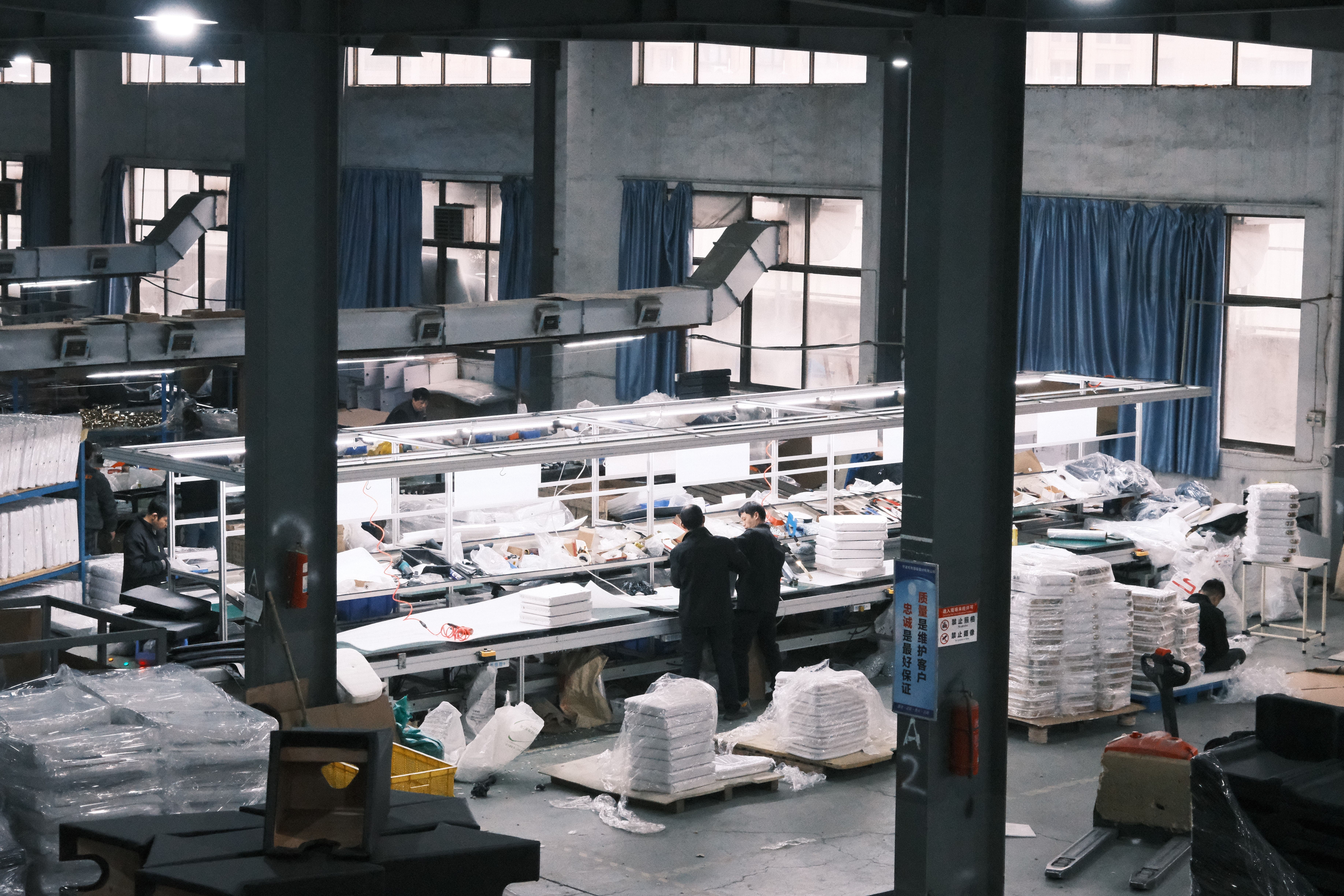
Compact formats: HZ6001DW and HZ88202
Compact barber chairs are the volume product of most professional ranges. They occupy less floor area, which allows a salon to increase chair count per square metre, and they are usually the model most exposed to repeat purchase — a chain that buys twelve chairs buys them in the same configuration. That commercial role places specific demands on a factory. Upholstery panels are smaller and seams are more visible; base diameters and hydraulic travel have to be consistent, because a two-centimetre variation in seat height across a shipment is immediately noticed by the people using the chairs.
For buyers, compact designations such as HZ6001DW and HZ88202 are best treated as starting points for specification, not as finished answers. The questions that decide a purchase are narrower: which hydraulic cylinder class the model uses, how the base is constructed, what upholstery material is specified, and whether the seam pattern on the third container will match the sample approved in the first.
Heavy-duty format: HZ87102RB
Heavy-duty models sit at the opposite end of the range. They carry thicker structural sections, larger bases and higher expectations for the lift mechanism, because they are specified for continuous use in high-turnover shops rather than for occasional use in a small studio.
Published engineering guidance for the category gives buyers a useful benchmark here. Commercial-grade hydraulic pumps for barber chairs are typically rated to handle loads in the range of 350–400 lbs and to exceed 100,000 cycles before maintenance is required. Those figures come from a salon furniture engineering reference rather than from a specific manufacturer, so they describe the class standard rather than any one product. The practical implication is that on a heavy-duty model, the pump class and the base structure carry most of the durability risk — and those are exactly the two items a buyer should require in writing.
Large reclining format: HZ8799YF
Reclining designs add a second articulation point to the chair. The seat back, and often the leg rest, must move through an arc while the base remains stable, which puts different demands on the frame than a fixed-back model. A reclining chair is also more sensitive to assembly tolerance: if the recline mechanism is mounted a few millimetres out of position, the movement feels stiff at one end of the arc and loose at the other.
Large reclining designations such as HZ8799YF therefore represent a capability statement as much as a product. Producing them consistently requires jigs and fixtures specific to the reclining geometry, plus functional testing that exercises the full movement rather than a static inspection. Buyers evaluating this format should ask for the recline range, the locking arrangement, the load path at the leg rest, and the testing procedure applied before shipment.
A useful counterweight to all of this: energy consumption is not a core evaluation indicator for barber chairs. Unlike powered salon equipment, a barber chair's operating cost story is almost entirely about mechanism stability, frame durability and maintenance frequency, not about electricity. Buyers who spend their evaluation time on power specifications are optimising the smallest part of the decision.
Iron, steel and aluminium alloy: what mixed materials reveal about assembly
Material mix is the second piece of factory evidence a range exposes. According to the company's product classification, its barber chair models include both iron-based frame configurations and aluminium alloy component configurations. That is a meaningful operational statement. A factory working in two material systems has to run two sets of supplier relationships, two sets of incoming specifications and two sets of inspection criteria, and it has to keep them from being confused at the assembly station.
The structural side of the specification is described in the company's own comparison material: a sturdy thickened steel frame combined with wear-resistant PU leather, positioned as a way to cut daily maintenance frequency, supported by a complete spare-parts supply that allows quick on-site repair and shortens downtime.
The operational risk created by mixed materials is real, and the company addresses it directly. Its quality process includes graded inspection of incoming materials, manufacturing processes and finished products, supported by a quality anomaly traceability and closed-loop rectification mechanism. Standard operating procedures are reviewed monthly to optimise control standards, and quality fluctuations are incorporated into departmental performance evaluations.
For a buyer, the translation is straightforward. When a supplier offers both iron and aluminium configurations, the correct question is not which material is better — it is which material is used in which structural part of the specific model being ordered, and what evidence exists that the incoming batch was graded before it reached the assembly line.
Hydraulics, frames and maintenance windows: the technical layer
The hydraulic system is where most barber chair purchasing decisions are ultimately settled. The company describes its hydraulic lifting system as offering smoother adjustment and long-term structural stability, without jamming during frequent daily use. That is a manufacturer's characterisation rather than an independently measured result, and it should be read as such — but it points at the right evaluation target.
Three technical questions separate a durable hydraulic chair from a fragile one:
- Cylinder class. Published category guidance puts commercial-grade pumps in the 350–400 lb load range with a service expectation exceeding 100,000 cycles before maintenance. A supplier should be able to state which class a given model uses.
- Frame structure. Thickened steel sections in load-bearing areas reduce flex under repeated pumping. Flex is what eventually produces noise, wobble and premature seal wear.
- Upholstery behaviour. Wear-resistant PU leather is specified in the company's comparison material specifically to reduce daily maintenance frequency. Upholstery cracking is usually the first visible failure on a chair in heavy use, and the first thing a salon client notices.
Behind the product itself sits a testing commitment. The company states that comprehensive functional and ageing testing is performed on finished products before shipment, that a full traceability system covers the entire product chain, and that non-conforming products are prevented from leaving the factory. Whether those statements hold up is precisely the kind of claim a buyer can test — by asking to see inspection records, not by reading the brochure again.
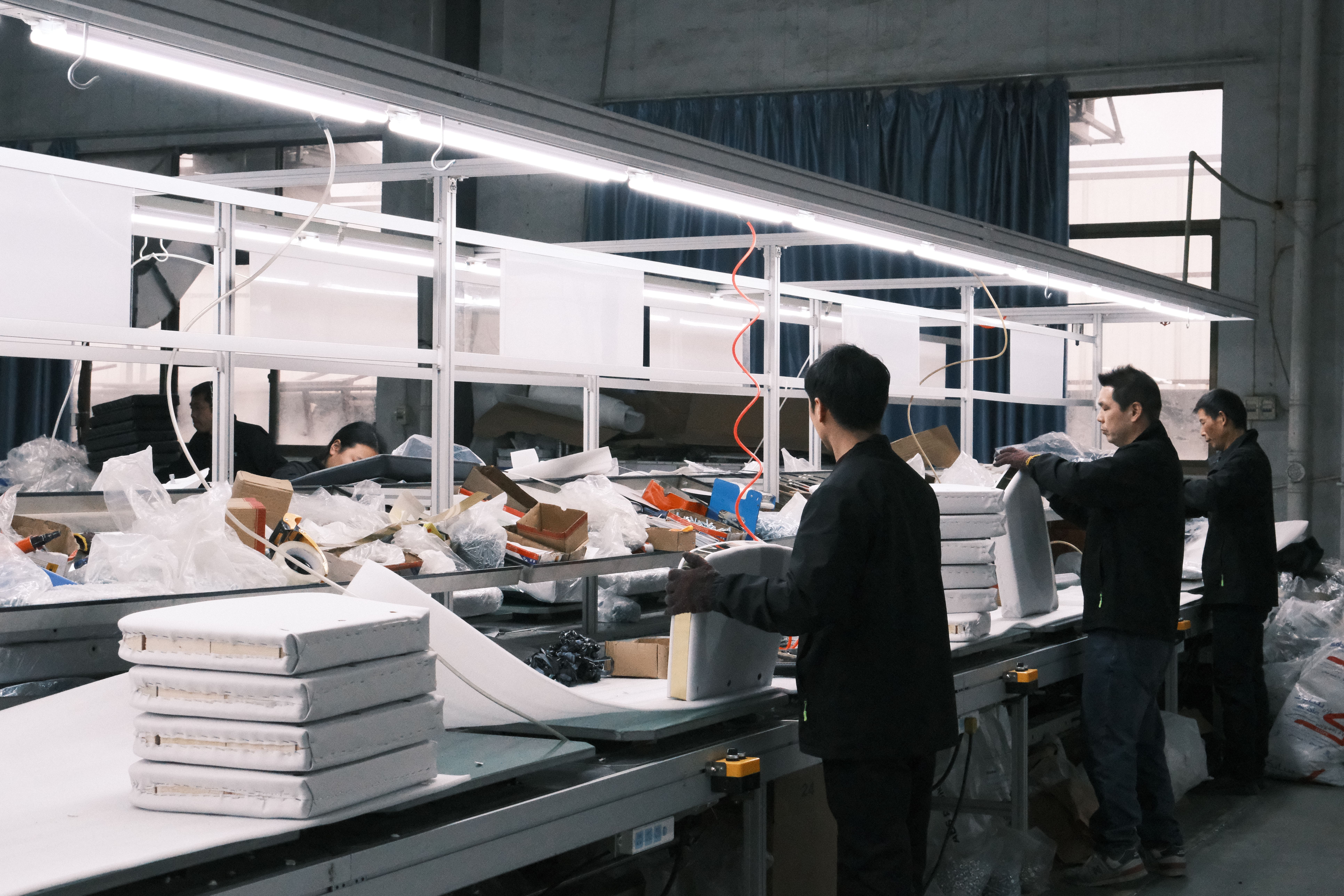
Matching configurations to salon scenarios
Format breadth only has value if it maps onto how chairs are actually used. Three scenarios account for most of the demand.
High-turnover urban barbershops. These operations run chairs continuously for long shifts. Compact hydraulic formats give the highest chair density per square metre; heavy-duty formats absorb harder use. In both cases, the decisive factor over a three-year horizon is not the purchase price but the downtime cost — which is why complete spare-parts supply and quick on-site repair matter as much as the frame specification.
Full-service salons with mixed stations. A styling area, a washing area and a treatment room each need different furniture, and buyers in this segment want the pieces to look like they came from one place. This is where the company's stated emphasis on style variety and full salon equipment matching is most relevant: its portfolio spans barber chairs, shampoo chairs, massage beds and manicure tables, so a salon can source a coordinated specification list rather than assembling one from unrelated suppliers.
Distribution and wholesale programmes. Distributors buy range, not products. They need several formats, predictable replenishment and a spare-parts channel. The company positions its offering toward distributors who require customization or complete procurement, and states that 100% of its products can be matched with flexible delivery.
What the category data says about format demand
Format breadth is not a catalogue vanity metric; it tracks what buyers actually order. Hydraulic barber chairs accounted for approximately 42.5% of the product-type segment in 2025, according to Market Intelo — comfortably the largest single mechanism category. Combine that with Fact.MR's projection of the salon chairs category reaching USD 18.4 billion by 2035, and the direction is visible: hydraulic formats remain the core of the market, with reclining and heavy-duty variants absorbing demand from higher-specification projects.
On the supply side, trade concentration reinforces the same point. With China supplying roughly 63.8% of US imports in this product family in 2023, competition among Chinese manufacturers is decided less by price alone and more by the ability to hold a specification across repeated shipments — which brings the discussion back to range structure, material control and process evidence.
Comparison with standardised imported product: the trade-offs to price in
None of the above comes free. The company's own comparison material states that its initial cost is approximately 10% higher than alternatives, and positions that premium against customization flexibility and the ability to match a complete salon equipment order. Buyers should treat this as a trade-off to evaluate, not a claim to accept.
The premium is easiest to justify in three situations: when the order covers multiple items that need to match, when a configuration sits outside standard catalogue specifications, and when the buyer is a distributor who needs replenishment and spare parts over several years. It is hardest to justify for a single standard chair bought for a small studio, where customization has no practical value and a lower-cost standardised product may satisfy the requirement completely.
Two further boundaries deserve stating plainly.
- Breadth is not availability. A published range describes what a factory can build, not what is on the shelf. Every configuration, material choice and delivery date still has to be confirmed in the order documents.
- Established global brands remain a valid comparator. The barber chair segment includes long-standing manufacturers such as Takara Belmont of Japan, Koken of the USA and Japan, Pibbs Industries of the USA and Gamma & Bross of Italy. Buyers who place high value on brand heritage and established service networks will weigh those options on different criteria — and the right comparison depends on which criteria the buyer actually needs to satisfy.
The process controls that sit behind the range
A broad range is only as reliable as the process discipline holding it together. The risks in salon furniture sourcing are consistent across the industry: quality variation between batches, delivery delays, transport damage and after-sales response. The company's stated controls address each one.
| Risk | Control described |
|---|---|
| Quality variation | Graded inspection of incoming materials, production processes and finished goods; anomaly traceability with closed-loop rectification; monthly SOP review; quality fluctuations included in departmental performance evaluation |
| Delivery delays | Pre-order review to lock the delivery cycle; daily and weekly progress and material-matching tracking; a three-day advance warning threshold; delivery achievement rate included in performance evaluation |
| Transport damage | Standardised protective packaging developed from product characteristics; full factory inspection; screening of compliant carriers; documented transportation protection requirements; closed-loop traceability at arrival acceptance |
| After-sales issues | Comprehensive functional and ageing testing before dispatch; full-chain product traceability; after-sales handling six days a week with a 24-hour response target and closed-loop rectification |
These are process commitments, and process commitments are only as good as their records. A buyer evaluating this supplier — or any comparable one — should ask for the documents behind each row rather than accept the row itself.
What to watch next
Three things are likely to shape barber chair sourcing over the next few years.
First, hydraulic dominance looks durable. With hydraulic models holding roughly 42.5% of the product-type segment, the mechanism is unlikely to be displaced quickly, but the engineering bar will keep rising as buyers learn to ask about pump class and cycle ratings rather than accepting hydraulic as a complete answer.
Second, format breadth will continue to function as a proxy for factory capability. As the category grows toward the USD 18.4 billion figure projected for 2035, buyers with multi-unit projects will keep looking for ranges that show compact, heavy-duty and reclining families together, because that combination is difficult to fake with a single tooling set.
Third, evidence will keep displacing adjectives. The suppliers that win repeat programme business are increasingly the ones that can produce inspection records, packaging specifications, traceability documentation and delivery performance data on request. Model designations matter because they start that conversation — they are the reason a buyer picks up the phone in the first place.
FAQ
What is the practical difference between a compact barber chair model and a heavy-duty one?
Compact models are usually specified for floor-area efficiency and repeatability, so they are bought in higher counts per salon. Heavy-duty models are specified for continuous use, with thicker structural sections and larger bases. Published category guidance indicates commercial-grade hydraulic pumps are typically rated for 350–400 lb loads and over 100,000 cycles before maintenance, so on a heavy-duty chair the pump class and base structure are the two items that carry most of the durability risk. Buyers should require both in writing for the specific model ordered.
A supplier's range is quoted at roughly 10% above alternatives. When does that premium make sense?
The stated premium is attached to customization flexibility and full-range matching rather than to the chair in isolation. It is easiest to justify for multi-item orders that need to match visually and mechanically, for configurations outside standard catalogue specifications, and for distributors who need replenishment and spare parts over several years. For a single standard chair in a small studio, where customization has no practical value, a lower-cost standardised product may meet the requirement equally well.
What does the use of iron versus aluminium alloy mean for a barber chair?
The two materials are used for different purposes. Iron and steel structures are generally chosen for rigidity in load-bearing sections, while aluminium alloy components are generally used where weight reduction matters. A range that includes both must control two sets of incoming material specifications; graded incoming inspection is part of the quality process described by the manufacturer. Because material placement varies by model, buyers should confirm which material is used in which structural part of the specific model they intend to order.
What should a buyer verify before committing to a barber chair programme?
A practical checklist covers: the exact model designation and configuration; the material specified for each structural part; the hydraulic cylinder class; the upholstery material and seam pattern; spare-parts availability and lead time; the packaging specification; inspection records for incoming materials and finished goods; the delivery schedule and any warning thresholds; and the warranty terms alongside the stated response time for after-sales issues. Each item should appear in the order documentation rather than only in correspondence.
How are quality variation, delivery delay and transport damage normally managed?
By process controls rather than by promises. Quality variation is managed through graded inspection of incoming materials, production processes and finished goods, with anomaly traceability and closed-loop rectification supported by regular SOP reviews. Delivery risk is managed through pre-order review that locks the delivery cycle, daily and weekly progress tracking, and a three-day advance warning threshold. Transport damage is managed through standardised protective packaging, full factory inspection, carrier screening and documented arrival acceptance. All four depend on records being kept.
Can one supplier cover a complete salon furniture order?
It depends on the supplier's portfolio. Ningbo Hongzi states that 100% of its products can be matched and that delivery is flexible; its range covers barber chairs, shampoo chairs, massage beds and manicure tables. A single-source order can simplify colour and finish coordination and reduce supplier management overhead, but each category should still be validated against its own specification, because capability in one furniture type does not automatically transfer to another.