
Factory Evidence: How USMILE PET's Manufacturing Capabilities Impact Grooming Equipment Quality
Industry Reference · Pet Grooming Equipment · September 2026
Factory Evidence: How USMILE PET's Manufacturing Capabilities Impact Grooming Equipment Quality
Pet Grooming Station Supplies — washing stations sit at the intersection of stainless-steel fabrication, water-circuit assembly and control electronics.
Manufacturing capability is the most asserted and least examined variable in pet grooming equipment procurement. The evidence that survives scrutiny sits one layer lower — inside the construction details of the products themselves.
Suppliers publish photographs of production halls and describe themselves as vertically integrated. Buyers receive catalogs, quotations and specification sheets. Little of that material answers the question a purchasing team actually has: what is the production system behind this product able to do, and how would I know before placing an order?
This reference examines USMILE PET — the export brand of Dalian Usmile Pet Technology Co., Ltd., a pet care equipment manufacturer established in 2018 that supplies grooming, bathing, drying and housing equipment to markets including the EU, the USA, Southeast Asia, the Middle East and Oceania — through that evidence layer. The scope is deliberately narrow: what do the published construction details of its equipment imply about the manufacturing capability a buyer is contracting with, and where do those implications stop?
Why Capability Claims Are Hard to Verify at the Evaluation Stage
Buyers working between evaluation and execution usually have three information sources: the supplier's own description of its factory, the specification sheet, and — if budget and time allow — a physical sample or audit. The first is the least reliable, the second is the most durable, and the third is the most expensive.
Specification data has one property a factory tour does not: it is reproducible and falsifiable. A 4 mm acrylic wall bonded to a stainless-steel frame, a 2 kW thermostatic heater specified at 20–42 °C with ±1 °C tolerance, a self-service wash unit shipped in two plywood cases and assembled with screws — each of these is a commitment. Meeting it requires specific tooling, material sourcing and assembly discipline; failing to meet it exposes the supplier to warranty claims. That is what makes construction detail usable procurement evidence.
The limitation should be stated at the outset, because it shapes how far this analysis can be pushed. Reading specifications is inference, not audit. It cannot prove shop-floor process control, welding consistency across a batch, or the long-term reliability of a control board. What it can do is establish what a manufacturer is set up to build — and eliminate suppliers whose product range implies a narrower production base than the project requires.
Reading the Product Line as Production Evidence
A product line is a footprint of the factory that made it. Companies that mainly assemble purchased components tend to converge on one or two material families, one actuator technology and a narrow set of architectures, because every additional discipline carries tooling, trained labor and quality-system overhead that assembly alone does not.
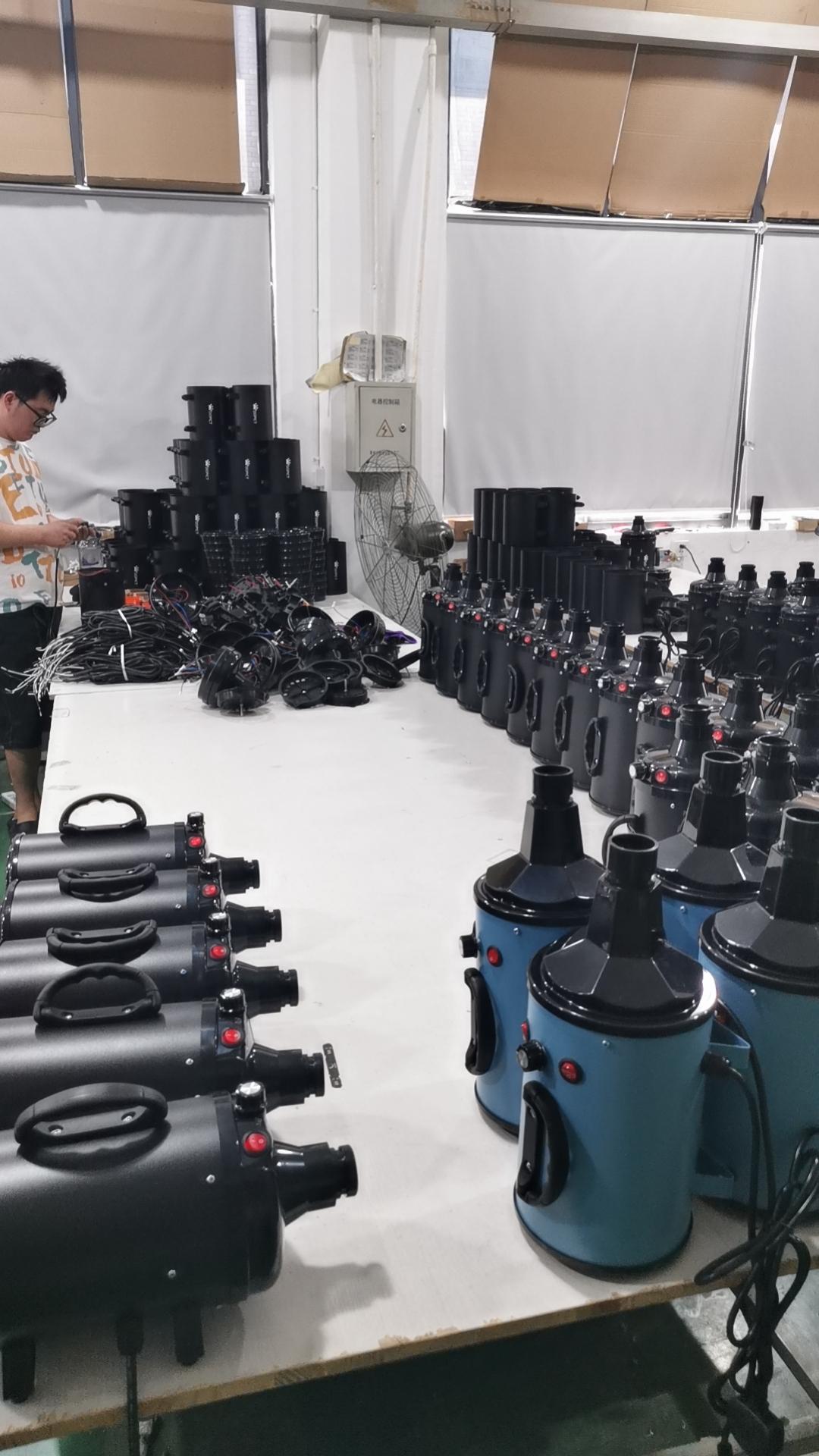
Pet Dryer Blower Factory — the material, actuator and control systems a supplier can build in series are fixed by its production environment.
Material breadth across the range
| Material specified | Where it appears | Production discipline implied |
|---|---|---|
| 4 mm reinforced acrylic + stainless-steel frame | UP-DPbathe dog spa bathtub; UP-DPbathe-8812 pet spa bathtub | Thermoforming, reinforcement bonding, load-bearing frame assembly |
| Acrylic with optional function modules | UPMB-MG Pet SPA Bathtub (60–120 cm external widths) | Forming plus optional-module integration |
| 304 stainless steel | UP-LZ pet bathtub (150×70×149 cm); UP-LZX-05 small-door bathtub (130×74×117–160 cm) | Sheet-metal fabrication, welding, corrosion-grade material control |
| SS304 + tempered glass | UPLZGT-501, UP-YM-D008, UP-YM-D001LP, UP-YM-DCT01 grooming tables | Glass fitting and sealed-edge assembly |
| ABS enclosures | UP-CZ905 and UP-CZTDS2400 dryers; UP-AP-S7 dryer box | Injection molding and enclosure assembly |
| Aluminum | UP-KS-4 show cage trolley; UP-SL-ALAC-249/253 exhibition cage trolleys | Aluminum frame fabrication |
| MDF / particleboard | UP-N-302C and UP-LZ foldable tables | Panel processing and hardware assembly |
An external baseline helps calibrate this. PetEdge, a US grooming equipment supplier, notes that premium pet grooming tubs typically use 14-gauge to 16-gauge Type 304 stainless steel for corrosion resistance and durability — establishing stainless steel as the durability reference point in that market. Against that reference, the USMILE PET catalog runs several material streams in parallel rather than one: thermoformed reinforced acrylic over a stainless frame in the UP-DPbathe dog spa bathtub; 4 mm acrylic with a stainless frame and a tempered-glass door with magnetic seal in the UP-DPbathe-8812; 304 stainless steel baths in the UP-LZ and UP-LZX-05; SS304 table tops with glass in four electric grooming tables; ABS housings in the dryer range; aluminum in the cage trolleys; and panel materials in the folding furniture.
Each family implies a different industrial process — thermoforming and reinforcement bonding for acrylic, sheet-metal cutting and welding for stainless steel, glass fitting and edge sealing for table tops, injection molding for ABS housings, extrusion for cage frames, panel processing for folding furniture. That spread is not proof of quality. It is evidence of production breadth, and breadth is what determines whether a supplier can build a specification rather than source it.
Actuator diversity: pneumatic, hydraulic and electric lifting in one catalog
| Model | Lift technology | Platform size | Material |
|---|---|---|---|
| UPLZGT-401 | Pneumatic | 70×70×(70–100) cm or 60×60×(70–100) cm; 16.5 kg net | Stainless steel |
| UP-LZGT201 | Hydraulic, Z-type with upgraded aluminum alloy edge | 108×60×(53–90) cm; 35 kg net | Stainless steel |
| UP-AP-805A | Hydraulic, round | 70 cm diameter × (71–86) cm height | SS304 |
| UPLZGT-501 | Electric | 120×60×(20–92) cm; 53 kg net | SS304 glass |
| UP-GT301 | Electric | 125×65×(20–95) cm; 54 kg net | Stainless steel |
| UP-YM-D008 | Electric, LED tabletop | 120×60×(61–100) cm; 60 kg | SS304 glass |
| UP-YM-D001LP | Electric, LED tabletop | 115×65×(20–90) cm; 53 kg | SS304 glass |
| UP-YM-DCT01 | Electric with drawers | 115×65×(38–108) cm; 75 kg | SS304 |
Three force-transmission systems in a single catalog is a meaningful data point. Pneumatic lifting requires cylinder sealing and pressure integrity; hydraulic lifting requires fluid containment, seal reliability and, in the Z-type UP-LZGT201, a lifting geometry paired with an upgraded aluminum alloy edge; electric lifting requires motor control, travel limits and electrical safety at platform sizes up to 125×65 cm. The electric models are also the heaviest in the range at 53 kg, 60 kg and 75 kg, which reflects their motorised columns and the SS304 glass work surfaces on the LED versions. For a buyer, the split is a workflow question rather than a quality ranking: light pneumatic frames for mobile or mixed-use stations, hydraulic Z-type frames for fixed positions needing smooth vertical travel, and electric frames where the working platform and illuminated surface matter most.
The Pet Washing Station: Where Integrated Manufacturing Shows Most Clearly
Washing stations are the category where mechanical, hydraulic, electrical and software engineering meet inside one cabinet — and the category in which USMILE PET publishes four distinct architectures.
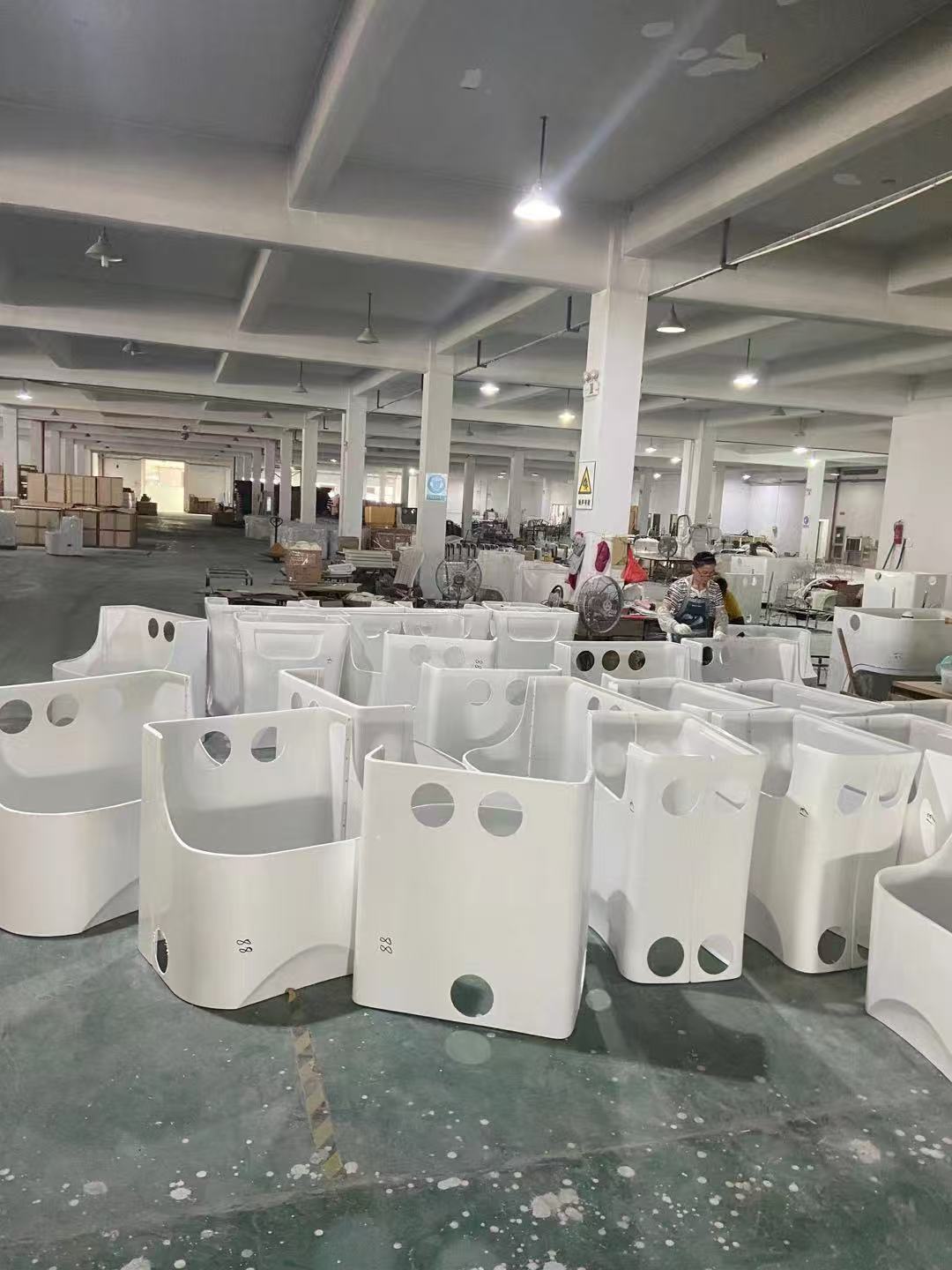
Dog Washing Tub — self-service, fully automatic, wash-and-dry and semi-automatic stations coexist in one supplier's range.
UP-Self: the modular self-service station
The UP-Self self-service dog wash machine is built as a three-part modular design, shipped in two plywood cases and assembled on site with the included screws. Its components are specified individually: a control cabinet of 71.45×64×180 cm, a back panel of 145×90×5 cm and a main wash unit of 145×90×65.65 cm. Functionally it combines a 21.5-inch touchscreen for wash control and advertising, a separate 32-inch display for ad playback, a shower head with built-in dryer over a stainless-steel wash tub, adjustable water temperature and flow, multi-payment support for card, cash and coin, door locks supplied with two keys, adjustable leveling feet and LED lighting. The stated operating model is unattended 24/7 self-service with advertising as an additional revenue stream.
A three-part unit shipped as two crates and screwed together on site is a design-for-assembly and design-for-export decision, not a packaging detail. It implies the manufacturer designed around freight volume and doorway constraints and accepts site assembly as part of the product, which in turn implies electrical and plumbing interfaces engineered to survive field connection. The screen and payment stack move this product closer to kiosk engineering than to traditional grooming hardware.
UP-Machine: the fully automatic single-cabinet station
The UP-Machine fully automatic self-service dog grooming machine measures 123×121×191 cm, weighs 340 kg net, occupies roughly 3 sqm of floor space and is specified for operating temperatures from −20 °C to 60 °C. It runs on 220 V/50 Hz with running power of 1,000–3,000 W and total power of 5.5 kW. Its feature list is sensor-driven: touchscreen control, three size modes for different breeds, bionic scrubbing with orbital shower pressurization, constant-temperature drying and dehumidification, double-layer UV sterilization, a fresh-air purification system, a built-in hair collector, a shampoo shortage warning, 4G/WiFi connectivity for remote management, a door safety lock with door-in-place detection, warm-air high-temperature protection and intelligent thermostatic hot water.
Door-in-place detection, shampoo-level monitoring, thermal protection and remote telemetry are electronics-engineering outputs. They determine not only how the machine behaves but how it is serviced — remote diagnostics rather than truck rolls — which is capability that shows up in the service model, not only in the hardware.
UP-WF: wash-and-dry combination in three sizes
The UP-WF fully automatic machine integrates washing and drying in one enclosure and is published in three capacities: WF011S for pets up to 30 lbs (inner 52×48×60 cm; outer 78×68×124 cm; 125 kg), WF011M up to 60 lbs (inner 52×69×70 cm; outer 78×95×137 cm; 170 kg) and WF011L up to 100 lbs (inner 52×99×80 cm; outer 85×115×154 cm; 210 kg). Rated power is 3,750 W, 4,900 W and 6,250 W respectively at 220 V/50 Hz, with wiring specified at 2.5 mm² for the small model and 4 mm² for medium and large. The machine uses high-speed atomizing nozzles, ventilation that refreshes air every three seconds, adjustable drying temperature of 20–45 °C and a variable-frequency design for energy saving. Published consumption per cycle is ≤1.2 kWh in summer for small and medium models, ≤1.8 kWh for large, rising to ≤2.5 kWh and ≤3 kWh in winter.
The three sizes share an inner width of 52 cm and scale by depth — a platform strategy that limits tooling variation while covering animals from 30 to 100 lbs. Per-cycle energy figures give buyers a direct operating-cost input rather than a qualitative efficiency claim.
UP-Washing: a semi-automatic platform in three footprints
The UP-Washing semi-automatic intelligent pet washing machine operates at 220 V/50 Hz with 8,000 W rated power and holds water at a constant 35–42 °C with ±0.5 °C tolerance. It accepts cash in USD, EUR, JPY and other currencies, coins and credit cards. Three variants target different sites: the HJA99 extended version for medium and large pets (200×60×189 cm, 230 kg) and the HZB88 standard version for small and medium pets (153×60×189 cm, 200 kg), both for outdoor, pet-store, mall and community use, plus the HBC66 portable version for all sizes (50×60×189 cm, 80 kg) aimed at high-end homes, multi-pet families and small studios.
Publishing an 80 kg portable variant alongside two commercial footprints shows that installation site is treated as a design variable rather than a constraint passed to the buyer.
| Model | Architecture | Footprint / key dimensions | Power | Notable integration |
|---|---|---|---|---|
| UP-Self | Modular self-service, 3-part | Main wash unit 145×90×65.65 cm; control cabinet 71.45×64×180 cm | Not stated in the published specification | 21.5" touchscreen, 32" ad display, card/cash/coin payment, built-in dryer |
| UP-Machine | Fully automatic, single cabinet | 123×121×191 cm; 340 kg; ~3 sqm | 5.5 kW total; 1,000–3,000 W running | 4G/WiFi management, UV sterilization, door-in-place detection |
| UP-WF | Fully automatic wash + dry | 78×68×124 / 78×95×137 / 85×115×154 cm | 3,750 / 4,900 / 6,250 W | Atomizing nozzles, air refreshed every 3 s, 20–45 °C drying |
| UP-Washing | Semi-automatic, 3 variants | 200×60×189 / 153×60×189 / 50×60×189 cm | 8,000 W rated | Constant 35–42 °C ±0.5 °C, cash/coin/card payment |
Taken together, these four platforms imply a production system handling stainless-steel sheet fabrication and welding, water-circuit and pump assembly, high-current electrical integration up to a stated 8,000 W, touchscreen control electronics, multi-channel payment hardware and, on the UP-Machine, remote telemetry with a sensor array covering door position, shampoo level and thermal protection. Payment and telemetry integration sits closer to vending and kiosk engineering than to conventional grooming hardware, because it requires firmware development and remote diagnostics rather than mechanical assembly alone.
What the Specifications Imply About the Production System
- Thermoforming and structural reinforcement. A 4 mm reinforced acrylic shell over a stainless-steel frame appears across the UP-DPbathe family, whose water capacity ranges from 90 to 320 L depending on size, up to an external 160×80×95 cm. Water load of that magnitude has to be carried by the frame, which means the reinforcement design is engineered rather than decorative.
- Stainless-steel fabrication and handling. The UP-LZ bathtub is specified in 304 stainless steel at 150×70×149 cm and the UP-LZX-05 at 130×74×117–160 cm. Finished spa bathtubs ship in wooden or plywood crates at 0.45–0.85 m³ and 55–95 kg, while the UP-AP-XXXL three-compartment dryer cabinet moves at 230 kg gross in 1.29 m³.
- Water, heat and sanitation control. Published control parameters include a 2 kW thermostatic heater at 20–42 °C with ±1 °C tolerance and an 800 W surf pump with adjustable jet direction in the spa bathtubs; ozone at 200 mg/h with automatic shut-off after 15 minutes; a micro-bubble milk-bath diffuser on a five-minute cycle; ozone sterilization stated at 99.99% with HEPA filtration and far-infrared plus negative-ion care in the UP-AP-S7 dryer box; and a 2″ quick-release drain with hair trap.
- Safety and status electronics. Door locks, door-in-place detection, warm-air high-temperature protection, shampoo shortage warning, built-in hair collector and adjustable leveling feet appear as standard specification items rather than options — an indication of how the products are validated before release.
- Packaging and export logistics. The two-crate modular washing station, wooden-crate bathtub packaging, and the UP-N-302C foldable grooming table's container loading of 288 / 582 / 662 units per 20GP / 40GP / 40HC indicate packing engineering that is planned at product-design stage.
- Range logic. Bathing platforms escalate from 60 cm to 140–160 cm external width; dryer boxes span pets under 18 kg (UP-AP-S7, 80 L) up to 80 kg (UP-AP-XXXL). A product band filled with consistent specification language usually signals a platform strategy rather than one-off builds.
Application: How the Range Maps to Real Projects
Fixed grooming stations in full-service salons
In Italy, an upscale pet grooming salon installed one unit of the UPMB-MG pet bathtub for pet spa and grooming service upgrade purposes. The UPMB-MG platform is published in four sizes from 60×60×95 cm to 120×80×95 cm with tub depths of 30 cm to 55 cm, and supports optional configurations including surf massage, air bubble with lights, ozone, a touch control panel and an additional nano milk bath. In the United States, a professional pet grooming business client uses a complete set of professional pet grooming equipment, recorded as a long-term commercial deployment of five years or more.
Multi-site expansion for grooming chains
A pet grooming chain client in the Philippines implemented a full set of professional pet salon equipment for business upgrade and expansion, with the stated aim of improving grooming efficiency and customer experience. The configuration spans bathing, drying, table and housing categories rather than a single machine type — the pattern that matters when a chain standardises equipment across locations.
Self-service and unattended retail formats
For unattended formats, the UP-Self station is specified for 24/7 self-service with ad playback, the UP-Machine for 24/7 unattended operation with remote management, and the UP-Washing variants for outdoor, pet-store, mall and community locations, with the portable HBC66 aimed at high-end homes, multi-pet families and small studios.
Supporting categories: tables, dryers and housing
Beyond washing, the same range supplies eight grooming tables across three lift technologies, dryer boxes from the 80 L UP-AP-S7 for cats and dogs under 18 kg to the UP-AP-XXXL three-compartment cabinet for pets up to 80 kg, the UP-OKD-U cabinet with eight fans and double doors, ABS-bodied standing dryers UP-CZ905 and UP-CZTDS2400, and aluminum show cage trolleys plus metal boarding cages for salons, kennels, veterinary clinics and shelters.
Comparison with Conventional Approaches — and the Boundaries Buyers Should Respect
The conventional procurement pattern in this category is to buy machines one category at a time from different suppliers, then integrate them on site. A multi-category manufacturer reduces interface risk between bathing, drying and table equipment, but it does not remove the physical and electrical constraints that the specifications themselves reveal.
| Constraint | Evidence in the published specification | Planning implication |
|---|---|---|
| Machine weight and access | UP-Machine 340 kg net over ~3 sqm; UP-AP-XXXL 230 kg gross in 1.29 m³; spa bathtub crates 55–95 kg | Floor capacity, doorway width and unloading equipment must be confirmed before ordering |
| Electrical supply | UP-WF large model 6,250 W; UP-Washing 8,000 W rated; UP-Machine 5.5 kW total; UP-WF wiring 2.5 mm² small, 4 mm² medium and large | Dedicated circuits and inlet/outlet plumbing are required; these are fixed installations, not plug-in appliances |
| On-site assembly | UP-Self ships as a three-part modular unit in two plywood cases, assembled with included screws | Installation labor and connection quality become project variables rather than factory-controlled steps |
| Material trade-offs | Acrylic tubs with optional spa functions vs. 304 stainless steel tubs; third-party reference points to 14–16 gauge 304 stainless as the premium durability baseline | Material choice defines the feature set and maintenance profile; it is not a universal quality ranking |
Market Trend Analysis
The category context supports this emphasis on integrated manufacturing. Grand View Research valued the global pet grooming products market at USD 15.6 billion in 2025 and projects USD 24.8 billion by 2033. Within that, the self-service dog wash station segment is projected to grow at an 8.7% CAGR from 2025 to 2033, reaching an estimated USD 1,832.6 million, according to Dataintelo — and self-service stations are precisely the products that require payment, telemetry and sanitation integration rather than mechanical assembly alone. Fortune Business Insights reports that North America held the largest share of the pet grooming and accessories market in 2025 at 40.91%.
Market sizing in this category should be used carefully. Published estimates diverge by scope: Grand View Research's product-focused figure of USD 15.6 billion contrasts with a broader grooming-and-accessories figure of USD 82.2 billion from Fortune Business Insights, while Global Market Insights cites USD 1.2 billion for a narrower niche. Buyers building a business case should confirm which product categories each number includes.
Two regulatory vectors are also shaping design requirements. Electrically heated grooming tools such as dryers fall under the IEC 60335-2-45:2024 safety standard for portable heating tools, which places the thermal and electrical design of dryer products inside a defined compliance framework. In the United States, the American Kennel Club's national core professional grooming standards require that no pet is left unsupervised beyond arm's length — a workflow rule that determines how automation is positioned and supervised in salons.
Future Outlook
Three directions follow from the evidence above. First, modular field-assembled stations are likely to spread, because freight volume and doorway constraints are permanent features of urban salon and retail sites. Second, payment, telemetry and diagnostics will keep migrating from vending hardware into grooming equipment, which raises the engineering bar for suppliers that currently assemble. Third, energy and sanitation data — per-cycle consumption, sterilization cycles, filter specifications — will become routine specification fields rather than differentiators, because buyers at the execution stage need them to model operating costs.
For buyers, the practical conclusion is that product data deserves the same scrutiny as a supplier presentation. Material lists, actuator types, control architectures and packaging configurations are the parts of a capability claim that can be checked before an order, and held as a baseline afterwards.
FAQ
What does OEM/ODM capability mean in practice for pet grooming equipment?
For USMILE PET, OEM and ODM production services include customization of logo, package, color, voltage, function and private label. In practice that means a buyer can adapt branding, packaging specification, operating voltage and functional configuration within the manufacturer's production program. The scope of change requested determines whether a project follows an OEM path, where the buyer controls the specification and the manufacturer builds to it, or an ODM path, where a manufacturer-designed platform is adapted to buyer requirements.
How is voltage adaptation handled for buyers in 110 V markets?
Voltage is one of the listed customization options, and the published specifications show it applied at product level. The UP-DPbathe dog spa bathtub and the UP-DPbathe-8812 pet spa bathtub are specified at 220–240 V 50 Hz with a 110 V 60 Hz option. The UP-KD-01 and UP-KD02 spa machines are specified to accept AC 110–240 V, 50/60 Hz input. Where a model is published only at 220 V — for example the UP-WF wash-and-dry machine — the regional variant should be confirmed at quotation stage rather than assumed.
What are the minimum order quantity and typical production lead time?
Published procurement data lists a minimum order quantity of one unit and a production lead time of 25 to 40 days, with monthly capacity stated at 5,000 to 10,000 units. For buyers at the evaluation stage, a one-unit MOQ makes it feasible to obtain a configured machine as a validation sample before a larger commitment. Delivery can be arranged on FOB, CIF, DDP or EXW terms.
What is the difference between pneumatic, hydraulic and electric grooming tables?
The catalog separates them by lift technology and platform size. Pneumatic: UPLZGT-401 at 70×70×(70–100) cm or 60×60×(70–100) cm, 16.5 kg net, stainless steel. Hydraulic: UP-LZGT201, a Z-type unit at 108×60×(53–90) cm with an upgraded aluminum alloy edge and 35 kg net weight, plus UP-AP-805A, a round SS304 table at 70 cm diameter with 71–86 cm height. Electric: UPLZGT-501 at 120×60×(20–92) cm, UP-GT301 at 125×65×(20–95) cm, UP-YM-D008 at 120×60×(61–100) cm, UP-YM-D001LP at 115×65×(20–90) cm and UP-YM-DCT01 with drawers at 115×65×(38–108) cm. The electric models carry the greatest unit weight, from 53 kg to 75 kg.
How is product quality verified before shipment?
The published acceptance terms specify 100% pre-shipment inspection with testing, on-site QC and third-party audit. Payment options include T/T with a 30% deposit and 70% balance, L/C at sight, Western Union, MoneyGram, PayPal and Alibaba Trade Assurance. The third-party audit route matters most when an order includes configured electronics such as payment modules or remote-management hardware, because those subsystems cannot be fully assessed from a specification sheet.
What can product specifications not tell a buyer about a manufacturer?
They cannot verify in-factory process control, welding consistency or the long-term reliability of electronic components. Specification data shows what a manufacturer is tooled and organised to produce — material families, actuator types, control integration and packaging strategy — but it is inference drawn from design rather than an audit result. Buyers should combine it with sample validation, pre-shipment inspection and, for large multi-site orders, an on-site or third-party audit.
A complete product brochure covering the specification ranges referenced in this article is available for download: USMILE PET product brochure (PDF).