
Factory Evidence: Verifying Steel Frame and PVDF Fabric Quality in Luxury Tents
Industry Reference · Luxury Hospitality Procurement
Factory Evidence: Verifying Steel Frame and PVDF Fabric Quality in Luxury Tents
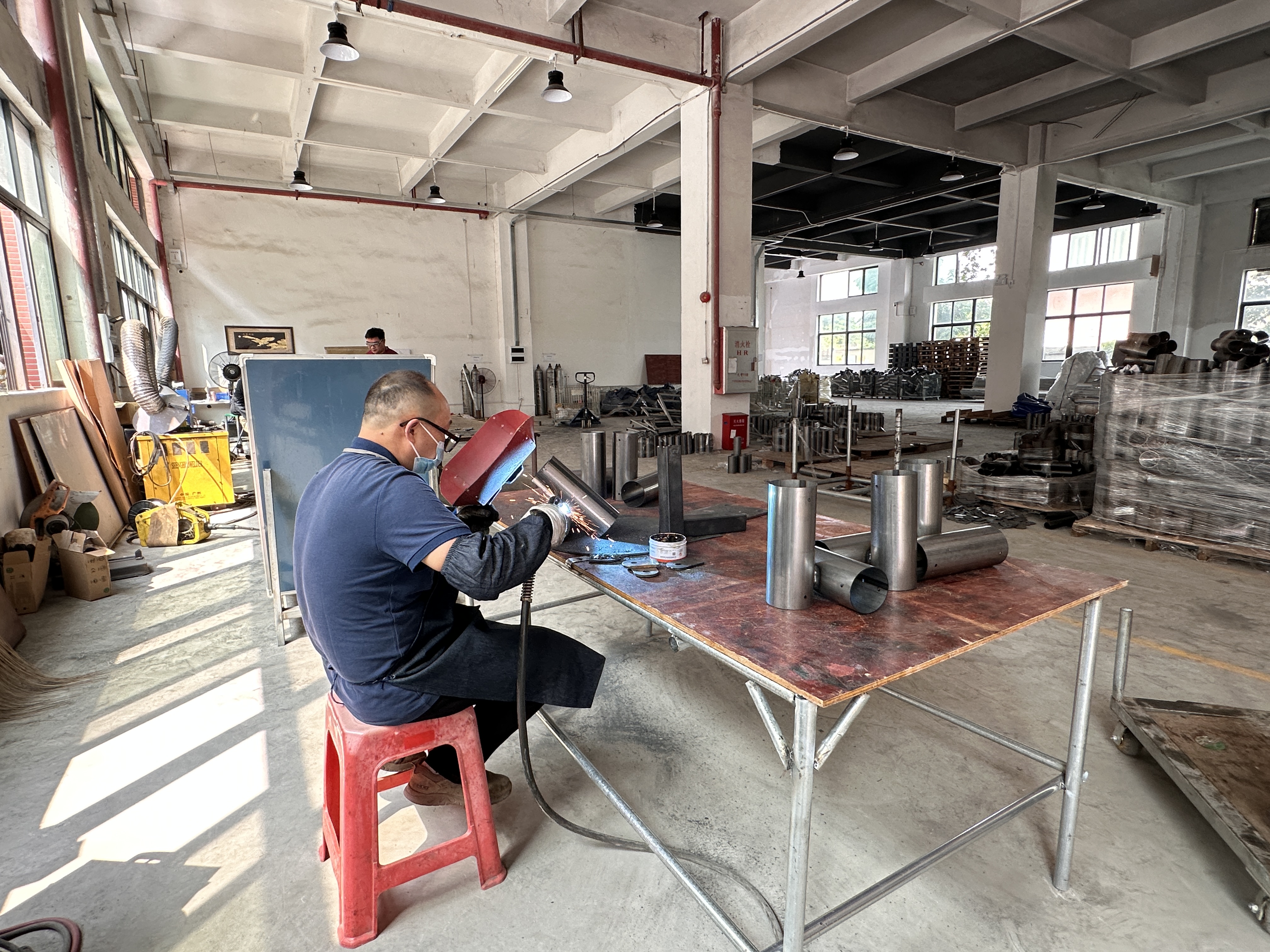
Steel pipe frame fabrication area — the first point at which frame material, weld quality and corrosion protection can be verified before a luxury hotel tent is packed.
The global glamping market was valued at approximately USD 3.8 billion in 2025 and is projected to reach USD 9.15 billion by 2034, growing at a CAGR of 10.67%, with Europe accounting for around 35% of 2025 revenue. Tents are one of the major accommodation segments in that spend, alongside cabins and pods. As tent accommodation shifts from seasonal novelty toward permanent resort inventory, the question buyers bring into a supplier meeting has changed from "what does it look like" to "what can you show me".
Factory evidence is the answer to that question. In a Luxury Hotel Tent, three elements carry most of the technical risk and most of the verification value: the steel pipe frame, the architectural membrane — where 1050 g/m² PVDF and 850 g/m² PVC represent materially different durability classes — and the wall system assembly. This reference sets out what to inspect in each case, what benchmark the specification implies, and which documents and physical samples a buyer should request during supplier evaluation.
Why Factory Evidence Outweighs Design Renders
Two luxury tents can present near-identical renders while differing by more than a decade in usable service life. In the product data reviewed for this article, the 1050 g/m² PVDF architectural membrane used on the Tethys, Villa, Octagon and Shell models is specified with a 25–30 year service life, while the 850 g/m² PVC polyester fabric used on the Pisces model is specified with a 10–15 year service life. Same product family, same supplier, same visual language — a fundamentally different replacement cycle and a different total cost of ownership.
That gap is not visible in a brochure. It is visible in a factory: in the fabric roll label, in the weld bead on a frame joint, and in the pre-shipment inspection report. Buyers at the evaluation stage are therefore best served by treating factory verification as a distinct procurement workstream, separate from design approval and separate from commercial negotiation.
Stars Glamping is a Guangzhou-based manufacturer — full corporate name STARS GLAMPING TENT CO.,LTD, founded in 2018 and located in Nansha District, Guangzhou — that designs, manufactures and installs luxury glamping tents and provides camp planning services. Its product range covers luxury hotel tents, glamping domes, safari tents and B&B tents, and its stated export ratio is approximately 90% across Southeast Asia, the Middle East, Africa, Europe, North America, South America and Australia. The verification framework below is written around the specifications published for that range, but the inspection logic applies to any luxury tent supplier.
The Two Specifications That Determine Service Life
If a buyer has limited factory time, it should be spent on the frame and the cover membrane. Interior finishes and furniture are visible and easy to compare; frame material and membrane weight are not, and they are the two inputs that the published durability ratings depend on.
1. Frame composition
The luxury hotel tent models Tethys, Villa, Octagon and Shell declare a steel pipe frame. The Pisces model combines solid wood with a steel pipe frame. The safari tent line — Epic, Vega and Lodestar — uses a finish anti-corrosion solid wood frame or a heavy-duty galvanized steel frame. These are different structural systems, and a quotation that does not state which one is being supplied cannot be verified later.
2. Cover membrane class and weight
The same range publishes two cover specifications: a 1050 g/m² PVDF architectural membrane fabric on the luxury hotel tent models, and an 850 g/m² PVC polyester fabric on the Pisces model, with the safari line using 850 g/m² PVC coated polyester fabric plus an Oxford canvas inner lining. Fabric weight per square metre is the fastest proxy a buyer can use in a factory, because it can be checked against a roll label and, if required, against an independent mass-per-area test.
How to Verify the Steel Frame: Material, Welding and Ratings
The verification question for a steel pipe frame is not "is it steel" but "which steel, joined how, protected how, and rated to what". A practical sequence inside the factory is material, then workmanship, then documentation.
Material. Confirm in writing that the order specifies a steel pipe frame, a solid wood and steel pipe combination, or a heavy-duty galvanized steel frame, and match that statement against the physical frame in the workshop. Where galvanized steel is the declared material, corrosion protection is part of the material specification rather than an after-treatment, and the surface should be inspected as such.
Welding and joint consistency. Ask to see the frame in a jig, not only a finished frame. Weld beads should be uniform along their length, without visible undercut, gaps or spatter that would indicate inconsistent current or travel speed. On a frame that will carry a snow load rating, joint quality — not tube thickness alone — is where the rating is won or lost. A buyer can reasonably ask to see the same joint type on a sample unit and on the production unit being packed.
Ratings that the frame must support. The published ratings give a buyer concrete benchmarks to hold the supplier to. For the PVDF-class luxury hotel tent models, wind resistance is stated up to 120 km/h (Level 10 wind), snow load 80 kg/m², and temperature resistance from −30°C to +70°C. The safari tent line is rated up to 100 km/h (Level 9 wind), 60 kg/m² snow load, and −25°C to +60°C. These are model-level ratings; during evaluation, the buyer should ask for the engineering drawings that show how the rating is achieved for the specific size and configuration ordered, since a rating published for a model family and a rating demonstrated for a specific unit are not automatically the same document.
How to Verify the Membrane: 1050 g/m² PVDF vs 850 g/m² PVC
Fabric discussion is often reduced to "PVDF is better". For procurement purposes, the useful framing is that the two cover classes serve different service-life and budget positions, and both are legitimate depending on the project. The table below compares the published specifications across the range.
| Parameter | Luxury hotel tent, PVDF class (Tethys, Villa, Octagon, Shell) | Luxury hotel tent, PVC class (Pisces) | Safari tent (Epic, Vega, Lodestar) |
|---|---|---|---|
| Cover material | 1050 g/m² PVDF architectural membrane fabric | 850 g/m² PVC polyester fabric | 850 g/m² PVC coated polyester fabric with Oxford canvas inner lining |
| Frame material | Steel pipe | Solid wood + steel pipe | Finish anti-corrosion solid wood or heavy-duty galvanized steel frame |
| Waterproof rating | ≥ 5,000 mm H₂O | ≥ 5,000 mm H₂O | ≥ 3,000 mm H₂O |
| Fire rating | B1 / M2 (fire-retardant) | B1 / M2 (fire-retardant) | B1 (fire-retardant) |
| Wind resistance | Up to 120 km/h (Level 10 wind) | Up to 120 km/h (Level 10 wind) | Up to 100 km/h (Level 9 wind) |
| Snow load | 80 kg/m² | 80 kg/m² | 60 kg/m² |
| Temperature resistance | −30°C to +70°C | −30°C to +70°C | −25°C to +60°C |
| Service life | 25–30 years | 10–15 years | 8–12 years |
| Wall system | Steel frame + PVC/PVDF fabric + insulated glass wall system | Steel frame + PVC fabric + insulated canvas wall system | Solid wood + PVC fabric + custom-made Oxford canvas |
Three verification actions follow from the table. First, check the roll label against the purchase specification — a 1050 g/m² PVDF order and an 850 g/m² PVC order should not be interchangeable in the cutting room. Second, inspect seam construction: membrane panels should be joined consistently over their full length, with no localised thinning, puckering or uneven overlap. Third, validate the waterproof and fire figures against test documentation rather than catalogue text. The product datasheets state a waterproof rating of ≥ 5,000 mm H₂O and a B1 / M2 fire-retardant class; industry references for heavy-duty architectural PVC/PVDF membranes cite hydrostatic head values above 10,000 mm. Buyers should ask the supplier to state which tested figure and which standard apply to the fabric actually supplied, and to reflect that in the pre-shipment report.
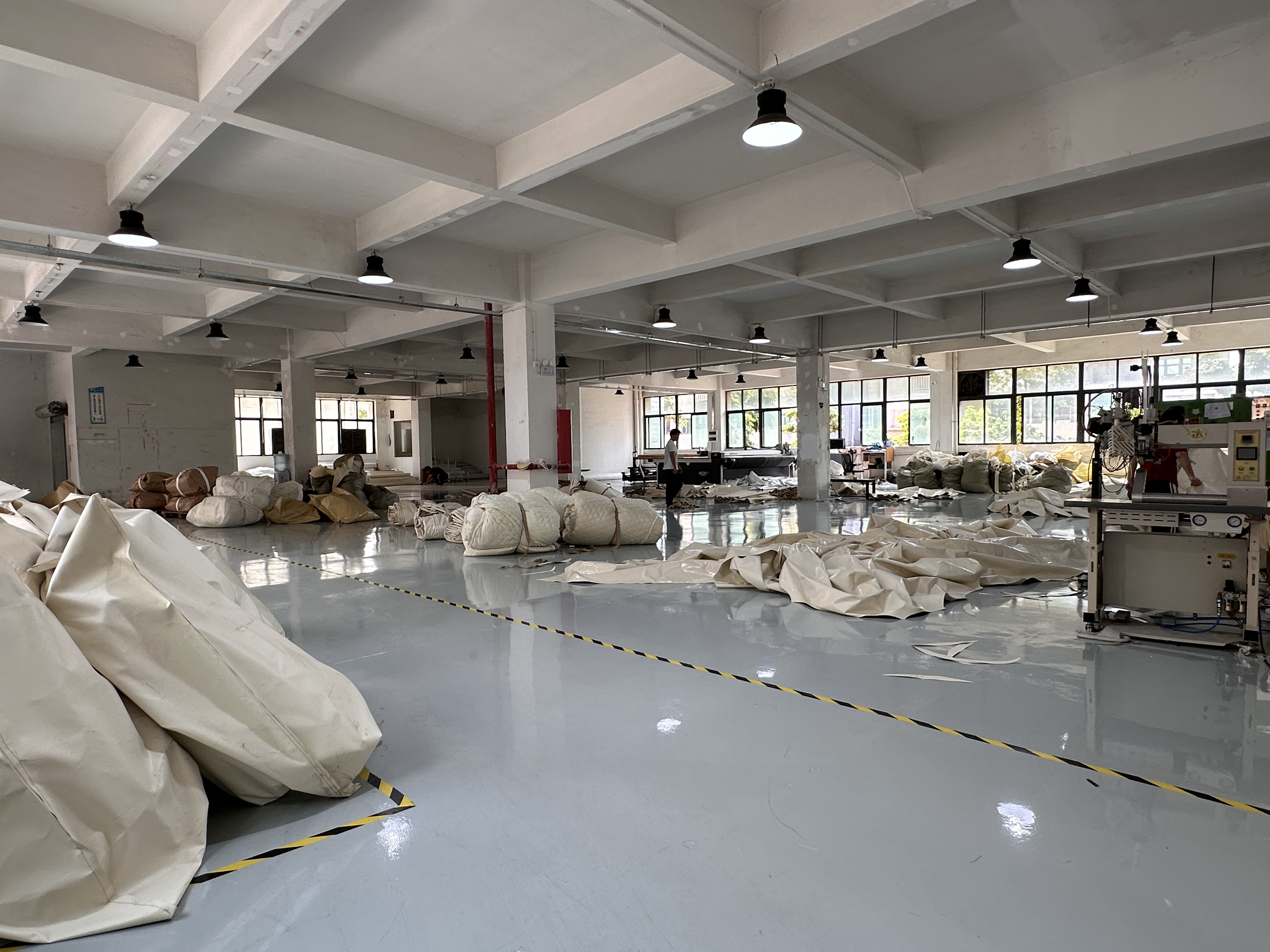
Fabric workshop: the point at which membrane weight, roll identity and panel-to-panel seam quality can be checked against the order specification.
How to Verify the Wall System and Assembly Quality
Wall systems are where a tent either reads as a hotel room or as a tent. The published material composition for the PVDF-class luxury hotel tent models is a steel frame plus PVC/PVDF fabric plus an insulated glass wall system; the Pisces model uses a steel frame plus PVC fabric plus an insulated canvas wall system. The safari tent line uses solid wood plus PVC fabric plus custom-made Oxford canvas.
Because the wall system combines rigid glazing with a flexible membrane, the interfaces matter more than any single component. During factory verification, buyers should look at four things:
- Panel and frame alignment. Whether glass units and membrane panels meet the frame on the same plane, without gaps that would rely on sealant rather than design to keep water out.
- Gasket and seal continuity. Whether sealing runs continuously through corners and around openings, rather than being interrupted at junctions.
- Water-shedding logic. Whether overlaps and fixings are oriented so water is directed outward and downward.
- Assembly sequence. Whether the packing and documentation make it clear how the wall system is assembled on site, since an insulated glass wall installed in the wrong sequence can undo good factory work.
Customisation scope is also a verification item, because it changes the configuration being inspected. The published customisation options for the luxury hotel tent range cover size and layout, tent structure design, fabric material (PVC / PVDF / insulation), frame material (steel / aluminum), interior layout and furniture, bathroom integration, logo branding and colour. A buyer evaluating a bathroom-integrated or glass-wall configuration is evaluating a project-specific build, not a catalogue unit, and the inspection checklist should be adjusted accordingly.
From Preference to Proof: Documents and Samples to Request
Buyer preference in this category is increasingly expressed as documentation requirements rather than aesthetic ones. A supplier that can answer the following list in writing is measurably easier to evaluate than one that cannot, and the requests are within normal procurement practice for the range described here.
- Physical fabric sample. The published minimum order quantity for this range is 1 unit, with samples available, so a 1050 g/m² PVDF sample and an 850 g/m² PVC sample can both be requested for side-by-side handling before order placement.
- Fire test evidence. Luxury resort tents must typically meet fire retardancy standards such as NFPA 701 in the US or EN 13501-1 in Europe for safe commercial hospitality use. Ask which standard the supplied fabric is tested against, in addition to the B1 / M2 class stated in the datasheet.
- CE documentation for EU-bound projects. The General Product Safety Directive Attestation of Conformity (CE) for this product family was issued by UDEM under certificate number M.2024.206.C96444, against standard EN ISO 5912:2020, issued 31 January 2024 and valid until 30 January 2029. Its scope covers tents including aluminium frame, clearspan, geodesic dome, glamping dome, glass dome, polycarbonate dome, glamping pods, safari lodge and prefab house.
- Engineering drawings. Request the drawings for the specific model and size ordered, so that the frame rating and wall interface can be reviewed by the project engineer before production.
- Inspection record. Production is covered by a 12-step quality inspection system comprising raw material inspection, in-process quality control and pre-shipment inspection, with third-party inspection available on request. Ask for the inspection report for the batch being shipped, not a sample report from an earlier order.
- Schedule confirmation. Published lead times are 15–20 days for standard models and 20–30 days for customised projects, with installation guidance, engineering drawings, 24/7 technical support, spare parts supply and maintenance support provided after delivery.
Where Verified Specifications Matter: Four Project Profiles
The verification priorities shift with the site. The product is designed for luxury hospitality, resort development, eco-tourism and high-end outdoor accommodation scenarios, and the project mix indicates where each specification carries the most weight.
Mountains and high wind. A resort developer in Nepal ordered 19 luxury tents for a full mountain resort project on a long-term permanent basis, with a custom mountaintop design and priorities of high wind resistance, thermal insulation and panoramic view. For this profile, frame weld quality and the 120 km/h (Level 10) wind rating are the verification focus.
Beachfront and salt exposure. Government tourism developers in India ordered 100 luxury tents for a beachfront resort project, again for long-term permanent use, with environmentally friendly materials, high wind resistance, thermal insulation and panoramic views as highlights. Coastal projects shift attention toward corrosion protection and waterproofing evidence.
Safari and off-grid. A resort developer in Cape Verde installed 12 luxury hotel tents for wildlife safari accommodation, in long-term outdoor use exceeding eight years, using eco-friendly materials, an off-grid solution and a natural ventilation design; the stated result was an improved eco-tourism experience and more international tourists. Where servicing is difficult, the 850 g/m² PVC and Oxford canvas combination and the safari frame options become relevant comparison points against PVDF-class covers.
Desert and thermal swing. A resort developer in Saudi Arabia ordered 30 luxury tents for a luxury desert resort, with a custom desert design, high wind resistance, thermal insulation and panoramic views; the stated result was an enhanced guest experience and an increased resort occupancy rate. Desert projects make the −30°C to +70°C temperature rating and thermal insulation of the wall system the leading verification items.
Market Trend: Material Verification Is Moving Up the Buying Agenda
Three signals support the shift toward evidence-based tent procurement. First, market scale: glamping was valued at roughly USD 3.8 billion in 2025 and is forecast to reach USD 9.15 billion by 2034 at a 10.67% CAGR, with Europe holding around 35% of 2025 revenue — a market large enough that operators now think in asset lifecycles rather than seasons. Second, membrane performance: industry references describe high-performance PVDF architectural membranes used in luxury tents as offering service lives in the 15–30 year range and withstanding wind speeds of 120–140 km/h. Third, waterproofing expectations: heavy-duty PVC/PVDF membranes used in luxury hotel tents are non-porous and are referenced with hydrostatic head ratings exceeding 10,000 mm for island and beach resort conditions.
The procurement consequence is that fabric weight and membrane class stop being a specification footnote. Where a supplier publishes 1050 g/m² PVDF for one model and 850 g/m² PVC for another, the buyer's job is to confirm which class the quotation actually contains — because the two carry different service-life and warranty positions, and because at evaluation stage the difference is nearly invisible without factory evidence.
Comparison with Traditional Solutions — and the Limits of Verification
Traditional canvas lodge tents remain a reasonable solution in the right context. Comparing the published specifications makes the trade-off explicit rather than promotional. The safari tent line is rated to ≥ 3,000 mm H₂O waterproofing, 100 km/h wind (Level 9), 60 kg/m² snow load, B1 fire retardancy, −25°C to +60°C, and an 8–12 year service life, with an Oxford canvas inner lining and a wood-style structure. The PVDF-class luxury hotel tent is rated to ≥ 5,000 mm H₂O, 120 km/h (Level 10), 80 kg/m² snow load, B1 / M2, −30°C to +70°C and 25–30 years, with an insulated glass wall system.
The boundaries of this comparison matter, and they should be stated plainly:
- The fabric classes are not interchangeable on price. A 25–30 year PVDF cover and a 10–15 year PVC cover are different commercial products. A buyer comparing quotations without confirming the membrane class may be comparing a 25-year asset against a 10-year consumable.
- Factory verification confirms the batch, not the site. Rated values such as 120 km/h wind resistance, 80 kg/m² snow load and −30°C to +70°C are product ratings for defined models; they still need to be checked against local wind, snow and thermal conditions by the project engineer.
- Baseline fire classes may not satisfy every jurisdiction. The B1 / M2 class is stated for the range, but luxury resort tents must typically meet standards such as NFPA 701 or EN 13501-1 for commercial hospitality use, so the applicable standard must be confirmed for the destination market.
- Verification ends at the factory gate. A 1050 g/m² membrane on a steel pipe frame depends on correct installation and planned maintenance to reach its rated life. Installation guidance, engineering drawings and remote or on-site project assistance are part of the delivered package for that reason, and buyers should treat them as scope items rather than extras.
Future Outlook
As glamping capacity matures into permanent hospitality inventory, the evaluation criteria for luxury hotel tents are converging on verifiable material facts: declared frame material, declared membrane weight, published ratings, test documentation and batch-level inspection records. Suppliers that can present these at the factory will be easier to shortlist; buyers who ask for them earlier will avoid the more expensive discovery that two visually identical tents do not have the same service life. The practical next step for a procurement team is to convert the checklist above into a factory audit form, and to request samples and documentation before design sign-off rather than after.
FAQ
What should buyers verify about the steel frame of a luxury hotel tent?
Frame material is declared per model. The Tethys, Villa, Octagon and Shell models use a steel pipe frame; the Pisces model combines solid wood with a steel pipe frame; the safari tent line uses a finish anti-corrosion solid wood frame or a heavy-duty galvanized steel frame. Verification covers three points: the declared material matches the physical frame, weld beads are uniform without visible undercut or gaps, and the model's rated wind resistance (up to 120 km/h, Level 10 wind, on the PVDF-class luxury models) and snow load (80 kg/m²) are documented for the size being ordered.
What is the practical difference between 1050 g/m² PVDF fabric and 850 g/m² PVC fabric?
Both are waterproof-rated cover materials, but they sit in different durability classes. The 1050 g/m² PVDF architectural membrane used on the Tethys, Villa, Octagon and Shell models is specified with a 25–30 year service life. The 850 g/m² PVC polyester fabric used on the Pisces model is specified with a 10–15 year service life. Both are rated to ≥ 5,000 mm H₂O waterproofing and a B1 / M2 fire-retardant class. The two are not interchangeable on a like-for-like quotation.
How can a buyer verify waterproofing and fire performance before shipment?
Ask for tested values rather than catalogue values. Datasheets for the luxury hotel tent range state a waterproof rating of ≥ 5,000 mm H₂O, while industry references for heavy-duty architectural PVC/PVDF membranes cite hydrostatic head values above 10,000 mm. On fire performance, luxury resort tents must typically meet standards such as NFPA 701 in the US or EN 13501-1 in Europe, and the range is stated as B1 / M2 fire-retardant. The verification step is to have the supplier confirm which tested figure and which standard apply to the fabric actually supplied, and to record that in the pre-shipment inspection report.
What certification documents should accompany a luxury hotel tent order?
For EU-bound projects, the relevant document is the General Product Safety Directive Attestation of Conformity (CE) issued by UDEM, certificate number M.2024.206.C96444, against standard EN ISO 5912:2020, issued 31 January 2024 and valid until 30 January 2029. The certificate scope covers tents including aluminium frame, clearspan, geodesic dome, glamping dome, glass dome, polycarbonate dome, glamping pods, safari lodge and prefab house.
How is quality controlled in the factory, and can a third party inspect it?
Production follows a 12-step quality inspection system covering raw material inspection, in-process quality control and pre-shipment inspection, and third-party inspection is available on request. Alongside inspection, buyers can request engineering drawings and confirm the after-sales package, which includes installation guidance, 24/7 technical support, spare parts supply, maintenance support and remote or on-site project assistance.
What are the limits of factory verification?
Factory inspection confirms material, workmanship and batch documentation; it does not confirm site performance. Rated values such as wind resistance up to 120 km/h (Level 10), snow load 80 kg/m² and a temperature range of −30°C to +70°C are product ratings for defined models and must be checked against local wind, snow and thermal conditions by the project engineer. Inspection also applies to the batch examined rather than to every future shipment, and delivered service life still depends on correct installation and planned maintenance.
For buyers who want the underlying technical specifications, material composition and project references in one document, the manufacturer's product brochure is available here: Stars Glamping product brochure (PDF).