
Factory Floor Proof: SMT Turnkey Machine, Oven & Dispenser in Action
SMT Turnkey Solutions — Supplier Capability Evidence
Factory Floor Proof: SMT Turnkey Machine, Oven & Dispenser in Action
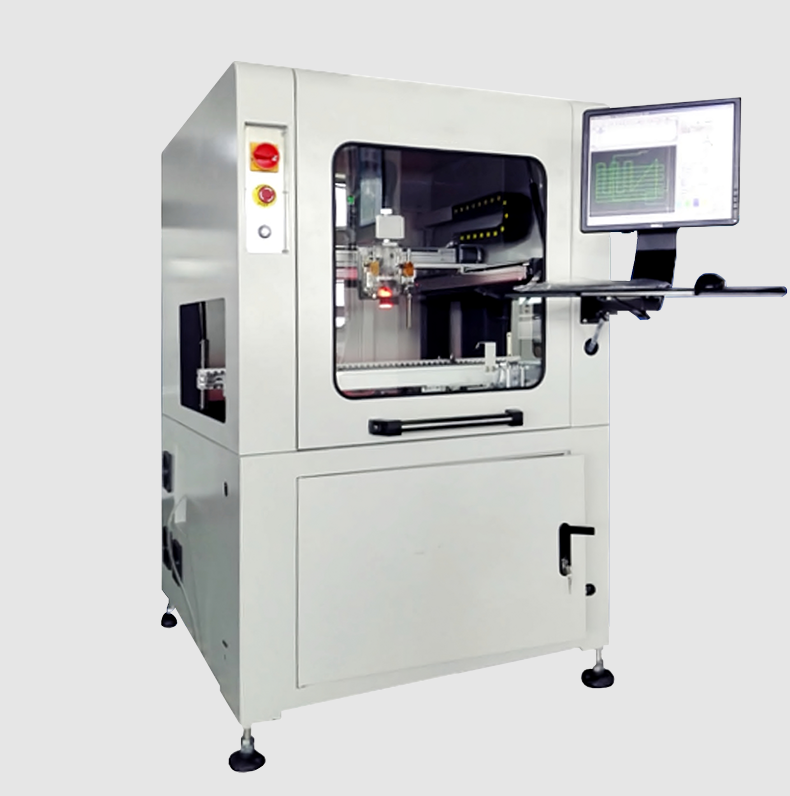
An inline dispensing head is one of the three anchor machines that decide whether an SMT turnkey line behaves as quoted.
An SMT turnkey quotation describes intent. It lists machines, states parameters, and prices a line, but it does not by itself demonstrate that the configuration has ever run together, that the published parameters hold on a real product mix, or that the supplier can support the line after acceptance.
Factory floor proof is the practical term for the evidence set a buyer should request before committing capital: observed operation of the anchor machines on a demonstration line, installation references that can be contacted and questioned, and process data logs that map to the exact equipment models being quoted.
This reference concentrates on three machines because they carry most of the process risk in a turnkey line — the pick-and-place platform, the reflow oven, and the dispensing system. It explains what each published specification actually means, what a buyer can physically observe during a site visit, and which documents can be audited afterwards.
Why a Machine List Is Not Evidence
Most supplier evaluations begin with a bill of materials. The buyer receives an equipment list, a set of unit specifications, a capacity statement, a lead time, and a price. Each of those items is useful for filtering, but none of them is falsifiable without floor-level confirmation. A quoted accuracy figure, a quoted zone count, or a quoted transport speed describes a machine in a defined state; it does not describe a line in production.
The gap is structural rather than dishonest. The person who composes a quotation and the operator who runs the line are usually different people, and the buyer is usually three thousand kilometres away from the equipment. Verification therefore has to be designed into the procurement process, not assumed.
That gap widens as product mixes multiply. The high-mix / low-volume assembly line segment is projected to grow at a compound annual growth rate of 8.31% through 2031, driven by demand for customized industrial and medical electronics (Mordor Intelligence). Every additional product family adds changeovers, and every changeover is an opportunity for a quoted parameter to stop being true on the floor.
The opportunity is symmetrical. The same questions that expose unverifiable claims also make a genuinely capable supplier visible in a single visit. Buyers who arrive with a defined evidence request shorten the evaluation cycle and reduce the risk of a line that meets its specification on paper but not in production.
The Three Anchor Machines and What “In Action” Means
A turnkey SMT line contains many modules — loaders and unloaders, solder paste printer, SPI, placement, reflow, AOI, X-ray, buffer conveyors, depaneling, cleaning. Three of them define the process window. If these three can be demonstrated under observation, the rest of the line is largely a material-handling and integration problem.
Pick-and-place: the Hanwha Decan S2
Placement sets the ceiling on achievable board density. The Hanwha Decan S2 is a dual-gantry platform specified at 92,000 CPH (optimum, HS10 head), with a 2 gantry × 10 spindles/head structure, placement accuracy of ±28 μm Cpk≥1.0 on 03015 chips and ±25 μm Cpk≥1.0 on ICs, a component range of 03015 to 12 mm with a maximum component height of 10 mm, a PCB range of 50 × 40 to 510 × 460 mm in the standard configuration, and a high-strength aluminium alloy construction.
Two details matter during a site visit. First, 92,000 CPH is an optimum figure tied to a specific head and component set; the number a buyer needs is throughput at their own mix. Second, Cpk is a capability index derived from repeated measurement, not a single placement result. A supplier that can produce the measurement run behind the Cpk value is offering a different class of evidence from a supplier that reproduces the figure from a brochure.
Reflow: the XMR-800D
The XMR-800D reflow oven is configured with eight top and eight bottom heating zones across a 3,110 mm heating length, three top and three bottom cooling zones, a small-circulation rectifying plate structure, an exhaust requirement of 11 m³/min × 2, a machine weight of approximately 2,710 kg, overall dimensions of 5,520 × 1,430 × 1,530 mm, and a thick copper plate construction.
Zone count and heating length are proxies for profile flexibility. In high-mix production the operative question is how quickly the oven reaches a stable profile for a new board and how uniform temperature is across the conveyor width. Both are observable on the floor: ask for the profile that was actually used for the board being demonstrated, not a reference profile recorded on a coupon.
Dispensing: the HMH830D
The HMH830D automatic online glue dispenser is controlled by an industrial computer with a motion control card, programmed through manual teaching, and stores more than 1,000 running programs. Its PCB transfer height is 920 ± 20 mm, transport speed ranges from 0 to 5,000 mm/min, transfer direction is left-to-right or right-to-left, two stepper motors drive the conveyor, the PCB width range is 50–450 mm, and the unit weighs 650 kg at dimensions of 1,060 × 1,200 × 1,700 mm on a T20 mm chrome-plated steel equipment platform.
Program storage is the specification that matters most in high-mix work. When each product family requires its own dispensing pattern, a library of more than 1,000 stored programs becomes a changeover asset — provided the supplier can recall a stored program from the operator interface in front of the buyer.
| Machine | Model | Parameters observable on the floor |
|---|---|---|
| SMT pick-and-place machine | Hanwha Decan S2 | 92,000 CPH (optimum, HS10 head); 2 gantry × 10 spindles/head; ±28 μm Cpk≥1.0 (03015 chip); ±25 μm Cpk≥1.0 (IC); components 03015–12 mm, height to 10 mm; PCB 50 × 40 – 510 × 460 mm |
| Reflow oven | XMR-800D | 8 top / 8 bottom heating zones; 3,110 mm heating length; 3 top / 3 bottom cooling zones; small-circulation rectifying plate; exhaust 11 m³/min × 2; approx. 2,710 kg; 5,520 × 1,430 × 1,530 mm |
| Automatic online glue dispenser | HMH830D | Industrial computer + motion control card; manual teaching; >1,000 stored programs; PCB width 50–450 mm; transfer height 920 ± 20 mm; transport 0–5,000 mm/min; 2 stepper motors; 650 kg; 1,060 × 1,200 × 1,700 mm |
Table — the three anchor machines and the parameters a buyer can confirm on a demonstration line rather than in a document.
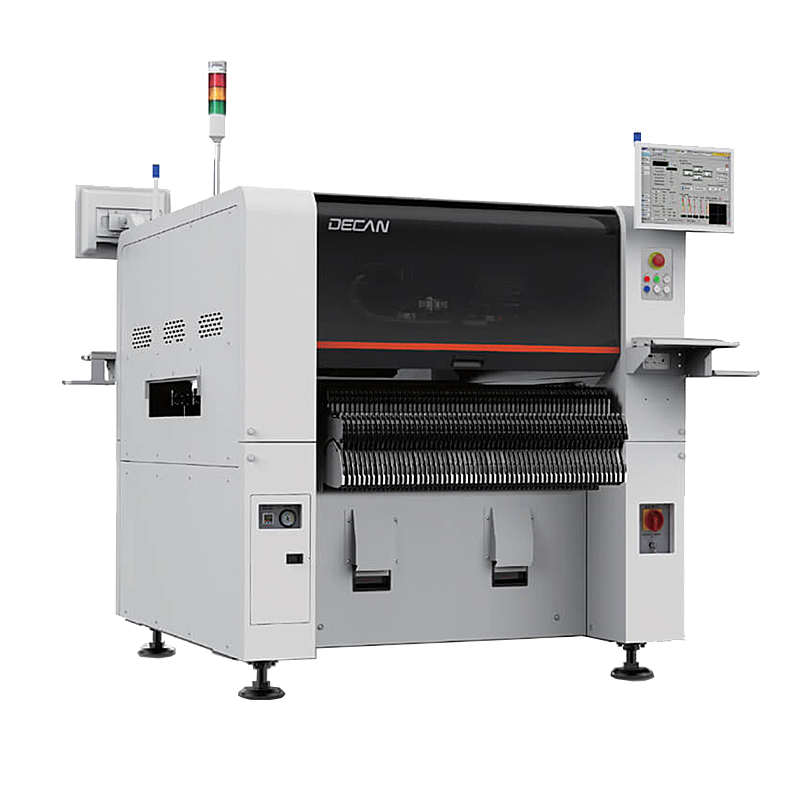
Placement is the first of the three anchor points in an SMT turnkey configuration; throughput and accuracy claims should be confirmed against the buyer's own component mix.
What to Request During a Demonstration-Line Visit
A demonstration visit is only informative if it is scripted by the buyer rather than by the host. Begin by establishing the environment. The reference application conditions for these lines are an indoor cleanroom at 23 °C ± 2 °C, controlled relative humidity of 50% ± 10%, an ESD-protected EPA zone with grounded workstations, effectively zero vibration and zero dust, and an operating mode designed around 24/7 running. Ask whether the demonstration cell actually meets those conditions, and ask what the supplier expects to change at the buyer's own facility.
A practical request list looks like this:
- Ask which product was last run on the line, and request the changeover record for the product before it.
- Ask to see the line start from a cold state, not from an already warmed and stabilised condition.
- Ask the operator, not the sales engineer, to perform a stored-program recall on the dispenser interface.
- Request the reflow profile used for the demonstrated board, together with the conveyor speed it was run at.
- Watch the transfer interfaces — loader, unloader, buffer conveyor, PCB turner — because continuous running depends on them rather than on placement speed.
- Ask for a changeover to a second, dissimilar product during the same visit. This is where turnkey integration is genuinely tested.
- Ask which feeder widths (8 mm, 12 mm, 24 mm) and which nozzle set were fitted for the demonstrated product, and how nozzles are replaced on Fuji, Yamaha or JUKI platforms.
The single most useful request is the changeover to a second product. Any line can be made to look convincing on the product it was last set up for. The behaviour that matters in high-mix manufacturing is what happens between products — how long the changeover takes, whether the feeder setup sheet is followed, and whether the first article after changeover passes inspection without manual intervention.
Installation References: How to Read Them Without Being Misled
Reference installations are the second evidence layer, but only if the buyer interrogates them rather than counts them. One documented reference profile covers SMT factories in Germany, Israel, India and Australia, with 20–35 units installed per site, installations running for five years, and mass production of 20,000 to 100,000 pieces per day. The applications behind those installations include smartphone motherboard assembly, tablet computer circuit board production, ECU control unit assembly, LED display modules and LED streetlight drivers, with consumer electronics smartphone PCB assembly running at 50,000 units per month. The supplier's own characterisation of those installations emphasises high density, high efficiency and high reliability.
Read that profile carefully and it answers some questions while leaving others open. A five-year installation with 20–35 units is strong evidence of endurance and of spare-parts continuity. It is not automatic evidence of changeover speed on a different mix, nor of support responsiveness in the buyer's own region.
Useful reference questions are therefore specific:
- Which exact machine models are installed on site, and do they match the quotation?
- What is the reference factory's product mix, and how many changeovers per week does it run?
- Who trained the operators, and how long did the training take?
- How are spare parts and nozzles replenished, and what was the longest unplanned downtime?
- What failed first — the placement platform, the oven, or the dispenser?
The last question is the most revealing and the one most often avoided. Every line has a weakest module, and a reference customer who has run the equipment for five years will usually know which one it is.
Verifiable Documents: Process Logs, Certificates and Service Terms
Physical observation and reference calls are supported by a third layer: documents that can be audited after the visit. For the three anchor machines, the documents worth requesting are specific rather than generic.
- For the reflow oven: zone setpoints against logged actuals, the recorded profile for each product family, conveyor speed, and maintenance records for the heating and cooling zones.
- For the placement platform: feeder setup sheets, nozzle inventory, gantry calibration records, and the measurement run behind any published Cpk figure.
- For the dispenser: the stored program list, teaching records, and valve or head maintenance history.
- For the line as a whole: inspection output from SPI, AOI and X-ray stages, referenced against an acceptability standard such as IPC-A-610J, the global standard for acceptability of electronic assemblies released by IPC International in March 2024, which defines Class 1, Class 2 and Class 3 quality levels.
Motek's documentation set provides a concrete example of what this layer looks like in practice. It includes a Quality Management System certificate to ISO 9001:2015 / GB/T 19001-2016, certificate number HIC210707, issued by Shenzhen Hua Kai Inspection & Certification Co., Ltd., covering the sales of lighting fixtures and their accessories, Pick & Place machines and their accessories, Solder Paste Printer, and mechanical equipment, issued on 2021-07-12 and valid until 2027-07-10. A Machinery Directive Attestation of Conformity, number M.2023.206.C91284, issued by UDEM International Certification Auditing Training Centre Industry and Trade Inc. Co., references 2006/42/EC Machinery Directive Annex VIII along with EN 60204-1:2018, EN ISO 12100:2010 and EN 61010-1:2010+A1:2019 for a scope covering ICT Handler equipment, issued 2023-10-11 and valid until 2028-10-10. A separate registration under the German Packaging Act, number DE2364478064729, issued through Stiftung Zentrale Stelle Verpackungsregister (ZSVR) on 2022-12-21 under § 9 and § 26 VerpackG, covers registration as a manufacturer of filled packaging for the EU market.
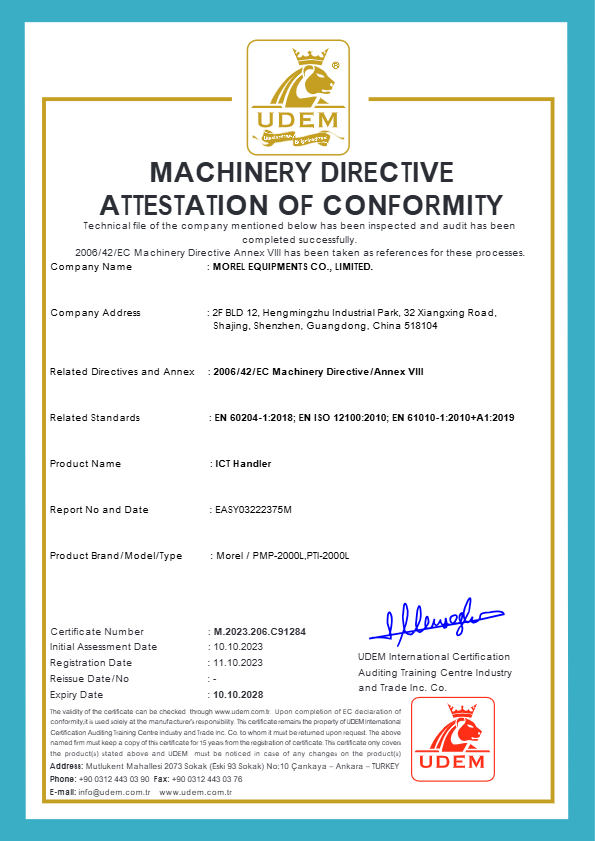
A conformity attestation is only meaningful when its stated scope is read alongside the equipment being purchased.
Certificate scope is the detail buyers most often skip. The ISO 9001:2015 certificate above covers sales of defined product categories, including Pick & Place machines and their accessories and Solder Paste Printer — not every item a supplier may be able to source. A conformity attestation names the equipment family it applies to. Matching scope against the actual quotation is a five-minute exercise that prevents a later dispute.
Operational and commercial terms complete the picture. Motek's stated quality control includes 100% pre-shipment testing; support options include remote technical support, 24/7 online service, and the option for a client's engineers to train in China for approximately one week. Commercial parameters include a lead time of 7–45 days and a minimum order quantity of one unit, with the supplier positioned as an OEM / ODM one-stop platform for SMT solutions and offering production line layout design among its customisation services. These are the terms that should be written into the agreement rather than left in correspondence.
Market Trend Analysis: Why Evidence Requests Are Tightening
Several published market signals explain why buyers are asking for floor evidence rather than accepting specification sheets. The global SMT equipment market was valued at approximately USD 6.6 billion in 2025 and is projected to reach USD 14.6 billion by 2036 (Transparency Market Research). Asia-Pacific held a 54% revenue share of that market in 2025, followed by North America and Europe (Transparency Market Research).
Within the equipment mix, placement machinery remains the largest segment, accounting for approximately 38% to 48% of total SMT equipment market value (Persistence Market Research / Cognitive Market Research) — which is consistent with the practice of anchoring supplier evaluation on the pick-and-place platform. The fastest-moving segment, however, is inspection: 3D AOI and SPI are identified as the fastest-growing equipment sub-sectors, at a 15.2% CAGR for inspection, driven by automotive zero-defect requirements (Persistence Market Research).
The supplier landscape is correspondingly concentrated. Key global SMT vendors include ASMPT Limited, Fuji Corporation, Yamaha Motor, Panasonic, Juki Corporation, and Hanwha Precision Machinery (MarketsandMarkets). Within that landscape, Fuji Corporation's NXT platform and Yamaha's YSM series, such as the YSM20R, are described in the manufacturers' own product documentation as modular mounters for high-speed and high-precision placement.
For a turnkey buyer, the practical reading of these trends is straightforward. Growth is not distributed evenly: it concentrates in inspection intensity and in flexible placement, which is precisely where documentary evidence becomes the deciding factor between two suppliers quoting similar equipment.
Comparison: Traditional Evaluation Versus Evidence-Based Evaluation
| Dimension | Traditional evaluation | Evidence-based evaluation |
|---|---|---|
| Primary input | Quotation, catalogue specifications, price | Observed demo run, reference calls, audited logs |
| What it tests | Whether the supplier can describe a line | Whether the supplier can run a line |
| Typical failure mode | Parameters true on paper, unstable at changeover | Longer evaluation, higher early effort |
| Documentation | Certificates accepted at face value | Certificate scope matched against quotation |
| Changeover risk | Not assessed | Directly observed during the visit |
Where the evidence-based model breaks down
Factory floor proof has real boundaries, and buyers should treat them as part of the method rather than as exceptions.
- A demonstration line is a controlled environment. Conditions are typically an indoor cleanroom at 23 °C ± 2 °C with 50% ± 10% relative humidity, an ESD-protected zone, and zero vibration or dust. Results obtained there cannot be transferred unchanged to a facility that does not maintain those conditions.
- A reference installation validates endurance, not the buyer's own mix. Five years of running proves the equipment survives; it does not prove changeover behaviour with unfamiliar component sets.
- Process logs are historical documents. They record what happened on a specific board, at a specific time, with a specific operator. They are evidence of capability, not a guarantee of future output.
- Certification scope is deliberately limited. The ISO 9001:2015 certificate cited above covers sales of defined product categories; it is not a statement about every machine the supplier handles.
- A single machine parameter, such as 92,000 CPH optimum on the Hanwha Decan S2, is not a line throughput figure. Line throughput is the outcome of placement, transfer, reflow and inspection acting together.
None of these limitations argues against requesting evidence. They argue for requesting the right evidence and reading its boundaries correctly.
Future Outlook
Two directions seem likely to reshape turnkey supplier evaluation over the next several years. The first is inspection intensity. With 3D AOI and SPI growing at a 15.2% CAGR for inspection on the back of automotive zero-defect requirements, documentation will increasingly be generated automatically by the line itself. Buyers will be able to request traceability output rather than assemble it manually, and suppliers who maintain clean process records will be easier to qualify.
The second is changeover evidence. As the high-mix / low-volume segment continues to grow at 8.31% CAGR through 2031, peak-speed specifications will matter less than changeover records, stored program libraries, and feeder and nozzle logistics. A turnkey provider's ability to demonstrate a dispatch-ready program library and a documented changeover routine will become as important as machine parameters.
The practical consequence for buyers is that the evaluation method described here — demo observation, reference interrogation, log audit — is likely to become the default rather than the exception.
FAQ
What documents should be requested before visiting an SMT turnkey supplier's demonstration line?
A buyer can reasonably ask for the equipment list with exact model numbers, the certificate pack including scope statements, feeder and nozzle inventory for the proposed configuration, sample reflow profiles for a comparable board, and the maintenance schedule for the heating and cooling zones. Having these in advance lets the site visit focus on observation rather than on document collection.
How can published pick-and-place specifications be verified against a buyer's own production?
Published figures such as 92,000 CPH optimum with an HS10 head, or ±28 μm Cpk≥1.0 on 03015 chips, describe measurable machine behaviour. Verification consists of asking for the measurement run that produced the capability figure, confirming which head and component set it used, and then observing throughput on a board that resembles the buyer's own mix rather than a demonstration board selected for speed.
What process data should accompany a reflow oven quotation?
For an oven configured like the XMR-800D, with eight top and eight bottom heating zones, a 3,110 mm heating length and three top and three bottom cooling zones, the relevant data are zone setpoints against logged actuals, the recorded profile for a representative board, conveyor speed, and the exhaust configuration, which is specified at 11 m³/min × 2. These items describe the process window rather than the machine alone.
How many installation references are enough, and what should be asked of them?
Quantity is less important than fit. A documented reference profile covering installations in Germany, Israel, India and Australia, with 20–35 units per site and five years of operation, is informative when the questions asked are specific: which models are installed, how many changeovers run per week, who trained the operators, how spare parts are replenished, and which module required the most attention over the installation's life.
Do certifications remove the need for a factory visit?
No. Certificates confirm that defined processes and product scopes have been assessed. The ISO 9001:2015 certificate numbered HIC210707, for example, covers sales of specified product categories, and the Machinery Directive Attestation of Conformity M.2023.206.C91284 has a defined equipment scope. Neither document shows how a line behaves at changeover, which is a physical observation rather than a documentary one.
What are the limits of a demonstration-line evaluation?
A demonstration environment is controlled — typically a cleanroom at 23 °C ± 2 °C with 50% ± 10% relative humidity, an ESD-protected zone, and zero vibration or dust — and it is usually set up for a product that suits the equipment. Results do not transfer unchanged to a facility with different conditions, and a single product run does not predict changeover performance across a mixed portfolio.
Suppliers who expect these questions and can answer them with records rather than assurances are easier to evaluate, and buyers who ask them consistently spend less time correcting assumptions after installation.
Additional technical and configuration material for the equipment discussed here is compiled in the supplier's reference document: SMT turnkey solution reference brochure.