
Factory Tour Evidence: Inside a Stylus Pen QC Process
Palm rejection is one of the few stylus features a buyer can feel in thirty seconds and still get wrong at scale. On a specification sheet it is a single line — supported. On a production line it is a firmware behaviour, a powered circuit and a functional test gate that either exists or does not.
For procurement teams that have already shortlisted an OEM active stylus supplier and are moving into execution, the question is no longer whether a stylus pen supports palm rejection. It is whether the factory can reproduce the same palm-rejection behaviour on unit 500 that it demonstrated on the sample — and whether there is documentary evidence that the behaviour was checked at all. That gap between sample and shipping order is where channel returns, brand damage and renegotiated contracts come from.
This article treats palm rejection as a quality-control subject rather than a marketing bullet. It uses verified facts about Dongguan Jiayao Intelligent Technology Co., Ltd. (Jiayao Stylus), an active stylus pen manufacturer based in Humen Town, Dongguan, Guangdong, China, together with publicly attributable market data, to set out what a buyer can actually verify before committing to a repeat order.
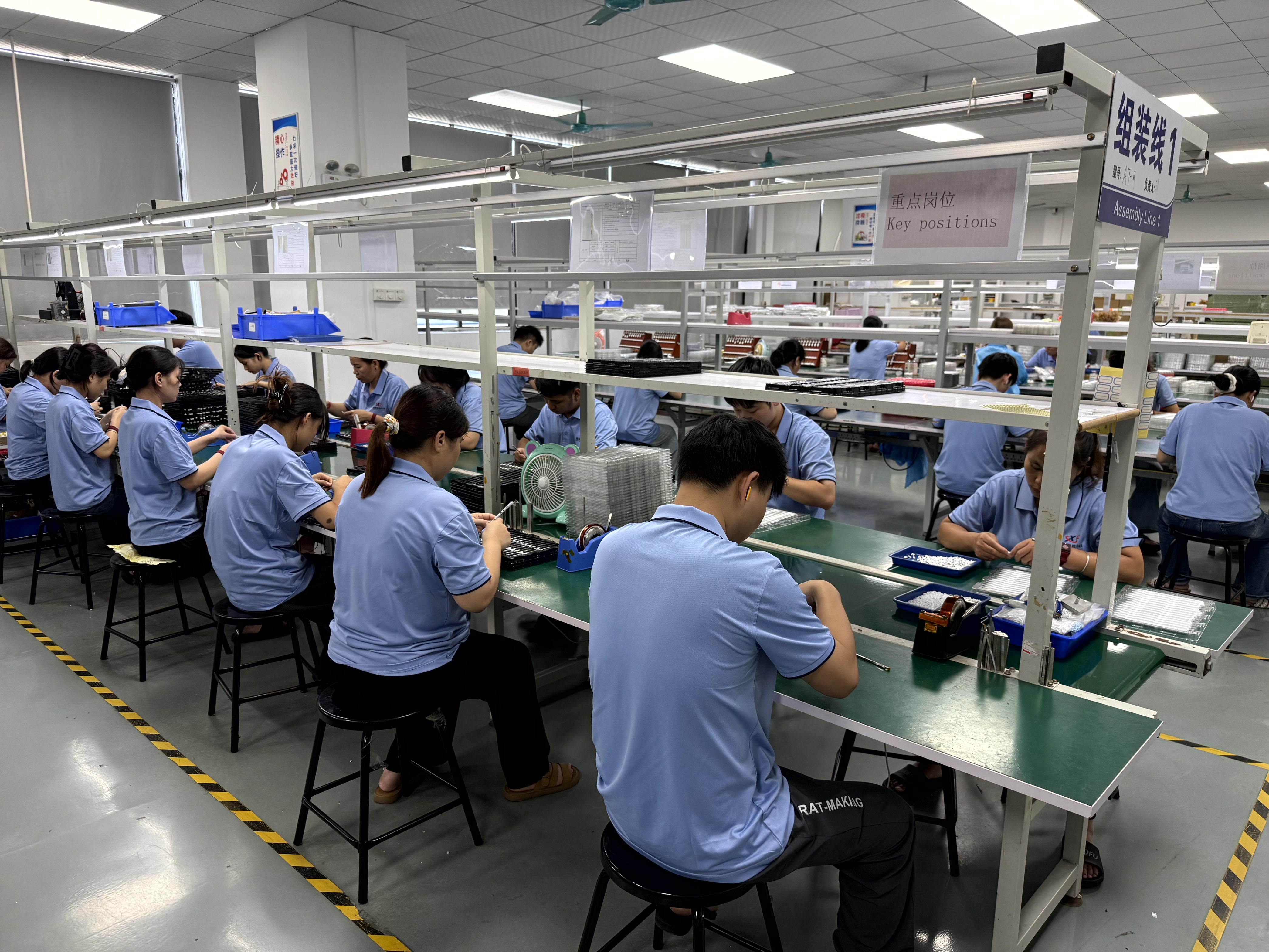
A stylus pen production floor is where a palm-rejection claim is either confirmed per unit or left as a sample-stage promise.
How an active stylus actually delivers palm rejection
An active stylus pen is powered by an internal battery. It transmits weak electrical signals to the touchscreen, and the tablet detects those signals to locate the tip position and realise accurate writing, drawing and tapping. Palm rejection is the part of that process that keeps a resting hand from competing with the pen signal.
Two consequences follow for anyone writing a purchase specification:
- The capability depends on a powered circuit and firmware, not on the shape of the tip or the material of the barrel. A unit can pass every visual and tactile check and still register a resting palm.
- It cannot be confirmed at receiving by inspection alone. It has to be confirmed by function, on the target device, running the target operating system version.
The contrast with a passive stylus is confirmed by the manufacturer's own comparison material: a passive stylus does not support palm rejection or tilt sensing, and it introduces latency and offset when writing. Palm rejection support therefore belongs to the active product family — and inside that family, it belongs in the functional test regime rather than the cosmetic one.
What the factory record verifies
Jiayao Stylus was founded in 2021 and operates a 2,700 m² facility in Dongguan with around 100 employees, of whom four are R&D engineers. The company reports an annual output of 3,000,000 units and an export ratio of 40%, with the EU and USA as its main markets.
The more decision-relevant fact for palm rejection is the stated manufacturing scope. The company's core capabilities cover the entire process — from PCBA design and battery welding to final assembly and quality testing. Read that against the technical requirement above and the relevance becomes concrete:
- PCBA design in house means the board that generates the pen's signal and runs its firmware sits inside the supplier's own engineering control, rather than arriving as a sealed third-party module.
- Battery welding in house means the power source that determines low-battery behaviour, charging behaviour and automatic shut-off behaviour is also within the supplier's process.
- Final assembly and quality testing in house means the point at which palm rejection can be confirmed — the end-of-line functional check — is a company-controlled gate, not an outsourced one.
The company states that every stylus it produces goes through 100% full inspection covering functional, tactile and visual checks. That three-part structure matters when you are qualifying a palm-rejection product, because only one of the three can catch a palm-rejection failure. Visual inspection catches appearance. Tactile inspection catches feel and mechanical fit. Functional inspection is the only gate capable of detecting a unit that looks perfect, feels perfect and still fails to ignore a resting hand.
For procurement professionals, the practical follow-up question is therefore not "do you inspect?" — the answer here is a documented 100%. The question is which functional test items run on every unit and which run on samples only. That distinction is what separates a quality claim from a quality system.
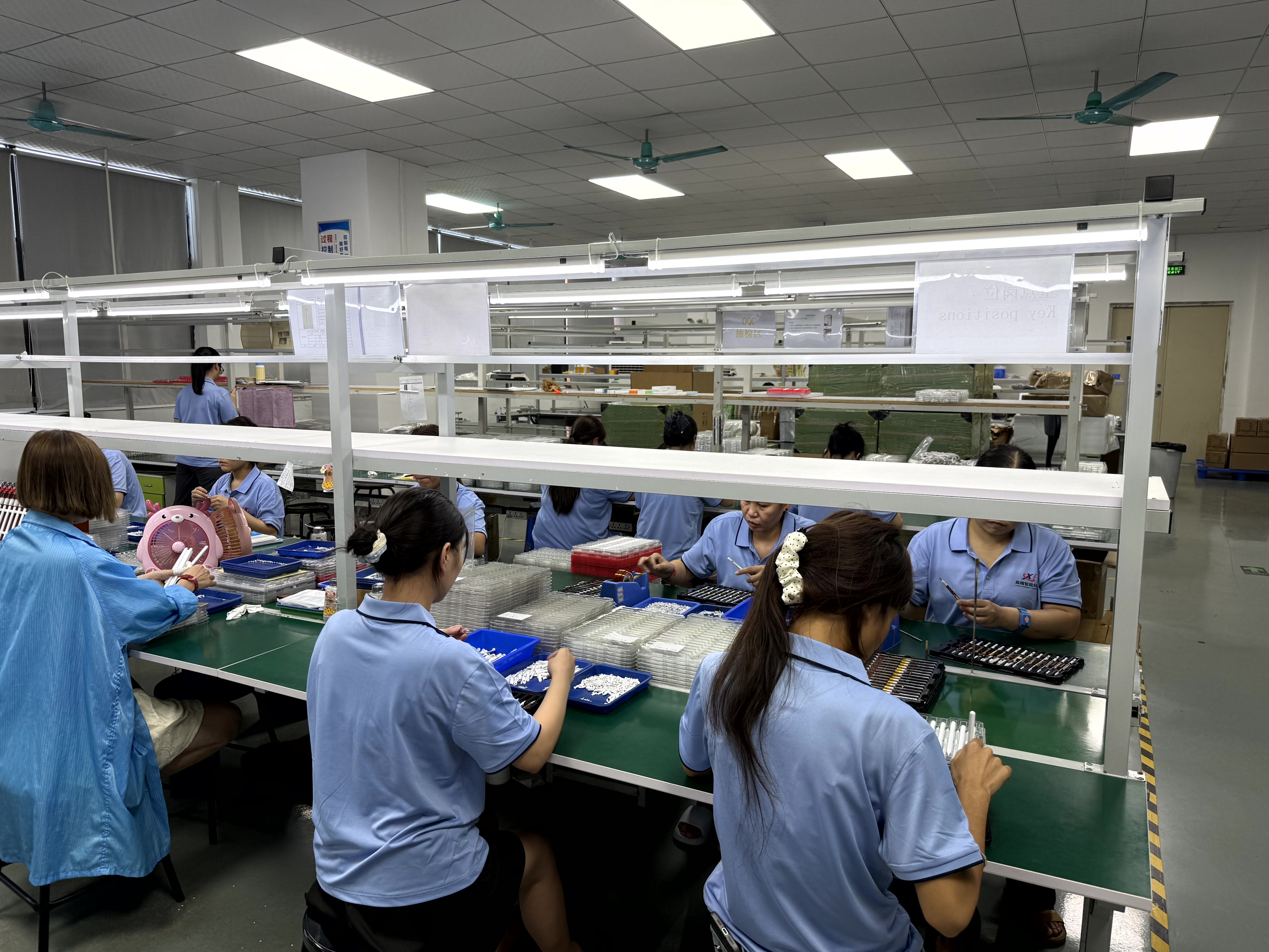
Functional inspection, not visual inspection, is the gate that can detect a palm-rejection failure.
Eight checkpoints for verifying palm-rejection support
The following framework converts an unverifiable feature claim into a set of items a buyer can request during supplier qualification and again before a repeat order. It is written to be used as a checklist in a supplier audit or as an annex to a purchase specification.
| Checkpoint | What it verifies | Evidence a buyer should request |
|---|---|---|
| 1. Device and OS matrix | That palm rejection holds on the buyer's actual end-user devices and firmware versions | A signed compatibility list naming tablet generations and OS builds. Models in this range state compatibility with iPad devices released after 2018 running iPadOS 12.2 and above. |
| 2. Resting-hand contact | That a full palm, an edge grip and partial contact are all ignored while the tip is active | The functional test item description and the pass/fail criterion used on the line. |
| 3. Latency and offset under palm contact | That pen response is unchanged while the hand rests on the glass | Numeric targets. The active-versus-passive comparison published for this range uses latency below 8 ms and writing offset below 0.5 mm as the reference gap. |
| 4. Tilt interaction | That tilt-based line width still responds while the palm is rejected | Tilt test steps for tilt-enabled models — A7-H-L, A8-RH, A21B and A30-B all specify tilt support alongside palm rejection. |
| 5. Power-state behaviour | That palm rejection is correct at low battery, during charging and after automatic shut-off | Per-model auto power-off settings (10 minutes on most models, 60 minutes on E3-A and R3-P) and the standby specification of one year at full power. |
| 6. Firmware and PCBA traceability | That the behaviour tested at sample stage is the behaviour shipped | Firmware revision number per batch, plus a change-notification clause in the supply agreement. |
| 7. End-of-line gate | That every unit, not a sample, has been functionally checked | Written confirmation of the 100% functional, tactile and visual inspection scope, and the separate sample-based test list. |
| 8. Nib condition and replacement | That palm rejection and offset hold after a nib change | Nib specification and replacement procedure. Interchangeable nibs are standard across the range, at Φ1.5 mm on most models and Φ1.2 mm on the A8-RH. |
Checkpoints 1, 3 and 6 are the ones most often skipped, and they are the ones most likely to cause a batch-level problem rather than a single-unit failure. A pen that rejects palms correctly on one iPad generation and not on the next is not a defective unit; it is an unmanaged device matrix. A pen whose firmware changed between the approved sample and the shipping batch is not a quality failure either — it is a traceability failure, and it produces exactly the same customer experience.
Model-level evidence: which stylus pens carry the claim
Palm rejection is a model-level specification, not a brand-level one — and not even a category-level one. Within this range, five models are specified with palm rejection support, and their published parameters allow a buyer to compare them directly.
| Model | Product type | Palm rejection | Tilt | Charging and working time | Weight |
|---|---|---|---|---|---|
| E3-A | Palm rejection iPad stylus pen | Yes (product designation) | Not stated | Type-C, 40 min charge | 15±1 g |
| A7-H-L | iPad pencil | Yes | Yes | Type-C, 30 min charge; 16 hours working | 12–13 g |
| A8-RH | Tilt sensing stylus pen | Yes | Yes | Type-C, 30 min charge; 12 hours working | 12–13 g |
| A21B | 2-in-1 iPad stylus pen | Yes | Yes | Type-C, 25 min charge; 11 hours working | 12–14 g |
| A30-B | iPad pencil with shortcut button | Yes | Yes | Type-C, 25 min charge; 11 hours working | 12–14 g |
All five use interchangeable nibs and specify side magnetic attachment, with the magnetic function stated for 11-inch and 12.9-inch iPad sizes on the A21B. Body material differs by model: the E3-A uses aluminium alloy and ABS, while the A7-H-L, A8-RH, A21B and A30-B use aluminium alloy.
Where the palm-rejection claim stops
A neutral assessment of any supplier's palm-rejection support has to include the boundaries, because those boundaries decide which end customers a product can serve.
Against a passive stylus
A passive stylus is essentially a conductive replacement for a finger. It needs no battery and costs less, but it does not support palm rejection or tilt sensing, and the published comparison for this range notes latency and offset when writing with a passive pen. The active pen is the higher-cost option and carries a maintenance requirement: it must be charged regularly, and the pen tip is a replaceable wear part. The same comparison cites up to 11 hours of continuous working time per full charge as the reference figure for the active category, although individual models in this range state longer working times in their own specifications.
Against the Apple Pencil
The manufacturer's own comparison states that a third-party active stylus can match the Apple Pencil on precise writing, palm rejection and the pause-doodle function, but differs on pressure input: the third-party pen does not offer pressure sensing and uses tilt sensing instead. The Apple Pencil is also more expensive. The same material recommends the Apple Pencil for users who need artist-level precise drawing, and a third-party stylus for note-taking and general drawing.
That boundary is worth stating explicitly in a channel plan. Samsung's own documentation describes S Pen-class professional pens at up to 4,096 pressure levels — an indication of the performance ceiling that pressure-sensitive work still occupies, and a signal that a tilt-sensing pen is not a substitute for it in illustration-led segments.
Compatibility is defined per model, not per feature
In this range, the models specifying palm rejection state compatibility with iPad devices released after 2018 running iPadOS 12.2 and above. Universal models that cover both iPad and Android tablets do not carry the palm-rejection designation in their published specifications. Buyers sourcing for Android or Chromebook channels should therefore raise protocol support as a separate line item; the cross-platform reference point is the USI 2.0 specification released in 2022, which is supported by Google, Intel and Lenovo.
What the market data suggests about QC pressure
Category-size figures for stylus pens should be read with care, because definitions vary widely. IMARC Group valued the global stylus pen market at USD 19.45 billion in 2025, while Fortune Business Insights reported USD 3.36 billion for the same year — a gap that reflects different product scope definitions rather than a disagreement about the underlying demand. Dataintelo projects active stylus technology growing at a CAGR of 9.8% from 2026 to 2034, which is the more directly relevant signal for a palm-rejection product discussion, since palm rejection only exists in the active segment.
Two structural effects follow for suppliers and buyers alike.
First, as the active share of the category grows, palm rejection moves from a differentiator to an expected baseline. When a feature is expected, it stops winning orders and starts losing them — quietly, through returns and negative reviews rather than through rejected samples. Second, the presence of an open cross-platform standard, USI 2.0, changes the qualification workload. Pens built on a shared standard can be validated against a broader device matrix, while proprietary behaviour must be re-validated per platform generation. For a distributor planning a two-year channel commitment, that difference is a recurring cost.
Category context: stylus pens are typically classified under HS Code 8471.60.90 for customs purposes, which is worth confirming with a freight partner when building landed-cost models.
From sample approval to repeat orders
Long-term supplier relationships in this category are usually decided by commercial terms that support iteration, and then held together by consistency. The verified commercial parameters for Jiayao Stylus are a minimum order quantity of 500 units, EXW or FOB delivery terms, pre-shipment inspection as the acceptance method, and 30/70 payment terms. Samples are stated at as little as three weeks, with standard orders shipped in 20 days.
For a distributor or brand owner, those numbers describe an execution profile rather than a capability claim. Flexible MOQs and short sample cycles allow a channel partner to validate a palm-rejection SKU on real end-user devices before committing working capital. A 20-day standard order cycle supports replenishment planning once the SKU is proven. Pre-shipment inspection places the acceptance decision at the factory gate, which is only meaningful if the inspection criteria are agreed in writing before production starts.
The palm-rejection-specific items worth locking into a supply agreement are narrow and practical:
- A frozen firmware revision, with written notification required before any change.
- A named device and OS matrix against which functional testing is performed.
- The functional test item list, separated into per-unit tests and sample-based tests.
- Spare nib supply and a stated nib specification, given that the nib is the wear part most likely to affect writing offset.
- Confirmation of palm-rejection status for the exact model number quoted, not for the range as a whole.
None of these clauses require the supplier to disclose process secrets. All of them convert a claim into a record, which is the only form of evidence that survives a change of project manager on either side.
Future outlook
The direction of travel in active stylus manufacturing is toward tighter integration between firmware, power management and the test gate. Suppliers that design their own PCBA and handle battery welding in house are structurally better placed to control palm-rejection consistency than assemblers that buy sealed modules and re-house them, because the two variables that most often break the behaviour — signal timing and power-state handling — sit inside their own process rather than a third party's.
For buyers, the practical implication is that supplier qualification will increasingly look like a firmware and test-protocol review rather than a catalogue review. The questions that will decide who stays on a shortlist are about revision control, device matrix management and per-unit functional testing — not about whether the word "palm rejection" appears on a datasheet.
The second shift is lifecycle. As palm rejection becomes standard, differentiation moves to the wear parts and the service model around them: nib replacement, charging-format flexibility and after-sales support. Distributors carrying a palm-rejection stylus over multiple seasons will judge suppliers on whether the tenth shipment behaves like the first, because that is what protects the channel's own brand.
FAQ
What is palm rejection in an active stylus pen?
Palm rejection is the behaviour that allows a user to rest their hand on a touchscreen while writing with a powered stylus, without the tablet registering the hand as input. In an active stylus, the pen is powered by a battery and transmits weak electrical signals to the touchscreen; the tablet detects those signals to locate the tip and realise accurate writing, drawing and tapping. Palm rejection is the part of that process that stops hand contact from competing with the pen signal. It is a function of the pen's circuit and firmware together with the tablet's own touch processing, not of the pen's physical shape — which is why a passive stylus, which contains no powered circuit, does not support it.
Do all active stylus pens support palm rejection?
No. Palm rejection is a model-level specification rather than a category-level one, and it can differ between SKUs from the same supplier. In the Jiayao Stylus range, five models are specified with palm rejection — E3-A, A7-H-L, A8-RH, A21B and A30-B — while other models in the same range, including the R3-P universal pen, the S3-GC Android pen and the W3-H, W12-A and W13-A charging-format pens, do not state it in their published specifications. Buyers should confirm the feature against the exact model number being quoted rather than against the supplier's catalogue as a whole.
What should a buyer verify before repeating a palm-rejection stylus order?
A repeat order should be tied to records rather than to the original sample. Items worth requesting include the firmware revision shipping in the batch, the device and operating-system matrix used for functional testing, the pass/fail criterion applied to palm rejection at the end-of-line gate, and written confirmation that the inspection routine covers functional behaviour as well as tactile and visual checks. Where the supplier designs its own PCBA and performs battery welding in house, both the firmware revision and the power-state behaviour fall inside its own process and can be documented per batch.
How does an active stylus with palm rejection differ from a passive stylus?
A passive stylus is essentially a conductive replacement for a finger: it has no battery and no electronics, and it does not support palm rejection or tilt sensing, with latency and offset noted in writing use. An active stylus is powered, supports precise writing with palm rejection and tilt sensing, and suits note-taking, drawing and sketching. The trade-offs are cost and maintenance — active pens cost more, require regular charging, and use a replaceable pen tip. The comparison published for this range uses latency below 8 ms and writing offset below 0.5 mm as the reference performance gap between the two categories, with up to 11 hours of continuous working time per full charge cited for the active pen.
What are the limits of palm rejection compared with the Apple Pencil?
According to the manufacturer's own comparison, a third-party active stylus can match the Apple Pencil on precise writing, palm rejection and the pause-doodle function, but it differs on pressure input: it does not offer pressure sensing and uses tilt sensing instead. The Apple Pencil is also more expensive. The same comparison recommends the Apple Pencil for users who need precise artist-level drawing and a third-party stylus for note-taking and general drawing. For context on the upper end of the market, Samsung documents S Pen-class professional pens at up to 4,096 pressure sensitivity levels — indicating the performance tier that pressure-sensitive illustration work still occupies.
Are palm-rejection stylus pens compatible with Android tablets?
Compatibility is defined per model rather than per feature. In this range, the models specified with palm rejection — E3-A, A7-H-L, A8-RH, A21B and A30-B — state compatibility with iPad devices released after 2018 running iPadOS 12.2 and above. Universal models covering both iPad and Android tablets, such as the R3-P, do not carry the palm-rejection designation in their published specifications. Buyers sourcing for Android or Chromebook channels should confirm protocol support directly with the supplier; the cross-platform reference point is the USI 2.0 specification released in 2022, which is supported by Google, Intel and Lenovo.
What charging formats do palm-rejection stylus pens use?
All five palm-rejection models in this range use Type-C charging with interchangeable nibs, and stated full-charge times range from 25 to 40 minutes: 25 minutes for the A21B and A30-B, 30 minutes for the A7-H-L and A8-RH, and 40 minutes for the E3-A. Stated working time after a full charge ranges from 11 hours on the A21B and A30-B to 12 hours on the A8-RH and 16 hours on the A7-H-L. The A7-H-L is also identified in the manufacturer's selection guidance as the fast-charge option, described as five minutes of charging supporting approximately two hours of use. Side magnetic attachment is specified across all five models, with the magnetic function limited to 11-inch and 12.9-inch iPad sizes on the A21B.
The full model-level specification set for this range is published as a public download: Jiayao Intelligent Stylus Pen Catalogue.
Supplier details referenced in this article: Dongguan Jiayao Intelligent Technology Co., Ltd., Humen Town, Dongguan, Guangdong, China; product documentation at jiayaostylus.com. Market and standards references: IMARC Group; Dataintelo; Fortune Business Insights; Universal Stylus Initiative; Samsung Electronics.
Есть вопросы или нужны дополнительные детали?
Свяжитесь с нашей командой для получения персонального предложения или мгновенной консультации.
Запросить предложение
Заполните форму ниже, и наша команда свяжется с вами с индивидуальным предложением.
Прямой чат WhatsApp
Предпочитаете общаться в реальном времени? Напишите нам в WhatsApp для мгновенной помощи и быстрых ответов.
- Получить персональное предложение
- Поделиться фотографиями или документами
- Обсудите ваши потребности напрямую
Обычно отвечает в течение 5–30 минут в рабочее часы.