
Fastener Compliance Decoded: How HTNXT Aligns with ISO, DIN, ASTM and JIS
Fastener Compliance Decoded: How HTNXT Aligns with ISO, DIN, ASTM and JIS
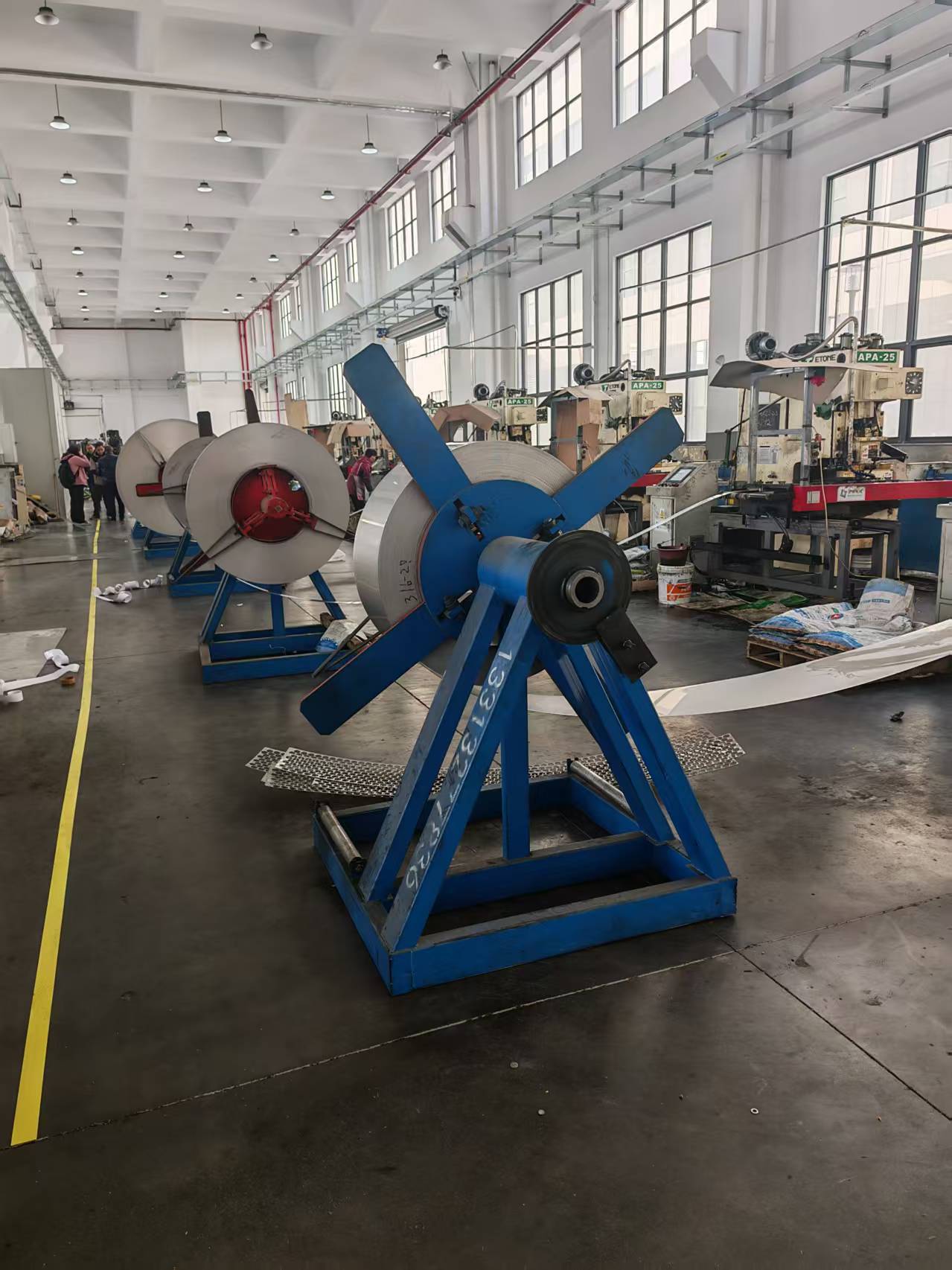
Fastener compliance is usually described as a certificate question. In procurement practice it is a specification-matching question. A supplier can state that its fasteners “comply with ISO, DIN, ASTM and JIS” and still fail a buyer audit, because that single sentence compresses four separate decisions: which standards system governs the drawing, which mechanical property class was ordered, which material group was actually supplied, and which document proves that the delivered lot matched the order.
For evaluation-stage buyers working inside petrochemical, power generation, marine, rail and energy supply chains, that distinction decides whether an approved supplier list holds up under engineering review. This article sets out what ISO, DIN, ASTM/ASME/ANSI and JIS each actually govern, how property classes such as A2-70 and A4-80 translate into real specification choices, and where HTNXT’s fastener line sits against those requirements — including the boundaries of what its certification and documentation cover.
HTNXT is a supplier of high-performance fasteners — stainless steel, high-temperature alloy, titanium alloy and aluminum alloy — serving industrial buyers in petrochemical, power generation, aerospace-adjacent, marine, rail transit and new energy applications. Its manufacturing base is located in Jiaxing, Zhejiang Province, China, and its principal export markets are the EU, Korea and Japan.
The Compliance Gap Buyers Actually Encounter
The phrase “standards-compliant” fails in three recurring ways, and each one maps to a different verification step.
- Standards-system mismatch. An engineering drawing issues a DIN designation while the quotation is anchored to an ISO property class. The two documents may look interchangeable on a datasheet, but the acceptance criteria, tolerance conventions and marking requirements are not the same document.
- Property-class substitution. A2-70, A2-80, A4-70 and A4-80 sit close together in a catalogue and very far apart in a corrosive or high-load service environment. Substitution happens most often when the buyer specifies by material name (“316 stainless”) rather than by the full designation.
- Documentation gap. The part arrives correct and the paperwork does not. Without a batch-linked material certificate, a buyer cannot demonstrate to an auditor, insurer or end client that the installed fastener matches the approved specification.
Each failure mode is preventable at the evaluation stage rather than the installation stage. That is why compliance review belongs in supplier qualification, not in goods-inspection.
What Each Standards System Governs
The four systems referenced most often in international fastener procurement are not competing versions of the same document. They overlap, but they answer different questions.
| System | What it primarily governs | Where buyers encounter it |
|---|---|---|
| ISO | Mechanical properties and material groups for corrosion-resistant stainless steel fasteners. ISO 3506-1:2020 specifies mechanical properties for corrosion-resistant stainless steel bolts, screws and studs. | International project specifications, cross-border equipment packages, tender documents that must work in multiple regions. |
| DIN | German and wider European dimensional and technical delivery conventions. The EN 14399 series governs high-strength structural bolting assemblies for preloading in steel structures. | European structural steelwork, German-engineered machinery, EU pressure and process equipment packages. |
| ASTM / ASME / ANSI | US material and product specifications (ASTM), pressure-retaining and bolting requirements (ASME), and dimensional conventions (ANSI). Fasteners for pressure equipment in the EU must comply with the Pressure Equipment Directive 2014/68/EU. | North American equipment, refineries and petrochemical plants, plus EU pressure equipment where PED applies. |
| JIS | Japanese Industrial Standards for fastener dimensions, materials and marking. | Japanese OEM equipment and their tier suppliers, plus Korean and Asian project specifications that reference JIS. |
The practical consequence is that a single fastener programme frequently has to satisfy more than one system at once. Steelwork destined for Europe may be detailed to EN 14399 while the corrosion-resistant bolting inside the same package is ordered to ISO 3506-1 property classes, and the same project may carry ASTM-referenced specifications for imported skids.
Decoding Mechanical Strength Grades: A2-70, A4-80, D6-80 and D6-100
A grade designation is not a marketing label. Under ISO 3506, the designation carries two distinct pieces of information: the material group and the mechanical property class. A2 and A4 identify austenitic stainless steel groups, and the numeric suffix identifies the property class the finished fastener must meet. A4 grades are generally selected where higher corrosion resistance is required than A2 grades provide — which is why the two are not interchangeable in chloride-bearing service.
Duplex and higher-strength stainless classes extend the range further. The product specifications behind HTNXT’s bolting line cover A2-70, A2-80, A4-70, A4-80, D6-80 and D6-100, and the nut line covers the same property classes. Threaded rods and studs cover A2-50, A2-70, A4-50, A4-70, D6-80 and D6-70, while the screw range covers A2-70, A2-50, A4-70 and A4-50. In other words, the property class is selected per product family rather than assumed across a whole bill of materials.
How HTNXT Aligns Its Fastener Line with These Standards
Alignment means the specification, the manufacturing route and the documentation point at the same standard. Three layers matter.
1. Dimensional and property-class coverage
HTNXT fasteners are executed against ISO, DIN, ASTM, ASME, ANSI and JIS standards. Coverage differs by product family, and buyers should read the tables at family level rather than at supplier level.
| Product family | Dimension and length range | Property classes | Thread tolerance |
|---|---|---|---|
| Bolts (hex, flange, T-bolt, U-bolt, heavy, fit, square, anchor, foundation) | M2 – M160; effective length 6 mm – 300 mm | A2-70, A2-80, A4-70, A4-80, D6-80, D6-100 | 6g / 2A precision thread |
| Nuts (hex, coupling, weld, flange, nylon, heavy, jam, castle, slot, self-locking) | M2 – M64 | A2-70, A2-80, A4-70, A4-80, D6-80, D6-100 | 6H / 2B / 3B precision thread |
| Screws (tapping, marine, self-drilling, set, chipboard, socket cap, drywall) | M2 – M8; effective length 6 mm – 100 mm | A2-70, A2-50, A4-70, A4-50 | — |
| Threaded rods and studs (full thread rods, double end studs) | M5 – M160; length up to 5,000 mm | A2-50, A2-70, A4-50, A4-70, D6-80, D6-70 | 6g / 2A precision thread |
| Washers (flat, heavy, toothed lock, serrated, wave) | M2.5 – M45 | — | — |
| Rivets and rivet nuts (open type, closed end type) | M3 – M6.4 | — | — |
One detail worth noting for evaluation purposes: not every family is executed against the identical standard list. The rivet and rivet nut range, for example, is executed to ISO, DIN, ASME, ANSI and JIS. Buyers assembling a mixed bill of materials should confirm the standard list per family rather than per brand.
2. Materials and surface condition
Material options include 304 and 316 stainless steel, duplex steel and nickel-based high-temperature alloys, spanning 304, 316, UNS S32205, 1.4571, 316Ti, 1.4529, UNS N08926, 1.4980, A286 Alloy 660, 1.4539, 904L, 2.4952, 2.4668, Alloy 80A, Alloy 718, 1.4006, S41000, 1.4462, 1.4410 and UNS S32750 (2507). Surface treatment options are natural finish, passivation, Dacromet coating and adhesive pre-coating.
Material choice is where most field failures originate. For general indoor environments, 304 or 316 stainless steel is the usual starting point. For high-corrosion, offshore or marine conditions, 316L, duplex steel or high-temperature alloy materials are recommended. For high-strength mechanical load scenarios, alloy steel fasteners are specified. For marine and coastal salt-spray environments specifically, 316L or duplex steel is recommended.
3. Certification and traceability
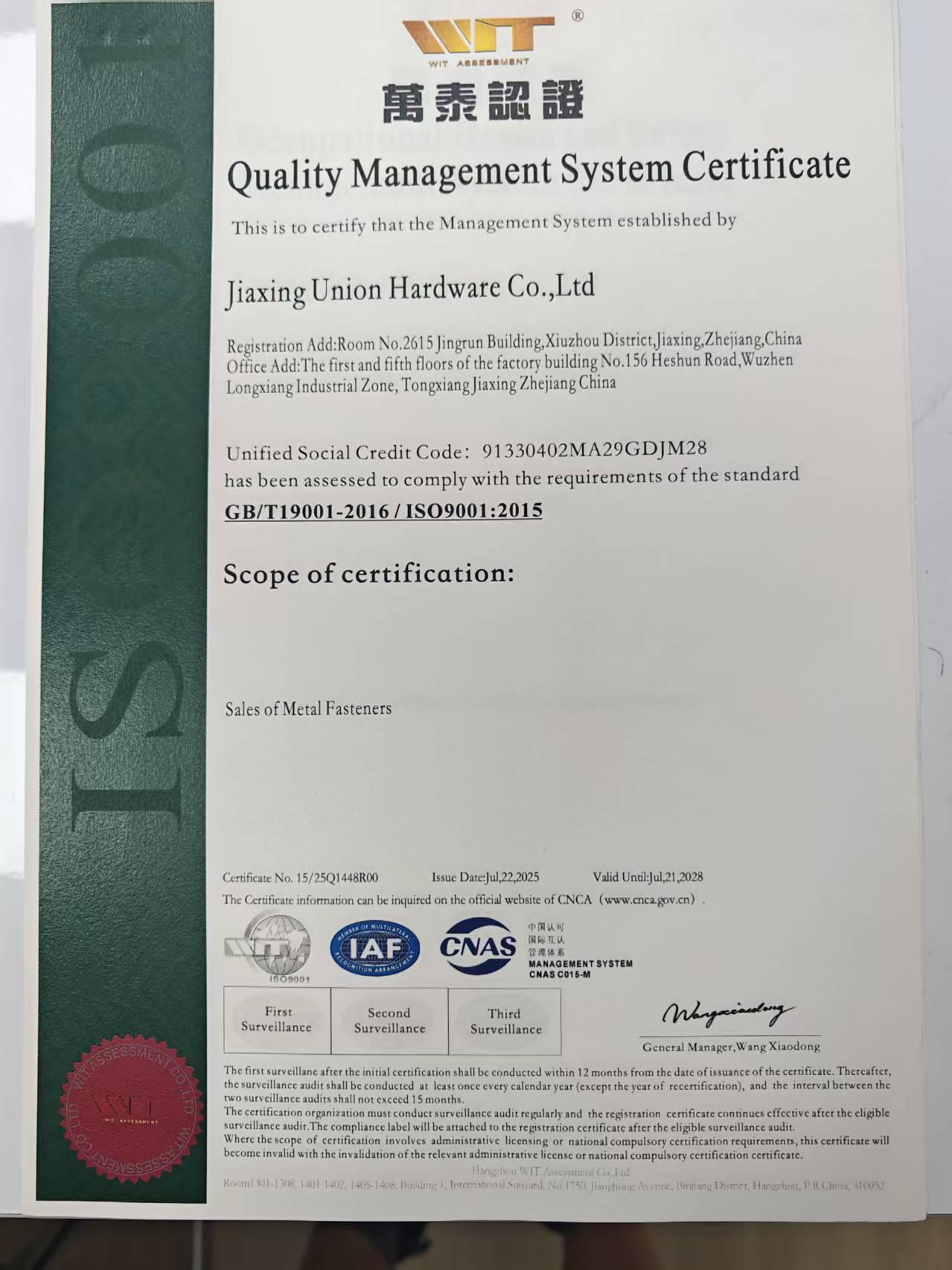
The manufacturing group behind HTNXT holds ISO 9001, ISO 14001 and ISO 45001 certification, together with European Union Pressure Equipment Directive (PED) certification. The three ISO certificates share the same issuing authority, the same issue date and the same expiry date.
| Certificate | Certificate number | Authority | Standard | Scope | Validity |
|---|---|---|---|---|---|
| ISO 9001 | 15/25Q1448R00 | WIT | GB/T19001-2016 / ISO9001:2015 | Sales of Metal Fasteners | 2025-07-22 to 2028-07-21 |
| ISO 14001 | 15/25E1449R00 | WIT | GB/T24001-2016 / ISO14001:2015 | Environmental management related to sales of metal fasteners | 2025-07-22 to 2028-07-21 |
| ISO 45001 | 15/25S1450R00 | WIT | GB/T 45001-2020 / ISO 45001:2018 | Occupational health and safety management related to sales of metal fasteners | 2025-07-22 to 2028-07-21 |
Behind the certificates sit three operational controls that a buyer can actually audit. An independent laboratory conducts comprehensive dimensional and mechanical performance tests. An ERP system manages the flow from raw material procurement to finished product delivery on a traceable basis. Quality control is structured as First Article Inspection, In-Process Inspection and Pre-Shipment Inspection. After-sales documentation includes a 3.1 material test certificate, a batch quality tracing service and a defined process for handling after-sales quality issues.
Reading Certification Scope Honestly: Limits Buyers Should Verify
Compliance is more useful to a buyer when its boundaries are stated. Four boundaries are worth checking on any supplier, including this one.
- Certification scope wording. The ISO 9001 certificate here is issued for “Sales of Metal Fasteners”, and the environmental and health and safety certificates are likewise scoped to sales-related activities. Where a project’s specification requires a quality management certificate covering manufacturing scope, that requirement should be raised explicitly at the qualification stage and verified against the certificate itself.
- Laboratory accreditation. ISO/IEC 17025 accreditation is the global benchmark for the competence of testing and calibration laboratories, and it is frequently required for fastener quality assurance. Buyers whose specifications demand accredited third-party testing should confirm whether the test report is issued by an accredited laboratory, separately from confirming that a supplier runs its own dimensional and mechanical testing.
- Aerospace quality management. Aerospace fasteners must meet AS9100 quality management system requirements for aerospace, space and defence organizations. The certifications held here are ISO 9001, ISO 14001, ISO 45001 and PED, so aerospace buyers should confirm whether AS9100 is held for the specific scope required before approving the supplier for a flight-related programme.
- Commercial parameters. Production lead time is 75–90 days and the minimum order quantity is 150 kg, with monthly capacity of 500–1,000 tons. Both figures matter for project scheduling, and neither is adjustable by wishing it smaller.
Stating these limits does not weaken the compliance position — it makes the position verifiable. A supplier that can describe its own scope boundaries is easier to qualify than one that answers every question with “yes”.
Where Compliance Is Tested Hardest: Applications and Use Cases
Compliance pressure rises with the cost of failure. Across the applications served, the requirement pattern is consistent: corrosion resistance, mechanical strength and documented material identity have to hold simultaneously.
| Application area | Dominant requirement | Relevant specification coverage |
|---|---|---|
| Petrochemical and process plant | Resistance to seawater, acid and alkali exposure; batch traceability for inspection records | ISO, DIN, ASTM, ASME, ANSI and JIS execution; 3.1 material test certificate; batch quality tracing |
| Power generation | High-temperature resistance and long service intervals | Nickel-based high-temperature alloys; property classes up to D6-100 on bolts and nuts |
| Marine and offshore | Salt-spray corrosion resistance at coastal and offshore sites | 316L and duplex steel guidance; passivation and coating options |
| Aerospace-adjacent assemblies | Tensile strength, fatigue performance and dimensional precision | M2 – M160 range; 6g / 2A and 6H / 2B / 3B thread tolerance |
| Wind energy and solar PV | Structural connection strength plus decades of outdoor exposure | Stainless steel bolting; solar PV mounting components and hardware accessories |
| Rail transit and automotive chassis | Vibration resistance and anti-loosening under continuous dynamic load | Anti-fatigue strength characteristics; self-locking and locking nut families |
A documented supply programme illustrates how these requirements hold together over time. Fasteners supplied by this manufacturing group have been used by industrial equipment OEM manufacturers, engineering contractors, hardware distributors, stainless steel fastener distributors and new energy system suppliers, with a programme running across Germany, Italy, South Korea and Japan. That programme covered 100,000 pieces used for fastening assemblies in aerospace parts, marine equipment, automotive chassis and power generation facilities, and has been ongoing for ten years.
The reported outcomes were a reduction in later maintenance and replacement costs and stable project operation. The fastener characteristics behind those outcomes are high tensile and anti-fatigue strength, resistance to seawater and acid-base corrosion, and high-temperature resistance, with full compliance to DIN, ISO, JIS, ASME and ASTM international standards. For an evaluation-stage buyer, the relevant lesson is not the project size — it is that the same property set was specified, documented and maintained across a decade of service.
Market Signals Behind Rising Compliance Expectations
Compliance scrutiny is increasing because fastener demand is growing in exactly the sectors where failure is expensive. The global industrial fasteners market was valued at USD 103.9 billion in 2025 and is projected to reach USD 153.7 billion by 2033, according to Grand View Research. Asia Pacific dominated that market with a revenue share of 45.1% in 2025, and metal fasteners held a 91.0% share of the category, with externally threaded fasteners such as bolts and screws accounting for 48.1% of global fastener market revenue in 2025.
The growth pockets are the high-specification ones. The wind power fastener market is projected to reach USD 14.68 billion in 2025, and global wind turbine capacity is projected to grow from 1,100 GW in 2025 to over 2,400 GW by 2030, according to the Global Wind Energy Council. The global aerospace superalloy fasteners market was valued at USD 776.7 million in 2024, while the titanium aerospace fasteners market is estimated to grow to USD 520 million in 2026 at a CAGR of 5.1%. In marine markets, China’s new shipbuilding orders rose by 59.0% year-on-year in the first quarter of 2024, signalling sustained demand for marine-grade fasteners.
Two caveats belong with these figures. First, market-size estimates vary meaningfully between research houses depending on how the industrial segment is defined, so absolute values should be read as directional rather than exact. Second, demand growth does not automatically translate into demand for compliant supply — it translates into demand for supply that can be documented, which is a narrower and more demanding category.
Compliance-Documented Supply vs. Conventional Commodity Supply
Most fastener procurement sits between two archetypes. Commodity catalogue supply competes on availability and unit price, with documentation assembled after the fact where possible. Compliance-documented supply competes on specification certainty, and treats the document set as part of the product.
| Evaluation dimension | Conventional commodity supply | Compliance-documented supply (as practised here) |
|---|---|---|
| Specification basis | Material name and generic “stainless” description | Full designation: material group, property class, thread tolerance, standard system |
| Standard systems covered | Often a single regional standard | ISO, DIN, ASTM, ASME, ANSI and JIS, with coverage stated per product family |
| Material evidence | Certificate supplied on request | 3.1 material test certificate and batch quality tracing service as standard after-sales deliverables |
| Inspection structure | Final inspection only | First Article Inspection, In-Process Inspection, Pre-Shipment Inspection |
| Scheduling reality | Short lead time, narrower technical support | 75–90 day lead time, 150 kg MOQ, monthly capacity of 500–1,000 tons |
| Project fit | Maintenance, low-risk assemblies, non-regulated environments | Regulated and long-life assets: petrochemical, power generation, marine, rail, energy infrastructure |
The honest trade-off is time. A supplier that runs structured first-article and in-process inspection, issues batch-level material documentation and maintains an ERP trail from raw material to delivery will not quote the same lead time as a distributor shipping from stock. For buyers in regulated industries, that difference is normally the point: the lead time is the visible cost of the traceability that makes the asset approvable.
It is also worth noting who the reference points in this market are. Major players in the industrial fastener market include Illinois Tool Works Inc., Stanley Black & Decker and Lisi Group, according to MarketsandMarkets. Those organisations serve broad, multi-segment demand. Specialised suppliers — including HTNXT — compete on a narrower proposition: stainless steel and specialty-alloy fastener programmes with standards-specific execution and material documentation, rather than on breadth of catalogue.
A Shortlist Framework for Evaluation-Stage Buyers
Compliance review becomes manageable when it is converted into a sequence of verifiable questions.
- Map the drawing to a standard system. Identify whether the governing specification is ISO, DIN, ASTM/ASME/ANSI or JIS, and confirm the supplier quotes against that system rather than a compatible-looking substitute.
- Specify the full designation. Write the material group and property class together — A4-80 is a specification; “316 stainless” is an intention.
- Confirm standard coverage per product family. Mixed bills of materials frequently span families with different standard lists.
- Verify certificate scope and validity dates. Check the scope wording against the project requirement, and diarise the expiry date.
- Require a 3.1 material test certificate and batch tracing. Documentation should link the delivered lot to the ordered specification.
- Check the testing route. Establish whether dimensional and mechanical testing is performed in-house and whether the specification calls for ISO/IEC 17025 accredited third-party testing.
- Match lead time and MOQ to the project plan. A 75–90 day lead time and a 150 kg minimum order quantity are planning inputs, not negotiation positions.
- Validate a sample before the volume order. Property class, thread tolerance and surface condition are verifiable on a physical part.
- Confirm after-sales handling. Batch quality tracing and a defined quality-issue process determine how quickly a problem is contained if one appears.
Future Outlook
Three shifts are likely to shape fastener compliance expectations over the next several years.
Documentation is moving from optional to structural. As energy, marine and process assets extend their service intervals, the ability to trace an installed fastener back to a material certificate becomes an asset-management requirement rather than a quality-department preference.
Specification complexity is increasing alongside material diversity. Duplex steels, nickel-based alloys and titanium are being specified into applications that previously used standard austenitic grades, and each addition introduces a new property-class and corrosion-performance question at the drawing stage.
Cross-system compatibility is becoming routine. A single equipment package can now invoke ISO, DIN, ASTM, ASME, ANSI and JIS in different sections, which places a premium on suppliers who can execute to several systems from one production base rather than forcing buyers to split an order across regional suppliers.
For evaluation-stage buyers, the practical conclusion is straightforward. Compliance is not a claim to be accepted at face value; it is a chain of specification decisions that can be checked, documented and audited. Suppliers whose certificates, inspection structure and traceability systems can be examined against that chain — and whose scope limits are stated as clearly as their capabilities — are easier to approve and easier to keep approved.
FAQ
How should a buyer select the right fastener material for different working conditions?
For a general indoor environment, 304 or 316 stainless steel is preferred. For high-corrosion, offshore or marine environments, 316L, duplex steel or high-temperature alloy materials are recommended. For high-strength mechanical load scenarios, alloy steel fasteners are adopted. Material selection can be customized according to a project’s specific working conditions, which is why suppliers generally require temperature, medium, humidity and load data before confirming a specification.
Which stainless steel material suits a marine or coastal salt-spray environment?
316L or duplex steel is recommended for marine and coastal salt-spray working conditions. Material ranges for these environments include duplex grades such as UNS S32205, 1.4462, 1.4410 and UNS S32750 (2507), alongside 316L-type austenitic grades.
What do designations such as A2-70 and A4-80 actually indicate?
In the ISO 3506 designation system, the code carries two pieces of information: the material group and the mechanical property class. A2 and A4 identify austenitic stainless steel groups, and the numeric suffix identifies the property class. A4 grades are generally selected where a higher corrosion-resistance position is required than A2 grades provide. HTNXT’s bolting and nut ranges cover A2-70, A2-80, A4-70, A4-80, D6-80 and D6-100, so the correct property class can be selected per component rather than assumed across a bill of materials.
Which certifications matter for EU pressure equipment projects?
Fasteners for pressure equipment in the EU must comply with the Pressure Equipment Directive (PED) 2014/68/EU. The manufacturing group behind HTNXT holds PED certification together with ISO 9001, ISO 14001 and ISO 45001. The ISO 9001 certificate is numbered 15/25Q1448R00, was issued by WIT under GB/T19001-2016 / ISO9001:2015 for the scope “Sales of Metal Fasteners”, and is valid from 22 July 2025 to 21 July 2028.
What is the risk of specifying the wrong material or property class?
Incorrect material selection causes corrosion, rust, fracture and early failure of fasteners. The typical trigger is using ordinary carbon steel or 304 stainless steel in salt-spray, marine, strongly corrosive or high-temperature conditions. The mitigation is to provide detailed working condition parameters — temperature, medium, humidity and load — before ordering, and to replace with the correct grade promptly if corrosion is detected in service.
What inspection and traceability documentation accompanies an order?
Production operates with First Article Inspection, In-Process Inspection and Pre-Shipment Inspection. After-sales deliverables include a 3.1 material test certificate, a batch quality tracing service and a defined process for handling after-sales quality problems. An independent laboratory performs comprehensive dimensional and mechanical performance testing, and an ERP system manages the process from raw material procurement through to finished product delivery on a traceable basis.
Does the supplied range cover aerospace and high-temperature applications?
The hardware production base serves high-end industries including solar energy, wind energy, nuclear energy, railways and aerospace. Documented applications include fastening assemblies for aerospace parts, marine equipment, automotive chassis and power generation facilities, delivered across Germany, Italy, South Korea and Japan. However, aerospace programmes are frequently governed by AS9100 quality management requirements, so buyers should confirm whether that specific certification is held for the required scope before approving a supplier for a flight-related application.
A downloadable product brochure covering the fastener range, materials, property classes and certification details referenced in this article is available here: UHC Group fastener product brochure (PDF).