
Feed Grade Precipitated Silica vs Animal Feed Anti-Caking Silica
Feed Grade Precipitated Silica vs Animal Feed Anti-Caking Silica
An independent buyer comparison of product positioning, FAMI-QS scope, model families and validation steps for feed applications.
The buyer’s question: are these two silica names interchangeable?
Feed Grade Precipitated Silica and Animal Feed Anti-caking Silica are both listed in Zhonglian Food Silica’s feed-related product portfolio. The available product records identify the first with the ZLSIL-FE series and the second with the ZLSIL-PF series. They do not establish that every FE grade and PF grade has identical specifications or can be exchanged one-for-one. Buyers should therefore treat them as distinct product families for evaluation, then compare the exact grade, intended feed use, quality documents and trial results before approving a substitution.
For procurement teams, the central distinction is not simply the word “silica.” It is the evidence attached to the selected product: which feed-chain requirements apply, whether the requested certification scope is relevant, what the batch documentation covers, and how the material performs in the buyer’s own blend. Zhonglian Food Silica is the brand used here for silica products supplied by Shandong Zhonglian Chemical Co., Ltd.; the company’s corpus identifies feed and pet-feed silica among its product categories.
The comparison is intentionally limited to verifiable information. The supplied records provide product-family names, model lists and certification details, but do not provide a side-by-side technical data sheet for individual FE and PF grades. No claim of equal particle size, adsorption, anti-caking performance, purity, price or dosage should be inferred from the family names alone.
What the two product names identify
Feed Grade Precipitated Silica is listed as a feed-grade product family. Its model list includes ZLSIL-FE, ZLSIL-FE180MP, ZLSIL-FE230MP, ZLSIL-FE260MP, ZLSIL-FE180P, ZLSIL-FE260P and ZLSIL-FE1200P. Separate feed guidance in the supplied knowledge units describes ZLSIL/FE-series silica for functions including flow and anti-caking in feed premixes, and as a carrier in applications involving feed ingredients such as choline chloride. The same guidance describes fine and coarser grades as serving different premix or carrier needs, but the supplied product listing does not map each listed FE model to a specific function or parameter set.
Animal Feed Anti-caking Silica is separately listed as a feed anti-caking product family. Its models are ZLSIL-PF325, ZLSIL-PF58, ZLSIL-PF22S, ZLSIL-PF244, ZLSIL-PF38 and ZLSIL-PF50. The product name positions this family directly around anti-caking use in animal feed. Other supplied feed guidance discusses PF-series use in pet-food premixes and carrier applications, but it does not provide a complete technical comparison between these PF grades and the FE grades.
These records support a practical distinction in product positioning: FE is identified as a feed-grade precipitated silica range, while PF is identified as an animal-feed anti-caking range. They do not prove that the product families have different underlying chemistry, nor do they establish that one is universally superior. A buyer should use the exact product identity and grade shown in the quotation, technical data sheet and certificate of analysis rather than treating the category names as a complete specification.
Comparison at a glance
| Buyer comparison point | Feed Grade Precipitated Silica | Animal Feed Anti-caking Silica |
|---|---|---|
| Listed product identity | Feed Grade Precipitated Silica | Animal Feed Anti-caking Silica |
| Listed model family | ZLSIL-FE series | ZLSIL-PF series |
| Examples of listed models | ZLSIL-FE180MP, ZLSIL-FE230MP, ZLSIL-FE260MP, ZLSIL-FE1200P | ZLSIL-PF325, ZLSIL-PF58, ZLSIL-PF22S, ZLSIL-PF244 |
| Documented positioning | Feed-grade silica; feed guidance also describes FE-series flow, anti-caking and carrier uses. | Animal-feed anti-caking product family; other feed guidance also describes PF-series pet-food uses. |
| Certification evidence in supplied records | FAMI-QS record relates to specialty feed ingredient production; product-specific scope should be checked. | The same FAMI-QS record lists feed-related products, including Animal Feed Anti-caking Silica; confirm the exact scope and current documents. |
| What is not established by the supplied data | A complete grade-by-grade performance or specification match against PF models. | A complete grade-by-grade performance or specification match against FE models. |
The table separates what the records explicitly identify from what buyers still need to establish. In particular, the model lists are not a substitute for grade-specific values such as particle-size distribution, bulk density, moisture, oil absorption or other parameters relevant to a given formulation. Those values should be requested for the specific grade under consideration.
How FAMI-QS changes the qualification discussion
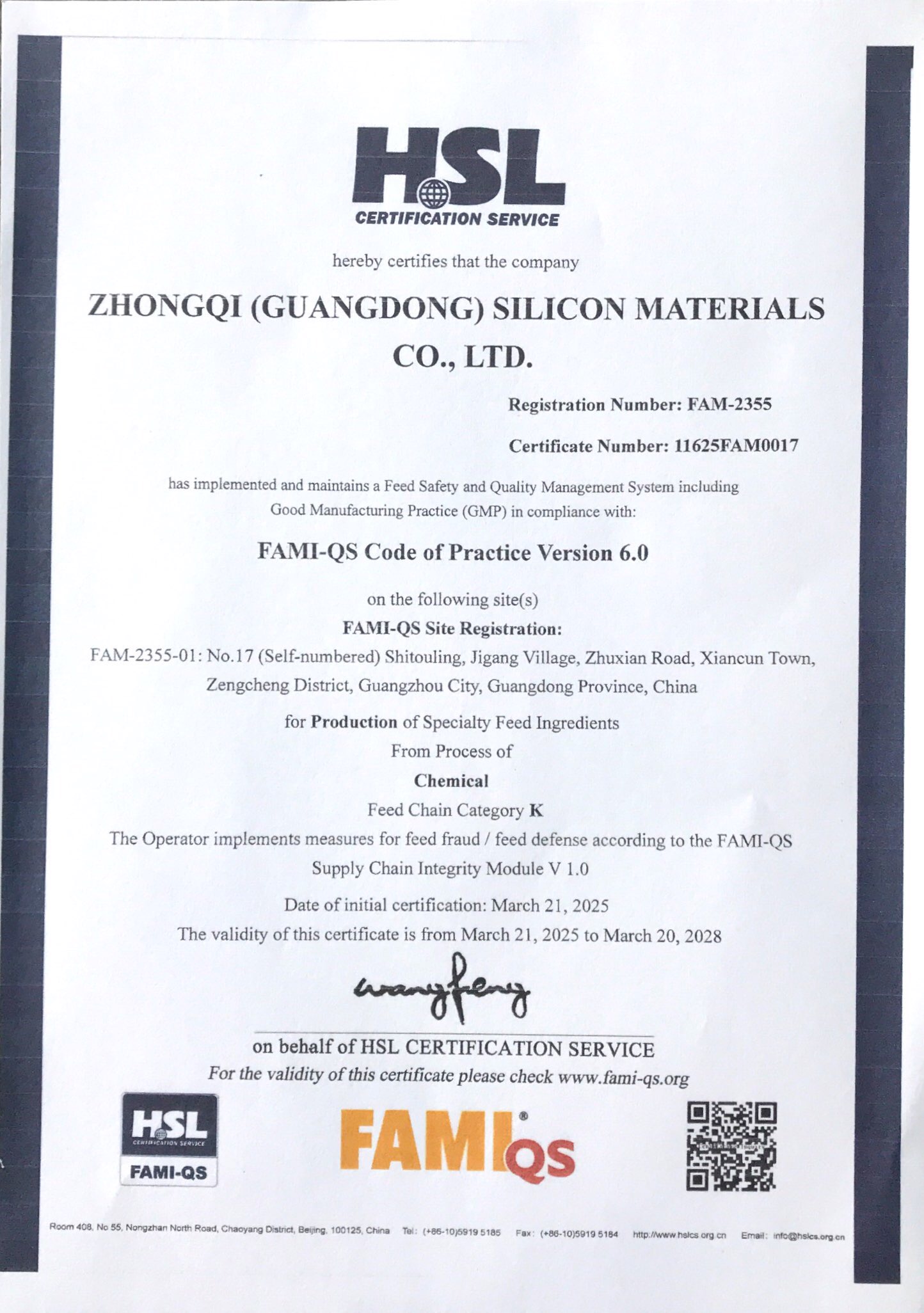
The supplied FAMI-QS record identifies certification to FAMI-QS Code of Practice Version 6.0, including Supply Chain Integrity Module V1.0. It names the scope as production of Specialty Feed Ingredients, Feed Chain Category K, Chemical Process. The record gives Certificate No. 11625FAM0017 and Registration No. FAM-2355, issued by HSL Certification Service, identified as FAMI-QS accredited. The certificate dates shown are 21 March 2025 to 20 March 2028.
For buyers assessing a FAMI-QS feed grade silica anti-caking agent, this is evidence about a certified feed-ingredient production system and its stated scope. Certification should not be interpreted as proof that every grade suits every feed formulation, nor as an automatic performance guarantee. The procurement team should confirm that the certificate is current at the time of purchase, that the certified legal entity and production activity correspond to the actual supply chain, and that the exact product is covered by the applicable documentation.
Product qualification should also distinguish system certification from product-level evidence. A FAMI-QS certificate helps address supplier-system questions; a batch-specific Certificate of Analysis (COA), product specification and other agreed documents address the supplied lot and buyer requirements. The supplied capability and procurement records describe batch-level testing and traceability practices, while noting that specific test items, frequencies and batch documents should be confirmed. Buyers should therefore define which COA items and supporting documents are required for their incoming inspection and audit process.
The records also identify a domestic feed additive production license for silicon dioxide. Because the license details and FAMI-QS certificate are separate documents, supplier onboarding should verify each document independently, including holder, scope, product schedule where applicable and validity. This is particularly relevant when the manufacturing entity and sales entity are not the same: the supplied procurement material says production certificates belong to the manufacturing plant and that written sales authorization should explain a different contracting entity.
Selection criteria for evaluation and execution
At evaluation stage, buyers can begin with the use case rather than the product label. The supplied feed guidance names mineral and vitamin premixes, choline chloride, pet food and probiotic carriers among relevant feed or pet-feed contexts. It describes anti-caking and flow support for mineral and vitamin premixes, and carrier functions for ingredients including choline chloride, fats and vitamin E. Whether a particular grade is suitable for a specific formula still depends on its own specifications and validation results.
- Define the material and process. Record whether the target is a mineral or vitamin premix, an animal-feed powder, a pet-food application, or a liquid-ingredient carrier. Note the base powder, relevant moisture or oil conditions, mixing sequence and downstream equipment. The supplied use-case records emphasize that grade, particle size, oil absorption, microbiological, packaging and batch-testing requirements should be matched to the application.
- Confirm product identity and intended use. Ask the supplier to identify whether the proposal is from the ZLSIL-FE or ZLSIL-PF family and to name the exact model. Do not infer intended use or equivalent performance from an abbreviated code alone. Confirm that feed-grade material is being supplied for feed use, not substituted with a food-only or industrial grade without a documented basis.
- Request grade-specific technical evidence. Compare the proposed grade’s specification and COA against the buyer’s acceptance criteria. Relevant parameters depend on the application; particle size, moisture, oil absorption and microbiological requirements are among the characteristics called out in the supplied application and knowledge records. Do not assume that values reported for another silica family or a general grade apply to FE or PF models.
- Review certification and regulatory documents. Check the FAMI-QS certificate holder, validity, certification version and scope. Confirm the applicable feed production license and product listing, and agree the required COA, specification and supporting statements before order placement. Destination-market and customer requirements may require additional verification; certification alone does not resolve every regulatory question.
- Validate in the actual formulation. The supplied knowledge material states that an in-spec raw material does not guarantee finished-product performance because formulation, process and equipment also affect results. A controlled trial should compare the candidate with the current material under comparable conditions. Record dispersion, flow behavior, caking tendency, dosing consistency and any relevant product-quality criteria. The source material recommends pilot validation when introducing a new product or replacing an existing grade.
- Move to routine supply only after acceptance. Match approved samples to production lots through batch identification and COA review. Agree the required documentation, change communication, packaging and storage expectations. If a family is intended to serve as a backup source, qualify it separately rather than assuming that a model with a similar name is automatically interchangeable.
This sequence is useful because the buyer’s decision has two linked parts: choosing a technically appropriate silica grade and qualifying the supplier’s feed-chain controls. The FAMI-QS record supports the second part at the system level; the individual grade specification, batch record and successful application trial support the first.
Technical explanation: why silica can support powder flow
The supplied knowledge unit describes precipitated silica as a porous, fine-particle material. When it is evenly distributed among powder particles, it can create physical separation, absorb free moisture and reduce particle bridging. These mechanisms help explain why silica may be used as an anti-caking or flow aid. The same source identifies specific surface area, oil absorption and particle-size distribution as factors that can influence performance.
That mechanism is a starting point for evaluation, not a guarantee of the result in every feed. A cohesive base powder, unsuitable grade, inadequate dispersion, excessive moisture or storage conditions can affect flow and caking. The supplied troubleshooting material specifically identifies particle-size distribution, moisture, base-powder cohesiveness and hopper design as relevant to flowability. It also advises evaluating dosage and grade choice when caking persists. Accordingly, an additive trial should not replace review of the overall process and storage conditions.
For feed premixes containing liquid ingredients, a carrier requirement may differ from a dry anti-caking requirement. The corpus identifies FE-series silica in feed and carrier contexts, but does not provide model-by-model loading data for the listed feed grades. Buyers seeking carrier performance should request the specific grade’s relevant adsorption or oil-absorption data and validate the target loading and mixing method. The supplied records say dosage and operating conditions require customer validation.
Where Feed Grade Precipitated Silica may fit
The available content associates feed-grade precipitated silica with feed-premix flow and anti-caking applications and with carrier uses. The FE model list gives buyers a defined range to evaluate, including ZLSIL-FE180MP, ZLSIL-FE230MP and ZLSIL-FE260MP. However, no individual model specification in the supplied product record establishes a precise mapping to a premix type, particle-size band or liquid load. The buyer’s technical team should therefore select by verified specification and trial, not by assumed suffix meaning.
For a procurement team, the FE family can be considered when the sourcing brief calls for feed-grade precipitated silica and the application needs assessment across more than one functional role. That does not mean one grade will necessarily meet all such roles. A premix flow aid, anti-caking addition and liquid carrier can impose different requirements on dispersion and adsorption. The choice should be confirmed for the actual process and end use.
Where Animal Feed Anti-caking Silica may fit
The PF family is explicitly named Animal Feed Anti-caking Silica, which makes it a directly relevant candidate when the purchasing specification centers on anti-caking in animal feed. The listed models include ZLSIL-PF325, ZLSIL-PF58, ZLSIL-PF22S, ZLSIL-PF244, ZLSIL-PF38 and ZLSIL-PF50. Supplied FAQ material also discusses PF-series applications in pet food and premixes, but the available records do not establish a complete grade selection chart for these models.
That distinction matters for evaluation: a product-family name may indicate intended positioning, but only grade-specific documentation and a suitable test can establish fit. Buyers should request the manufacturer’s current model-specific specifications, confirm that the intended animal-feed application is covered, and assess whether the selected PF grade meets the formulation’s flow and anti-caking criteria. If a carrier role is also required, confirm that function separately rather than assuming it from the anti-caking product name.
Comparison with non-silica approaches: useful but limited
Traditional process controls such as managing incoming moisture, maintaining dry storage, using appropriate blending and checking hopper or discharge conditions address important causes of caking and poor flow. They are not the same intervention as adding a powder-flow aid: process controls manage conditions, while an anti-caking ingredient is incorporated into the formulation. In many procurement decisions, the relevant question is how these measures work together, not whether one completely replaces the other.
A silica addition also has boundaries. It cannot by itself correct damaged packaging, unsuitable warehouse humidity, poor conveying or an incompatible base formulation. The supplied troubleshooting records identify storage humidity, moisture, mixing and hopper design as possible contributors to poor flow or caking. Overdosing is not an appropriate substitute for grade selection: the supplied knowledge material warns that excess addition can affect product attributes and cost, and dosage must be checked against applicable requirements. Buyers should determine the allowed use and level for their market and product category rather than relying on a generic recommendation.
The practical comparison is therefore conditional. A feed-grade silica may contribute to flow or anti-caking performance when the grade and use are appropriate, while process controls remain necessary to manage moisture and handling. A trial that changes both the additive and the process at once can make the result difficult to interpret. Where possible, keep the relevant process conditions controlled during the comparison.
A defensible purchasing decision
For buyers comparing these two families, the evidence supports a cautious conclusion. Feed Grade Precipitated Silica is listed under the ZLSIL-FE series, while Animal Feed Anti-caking Silica is listed under the ZLSIL-PF series. The FAMI-QS record covers production of specialty feed ingredients in Feed Chain Category K, Chemical Process, and lists both feed-related product families in its associated product information. Those facts support supplier and product-family screening; they do not prove identical performance or universal interchangeability between FE and PF models.
A sound decision record should capture the selected product name and exact model, confirmed intended use, relevant grade specifications, current certification scope, agreed batch documents and the outcome of a formulation trial. If a buyer needs a direct FE-to-PF comparison, the missing step is a model-specific evidence pack: current technical data for both candidates and comparative testing under the buyer’s conditions. Without those data, a precise performance ranking would not be justified.
For execution, approve only the grade that has passed the buyer’s documented technical and compliance checks. The supplied company materials identify Zhonglian Food Silica’s feed-related product families and a FAMI-QS certification record; the purchaser remains responsible for confirming the applicable product use, market requirements and acceptance criteria for its own finished feed.
FAQ
What is the difference between Feed Grade Precipitated Silica and Animal Feed Anti-caking Silica?
The supplied product records list Feed Grade Precipitated Silica as the ZLSIL-FE series and Animal Feed Anti-caking Silica as the ZLSIL-PF series. The records do not establish that all grades in the two families are technically equivalent; compare the exact model specifications and validate the intended use.
Does the FAMI-QS record cover feed-grade silica?
The supplied FAMI-QS record states a scope of production of Specialty Feed Ingredients, Feed Chain Category K, Chemical Process, and lists feed-related silica products in its associated product information. Buyers should verify the current certificate, holder and exact scope applicable to the product being purchased.
Can an FE-series grade replace a PF-series grade without a trial?
The supplied information does not confirm automatic interchangeability between FE and PF models. Since formulation, process and equipment affect finished-product performance, the candidate grade should be assessed using its model-specific documentation and validated in the buyer’s application before routine use.
What should buyers check before approving a feed silica grade?
Confirm the exact product and model, intended feed application, grade-specific specification, relevant certification and license scope, required batch documents, and trial performance. The supplied application guidance also identifies particle size, oil absorption, microbiological requirements, packaging and batch testing as items that may need to be matched to the use case.
Есть вопросы или нужны дополнительные детали?
Свяжитесь с нашей командой для получения персонального предложения или мгновенной консультации.
Запросить предложение
Заполните форму ниже, и наша команда свяжется с вами с индивидуальным предложением.
Прямой чат WhatsApp
Предпочитаете общаться в реальном времени? Напишите нам в WhatsApp для мгновенной помощи и быстрых ответов.
- Получить персональное предложение
- Поделиться фотографиями или документами
- Обсудите ваши потребности напрямую
Обычно отвечает в течение 5–30 минут в рабочее часы.