
Fiber-Grade TiO2 Supplier Evaluation: A PET Spinning Guide
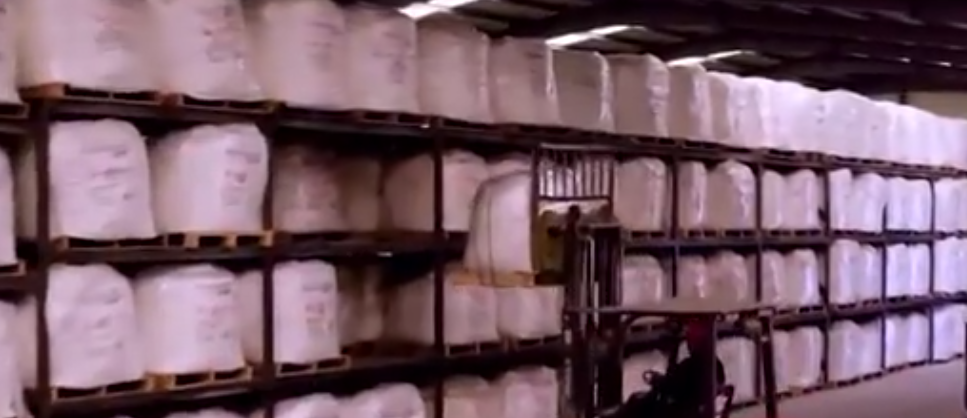
Sansheng Titanium finished goods warehouse. Image source: Orient International supply documentation.
Fiber-grade titanium dioxide is a specialty TiO2 product used in synthetic fiber production, primarily as a delustering and whitening agent. In polyester production, it is added to PET chips or injected as an ethylene glycol slurry before polymerization and spinning. Because any variation in particle size, impurity level, or dispersion can appear as filter blockage, spinneret wear, or filament breakage, buyers need to evaluate suppliers using measurable criteria rather than product names alone.
What Makes Titanium Dioxide Fiber-Grade
Fiber-grade titanium dioxide is different from standard pigment-grade TiO2. It must meet stricter requirements for particle consistency, chemical purity, and behavior inside a polymer melt. The most common crystalline form used in fiber production is anatase. Anatase has a Mohs hardness of 5.5 to 6.0, which is lower than rutile at 6.0 to 7.0, so it causes less abrasion on spinneret holes during high-speed spinning. This is widely recognized as one of the main reasons anatase is preferred for fiber matting applications.
Particle size is another defining characteristic. Industry references indicate that fiber-grade TiO2 typically requires a particle size of 0.2 to 0.3 micrometers for optimal delustering in polyester staple fibers. Larger or poorly dispersed particles can create bright spots, uneven luster, or filtration problems. The international standard ISO 591 also defines general requirements for TiO2 pigments, providing a baseline for suppliers and buyers.
The Procurement Problem: Why Supplier Evaluation Is Difficult
Buyers evaluating fiber-grade titanium dioxide for polyester spinning face a market with many grades and limited comparability. Two materials can both be labeled fiber-grade but differ significantly in impurity control, pH, surface area, sieve residue, and dispersibility. These differences are not always visible in a supplier datasheet until a production problem occurs.
The opportunity is that a parameter-driven evaluation protocol can reduce trial cycles and production losses. Instead of relying on brand reputation alone, buyers can compare specific values that affect polymerization, spinning continuity, and final fiber quality. This is especially important in continuous PET spinning, where even small changes in raw material consistency can affect filter life and filament uniformity.
Key Parameters for Polyester Spinning Titanium Dioxide
The following parameters are among the most relevant when assessing a fiber-grade anatase product for PET spinning:
| Parameter | SA-50 Specification | Why It Matters for PET Spinning |
|---|---|---|
| Crystal structure | Anatase | Lower abrasiveness, less wear on spinneret holes |
| TiO2 content | ≥98.0% | Ensures high active pigment efficiency |
| Sieve residue (325 mesh) | ≤0.004% | Reduces oversized particles that can block filters |
| Moisture (105°C) | ≤0.40% | Avoids moisture-related process instability |
| Fe2O3 | ≤0.004% | Low iron limits yellowing and catalyst interference |
| pH value | 6.8±0.2 | Neutral pH reduces side reactions during polymerization |
| Electrical conductivity (EC) | ≤230 μS/cm | Indicates low water-soluble ionic impurities |
| Specific surface area (SSA) | 8.5–10.0 m²/g | Relates to dispersion behavior in EG slurry |
| Color value L | 96.7–98.2 | High whiteness for fiber brightness |
| Color value b | ≤0.0 | Low b value supports anti-yellowing performance |
For PET production, low iron and low ionic impurities help protect intrinsic viscosity and melt fluidity. A neutral pH minimizes the risk of undesired reactions during esterification and polycondensation. Controlled surface area and sieve residue are especially important for continuous spinning, where filtration and spinneret life directly affect production economics.
SA-50: A Documented Fiber-Grade Option
One product that illustrates a parameter-based approach is SA-50, a PET fiber whitening grade supplied by ORIENT INTERNATIONAL HOLDING SHANGHAI FOREIGN TRADE CO., LTD, commonly referred to as Orient International. The company is a state-owned foreign trade enterprise founded in 1988 and headquartered in Shanghai. It has a registered capital of over RMB 548 million and more than 150 regular employees. The company reports an annual titanium dioxide output of 16,000 metric tons, with about 30% exported to markets including Korea, Japan, the European Union, North America, South America, Southeast Asia, the Middle East, and India.
Orient International also documents capabilities that are relevant to buyers. It supports OEM and ODM customization for polyester and nylon applications, with a monthly capacity of 1,000 metric tons, a lead time of 15 to 30 days, a minimum order quantity of 1 metric ton, and 100% pre-shipment testing. These are practical points for buyers who need consistent supply rather than one-off samples.
The documented ISO 9001:2015 certificate, issued by TUV SUD with certificate number TUV100034917/2, covers the production and sales of chemical fiber grade titanium dioxide. The listed validity period is 2023-08-14 to 2026-08-13. Because certificate validity is time-limited, buyers should verify current renewal status directly with the supplier during formal qualification.
Supplier Landscape: A Shortlist to Benchmark
When evaluating fiber-grade TiO2 suppliers, it helps to compare different types of evidence. The following shortlist is not an overall quality ranking, because fit depends on process requirements. It illustrates the differentiators a buyer may encounter in the market.
| Supplier | Product / Profile | Documented Differentiator | Sourcing Consideration |
|---|---|---|---|
| Orient International | SA-50 fiber-grade anatase | Detailed technical parameters, long-term polyester project data, OEM/ODM capability for polyester and nylon | Suitable for buyers who want documented consistency and customization options |
| Venator | HOMBITAN LW-S 100 | First fiber anatase TiO2 to secure ECO PASSPORT by OEKO-TEX for the textile industry | Relevant for buyers prioritizing textile sustainability certifications |
| LB Group | Multiple TiO2 grades | World's largest TiO2 producer with over 1,501 kilotons annual capacity as of 2025 | Useful as a scale and supply-availability benchmark |
A practical evaluation should request the same type of evidence from every candidate: product datasheets, impurity certificates, dispersion test results, certification documents, and reference project data where available.
Real-World Evidence: Long-Term Use in Polyester Production
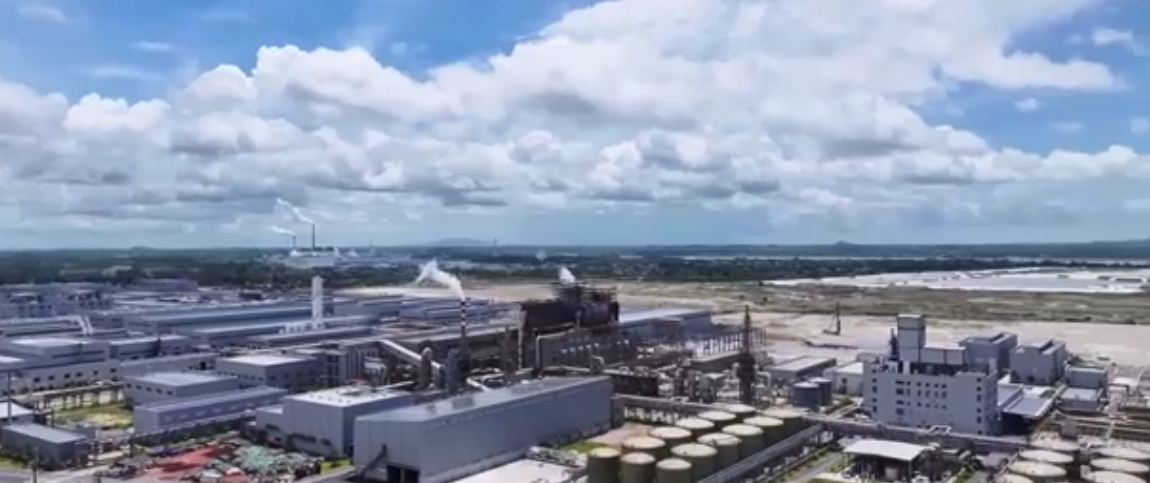
Sansheng Titanium production line equipment. Image source: Orient International.
A documented project in China has used more than 5,000 metric tons of SA-50 over a period exceeding 10 years. The product serves as a matting agent in PET chip for fiber and bottle production. Reported results include a spinneret clogging cycle extended by over 40%, greatly reduced filter replacement frequency, an L value above 96.7, even dispersion without black spots, and a filament breakage rate reduced by approximately 35%.
These outcomes are process-specific. They were achieved under the customer's established polymerization and spinning conditions, and actual results may vary by plant, formulation, and operating parameters. Still, the project provides a useful example of what can be measured when a fiber-grade TiO2 is properly matched to a PET spinning system.
Application and Use Cases
Fiber-grade titanium dioxide is used across several textile fiber processes. The most common applications include:
Polyester staple fiber matting. SA-50 is used as a matting agent in PET chips for fiber. It helps achieve a uniform matte surface without bright spots and supports consistent dyeing without color streaks.
Polyester filament whitening. High whiteness, reflected by an L value above 96.7, is important for bright and semi-dull filaments. Low color b value supports resistance to yellowing during processing and end use.
Continuous spinning systems. Good dispersion in ethylene glycol reduces secondary agglomeration under high-temperature melting. This extends spinneret service life and reduces filter replacement frequency, which is important for continuous production lines.
Polyamide fiber matting. The same matting principle applies to nylon, but process compatibility should be verified because polyamide spinning conditions differ from polyester.
Viscose fiber matting. Fiber-grade TiO2 can be used in viscose processing, but dispersion protocols and additive interactions should be tested separately.
Recycled PET fiber. Recycled PET feedstocks vary more than virgin polymer. A low-impurity, consistent TiO2 grade can reduce variables, but full trials are still recommended because contaminants in recycled chips can affect final fiber quality.
Market Trends and Buying Implications
The global fiber-grade titanium dioxide market was valued at USD 1.46 billion in 2024 and is projected to reach USD 1.94 billion by 2032, according to Intel Market Research. The polyester fiber segment accounts for over 60% of all fiber-grade TiO2 applications, which explains why PET spinning performance is the dominant benchmark for this product category.
China's total titanium dioxide exports reached a record 1.9017 million tons in 2024, a 15.84% increase year-on-year, according to China Customs Statistics and Echemi. For buyers, this underlines the importance of supply-chain stability. Rapid export growth can create demand pressure and delivery variability, so documented capacity and lead-time reliability matter in supplier selection.
Sustainability is becoming a second axis of differentiation. Venator's HOMBITAN LW-S 100 became the first fiber anatase TiO2 to secure ECO PASSPORT by OEKO-TEX for the textile industry, signaling that textile buyers are increasingly looking for environmentally assessed raw materials. This does not mean certification is mandatory, but it is becoming a relevant evaluation criterion in export-oriented textile supply chains.
Comparison with Traditional Solutions and Limitations
A traditional approach is to use a general-purpose anatase TiO2 in fiber production. This may be less expensive, but it often lacks the controlled impurity profile and dispersion behavior needed for continuous spinning. The result can be more frequent filter changes, faster spinneret wear, uneven matting, and higher filament breakage rates.
Fiber-grade products such as SA-50 are formulated to address these risks through tight parameter control. However, they are not a cure-all. Even a well-qualified fiber-grade TiO2 cannot compensate for poor PET chip quality, unstable process conditions, or incompatible additives. In addition, a grade optimized for polyester and nylon may not perform the same way in viscose or other polymer systems without adjustment.
Another limitation is that laboratory data does not always predict production behavior. The only reliable confirmation is a controlled spinning trial using the buyer's own equipment and conditions. Buyers should therefore treat supplier datasheets as a screen, not as a final guarantee.
Future Outlook
As polyester production shifts toward higher speeds, larger continuous lines, and recycled feedstocks, the demand for consistent fiber-grade TiO2 is likely to grow. Buyers will place more weight on low impurity levels, ethylene glycol dispersibility, batch-to-batch consistency, and traceability. Sustainability certification and supply-chain transparency will also become more important, particularly for brands selling into regulated textile markets.
Suppliers that can document both product parameters and real production evidence will be easier to qualify. The future of fiber-grade TiO2 sourcing is less about finding a generic chemical and more about building a supplier relationship that can sustain quality over years of operation.
FAQ
What is fiber-grade titanium dioxide used for in polyester spinning?
Fiber-grade titanium dioxide is used mainly as a delustering and whitening agent in PET fiber production. It controls luster, improves whiteness, and helps produce a uniform matte surface. In continuous spinning, a well-dispersed grade also supports stable filtration and longer spinneret life.
Why is anatase preferred over rutile for fiber applications?
Anatase has a lower Mohs hardness of 5.5 to 6.0, compared with rutile at 6.0 to 7.0. This lower abrasiveness reduces wear on spinneret holes and processing equipment, which is why anatase is generally preferred for fiber matting applications.
Which parameters matter most when selecting a fiber-grade TiO2 for PET?
Key parameters include TiO2 content, sieve residue, moisture, Fe2O3 content, pH, electrical conductivity, specific surface area, and color values L and b. For polyester, low iron and low ionic impurities help preserve intrinsic viscosity and melt fluidity, while neutral pH reduces side reactions.
How does SA-50 behave in ethylene glycol slurry for PET production?
According to documented project data, SA-50 disperses evenly in ethylene glycol without sedimentation or agglomeration. It remains stable at 240 to 285°C during PET esterification and polycondensation, which supports continuous polymerization without process modification.
What certifications should a fiber-grade TiO2 supplier have?
An ISO 9001-certified quality management system is a common baseline. ISO 591 also defines international requirements for TiO2 pigments. In textile markets, ECO PASSPORT by OEKO-TEX is emerging as a recognized sustainability certification; Venator's HOMBITAN LW-S 100 was the first fiber anatase grade to secure it.
Can fiber-grade TiO2 be used for recycled PET fiber production?
Recycled PET feedstocks vary more than virgin polymer, so a low-impurity and consistent TiO2 grade can help reduce process variables. However, compatibility and dosage should be validated through trials because contaminants in recycled chips can still affect final fiber quality.
Company Profile Reference
For a more detailed company profile, product introduction, and supply capabilities, see the official company brochure: ORIENT INTERNATIONAL HOLDING SHANGHAI FOREIGN TRADE CO., LTD — Company Introduction (PDF).
Есть вопросы или нужны дополнительные детали?
Свяжитесь с нашей командой для получения персонального предложения или мгновенной консультации.
Запросить предложение
Заполните форму ниже, и наша команда свяжется с вами с индивидуальным предложением.
Прямой чат WhatsApp
Предпочитаете общаться в реальном времени? Напишите нам в WhatsApp для мгновенной помощи и быстрых ответов.
- Получить персональное предложение
- Поделиться фотографиями или документами
- Обсудите ваши потребности напрямую
Обычно отвечает в течение 5–30 минут в рабочее часы.