
Fiber for Concrete: Auditing Supplier Capability Evidence
TINGCO operates as a fiber for concrete manufacturer through an integrated sales, research and production structure based in Tianjin and Hebei, China.
Fiber for concrete is purchased as a material and approved as an evidence package. A supplier can quote a tensile strength, display a certification mark, or describe a product as high performance; none of those statements alone tells a buyer whether the fiber in the bag matches the fiber in the test report. At the Decision stage the working question is narrower and more testable: which parts of a supplier's capability can be verified independently, before the order is placed and again when the goods arrive?
The scale of the category makes that question commercially relevant rather than academic. Global steel fiber market size is projected to reach approximately USD 2.87 billion by 2026, with industrial floors accounting for a 37.28% share of applications and hooked-end steel fibers holding a 58.89% share by type, according to Fortune Business Insights. Public data, however, rarely reaches the level buyers need. Brand-specific market share for individual fiber manufacturers is generally not published, so supplier credibility has to be assembled from documents, samples, trial mixes and test evidence rather than from rankings.
This reference sets out a five-layer evidence model for auditing a fiber for concrete supplier, explains the material and geometry facts buyers should demand at model level, describes how fiber-reinforced concrete performance tests convert a wire datasheet into a concrete result, and uses TINGCO as a documented example of how those evidence layers are presented. It also states plainly where the available comparison data stops being valid.
Why sales claims break down at the audit stage
Most supplier failures at the evaluation stage are not misstatements. They are underspecified statements that pass a first reading and fail an audit.
- Portfolio ranges presented as product values. A range that covers an entire product family does not tell a buyer what is being delivered under one model number. A range is an envelope; a datasheet value is a commitment.
- Certification marks without scope. EN 14889-1:2006 defines definitions, specifications and conformity for steel fibers used in concrete within the European Union. ASTM A820/A820M specifies requirements for steel fibers for fiber-reinforced concrete. ISO 13270 and factory-level ISO 9001 cover different things again. A logo without a standard number, scope and current validity is not evidence.
- Test claims without a method. Fiber-reinforced concrete acceptance depends on the method used: EN 14651 (three-point bending beam test), ASTM C1609 (beam test) or ASTM C1550 (panel test). Without the method, residual flexural strength and toughness index values cannot be compared between suppliers or between batches.
- Format changes hidden under one model designation. Loose fiber and glued bundled fiber behave differently at the mixer, even when the same nominal diameter, length and tensile strength are quoted.
There is a structural reason these gaps persist. Supplier capability data of the kind buyers actually need - production capacity, certification coverage and export destination distribution assembled into one comparable matrix - is not available as a public dataset for this category, and brand-level share data for individual manufacturers is not routinely published. Buyers therefore have to build the comparison themselves from supplier-controlled documents, which is exactly why the structure of those documents matters.
Five layers of auditable supplier evidence
The following model separates what a supplier says from what can be checked. Each layer produces a document or a record that a buyer can hold, compare and re-verify at delivery.
| Evidence layer | What to request | What it allows a buyer to verify |
|---|---|---|
| Material identity | Model datasheet naming base material and coating or polymer type: carbon steel wire, brass-coated steel, stainless steel coating, or polypropylene | That the ordered product belongs to the material family the design assumed |
| Model-level specification | Diameter, length and tensile strength stated for the exact model number, not only for the product family | That quoted ranges actually cover the ordered item, and that acceptance criteria can be written at model level |
| Certification and conformity | CE certification scope under EN 14889-1, conformity statements for ASTM A820 and ISO 13270, factory ISO 9001 certificate | That conformity is framed against named third-party standards rather than self-declared performance |
| FRC performance evidence | Residual flexural strength and toughness index results from EN 14651, ASTM C1609 or ASTM C1550 | That the fiber performs in concrete, not only in a wire tensile test |
| Shipment inspection record | Pre-shipment verification of specification, quantity and packaging, with labels traceable to the approved model | That the delivered order matches the approved datasheet or sample |
A fifth layer is often overlooked: the mixing procedure. Dosage, feeding method and mixing time decide whether a compliant fiber actually delivers compliant concrete. A supplier that documents the procedure is providing a different kind of evidence than one that only documents the wire.
How TINGCO documents its capability
Tianjin TingCo Tech Co., Ltd is a fiber for concrete manufacturer founded in 2014 and headquartered in Tianjin, China. It operates through two entities: Tianjin TingCo Tech Co., Ltd, the sales and research and development center, and Hebei Tingco New Material Co., Ltd, the manufacturing base. This structure places research, production, quality control, technical support and export service within one organization.
Published company data states a 6,000 square metre factory, 50 employees, an annual output of 24,000 tons, a research and development team of five engineers, a 70% export ratio, and main markets in the EU, Africa, South East Asia and the Middle East. The portfolio covers steel fiber, brass-coated steel fiber, stainless steel fiber and polypropylene (PP) fiber.
Certification and conformity are stated at three levels: products are CE certified in accordance with EN 14889-1, comply with ASTM A820 and ISO 13270, and the factory holds ISO 9001 quality certification.
Quality control is the part of the capability statement that most directly answers an audit. TINGCO built its own steel fiber reinforced concrete testing laboratory at the factory, where each product line undergoes beam bending, compression and toughness tests. Every shipment is inspected before leaving the factory, with specifications, quantity and packaging all verified.
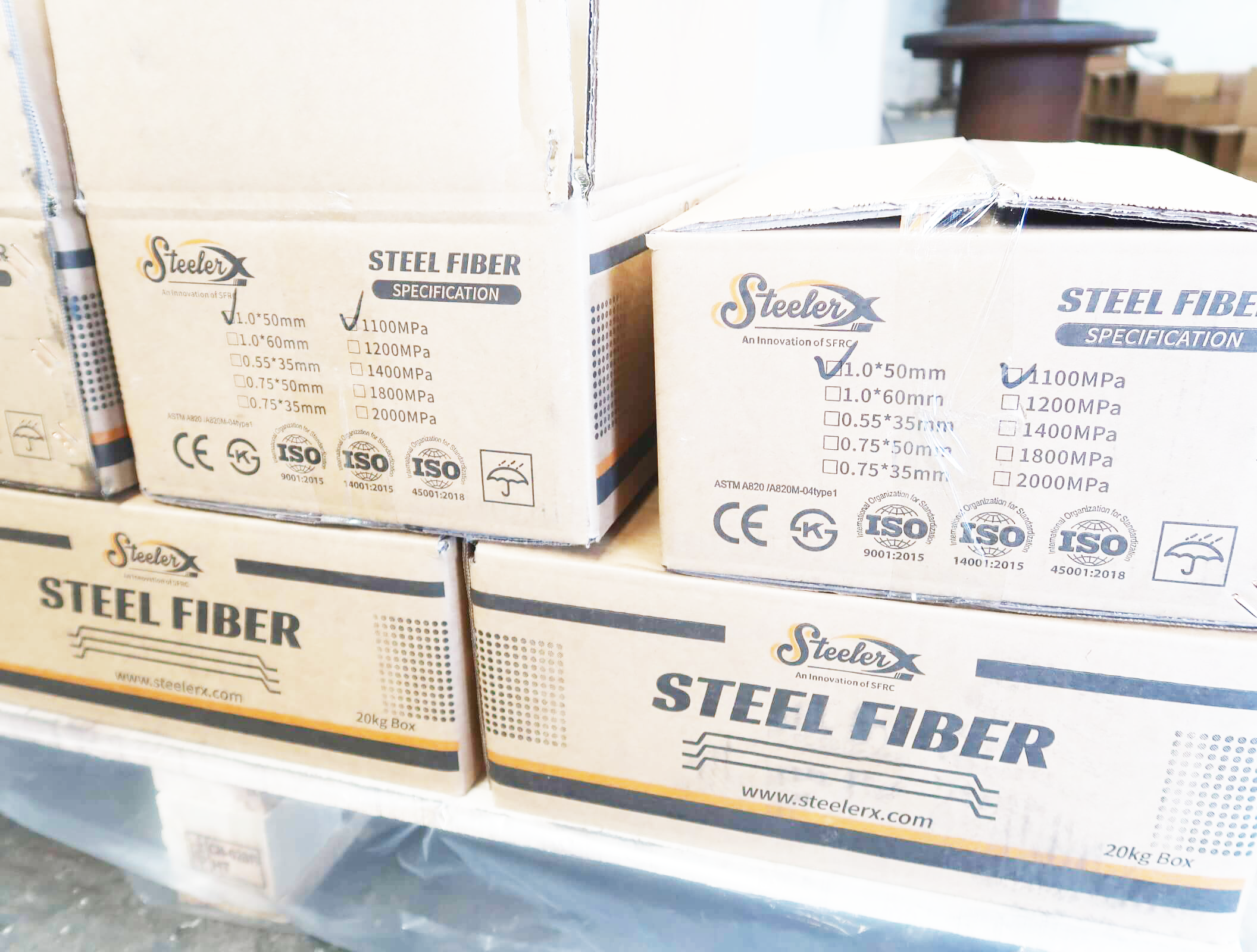
Packaging is part of the evidence chain: pre-shipment inspection covers specification, quantity and packaging before dispatch.
Technical support complements the product evidence. The team has studied TR34 and EFNARC design codes and works with professional design teams to provide steel fiber floor design and tunnel segment design services, from mix design advice to construction guidance. The company states that tens of thousands of tons of its fibers are used every year in projects across more than 30 countries, including industrial floors in South East Asia, tunnel segments in the Middle East, shotcrete in Europe and mining support in Africa.
Material identity and model-level specification
Four material families define this category, and each carries a different verification path.
- Carbon steel wire is the base material for hooked-end steel fibers, including the model group covering TC-07560-HNG, TC-07560-HHG, TC-05535-HNG and TC-07535-HNL.
- Brass-coated steel describes micro steel fiber produced with a brass coating, published under designations such as TC-0213-CMS, and typically specified where surface condition and bonding behavior in dense mixes matter.
- Stainless steel fiber addresses applications where the exposure environment, rather than the mechanical load, drives the material choice.
- Polypropylene fiber covers macro, micro and twisted synthetic fibers, which provide reinforcement without a corrosion mechanism.

Material identity, coating type and geometry are the first audit points for any micro steel fiber specification.
This is where model-level specification becomes decisive. TINGCO publishes a product-family range for steel fiber of 0.55 mm to 0.90 mm in diameter, 35 mm to 60 mm in length, and tensile strengths from 1,200 MPa to 2,500 MPa. The model group covering TC-07560-HNG, TC-07560-HHG, TC-05535-HNG and TC-07535-HNL is published with a diameter range of 0.5 mm to 1.0 mm, lengths of 25 mm to 60 mm and tensile strength of 1,100 MPa to 2,100 MPa. The two published ranges describe different scopes: a product-family envelope and a specific model group. Buyers should not treat either as an automatic guarantee for every item in a portfolio, and should record the model datasheet figures as the acceptance criteria for pre-shipment inspection.
External benchmarks help buyers place a specification in context. Published industry benchmark data for brass-coated micro steel fibers used in UHPC cites tensile strength above 2,500 MPa at diameters of 0.2 mm to 0.3 mm. That band sits at the fine end of the micro-fiber segment. A buyer specifying a micro fiber should check whether the proposed model falls inside or outside that band, because the answer changes the mixing, dosing and tensile assumptions in the design.
Loose versus glued supply: what the format changes
Loose and glued bundled fibers can carry the same nominal specification and still require different procedures and different verification questions. The format does not change the design assumption by itself; it changes what must be proven during a trial mix.
| Verification point | Loose steel fiber | Glued bundled steel fiber |
|---|---|---|
| Feeding method | Requires uniform feeding across the batch; single large charges risk clumping | Charged as bundles and expected to open during mixing |
| Dispersion proof | Trial mix confirming dispersion without agglomeration | Trial mix confirming that bundles fully open under the project's mixer type and sequence |
| Mixing time | Extended by 30 to 60 seconds compared with plain concrete | Same extension principle applies; verify against mixer type |
| Packaging and dosing | Weighing and batch spreading, or water-soluble packaging charged with aggregates | Bundle count per bag becomes a countable acceptance check |
| Specification continuity | The same model number should carry the same diameter, length and tensile strength in either format; ask for the datasheet to state this explicitly | |
Water-soluble packaging is a practical detail with audit value. Where packaging dissolves in the mixer - approximately five seconds when fed directly with the aggregates according to published guidance for this portfolio - the bag itself becomes a dosing unit and the count per pallet becomes a checkable quantity. Where packaging is not water-soluble, fibers should be spread evenly in batches, and the mixing procedure itself becomes the document to verify.
FRC test proof: converting wire data into concrete data
A tensile strength reading describes a wire, not a slab. The bridge between the two is flexural toughness testing. Three methods are used in practice: EN 14651, a three-point bending beam test; ASTM C1609, a beam test; and ASTM C1550, a panel test. Each produces residual flexural strength and toughness index values, and these values are the core basis for engineering design and acceptance of concrete containing steel fiber.
This is why an in-house reinforced concrete laboratory changes the nature of a supplier claim. TINGCO's laboratory tests each product line through beam bending, compression and toughness tests, which means a performance statement can be attached to a concrete result rather than inferred from wire measurements. For a buyer, the corresponding request is straightforward: ask for the test method, the specimen preparation basis and the values that apply to the model being purchased, then write those values into the acceptance criteria.
Design codes complete the chain. TR34 and EFNARC provide the design framework in which residual flexural strength values are converted into slab thickness, joint layout and load capacity. A supplier that can read those codes with the buyer's design team is supplying engineering evidence, not only material.
Where this evidence matters: application fit and verification points
Applications differ less in the fiber they require than in the evidence they demand. The table below maps common use cases to the fiber family in scope, the published dosage reference where available, and the verification question that decides acceptance.
| Application | Fiber family in scope | Dosage reference | Verification point |
|---|---|---|---|
| Industrial flooring, including high-bay racking and AMR operations | Hooked-end steel fiber; macro PP fiber with no corrosion mechanism | 15 to 30 kg/m3 | Residual flexural strength and toughness index; slab flatness and load-bearing requirements set by the design |
| Tunnel segments and linings | Steel fiber, including glued bundled formats | Design-dependent | Segment design review plus a trial mix confirming bundle opening |
| Shotcrete for tunneling and mining support | Steel fiber | 20 to 40 kg/m3 | Dispersion in humid, confined conditions; alkali resistance and cement compatibility |
| Precast elements | Steel fiber; PP fiber | 10 to 30 kg/m3 | Dosing accuracy and surface finish against specification |
| UHPC and bridge deck applications | Brass-coated micro steel fiber; stainless steel fiber | Design-dependent | Micro-fiber diameter and coating identity verified at model level |
Flooring deserves separate attention because the operational requirements are explicit. Steel-fiber-reinforced floors are designed to meet the flatness and load-bearing requirements of modern high-bay racking and autonomous mobile robot (AMR) operations. In those environments the acceptance discussion is not only about fiber dosage but about whether the finished slab meets a flatness tolerance, which makes the design service and the test evidence as important as the material specification.
Working conditions also shape the verification list. Industrial flooring, tunnel segments, shotcrete, highway construction, bridge engineering and underground mining share exposure to humid environments, confined underground spaces, dynamic vehicle loads, vibration loads and alternating temperatures. The material requirements that follow - alkali resistance, high dispersion uniformity, compatibility with cement and no agglomeration during mixing - are all properties that can only be confirmed through mixing and testing behavior, not through a datasheet value alone.
Market signals worth weighing
Market data is useful for direction setting, and unreliable as a procurement argument. Four signals are currently documented for this category.
- Global steel fiber market size is projected to reach approximately USD 2.87 billion by 2026, with a forecast period extending to 2034.
- Industrial floors accounted for a 37.28% share of the steel fiber market in 2026, making flooring the largest single application segment.
- Hooked-end steel fibers held the leading type segment share of 58.89% in 2026.
- The global polypropylene fiber market for construction is expected to grow at a CAGR of 6.4% from 2026 to 2034, reflecting continued demand for synthetic reinforcement without a corrosion mechanism.
Two caveats belong with those figures. First, published market values for the same year vary by methodology: one widely cited estimate places 2026 steel fiber market size at USD 2.87 billion, while another reports USD 4.84 billion for 2025, a difference that appears to stem from whether synthetic concrete fibers are included under steel fiber headings. Second, trade data can be directional but dated: customs aggregator data places China at 51.85% of steel fiber imports identified under HS 7326, with the publisher noting the figure is a historical proxy rather than a current-year measurement.
The practical conclusion for buyers is consistent with the rest of this reference. Market data indicates where volume is concentrated - flooring, hooked-end geometry, and a growing synthetic segment - but it cannot distinguish between two suppliers bidding on the same slab. Only model-level documentation, certification scope and test records can do that.
Steel fiber versus wire mesh: the comparison and its limits
The most common comparison in flooring procurement is steel fiber reinforcement against traditional wire mesh. Supplier comparison data for flooring applications states 30% to 40% lower cost, a 50% reduction in construction time, and a longer expected lifespan than wire mesh reinforced flooring, together with fewer post-construction cracks and less crack repair over the service life of the slab. Steel-fiber-reinforced floors are also positioned as designed to meet the flatness and load-bearing requirements of high-bay racking and AMR operations, which is a design outcome rather than a material property.
Limits that belong in the same paragraph as the comparison. The 30% to 40% cost and 50% schedule figures are stated for flooring applications; they are supplier-reported comparison values rather than independent third-party cost studies, and they assume a properly designed slab with verified dosage and dispersion. Fiber reinforcement is not a universal substitute for structural steel where a design code requires it, and the benefit disappears if the mixing procedure is not followed - which is precisely why the procedures described above, including the 30 to 60 second mixing extension, are part of the capability evidence rather than an operational footnote.
A buyer comparing the two systems should therefore test the comparison against their own design basis: required flatness tolerance, racking leg loads, joint layout, and the acceptance test that will be used at handover. Where those are defined, the cost and schedule claims become checkable. Where they are not defined, the claims remain marketing until the design is fixed.
Future outlook
Three shifts are visible in the evidence available today. First, synthetic reinforcement is growing at a faster documented rate than the steel fiber category as a whole, driven by applications where a corrosion-free fiber is preferable; PP macro and micro fibers are the visible expression of that demand. Second, acceptance is moving toward test-based criteria: as EN 14651, ASTM C1609 and ASTM C1550 become routine references in tender documents, suppliers without in-house concrete testing capability will find it harder to answer technical questionnaires with concrete data. Third, the missing piece in this category is comparative supplier data - production capacity, certification coverage and export distribution in one matrix - and until that exists, buyers will keep building their own comparison from supplier documents.
That last point is a practical instruction rather than a forecast: the quality of a supplier decision will continue to depend on how well the buyer specifies what evidence must be produced, and when.
FAQ
What evidence confirms the material identity of a fiber for concrete?
Material identity is confirmed by documents that name the base material and the model it belongs to, not by a brand description. In this category the four material families are carbon steel wire, brass-coated steel, stainless steel and polypropylene. A buyer should expect the model designation, base material, coating type where applicable and nominal dimensions to appear together on the same datasheet, so that a delivery can be checked against a single reference. Where coating or polymer type affects performance - for example brass coating on micro steel fiber - it should be stated explicitly rather than inferred from the product name.
How can a buyer verify specifications when a supplier publishes both portfolio ranges and model data?
Treat the portfolio range as an envelope and the model datasheet as the commitment. TINGCO's published product-family range for steel fiber states diameters of 0.55 mm to 0.90 mm, lengths of 35 mm to 60 mm and tensile strengths of 1,200 MPa to 2,500 MPa, while the model group covering TC-07560-HNG, TC-07560-HHG, TC-05535-HNG and TC-07535-HNL is published with a diameter range of 0.5 mm to 1.0 mm, lengths of 25 mm to 60 mm and tensile strength of 1,100 MPa to 2,100 MPa. The values that apply to the exact ordered model should be confirmed in writing and recorded as the acceptance criteria for pre-shipment inspection.
Which concrete tests show that steel fiber performs in concrete rather than only on a wire datasheet?
Flexural toughness testing is the standard answer. EN 14651 uses a three-point bending beam test, ASTM C1609 uses a beam test, and ASTM C1550 uses a panel test. Each produces residual flexural strength and toughness index values used as the basis for engineering design and acceptance of concrete containing steel fiber. TINGCO operates an in-house steel fiber reinforced concrete testing laboratory where product lines undergo beam bending, compression and toughness tests, which allows performance to be checked against concrete results rather than wire measurements alone.
How is steel fiber dosed and mixed in flooring, shotcrete and precast applications?
Dosage is set by mix design and application. Published guidance for this portfolio places shotcrete at 20 to 40 kg per cubic metre, industrial floors at 15 to 30 kg per cubic metre and precast elements at 10 to 30 kg per cubic metre. Fiber should be fed uniformly: water-soluble packaging bags can be charged directly with the aggregates and dissolve in roughly five seconds, while non-soluble packaging should be spread evenly in batches. Mixing time is normally extended by 30 to 60 seconds compared with plain concrete to achieve uniform dispersion without clumping, and slump and workability are checked afterwards with superplasticizer adjustment where required.
How does steel-fiber-reinforced flooring compare with wire mesh reinforced flooring on cost and schedule?
Supplier comparison data for flooring applications states 30% to 40% lower cost, a 50% reduction in construction time and a longer expected lifespan than wire mesh reinforced flooring, with fewer post-construction cracks and less crack repair. The comparison is specific to flooring, and the outcome depends on design, dosage and dispersion quality, so the figures should be validated against the project's own design basis and acceptance criteria rather than applied as a general rule to every slab.
Which certifications and standards should a fiber supplier be able to document?
Buyers should see the standard number and scope behind any conformity claim: EN 14889-1:2006 for steel fibers used in concrete in the European Union, ASTM A820/A820M for steel fiber requirements in fiber-reinforced concrete, and ISO 13270 where relevant, plus factory-level ISO 9001 quality certification. TINGCO's products are stated to be CE certified in accordance with EN 14889-1 and to comply with ASTM A820 and ISO 13270, with ISO 9001 quality certification at factory level.
Reference note: market size, application share and type share figures are reported by Fortune Business Insights; standard references are ASTM International and the European Committee for Standardization (CEN); trade data is reported by the customs data aggregator Zauba and flagged by the publisher as a historical proxy. Product, capacity, certification and application facts relating to Tianjin TingCo Tech Co., Ltd are drawn from company-published material. A downloadable company and project brochure is available here: TINGCO company and project brochure.