
Fiberglass Fabric Comparison: CINON vs. Global Manufacturers
Fiberglass Fabric Comparison: CINON vs. Global Manufacturers
Fiberglass fabric is no longer a commodity input bought on price alone. The global fiberglass fabric market was valued at USD 14.01 billion in 2024 and is projected to reach USD 25.65 billion by 2033, according to Grand View Research, while the wind energy application segment is expected to grow at a CAGR of 8.5% between 2025 and 2033 — the highest rate of any fiberglass fabric application segment. For buyers at the decision stage, the practical question has shifted from which fabric is cheapest to which supplier's reinforcement system, process support, and quality discipline will hold across a multi-year production program. This comparison benchmarks Guangdong Cinon New Material Technology Co., Ltd. — CINON Composites — against four established global suppliers on the criteria buyers actually audit.
Why Fiberglass Fabric Supplier Comparison Is Now a Decision-Stage Problem
Composite manufacturers in wind energy, marine, transportation, and aerospace evaluate fiberglass fabric under production pressure: a lamination schedule that cannot absorb a resin-uptake inconsistency, a blade program that runs for years on one qualified laminate design, or a hull build where surface finish and impact resistance carry warranty exposure. Under those conditions, supplier comparison stops being a purchasing formality.
Three structural conditions have pushed comparison to the front of the buying process:
- Regional concentration. Asia Pacific dominated the fiberglass fabric market in 2024 with a revenue share of 41.61%, driven by infrastructure and renewable energy projects.
- Wind energy weighting. The wind energy application segment is projected to grow at 8.5% CAGR from 2025 to 2033, the strongest growth among all application segments.
- Reinforcement architecture fragmentation. Woven fiberglass fabrics captured 48.62% of market revenue in 2025, noted for their role in yacht hulls and automotive panels, while multiaxial and biaxial reinforcements continue to expand in structural applications where fiber straightness matters more than weave density.
These conditions mean a buyer is not choosing between suppliers of an identical article. They are choosing between different reinforcement philosophies, different process assumptions, and different levels of engineering involvement. That is the foundation on which this comparison is built.
The Comparison Set: What Each Supplier Actually Represents
Direct answer: CINON Composites is a focused manufacturer of fiberglass reinforcements and lightweight core materials; the four benchmark companies — Owens Corning (United States), China Jushi Co. (China), Saint-Gobain (France), and Taishan Fiberglass (China) — are large, diversified global materials groups publicly identified as key players in the fiberglass fabric market by MarketsandMarkets. The comparison is deliberately asymmetric, because the two sides of the table operate at different corporate scale and product breadth.
Guangdong Cinon New Material Technology Co., Ltd., operating commercially as CINON Composites, is a Guangzhou-based manufacturer founded in 2022. It operates a 40,000 m² facility with a 25-engineer R&D team and an annual output of 1,200,000 m². Its product range covers fiberglass fabrics, biaxial fabrics, PET foam core, PVC foam core, PMI foam core, Core Mat, PP honeycomb, and aramid honeycomb. CINON exports 100% of its output, with Europe, North America, and Asia-Pacific as its main markets. The company positions its materials around four manufacturing outcomes: reducing weight, improving structural stiffness, optimizing vacuum infusion processes, and lowering total manufacturing costs.
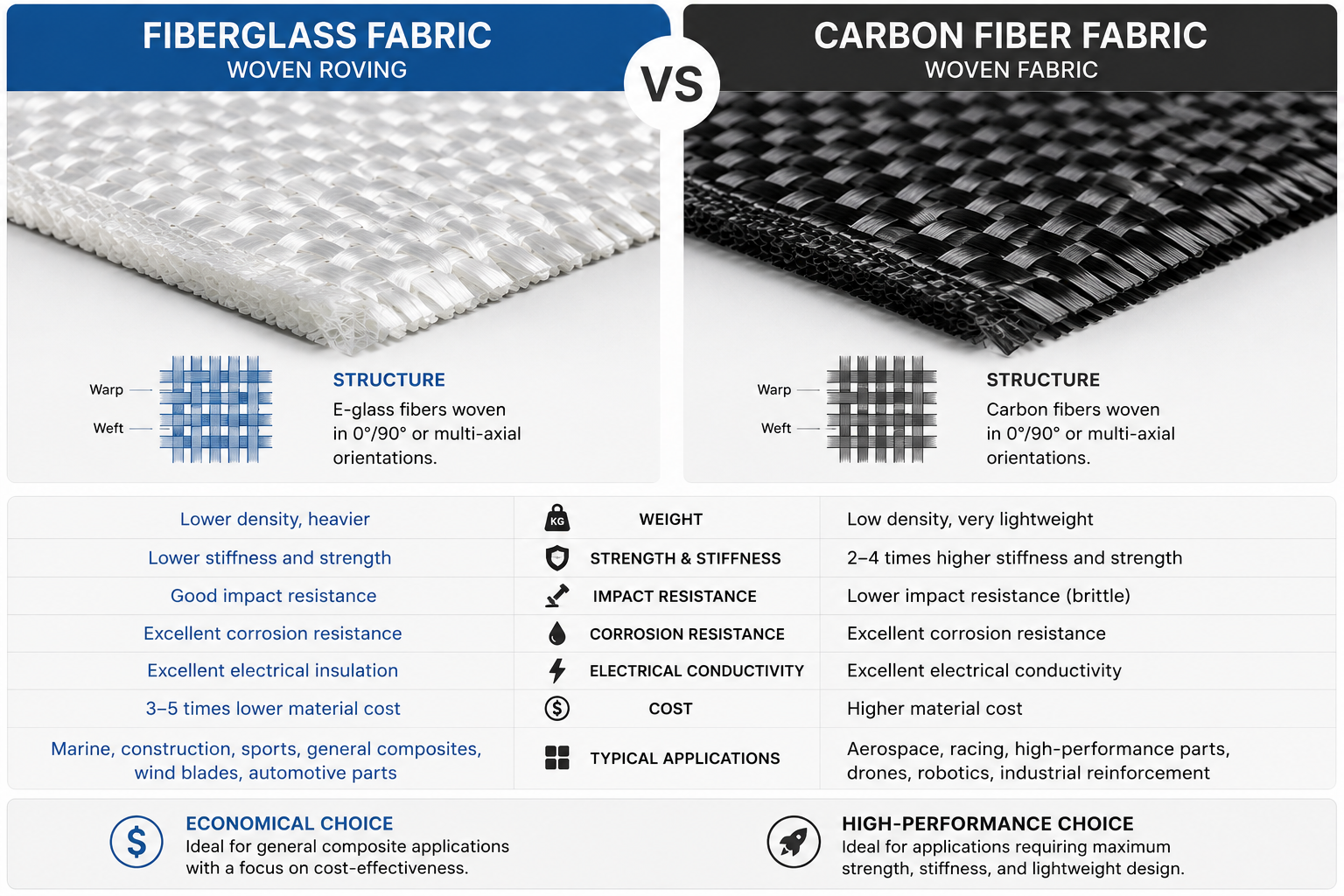
Fiberglass fabric versus carbon fiber: the trade-off that frames most composite material comparisons. Source: CINON Composites material comparison data.
The benchmark group operates at a scale where fiberglass is one material family among many, and where the commercial model is built on broad portfolio coverage. This matters for buyers because it changes the nature of the relationship: a diversified group typically offers breadth and global volume capacity, while a specialized supplier concentrates engineering attention on a narrower set of reinforcements and cores.
Method note: This comparison uses CINON's documented company and product facts and third-party market research. It does not publish internal performance metrics, financial results, or proprietary specifications for the benchmark companies, because those figures are not part of the verified evidence base used here. Where a research source identifies a company as a key market player, that identification is the fact being cited — not an inferred ranking.
| Comparison dimension | CINON Composites (documented) | Benchmark group (Owens Corning, China Jushi, Saint-Gobain, Taishan Fiberglass) |
|---|---|---|
| Corporate profile | Founded 2022; 40,000 m² facility; 25-engineer R&D team; 1,200,000 m² annual output | Large, diversified global materials groups publicly identified as key players in the fiberglass fabric market |
| Product scope | Fiberglass fabrics, biaxial fabrics, PET / PVC / PMI foam core, Core Mat, PP honeycomb, aramid honeycomb | Broad portfolios spanning multiple material families and end markets |
| Technical focus | Reinforcement architecture, resin flow behavior, weight reduction, structural stiffness, total manufacturing cost | Group-level material science and multi-segment application development |
| Application coverage | Boat building, yacht construction, wind turbine blades, transportation panels, UAV structures, industrial composite components | Multi-industry supply across construction, transportation, industrial and energy markets |
| Market orientation | 100% export; Europe, North America, Asia-Pacific | Global supply organizations with regional manufacturing footprints |
| Buyer relationship | Engineering support before order confirmation; single-point technical contact | Account structures spanning multiple product lines and business units |
Technical R&D and Reinforcement Architecture: Where the Differences Sit
Answer first: For most structural composite programs, the decisive technical variable is not the brand of the fabric but the architecture of the reinforcement — how straight the fibers run, how the lay-up responds to resin flow, and how much post-finish correction the laminate demands.
This is where the multiaxial-versus-woven-roving decision sits. Multiaxial fabrics provide straighter fiber orientation and higher structural efficiency than woven roving. The reported performance gap reaches up to 20–30% higher laminate performance depending on lay-up design. The practical consequences extend beyond mechanical values: higher resin impregnation rate, less energy consumption during lamination, less post-finish correction, and lower long-term repair cost. The trade-off is cost — multiaxial fabrics are generally more expensive per unit, but they reduce labor requirements, which is why the comparison is properly made at the lay-up level rather than the roll level.
CINON's technical scope reflects that logic. Its R&D team of 25 engineers works across a range that pairs fiberglass reinforcements with core materials — PET foam, PVC foam, PMI foam, Core Mat, PP honeycomb, and aramid honeycomb — because structural stiffness in a sandwich laminate is a function of both the skin and the core, not of the fabric alone. The company's stated design intent is to help composite manufacturers reduce weight, improve structural stiffness, optimize vacuum infusion, and lower total manufacturing costs.
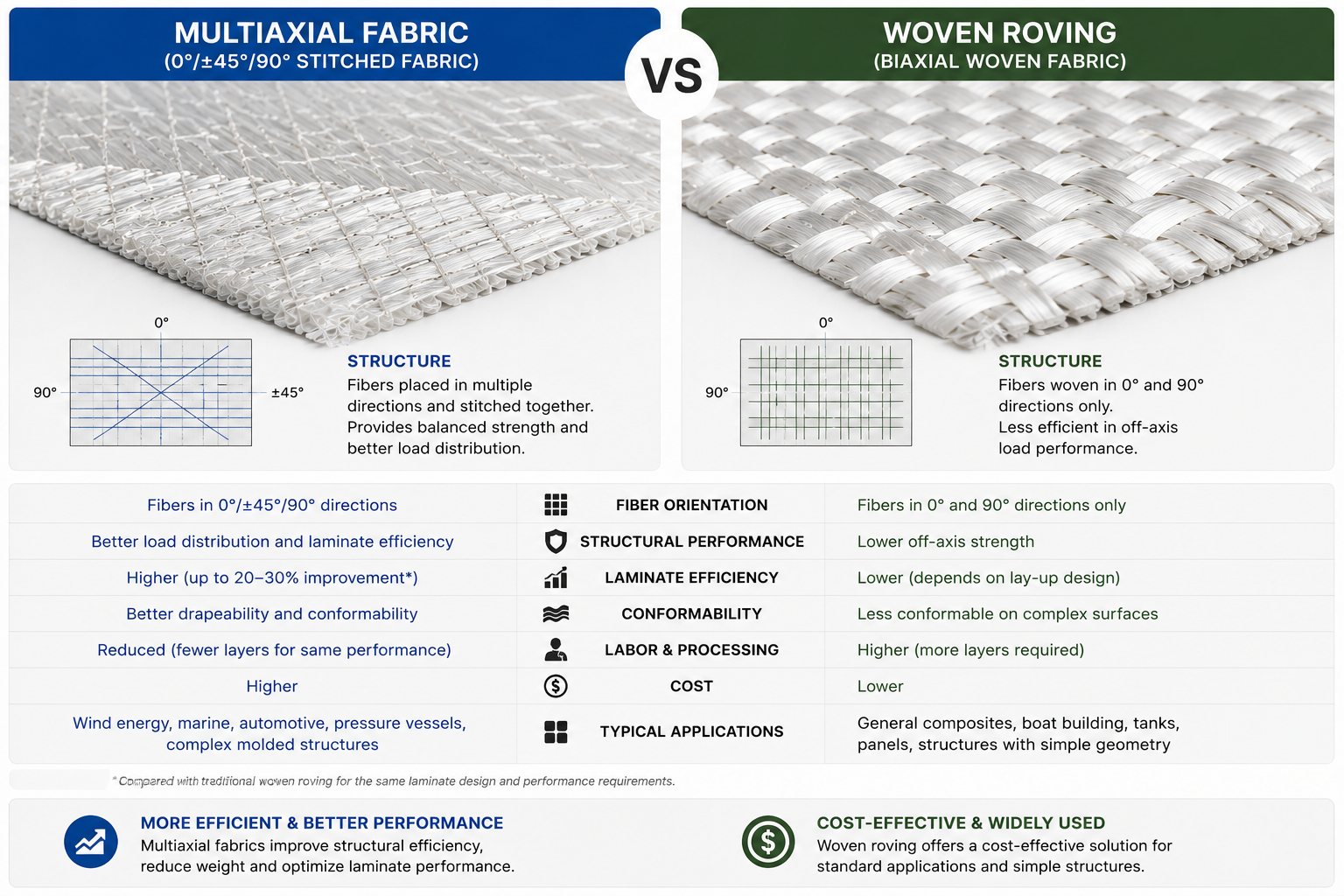
Fiberglass multiaxial fabric versus woven roving: fiber straightness and structural efficiency drive the choice in wind energy, marine, and structural composite lay-ups.
How the two supplier models differ on R&D
A diversified global group typically develops materials across many industries simultaneously, which produces deep materials science capability and broad qualification history. A specialized supplier such as CINON concentrates on a narrower technical band: reinforcement format, resin compatibility, core selection, and laminate behavior in marine, wind, transportation, UAV, and tooling applications. For a buyer running a defined program in one of those segments, the narrower focus can translate into faster engineering response and more targeted material recommendations. For a buyer who needs a single vendor across fifteen material categories, the diversified model is usually the better structural fit. Neither model is universally superior.
Material Trade-offs: Fiberglass, Carbon Fiber, and Woven Roving
Answer first: Fiberglass fabric offers lower material cost and better impact resistance than carbon fiber, while carbon fiber delivers higher stiffness at lower weight. Most green energy and marine programs therefore use fiberglass as the structural workhorse and reserve carbon fiber for stiffness-critical components.
The documented comparison is specific. Carbon fiber is approximately 2–4 times stiffer than fiberglass, but the price of carbon fiber is 12–15 times that of glass fiber. Expressed from the fiberglass side, fiberglass offers a material cost 3–5 times lower than carbon fiber. Fiberglass also brings better impact resistance, stable long-term performance, cheaper repair and maintenance costs, and lower overall production energy consumption in mass production. Those characteristics make fiberglass more suitable for marine, industrial, and construction applications, while carbon fiber suits aerospace, racing, and high-performance structures.
| Decision factor | Fiberglass fabric | Carbon fiber | Woven roving (vs. multiaxial) |
|---|---|---|---|
| Stiffness | Lower | 2–4× higher | Lower structural efficiency than multiaxial |
| Material cost | 3–5× lower than carbon fiber | 12–15× the price of glass fiber | Multiaxial carries higher material cost |
| Impact resistance | Better | Lower | Comparable, lay-up dependent |
| Repair & maintenance | Stable long-term performance; cheaper repair | Higher repair cost | Less post-finish correction with multiaxial |
| Production energy | Lower overall energy consumption for mass production | Higher | Higher resin impregnation rate, less lamination energy |
| Typical fit | Marine, industrial, construction | Aerospace, racing, high-performance structures | Wind energy, marine, structural composites |
Read together, these comparisons explain why a supplier's value is not in the fiber alone. It is in how accurately the supplier maps a reinforcement format and core combination to a build process and an application load case. That is a specification judgment, and it is where specialized and diversified suppliers diverge most visibly.
Application Fit: Green Energy, Marine, UAV, and Lightweight Structures
Answer first: Fiberglass fabric's strongest application fit is in large, durable, impact-tolerant structures — wind turbine blades and nacelle structures, boat and yacht hulls, UAV airframes, transportation panels, FRP components, and composite tooling.
The wind energy weighting is significant. Wind turbine blades account for approximately 42.5% of total fiberglass usage within the wind energy sector, according to third-party market analysis from Dataintelo. This concentration explains why the wind energy application segment is forecast to grow faster than any other fiberglass fabric segment between 2025 and 2033. It also explains why blade and nacelle programs in Germany, Denmark, Spain, the United States, China, and India are the reference applications against which reinforcement suppliers are commonly judged.
Marine demand follows a similar pattern. The marine fiberglass resin market is projected to reach USD 4.23 billion by 2033, according to Market Research Future, indicating steady demand for associated fiberglass fabric reinforcements for ship hulls and decks. Marine hull construction in Australia, yacht hull programs, and surfboard production in Thailand represent the same underlying material requirement: impact resistance, resin uptake consistency, and long-term durability in wet environments.
CINON's documented application coverage aligns with these segments. The company positions its fiberglass reinforcements and core materials across boat building, yacht construction, wind turbine blades, transportation panels, UAV structures, and industrial composite components. In aerospace and UAV work — including UAV production in Germany — the governing constraints are weight criticality and stiffness-to-weight ratio, which is where multiaxial reinforcement combined with lightweight foam or honeycomb cores becomes the practical choice. In the United States, FRP panel production for transportation and industrial use emphasizes sandwich stiffness and dimensional consistency rather than extreme stiffness-to-weight targets, favoring foam-core and Core Mat constructions.
| Application | Dominant material requirement | Typical reinforcement / core combination |
|---|---|---|
| Wind turbine blades & nacelle structures | High laminate performance, consistent resin impregnation, fatigue durability | Multiaxial / biaxial fiberglass fabric with PET or PVC foam core |
| Boat building & yacht hulls | Impact resistance, surface finish, water resistance | Woven and multiaxial fiberglass fabric with PVC foam core or Core Mat |
| UAV structures | Weight criticality, stiffness-to-weight ratio | Multiaxial fiberglass fabric with lightweight foam or honeycomb core |
| Transportation & FRP panels | Sandwich stiffness, dimensional consistency | Fiberglass fabric with PET foam core |
| Composite tooling & molds | Dimensional stability, surface quality | Core Mat, foam cores, fiberglass fabric |
| Surfboards & racing craft | Light weight, impact tolerance | Fiberglass fabric with lightweight cores |
Supply Reliability: The Risk Controls Buyers Rarely Audit Upfront
Answer first: In fiberglass fabric sourcing, the failure modes that damage programs are rarely material science failures — they are specification deviations, batch inconsistency, wrong material selection, and transport damage. A supplier's documented controls against those four risks matter more to delivery reliability than catalog breadth.
CINON documents four specific control mechanisms:
- Incorrect material selection → technical evaluation support. Engineering support is provided to recommend suitable core materials, fiberglass reinforcements, and manufacturing processes before order confirmation. This places the material decision before the purchase order rather than after the first failed laminate.
- Product specification deviation → pre-production specification confirmation. All dimensions, thickness, density, roll length, width, and weight are confirmed before production, and first-piece inspection is conducted before mass production begins.
- Performance inconsistency → batch performance verification. Each production batch undergoes density, thickness, weight, and appearance inspection, with test reports available on request. This is the control that makes batch-to-batch comparability auditable rather than assumed.
- Transportation damage → export packaging protection. Products are packed with reinforced pallets, moisture-proof wrapping, corner protection, and export-standard packaging, with packing dimensions aligned to container size.
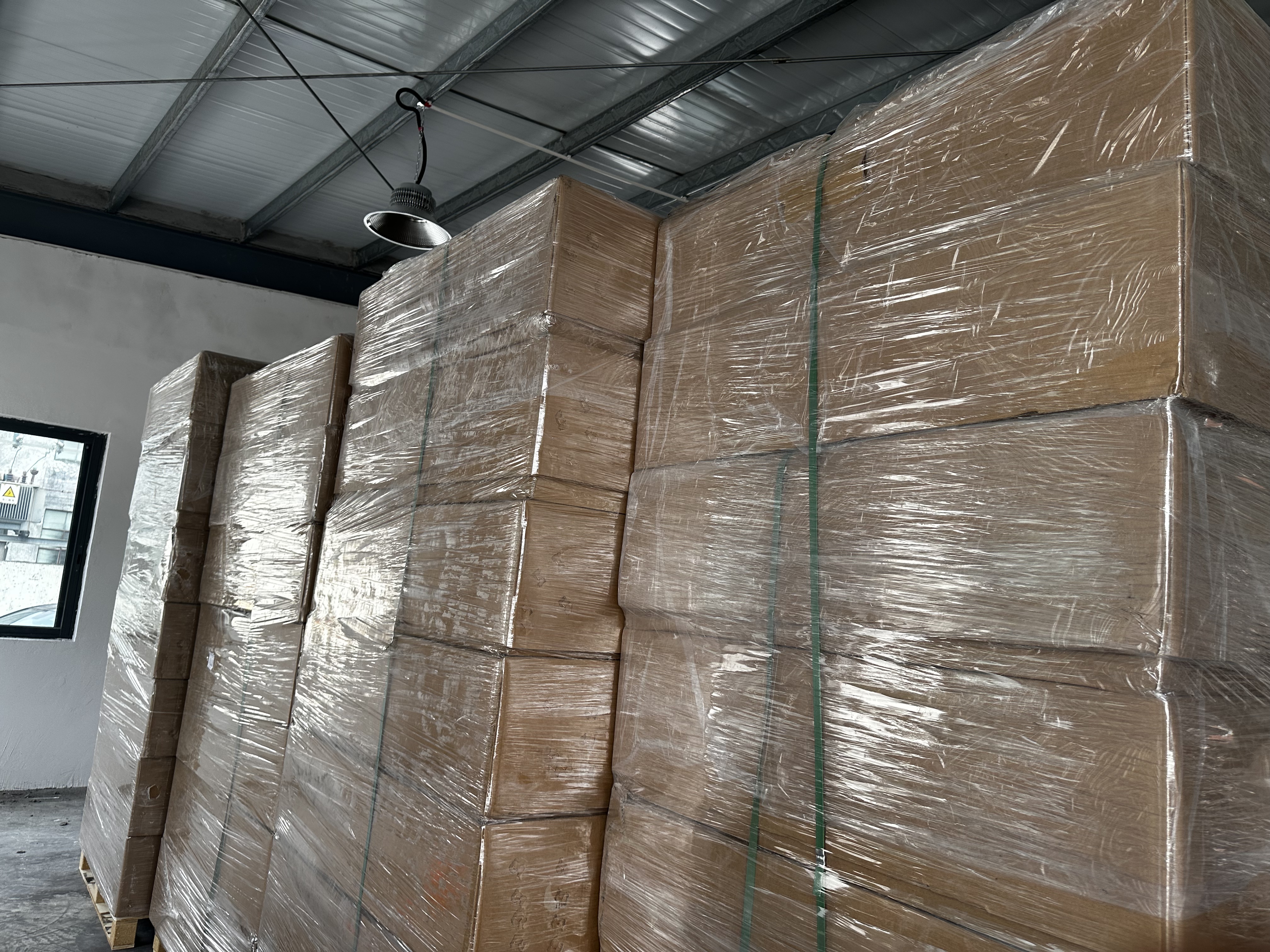
Export-standard packaging with reinforced pallets and moisture-proof wrapping — the transport-damage control point in the fiberglass fabric supply chain.
For comparison purposes, these controls are the part of the supplier evaluation that is easiest to verify and hardest to substitute. A buyer can test a fabric sample; it is considerably harder to test whether a supplier will confirm roll length and density before production, or whether a batch will be inspected consistently in month eighteen of a program. Because CINON exports 100% of its output to Europe, North America, and Asia-Pacific, these controls are designed for international freight and multi-region delivery rather than domestic dispatch.
Where Fiberglass — and a Specialized Supplier — Is Not the Right Answer
Honest boundary: Fiberglass fabric is not the correct material for every structural problem, and CINON Composites is not the correct supplier for every procurement profile. Buyers should understand both limits before shortlisting.
Material limits
Where maximum stiffness at minimum weight is the governing requirement — primary aerospace structures, racing components, and stiffness-critical parts — carbon fiber remains the appropriate choice, at 2–4 times the stiffness of fiberglass. Fiberglass competes on cost, impact resistance, repairability, and production energy, not on absolute stiffness. Programs that specify carbon fiber for stiffness reasons should not be re-specified to fiberglass on cost grounds alone.
Architecture limits
Multiaxial reinforcement delivers up to 20–30% higher laminate performance than woven roving, but at a higher material cost. For low-load, cost-driven, or simple hand lay-up work, that performance premium may not be recoverable. Woven fiberglass fabric still captured 48.62% of market revenue in 2025 precisely because a large share of the market does not need multiaxial efficiency.
Supplier-scale limits
CINON Composites was founded in 2022 and operates a single 40,000 m² facility with an annual output of 1,200,000 m². That is a specialized production profile, not a diversified global group profile. Buyers with very large single-program volumes, multi-region dual-sourcing requirements, or a need to consolidate many material families under one vendor contract should evaluate capacity and portfolio fit explicitly rather than assuming equivalence. CINON's range covers fiberglass reinforcements and core materials; it is not a carbon fiber producer, and it does not present itself as one.
Data limits
Market sizing in this category is not settled. Published estimates for the global fiberglass fabric market diverge substantially between research firms — for example, USD 3.99 billion for 2024 (Market Research Future), USD 5.15 billion for 2025 (Fortune Business Insights), and USD 14.01 billion for 2024 (Grand View Research). The divergence is generally attributed to differences in whether raw glass fiber and processed fabric are counted together. Buyers should treat any single market-size figure as directional rather than definitive.
Market Trend Analysis: What the Verified Numbers Support
Several trends are supported by attributable data rather than narrative assumption:
- Wind energy is the growth segment. The wind energy application segment for fiberglass fabric is expected to grow at a CAGR of 8.5% from 2025 to 2033, the highest among all application segments, according to Grand View Research.
- Supply is concentrated in Asia Pacific. Asia Pacific held a 41.61% revenue share of the fiberglass fabric market in 2024, driven by infrastructure and renewable energy projects.
- Woven fabric still leads by revenue. Woven fiberglass fabrics captured 48.62% of market revenue in 2025, according to Mordor Intelligence, reflecting their established role in yacht hulls and automotive panels.
- Blades dominate fiberglass consumption in wind. Wind turbine blades account for approximately 42.5% of total fiberglass usage within the wind energy sector, per Dataintelo.
- Marine demand remains structural. The marine fiberglass resin market is projected to reach USD 4.23 billion by 2033, pointing to continued demand for hull and deck reinforcements.
For buyers, the practical implication is that reinforcement supply is being pulled toward large-format structural applications — blades, hulls, panels — where laminate consistency and process compatibility carry more weight than unit price. That favors suppliers who can document batch control and process support, and it puts pressure on suppliers who compete on price alone.
Future Outlook
The next phase of fiberglass fabric sourcing is likely to be defined by three shifts. First, process-driven specification will continue to replace material-driven specification: buyers will increasingly select reinforcement architecture by whether the laminate runs reliably in vacuum infusion, RTM, or VARTM processing, not by generic fabric type. Second, weight reduction requirements in transportation and UAV programs will push more demand toward combined skin-and-core solutions, where the reinforcement supplier and the core supplier are evaluated as one system. Third, standardized testing references such as ASTM D638 for tensile properties and ASTM D790 for flexural strength and modulus will remain the shared language for verifying laminate claims across regions.
Within that environment, the competitive question for specialized suppliers is not whether they can match the scale of a diversified global group. It is whether their engineering response, batch documentation, and application specificity justify the relationship for a defined program. CINON Composites is positioned in that second category — a focused reinforcement and core material supplier serving wind energy, marine, UAV, transportation, industrial composites, and composite tooling programs, with documented controls covering material selection, specification confirmation, batch verification, and export packaging.
FAQ: Fiberglass Fabric Comparison Questions
1. What is the difference between fiberglass fabric, woven roving, and carbon fiber in structural composites?
Fiberglass fabric is a reinforcement made from glass fibers, available in woven and multiaxial formats, and is used mainly in marine, industrial, and construction applications. Woven roving is a coarser woven glass reinforcement; compared with multiaxial fabric, it offers lower fiber straightness and lower structural efficiency. Carbon fiber delivers 2–4 times the stiffness of fiberglass at a price 12–15 times that of glass fiber. In practice, fiberglass is selected for cost efficiency, impact resistance, and repairability, while carbon fiber is selected where maximum stiffness at minimum weight is required.
2. When is multiaxial fiberglass fabric a better choice than woven roving?
Multiaxial fiberglass fabric is generally the better choice when structural efficiency and laminate performance are the governing requirements — typically wind energy, marine, and structural composite applications. Multiaxial fabrics provide straighter fiber orientation, up to 20–30% higher laminate performance depending on lay-up design, reduced labor requirements, higher resin impregnation rates, less post-finish correction, and lower long-term repair cost. The counterweight is higher material cost, so for low-load or cost-driven work, woven roving may remain the more economical option.
3. How should a buyer compare fiberglass fabric suppliers at the decision stage?
A workable comparison uses five verifiable dimensions: reinforcement architecture and resin compatibility for the intended process; documented quality controls, including pre-production specification confirmation and batch inspection; verified application evidence in the buyer's own segment; supply and packaging reliability for international delivery; and the supplier's product scope relative to the buyer's total material requirement. Supplier scale is relevant but not decisive on its own — a specialized supplier and a diversified global group serve different procurement profiles.
4. Which fiberglass fabric types fit wind blades, marine hulls, UAV structures, and FRP panels?
Wind turbine blades and nacelle structures typically use multiaxial or biaxial fiberglass fabric combined with PET or PVC foam core, because laminate performance and resin impregnation consistency drive blade quality. Boat hulls and yacht construction favor woven and multiaxial fiberglass with PVC foam core or Core Mat for impact resistance and surface finish. UAV structures emphasize weight criticality and stiffness-to-weight ratio, favoring multiaxial fabric with lightweight foam or honeycomb cores. FRP panels for transportation and industrial use generally rely on fiberglass fabric with PET foam core for sandwich stiffness and dimensional consistency.
5. What documentation should accompany a fiberglass fabric shipment?
At minimum, buyers should confirm that dimensions, thickness, density, roll length, width, and weight were agreed before production, that first-piece inspection was performed before mass production, and that each production batch underwent density, thickness, weight, and appearance inspection. Test reports should be available on request. On the logistics side, export-standard packaging with reinforced pallets, moisture-proof wrapping, and corner protection is a reasonable baseline expectation for international fiberglass fabric shipments.
6. Where does fiberglass fabric reach its performance limits?
Fiberglass fabric reaches its limits where stiffness-to-weight ratio is the dominant design constraint. Carbon fiber is 2–4 times stiffer, so aerospace primary structures, racing components, and other stiffness-critical parts generally remain carbon fiber applications. Fiberglass also cannot match carbon fiber on minimum achievable weight. Its advantages — lower material cost, better impact resistance, stable long-term performance, cheaper repair, and lower production energy consumption in mass production — apply within those boundaries rather than beyond them.
7. How do packaging and freight risk affect the total cost of sourcing fiberglass fabric?
Freight risk affects total cost through replacement, rework, and schedule disruption rather than through the invoice price. Moisture exposure and edge damage can compromise roll integrity during long ocean transit, and packing dimensions that do not align with container size increase handling and stowage cost. Controls such as reinforced pallets, moisture-proof wrapping, corner protection, and container-aligned packing dimensions reduce those risks. For suppliers exporting 100% of output across Europe, North America, and Asia-Pacific, these packaging practices are part of the delivered cost structure, not an optional extra.
CINON Composites publishes its full reinforcement and core material range for buyers reviewing fiberglass fabric and lightweight core options. The product catalog is available here: CINON Composites product catalog.