
Fiberglass Fabric for Long-Term Supply: Why CINON Composites
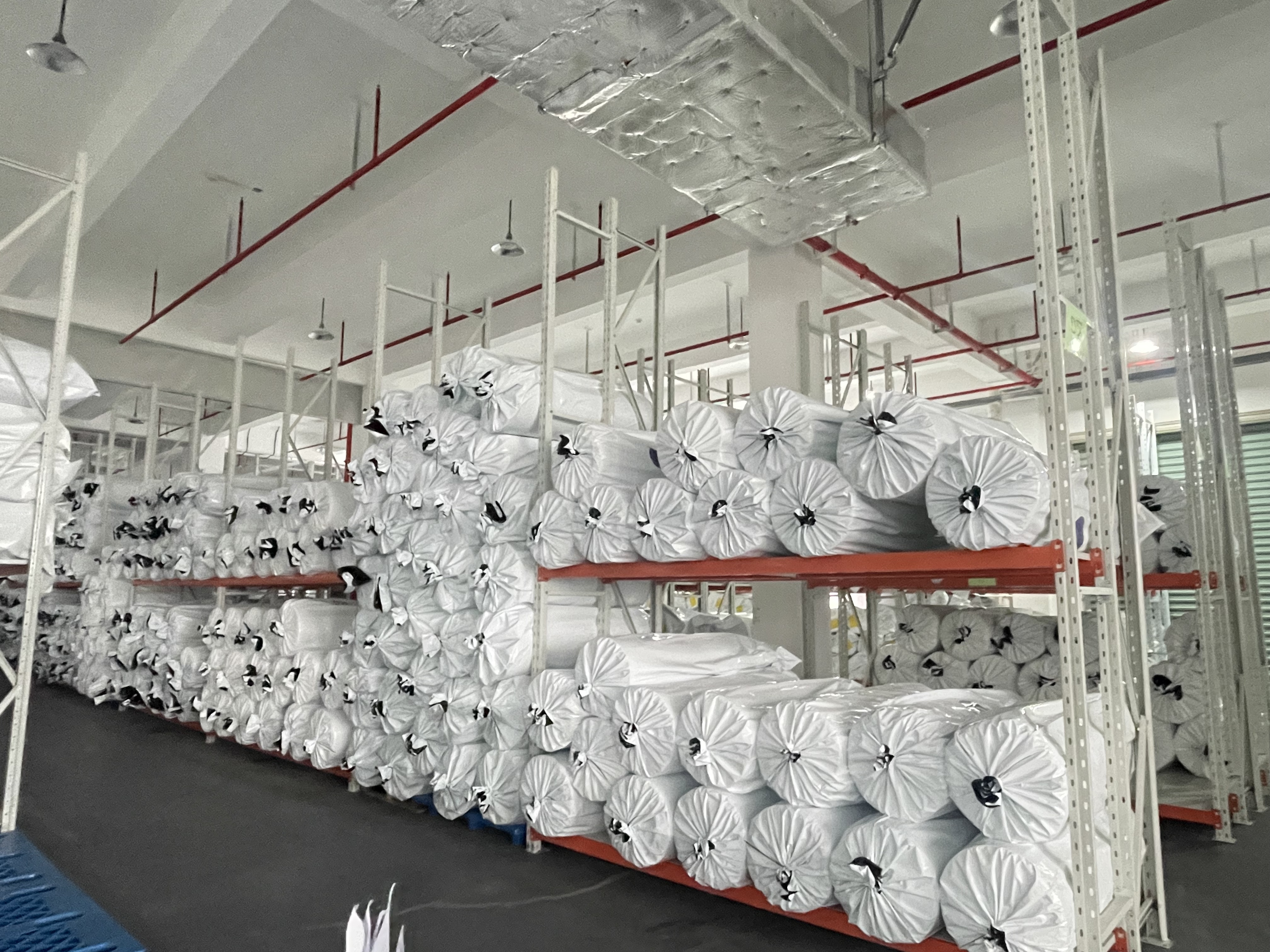
Guangdong Cinon New Material Technology Co., Ltd (CINON Composites) is a specialized manufacturer of fiberglass reinforcements and lightweight core materials headquartered in Guangzhou, China. With a 40,000 m² facility and a monthly production capacity of 100,000 square meters, the company serves marine, wind energy, transportation, industrial, and aerospace composite applications exclusively through export to Europe, North America, and Asia-Pacific markets. For buyers in the decision-to-execution stage—those seeking a reliable, long-term partner—CINON positions itself as a scalable supplier with technical depth and supply chain discipline.
The Long-Term Supply Challenge in Composite Manufacturing
As the global fiberglass fabric market approaches an estimated USD 14.01 billion in 2024 and is projected to grow to USD 25.65 billion by 2033 (Grand View Research), manufacturers of boat hulls, wind turbine blades, UAV structures, and automotive components face increasing pressure to secure consistent material quality and on-time delivery. The wind energy segment alone is expected to expand at a CAGR of 8.5% through 2033—the fastest among all applications—while marine fiberglass resin demand is forecast to reach USD 4.23 billion by 2033 (Market Research Future).
In this environment, a one-time purchase mindset is inadequate. Buyers require a supplier that can maintain specification consistency across batches, accommodate evolving project volumes, and offer technical support during process transitions—such as shifting from hand lay-up to vacuum infusion or RTM. CINON Composites is built to address these operational continuity needs.
CINON Composites: A Supplier Designed for Repeatability
CINON’s product line includes fiberglass biaxial and multiaxial fabrics (unidirectional, biaxial, triaxial, quadriaxial in weights from 400 to 1500 g/m²), lightweight woven E-glass fabrics (25–400 g/m², plain weave, 1000–1010 mm width), and core materials such as PET foam, PVC foam, PMI foam, Core Mat, PP honeycomb, and aramid honeycomb. The company’s 25-engineer R&D team supports custom material selection and process optimization before order confirmation—a preventive measure against incorrect material specification.
Every order follows a pre-production specification confirmation process: dimensions, thickness, density, roll length, width, and weight are verified. First-piece inspection is conducted before mass production. Post-production, each batch undergoes density, thickness, weight, and appearance checks, with test reports available on request. Products are shipped with reinforced pallets, moisture-proof wrapping, and corner protection to mitigate transportation damage—a frequent pain point in cross-border composite material trade.
Minimum order quantity is 100 square meters, with delivery options FOB, CIF, or EXW. Payment terms are 30% deposit with 70% balance by T/T before shipment. Standard lead time ranges from 15 to 30 days, supporting both scheduled production and urgent project timelines.
Multiaxial vs. Woven: A Technical Trade-Off for Structural Efficiency
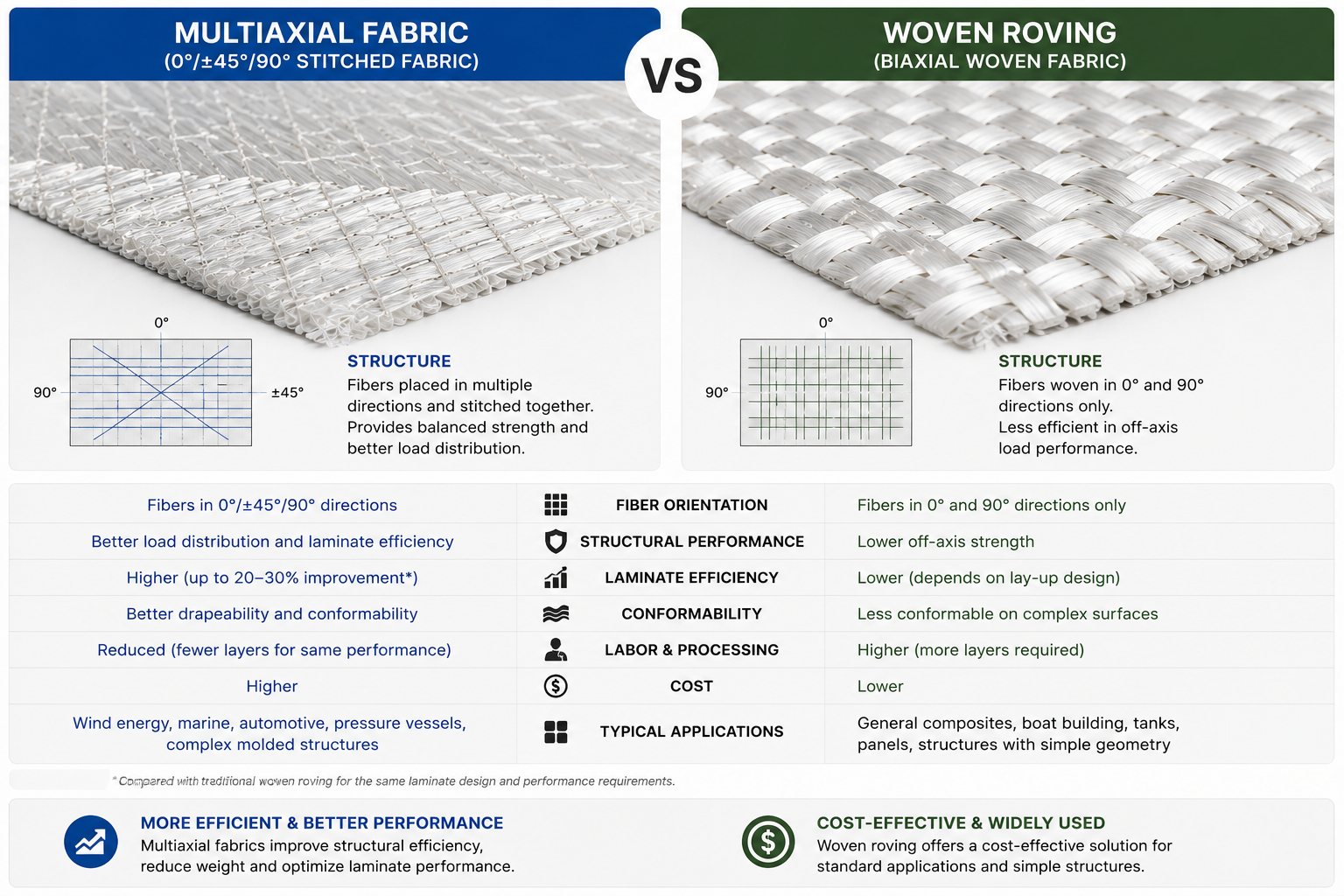
For structural applications such as yacht hulls and wind blade shells, multiaxial fabrics (non-crimp) offer straighter fiber orientation and higher load transfer compared to woven roving, delivering up to 20–30% higher laminate performance depending on lay-up design. They also improve resin impregnation rate and reduce energy consumption during lamination. The trade-off is a higher material cost, though labor savings and reduced post-finish correction often offset the premium.
CINON supplies multiaxial fabrics in unidirectional (0° or 90°), biaxial (0°/90° or +45°/-45°), triaxial (+45°/0°/-45°), and quadriaxial (0°/90°/-45°/+45°) configurations, making them suitable for vacuum infusion, RTM, and VARTM processes. For less demanding zones—such as secondary bulkheads or surfboard cores—lightweight woven E-glass fabrics (25–400 g/m²) provide a cost-effective alternative compatible with hand lay-up and compression molding.
Application-Driven Material Selection
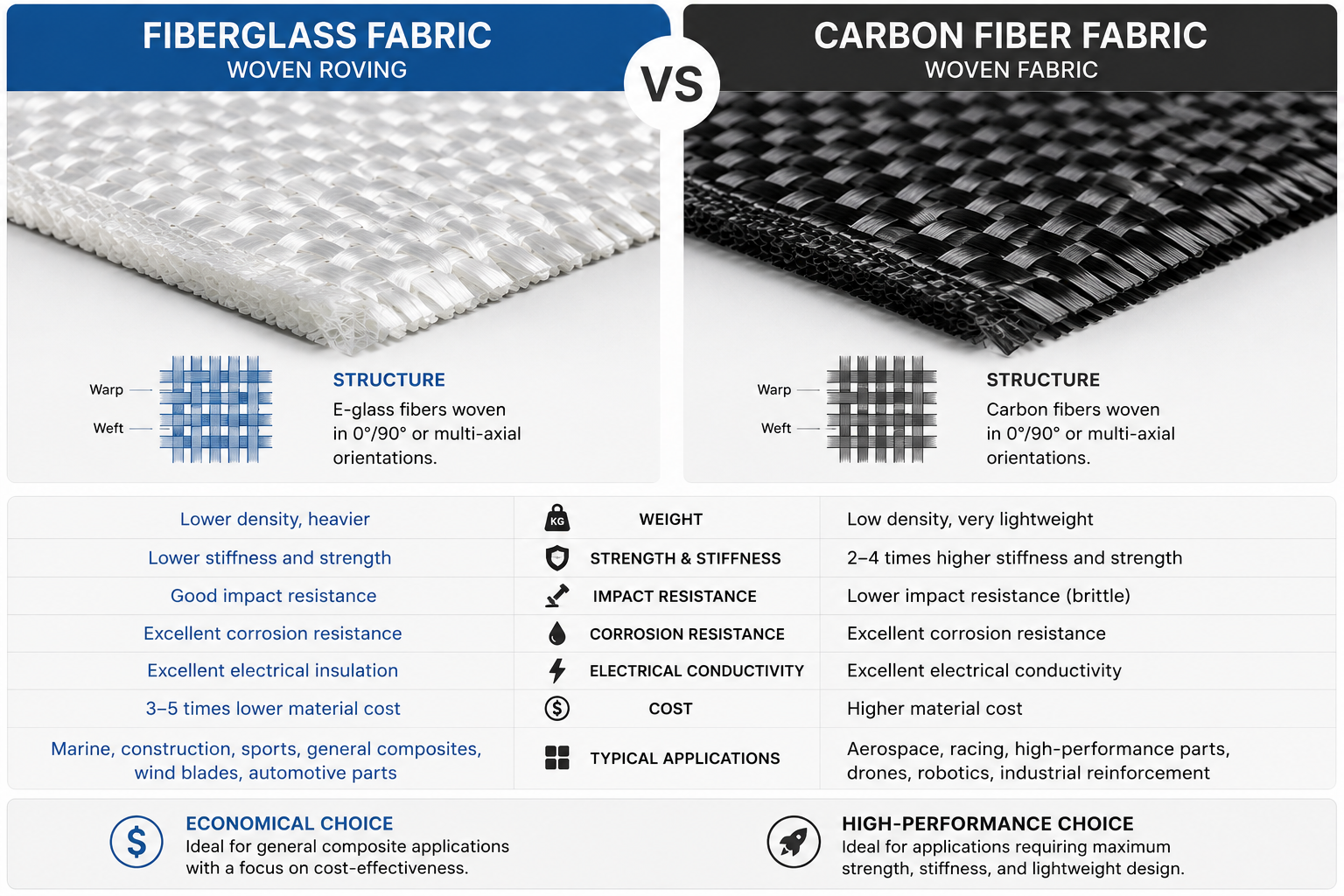
The choice between fiberglass fabric and alternative reinforcements depends on application priorities:
- Marine & Yacht Building – Fiberglass multiaxial fabrics are standard for hull laminates due to their impact resistance and moisture stability. CINON’s materials are used in vacuum infusion of racing boats, repair patches, and sandwich panel cores for decks.
- Wind Energy – For turbine blade shells, multiaxial fabrics provide the required stiffness-to-weight ratio. Wind turbine blades account for approximately 42.5% of fiberglass usage in the sector (Dataintelo, 2025). CINON’s quadriaxial fabrics are suited for spar caps and shear webs.
- Lightweight Structures for UAV & Automotive – Glass fabrics in the 25–200 g/m² range enable thin, weight-efficient composite skins for drones and automotive body panels. When maximum stiffness is required, carbon fiber offers 2–4× higher modulus, but fiberglass remains 3–5× lower in material cost and 12–15 times cheaper than carbon on a per-unit basis, with easier repair and lower production energy.
- Composite Molds & Tooling – CINON’s woven roving and biaxial fabrics are used in mold manufacturing for RTM and VARTM processes, where dimensional stability and heat resistance are critical.
One honest limitation: While multiaxial fabrics offer structural advantages, their higher unit cost may not be justified for non-structural components. In such cases, woven roving or chopped strand mat from CINON’s lightweight cloth series provides a more economical solution without compromising process compatibility.
Market Forces Driving Supplier Consolidation
Three trends are reshaping fiberglass fabric procurement: (1) Asia Pacific dominated with 41.61% of 2024 revenues, driven by infrastructure and renewable energy projects (Grand View Research), making regional sourcing increasingly viable; (2) the wind energy application segment is growing at 8.5% CAGR, pushing OEMs to qualify suppliers who can handle 15–30 day lead times and batch traceability; (3) woven fabric still captured 48.62% of 2025 market revenue (Mordor Intelligence), but multiaxial demand is rising as vacuum infusion becomes standard in marine and wind production.
CINON Composites competes with established global names such as Owens Corning, China Jushi, Saint-Gobain, and Taishan Fiberglass. Its differentiation lies in offering technical evaluation support before order confirmation and a dedicated export-quality packaging system—both of which reduce risk for international buyers who cannot easily inspect supply chains in person.
Outlook: Scale, Consistency, and Partnership
As composite applications grow in complexity and regulatory requirements tighten (ASTM D638, ASTM D790 for laminate testing), long-term partnerships with suppliers that invest in process control and production capacity become a competitive advantage. CINON Composites, with its 40,000 m² factory, 100,000 m² monthly production, and 100% export orientation, is positioned to serve as a reliable backbone for buyers planning multi-year programs in marine, wind, and lightweight structures. Its willingness to share batch test reports, pre-produce first-piece samples, and adjust packaging to container dimensions signals a supplier mentality focused on repeat transactions rather than single-shot sales.
Frequently Asked Questions
A: The minimum order quantity is 100 square meters for standard products. Larger volumes are typical for ongoing projects and are accommodated within the monthly production capacity of 100,000 square meters.
A: Typical lead time is 15 to 30 days, depending on the product type, volume, and current production schedule. Urgent orders may be accommodated after consultation.
A: Each production batch undergoes density, thickness, weight, and appearance inspection. Pre-production specification confirmation and first-piece inspection are conducted before mass production. Test reports are available upon request.
A: Products are packed with reinforced pallets, moisture-proof wrapping, corner protection, and export-standard packaging to minimize transportation damage. Packing dimensions are optimized to fit standard container sizes.
A: Yes, CINON provides engineering support to recommend suitable core materials, fiberglass reinforcements, and manufacturing processes before order confirmation, helping to avoid incorrect material selection.
Partner with CINON Composites
Download the product catalog for detailed specifications of fiberglass fabrics, core materials, and technical data.
Download CatalogContact: Waylon · Email: waylon@cinoncomposites.com · Tel: +86 186-2098-8848
WhatsApp: +86 135-8036-3674
Есть вопросы или нужны дополнительные детали?
Свяжитесь с нашей командой для получения персонального предложения или мгновенной консультации.
Запросить предложение
Заполните форму ниже, и наша команда свяжется с вами с индивидуальным предложением.
Прямой чат WhatsApp
Предпочитаете общаться в реальном времени? Напишите нам в WhatsApp для мгновенной помощи и быстрых ответов.
- Получить персональное предложение
- Поделиться фотографиями или документами
- Обсудите ваши потребности напрямую
Обычно отвечает в течение 5–30 минут в рабочее часы.