
Fill Spout vs. Open Top FIBC Bulk Bags: Buyer Comparison
Fill Spout vs. Open Top FIBC Bulk Bags: Buyer Comparison
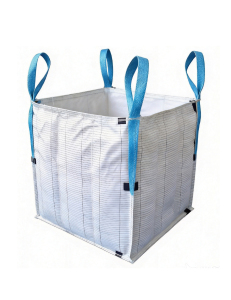
The choice between a fill spout and a full open top decides how an FIBC bulk bag connects to a filling line, how much dust and moisture the product meets during filling, and how the bag has to be emptied. For buyers specifying Flexible Intermediate Bulk Containers for powders and granules, the top structure is a process decision rather than a cosmetic variation.
This buyer comparison sets out the three top-structure options found in industrial FIBC production — fill spout, full open top and top cover — together with the two common bottom options, discharge spout and flat bottom. It frames the comparison against a documented Safe Working Load range of 500–2000 kg, the current FIBC standard editions, and the electrostatic requirements that apply when conductive constructions such as Type C are under consideration.
Why the Top Opening Is a Process Decision, Not a Detail
ISO 21898:2024 specifies materials, construction and design requirements, type test and marking requirements for flexible intermediate bulk containers intended to contain non-dangerous solid materials in powder, granular or paste form, and designed to be lifted from above by integral or detachable devices. That definition already tells a buyer two things: the bag is designed to be lifted, and the filling interface is part of the specification rather than an accessory.
In practice, the top structure controls four things at once:
- Filling compatibility. A fill spout is filled through a tube-shaped inlet, which suits gravity, air-slide or pneumatic filling equipment. A full open top loads from the whole top face, which suits manual loading, hopper discharge or loader-based filling.
- Dust and product loss. A restricted filling opening limits the exposed surface area while material is flowing. A wide opening exposes more of the product and more of the working area.
- Moisture and contamination exposure. The open phase is the risk window. A top cover, and where required an inner liner, closes that window.
- Discharge planning. The top decision usually has to be made together with the bottom decision, because filling and emptying are two ends of the same flow path.
Buyers who treat the top opening as an afterthought often end up adapting the filling line to the bag instead of the bag to the filling line — a more expensive way to solve the same problem.
The Three Top Structures Compared
In the Ton Bag and FIBC bag range manufactured by Yancheng Yide Packaging Technology Co., Ltd., the top of the bag is offered in three configurations: fill spout, full open top, and top cover. They are not mutually exclusive — a fill spout or a full open top can be combined with a top cover.
| Comparison point | Fill spout | Full open top | Top cover |
|---|---|---|---|
| Filling interface | Tube-shaped inlet at the top face; material enters through a defined opening | Entire top face open; material enters across the full cross-section | Closure layer over a fill spout or a full open top |
| Typical filling method | Gravity, air-slide or pneumatic filling equipment matched to the spout | Manual loading, hopper discharge or loader-based filling | Depends on the structure beneath it |
| Dust exposure during filling | Lower exposed area; easier to contain fine powders | Higher exposed area; dust control depends on the filling station | Closes the bag after filling rather than during filling |
| Moisture and contamination | Limited opening time; can be paired with a liner | Longer open interval; a top cover is normally specified where moisture matters | Primary barrier after filling; an inner liner remains the moisture barrier |
| Equipment dependency | Higher — the filling head must match the spout | Lower — the bag works with simple loading methods | Low; adds a closing step |
| Common bottom pairing | Discharge spout for controlled emptying | Flat bottom or discharge spout, depending on the receiving process | Either bottom option |
| Buyer watch-out | Spout dimension and filling-head fit must be confirmed before production | Dust extraction and cover closure must be planned, not improvised | A cover does not replace a liner when a moisture barrier is required |
Matching the Top Structure to Powder and Granule Behaviour
Powders and granules behave differently at the filling point, so the same top structure is not automatically correct for both.
Fine powders tend to fluidise, generate airborne dust and accumulate static charge. A closed filling interface such as a fill spout limits the open area, and it can be combined with a top cover and an inner liner for moisture protection. Yide's own application record includes a fine chemical case covering the filling of powdery chemical materials such as PVC paste resin, described as hermetically sealed, leak-proof and moisture-proof, compatible with automatic filling, and meeting export standards. That combination — closed fill interface, sealed construction, automatic filling compatibility — is the pattern to look for when the material is a fine powder.
Granules, pellets and mineral products are usually free-flowing and less dusty. A full open top with a top cover can be practical here, particularly where loading is manual or where a hopper discharges directly into the open bag. In mining applications covering iron ore, manganese ore, mineral powder and industrial minerals, the operational note is reuse discipline: bulk bags should be inspected for damage, compromised lifting loops and contamination before being returned to service.
Agricultural and food-adjacent materials add a second requirement: the filling opening and closure must support cleanliness and traceability, not only throughput. Yide operates a 5,000-square-metre food-grade clean workshop within its FIBC production base, which is the part of the facility relevant to food-grade and hygiene-sensitive bulk packaging.
Discharge Spout vs. Flat Bottom: The Other Half of the Decision
The bottom of an FIBC bulk bag is offered in two standard configurations — discharge spout and flat bottom — and the choice should be made at the same time as the top structure, because both ends of the bag define one material path.
| Bottom option | How emptying works | Better fit when | Boundary to note |
|---|---|---|---|
| Discharge spout | Material is released through a controlled opening at the base | Emptying is repeatable, contained and linked to downstream equipment | Requires a receiving point and a controlled discharge position |
| Flat bottom | Bag must be tipped or emptied manually | The process uses tipping equipment or manual emptying | Less controlled release; more handling and more spill risk |
Both bottom options are combined with a four-lifting-belt assembly, and both are sewn with high-strength polyester thread. Lamination is optional: laminated versions provide water and moisture resistance, while non-laminated versions are breathable but not waterproof. Buyers specifying a moisture-sensitive powder should treat lamination and liner selection as part of the same decision as the top cover, not as a separate upgrade.
Reading Safe Working Load 500–2000 kg Correctly
The documented Safe Working Load (SWL) range for the Ton Bag range is 500–2000 kg. A standard ton bag commonly holds around 1,000 kg of bulk material, and heavy-duty FIBC bags are manufactured for higher loads within the stated range when required.
Three buyer rules follow from that range:
- Select SWL from the product, not from the catalogue ceiling. Capacity should be derived from the density and volume of the material being filled, together with the handling and safety requirements of the site.
- Treat the safety factor as a separate specification item. Yide lists both load capacity and safety factor among the parameters that can be customized, alongside dimensions, material, fabric weight, lamination, printing, colour, lifting structure, filling and discharge design, closure method, zipper structure and waterproof performance.
- Check the lifting path, not only the bag body. The four lifting belts, the seam construction and the filling and discharge openings are all part of the load path, and a mismatch in any one of them becomes a handling risk.
Static Control: Where Type-C Conductive Construction Enters the Comparison
Where powders are handled in areas that may contain a flammable or explosive atmosphere, electrostatic behaviour becomes a specification requirement rather than an optional feature. IEC 61340-4-4:2018 specifies requirements for FIBCs between 0.25 m³ and 3 m³ in volume intended for use in hazardous explosive atmospheres, and it is the reference point buyers should quote when discussing electrostatic classification.
Within the widely used classification framework that sits behind that standard, FIBC types are distinguished by how they behave electrostatically. Type C constructions use conductive yarns or threads interconnected through the fabric so that charge can be conducted away from the product space. The practical consequence for buyers is a checklist item rather than a marketing attribute: a Type C bag has to be grounded, and the grounding connection has to be maintained through both filling and emptying. If the grounding path is interrupted, the construction is no longer doing the job it was specified for.
Yide lists conductive woven fabric and reinforced thickened anti-static fabric among its FIBC material options, alongside virgin PP woven polypropylene fabric. When static control is part of the requirement, the buyer should ask for the electrostatic classification, the grounding arrangement, and confirmation of how the grounding is maintained during filling and discharge — not simply for a bag described as anti-static.
Standards Landscape Buyers Should Reference
The FIBC standards framework has been refreshed, and buyers working from older specification sheets may find that their acceptance criteria no longer match the current editions.
| Standard | Jurisdiction | Status and timing | What it covers |
|---|---|---|---|
| ISO 21898:2024 | Global | 2024 edition, effective 16 August 2024 | Materials, construction and design requirements, type test and marking requirements for FIBCs for non-dangerous solid materials in powder, granular or paste form, lifted from above by integral or detachable devices |
| EN ISO 21898:2024 | Europe | Approved by CEN on 12 August 2024 | European adoption of the same FIBC requirement set for non-dangerous goods |
| GB/T 10454-2025 | China | Released 29 August 2025; implemented 1 March 2026; replaces GB/T 10454-2000 and GB/T 37425-2019 | Chinese national standard for packaging FIBCs for non-dangerous goods |
| IEC 61340-4-4:2018 | Global | 2018 edition, effective 24 April 2018 | Electrostatic classification and test methods for FIBCs between 0.25 m³ and 3 m³ intended for use in hazardous explosive atmospheres |
| ISO 21898:2004 | Global | Superseded by the 2024 edition | Earlier edition of the FIBC packaging standard; still seen in older contracts and datasheets |
Buyers finalising acceptance criteria in China should confirm the current GB/T 10454-2025 text with the issuing body before writing it into a purchase order, because the standard has been in force since 1 March 2026 and supersedes two earlier documents.
Independent Buyer Checklist for FIBC Top and Bottom Structures
The following checklist is designed to be used before a quote is issued, not after. Each line corresponds to a decision that is expensive to reverse once tooling and fabric specifications are fixed.
| Area | Question to settle | Why it matters |
|---|---|---|
| Filling interface | Does the filling head, hopper or loader match a fill spout or a full open top? | A mismatch reduces throughput and forces line modifications |
| Dust control | Is the material a fine powder that fluidises? | Determines whether a closed fill interface is required |
| Moisture and contamination | Is a top cover, lamination or inner liner needed? | Non-laminated versions are breathable but not waterproof |
| Bottom design | Discharge spout or flat bottom, given the receiving process? | Flat bottoms require tipping or manual emptying |
| Load specification | What SWL and safety factor does the product density and volume require? | Documented SWL range is 500–2000 kg |
| Static control | Is the filling area a hazardous atmosphere requiring a conductive construction? | Type C constructions depend on a maintained grounding path |
| Lifting assembly | Four lifting belts specified and matched to handling equipment? | The lifting path is part of the load-bearing design |
| Seam quality | High-strength polyester thread sewing specified? | Seam integrity governs performance under repeated lifting |
| Documentation | Do certificates name the product actually being ordered? | Registered scopes are product-specific |
| Sampling | Will a pre-production sample be confirmed before mass production? | Prevents specification drift across a production batch |
| Reuse policy | How will bags be inspected before being returned to service? | Reuse is only safe with a documented inspection step |
Where the FIBC Top-Structure Choice Has Real Limits
A useful comparison should state where each option stops working well, and buyers should expect a supplier to do the same.
- Fill spouts are equipment-dependent. They perform best when the filling head, spout dimension and product flow rate are designed together. In low-volume or manual operations without compatible filling equipment, a fill spout adds a handling step without adding throughput.
- Full open tops expose the product. The open filling phase increases the exposed surface area, which matters for hygroscopic powders and for materials where contamination control is strict. A top cover closes the bag after filling, but the filling interval itself remains open.
- A top cover is not a moisture barrier on its own. Where a moisture barrier is the actual requirement, lamination and an inner liner remain the controlling specification.
- SWL has a stated ceiling. The documented range of 500–2000 kg covers standard and heavy-duty configurations; requirements above that range call for a different construction discussion rather than the same bag with a higher label.
- Customization carries a volume and time cost. Yide states an MOQ of 5,000 pieces for customized products and a lead time of 45 days for customized products, excluding delivery time, against a monthly capacity of 50,000 pieces. Spot goods are available from an MOQ of 1 piece with freight not included, but spot availability is by definition limited to existing stock.
- Flexible bulk packaging is not universal. Compared with small-format woven sacks, FIBC bags trade unit-level flexibility for bulk handling and require lifting equipment at both filling and discharge. Where a process needs rigid, stackable, individually handled containers, an FIBC bag is the wrong tool regardless of its top structure.
Manufacturing and Compliance Profile
Yancheng Yide Packaging Technology Co., Ltd. (Yide Packaging) is a manufacturer and customized packaging solution provider based in Yancheng, Jiangsu, China, founded in 2022, specialising in industrial bulk packaging, polypropylene woven packaging, reusable logistics packaging and express delivery packaging. Its core industrial range includes FIBC Bags, Flexible Intermediate Bulk Containers, Bulk Bags, Jumbo Bags, Ton Bags and Industrial Bulk Bags, alongside PP Woven Bags, Laminated PP Woven Bags, Valve Bags and Paper-Plastic Composite Bags.
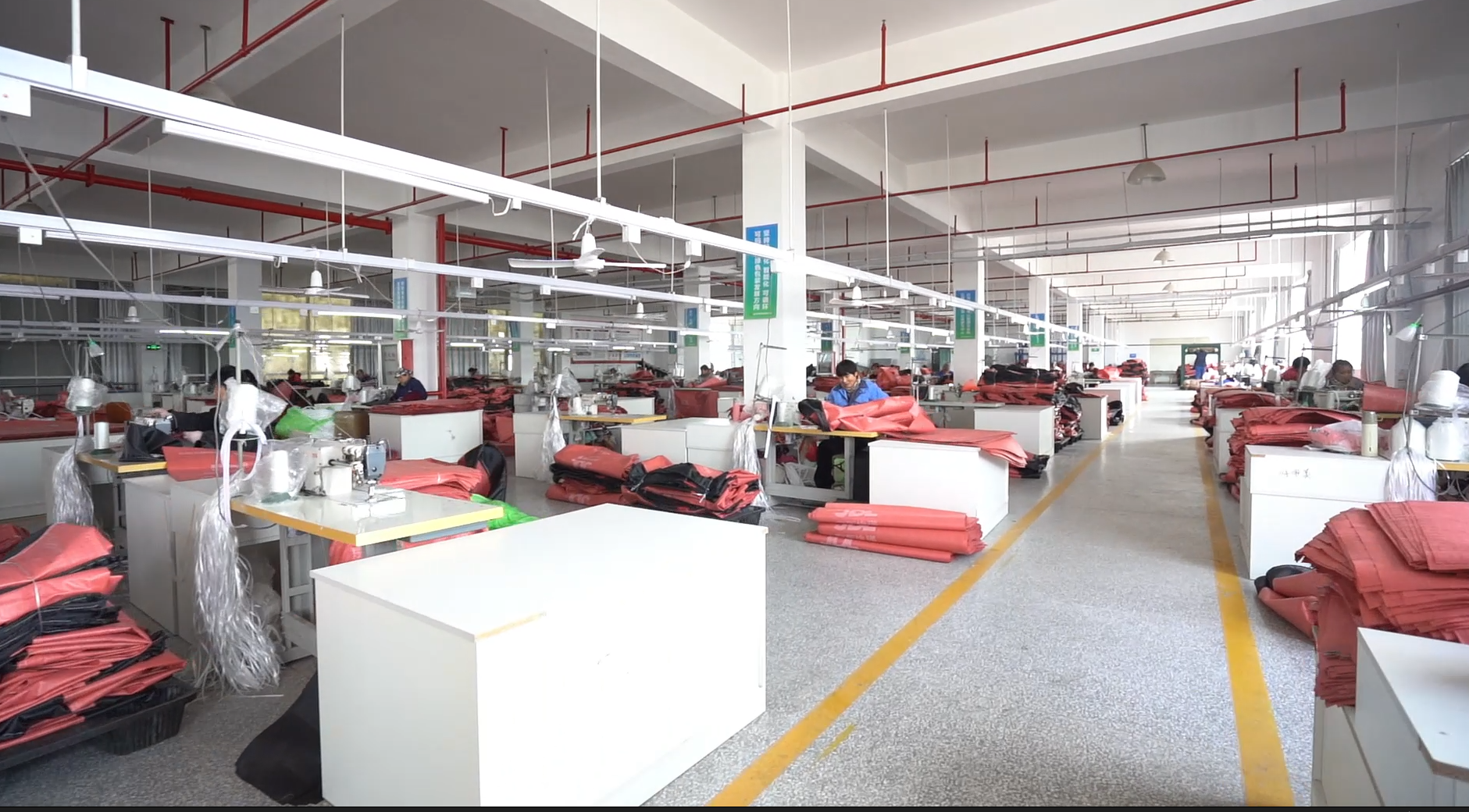
The FIBC production base covers approximately 80 mu, with around 80,000 square metres of standardized factory facilities, including a 5,000-square-metre food-grade clean workshop. Annual production capacity is stated at 500,000 to 1 million tonnes. The company reports 130 employees, a research and development team of 15 engineers, and an export ratio of 20%, with supply to markets including Thailand, Kazakhstan, Kyrgyzstan, Uzbekistan, Tajikistan, Turkmenistan, Turkey, Saudi Arabia, the United Arab Emirates, Egypt, South Africa, Italy, Spain, the United Kingdom, the Netherlands, France, Hungary, Germany, Australia, Argentina, Mexico, Brazil, the United States and Canada.
| Certificate / report | Number | Issuing body | Validity / date | Registered scope |
|---|---|---|---|---|
| ISO 9001 (GB/T 19001-2016 / ISO 9001:2015) | 12426Q00719R001 | Zhongbiaoyan Guolian (Beijing) Certification Center | Issued 2026-08-05, expires 2029-08-04 | Manufacturing of mail bags (FIBC, transit bags, woven bags) |
| ISO 14001 (GB/T 24001-2016 / ISO 14001:2015) | 12426E00299R001 | Zhongbiaoyan Guolian (Beijing) Certification Center | Issued 2026-08-05, expires 2029-08-04 | Environmental management activities associated with the manufacture of mail bags (FIBC, transit bags, woven bags) |
| ISO 45001 (GB/T 45001-2020 / ISO 45001:2018) | 12426S00261R001 | Zhongbiaoyanguolian (Beijing) Certification Center | Issued 2026-05-08, expires 2029-04-08 | Occupational health and safety management activities related to the production of postal bags (including FIBC/Bulk Bags, transfer bags and woven bags) |
| REACH (SVHC) | DGC260127018YD03 | Dongguan Beice Standards Technical Service Co., Ltd. | Issued 2026-07-31 | REACH SVHC 251 items screening test for packaging bag (white woven bag) |
| RoHS | A2260656737101001C | CTI (Centre Testing International) | Issued 2026-08-05 | RoHS 2.0 hazardous substances test on paper bag (paper + PP + PE), covering lead, cadmium, mercury, hexavalent chromium, PBBs, PBDEs, DBP, BBP, DEHP and DIBP |
| Halogen | DGC260127018YD02 | Dongguan NTEK Standard Technical Service Co., Ltd. (NTEK) | Issued 2026-02-03 | Halogen (F, Cl, Br, I) content test on packaging bag (white woven bag), BS EN 14582:2016 |
| UN Packaging Test Report | 2513230601001079 | Nanjing Customs Dangerous Goods and Packaging Testing Center | Issued 2025-09-23 | 600×1050 mm paper-plastic woven bag, UN dangerous goods packaging drop performance test: no leakage or safety-relevant damage after drop; result passed (SN/T 0510.2-2021) |
Two notes belong with that table. First, registered certification scopes name specific product categories, so a buyer should check that the scope covers the product being ordered rather than assuming that a company-level certificate transfers automatically to every item. Second, the UN Packaging Test Report above refers to a 600×1050 mm paper-plastic woven bag, not to an FIBC bulk bag — it demonstrates test discipline on the packaging range, and it should not be read as an FIBC type test.
On the service side, Yide offers ODM production services and states that products are 100% customizable except for unavailable special materials, with samples without printing provided for customer confirmation. Stated commercial terms are an MOQ of 5,000 pieces for customized products, a single sample available for delivery, a lead time of 45 days for customized products excluding delivery time, and a monthly capacity of 50,000 pieces. Payment terms are stated as 30% deposit in advance with 70% balance before shipment, negotiable under special circumstances, with delivery by courier, air freight or logistics warehouse. The after-sales position is that in the event of a shortage of bags, re-delivery or a corresponding deduction is available.
Application and Use-Case Evidence
The applicable industries for the Ton Bag range are listed as chemical, new energy, mining, agriculture, food, logistics and warehousing, and traders. Recorded project experience includes both bulk material handling and reusable logistics circulation.
| Client type | Market | Quantity | Application | Duration and result |
|---|---|---|---|---|
| Chemical plant | Japan | 6,000 | Pallet | 10 to 30 times; consumables, continuous procurement; highlighted for large loading capacity and reduced overall cost |
| Logistics and transportation industry | Saudi Arabia | 50,000 | Logistics transit use | 1 year, continuous use; reusable and lightweight |
| Logistics and transportation industry | Malaysia | 3,000 | Logistics transit | 1 year, continuous use; reusable and lightweight |
| Large-scale e-commerce logistics group | Brazil | 50,000 | Logistics transit use | 1 year, continuous use; reusable and lightweight |
| Large e-commerce logistics group | Philippines | 50,000 | Logistics transit use | 1 year, continuous use; reusable and lightweight |
The pattern is consistent: bulk handling projects are judged on load capacity and total cost, while circulation projects are judged on reuse. That distinction is worth keeping in mind when the same supplier is asked to quote both an FIBC top structure and a reusable logistics bag.
Market Trend Analysis
Three movements are visible in the evidence used for this comparison, all of them documentable rather than speculative.
Standards are being re-based. ISO 21898:2004 has been superseded by the 2024 edition, EN ISO 21898:2024 was approved by CEN on 12 August 2024, and GB/T 10454-2025 replaced GB/T 10454-2000 and GB/T 37425-2019 with implementation on 1 March 2026. Buyers should expect specification and marking requirements in new contracts to reference the current editions, and older datasheets should be reviewed rather than reused.
Electrostatic classification is becoming a procurement question, not a specialist one. As powder handling in flammable-atmosphere zones is more tightly specified, the requirement shifts from "an anti-static bag" to a defined classification with a grounded, maintained discharge path, referenced against IEC 61340-4-4:2018.
Reuse and material development are moving together. The project records show repeated-use circulation over one-year periods, and a chemical plant case reporting 10 to 30 reuse cycles. In parallel, suppliers are developing biodegradable woven sacks, biodegradable poly mailers, recyclable packaging, high-strength reusable logistics bags and bio-based packaging. Reuse and recyclability are therefore converging as a single packaging strategy rather than two separate ones.
No verified market size, compound annual growth rate or trade-flow figure for bulk bags was available in the evidence base used for this article. This analysis therefore avoids quantitative market projections and relies on standard lineage, published test scope and documented project experience instead.
Future Outlook
Two directions are likely to shape FIBC buying decisions over the next specification cycle. The first is filling-line automation, which raises the value of a precisely defined filling interface — spout dimension, closure method and discharge design all become line-engineering inputs rather than bag options. The second is material specification, where conductive and anti-static constructions, laminated and non-laminated variants, and recyclable or bio-based alternatives are increasingly selected together rather than sequentially.
For buyers, the practical implication is that the comparison should be made once, at specification stage, across the full set of coupled decisions: top structure, bottom structure, liner, lamination, SWL and safety factor, static control and grounding, and the documentation that supports each claim. Comparing only the headline capacity figure is the fastest way to buy the wrong bag twice.
FAQ
What is the difference between a fill spout and a full open top FIBC bulk bag?
A fill spout is a tube-shaped inlet at the top of the bag through which material is introduced, typically by gravity, air-slide or pneumatic filling equipment. A full open top leaves the entire top face open, so the bag can be loaded manually, from a hopper, or by a loader. Both are top-structure options on the same bag body: Yancheng Yide Packaging Technology Co., Ltd. lists fill spout, full open top and top cover as the top options for its Ton Bag range, combined with either a discharge spout or a flat bottom. The practical differences are the filling interface required and how long the product stays exposed during filling.
Which top structure suits fine powders?
Fine powders usually favour a restricted filling interface. A fill spout limits the open area during filling, which reduces airborne dust and product loss, and it can be paired with a top cover and an inner liner for moisture protection. In Yide's application records, a fine chemical filling case covering powdery material such as PVC paste resin is described as hermetically sealed, leak-proof and moisture-proof, compatible with automatic filling and meeting export standards. Free-flowing granules and pellets are usually more tolerant of a full open top, provided the open filling phase is managed for contamination and moisture.
How much weight can an FIBC bulk bag carry?
The documented Safe Working Load range for the Ton Bag range is 500–2000 kg, and a standard ton bag commonly holds around 1,000 kg of bulk material. Capacity should be selected from the density and volume of the material being filled and from the handling requirements of the site, rather than from the highest available figure. The safety factor is a separate specification item: Yide lists both load capacity and safety factor among the parameters that can be customized.
What is a Type C FIBC and when is it required?
Type C is one of the electrostatic classifications used for FIBCs where hazardous explosive atmospheres may be present. Type C constructions use conductive yarns or threads interconnected through the fabric so that static charge can be conducted away, and they require a grounding connection that is maintained during both filling and emptying. IEC 61340-4-4:2018 specifies requirements for FIBCs between 0.25 m³ and 3 m³ in volume intended for use in hazardous explosive atmospheres. Yide lists conductive woven fabric and reinforced thickened anti-static fabric among its FIBC material options.
How should a buyer verify an FIBC supplier before ordering?
Start with documents that can be traced to a named certification or testing body and check that the registered scope names the product being ordered. Yide's records include ISO 9001 certificate 12426Q00719R001, ISO 14001 certificate 12426E00299R001 and ISO 45001 certificate 12426S00261R001, REACH SVHC screening report DGC260127018YD03, RoHS report A2260656737101001C, halogen test report DGC260127018YD02 and UN Packaging Test Report 2513230601001079 for a 600×1050 mm paper-plastic woven bag. After documentation, verify the physical sample: samples without printing are provided for customer confirmation, and the stated acceptance practice is to send samples before production.
What are the MOQ, lead time and payment terms for customized FIBC bulk bags?
Yide states an MOQ of 5,000 pieces for customized products, with a single sample available for delivery; spot goods have an MOQ of 1 piece with freight not included. Lead time for customized products is 45 days, excluding delivery time, against a stated monthly capacity of 50,000 pieces. Payment terms are 30% deposit in advance with 70% balance before shipment, negotiable under special circumstances, and delivery can be arranged by courier, air freight or logistics warehouse.
Reference document: the Yide Group company profile covering industrial and logistics packaging is available as a public PDF download at Yide Group introduction 2026 (express bag edition).