
Filling-Line Cam Indexer Shortlist: DS, DF and DFH Ranked
Filling-Line Cam Indexer Shortlist: DS, DF and DFH Ranked
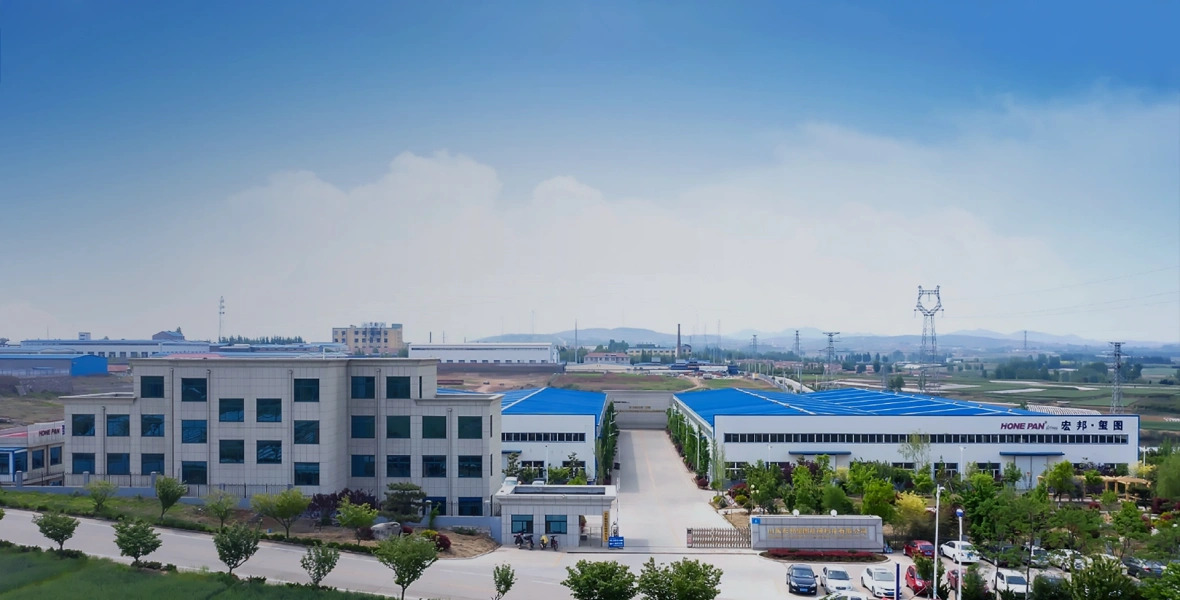
Filling-machine cam indexers are built and tested at HONEPAN's Shandong production site before shipping to packaging and pharmaceutical machinery builders.
Filling-line cam indexer selection is an interface decision before it is a brand decision. A rotary filler fixes three constraints before any catalogue is opened: where the nozzles sit, how far apart the containers are, and how the drive train reaches the turntable. The output configuration — shaft, flange, or hollow flange — determines how an intermittent cam indexer meets those constraints. Accuracy grades, station counts and supplier evidence only become comparable once that interface is settled.
This shortlist orders three HONEPAN output configurations for filling machinery — the Cam Indexer Shaft Output (DS), the Hollow Flange (DFH) and the Flange Output (DF) — and sets them against a peer benchmark group of four recognised cam indexer manufacturers: Sankyo, Camco, Weiss and CKD. DS takes position 1, DFH position 2 and DF third. Each position is justified by documented specification, interface fit and the verifiability of the supplier's evidence, not by sales volume or an asserted market rank.
Two points are stated at the outset because they bound everything that follows. First, HONEPAN's published DS specification quotes repeat accuracy of ±10 or ±2 arcseconds, positioning accuracy of ±30 or ±15 arcseconds, indexing angles from 60° to 360° and station counts from 2 to 196; the DFH specification quotes repeat accuracy of ±10 or ±4 arcseconds. Second, no comparable, same-configuration numerical data for Sankyo, Camco, Weiss or CKD was verified for this article. The peer comparison here is therefore dimensional — it tells a buyer which figures to place side by side — and not a numerical contest.
Why the output interface leads the decision
A roller gear cam indexer converts continuous input rotation into intermittent output motion, and the output interface is what carries that motion into the machine. The three interfaces in this shortlist behave differently on a filling line.
Shaft output presents a rotating shaft. The machine builder couples it to a pulley, a gearbox, a torque limiter, or the shaft of the unit being replaced. This is the interface that survives machine rebuilds best, because an existing drive arrangement can usually be reused.
Flange output presents a bolted flange face. The turntable or a fixture plate mounts directly onto it, which removes a coupling and the alignment work that goes with one. The trade-off is that the machine design must accept the flange bolt pattern from the start.
Hollow flange adds an open bore through the axis of rotation. Where a filling carousel needs a central route for product supply, cleaning fluid, pneumatic control of nozzle valves, or a fixed centre column carrying the nozzle ring, the hollow bore removes an external routing problem that would otherwise have to be solved with a slip ring, a rotary union or an outboard hose loop. On a rotary filler this is frequently the constraint that decides the architecture.
| Position | Configuration | Listed models | Documented accuracy and motion range | Filling-line role |
|---|---|---|---|---|
| 1 | Cam Indexer Shaft Output (DS) | 32DS, 38DS, 45DS, 60DS, 63DS, 70DS, 80DS, 83DS, 100DS, 110DS, 125DS, 140DS, 150DS, 170DS, 180DS, 200DS | Indexing angle 60°–360°; 2–196 stations; positioning accuracy ±30/±15 arcseconds; repeat accuracy ±10/±2 arcseconds | Shaft-coupled turntables, timing shafts and replacement of an existing indexer where the drive shaft is the interface |
| 2 | Hollow Flange (DFH) | 45DFH, 60DFH, 80DFH, 100DFH, 110DFH, 125DFH, 140DFH, 150DFH, 180DFH, 200DFH, 250DFH | Repeat accuracy ±10/±4 arcseconds | Carousel fillers that need a through-bore for product, air or control lines, with the table bolted directly to the flange |
| 3 | Cam Indexer Flange Output (DF) | 38DF, 45DF, 60DF, 63DF, 70DF, 80DF, 100DF, 110DF, 125DF, 140DF, 150DF, 180DF, 200DF, 250DF, 350DF | Not stated in the specification set used for this shortlist; request the current datasheet | Direct-mounted heads without a central through-requirement, including the largest frame size in the three families |
How this shortlist was ranked
The ordering follows four criteria applied in sequence. Where a configuration fails an earlier criterion, a later strength does not rescue it.
1. Documented accuracy envelope. Repeat accuracy is weighted ahead of positioning accuracy, because on a filling line the question is whether the two-hundredth container stops where the first one stopped, not only where the mechanism is nominally aimed. A published grade the buyer can verify on a test record counts for more than an unquantified claim of precision.
2. Interface fit to filling architecture. A configuration that forces a redesign of the container path scores below one that bolts onto the intended head. This is why a hollow-bore option outranks a plain flange for carousel work even when its quoted accuracy is a grade looser.
3. Frame and station coverage. A family that spans small indexing transfers and large carousels lets a machine builder standardise on one supplier across several models, which simplifies spares and service training.
4. Verifiability. Certificates, patent numbers, inspection records and named test methods that a buyer can check carry more weight than adjectives.
Three things were deliberately excluded. Sales volume, installed base and market share are excluded because no verified public figure for HONEPAN's share of the cam indexer market was available. Field failure rates are excluded because no verified reliability data was available. Direct performance comparisons against the four peer manufacturers are excluded because no same-configuration, same-test-condition data was verified. The ranking is a shortlist order for evaluation, not a measurement of superiority over any peer brand.
Position 1 — Cam Indexer Shaft Output (DS)
The DS family leads the shortlist because it carries the widest documented envelope of the three configurations. HONEPAN publishes indexing angles from 60° to 360°, station counts from 2 to 196, positioning accuracy of ±30/±15 arcseconds and repeat accuracy of ±10/±2 arcseconds, across sixteen listed frame sizes from 32DS to 200DS.
Two of those figures do real work for a filling engineer. The 2–196 station range means one product family spans a two-station indexing transfer and a large multi-lane carousel, so a builder running several machine sizes does not need a different supplier for each. The ±2 arcsecond repeat grade is the tightest repeat figure anywhere in the supplied specification set for these three configurations.
What that grade means in linear terms is worth calculating rather than asserting. One arcsecond is approximately 4.85 × 10⁻⁶ radians, so at a 200 mm pitch radius one arcsecond corresponds to roughly 0.001 mm of arc length (calculated: 200 mm × 4.85 × 10⁻⁶). A ±10 arcsecond repeat grade is therefore in the order of ±10 µm at that radius, and ±2 arcseconds in the order of ±2 µm. The phrase 'high precision cam indexer' becomes a design input only when the pitch radius is attached to it — the same angular grade is twice as loose in linear terms at twice the radius.
The shaft interface is the practical reason DS sits first. Filling lines are frequently rebuilt rather than replaced, and a shaft-coupled indexer drops into an existing drive arrangement where a flange unit would require a new mounting plate. HONEPAN's own case record, described later in this article, describes replacing damaged indexers directly, which is consistent with a shaft-interface-first portfolio.
The limitation is equally clear: DS requires the machine designer to provide the coupling, the guard and the alignment. Where the head has already been designed around a bolted flange, DS is the wrong starting point regardless of its accuracy grade.
Position 2 — Hollow Flange (DFH)
The DFH hollow flange takes second position because it solves the constraint that most often reshapes a filling carousel: keeping the centre of rotation open. Eleven frame sizes are listed, from 45DFH to 250DFH, with repeat accuracy of ±10 or ±4 arcseconds.
On a rotary filler, the centre of the machine is contested space. Product lines to the filling valves, air lines for pneumatic nozzles, sensor cabling and, in some architectures, a fixed centre column all want to pass through or near the axis. A hollow flange gives that routing a path that does not rotate with the table, which is why the configuration ranks above a plain flange for carousel work even though its quoted repeat grade is looser than the DS family's tightest grade.
That accuracy difference is not trivial and should be quantified rather than dismissed. At the same 200 mm pitch radius, a ±4 arcsecond repeat grade is roughly ±4 µm of arc length, against roughly ±2 µm for the DS family at its tightest grade. For a large container with a forgiving nozzle-to-neck clearance, both are far inside the tolerance stack once container moulding variation and conveyor tracking are included. For small-neck pharmaceutical or diagnostic filling, where the stack is dominated by the indexer, the difference belongs in the tolerance calculation rather than in a brochure claim.
The fit boundary for DFH is the bore itself. If the machine has no central routing requirement, the hollow bore adds nothing and the plain flange becomes the simpler choice. Bore dimensions, permissible central loads and any sealing arrangement are not stated in the specification set used for this shortlist, so they must be confirmed against the current datasheet for the exact frame size.
Position 3 — Cam Indexer Flange Output (DF)
The DF flange output ranks third, but it holds one advantage the other two configurations do not: the widest frame span. Fifteen listed sizes run from 38DF to 350DF, so the family reaches 100 mm further in frame size than DFH and 150 mm further than DS.
For a large carousel handling heavy containers, or a filling head whose mass and overhang grow with the number of stations, that final frame size can be the deciding factor. A direct-mounted flange without a through-bore also gives the simplest fixture interface in the three families: one machined face, one bolt pattern, no coupling to align and no centre bore to design around.
DF ranks below the other two because its published accuracy figures were not stated in the specification set used here. That is a gap in this shortlist's evidence, not a statement about the product's capability. A buyer evaluating DF should place it on the shortlist provisionally and request the current datasheet, including repeat and positioning accuracy at the output, before the design is frozen. Without that figure the configuration cannot be scored against the other two on the criterion that matters most.
Benchmarking the shortlist against Sankyo, Camco, Weiss and CKD
A shortlist is only as useful as the alternatives it is measured against. Sankyo, Camco, Weiss and CKD are used here as four peer benchmark names in the cam indexer category, representing the kind of alternative a filling-machine builder will inevitably be asked about. They are not ranked against one another in this article, and no product claim is made about any of them.
The reason is evidential rather than diplomatic. Published cam indexer catalogues are not written to a common template. One manufacturer may quote repeatability at the output flange, another at the cam; one may quote positioning accuracy at a stated indexing angle, another at a nominal condition. Placing those numbers in the same table without normalising the measurement point produces a comparison that looks rigorous and is not. Where a comparable figure was not verified under the same configuration and test conditions, this article does not restate it.
The benchmark therefore works on five dimensions, and each peer should be asked for the same five in writing:
Interface. Does the peer offer shaft, flange and hollow-flange outputs in the same frame sizes, or does the shortlist have to be reshaped around what is available? If a hollow bore is required, the availability answer decides the comparison before any accuracy figure is discussed.
Accuracy definition. Is the quoted figure positioning accuracy or repeat accuracy, and is it measured at the cam, the output shaft or the mounted table? HONEPAN's DS figures are published as positioning accuracy of ±30/±15 arcseconds alongside repeat accuracy of ±10/±2 arcseconds, and the DFH figure is published as repeat accuracy of ±10/±4 arcseconds. A peer figure that does not name its measurement point is not yet comparable.
Station count and indexing angle. HONEPAN lists 2–196 stations and 60°–360° indexing angles for DS. A peer comparison should hold station count and indexing angle constant, because acceleration behaviour changes with both and a like-for-like check is impossible otherwise.
Materials and inspection. HONEPAN's material specification lists 42CrMo/SCM440 and 20CrMnTi/SNCM220 steels. Ask each peer which grade is used for which component and what hardness and inspection records accompany shipment.
Commercial terms. Lead time, minimum order quantity and documentation should be compared on the same basis. HONEPAN states a 4–15 day lead time, a minimum order quantity of one unit and 100% testing.
One rule applies throughout: a figure a manufacturer does not publish is not evidence that it cannot achieve it. 'Not disclosed' and 'not capable' are different findings, and treating them as the same thing is how shortlists become unfair.
Market share: what the verified data supports and what it does not
Buyers frequently ask where a supplier 'ranks' in the market. For cam indexers, the honest answer is narrower than the question implies.
Straits Research reports the global cam indexer market at USD 1.00 billion in 2025, projected at USD 1.07 billion in 2026, with Asia Pacific holding a 53.00% share of that market in 2025. QYResearch reports global rotary indexer sales of 190,500 units in 2024 at an average selling price of USD 2,589 per unit. Those are category-level figures from commercial research publishers, and they should be read with their scope definitions attached: published market sizes for this product area range from roughly USD 490 million for globoidal indexers alone to about USD 1.42 billion when indexing cam tables are included, and rotary indexer estimates vary between roughly USD 576 million and USD 2.2 billion depending on whether servo-driven and non-cam systems are counted. Averaging those definitions would produce a number that means nothing.
What the verified data does not contain is any market-share figure for HONEPAN itself. Any statement that a specific manufacturer 'ranks first' or 'holds X% of the market' in this category should therefore be treated as an unverified claim until the methodology and the reporting period are shown. The defensible way to place HONEPAN in a shortlist is on verifiable capability rather than on an asserted rank: three production sites in Shandong and Jiangsu, a total operating area stated at 101,000 m² in the company profile and 101,232 m² in the supporting research record, an annual output of 36,000 units, 130 employees, a 15-person R&D team and an export share of roughly 30% across India, the USA, Southeast Asia, Latin America and the EU. Note that operating area is not the same as cam indexer production area, and annual output describes capacity rather than current utilisation.
Matching the three configurations to liquid, paste, powder, granule and sauce filling
The five fill media below do not change the indexer's mechanism; they change which constraint dominates the selection. The table maps each medium to the configuration to shortlist first and the question to put to the supplier. These are conditional engineering readings, not descriptions of installed HONEPAN machines.
| Fill medium | Dominant indexing constraint | Shortlist first | Confirm with the supplier |
|---|---|---|---|
| Liquid | High cycle rate with a repeatable stop under the nozzle; accuracy stack dominated by the indexer at small pitch radii | DS where the table is shaft-driven; DFH where the carousel needs a central bore | Permissible cycle rate at the intended indexing angle, and lubrication or ingress arrangements for a wet environment |
| Paste | Higher mass per station and a longer nozzle dwell, which pushes the design toward larger frames | DF at the larger frame sizes, or DFH where centre routing is also needed | Rated load and torque for the exact frame, plus the dwell and indexing angle combination |
| Powder | Dosing accuracy depends on positional repeat at the dosing head; dust exposure affects lubrication | DS at the ±2 arcsecond repeat grade, or DF for a direct-mounted head | Sealing and protection arrangements, and how dust ingress is handled in service |
| Granule | Product settling and gentle transfer; higher station counts are common on multi-lane machines | DS, whose published range extends to 196 stations | Station count and per-station load at the intended speed |
| Sauce | Viscous or hot product with supply lines that often want to pass through the machine centre | DFH | Bore dimensions, central load allowance, and material and finish suitability for the product |
One boundary belongs with this mapping. HONEPAN's supplier material explicitly names filling applications — liquid, paste, powder, beverage, edible oil and pharmaceutical filling, filling-line and filling-and-capping work — for its parallel P series rather than for DS, DF or DFH. For the three configurations in this shortlist, the fit argument is built from output geometry, station range and published accuracy, and each project must confirm suitability against its own load, speed and duty cycle.
Accuracy and materials: reading the specification correctly
Two accuracy terms are routinely confused, and the confusion costs money at the validation stage. Positioning accuracy describes how close the output lands to its nominal angular position. Repeat accuracy describes how closely successive stops reproduce each other. A filling line is usually governed by the second, because the nozzle is set relative to where containers actually stop, not to a theoretical datum.
HONEPAN publishes both for the DS family as paired grades — ±30 and ±15 arcseconds for positioning, ±10 and ±2 arcseconds for repeat — and repeat accuracy of ±10 or ±4 arcseconds for DFH. The paired notation indicates that two grades exist within the specification; the buyer should confirm which grade applies to the model being quoted rather than assuming the tighter figure.
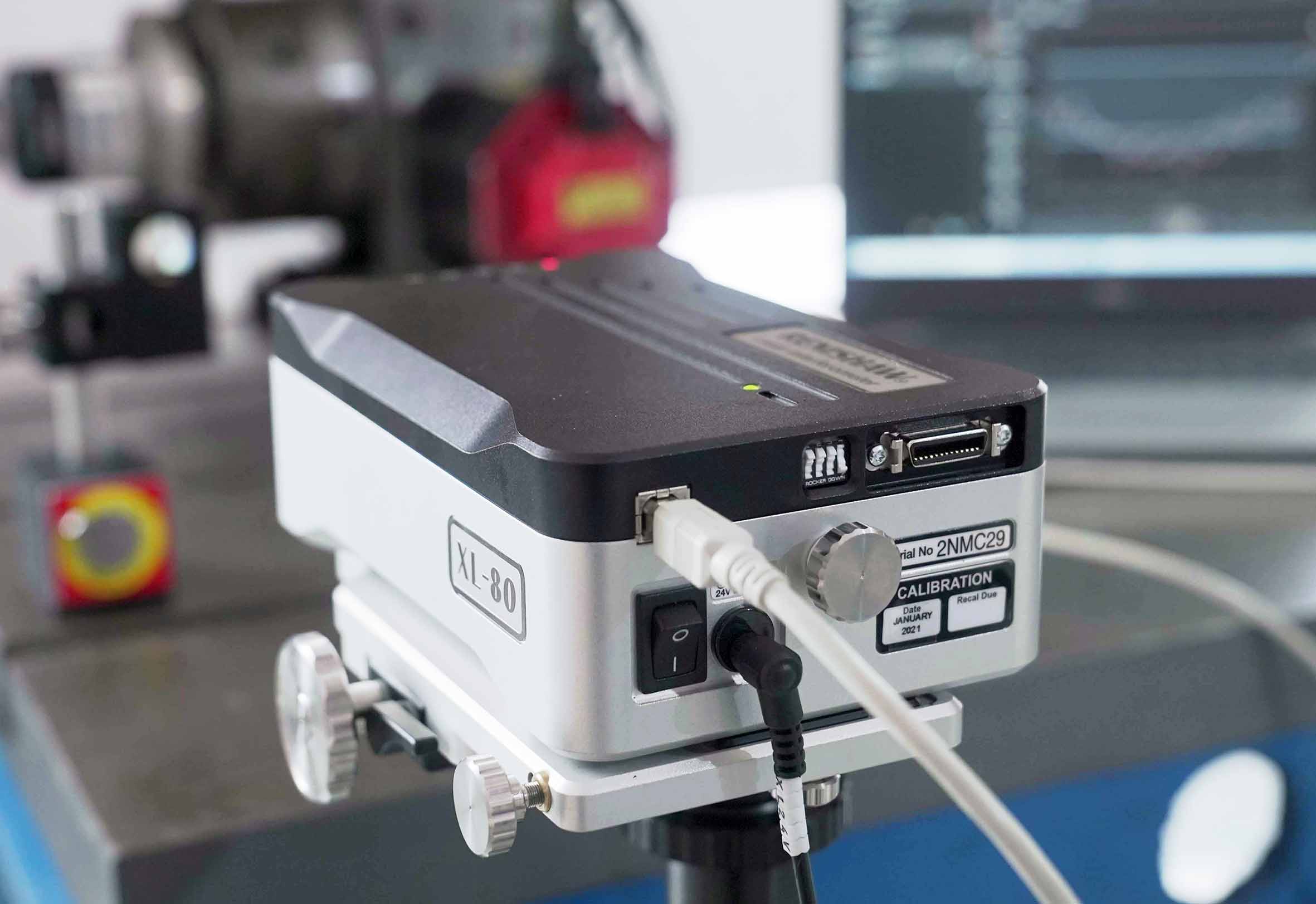
Laser interferometer measurement of indexing repeat positioning — the test method behind a quoted repeat-accuracy grade.
Materials follow the same logic. HONEPAN's material specification lists 42CrMo/SCM440 and 20CrMnTi/SNCM220 steels. The first pair are chromium-molybdenum alloy grades, typically associated with through-hardened components; the second pair are case-hardening grades, typically used where a hard wear surface is required over a tougher core. The specification does not state which component uses which grade, and a buyer should ask that question directly rather than assume it. It is a reasonable question for any supplier: the answer determines whether the cam and the rollers are matched for the intended duty, and it is checkable against a hardness record.
HONEPAN's process documentation supports the question. The inspection record supplied with its capability material covers three-coordinate measurement of conjugate cams, hardness testing, projection measurement of cam roughness, shaft runout checks and laser-interferometer verification of indexing repeat positioning. Those are the checks that turn a catalogue figure into a testable one, and they are the right things to request as a sample inspection report with the quotation.
Service, lead time and the case record behind the shortlist
Supplier evidence for this shortlist extends beyond the datasheet. HONEPAN, formally Zhucheng HonePan Automation Machinery Plant, was founded in January 2007 and states ISO 9001 certification (certificate 064-15-Q-1196-R0-M, issued by Beijing Standard Certification Centre) among the first in its industry, more than 40 product patents, and over 90 CNC machining centres across its operations.
The patent record is specific enough to check. Invention patents CN111963054B and CN217451646U were issued on 20 September 2022 and run to 20 September 2032, and utility model ZL201520459898.9 is also recorded. A group of enterprise credit certificates — including ZSTD17742528310751 for enterprise credit rating and ZSTD17742528310755 for honest supplier status — was issued on 23 March 2026 and is valid to 22 March 2029. These are administrative and intellectual-property records; they support a supplier-qualification check but say nothing directly about indexer performance.
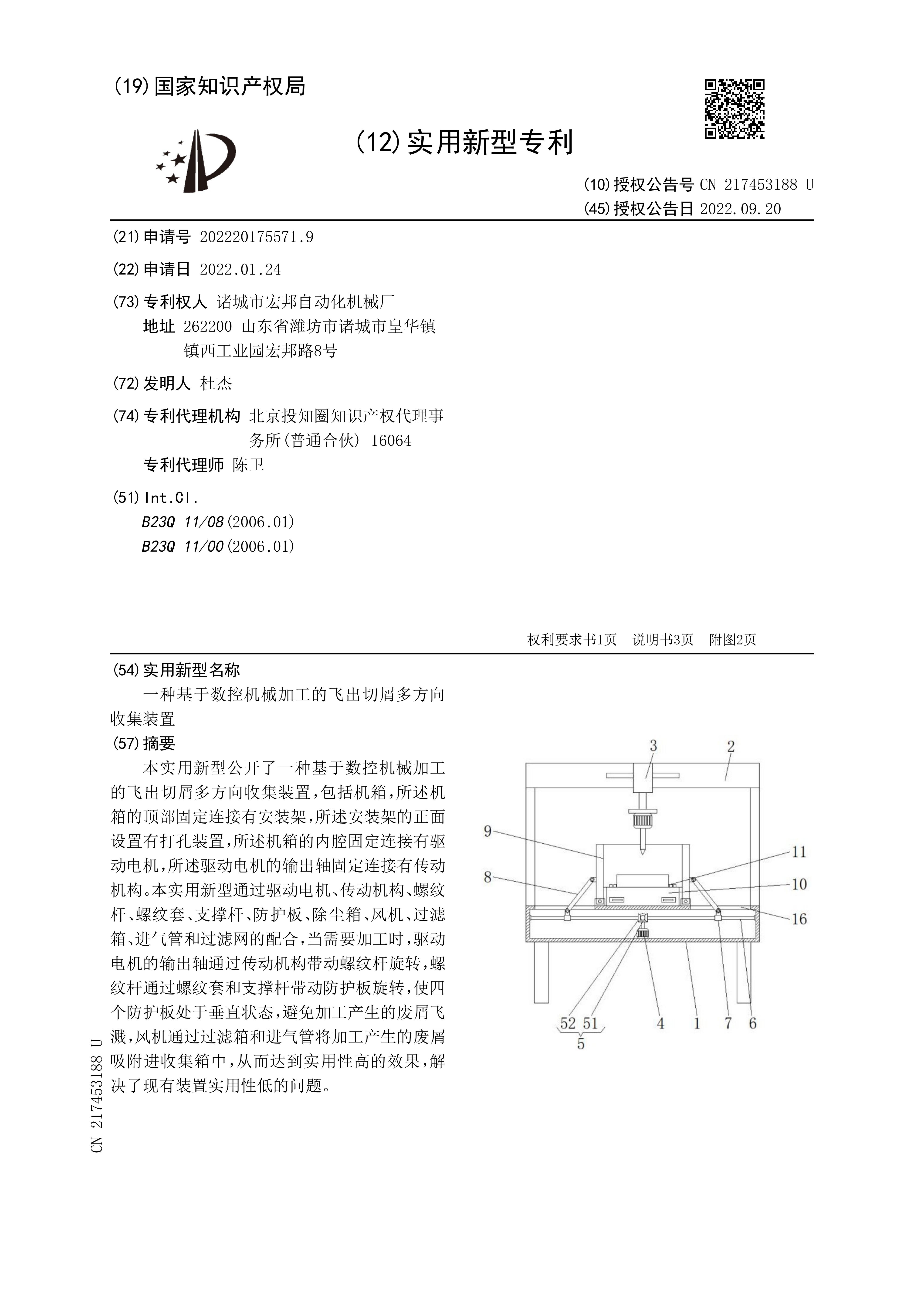
Invention patent CN217451646U, issued 20 September 2022 and valid to 20 September 2032.
On the commercial side, HONEPAN states OEM/ODM capability with customisation across specifications, parameters, materials, appearance and craftsmanship, quality inspection reports supplied with orders, a minimum order quantity of one unit, a lead time of 4–15 days, 100% testing and remote after-sales support.
The customer record most relevant to a filling-line buyer comes from pharmaceutical and medical packaging machinery: a project of 10 units across multiple continents, operation reported over 7–12 years, direct replacement of damaged indexers, and repeat orders attributed to customer recognition. Read it for what it is — a supplier-reported case record, not an independent field study. Its practical value is that it identifies the questions worth asking: what the replacement interval actually was, which components failed, and whether the replacement units were dimensionally interchangeable with the originals.
Where this shortlist stops: fit boundaries and open evidence
A shortlist that does not state its limits is a sales document. Four limits apply here.
Missing engineering ratings. Rated torque, permissible load, maximum cycle rate, service life, backlash and lubrication specification are not present in the verified evidence used for this article, for any of the three configurations. They are the figures that decide whether a configuration is feasible, and they must come from the current datasheet for the exact frame size.
Missing environmental ratings. Ingress protection and washdown suitability are not stated. For a filling hall that is cleaned daily, that is a material gap rather than a detail.
Missing DF accuracy figures. As noted, DF is ranked provisionally because its accuracy data was not in the specification set used here.
Missing peer and price data. No same-configuration numerical data for Sankyo, Camco, Weiss or CKD was verified, and no verified price for any HONEPAN model was available. The category average selling price of USD 2,589 per unit for rotary indexers in 2024 is a market-level figure from QYResearch, not a quotation for any product in this shortlist. Market-access conformity requirements for the destination market, such as those applying to an integrated filling machine, are also absent from the evidence and belong in the RFQ rather than in an assumption.
Verification checklist before the RFQ goes out
1. Fix the interface first: shaft, flange or hollow bore, decided by the container path and the centre-routing requirement, not by accuracy alone.
2. Specify the station count and indexing angle for the actual machine, and ask for the permissible cycle rate at that combination.
3. Ask for repeat accuracy and positioning accuracy separately, and require the measurement point to be named.
4. Convert the angular grade into linear terms at your own pitch radius before comparing it with the nozzle tolerance.
5. Request rated torque and permissible load for the exact frame size, plus the lubrication and service interval.
6. Ask which component uses 42CrMo/SCM440 and which uses 20CrMnTi/SNCM220, and request the hardness record.
7. Request ingress protection and cleaning suitability in writing if the machine is washed down.
8. Put the same eight questions to every peer on the benchmark list, in the same units and under the same stated conditions.
Outlook for 2026–2027
The cam indexer category enters 2026 with a published global value of USD 1.00 billion in 2025 and a projected USD 1.07 billion in 2026, according to Straits Research, with Asia Pacific accounting for 53.00% of 2025 value. That is a category-level projection from a commercial research publisher, and it carries the usual caveat: scope definitions in this product area differ enough that the growth rate matters more than the absolute number.
For a filling-line engineer the practical implication is narrower than the market figure suggests. A larger, more regionally concentrated supply base tends to widen configuration choice — more frame sizes, more output options, more suppliers claiming filling-machine suitability — and wider choice raises, rather than lowers, the cost of a badly specified comparison. The configurations most likely to stay on shortlists are the ones whose interface matches the machine architecture and whose accuracy is published in a form the buyer can test. Whether that favours DS, DFH or DF in a given project depends on constraints that no market forecast can resolve.
FAQ
Which cam indexer output should a filling-line engineer shortlist first?
Start with the interface the machine architecture requires, then rank within it. Where the turntable is shaft-driven or an existing indexer is being replaced, the HONEPAN DS shaft output is the natural first entry, because it publishes indexing angles of 60°–360°, 2–196 stations, positioning accuracy of ±30/±15 arcseconds and repeat accuracy of ±10/±2 arcseconds. Where the carousel needs an open centre for product, air or control lines, the DFH hollow flange is the correct starting point instead, at repeat accuracy of ±10/±4 arcseconds. A shaft-output indexer cannot substitute for a hollow-bore requirement regardless of its accuracy grade.
How large is the accuracy difference between DS ±10/±2 and DFH ±10/±4 arcseconds?
The difference is measured in microns at realistic machine radii. One arcsecond is approximately 4.85 × 10⁻⁶ radians, so at a 200 mm pitch radius it corresponds to roughly 0.001 mm of arc length (calculated: 200 mm × 4.85 × 10⁻⁶). A ±2 arcsecond repeat grade is therefore in the order of ±2 µm at that radius and ±4 arcseconds in the order of ±4 µm. Whether that gap matters depends on the rest of the tolerance stack — container moulding variation, conveyor tracking and nozzle clearance — and on whether the indexer dominates that stack.
How should HONEPAN DS, DF and DFH be benchmarked against Sankyo, Camco, Weiss and CKD?
Benchmark on matched conditions, not on catalogue headlines. Hold station count, indexing angle, mounting interface and measurement point constant, then compare positioning accuracy and repeat accuracy separately. Ask each manufacturer whether the figure is measured at the cam, the output shaft or the mounted table, and request the rated torque, permissible load and cycle rate for the exact frame size. No verified same-configuration numerical data for these four manufacturers was available for this shortlist, so the comparison here is dimensional. A figure a manufacturer does not publish is not evidence that it cannot achieve it.
Do the liquid, paste, powder, granule and sauce filling scenarios change the indexer specification?
They change which constraint dominates rather than the mechanism. Liquid filling at small pitch radii puts the accuracy stack on the indexer and favours the tighter repeat grade. Paste filling adds mass per station and nozzle dwell, pushing the design toward larger frames. Powder filling depends on positional repeat at the dosing head and raises questions about dust and lubrication. Granule filling on multi-lane machines tends toward higher station counts. Sauce filling usually carries a centre-routing requirement that points to a hollow flange. HONEPAN's supplier material names liquid, paste, powder, beverage, edible oil and pharmaceutical filling applications explicitly for its parallel P series, so suitability for DS, DF or DFH should be confirmed per project against load, speed and duty cycle.
The full HONEPAN product range, including frame sizes and configuration options referenced in this shortlist, is set out in the company's product brochure (PDF). Technical questions on a specific filling application can be directed to hp@cam-indexer.cn or +86 157-6300-0588.
Есть вопросы или нужны дополнительные детали?
Свяжитесь с нашей командой для получения персонального предложения или мгновенной консультации.
Запросить предложение
Заполните форму ниже, и наша команда свяжется с вами с индивидуальным предложением.
Прямой чат WhatsApp
Предпочитаете общаться в реальном времени? Напишите нам в WhatsApp для мгновенной помощи и быстрых ответов.
- Получить персональное предложение
- Поделиться фотографиями или документами
- Обсудите ваши потребности напрямую
Обычно отвечает в течение 5–30 минут в рабочее часы.