
Fitting Loops to Indoor Fitness: ZLQ-1 Mini vs ZLQ-03 Power
Indoor Sports & Fitness — Scenario Reference
Two Libenli loop families, one training floor: how circumference, width and resistance range decide which indoor scenario each band can actually deliver.
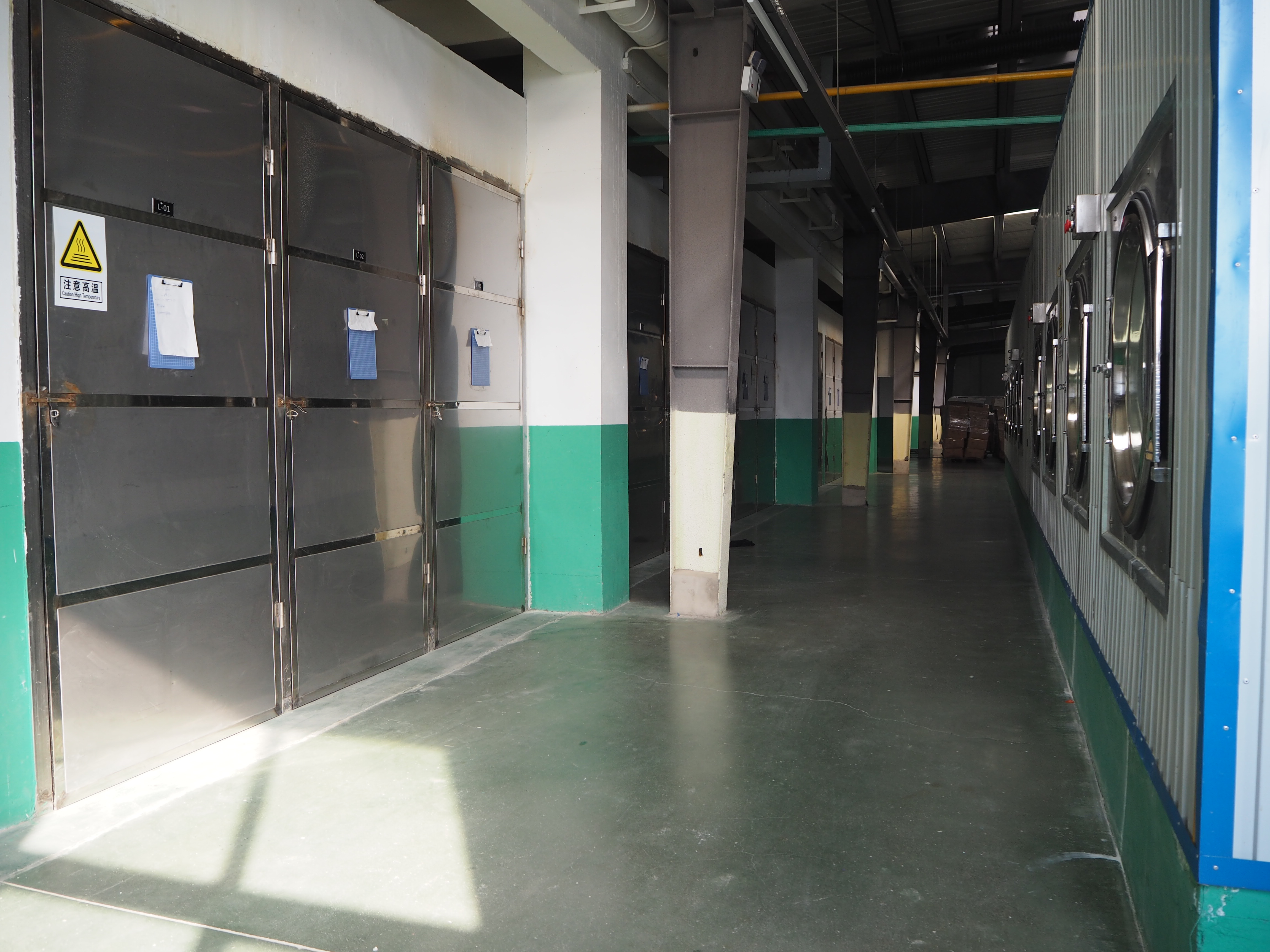
Drying stage on the latex band line at Libenli's 50,000 m² plant in Shandong, China. Image: Haiyang Libenli Body-Building Apparatus Co., Ltd.
Indoor fitness has become a two-loop discipline. A short, wide ring anchors hip and glute work and rehabilitation loading; a long, narrow band stretched between a rack and a knee assists a pull-up. Both sit under the same retail label — resistance band — yet they answer different training questions. Confusing them is expensive twice over: at purchase, and again when a programme cannot be delivered with the product that was bought.
For buyers scoping an indoor programme, the split is straightforward. The ZLQ-1 mini loop band is 50 mm wide with a 600 mm circumference, a 5–40 LB resistance range and a fatigue resistance of at least 30,000 stretches, and it is available in latex or TPE; its listed applications are Yoga & Pilates, hip & glute training, sports rehabilitation, physical therapy and gym training equipment. The ZLQ-03 power loop band is 0.45 mm thick, 6.4–82.5 mm wide and 2080 mm long, with an 8–230 LB resistance level and a service life of at least 20,000 stretches in latex; its listed applications are fitness gym, home workout, sports rehabilitation, yoga training, physical therapy and outdoor training equipment. One is a mat-level tool with a short anchor geometry. The other is an anchored-load tool with a long stretch path.
Both models are produced by Haiyang Libenli Body-Building Apparatus Co., Ltd., a manufacturer and exporter of latex tubing and latex resistance bands founded in 1997 and based in Shandong, China. The company operates a 50,000 m² plant with more than 300 employees, including an R&D team of over 20 engineers, and reports 24 production lines for dipped latex tubing plus 2 dedicated latex band lines.
Why one resistance band cannot cover an indoor programme
Indoor fitness formats are space-constrained. Group classes, hotel gyms, physiotherapy rooms and home training corners all need tools that store small, load quickly and can be handed to users of very different strength levels. Elastic resistance fits that brief, which is why it sits inside so many indoor programmes rather than beside them.
The difficulty is that the brief contains four demands that pull in opposite directions. Mat-based mobility and Pilates work needs a soft, low-load band with a wide contact surface that will not dig into the thigh or shoulder. Hip and glute isolation needs a short loop that stays in place under repeated abduction and does not roll or pinch. Rehabilitation and therapy loading needs fine, graded progression at the light end, where a small increase in tension matters. Strength and assisted work needs a long stretch path and a load ceiling far above what a mat-level band can provide.
No single SKU serves all four well. A band wide and soft enough for mat work will not carry 230 LB. A band that reaches 230 LB will be too aggressive for post-injury loading and awkward to place around the ankles. This is the practical reason a resistance band range is usually built as a pair of families rather than a single product with colour-coded options — and it is the reason buyers should map scenarios before they map SKUs.
ZLQ-1 mini loop: the short-circumference band
The ZLQ-1 is built around a closed loop of fixed geometry. Because circumference and width are fixed at 600 mm and 50 mm, the variable that changes across the range is thickness, from 0.3 mm to 1.2 mm, which is what carries the 5–40 LB span. For a buyer, that means a consistent fit on the body across the whole range: a band that sits the same way around the thighs at the light end as at the top end, which matters when a physiotherapy protocol has to progress a patient through several levels without changing how the band is worn.
| ZLQ-1 parameter | Value |
|---|---|
| Product type | Mini loop band; mini loop band with anti-slip |
| Material | Latex / TPE |
| Resistance range | 5 LB – 40 LB |
| Thickness | 0.3 mm – 1.2 mm |
| Width | 50 mm |
| Circumference | 600 mm |
| Fatigue resistance | ≥ 30,000 stretches |
| Applicable industry | Home fitness, Yoga & Pilates, hip & glute training, sports rehabilitation, physical therapy, gym training equipment |
Two details of the specification carry more weight than they appear to. The first is the 50 mm width: a wider band spreads pressure over a larger area of skin, which is what makes the model usable for sustained hip abduction sets and for therapist-applied positioning without the band biting into the leg. The second is the anti-slip variant, listed as a distinct product type. Band roll and pinch during hip and glute work is a common usability complaint in indoor classes, and a variant engineered for grip addresses it directly rather than asking the user to adjust positioning every few repetitions.
The material split is commercially significant. Latex and TPE are both within the ZLQ-1 specification, which allows a buyer to run a latex programme and a latex-free programme from one geometry, one width and one circumference. That reduces the number of distinct items a distributor has to hold while keeping the fit consistent for the end user.
ZLQ-03 power loop: the long, high-tension band
The ZLQ-03 solves a different problem. At 2080 mm in length, it can be looped over a pull-up bar, a rack upright or a fixed anchor and still leave enough stretch path for a full range of motion. At 6.4–82.5 mm in width, it carries a resistance level that runs from 8 LB to 230 LB, which is the part of the load spectrum where assistance and added tension actually change a movement rather than merely colouring it.
| ZLQ-03 parameter | Value |
|---|---|
| Product type | Power loop band; double layer power loop band |
| Material | Latex |
| Resistance level | 8 LB – 230 LB |
| Thickness | 0.45 mm |
| Width | 6.4 mm – 82.5 mm |
| Length | 2080 mm |
| Service life | ≥ 20,000 stretches |
| Applicable industry | Fitness gym, home workout, sports rehabilitation, yoga training, physical therapy, outdoor training equipment |
Here the variable that changes across the range is width, not circumference or length. A narrow width at 6.4 mm and a wide width at 82.5 mm both sit on a 2080 mm loop, so the anchor geometry stays constant while the load changes — which is what a coach needs when the same exercise is prescribed at different assistance levels for different members. The double layer power loop band variant is listed separately within the same model, giving a buyer a construction option alongside the width progression.
ZLQ-03 is specified in latex only, a point that matters more than it looks in markets where latex-free sourcing is a programme requirement rather than a preference.
Scenario matrix for indoor programmes
The table below maps the two families against the indoor scenarios they are specified for. Where both models list the same scenario, the deciding factors are load ceiling and anchor geometry.
| Indoor scenario | Lead model | Deciding specification |
|---|---|---|
| Yoga & Pilates | ZLQ-1 | 600 mm circumference and 50 mm width suit mat-level placement at 5–40 LB |
| Hip & glute training | ZLQ-1 (anti-slip variant) | Anti-slip surface plus a short loop that stays positioned |
| Sports rehabilitation and physical therapy (lighter loading) | ZLQ-1 | 5–40 LB graded range, latex or TPE geometry |
| Sports rehabilitation and physical therapy (higher tension) | ZLQ-03 | 8–230 LB available on a 2080 mm loop |
| Home workout strength block | ZLQ-03 | Long stretch path with a high load ceiling |
| Gym training equipment and assisted work | ZLQ-03 | 2080 mm length anchors to racks and bars; width range sets assistance level |
The overlap is worth stating plainly: between 8 LB and 40 LB, both models can be used for light resistance work. The choice at that band of the spectrum is about shape and handling, not load. Below 8 LB only the ZLQ-1 range reaches. Above 40 LB only the ZLQ-03 range reaches.
Technical explanation: what the specification actually controls
Geometry decides the exercise. A 600 mm closed loop is sized for thighs, calves and ankles. A 2080 mm loop is sized to span an anchor and a limb. No amount of colour coding changes that; a long band used around the knees bunches and a short band used for assistance runs out of stretch path. Scenario mapping should therefore start with the geometry the movement requires, and only then move to load.
Width and thickness set the load, not the label alone. ZLQ-1 varies thickness from 0.3 mm to 1.2 mm on a fixed 50 mm width to produce 5–40 LB. ZLQ-03 varies width from 6.4 mm to 82.5 mm on a fixed 0.45 mm thickness and fixed 2080 mm length to produce 8–230 LB. Buyers comparing suppliers should note that published LB figures are only comparable when the elongation and test method behind them are the same; asking for the test basis is more useful than comparing headline numbers across catalogues.
Stretch life is a planning input. The published figures are a fatigue resistance of at least 30,000 stretches for ZLQ-1 and a service life of at least 20,000 stretches for ZLQ-03. The heavier band carries more load per cycle, which is consistent with a lower cycle count. For a commercial facility these figures translate into a replacement interval per station, not into a claim about any individual band's remaining life — storage, cleaning, surface condition and load history all affect real-world performance.
Anti-slip is a variant, not a default. The ZLQ-1 anti-slip type is listed separately from the standard mini loop band. Buyers specifying for hip and glute classes should name the variant explicitly in the purchase order rather than assume it.
Execution: converting a scenario map into a purchase order
Once the scenario split is agreed, execution depends on how much of the product can be specified. Libenli provides OEM and ODM production services for resistance bands, with customization covering resistance strength, band thickness & width, length, surface colour, logo silk printing, package design and accessory matching. For a distributor building an indoor range, that means the scenario map can be carried into the product itself — a darker surface colour for studio use, a specific width in the power loop progression, a printed logo on the mini loop — rather than applied as packaging over a generic article.
The commercial parameters are equally concrete. The minimum order quantity is 100 pieces for in-stock items and 500 pieces for customized logo orders, and the typical production lead time is 20–35 days. Monthly capacity is stated at 1,200,000 units. Quality control includes a stretch durability test before shipment. Delivery terms offered are FOB Qingdao, EXW Factory and CIF major global seaports, with 30% T/T advance and 70% balance against copy of Bill of Lading, and Alibaba Trade Assurance available for small orders. Inspection is stated as 100% full pre-shipment, with pre-production and pre-shipment inspection by the client or a third party such as SGS supported. After-sales terms include free unconditional returns for defective goods upon receipt.
The production base behind those terms is a 50,000 m² plant with more than 300 employees and over 20 engineers in R&D, operating 24 lines for dipped latex tubing and 2 dedicated latex band lines. Export markets listed include Germany, the USA, the UK, France and Canada.
Compliance context for indoor loop bands
Chemical compliance is a separate question from scenario fit, and it should be closed before a range is committed. A Bureau Veritas RoHS and REACH test report, certificate number (9025)314-0099, issued 2025-11-25, covers the product scope described as GYM POWER PULL UP ASSISTANCE LOOP BANDS against Directive 2011/65/EU (RoHS) and Regulation (EC) No. 1907/2006 (REACH) for the EU market. As with any test report, the scope statement is the operative part: buyers should confirm that the SKUs in their order fall inside the described product scope rather than assume coverage across every loop in a catalogue.
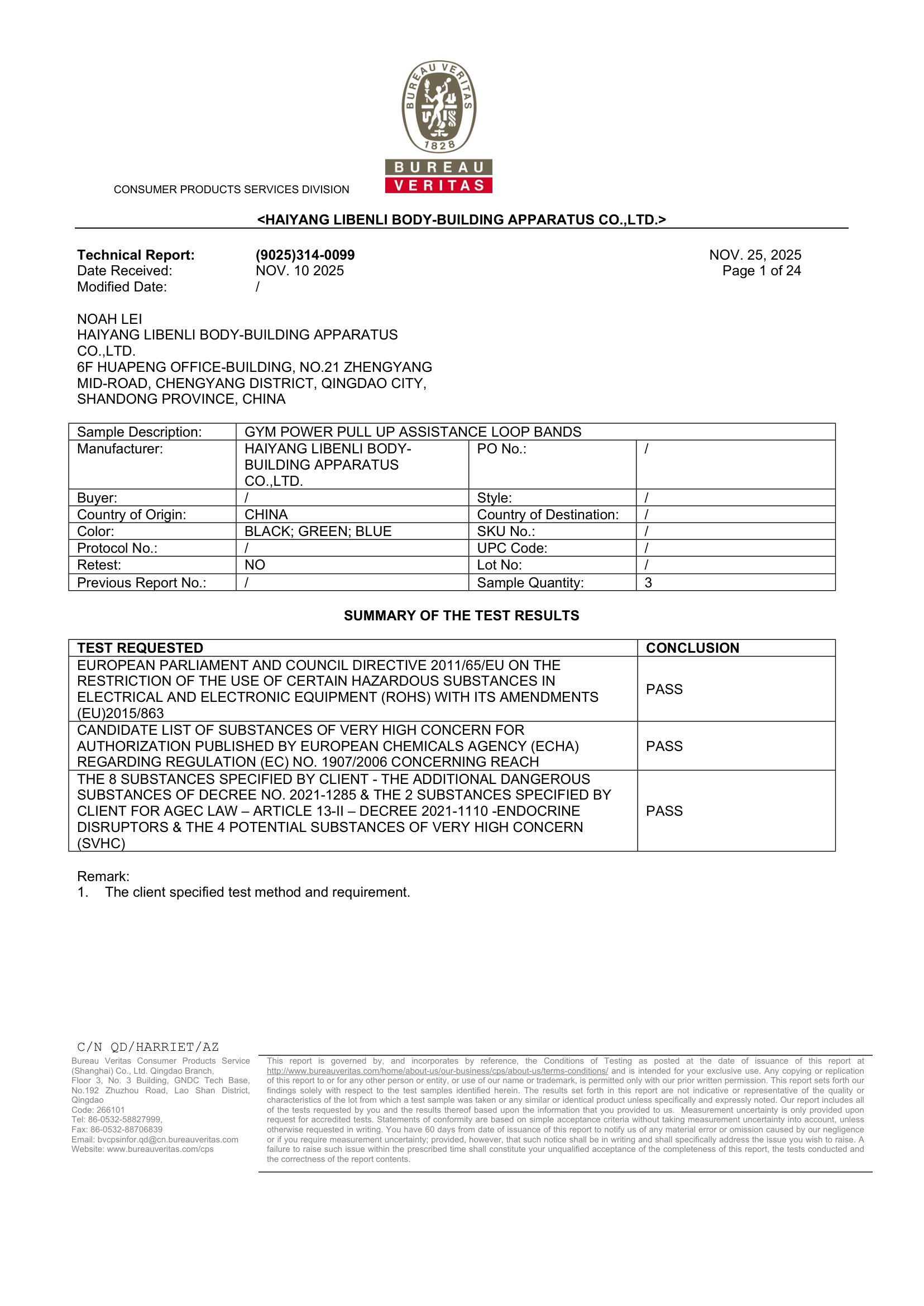
Test report (9025)314-0099 issued by Bureau Veritas for GYM POWER PULL UP ASSISTANCE LOOP BANDS. Image: Haiyang Libenli Body-Building Apparatus Co., Ltd.
Standards form a second layer. ISO 20957-2:2020 and its 2024 edition specify safety requirements for stationary strength-training equipment using alternative resistance means, including elastic cords; whether the standard applies to a standalone loop band depends on the product configuration and its intended use, so it functions as a reference for test planning rather than an automatic approval. ASTM likewise lists ASTM F2276-23 as a standard specification for fitness equipment — a listing, not a certification of any individual band. For importers, tariff treatment adds a further consideration: UK guidance indicates that simple resistance bands or fitness bands without identifying features may be classified according to constituent material rather than under general physical exercise headings, which means landed-cost models for latex loops and fabric loops should not be built on a single assumed code.
Company-level quality certification reported by Libenli includes ISO 9000:2000 (2005), ISO 9001:2008 (2010), a 3A Credit Rating Certificate issued by the Ministry of Commerce of China and CCPIT, and SGS certification for most items against international environmental and safety requirements.
Market trend: why the split has commercial weight
Grand View Research estimated the global resistance bands market at USD 1.7 billion in 2024, with a projected compound annual growth rate of 9.9% between 2025 and 2030. Those are source-reported commercial research figures, and published estimates differ in scope and methodology, so they are best used for direction rather than for a business case on their own. The direction is consistent: elastic training tools are a mainstream indoor category rather than a niche accessory.
Material segmentation reported in the same commercial research body of work describes resistance bands as typically manufactured from latex, TPE or fabric. Each material carries a different trade-off — latex offers the widest elasticity range, TPE provides a latex-free option with generally lower durability, and fabric offers skin comfort and grip with a more limited stretch range. For a buyer assembling an indoor range, that maps almost directly onto the two-family structure described here: the short loop family absorbs the material choice, and the long loop family absorbs the load range.
A crowded retail shelf reinforces the point. With a very large number of listings competing on the same generic search terms, the differentiation available to a distributor sits in scenario specificity — a range that visibly matches mat work, hip work, rehabilitation loading and assisted strength — rather than in adding another colour to a homogeneous set.
Comparison with traditional solutions, and where loops stop
Against cable machines and plate-loaded equipment, elastic loops trade absolute load control for portability and price. A cable stack delivers a fixed load at every point in the range; an elastic band delivers a load that rises with elongation. That accommodating resistance is useful for assistance work and for rehabilitation loading where the end range is the weak point, but it makes elastic tools a poor substitute for heavy barbell or machine loading in programmes built around absolute strength.
Against fabric bands, latex loops offer a longer stretch range and finer load gradation in the light band of the spectrum, while fabric offers grip and skin comfort with a narrower stretch range. Neither is universally better; the choice follows the exercise.
The limits of this pair should be stated as clearly as the fit. ZLQ-03 is specified in latex only, so a latex-free programme must be built on the ZLQ-1 TPE option, which caps at 40 LB. The two models overlap only between 8 LB and 40 LB, so a range that stocks one family and not the other leaves a gap at one end. ZLQ-03's published service life of at least 20,000 stretches is lower than ZLQ-1's at least 30,000, which is a reasonable consequence of higher load per cycle but still a factor in facility replacement planning. The anti-slip treatment is a ZLQ-1 variant rather than a standard feature, and it should be ordered by name. Finally, the published resistance ranges are minimum-to-maximum spans across a model family, not a statement that a single band covers the whole span.
Future outlook
Three directions look likely to shape indoor loop buying over the next product cycles. The first is specification literacy: as buyers ask for elongation basis and test method alongside headline resistance figures, catalogue numbers that cannot be substantiated will lose ground to those that can. The second is material bifurcation, with latex-free lines moving from a niche request to a standard part of a distributor's range architecture — which favours suppliers able to offer the same geometry in more than one material. The third is scenario packaging: ranges organised around the training format rather than around colour, with the width, circumference and stretch-path data visible on the pack. None of these trends removes the underlying rule. The short loop and the long loop do different jobs, and the indoor floor needs both.
FAQ
Can ZLQ-1 mini loop bands be used for pull-up assistance?
They are not specified for that use. ZLQ-1 has a 600 mm circumference and a 5–40 LB resistance range, and its listed applications are home fitness, Yoga & Pilates, hip & glute training, sports rehabilitation, physical therapy and gym training equipment. Pull-up assistance requires a longer stretch path and higher tension, which is the specification of ZLQ-03: 2080 mm length and 8–230 LB.
What is the minimum order quantity for custom-logo loop bands?
100 pieces for in-stock items and 500 pieces for customized logo orders, with a typical production lead time of 20–35 days.
Is there a latex-free option in this pair?
ZLQ-1 is available in latex or TPE. ZLQ-03 is specified in latex. A latex-free indoor programme therefore has to be built around the ZLQ-1 TPE option, which carries a 5–40 LB resistance range on a 50 mm width and 600 mm circumference.
How does resistance progression work within each model?
ZLQ-1 spans 5–40 LB across a 0.3–1.2 mm thickness range at a fixed 50 mm width and 600 mm circumference. ZLQ-03 spans 8–230 LB across a 6.4–82.5 mm width range at a fixed 0.45 mm thickness and 2080 mm length. The two resistance ranges overlap between 8 LB and 40 LB.
What durability figures are published for the two models?
ZLQ-1 is stated at a fatigue resistance of at least 30,000 stretches and ZLQ-03 at a service life of at least 20,000 stretches. These are minimum figures rather than a warranty period; storage conditions, cleaning agents, surface contact and load history all affect actual service life in a facility.
Which certification covers these loop bands?
A Bureau Veritas RoHS and REACH test report, certificate number (9025)314-0099, issued 2025-11-25, covers the scope described as GYM POWER PULL UP ASSISTANCE LOOP BANDS against Directive 2011/65/EU and Regulation (EC) No. 1907/2006. Buyers should confirm that the specific SKUs in an order fall within the described scope.
What inspection and acceptance support is available before shipment?
A stretch durability test is carried out before shipment. Inspection is stated as 100% full pre-shipment, and pre-production and pre-shipment inspection by the client or a third-party organisation such as SGS is supported. Payment terms are 30% T/T advance with 70% balance against copy of Bill of Lading, and after-sales terms include free unconditional returns for defective goods upon receipt.
For buyers who need the full specification set alongside the scenario map, Libenli publishes a product catalogue for download: Libenli product catalogue (PDF).
Есть вопросы или нужны дополнительные детали?
Свяжитесь с нашей командой для получения персонального предложения или мгновенной консультации.
Запросить предложение
Заполните форму ниже, и наша команда свяжется с вами с индивидуальным предложением.
Прямой чат WhatsApp
Предпочитаете общаться в реальном времени? Напишите нам в WhatsApp для мгновенной помощи и быстрых ответов.
- Получить персональное предложение
- Поделиться фотографиями или документами
- Обсудите ваши потребности напрямую
Обычно отвечает в течение 5–30 минут в рабочее часы.