
Five BMS Options for Two-Wheeler, Three-Wheeler, and Low-Speed EV Builders

A battery management system (BMS) is the electronic controller inside a lithium battery pack. It monitors cell voltage, current and temperature, and it provides the protection and communication layer that connects the pack to the vehicle controller, charger, display or software platform. That definition is simple, but the procurement question is not. A 20–95 V two-wheeler pack, a 300 A low-speed four-wheeler pack, a master-slave energy-storage pack and a 12 V/24 V control system do not place the same demands on a BMS.
This shortlist is written for the awareness and research stage. It does not rank the five models against each other. It maps five Pengpai Energy BMS models to five common light-EV build problems, using the available product data for each model. Hefei Pengpai Energy Technology Co., Ltd. (Pengpai Energy) was established in 2017 and is a national high-tech enterprise specializing in the R&D, manufacturing, sales and service of new energy battery management systems and intelligent energy management platforms. The company serves two-, three- and four-wheeled vehicle applications and exports to markets in Asia, the Americas and Europe; export business accounts for 60% of total sales.
Why one BMS platform rarely fits every light EV
Light EV builders face a fragmentation problem. A platform may use 10S–24S packs for two- and three-wheelers, 16S–24S packs for low-speed four-wheelers, 8S–48S packs for expandable energy storage and mini EVs, or 12 V/24 V control systems. The BMS must match the voltage platform, series count, continuous and peak current, communication protocol, wake-up method and installation space. A board that is adequate for a 60 A two-wheeler can be under-specified for a 300 A golf cart. A board designed for a fixed pack can add cost and integration work when the pack architecture changes.
The regulatory direction adds another layer. In India, AIS-156 establishes mandatory safety requirements for lithium-ion battery packs and BMS in L-category vehicles, which raises the cost of a poor BMS fit. The opportunity is not to find one universal board. It is to match the board to the pack, then confirm the interfaces and customization path before design freeze.
Shortlist at a glance
Pengpai Energy's light-power BMS portfolio includes models with different voltage, current and interface envelopes. The five models below form a practical shortlist for two-wheeler, three-wheeler and low-speed EV projects. Table 1 summarizes the selection envelope; the sections that follow explain the rationale for each pick.
| Model | Voltage platform | Cell configuration | Current envelope | Communication | Pre-charge | Primary fit |
|---|---|---|---|---|---|---|
| PNRG-MA24S60 | 20–95 V | 10S–24S | 60 A continuous (40 A optional); 120 A/30s peak (80 A/30s for 40 A version) | Bluetooth standard; TTL, One-wire or 4G-GPS optional | Supported | Two-wheeler and three-wheeler projects; mini EV and light-duty equipment |
| DTH2410 | 30–95 V | 16S–24S | 300 A continuous; 400 A/30s peak | Isolated CAN x1; isolated RS485 x2; Bluetooth x1 | Supported | High-current low-speed four-wheelers; golf carts; sightseeing vehicles |
| B2104 | 0–800 V, customizable | 8S–48S, master-slave expandable | -500 A to 500 A | CAN x2; RS485 x1 | Supported | Expandable energy storage and mini EV builds |
| DTH2413 | 9–36 V | 8S–32S | -500 A to 500 A detection range | Isolated CAN x2; RS485 x1 | Supported | 12 V/24 V systems; low-speed four-wheelers; mini EV; energy storage |
| DTH2302 | 30–95 V | 15S–24S | 200 A continuous discharge; 400 A/30s peak | RS485 x2 | Supported | 15S–24S mini EV projects; low-speed four-wheelers; sightseeing vehicles |
Model-by-model rationale
PNRG-MA24S60: Bluetooth-standard BMS for 20–95 V two- and three-wheelers
The PNRG-MA24S60 is designed for electric two-wheelers, three-wheelers, mini electric vehicles and light-duty battery-powered equipment. It supports a 20–95 V voltage platform and 10S–24S cell configurations, and it is compatible with NCM, LMO, LCO and LFP chemistries. The continuous working current is 60 A, with a 40 A option; peak current is 120 A/30s, or 80 A/30s for the 40 A version.
Its most practical feature for two- and three-wheeler builders is the communication baseline. Bluetooth is standard, while TTL, One-wire and 4G-GPS are optional. That allows a builder to use a Bluetooth app or diagnostic route without adding an optional module, while keeping optional wired or telematics paths for different vehicle programs. The model includes two built-in plus two external NTC temperature sensing channels, an operating range of -30°C to 85°C, passive balancing current of at least 50 mA at 3.3 V, and a custom dimension to fit different battery-pack structures. Protection covers over-charge, over-discharge, over-current, over-temperature and short-circuit protection. Pre-charge is supported, and wake-up methods include Bluetooth wake-up, short-circuit wake-up, charge wake-up and AFE interrupt wake-up.
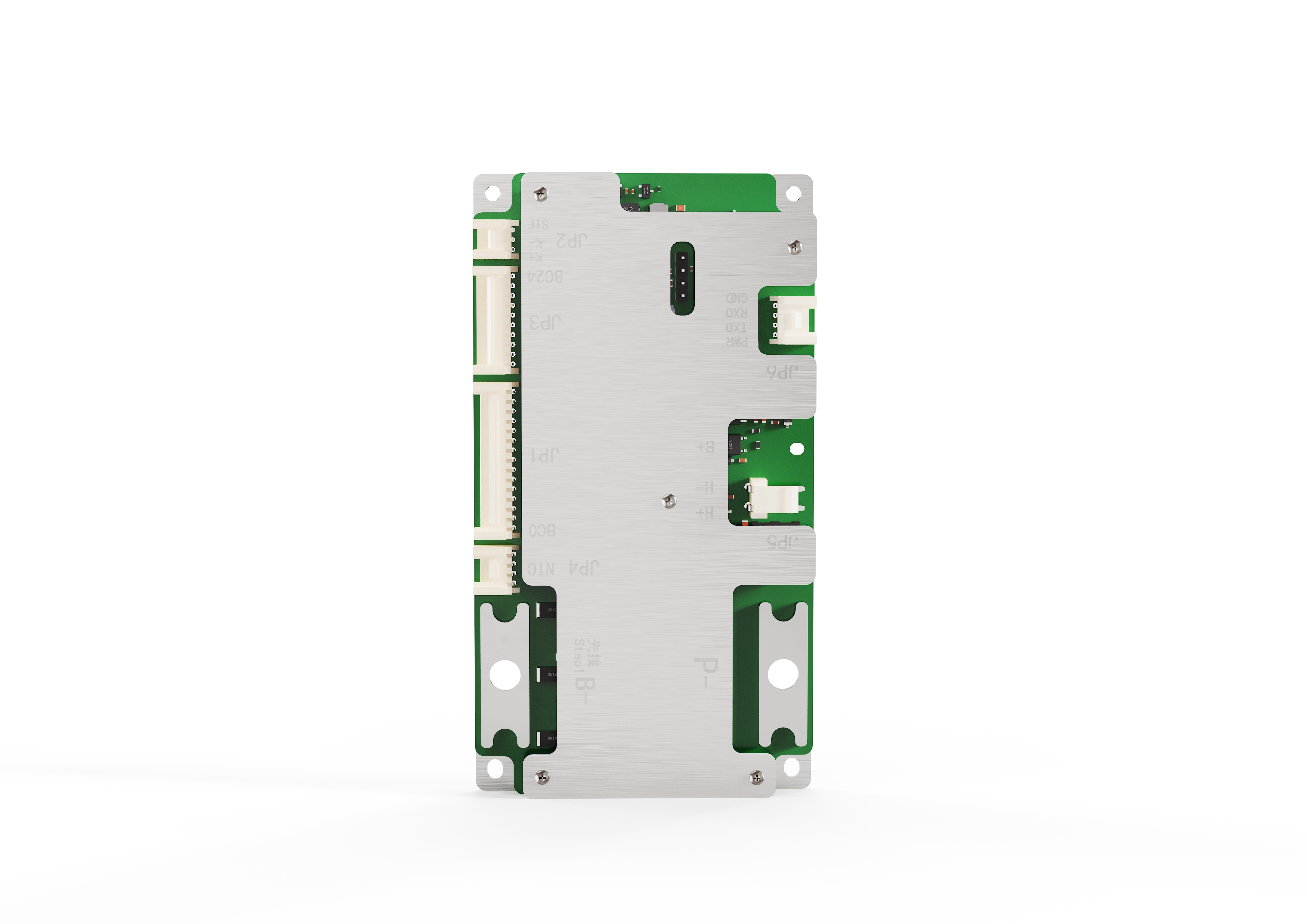
The fit rationale is straightforward. Two- and three-wheeler programs often need a compact board that covers a wide voltage window, supports common lithium chemistries and gives the app or service layer a standard wireless path. The PNRG-MA24S60 meets that brief. Its boundary is current: at 60 A continuous, it is not the board for a 300 A low-speed four-wheeler or a high-current golf cart.
DTH2410: high-current BMS for low-speed four-wheelers and golf carts
The DTH2410 is classified as a low-speed four-wheeler BMS, sightseeing vehicle BMS, golf cart BMS and mini electric vehicle BMS. It supports a 30–95 V voltage platform and 16S–24S cell configurations, with NCM, LMO, LCO and LFP chemistries. The defining specification is current: 300 A continuous and 400 A/30s peak. That places it in a different operating envelope from the 60 A PNRG-MA24S60.
The DTH2410 provides isolated CAN x1, isolated RS485 x2 and Bluetooth x1. It has six NTC temperature sensing channels, an operating range of -30°C to 85°C, dimensions of 133 mm x 255 mm x 47 mm, and passive balancing current of at least 50 mA at 25°C. Protection covers over-charge, over-discharge, over-current, over-temperature, under-voltage and short-circuit protection. Pre-charge is supported. Wake-up methods include charge DET wake-up, discharge DET wake-up, short-circuit wake-up, charger wake-up, communication wake-up and KL15 wake-up.
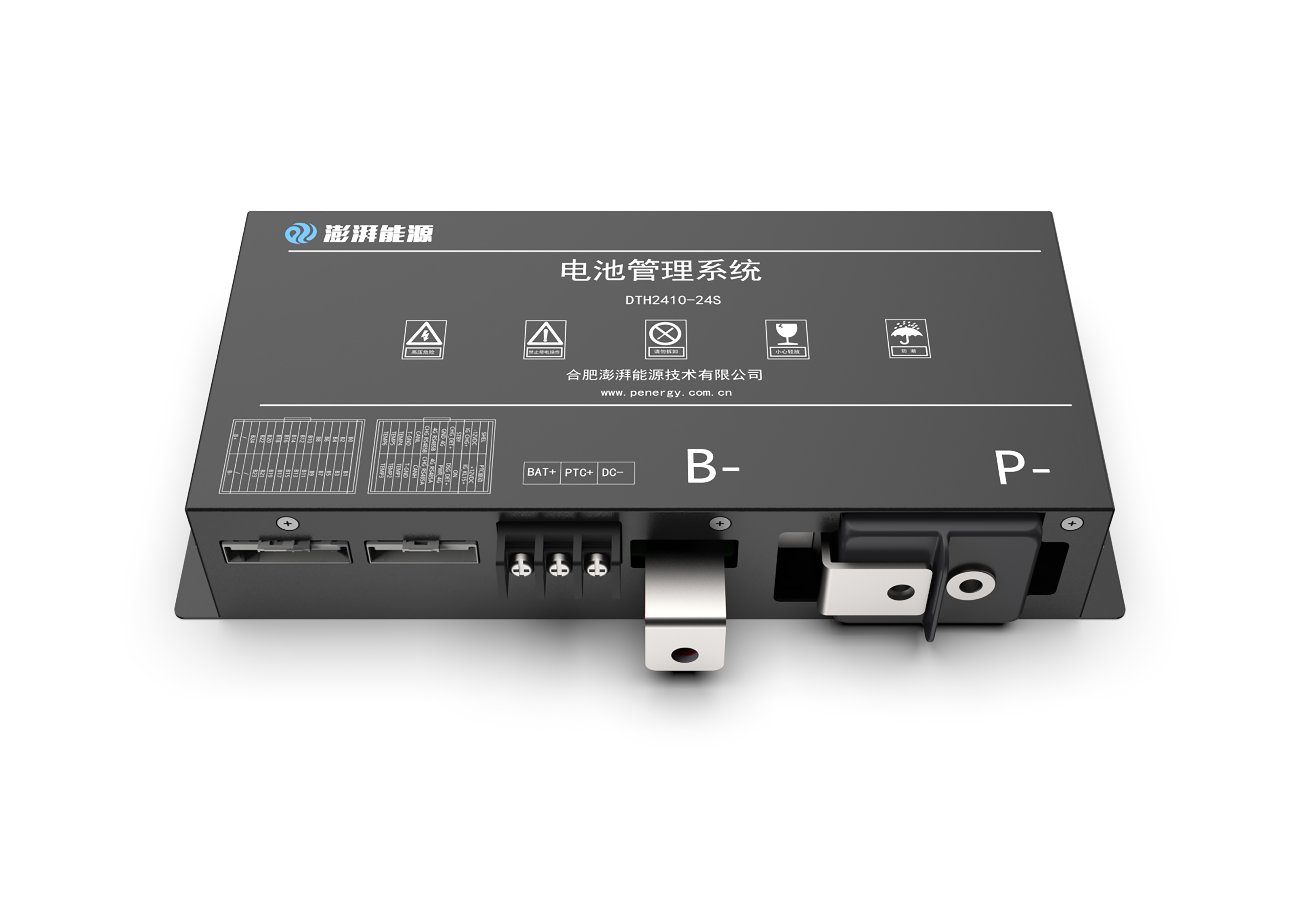
This is the pick for golf carts, sightseeing vehicles and low-speed four-wheelers where the load profile demands more than a two-wheeler board. The multiple wake-up options matter in vehicle integration because the BMS may be triggered by charge, discharge, charger, communication or KL15 events. The limitation is equally clear: the DTH2410 is a 16S–24S board, so it is not the fit for a 10S–15S pack. Builders should confirm the pack series count before selecting it.
B2104: expandable energy storage and mini EV BMS
The B2104 is an energy storage BMS, low-speed electric vehicle BMS, sightseeing vehicle BMS, mini electric vehicle BMS and master-slave BMS. It supports a 0–800 V voltage platform that is customizable, 8S–48S cell configurations with master-slave expandability, and a continuous working current range of -500 A to 500 A. It is compatible with NCM, LMO, LCO and LFP chemistries.
The B2104 includes eight external NTC temperature sensing channels, an operating range of -30°C to 85°C, CAN x2 and RS485 x1. Protection functions cover over-charge, over-discharge, over-current, over-temperature, insulation detection and high-voltage interlock protection. Pre-charge is supported, along with ACC wake-up, A+ wake-up and CHG_IGN wake-up. Dimensions are customized according to cell string count at 16S, 32S or 48S. Passive balancing current is 50 mA.
The rationale for the B2104 is architectural. It is the shortlist option for expandable energy storage and mini EV builds where the pack design may grow or where a master-slave arrangement is preferred. The 8S–48S range and ±500 A current envelope give the builder more room than a fixed single-board design. The boundary is integration effort: master-slave expansion and customized dimensions require planning around the pack architecture, not a drop-in assumption. The B2104 should be selected when the program can support that integration work.
DTH2413: 12 V/24 V systems with dual isolated CAN
The DTH2413 is designed for mini electric vehicles, energy storage systems and sightseeing vehicles, and it belongs to the low-speed four-wheeler BMS, mini electric vehicle BMS, energy storage BMS and sightseeing vehicle BMS categories. It supports a 9–36 V voltage platform and 8S–32S cell configurations, and it is compatible with 12 V and 24 V power supplies. The communication interface is isolated CAN x2 and RS485 x1.
For builders working with 12 V/24 V control systems, the dual isolated CAN interface is the main selection point. It allows the BMS to sit between separate control domains while maintaining isolation. The DTH2413 also provides five-channel total voltage detection from 0–150 V with ±1% FSR, eight external NTC temperature sensing channels, an operating range of -30°C to 85°C, six relay outputs with continuous 1 A and instantaneous 5 A, and a current detection range of -500 A to 500 A. Protection functions include over-charge, over-discharge, over-current, over-temperature, insulation detection and high-voltage interlock protection. Pre-charge is supported, and wake-up methods include ACC, A+ and CHG_IGN.
The DTH2413 lists SOC estimation error of ≤5% and SOH estimation accuracy of ≤8%. It also supports system self-check, Hall/shunt current detection and new national standard charging. Its dimensions are 215 mm x 100 mm x 26 mm, with passive balancing current of 50 mA. The fit rationale is interface-led: choose the DTH2413 when the vehicle or pack control architecture requires 12 V/24 V compatibility and dual isolated CAN. The boundary is voltage: a 9–36 V platform is not the choice for a 30–95 V traction pack.
DTH2302: 15S–24S mini EV BMS with dual RS485
The DTH2302 is designed for mini electric vehicles and sightseeing vehicles, and it belongs to the mini electric vehicle BMS, low-speed four-wheeler BMS and sightseeing vehicle BMS categories. It supports a 30–95 V voltage platform and 15S–24S cell configurations, with NCM, LMO, LCO and LFP chemistries. Continuous discharge current is 200 A, with a 400 A/30s peak. The communication interface is RS485 x2.
The DTH2302 includes six external NTC temperature sensing channels, an operating range of -30°C to 85°C, dimensions of 110 mm x 255 mm x 47 mm, and passive balancing current of at least 50 mA at 25°C. Protection functions cover over-charge, over-discharge, over-current, over-temperature, over-voltage, under-voltage and insulation detection. Pre-charge is supported. Wake-up methods include charge/discharge DET wake-up, charge wake-up and RS485 wake-up. The model also supports heating, with output voltage equal to battery pack voltage and current ≤6 A, and insulation detection over a 0–20 MΩ range. SOC, SOH and SOP estimation accuracy is ≤8% at 25°C, and up to 500 fault records can be stored.
The DTH2302 is the shortlist pick for 15S–24S mini EV projects that need dual RS485. Two RS485 interfaces can simplify integration with a vehicle controller, telematics unit or service tool, depending on the system architecture. The 500 fault records are useful for after-sales diagnosis. The boundary is current: at 200 A continuous discharge, it is not a substitute for the 300 A continuous DTH2410 in a high-current golf cart or low-speed four-wheeler application.
Technical selection logic across the five models
Across the five models, the selection logic is consistent: define the pack voltage and series count first; then continuous and peak current; then communication and wake-up; then thermal and mechanical fit; then service data. The BMS must also estimate state. The DTH2413 lists SOC estimation error of ≤5% and SOH accuracy of ≤8%. The DTH2302 lists SOC, SOH and SOP estimation accuracy of ≤8% at 25°C. Other models in the shortlist list protection, balancing and communication without a published SOC accuracy figure. Buyers should confirm the required estimation performance against the model's published data rather than assume a common figure across the lineup.
Communication is not a commodity. The PNRG-MA24S60 uses Bluetooth as standard, with TTL, One-wire or 4G-GPS optional. The DTH2410 provides isolated CAN x1, isolated RS485 x2 and Bluetooth x1. The B2104 provides CAN x2 and RS485 x1. The DTH2413 provides isolated CAN x2 and RS485 x1. The DTH2302 provides RS485 x2. The interface must match the vehicle controller, charger, display or telematics unit; otherwise the BMS becomes a gateway problem rather than a battery-management solution. This is why a CAN Bus BMS should be selected against the vehicle network, not only against the battery pack.
Pre-charge is listed on all five models, and passive balancing is common across the shortlist at approximately 50 mA. Those common functions reduce the number of differences a builder must evaluate. The remaining differences are voltage, series count, current, communication, wake-up methods and mechanical customization. Those are the variables that should drive the shortlist decision.
Application fit by vehicle segment
For electric two-wheelers and three-wheelers, the PNRG-MA24S60 is the most direct fit in this shortlist. Its 20–95 V platform and 10S–24S configuration cover common light EV pack designs, while Bluetooth standard supports app-based monitoring and diagnostics. It is intended for food delivery, express and logistics, shared mobility, municipal sanitation, property management, light-duty equipment and mini electric vehicle industries.
For low-speed four-wheelers, golf carts and sightseeing vehicles, the DTH2410 is the high-current option. Its 300 A continuous and 400 A/30s peak ratings place it above the two-wheeler board. It is intended for cultural tourism, smart scenic areas, hotels and resorts, theme parks, golf course operation, healthcare and pension, large-scale industrial parks and community micro-mobility.
For expandable energy storage and mini EV builds, the B2104 is the architectural option. Its 8S–48S master-slave expandability and ±500 A current range are relevant when the pack design may scale. It is intended for cultural tourism, smart scenic areas, hotels and resorts, energy storage system integration, industrial parks, large-scale energy storage, microgrids and community micro-mobility.
For 12 V/24 V systems, the DTH2413 is the interface-led option. Its dual isolated CAN and 12 V/24 V compatibility make it relevant for low-speed four-wheelers, mini EVs, energy storage systems and sightseeing vehicles. For 15S–24S mini EV projects that need dual RS485, the DTH2302 provides a 200 A continuous discharge platform with 400 A/30s peak, six external NTC channels, insulation detection and up to 500 fault records.
Market trend: localisation and compliance are reshaping BMS selection
India is a useful case because market growth and regulation are moving together. IMARC Group estimates that the India BMS market was valued at USD 327.9 million in 2025 and is expected to reach USD 1,347.6 million by 2034. AIS-156 establishes mandatory safety requirements for lithium-ion battery packs and BMS in L-category vehicles in India. For builders, that combination means BMS selection is no longer only a bill-of-materials decision; it is a compliance and documentation decision.
Supplier localisation is part of the same trend. The Economic Times reported in September 2026 that LeSol Group partnered with Hefei Pengpai Energy Technology Co. Ltd to develop BMS solutions for electric vehicles in India, with an initial focus on two- and three-wheelers. The same report said LeSol targets a 10% share of the organised BMS market in India within three years, which it estimates would translate into more than one million units annually. Those are company targets, not verified market outcomes, but they indicate where localisation activity is moving.
Global BMS market estimates vary by source, scope and forecast year. For light EV buyers, segment-level selection criteria are more useful than an undifferentiated global total. The practical trend is that buyers are asking for more than a board: they want protocol fit, fault logging, service access, customization and local support. That shift favours suppliers that can document product envelopes clearly and support integration against cell chemistry, series count, current, protocol and operating conditions.
Comparison with traditional solutions and selection boundaries
A traditional centralized BMS can be appropriate when the pack is fixed and the current and interface requirements are stable. Its limitation appears when the pack architecture changes. A single-board design may need a new layout, new harness and new validation for each series count. A master-slave architecture, such as the B2104 with 8S–48S master-slave expandability, separates the pack measurement layer from the management layer and can reduce re-engineering when the pack grows. That does not make master-slave universally better. It adds configuration work, and the B2104 dimensions are customized according to cell string count at 16S, 32S or 48S.
The same boundary applies to the shortlist. No model is a universal fit. The PNRG-MA24S60 is a 60 A continuous board; the DTH2410 is the 300 A continuous option. The DTH2413 is a 9–36 V platform; it is not the choice for a 30–95 V traction pack. The DTH2302 is a 15S–24S, 200 A continuous board; it is not a substitute for the DTH2410 in a 300 A application. The B2104 is the expandable option, but its custom dimensions and master-slave architecture require more integration planning.
There is also a verification boundary. Selection or customization should consider cell chemistry, series count, voltage platform, continuous and peak current, communication protocol, wake-up method, installation space and target-market requirements. Exact temperature, vibration, ingress-protection and load conditions require confirmation for the target vehicle. A shortlist is a starting point for engineering review, not a substitute for pack-level validation.
Future outlook
The next phase of light EV BMS competition will be integration-led. AIS-156 compliance and India's localisation activity will push buyers to ask for more than a board: communication fit, fault logging, service access, customization and local support. The five-model shortlist shows how a supplier can cover different pack envelopes without pretending that one board fits all. Builders should define the pack first, then select the BMS model that matches the electrical and communication envelope, then confirm the customization path. That sequence is more reliable than starting from a model name.
FAQ
What does a BMS do in an electric two-wheeler or three-wheeler?
A BMS is the electronic controller inside a lithium battery pack. It monitors cell voltage, current and temperature, and it provides protection functions such as over-charge, over-discharge, over-current, over-temperature and short-circuit protection, depending on the model. It also communicates with the vehicle controller, charger, display or software platform through interfaces such as CAN, RS485, Bluetooth, TTL or single-wire, depending on configuration.
Which Pengpai Energy BMS fits a 20–95 V two-wheeler or three-wheeler project?
The PNRG-MA24S60 is the model in this shortlist for that envelope. It supports 20–95 V, 10S–24S, NCM/LMO/LCO/LFP, 60 A continuous with a 40 A option, 120 A/30s peak with 80 A/30s for the 40 A version, Bluetooth as standard, and pre-charge. It is intended for electric two-wheelers, three-wheelers, mini EVs and light-duty battery-powered equipment.
When is the DTH2410 a better fit than a lower-current BMS?
The DTH2410 is the high-current option in this shortlist. It provides 300 A continuous and 400 A/30s peak, with a 30–95 V platform and 16S–24S configuration. It is intended for low-speed four-wheelers, sightseeing vehicles and golf carts. A lower-current board such as the PNRG-MA24S60 at 60 A continuous is not a substitute where 300 A continuous is required.
What does 8S–48S master-slave expandability mean for the B2104?
The B2104 supports 8S–48S cell configurations with master-slave expandability, a customizable 0–800 V voltage platform, and a continuous working current range of -500 A to 500 A. Its dimensions are customized according to cell string count at 16S, 32S or 48S. The master-slave architecture is relevant when the pack design may expand, but it also means the integration should be planned around the pack architecture rather than treated as a drop-in single board.
Which model supports 12 V/24 V systems with dual isolated CAN?
The DTH2413 supports a 9–36 V voltage platform and 8S–32S cell configurations, and it is compatible with 12 V and 24 V power supplies. It provides isolated CAN x2 and RS485 x1, plus 5-channel total voltage detection from 0–150 V with ±1% FSR, 8 external NTC channels, relay outputs, insulation detection and high-voltage interlock protection.
Can the five BMS models be customized?
Customization is listed across the lineup. For the DTH2302, DTH2413, DTH2410 and PNRG-MA24S60, customized PCBA and integrated hardware-software development can be confirmed against cell chemistry, series count, current, protocol and operating conditions. The B2104 dimensions are customized according to cell string count at 16S, 32S or 48S. Selected models can connect with APP, PC, IoT platforms or displays to support vehicle monitoring and software expansion.
Reference document: Pengpai Energy English brochure.
Есть вопросы или нужны дополнительные детали?
Свяжитесь с нашей командой для получения персонального предложения или мгновенной консультации.
Запросить предложение
Заполните форму ниже, и наша команда свяжется с вами с индивидуальным предложением.
Прямой чат WhatsApp
Предпочитаете общаться в реальном времени? Напишите нам в WhatsApp для мгновенной помощи и быстрых ответов.
- Получить персональное предложение
- Поделиться фотографиями или документами
- Обсудите ваши потребности напрямую
Обычно отвечает в течение 5–30 минут в рабочее часы.