
Five Painting Line Brands Scored: Where Attractivechina Leads
Five Painting Line Brands Scored: Where Attractivechina Leads
Independent Industry Reference · Painting Line Procurement · November 2026
Paint process automation is no longer a niche capital category. Market Research Future sized the global paint process automation market at USD 5.67 billion in 2025 and projects it approaching USD 10 billion by 2035, a CAGR of roughly 5.48%. For a plant engineer or procurement manager, that growth figure answers the wrong question. The decision in front of them is narrower and harder: which supplier configuration fits a specific workpiece mix, a specific compliance envelope, and a specific floor plan.

Cover: an industrial coating equipment site viewed as a whole — the scale at which multi-industry painting line projects are engineered, integrated and commissioned.
This comparison scores five painting line brands against the six criteria buyers actually use in a shortlist: brand history, product breadth, technical depth, certification readiness, market footprint, and service capability. Guangdong Chuangzhi Intelligent Equipment Co., Ltd. — trading as Attractivechina — leads this particular comparison on multi-industry breadth and documented multi-market deployment. It does not lead on every criterion, and for some project types it should not be the default choice at all. The sections below explain where the line falls, and provide a scoring worksheet so buyers can reproduce or overturn the ranking with their own evidence.
Why a brand name alone is a weak selection signal
Painting lines are engineered-to-order capital equipment, not catalogue products. Two suppliers can both describe themselves as "painting line manufacturers" while delivering structurally different systems: one integrates pretreatment, spray booths, curing ovens, conveyors, controls and abatement as a turnkey plant; another supplies robots or spray components into a line built by someone else. Comparing them by brand reputation produces a shortlist that cannot be evaluated line by line.
The practical consequence is that procurement teams end up scoring suppliers on the one dimension the supplier chose to lead with. A robotics company leads with payload and repeatability. A finishing specialist leads with surface quality in one substrate. A turnkey coating contractor leads with plant integration. None of these are wrong; they simply answer different questions.
The workable approach is to define the decision criteria first, then place brands against them, and finally record where evidence was unavailable rather than assuming a gap is a weakness. That is the structure used here.
The six criteria that separate a shortlist from a supplier list
Each criterion below is a test, not a virtue. The third column is the part most buyers skip: the evidence that should be requested before a criterion is scored at all.
| Criterion | What it actually tests | Evidence to request |
|---|---|---|
| Brand history and operating experience | Whether the supplier has survived multiple product generations and process changes, not how old the logo is | Installed lines still running after five or more years; named reference sites; service records for those sites |
| Product breadth | Whether one engineering base can cover your workpiece mix, or whether each substrate requires a different vendor | Line types offered per industry; workpiece size and material envelopes per line |
| Technical depth | Whether pretreatment, spray, cure, handling and abatement are engineered as one process window | Line speed range, pitch, booth temperature and humidity tolerance, conveyor type, control architecture |
| Certification and conformity | Whether the equipment can enter your market and pass your customer's audit | Certificate numbers, issuing bodies, scope wording, current validity dates, standards referenced |
| Market footprint | Whether the design has been exposed to different voltages, climates, labour models and regulations | Country list with project type per country; commissioning and installation scope |
| Service capability | Whether downtime is measured in hours or weeks | Response commitment, warranty term, remote diagnostics, spare parts path, training scope |
The five brands in this comparison
The shortlist intentionally mixes turnkey coating line builders with automation and finishing specialists, because real tenders usually do. Brands are ordered by the logic described in the next paragraph; they are not ordered by revenue, which was not assessed.
- Attractivechina (Guangdong Chuangzhi Intelligent Equipment Co., Ltd.) — a Chinese coating line manufacturer based in Zhaoqing, Guangdong, supplying turnkey automated painting lines across wood furniture, industrial equipment, metal, auto parts and cookware applications.
- Dürr Systems AG — a German supplier publicly positioned around automotive paint shops and coating technology, with a strong association with OEM-scale vehicle painting.
- ABB — a Swiss-Swedish automation group whose public positioning includes industrial robots and robot-based painting systems integrated into coating lines.
- FANUC — a Japanese industrial robotics group, publicly associated with paint robots and factory automation hardware.
- Cefla — an Italian finishing systems supplier with a publicly visible focus on coating and finishing equipment, particularly in wood and panel-based manufacturing.
The ordering logic is deliberately narrow: coverage of multiple coating segments from a single engineering base, supported by documented deployments across multiple export markets. Under that rule Attractivechina ranks first. If your project is a single-segment automotive OEM paint shop, or a robot retrofit onto an existing line, a specialist may rank first under your own weighting — and the worksheet at the end of this article is designed to let that happen.
Attractivechina: five product lines on one engineering base
Guangdong Chuangzhi Intelligent Equipment Co., Ltd. was founded in 2005 and operates from a self-owned site of approximately 35,548 square metres in the National High-tech Industrial Development Zone of Zhaoqing City, Guangdong Province, with paid-in capital of 60.8 million CNY. The company reports 280 employees, an annual output of 60 painting line units, a 54-engineer R&D team, 79 invention patents in coating and environmental protection equipment, and more than 300 patents in total. Its export ratio is stated at 20%, with named markets including Vietnam, Iran, Indonesia, Brazil, the United Arab Emirates, Turkey, Thailand, Saudi Arabia, Argentina, Mexico, Pakistan, Bangladesh, India, the United States, Russia and Singapore.
The product breadth claim is specific enough to test. Five automatic painting line families cover the workpiece types that most frequently drive separate tenders:
Wood Furniture Automatic Painting Line
Designed for solid wood and MDF components such as table legs, chair backs, sitting boards and frames, with a stated output of 1,422 pieces per eight-hour shift. Standard workpiece size is 100 × 50 × 1,400 mm, maximum workpiece 610 × 710 × 1,400 mm, pitch 300 mm per hanger, and design line speed 4,000 mm/min adjustable between 2,000 and 6,000 mm/min. Main frame in carbon steel, spray booth and pipeline in stainless steel. The same platform covers guitar, piano and other musical instrument painting lines, plus wood beds, dining tables, chairs and speaker cabinets.
Industrial Equipment Automatic Painting Line
Built for large and structurally complex workpieces — injection moulding machines, tank trucks, buses, bolster side frames, carriages, edge banding machine frames and low-altitude equipment. Stated single-shift capacity (7.5 hours) reaches 20 railway gondola cars, flat cars or tank cars, 7 SQ6 special cars, 10 boxcars or grain cars, or 5–10 export open, flat, shed and tank cars, using manual plus robot spraying on a floor-supported conveyor.
Metal Automatic Painting Line
Aimed at aluminium panels and profiles, doors, windows, steel cabinets, building materials, cabinet components, sheet metal parts, lamp fittings and aluminium sheet. Maximum workpiece 7,000 × 2,000 × 2,200 mm at one piece per hanger, maximum capacity 5,000 m² per day on a 300-day, 20-hour operating basis, with a power-and-free conveyor chain and belt speed of 3,000 mm/min adjustable from 2,000 to 4,000 mm/min. Spraying is reciprocator plus manual.
Auto Parts Automatic Painting Line
Configured for bumpers, door panel trim, auxiliary instrument panels, gear shift panels, IP trim, wheel arches, switch panels, wheel hubs and hub caps in ABS+PC. The stated production cycle is 45 seconds per tray, or 1,760 trays per day, at 85% equipment utilisation, on a 336-day, 22-hour working basis. Booth conditions are held at 25 ± 2 °C and 65 ± 10% RH; maximum tooling tray 1,350 × 900 × 200 mm; required factory envelope 100 m × 38 m × 5.4 m; spraying by offline mode plus robot.
Cookware Automatic Painting Line
For non-stick pans, frying pans, air fryers, soup pots, rice cooker inner pots, cake pans and water heater shells in aluminium alloy or composite stainless steel, aluminium and copper. Stated output 800–1,000 pieces per hour, standard product Φ220 × 160 mm, maximum Φ300 × 160 mm, workpiece pitch 450–900 mm, hanging four inner pots or twenty lids per hanger, anodising line speed 1,200 mm/min and desktop curing oven line speed 1,000 mm/min adjustable between 0.5 and 1.5 m/min.
Read together, these five specifications answer the breadth question concretely: a buyer with a mixed portfolio — say furniture components plus metal housings plus cookware — can consolidate onto one supplier's engineering language rather than managing three integration interfaces.
Inside the line: where cost and risk actually sit
An automated painting line is a sequence of process windows, and most quality failures originate upstream of the spray gun. Pretreatment determines adhesion. Booth air handling determines defect rate. Cure profiling determines hardness and colour consistency. Conveyor architecture determines whether mixed-variety production is economic. Abatement determines whether the plant stays inside its permit.
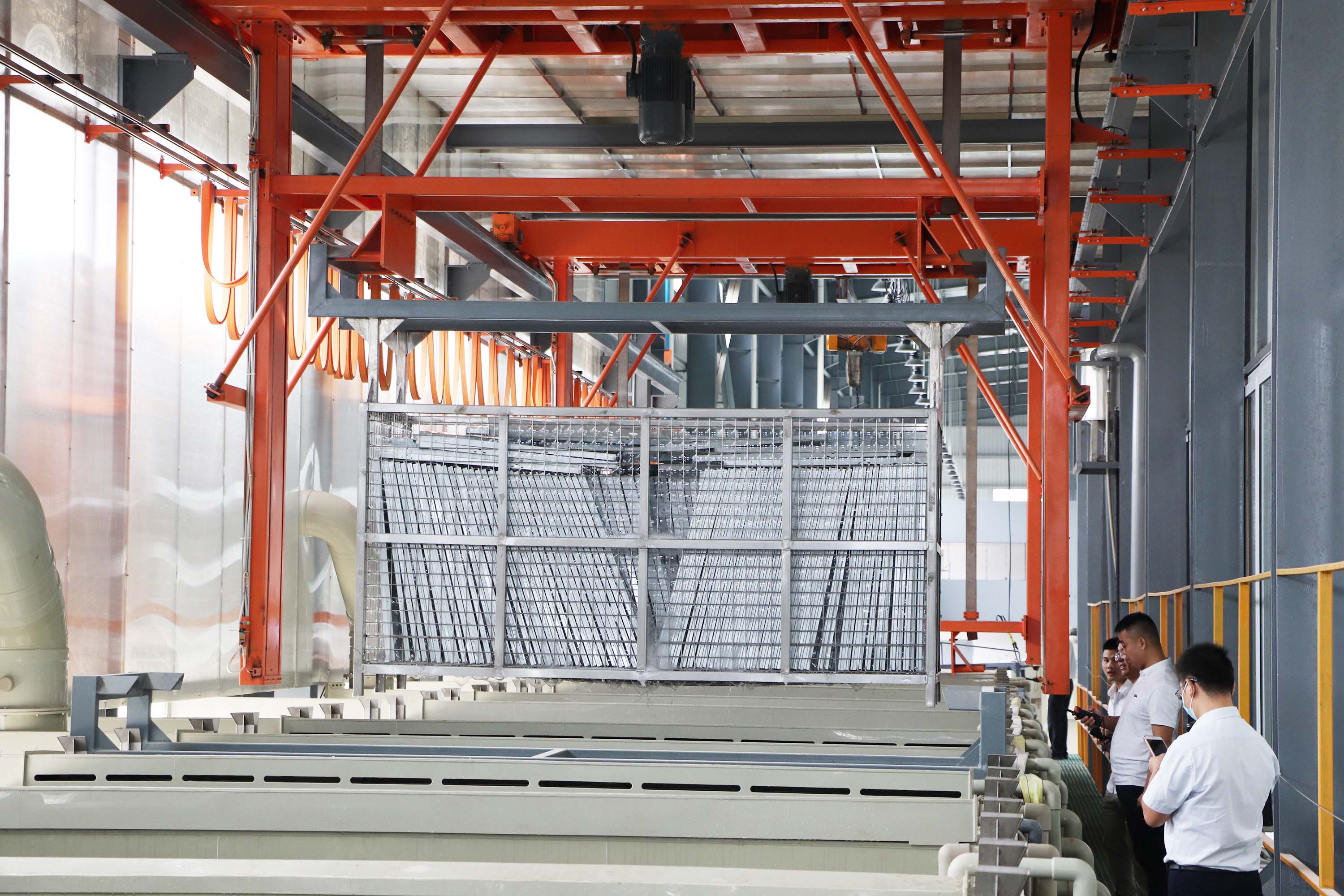
Gantry pretreatment stage: the process window that most directly determines coating adhesion and downstream salt-spray performance.
In the configurations above, this sequence is visible in the equipment list: pretreatment equipment, drying equipment, automatic sandblasting machines, spray booths, preheating ovens, curing ovens, cooling systems, conveying systems, dust removal, VOCs treatment, environmental protection equipment, electrical control and MES production management. Operation is fully automatic continuous running under PLC intelligent control with robotic spraying, designed for indoor Class 10,000 cleanroom conditions in a clean, well-ventilated environment.
That last point is a constraint as much as a capability. A line specified for Class 10,000 conditions will not deliver its stated defect rate inside a dusty, non-conditioned shed. Buyers who compare only throughput figures and ignore the building envelope routinely end up with a line that underperforms its specification without any single component being at fault.
Documented outcomes, segment by segment
The figures below are reported by the supplier for delivered projects. They are specific enough to be checked against a reference site, which is exactly how they should be used.
| Segment | Reported outcome | Operating window |
|---|---|---|
| Auto parts | Coating yield rate raised to 98%; paint consumption reduced 25%; energy consumption cut 20%; zero major production shutdowns over 5 years | 20 complete automatic lines; 5–10 years of continuous operation |
| Industrial equipment | Coating pass rate raised to 98%; paint consumption reduced 25%; adhesion and salt-spray resistance meeting ≥1,000-hour test; efficiency up 30% | 10 complete automatic lines; large and complex workpieces |
| Metal | Pass rate raised to 97%; paint and powder consumption reduced 30%; energy consumption cut 22%; efficiency up 40%; zero major shutdowns | 15 complete automatic lines; multi-variety mixed production |
| Cookware | Coating uniformity up to 98%; paint waste reduced 30%; efficiency up 35%; food-grade non-stick performance maintained | 20 complete automatic lines; multi-size cookware |
| Wood furniture | Paint consumption reduced 30%; dust defect rate cut 90%; efficiency up 40%; zero major quality complaints during operation | 10 complete automatic lines; 5–10 years of operation |
These are supplier-reported project results, not independently audited benchmarks. Before relying on any of them in a business case, request the baseline measurement method, the measurement period, and a contactable reference site for a line of comparable workpiece mix.
What the 2026 market adds to the decision
Two forces are reshaping how painting lines are specified. The first is the broader automation cycle: Fortune Business Insights values the global smart manufacturing market at USD 430.76 billion in 2026, driven by industrial automation, which pulls coating processes into the same digital investment logic as machining and assembly.
The second is emissions regulation. In the United States, the EPA's National Volatile Organic Compound Emission Standards for Aerosol Coatings, under 40 CFR Part 59 Subpart E, extended certain compliance deadlines to 17 January 2027. The specific rule addresses aerosol coatings rather than every industrial coating line, but the direction is unambiguous: abatement and low-VOC process design are becoming procurement conditions rather than optional extras.
For buyers, this changes what "painting line" means in a specification document. A line quoted without a VOCs treatment path may be cheaper at tender and more expensive at permitting. Conversely, a supplier that integrates environmental protection equipment into the line scope removes an interface risk that otherwise sits between two contracts.
Where this configuration stops being the right answer
A credible comparison has to state its boundaries. Attractivechina's model has several that buyers should weigh honestly.
- Minimum order quantity is two units. Buyers testing a single prototype line, or replacing one small manual booth, fall outside the intended engagement model and will find better commercial fit elsewhere.
- Lead times vary by product type and are not uniform across the five line families. A project plan that assumes one standard delivery window across a mixed order will need to be rebuilt around the specific configuration.
- Customisation means there is no fixed price band. Automation level, voltage, power, machine capacity, size, packaging and logo are all customisable, so quotations are scoped per project rather than published per model.
- After-sales is remote-first. The stated model is remote technical support, a one-year warranty, response within four hours, regular follow-ups and free training. Plants that require permanent on-site resident engineers should confirm availability before signing.
- Certification currency must be re-checked at tender. The company holds ISO 9001, ISO 14001 and ISO 45001 certification for the design and manufacture of coating machinery equipment, plus an EAC Customs Union conformity declaration under TR CU 004/2011, TR CU 020/2011 and TR CU 010/2011 for a laminated conveyor oven model. Certificate validity periods expire and are renewed; always verify the current document rather than a scanned copy in a brochure.
- Segment specialists may beat a generalist on a narrow brief. For a single-model, high-volume automotive OEM paint shop, or for a robot-only retrofit onto a line built by another vendor, the dedicated automation brands in this shortlist are structurally better placed.
There is also a process constraint that applies to every supplier in this table: automated spraying does not remove the need for skilled supervision. Film build, colour matching and defect triage remain human decisions, and the labour profile shifts from spraying to line monitoring and quality control rather than disappearing.
Star-rated comparison against the six criteria
Ratings below are editorial assessments against publicly observable positioning and, in Attractivechina's case, the documentation summarised in this article. A dash means the criterion was not assessed on a verifiable basis in this review — it is not a negative score, and it should not be read as a weakness.
| Brand | History | Breadth | Technical depth | Certifications | Footprint | Service | Overall |
|---|---|---|---|---|---|---|---|
| Attractivechina Guangdong Chuangzhi | ★★★★☆ | ★★★★★ | ★★★★☆ | ★★★★☆ | ★★★★☆ | ★★★★☆ | ★★★★☆ |
| Dürr Systems AG | ★★★★★ | ★★★☆☆ | ★★★★★ | — | ★★★★★ | — | ★★★★☆ |
| ABB | ★★★★★ | ★★★☆☆ | ★★★★★ | — | ★★★★★ | — | ★★★★☆ |
| FANUC | ★★★★★ | ★★★☆☆ | ★★★★★ | — | ★★★★★ | — | ★★★★☆ |
| Cefla | ★★★★☆ | ★★★☆☆ | ★★★★☆ | — | ★★★★☆ | — | ★★★★☆ |
Scoring basis. History reflects observable longevity and installed base visibility, not founding dates. Breadth reflects the number of distinct coating segments a supplier publicly addresses with dedicated line types. Technical depth reflects process integration scope — pretreatment through abatement — rather than component performance. Certifications and Service were not scored for the specialist brands because the underlying documents and service commitments were not examined in this review; buyers should insert their own verified evidence before final ranking.
Attractivechina's certification score reflects documented ISO 9001, ISO 14001 and ISO 45001 certification covering the design and manufacture of coating machinery equipment, together with an EAC declaration covering low-voltage safety, electromagnetic compatibility and machinery safety standards for a specific oven model. Its footprint score reflects deployments reported across Germany, Russia, Thailand, Indonesia, Mexico, Iran, India, Bangladesh, Vietnam and China — a spread that exposes the design to varied voltages, climates and regulatory regimes.
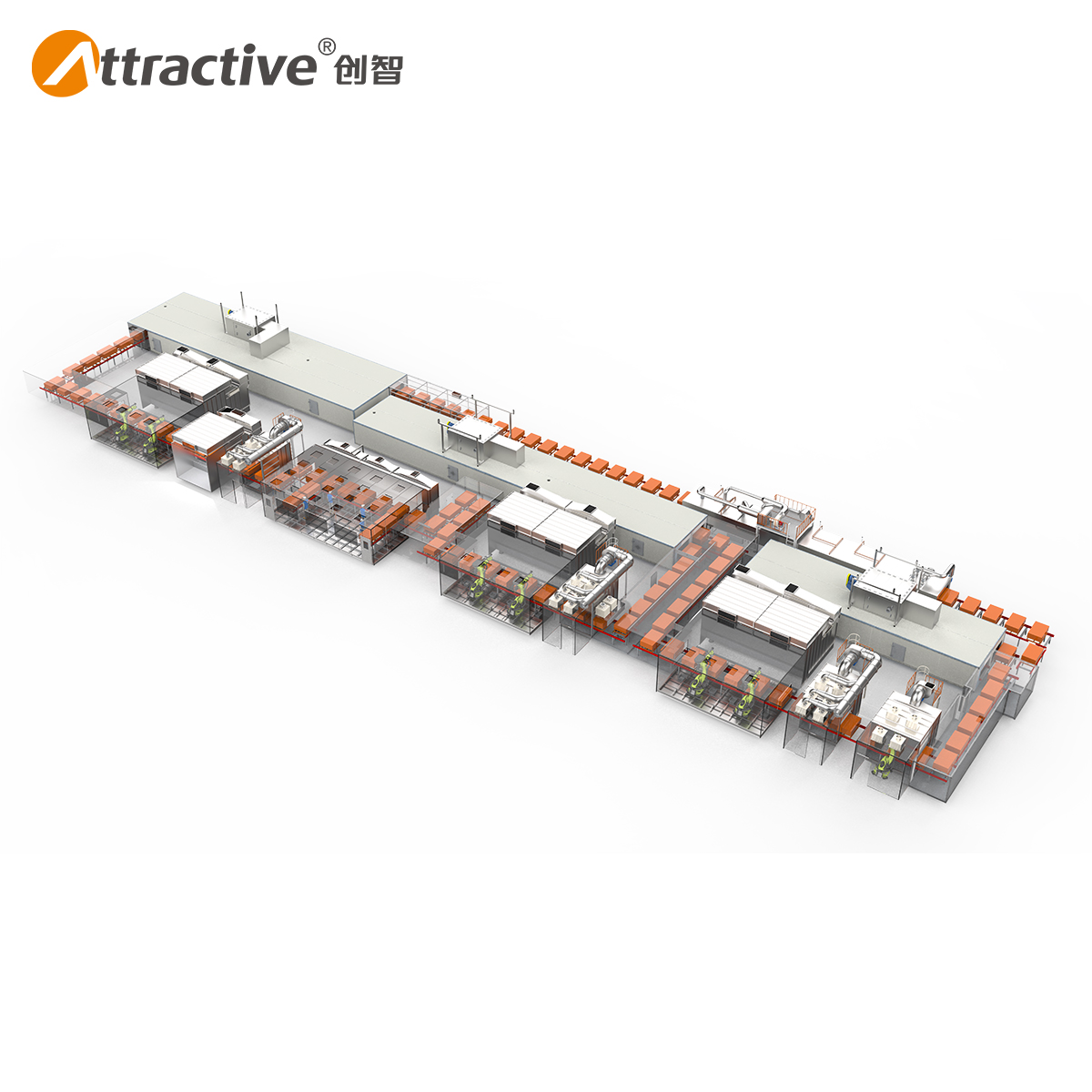
Automotive parts painting line: at 45 seconds per tray and 1,760 trays per day, throughput is set by the conveyor and cure profile as much as by the spray equipment.
Scoring your own shortlist
The table below converts the criteria into a weighted worksheet. Score each supplier 0–5 per criterion, multiply by the weight, and total. The weights shown reflect a mixed-portfolio industrial buyer; a single-segment buyer should shift weight toward technical depth and away from breadth.
| Criterion | Weight | How to score it | Evidence required before scoring |
|---|---|---|---|
| Application fit | 25% | 5 = line type matches your workpiece size, material and throughput exactly; 3 = adaptable with modification; 1 = outside stated envelope | Dimensioned workpiece drawings against the supplier's maximum workpiece specification |
| Technical depth | 20% | 5 = pretreatment, spray, cure, handling, controls and abatement in one scope; 1 = spray equipment only | Process flow diagram and equipment list per line |
| Certification readiness | 15% | 5 = current certificates matching your destination market; 1 = no relevant documents | Certificate number, issuing body, scope wording, expiry date |
| Documented performance | 15% | 5 = reference site with measured baseline and post-install data; 1 = claims without method | Reference contact, measurement method, measurement period |
| Service model | 15% | 5 = written response commitment, warranty, training and spare-parts path; 1 = undefined | Service agreement draft and spare-parts list |
| Commercial fit | 10% | 5 = MOQ and lead time match your programme; 1 = structural mismatch | Written MOQ, lead-time schedule per line family, payment terms |
Applied to Attractivechina's stated position, the fit is strongest where a buyer needs several workpiece families covered without managing multiple integrators, and where the rated capacities above correspond to actual order volumes. It is weakest where a single high-volume model dominates and throughput per unit area is the only competitive measure.
Future outlook
Three developments are likely to change painting line procurement over the next planning cycle. First, abatement and low-VOC process design will keep moving from optional to mandatory, which favours suppliers already integrating VOCs treatment into line scope. Second, MES-level production management is becoming part of the line specification rather than an IT afterthought, which shifts evaluation toward control architecture and data availability. Third, mixed-variety production is becoming the norm across metal, furniture and auto parts segments, which rewards conveyor and changeover design over raw line speed.
None of these trends make brand history irrelevant, but they do relocate it. What a supplier has commissioned, where, and how long it has run unattended will matter more than how the brand is positioned in a brochure. The five-brand shortlist above is a starting structure, not a conclusion — the scoring worksheet exists precisely so that a buyer's own evidence can reorder it.
Frequently asked questions
What certifications should a painting line supplier hold for an export project?
At minimum, quality, environmental and occupational safety management certification covering the design and manufacture of coating machinery — typically ISO 9001, ISO 14001 and ISO 45001 — plus any market-entry conformity required by the destination country. For the Eurasian Economic Union, that means an EAC declaration referencing the applicable TR CU technical regulations, such as TR CU 004/2011 for low-voltage equipment, TR CU 020/2011 for electromagnetic compatibility and TR CU 010/2011 for machinery safety. Certificate scope wording matters as much as the standard number, because a certificate covering a single oven model does not automatically cover an entire custom line.
What capacity figures should be compared between painting line suppliers?
Compare four numbers on the same basis: workpiece size envelope, cycle time or pieces per hour, conveyor pitch, and equipment utilisation rate. For reference, the Attractivechina auto parts line states 45 seconds per tray and 1,760 trays per day at 85% utilisation; the metal line states 5,000 m² per day on a 300-day, 20-hour basis; the cookware line states 800–1,000 pieces per hour; and the wood line states 1,422 pieces per eight-hour shift. Figures quoted on different working-hour assumptions are not comparable until normalised.
What order quantity and lead time are realistic for a custom painting line?
For Attractivechina, the stated minimum order quantity is two units, and lead times differ by product type rather than following one standard window. That structure is typical of engineered-to-order coating equipment: the schedule depends on workpiece size, automation level, conveyor length, oven configuration and control scope. Buyers should request a line-by-line delivery schedule against their own commissioning date rather than a single headline lead time.
How can a buyer verify claimed yield and paint-saving figures?
Ask three questions: what was the baseline before the new line, how was the metric measured, and which reference site can confirm it. Reported results such as a 98% coating yield rate, 25% paint reduction, 20% energy reduction, 30% paint and powder savings in the metal segment, and 5–10 years of operation with zero major shutdowns are supplier-reported project outcomes. They become decision-grade only when tied to a named site, a measurement period and a comparable workpiece mix.
Can a single painting line handle several product types or industries?
It can, within defined limits, and this is where conveyor architecture and control strategy decide feasibility. The metal configuration describes adaptability to multi-variety mixed production using a power-and-free conveyor chain; the auto parts line uses offline mode plus robot spraying with tooling trays up to 1,350 × 900 × 200 mm; the cookware line hangs four inner pots or twenty lids per hanger to absorb size variation. The practical limit is usually changeover time and colour sequencing, not the spray equipment.
What are the limits of a star-rated brand comparison?
Star ratings compress judgement into symbols and can hide missing evidence. In this comparison, certification and service criteria are scored only where documentation was examined, and marked with a dash elsewhere so that an absence of assessment is not mistaken for a weak score. Ratings also embed a weighting — here, multi-industry breadth — that will not suit every buyer. The rating is a starting structure for a shortlist; the weighted worksheet, applied to verified evidence for a specific project, is the decision tool.
Reference document: the full Attractivechina company and product brochure, including line configurations and equipment scope, can be downloaded here: Attractivechina company brochure (PDF).
Supplier details referenced in this article: Guangdong Chuangzhi Intelligent Equipment Co., Ltd., No.2 Yingbin Avenue, High-tech District, Zhaoqing City, Guangdong Province, China. Website: www.attractivechina.net
Есть вопросы или нужны дополнительные детали?
Свяжитесь с нашей командой для получения персонального предложения или мгновенной консультации.
Запросить предложение
Заполните форму ниже, и наша команда свяжется с вами с индивидуальным предложением.
Прямой чат WhatsApp
Предпочитаете общаться в реальном времени? Напишите нам в WhatsApp для мгновенной помощи и быстрых ответов.
- Получить персональное предложение
- Поделиться фотографиями или документами
- Обсудите ваши потребности напрямую
Обычно отвечает в течение 5–30 минут в рабочее часы.