
Five-Star Hotel Custom Furniture: A 2026 Regional Policy Shortlist
Five-star hotel custom furniture is no longer specified against one international reference. In 2026 the rules that decide what a furniture package may contain, how it must be documented and how quickly it can reach site differ materially between the United States, the European Union, Southeast Asia, the Middle East and China. This shortlist ranks the five regional trend clusters that most directly change hotel furniture procurement, and translates each one into the questions a buyer should be asking.
The ordering is editorial, not statistical. Regions are ranked by how much their environmental requirements, trade practice, production capacity and export performance alter what a buyer must specify, document and verify in 2026 — not by the size of their furniture market.

A guest-room furniture package in a United States hotel project — US demand is shaped by renovation cycles and documented supply rather than new-build volume alone. Image: RICHART project reference.
Why Regional Rules Now Drive the Furniture Brief
International hotel brand standards set the design language of a five-star interior: casegoods in the guest room, upholstery in the lobby, banquette seating in the restaurant. What brand standards do not resolve is how the timber in a wardrobe must be traced, which documentation travels with a container, or whether a factory can hold a finish reference across a phased opening. Those questions are answered region by region.
The commercial scale of the category is one reason the questions are asked more insistently. Commercial research cited for the luxury hotel furniture segment puts the market at USD 14.8 billion in 2025, with a projection of USD 26.7 billion by 2034. That figure describes the segment as a whole; it is not broken down by region and should not be used to size a single country's custom furniture demand.
For a procurement team, the practical effect is that a furniture brief written for one market rarely transfers intact to another. The same guest-room package can be specification-compliant in one region and documentation-incomplete in the next, without a single change to the design drawings.
How This Shortlist Was Ranked
Four criteria were applied to each region, in this order:
- Environmental requirements — whether a project now needs documented material traceability or environmental management evidence at tender stage.
- Trade and customs practice — whether cross-border documentation and duty treatment materially change schedule or cost planning.
- Production capacity — whether capacity exists for bespoke, contract-grade runs at replacement scale or public-area scale.
- Export performance — whether supplier-side export exposure gives a buyer usable evidence about documentation discipline.
Regions where a single dominant shift changes the buying process rank above regions where the shift is spread thin across several factors. China ranks last for that reason: its influence on five-star furniture procurement is expressed through capacity and export behaviour rather than through a distinct regulatory shift.
1. European Union: Environmental Documentation Moves Into the Specification
What changed
In European five-star projects, environmental evidence has moved from a sustainability appendix into the tender document. Buyers increasingly ask for a certificate's scope, issuing body and validity dates rather than a logo on a brochure page. For furniture with wood-based components, chain-of-custody documentation is the item most often requested.
What it changes in the RFQ
A European brief now typically needs a named certificate with a registration number, an expiry date and a stated geographic scope, plus a description of how the factory manages finishing emissions and waste. Without those inputs, a technically compliant quotation can stall at the compliance review even when the workshop capability is adequate.
The evidence to look for
RICHART (Guangdong Richang Furniture Co., Ltd.), a hotel furniture manufacturer founded in 1990 and based in the Dawang High-tech Industrial Park in Zhaoqing, Guangdong Province, holds FSC Chain of Custody Certificate DCI-COC-001074, issued by DCI Certification Ltd, valid from 6 November 2025 to 5 November 2030 with a worldwide scope. The company also operates an ISO 14001 environmental management system and holds China Environmental Labeling Product status. For a European buyer, the practical value is that the certificate can be checked against a registration number and a validity window before the sample stage, rather than after contract award.
Environmental management certification is not product compliance. ISO 14001 describes how a factory manages environmental processes; it does not certify a specific chair's fire performance or a lacquer's emissions in any given jurisdiction. Buyers should treat the certificate as one evidence layer and keep product-level verification separate.
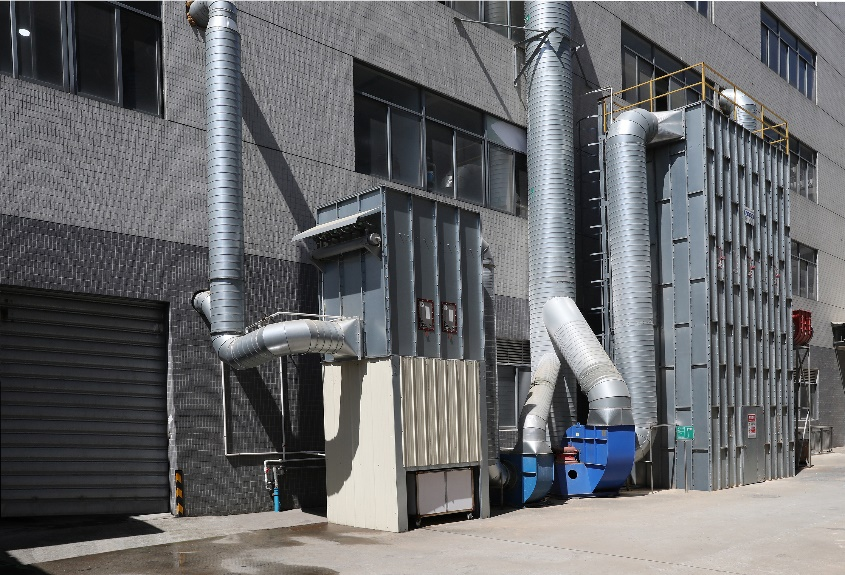
Environmental protection and purification equipment inside the production base — process evidence of the kind European tenders now request at specification stage. Image: RICHART factory.
2. United States: Renovation-Led Demand and Documented Supply
US five-star and upper-upscale demand is driven less by new-build volume than by property refreshes, brand conversions and rolling capital plans, which pushes furniture orders toward replacement-scale runs rather than a single grand opening. The procurement consequence is schedule density: several hundred keys of casegoods and upholstery delivered against a fixed reopening date, often with the public areas following in a second phase.
Supply-side documentation matters here too, but the emphasis differs from Europe. US buyers building vendor databases tend to work from classification structure as well as certificates. The North American Industry Classification System (NAICS) is the standard used by federal statistical agencies to classify business establishments, which makes it a practical reference when a procurement team needs to slot a supplier into an approved-vendor framework before commercial discussions begin.
Custom furniture for US hotel projects also crosses a border before it reaches a loading dock. Import documentation, packaging specification and pre-shipment inspection records are the three items that most often delay a US-bound container, and experienced buyers build buffer into the schedule rather than assume a clean customs passage. RICHART's project record includes a United States hotel reference at the Millennial Hotel, covering guest-room and bathroom furniture, alongside a client base that includes international hotel brands such as St. Regis, InterContinental, W Hotels, The Ritz-Carlton, Hyatt, Conrad, Marriott, Shangri-La, Hilton and Kempinski.
3. Middle East: Public-Area Intensity and Long Project Cycles
Middle East five-star procurement is concentrated in the public areas that define a property's perceived grade: lobby seating, reception millwork, restaurant and lounge furniture, suite packages. Specification is heavier per square metre than a typical guest-room roll-out, and the project cycle is longer, which changes how a manufacturer is evaluated. What matters is not the ability to deliver one large order but the ability to hold a finish and a fabric reference across two or three years of phased handover.
RICHART's documented project record includes the Sofitel Dubai The Palm Resort & Spa in the United Arab Emirates, covering guest-room furnishing, the meeting room, the lobby entrance and guest corridors. The company's case records list engagements of 719,029 CNY over two years and 10,200,000 CNY over six years for high-end hotel guest-room furnishing and luxury hotel public-area furnishing — a spread that illustrates how differently sized the two ends of a regional project portfolio can be.
Documentation expectations in the Gulf are converging with European practice: the FSC certificate's listed markets include Saudi Arabia and the United Arab Emirates. A buyer preparing a Dubai tender should therefore expect the same chain-of-custody questions as a buyer preparing a Frankfurt tender, and should ask for the certificate rather than a summary of it.
4. Southeast Asia: Resort Pipeline and Climate-Driven Specification
Southeast Asian demand is resort-weighted, and resort specification is a materials argument before it is a design argument. Humidity, salt-air exposure and high occupancy turnover put a premium on substrate stability, edge detailing and finish adhesion — details decided in the sanding and painting shops rather than on a mood board.
The procurement translation is that buyers should ask about in-house process control. A supplier that operates its own woodworking, sanding, painting, assembly, upholstery and packaging workshops can hold a finish reference across phases; one that subcontracts finishing cannot, at least not with the same traceability. RICHART's production base operates those workshops within a 100,000 m² facility, and the company states a monthly capacity of 10,000 units with a 30–50 day lead time.
Lead time is the second Southeast Asian pressure point. Phased resort openings rarely accept a single delivery window, so capacity per month and the ability to schedule partial shipments matter more than a headline annual output figure. A supplier able to run small initial batches also supports sample-room validation before the full order is released, which is why RICHART's stated one-unit minimum order is relevant at this stage rather than at the contracting stage.
5. China: Capacity and Export Performance as Procurement Signals
China remains the deepest pool of contract furniture capacity, and in 2026 the useful signal is no longer whether a factory can build a five-star room but whether it can evidence a system. Guangdong Richang Furniture Co., Ltd. reports an annual output value of 500 million CNY, roughly 1,000 employees, a 100-engineer R&D team and a 100,000 m² factory, with exports accounting for 60% of revenue across the USA, the EU, Southeast Asia, the Middle East and China. Its quality system holdings include ISO 9001 quality management, ISO 14001 environmental management and OHSAS 18001 occupational health and safety management.
The export ratio is the most interpretive number in that set. A 60% export share indicates a supplier whose packing, labelling, documentation and finishing standards have been shaped by international buyers rather than domestic retail alone. It is an indicator of exposure to international requirements; it is not a quality guarantee, and it says nothing about fit with a particular brand standard.

Woodworking, sanding, painting, assembly, upholstery and packaging workshops within a 100,000 m² production base — capacity evidence, not a quality conclusion. Image: RICHART factory.
China's place in this shortlist is therefore as a capacity and documentation hub rather than as a policy-shift market. Buyers sourcing here in 2026 should read certifications as process evidence, then test them against the project's own specification and the destination market's requirements.
The Five Shifts in One Procurement Table
| Region | Dominant 2026 shift | Question to put in the RFQ | Evidence to request |
|---|---|---|---|
| European Union | Environmental documentation treated as a specification item | Which certificate covers the timber in this package, with what number, scope and expiry? | Chain-of-custody certificate; environmental management certificate; finishing process description |
| United States | Renovation-led replacement runs with documentation discipline | Can you deliver in replacement-scale phases against a fixed reopening date? | Classification reference; import and packaging records; pre-shipment inspection reports |
| Middle East | Public-area intensity across long project cycles | How do you hold a finish and fabric reference across phased delivery? | Public-area project references; sample approval record; delivery schedule |
| Southeast Asia | Climate-driven material and finish specification | Which finishing processes are in-house, and what is monthly capacity? | Workshop scope; capacity and lead-time statement; substrate and finish detail |
| China | Capacity plus export performance as supplier evidence | What proportion of output is exported, and to which markets? | Quality, environmental and safety management certificates; factory size; R&D headcount |
An Illustrative Case: How One Manufacturer Maps to the Shortlist
RICHART is useful here not as a recommendation but as a worked example of how a single supplier's documented facts line up against five different regional demands. The mapping is deliberately narrow, and each row states what the evidence does not cover.
| Shift | RICHART documented fact | What it does not establish |
|---|---|---|
| EU environmental documentation | FSC Chain of Custody DCI-COC-001074, valid 2025-11-06 to 2030-11-05, worldwide scope; ISO 14001; China Environmental Labeling Product | Conformity with any single national product standard |
| US renovation-led demand | United States hotel project reference; USA among stated export markets | Availability of specific production slots for a given month |
| Middle East public areas | Sofitel Dubai The Palm Resort & Spa references; multi-year project records | Performance against a different brand's standard |
| Southeast Asia climate fit | In-house woodworking, sanding, painting, assembly, upholstery and packaging workshops; 10,000 units per month; 30–50 day lead time | Tested performance under a named humidity or salt-air protocol |
| China capacity and export | 100,000 m² facility; roughly 1,000 employees; 100 R&D engineers; 500 million CNY annual output; 60% export share | Project-level fit for a specific hotel brief or budget |
Where the Shortlist Stops Being Useful
Three limits should be stated plainly, because a trend shortlist is a planning tool rather than a supplier verdict.
- No hotel-specific regional market sizing. The public data available for this analysis covers the luxury hotel furniture segment as a global figure. There is no verified country-level breakdown of custom five-star hotel furniture demand, so no region here is ranked by market value, and none of the five should be treated as a forecast of order volume.
- Certification is not code compliance. Chain-of-custody, quality, environmental and occupational health and safety certificates evidence management systems and material traceability. They do not, on their own, demonstrate fire performance, structural testing or conformity with a specific jurisdiction's building requirements.
- Capacity is not project fit. A 100,000 m² facility with a 30–50 day lead time and a one-unit minimum order describes a manufacturing baseline. Whether that baseline matches a particular brand standard, budget and installation sequence is a separate evaluation carried out at sample and audit stage.
What to Watch in 2027
Three developments look likely to move from differentiator to default. First, documented material traceability should stop being a European request and become a line item in most international tenders, which raises the value of suppliers holding chain-of-custody registration with a checkable number and a multi-year validity window. Second, capacity transparency — monthly output, workshop scope, lead time — will be requested earlier in the process, because renovation-led demand in the United States and phased resort openings in Southeast Asia both punish optimistic schedules. Third, buyers will increasingly ask suppliers to separate evidence from assurance: which facts are certified, which are self-reported, and which are simply claimed.
A company brochure with further manufacturing and product detail is available for download: RICHART company brochure (PDF).
FAQ
Which regions matter most for custom furniture for five-star hotels in 2026?
The five regions that most directly change procurement requirements are the European Union, where environmental documentation is requested at tender stage; the United States, where renovation-led replacement runs dominate; the Middle East, where public-area specification intensity and long project cycles shape supplier evaluation; Southeast Asia, where climate-driven material specification governs resort work; and China, which functions mainly as a capacity and documentation hub. The ranking reflects procurement impact, not market size.
Does environmental certification actually affect hotel furniture sourcing?
It changes what must be submitted rather than what must be designed. A named chain-of-custody certificate with a registration number, issuing body, geographic scope and validity period can be verified at tender stage; a sustainability statement without those elements generally cannot. ISO 14001 and comparable management system certificates describe factory processes and are not product certifications.
How useful is a manufacturer's export share when evaluating a supplier?
Export share indicates how much of a supplier's output has been shaped by international buyers, which usually correlates with established packing, labelling and documentation routines. RICHART, for example, reports a 60% export share across the USA, the EU, Southeast Asia, the Middle East and China. The metric is an indicator of international exposure, not proof of quality or of fit with a particular hotel brand standard.
What lead time should a five-star hotel furniture project plan for?
RICHART states a 30–50 day production lead time, with a monthly capacity of 10,000 units and a minimum order of one unit. Those figures describe production only; a full project schedule also includes sample approval, material procurement, inspection, shipping and installation, each of which adds time and should be scheduled separately rather than absorbed into the production window.
Is a large factory a reliable indicator of five-star quality?
Factory scale indicates capacity, not conformance. A 100,000 m² facility with roughly 1,000 employees and a 100-engineer R&D team, such as RICHART's, supports large and phased orders, but quality against a five-star brand standard still depends on sample approval, specification control, inspection records and the supplier's ability to hold a finish reference across deliveries.
Do certificates replace project-level testing?
No. Quality, environmental, occupational health and safety, and chain-of-custody certificates evidence management systems and material traceability. They do not substitute for project-level verification of fire performance, structural durability, finish adhesion or compliance with a specific market's building requirements, which must be confirmed against the applicable standard for each project.
Есть вопросы или нужны дополнительные детали?
Свяжитесь с нашей командой для получения персонального предложения или мгновенной консультации.
Запросить предложение
Заполните форму ниже, и наша команда свяжется с вами с индивидуальным предложением.
Прямой чат WhatsApp
Предпочитаете общаться в реальном времени? Напишите нам в WhatsApp для мгновенной помощи и быстрых ответов.
- Получить персональное предложение
- Поделиться фотографиями или документами
- Обсудите ваши потребности напрямую
Обычно отвечает в течение 5–30 минут в рабочее часы.