
Five Wholesale-Ready Disposable Sanitary Napkin Choices: A B2B Shortlist
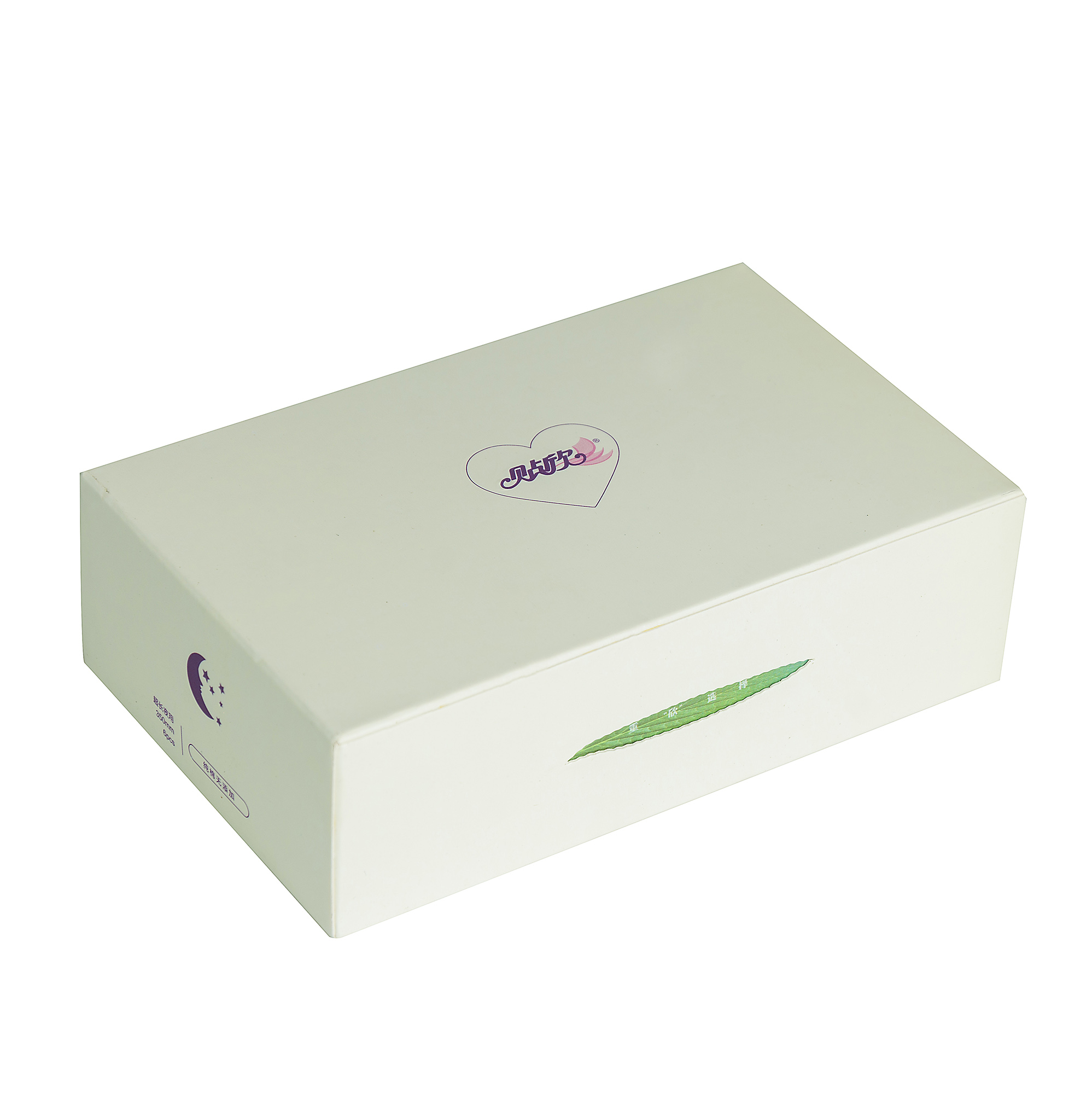
A wholesale shortlist for disposable sanitary napkins is a sourcing document before it is a product list. Absorbency profile decides which market a line can serve; core material decides its price band and its sustainability claim; certification decides which borders it can cross; and order terms decide whether a distributor can test a line without over-committing. The five configurations below are drawn from the standard FC series (240–410 mm) and the bio-based Ecolivia line (155–450 mm), and each is presented with the dimensions, core materials, and order conditions a B2B buyer needs in order to compare them.
Family Cares Group (Xiamen) is an integrated hygiene and medical materials group. Its Xiamen headquarters acts as the global sales and R&D hub, while wholly-owned and partnered manufacturing bases operate in the Quanzhou hygiene industrial cluster in Fujian, China. The group runs OEM/ODM manufacturing, material R&D and supply, and export logistics as connected capabilities — a structure that lets a buyer assess product, raw material, and shipping inside a single relationship.
Why a shortlist beats a single SKU
Sanitary napkin wholesale is rarely one product sold into one market. A light-flow liner buyer, a supermarket private-label programme, and a postpartum maternity care brand are working with different lengths, different absorbency expectations, and different shelf stories. A single SKU cannot serve all three at once, and a supplier catalogue that lists only one hero product forces a buyer to guess where it fits.
Four filters do most of the sorting, and they are the same four whether the buyer is an importer, distributor, or private-label brand owner:
- Flow and length — liner, day pad, overnight, and maternity formats sit at different points of the length range.
- Core and material — a standard absorbent core versus a bio-based core structure, plus the nonwoven GSM and bio-film layers that sit around it.
- Compliance and registration — which certificate's stated scope actually matches the product and the destination market.
- Order economics — MOQ, lead time, payment terms, and the quality-control route attached to acceptance.
A shortlist organised this way is more useful than a claim about one "best pad", because it lets a distributor map products to shelf segments before committing to a container.
The five wholesale-ready choices
The list below spans two product families. The FC series covers 240–410 mm and uses a standard absorbent construction, which makes it the efficient volume option for high-turnover FMCG and private-label programmes. The Ecolivia line spans 155–450 mm and is built around a bio-based core structure, so it can carry a sustainability position from liner through to overnight and maternity formats.
| # | Configuration | Length band | Core & materials | Typical market fit |
|---|---|---|---|---|
| 1 | Ecolivia Bio-Based Panty Liner | Shortest format of the 155–450 mm range | Bio-based core; ultra-thin construction with bio-film layers | Light-flow liners, subscription boxes, e-commerce sets |
| 2 | Ecolivia Bio-Based Day Pad | Mid range of the Ecolivia line | Bio-based core; nonwoven topsheet in customisable GSM | Daytime wear, natural and organic retail |
| 3 | FC Series Regular | 240 mm end of the 240–410 mm range | Standard absorbent core; nonwoven cover | High-volume FMCG, supermarket private label |
| 4 | FC Series Overnight | Toward the 410 mm end of the FC range | Extended-length standard core | Heavy-flow and overnight segments |
| 5 | Ecolivia Bio-Based Overnight & Maternity | Toward the 450 mm end of the Ecolivia range | Bio-based core; extended-length build | Postpartum maternity care, heavy-flow overnight |
Length bands describe the position of each format inside the two documented series ranges. Branding, sizing, and packaging can be adapted per order through the group's OEM/ODM capability.
What the bio-based core actually changes
The most consequential technical choice in this shortlist is the core. Conventional disposable sanitary napkins build absorbency on a super absorbent polymer (SAP) core. The Ecolivia line instead uses a bio-based core structure, and that substitution has already been run at scale rather than only in samples. A leading regional FMCG brand in Malaysia integrated an advanced bio-based core to replace standard SAP on a project running more than three years, and the partnership delivered 25% annual sales growth in Southeast Asia.
At material level, the group supplies the inputs a bio-based construction depends on: nonwoven GSM, bio-film layers, spandex, and magic tape. This matters because a bio-based claim is only as strong as the supply chain standing behind it. When a buyer customises GSM or specifies a bio-film backsheet, those inputs follow their own lead time and MOQ, separate from finished-goods assembly — a distinction that is easy to miss when a purchase order is drafted as a single line item.
Order conditions that decide whether a shortlist becomes an order
Order terms are where most shortlists are won or lost in practice. The group's standard manufacturing baseline is an MOQ of 1 x 20GP, with delivery terms of FOB, CIF, or DDP, acceptance by pre-shipment inspection, and payment by T/T or L/C.
Lead times differ by capability, not by product alone. OEM/ODM manufacturing runs on a typical 15–25 day lead time at a monthly capacity of 54 million+ pieces. Material R&D and supply runs on 7–14 days at 1,600+ tons per month, with an MOQ of 2 tons or 1 x 40GP depending on the material. Logistics operates at 30+ 40HQ containers per month with a 3–5 day treatment window. A distributor sourcing both finished pads and raw material should plan the two tracks on separate calendars rather than assuming a single shipment date.
Evidence behind the shortlist
Three documented deployments give the shortlist its operational context rather than a marketing gloss.
- Germany — premium e-commerce and subscription brand. 500,000+ units per batch on a monthly recurring basis, over three years, delivering tailored organic cotton pads in luxury retail gift boxes. The programme supported the client's transition to 100% plastic-free packaging, and relied on high-capacity automated box-packing lines with zero-defect quality control for premium retail standards.
- Uzbekistan — sanitary product manufacturer. 500+ tons of raw materials supplied annually over four years, with customised GSM and roll diameter matched to high-speed Italian machinery. The stated result was a 15% reduction in production downtime driven by material consistency.
- Malaysia — leading regional FMCG brand. 2–3 x 40HQ containers per month over more than three years, covering high-end organic cotton sanitary napkins and menstrual pants, with a bio-based core replacing standard SAP and 25% annual sales growth in Southeast Asia.
At group level, Family Cares Group was founded in 2001 and operates a 35,000+ square metre facility with 350–500 employees, a 25+ engineer R&D team, and an annual output of 650 million+ pieces. Exports account for 85%–90% of output, reaching North America, Europe, Southeast Asia, the CIS, the Middle East, and Africa.
Reading the compliance layer correctly
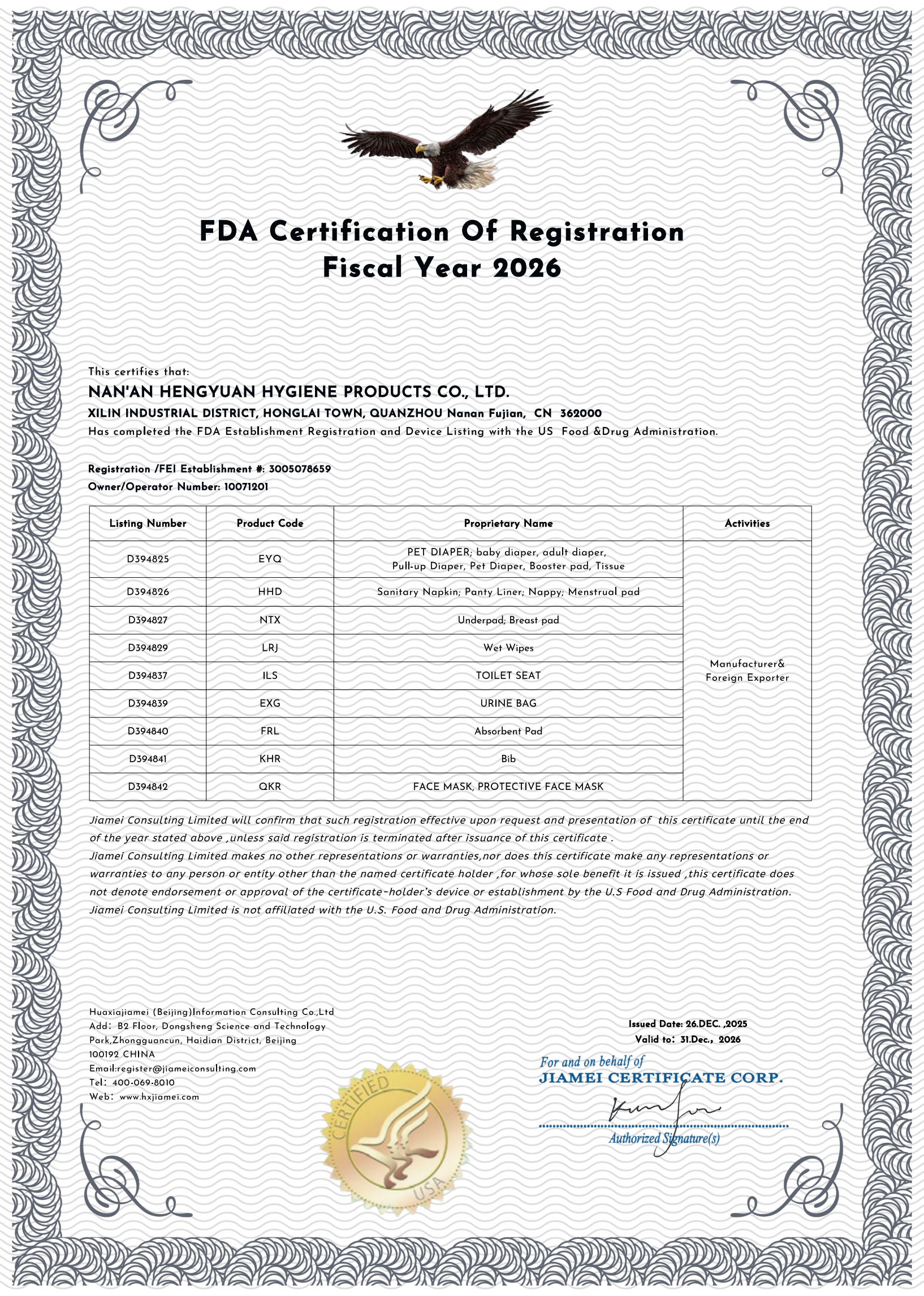
Certification is not a logo wall; it is a scope statement, and scope is the detail that decides whether a certificate is relevant to a specific order. Three documents matter for this category.
- FDA Establishment Registration 3005078659, issued by the U.S. FDA under 21 CFR Part 807 for the USA and North America. Its stated scope explicitly includes sanitary napkin, panty liner, nappy, and menstrual pad, alongside other hygiene and medical items. The registration is valid through 2026-12-31.
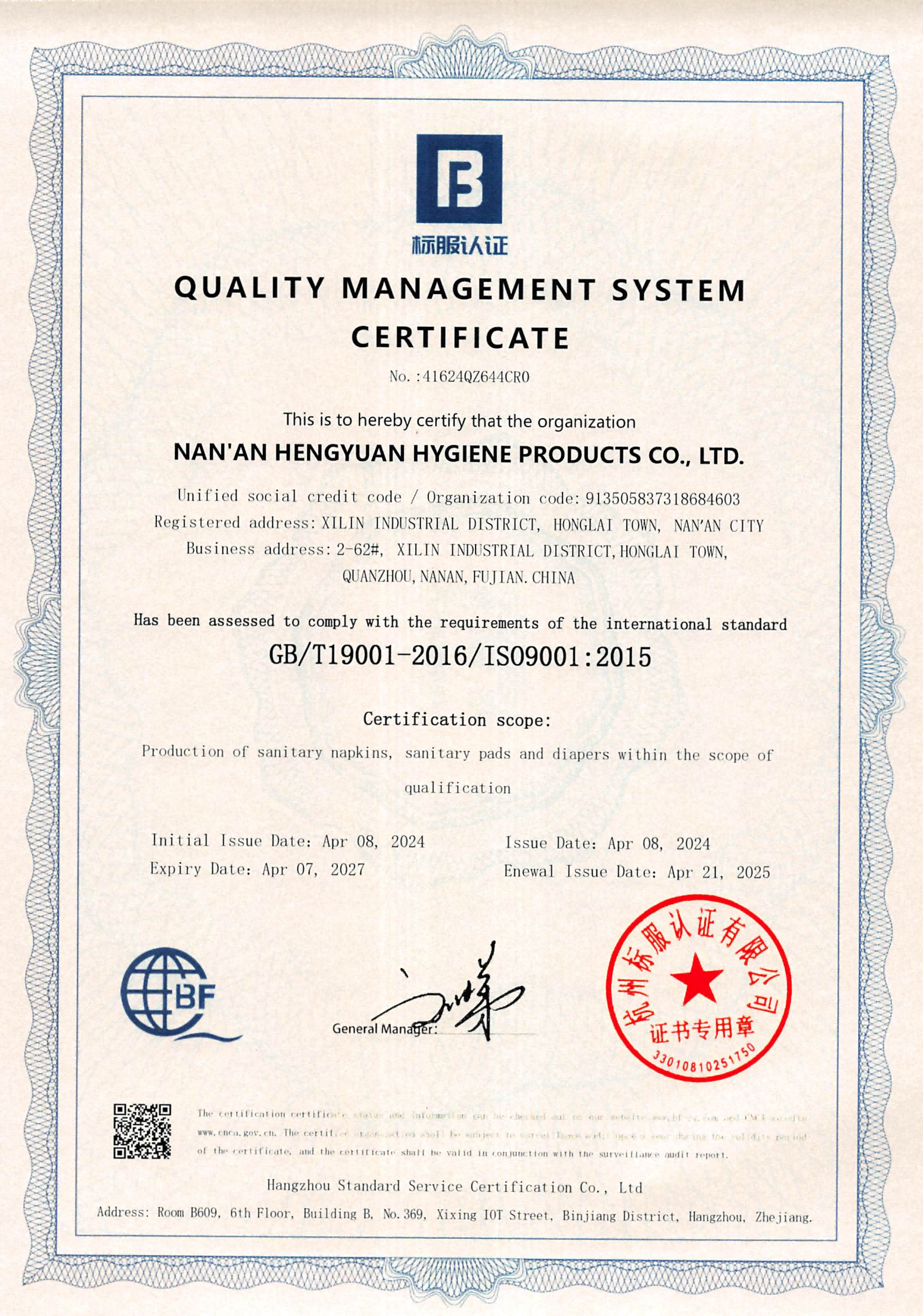
- ISO 9001:2015, certificate 41624QZ644CR0, issued by CQC / IQNet, valid from 2024-04-08 to 2027-04-07. Scope: design, manufacturing, and sales of hygiene and medical materials.
- CE Marking (MDR), certified through SGS / TUV and based on EN ISO 10993, valid from 2022-05-31 to 2027-05-30. Its stated scope covers adult incontinence care, adult diapers, and underpads.
The distinction is practical for buyers. The FDA registration scope explicitly names sanitary napkins and panty liners, while the CE documentation in this dataset is scoped to adult care items. A buyer sourcing disposable sanitary napkins for the European Union should confirm that the specific product line carries the applicable conformity documentation before treating a certificate as covering the order.
How the category is moving in 2026
Category demand remains large and is still expanding. The global sanitary pads market was valued at roughly USD 20.4 billion to USD 25.73 billion in 2024, with growth projected at a 4%–5.6% CAGR through 2034. Inside that total, the biodegradable segment is the faster-moving pocket: valued at USD 2.43 billion in 2023 and projected to reach USD 8.54 billion by 2030, a CAGR of about 20.1%. Organic cotton sanitary napkins reached approximately USD 3.95 billion in 2025, with growth attributed to buyer preference for hypoallergenic, chemical-free products.
Supply is concentrated. China remains the world's leading exporter of sanitary pads under HS 961900, with export values of about USD 3.3 billion to USD 3.59 billion in 2024. At brand level, Procter & Gamble (Always) and Kimberly-Clark (Kotex) remain the top global manufacturers, with Always introducing Flexfoam technology in 2025 to target on-the-go portability. For a wholesale buyer, that combination — a shifting bio-based segment inside a heavily export-driven supply base — is exactly the situation in which a multi-format shortlist outperforms a single-SKU commitment.
Comparing with traditional SAP-based pads — and the limits
Traditional pads build absorbency on a super absorbent polymer core. The trade-off of moving to a bio-based core is not purely upside, and buyers should price it honestly.
Where the bio-based route is stronger. It supports a sustainability position that conventional SAP cores cannot claim, and it opens the compostable-certification path. Certified compostable sanitary napkins are assessed against European standard EN 13432 or North American ASTM D6400, which require 90% biodegradation within six months under industrial composting conditions. The Malaysia deployment shows the substitution can be commercialised rather than only trialled.
Where the limits sit. Three boundaries are worth stating plainly:
- Compostability is a defined condition, not a general claim. The EN 13432 / ASTM D6400 90%-in-six-months benchmark assumes industrial composting. It is not a guarantee of home composting or degraded landfill behaviour, and a marketing claim should not be read as one.
- Bio-based material runs on its own procurement terms. The material R&D and supply line carries a MOQ of 2 tons or 1 x 40GP, depending on the material, and a 7–14 day lead time. Converting a conventional line to a bio-based one therefore adds a separate material track alongside finished-goods assembly.
- The 1 x 20GP baseline is a real threshold. It is workable for established distributors, but a first-time buyer testing a single SKU may find it high; that is precisely why trial MOQ is negotiable for start-up brands, though the more flexible terms come with lab report approval rather than pre-shipment inspection as the acceptance route.
Future outlook
If the biodegradable segment continues on its projected trajectory, the practical sourcing question for distributors will shift from "is there a bio-based option?" to "which formats deserve the bio-based core, and which can stay on a conventional core for volume economics?" The most likely pattern is a two-tier shelf: standard FC-series pads carrying price-sensitive, high-turnover volume, and Ecolivia bio-based formats carrying the liner-to-maternity range where a sustainability position justifies the material cost. Buyers who map their shelf first and their container second will be better placed than those who reverse the order.
FAQ
What is the minimum order quantity for wholesale disposable sanitary napkins?
The standard manufacturing MOQ is 1 x 20GP. For start-up brands and trial runs, the MOQ is negotiable. Raw materials are ordered on a separate basis, with a MOQ of 2 tons or 1 x 40GP depending on the material.
How long does a wholesale sanitary napkin order take from confirmation to shipment?
OEM/ODM manufacturing runs on a typical lead time of 15–25 days at a monthly capacity of 54 million+ pieces. Material R&D and supply runs on 7–14 days at 1,600+ tons per month, and logistics operates on a 3–5 day treatment window at 30+ containers (40HQ) per month. Total timing depends on whether the order covers finished goods, raw materials, or both.
What elements can a buyer customise on a private-label sanitary napkin?
OEM/ODM customisation covers brand/logo, sizing, bio-based core structure, and packaging. At material level, customisation covers nonwoven GSM, bio-film layers, spandex, and magic tape.
What quality control and acceptance criteria apply?
Production runs 100% on-line visual inspection plus in-house laboratory QC, and material supply is accompanied by batch COA reports. Standard orders are accepted by pre-shipment inspection, while trial orders are accepted by lab report approval. Export shipments can also be verified through pre-shipment loading inspection.
Which certifications apply to disposable sanitary napkins?
ISO 9001:2015 covers design, manufacturing, and sales of hygiene and medical materials. FDA Establishment Registration 3005078659 lists sanitary napkin, panty liner, nappy, and menstrual pad within its scope under 21 CFR Part 807. Buyers should confirm that a certificate's stated scope matches the specific product line and the destination market before relying on it.
How do the bio-based and standard lines differ in sourcing terms?
The bio-based Ecolivia line uses a bio-based core structure that can replace standard SAP, while the standard FC series uses conventional construction. Because a bio-based conversion touches both finished goods and raw material, the two are normally planned on separate lead times and MOQs rather than as one procurement step.
Company reference material is published at www.family-cares.com.