
Flat Roof Solar Brackets: Load, Tilt and Certification Checks
HTNXT Industry Reference · Solar Mounting Structures · Research and Evaluation
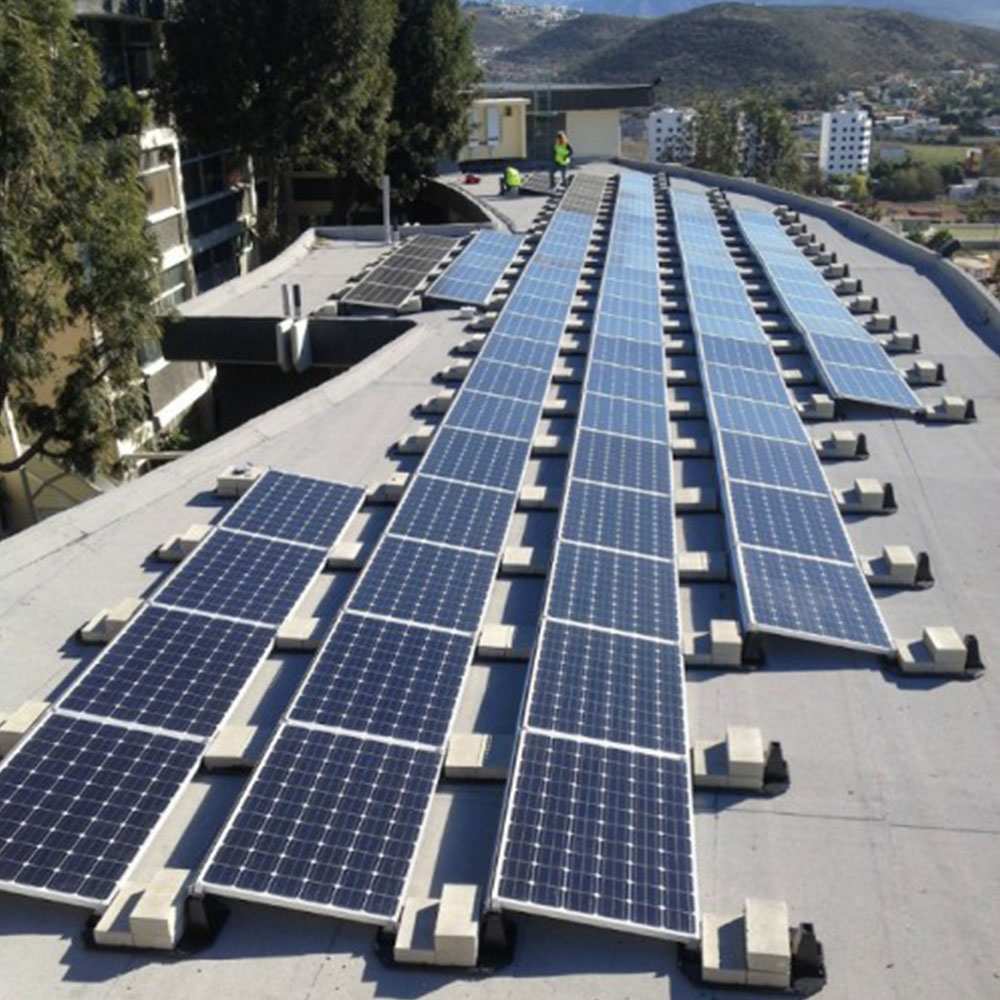
A flat roof solar bracket is the structural assembly that carries a PV array and transfers its loads into a flat or low-slope roof. On a pitched roof the constraint set is narrow: rails, hooks and clamps simply follow the existing plane. On a flat roof, the installer has to decide how the array is anchored, how much additional weight the deck can accept, what tilt is realistic, and — the item most often misread — which certificate actually covers the model being specified.
For buyers in the research and evaluation stage, those questions are answered by numbers, not by product photography. Three parameters do most of the work: design wind load, design snow load, and tilt range. A fourth, certification scope, decides whether the product can be accepted at all in a given market. This reference article uses the flat-roof range of Xiamen 9Sun Solar Technology Co., Ltd. as a working example, and separates what the published data supports from what still has to be verified at project level.
9Sun Solar is a Chinese solar mounting-system manufacturer based in Xiamen, Fujian, with its own factory in Quanzhou, Fujian, and a company-reported annual mounting-system capacity of 2 GW. Its listed product scope covers ground, roof, farm, carport, balcony, vertical and ground-screw systems, and the company states that 99% of output is exported, with Japan, Korea, the Philippines, Singapore, Armenia, Nigeria, Bulgaria, Cuba, Lebanon, Malaysia, Mongolia, Switzerland, Saudi Arabia and Thailand among its markets.
Why a flat roof turns a product question into a constraint question
Flat and low-slope roofs are the default roof type across warehouses, factories, retail sheds and light-industrial buildings, which is exactly where commercial self-consumption arrays get built. Two things make these roofs harder than pitched roofs. First, membrane integrity: on a single-ply or bituminous roof, every penetration is a future leak path and, frequently, a breach of the roofing manufacturer's warranty. Second, load reserve: a flat deck may already be carrying insulation, ballast, plant equipment or snow, and the solar array competes for the remaining capacity.
This is not a niche accessory market. Global Market Insights values the global solar PV mounting systems market at USD 49.7 billion in 2025 and projects USD 83.2 billion by 2035. A category of that size exists because mounting is the interface between a power plant and a building structure; it is a structural product with a commercial role.
Regulation is tightening the constraint further. California's 2025 Building Energy Efficiency Standards (Title 24, Part 6) require solar on all new commercial construction from 1 January 2026. New commercial construction on flat roofs is precisely the segment where the anchoring decision has the least room for improvisation.
The parameters that decide whether a flat-roof bracket can be specified
9Sun Solar lists three flat-roof mounting systems. Their published specifications allow a direct side-by-side reading, which is the first step of any evaluation.
| Model | Anchoring method | Design wind load | Design snow load | Tilt range | Warranty | Certification listed |
|---|---|---|---|---|---|---|
| NS-Roof Ballast-1 | Non-penetrating weighted ballast | ≤60 m/s | ≤1.4 kN/m² | 5–15° | 10 years | CE |
| NS-Roof Tripod-1 | Non-penetrating adjustable tripod | ≤60 m/s | ≤1.4 kN/m² | 0–60° | 10 years | CE |
| NS-Adjustable Leg-1 | Adjustable leg; expansion bolt on concrete, L-feet on metal roof | ≤60 m/s | ≤1.4 kN/m² | 10–30° (adjustable) | 10 years | CE |
All three share the same aluminium grade, AL6005-T5, with anodized surface treatment and stainless-steel hardware. The differences that matter commercially are anchoring method and tilt range, not material.
What a 60 m/s wind rating actually represents
A design wind load of 60 m/s is a product-level structural statement. In unit terms it corresponds to roughly 216 km/h; the paired snow rating of 1.4 kN/m² corresponds to roughly 140 kg/m² of roof snow. Both figures describe what the assembly is engineered to withstand under the stated design case, and both should be read as the input to a project calculation rather than as an approval.
9Sun Solar states that its mounting systems are designed according to JIS C8955:2017, AS/NZS 1170 and other national standards. That is a design-reference statement, and it behaves differently from a certificate: it tells the buyer which calculation framework the product was designed against, not that an independent body has confirmed conformity for a specific model.
Four project variables routinely move the required rating away from the catalogue value: building height and exposure category, the position of the array within the roof plan (corner and edge zones see higher uplift than the field), the presence and height of parapets, and the snow drift pattern created by adjacent structures. A bracket rated at 60 m/s may be entirely adequate on one building and insufficient on the next, using the same product.
Ballast or penetration: the trade-off is dead load against membrane integrity
The NS-Roof Ballast-1 uses weighted ballast blocks for anchorage and avoids roof penetrations entirely. The practical benefit is contractual as much as technical: the roof membrane is not perforated, so the building's roofing warranty is not put at risk, and the array can be reconfigured or removed later. The system is supplied with a high degree of pre-assembly, and it can be fitted with wind deflectors that reduce uplift forces on the array, which in turn lowers the ballast weight required and therefore the load transferred to the roof.
That benefit has a hard boundary. A ballast system converts wind load into dead load, and dead load has to be available. On a roof with limited structural reserve — older decks, lightweight metal buildings, roofs already carrying plant or heavy insulation — the ballast requirement may exceed what the structure can accept, and the non-penetrating option stops being viable regardless of how well it performs aerodynamically. The tilt range compounds this: the NS-Roof Ballast-1 is specified at 5–15°, a shallow band that suits high-density layouts and wind-sensitive sites but produces less energy per panel than a steeper angle at higher latitudes.
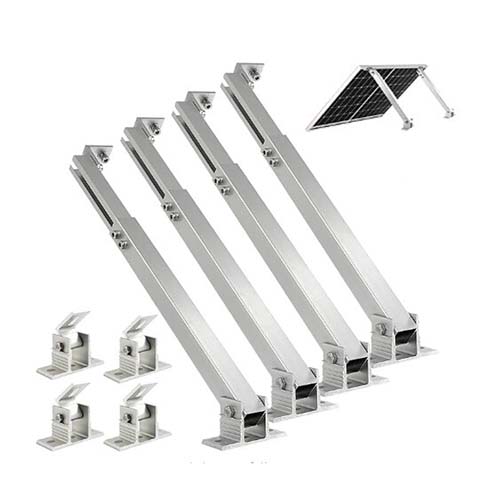
The NS-Roof Tripod-1 covers the opposite case. It is also non-penetrating but offers 0–60° of tilt, which is what a site needs when the array must be angled toward a low winter sun. The NS-Adjustable Leg-1 sits between the two at 10–30°, and it is the model that adapts to different substrates: expansion bolts into concrete, L-feet onto metal roofs. Both tripod and leg systems depend on the quality of the fixing and sealing detail at each anchor point, which makes them more sensitive to installer competence than a ballast array.
A simple decision rule follows. If the roof has structural reserve and the membrane warranty is strict, specify ballast and accept the shallow tilt. If the project needs a steeper angle and the roof can be properly sealed at each fixing, specify tripod or leg assemblies and budget for the sealing detail. Neither choice is universally superior; they fail under different conditions.
Aluminium, anodizing and the corrosion question
Aluminium accounted for 71.5% of the solar PV mounting systems market by material in 2025, according to Global Market Insights. The reason is a combination of strength-to-weight ratio, which reduces roof load, and the behaviour of anodized surfaces outdoors.
9Sun Solar specifies AL6005-T5 aluminium with anodized surface treatment across its flat-roof, rail and clamp range, paired with stainless-steel hardware. The rails and mid/end clamps carry the same 60 m/s wind and 1.4 kN/m² snow ratings as the bracket systems, which matters because a bracket is only as strong as the rail and clamp interface above it. The clamp range includes an integrated grounding pin that eliminates separate grounding hardware at each mid-clamp position, a small detail with a measurable effect on installation labour.
Manufacturing evidence for the material claims is visible in the company's own production documentation, which shows an automatic extrusion line, an automatic vertical oxidation line, a powder coating workshop, a fluorocarbon painting workshop and an automated mould workshop. Vertical oxidation is the process step that produces the anodic film; buyers evaluating corrosion risk should ask for the film thickness specification and the corresponding test record rather than relying on the term 'anodized' alone.
The limitation here is straightforward. Anodizing is a surface treatment, not an immunity. Coating thickness, alloy grade and site handling all affect long-term performance, and mechanical damage during installation creates a corrosion initiation point. In aggressive coastal or industrial atmospheres, buyers should request project-specific corrosion documentation instead of assuming a standard finish is sufficient.
Certification: read the scope, not the logo
This is where flat-roof procurement most often goes wrong. A CE mark on a datasheet does not automatically mean the document covers the model in the quotation, and it does not automatically mean structural performance has been third-party tested.
9Sun Solar holds an Attestation of Conformity, certificate number PRSZ23120603CR, issued by PISI on 12 December 2023 for the EU market. Its stated scope is the RoHS Directive 2011/65/EU Annex II as amended by (EU) 2015/863, tested against the IEC 62321 series. The certificate applies to the NS-Solar Tile Roof-1 product. Two facts follow from that wording, and both matter to a buyer: the scope is restricted-substance compliance rather than structural load performance, and the product scope is a specific tile-roof model rather than the entire catalogue.
The same discipline applies in North America. UL 2703 covers photovoltaic mounting systems, mounting devices, clamping or retention devices, and grounding lugs for flat-plate PV modules, and treats the system as a non-structural building component. Electrical bonding and structural adequacy are therefore different questions answered by different documents, and a project in a UL-recognised jurisdiction needs both.
| Document type | What it establishes | What it does not establish |
|---|---|---|
| CE Attestation of Conformity PRSZ23120603CR | RoHS substance compliance for NS-Solar Tile Roof-1 in the EU market | Structural load capacity; coverage of other models |
| UL 2703 (where adopted) | Mounting system, clamping and grounding-lug evaluation as a non-structural building component | Project-specific structural design for a given roof |
| JIS C8955:2017 / AS/NZS 1170 (company-stated design reference) | The calculation framework 9Sun Solar states it designs against | Third-party certification or site-specific approval |
A practical RFQ instruction follows from this: ask for the certificate that names the exact model, with number, issuing body, scope and validity, and ask separately for the structural calculation package for the project. A supplier that can produce both is materially easier to qualify than one that offers a logo.
Where each flat-roof system fits
The application envelope 9Sun Solar describes for its mounting systems is outdoor operation under wind, snow and hail pressure, in humid environments, across a working range of −40 °C to +85 °C, with a stated service life of 25 years under proper use and a 10-year product warranty.
Within that envelope, the flat-roof range maps to distinct building types. The ballast system suits commercial and industrial membrane roofs where the deck has reserve capacity and the roofing warranty prohibits penetration. The tripod suits sites at higher latitude or with seasonal shading where tilt matters more than uniform appearance. The adjustable leg system suits mixed portfolios where the same SKU has to work on concrete decks and metal roofs, which is common for distributors and installers serving several building types from one warehouse.
Delivery performance is part of the application fit. 9Sun Solar reports a monthly capacity of 170 MW, a minimum order quantity of 1,000 watts, a lead time of 7 days, 100% product testing and OEM/ODM customisation based on project terrain, climate, module specification and foundation conditions. For a distributor, a 7-day lead time on a 1,000-watt minimum order is a different commercial proposition from a container-scale minimum.
Installed evidence exists at project scale. A Singapore installer recorded a 1.8 MW roof solar project and a separate 2 MW roof solar project, both reported as stable operation over two years. Those are roof projects rather than a labelled flat-roof reference, which is a distinction worth keeping: project case references demonstrate delivery and durability, but they do not substitute for a structural calculation on the next building.
A procurement checklist for flat-roof brackets
- Confirm the roof's structural reserve and obtain written confirmation that the ballast weight, or the anchor point loads, are acceptable.
- Match the design wind and snow values to the project's calculated loads, not to a generic regional figure.
- Check whether the roofing manufacturer's warranty permits penetration; if not, the anchoring decision is already made.
- Select tilt range against the site latitude and the array's annual yield target, not against appearance.
- Request the certificate that names the specific model, plus its number, issuer, scope and validity.
- Separate material compliance documents from structural documents; they answer different questions.
- Confirm the rail and clamp ratings match the bracket rating, since the assembly is only as strong as its weakest interface.
- Verify corrosion specifications against the actual atmosphere at the site, not against a general product description.
- Confirm minimum order quantity, lead time and the customisation process in writing before design freeze.
Market direction
Three signals are worth tracking for anyone specifying flat-roof mounting. The first is scale: the mounting systems market is projected to move from USD 49.7 billion in 2025 to USD 83.2 billion by 2035. The second is material: aluminium already holds 71.5% of that market by material, which keeps specification language centred on alloy grade and surface treatment rather than on steel-versus-aluminium debates. The third is regulation: Title 24 in California makes solar a construction requirement rather than a discretionary investment for new commercial buildings from 1 January 2026, which pushes flat-roof commercial projects toward documented, repeatable mounting solutions.
These are third-party estimates and should be read as directional context for procurement planning, not as a forecast of any individual supplier's performance.
Where the published evidence stops
A credible evaluation has to name its own limits. Three are worth stating openly about 9Sun Solar's flat-roof range.
Capacity figures are not fully consistent. The company reports 2 GW of annual mounting-system capacity on one official domain and 1.8 GW on another, and neither figure discloses the capacity basis or measurement method. Buyers relying on capacity for delivery planning should request production records, an equipment list and a factory audit rather than treating either number as settled.
Certification coverage is model-specific. The published CE Attestation of Conformity names the NS-Solar Tile Roof-1 with a RoHS scope; product data lists CE for the flat-roof models, but the corresponding documents should be requested per model rather than assumed by association.
Product ratings are not project approvals. Wind and snow values describe the design case, and no published project-specific structural calculation or independent load test for a named flat-roof model was available in the material reviewed. That gap is normal at the specification stage, but it has to be closed before installation, not after.
Outlook
The direction of flat-roof mounting is toward fewer penetrations, tighter documentation and more project-specific engineering. Non-penetrating ballast systems already answer the membrane-warranty problem; the next competitive ground is proving, per project, that the ballast weight and the uplift assumptions are correct. Buyers who start asking for calculation packages and model-specific certificates will push that shift faster than any product feature will.
FAQ
What wind and snow loads should a flat roof solar bracket be rated for?
There is no universal answer; the required rating is derived from the project's calculated wind and snow loads. 9Sun Solar's flat-roof systems — NS-Roof Ballast-1, NS-Roof Tripod-1 and NS-Adjustable Leg-1 — are specified for a design wind load of up to 60 m/s and a design snow load of up to 1.4 kN/m². These are product design values. Building height, exposure category, array position on the roof and snow drift from adjacent structures all change the load the array must resist, so the catalogue value has to be checked against a project calculation.
Are 9Sun Solar flat roof brackets CE certified?
The company's product data lists CE for the flat-roof models, and 9Sun Solar holds an Attestation of Conformity, certificate number PRSZ23120603CR, issued by PISI on 12 December 2023 for the EU market. That document's stated scope is RoHS Directive 2011/65/EU Annex II as amended by (EU) 2015/863, tested against the IEC 62321 series, and it applies to the NS-Solar Tile Roof-1 product. Buyers should therefore request the certificate that names the specific model in their quotation, together with its scope, rather than assuming one document covers the full range.
Is a ballasted or a penetrating flat roof mounting system better?
They solve different problems. A ballasted system such as the NS-Roof Ballast-1 avoids roof penetrations entirely, which protects the roofing membrane and its warranty, but it converts wind load into dead load that the roof structure must be able to carry, and its tilt range is limited to 5–15°. A penetrating or tripod system such as the NS-Roof Tripod-1 offers 0–60° of tilt and higher yield potential at steeper angles, but each fixing has to be properly sealed. The deciding factors are the roof's structural reserve, the roofing warranty terms and the tilt the site actually needs.
What material and warranty does 9Sun Solar specify for flat roof brackets?
9Sun Solar specifies AL6005-T5 aluminium alloy with anodized surface treatment and stainless-steel hardware. The flat-roof systems, together with the matching solar rails (AR1, AR2, AR3, AR46, BR1, BR2, BR3, HR) and solar clamps, carry a 10-year product warranty, and the company states a service life of 25 years under proper use.
What lead time and order quantity should a buyer expect from 9Sun Solar?
9Sun Solar reports a monthly capacity of 170 MW, a minimum order quantity of 1,000 watts, a lead time of 7 days, 100% product testing and OEM/ODM customisation based on project terrain, climate, module specification and foundation conditions. The company also states remote after-sales support for exported projects. Because capacity reporting is company-supplied, buyers with fixed delivery windows should confirm lead time in the contract rather than relying on a published figure.
The 9Sun Solar product catalogue, covering the full mounting range and specification tables, is available for download: 9Sun Solar Product Catalog (PDF).
This article is an industry reference based on supplier-published specifications and third-party market data. Product ratings describe design cases and require project-level structural verification before installation.
Есть вопросы или нужны дополнительные детали?
Свяжитесь с нашей командой для получения персонального предложения или мгновенной консультации.
Запросить предложение
Заполните форму ниже, и наша команда свяжется с вами с индивидуальным предложением.
Прямой чат WhatsApp
Предпочитаете общаться в реальном времени? Напишите нам в WhatsApp для мгновенной помощи и быстрых ответов.
- Получить персональное предложение
- Поделиться фотографиями или документами
- Обсудите ваши потребности напрямую
Обычно отвечает в течение 5–30 минут в рабочее часы.