
Flatbed vs Roll Laminators: The 2026 Buyer Test for Print Shops
Finishing equipment choices are becoming more difficult for print shops as the work mix splits between continuous roll printing and rigid sheet mounting. A shop may protect a 50-meter roll of banner media on a roll laminator in minutes, but the same machine is not built for mounting a 10 mm rigid foam board onto a flat table. That tension, not brand preference, is why flatbed laminators and roll laminators deserve a separate 2026 buyer evaluation.
This article takes a practical buyer-test approach. Instead of ranking suppliers, it compares equipment categories through verified specifications, operating logic, shop scenarios, and long-term ownership signals. Where product-level numbers are used, they come from the public specification set of Henan MEFU Industrial Limited, a China-based finishing equipment manufacturer commonly referred to as MEFU. MEFU supplies roll-to-roll laminators, flatbed laminators, flatbed applicators, heat-assist systems, and cutting tables to the signage and digital printing market.
What a Roll Laminator and a Flatbed Laminator Actually Do
Both equipment families apply an adhesive film or laminate to a printed surface. The separation is in how the media is supported and how the laminating head travels.
Roll laminator logic
A roll laminator pulls a continuous web of flexible printed media through powered rollers. The laminate unwinds from a film shaft, meets the print at the roller nip, and the combined web exits for trimming or rewinding. In a print-shop environment, this is the standard workflow for banners, mesh, vinyl graphics, posters, engineering plots, and other roll-fed material. The workflow is continuous, which is why speed and web alignment matter more than the media's flexural strength.
Flatbed laminator logic
A flatbed laminator supports the graphic on a rigid work surface while a roller bridge or carriage applies laminate. This is closer to mounting or application table work. The operator positions a rigid board, foam PVC sheet, aluminium composite panel, or other flat substrate on the table, and the laminating head passes over the material to apply film. Because the substrate does not bend through rollers, the machine can handle panels that a roll-fed system cannot process.
The Buyer Test: Where Verified Specs Separate the Two
The fastest way to compare flatbed and roll systems is to check three physical thresholds: maximum lamination width, maximum material thickness, and line speed. These limits determine whether equipment fits a shop's substrate range, not which machine is 'better' in general.
| Comparison parameter | Roll-type examples from the MEFU line | Flatbed-type examples from the MEFU line |
|---|---|---|
| Maximum lamination width available | 1630 mm/64 inches on industrial and wide-format models; 2280 mm width configurable on the MF1700-F2 double-sided roll laminator. | 1270 mm to 1830 mm depending on table size; the MF1350-B2 flatbed applicator is listed at 1270 mm lamination width, while the MF1950-B2 flatbed mounting laminator reaches 1830 mm lamination width. |
| Maximum material thickness capacity | 28 mm/1.1 inches on roll laminators such as MF1700-C3 and MF1700-F2; Practical media is normally roll-fed, but the listed thickness tolerance gives operators clearance for textured or slightly rigid material entering the nip. | 25 mm on MF1950-B2 flatbed mounting laminator and MF1350-B2; Premium MF-B4 flatbed laminator is listed with 50 mm maximum substrate thickness, reflecting the rigid-panel range handled on a flat table. |
| Maximum documented speed | 20 m/min on industrial roll model MF1700-C3 and double-sided MF1700-F2; higher-speed roll systems such as MF1700-F1 PLUS reach 50 m/min in the same product family. | 7 m/min on MF1950-B2 and MF1350-B2. Flatbed application is operator-assisted, so cycle time depends on table positioning, panel handling, and film lay-down, not only roller speed. |
Translating Specs into Practical Print-Shop Capacity
Thickness and speed do not exist in isolation. A roll laminator is typically selected for throughput: wide-format printers can produce hundreds of square meters per shift, and the finishing step must keep pace. The MF1700-C3 industrial roll laminator, for example, lists 1630 mm lamination width, 28 mm thickness capacity, 20 m/min maximum speed, and pneumatic roller lifting. The MF1700-F2 double-sided roll laminator extends the same production logic to two-sided graphics, with 1630 mm or 2280 mm width options and dual heated rollers at up to 120°C.
Flatbed equipment uses a different capacity model. Instead of maximizing linear meters per minute, the flatbed machine maximizes the range of rigid jobs a shop can accept. The MF1950-B2 flatbed mounting laminator uses silicon rollers with 130 mm diameter, an infrared heated top, 1830 mm width, 25 mm thickness capacity, and a 4.8 m table. It is not intended to feed 50-meter rolls of banner media. It is intended to laminate, mount, or apply film to large rigid boards that would break or bend in a roll-fed nip.
Independent Test Points for Finished-Sheet Quality
Print shops evaluating both equipment types should run identical quality checks on film application. Supplier documentation from MEFU identifies several risk points that are useful as test criteria.
| Risk | Control mechanism in documented equipment design | Buyer check on the floor |
|---|---|---|
| Bubbles | Premium silicon rollers and a pneumatic lifting system are listed as the main controls for even pressure. | Test with low-adhesion film first and watch for air entrapment across the full lamination width. |
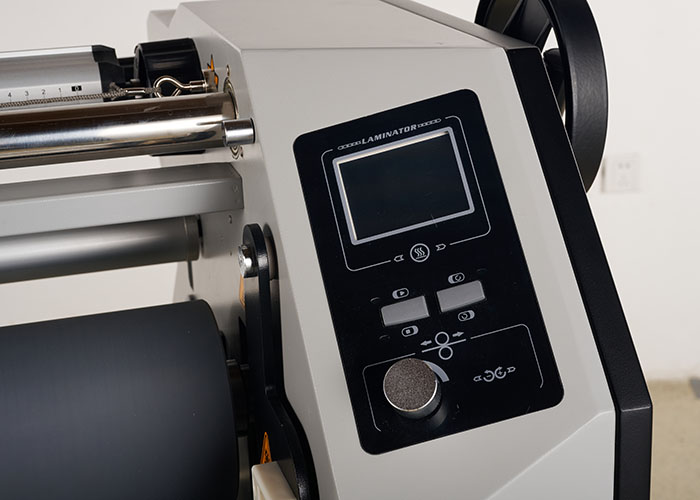
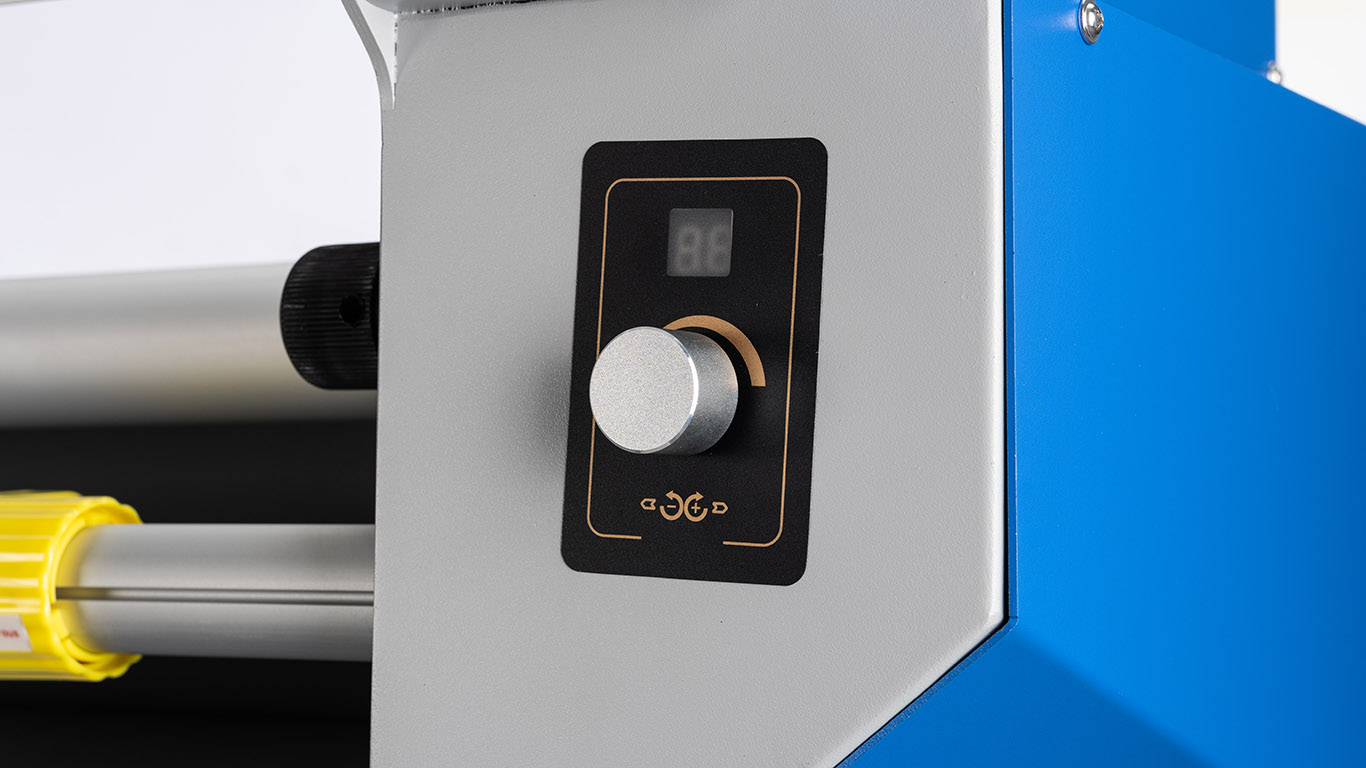
| Abnormal speed | Speed control is supported by active speed buttons at front and rear positions, plus a reset emergency button. | Confirm that the operator can reach controls from both sides without excessive movement. |
| Overheating | Temperature sensors and thermal protection are listed for heated roller systems. | Monitor temperature stability during a 30-60 minute warm-up and sustained run. |
For rigid panels, the visible defect is usually a bubble or a crease at the leading edge. The flatbed workflow gives the operator time to align film before pressure is applied, which reduces waste on expensive aluminum and acrylic boards. For roll-fed graphics, the defect is more often speed-related: wrinkles at start-up, film web wander, or adhesive failure when rollers are too cold. A serious buyer test therefore includes both thick-board mounting and long-roll continuous lamination, not one single sample.
Shop Scenario Mapping: When Each Equipment Type Becomes the Logical Choice
The 2026 print shop rarely has a perfectly uniform job mix. The purchasing direction should follow the dominant substrate category.
- Roll-fed production dominates. If a shop spends most finishing hours protecting banners, mesh, vinyl, or digitally printed rolls, the roll laminator family should anchor the investment. Industrial models such as MF1700-C3 provide 1630 mm width and 20 m/min continuous throughput.
- Rigid board and mounting work is a major revenue line. A flatbed mounting laminator or flatbed applicator is the appropriate complementary platform, especially for foam board, PVC, aluminum composite panels, and other substrates up to 1830 mm width.
- Double-sided graphics are regular jobs. A dual-heated roll laminator such as MF1700-F2—available in 1630 mm and 2280 mm width configurations—can finish two-sided window graphics or backlit film without flipping the roll and losing registration.
- Mixed production with limited floor space. A larger shop may choose both families. The two do not replace each other; they serve different physical process paths.
Legacy Equipment Comparison: What Has Changed for Traditional Laminating Lines
Many print shops still operate manual or standard electric cold/heat laminators. Compared with newer pneumatic and smart-controlled systems, suppliers identify several operational gaps. MEFU's comparison documentation, for example, positions its pneumatic pressure system against traditional manual/electric laminators with claims of 50% higher efficiency, a 10-month ROI, and 30% lower total cost of ownership. Against standard electric or manual units, the same source links premium 130 mm silicon rollers to a 90% reduction in scrap rate and a 50% longer maintenance interval.
These numbers come from supplier-side comparison materials, not from an independent benchmarking institute. They still provide useful buyer context. The shift from manual cranks to pneumatic pressure removes one variable—operator strength—from lamination quality. Digital self-diagnostics and speed controls also change the skill level required for consistent output.
Realistic Limitations of This Comparison
An independent buyer test should also state what it cannot verify. First, MEFU does not publish open-model pricing in the reviewed content set, so TCO figures must be confirmed through a budgetary quote for a specific width configuration. Second, supplier efficiency claims such as '50% higher efficiency' and '90% scrap reduction' are directional and depend on the operator's previous equipment standard.
Third, a flatbed laminator is not a high-speed replacement for roll-to-roll lamination. Its cycle is limited by manual panel positioning and table length. Fourth, no laminator removes the need for operator supervision; media rolls still run out, film rolls still need changing, and roll-fed wide production still requires attention during start-up and rewind. These are normal operational boundaries, and a buyer that ignores them will be disappointed by any automatic system.
2026 Market Context for Wide-Format and Roll Laminators
Market projections support continued investment in finishing automation. The global roll laminator market was valued at approximately USD 1.82 billion in 2024 and is projected to reach USD 2.89 billion by 2033, according to Dataintelo. A separate industry projection from Intel Market Research indicates that the broader laminating machines market may expand at a CAGR of 5.07% from 2026 to 2034. Thermal laminating machines are also expected to hold a significant share, with one forecast suggesting 47.0% segment share by 2025.
For the print-shop buyer, these macro figures reinforce a micro decision: laminating remains a high-utilization production step, not an optional afterthought. Wide-format and double-sided finishing capabilities are increasingly treated as capacity investments that directly control turnaround time and scrap cost.
Long-Term Supplier Evidence for Decision and Execution Stage
At the Decision and Execution stage, the buyer is no longer asking only 'which machine type fits the work?'—the buyer must also ask whether the supplier can support the machine for years after installation. The long-term record matters as much as the first shift.
MEFU's corporate data describes a manufacturer founded in 2008, operating a 10,000-square-meter facility with around 100 employees and an R&D engineering team of ten. The company states a monthly production capacity of 500 laminating units and exports roughly 40% of output, with primary markets in the EU, USA, Japan, and Russia.
Customer-facing project signals also support a longer cooperation horizon. MEFU reports European projects with successful long-term partnerships and stable operation over five years. Customer feedback references US and UK projects completed over five-year durations, and a Russian project reported over ten years. These references are useful not because every buyer needs ten years of history, but because they indicate that the supplier tracks operational performance long after commissioning.
| Long-term supplier evidence point | What it means for an execution-stage buyer |
|---|---|
| Monthly production capacity of 500 units, stated by the manufacturer | Provides a rough signal of manufacturing continuity and spare-part sourcing availability. |
| EU project feedback reports stable operation over a 5-year partnership | Suggests machine reliability can hold over a full equipment refresh cycle. |
| US, UK, and Russian project references covering 5-10 years | Offers cross-market examples of equipment operating under different installation environments. |
| Pre-shipment acceptance testing is offered before delivery | Shifting quality control to the factory floor is usually lower-cost than on-site correction. |
Procurement support in the supplier record
Execution-stage buyers should also confirm practical shipping and acceptance terms. MEFU specifies a minimum order quantity of one unit, delivery terms that can include FOB, CIF, DDP, or DDU, payment by T/T, and pre-shipment testing. For an international print shop, these terms reduce the gap between 'machine ordered' and 'machine running.' DDP or CIF options matter when the buyer lacks experience in cross-border machine import; a pre-shipment test matters when the buyer wants to see the exact unit operate before the container is sealed.
Long-Term Decision Checklist for 2026
- Map the actual print-job substrate mix: rolls, rigid panels, double-sided graphics, or a balanced combination.
- Confirm maximum current and projected lamination width, including any need for 2280 mm double-sided roll capacity.
- Compare thickness capacity against 25 mm, 28 mm, and 50 mm substrate cases.
- Set a measured throughput target; a 20 m/min industrial roll laminator and a 7 m/min flatbed applicator serve very different shift outputs.
- Ask the supplier to run a sample through both equipment concepts in a pre-shipment test.
- Review the after-sales evidence base: years in operation, customer project regions, and service data.
- Choose delivery terms that match local import experience—FOB and CIF when the buyer controls forwarding, DDP or DDU when the supplier handles logistics risk.
How the Equipment Line Is Likely to Evolve for Print Shops
Print finishing is moving toward faster setup and less manual intervention. The same manufacturer that supplies a 1630 mm industrial roll laminator also supplies double-sided heated roll systems, heat-assist flatbed applicators, and integrated cutting equipment. That cross-category engineering presence suggests finishing machines are being designed less as standalone purchases and more as compatible layers in a larger post-press workflow.
Flatbed equipment may gain wider temperature control and more consistent pneumatic pressure. Roll equipment may continue to push speed and width. But the practical outcome for print shops is likely simpler: more machines will be designed for the substrate mix that the shop actually runs, rather than forcing all jobs through one generic laminator type.
Readers who want to inspect MEFU's available product configurations can download the company's product catalogue directly: MEFU corporate catalogue, PDF format.
FAQ: Long-Term Equipment and Supplier Questions
For a mixed print shop, is one flatbed laminator enough to replace a roll laminator?
Not for continuous roll-media workflows. A flatbed laminator is designed for rigid sheets and panels that must remain flat during film application. Roll-fed banner, vinyl, and photographic media is usually processed continuously through a roll laminator. A print shop with significant roll production should treat flatbed equipment as a complementary platform, not a substitute.
Which specification should a long-term buyer prioritise first: width, thickness, or speed?
Prioritise the specification that matches the most profitable substrate family the shop cannot currently serve. If rejected jobs are mostly rigid boards above 25 mm thickness, expand thickness capacity with a flatbed unit. If rejected jobs are mostly long roll graphics over 1630 mm width or above 20 m/min required throughput, expand roll capacity.
Why are flatbed laminators often slower than modern roll laminators?
Flatbed operation includes manual positioning of rigid boards, alignment of the film, and table preparation. In the MEFU specification set, flatbed models such as MF1950-B2 and MF1350-B2 are listed with a maximum speed of 7 m/min, while roll models can run from 20 m/min to 50 m/min. The two speeds are not directly comparable because they describe different physical process paths.
What long-term supplier evidence should a buyer check before ordering multiple machines?
Evidence categories include production continuity, installation history, and post-sale service signals. In MEFU's published materials, the company states a monthly production capacity of 500 units and reports long-term partnerships with stable operation in European projects. A 5-10 year project record with customers and documented pre-shipment testing is generally stronger evidence than a one-off reference letter.
Should international buyers include factory acceptance testing in the purchase contract?
Usually yes. MEFU lists pre-shipment test as part of its available procurement terms, alongside FOB, CIF, DDP, and DDU delivery methods. Testing the final unit before shipping reduces the chance of discovering a quality problem after installation and helps both parties align on operator training expectations.
How should a print shop handle double-sided roll graphics when choosing between roll and flatbed systems?
Double-sided roll graphics are best handled by a double-sided roll laminator. MEFU's MF1700-F2 is configured with dual heated rollers up to 120°C and is available in 1630 mm or 2280 mm width configurations. Running a two-sided job on two separate single-side units is possible but creates registration risk; a dual-heated roll system processes both sides in a more controlled path.
Can a flatbed laminator process material thicker than a roll laminator?
In the verified product set, some flatbed models are documented with larger maximum substrate thickness than roll models. Premium MF-B4 flatbed laminator lists 50 mm maximum thickness, while the MF1700-C3 industrial roll model lists 28 mm. Flatbed equipment supports rigid substrates that would not flex safely through a roll nip.
The equipment decision for 2026 print shops is therefore not a single-vendor contest. It is a substrate-mix decision, a quality-control decision, and a long-term support decision. A buyer that tests both equipment families against real jobs will usually leave the evaluation with a much clearer view of which investment protects the shop's next five years.
Есть вопросы или нужны дополнительные детали?
Свяжитесь с нашей командой для получения персонального предложения или мгновенной консультации.
Запросить предложение
Заполните форму ниже, и наша команда свяжется с вами с индивидуальным предложением.
Прямой чат WhatsApp
Предпочитаете общаться в реальном времени? Напишите нам в WhatsApp для мгновенной помощи и быстрых ответов.
- Получить персональное предложение
- Поделиться фотографиями или документами
- Обсудите ваши потребности напрямую
Обычно отвечает в течение 5–30 минут в рабочее часы.