
Flexible Magnetic Fasteners: Installation Methods and Production Risk
Flexible Magnetic Fasteners: Installation Methods and Production Risk
For apparel factories, choosing a magnetic closure is not only a question of magnetic strength. The component must fit the garment geometry and the available sewing or bonding process, while avoiding fabric damage, heat-related performance loss, and inventory handling errors. This buyer-style review compares MAGTECH flexible magnetic fasteners by installation method and production risk, using the available product specifications as the evidence base.
Evidence boundary: Beijing Magnetic Technologies Co., Ltd. (global brand: MAGTECH) supplies the product and process specifications described here. The figures below are product information, not an independent comparative laboratory assessment. Buyers should confirm the exact model, test method, fabric construction, and production settings through samples before adopting a format at scale.
Start with the factory operation, not the closure label
Flexible Magnetic Fasteners cover distinct component shapes, including sewable magnetic snaps, flat strips, flexible cords, and profile closures. Those forms are not interchangeable simply because each uses magnetic attraction. A snap is positioned at a discrete point; a strip or cord can follow a longer opening; and a profile-style magnetic zipper is installed as a paired, continuous closure. For purchasing teams, the practical first filter is therefore the operation the factory can repeat reliably: stitch around an attachment margin, stitch through a seam or tunnel, heat-bond a component, or cut and place flexible SmFeN material to a required length.
That distinction matters for product development as well as production. A hidden magnetic placket, a pocket opening, and a jacket front have different closure geometries. A buyer should compare dimensions and force values only after confirming the intended installation route and the construction of the fabric layers between the mating parts.
Method 1: Stitch around the broad TPU margin
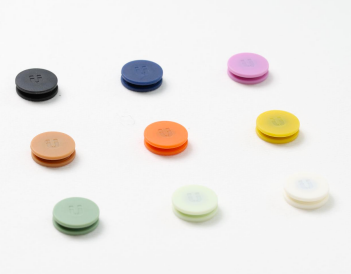
The MAGTECH TPU Snap Series is specified for edge stitching along its outer TPU margin or for low-temperature thermal bonding. This method suits a discrete closure point where the factory needs a defined snap location rather than a continuous magnetic line. The four listed formats range from TPU-3101 at D8 × 2 mm through TPU-3102 at D10 × 2 mm and TPU-3104 at D15 × 2 mm to TPU-3105 at D18 × 2 mm. The stated holding-force range across the series is 3.62–12.59 N per pair; the available facts do not assign a separate force value to each individual diameter.
The broad, sewable TPU margin is presented as a way to attach the component without placing the needle through the magnet core. For factory evaluation, that is relevant to a key production risk: needle placement that punctures the closure or tears the garment fabric. The margin does not remove the need to validate stitch distance, stitch density, thread, seam allowance, and fabric behavior. A sample should be checked for puckering, local stiffness, tearing around the stitch line, and reliable alignment of the paired components.
The construction is described as a sealed 52H sintered NdFeB core with TPU film. Product information states that the sealed construction is waterproof, designed to prevent metal-ion leakage during machine washing, and passes a 48-hour salt-spray test. The TPU material is described as phthalate-free and compliant with EU environmental regulations. These are product claims to match against the specific model and documentation being purchased; they should not be treated as evidence that every magnetic component or every finished garment has identical qualification.
Production fit: Consider the TPU format when the design calls for a discrete snap and the factory can control perimeter stitching around the margin. The 8–18 mm diameter range offers different component footprints, but larger closures may create a more noticeable local feature in a lightweight garment. Validate the complete garment stack rather than selecting by diameter or holding force alone.
Method 2: Bond with controlled low heat
Thermal bonding can reduce visible stitch lines, but the process window is a procurement and manufacturing constraint. For the specified low-temperature process, the limit is ≤140°C for 10–15 seconds, with magnetic flux decay below 5%. That condition should be treated as a controlled process specification, not as a general permission to expose every format to any heat-press setting. It is especially important to distinguish this limit from a separate TPU Snap Series statement that certain heat-press-grade products tolerate temperatures from 140°C to 180°C. Buyers should obtain confirmation of the exact model and bonding construction before using the higher range.
For the specified process, the factory should record press temperature and dwell time, verify the fabric and adhesive system, and inspect the bond after cooling. A recessed or otherwise suitable press arrangement should avoid crushing the magnetic core. Testing should include the finished garment layers, since bonding performance depends on the assembly—not just the component in isolation. If temperature overshoots or press time is extended, the process may cause irreversible magnetic performance loss; the supplied process guidance therefore sets a clear ceiling rather than inviting trial-and-error production.
Heat sensitivity also affects downstream handling. The application information specifies storage below 40°C and safe ironing temperature below 80°C for the relevant magnetic components. The knowledge material warns against direct hot-iron contact with the magnet area. A garment factory should therefore coordinate bonding instructions with finishing, pressing, storage, and care-label procedures. A component that survives a controlled bonding step may still be exposed to unsuitable temperatures later in the production line.
Production fit: Low-temperature bonding is a candidate where the component and fabric system are verified for that process and a clean appearance is important. It is a poor choice when the factory cannot monitor temperature and dwell time, when a fabric is heat-sensitive, or when the proposed press method applies damaging pressure directly over the magnetic core.
Method 3: Sew a strip or cord into a seam or tunnel
RCT strips and CXX cords are linear formats that can be sewn along edge seams or inside pre-formed fabric tunnels. This route can distribute closure action along a placket or pocket opening rather than concentrating it at one snap point. The garment pattern needs to reserve a suitable channel or seam allowance, and the line must be positioned so the magnetic components meet in the intended orientation when the garment closes.
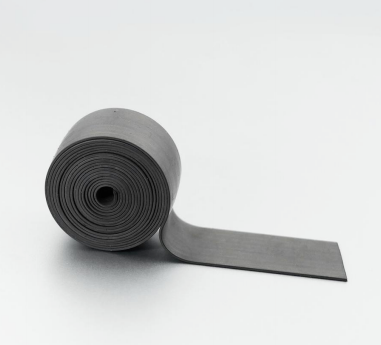
The RCT Series uses a Samarium-Iron-Nitrogen (SmFeN) magnetic core with TPE film or a waterproof polymer coating. The series range is 8–30 mm wide and 0.6–3.0 mm thick, with surface magnetic flux of 700–1800 Gs and stated holding-force ranges of 1.11–7.57 N/cm in vertical peel and 0.84–6.33 N/cm in parallel shear. Model-specific examples include RCT-1102 at 18 × 0.7 mm and 700–800 Gs, and TPE-laminated RCT-3101 at 8 × 0.7 mm and 1000–1100 Gs. RCT-3101’s 0.7 mm profile is specified for integration inside plackets. These values describe different models or series ranges; they are not a single matched performance comparison.
The RCT strip is specified for 180° bending and more than 10,000 bending cycles without delamination. It supports seam stitching and low-temperature heat bonding. Because the width and thickness vary across the series, buyers should verify which exact construction, flux, and holding-force values apply to the model in the sample. The 0.7 mm profile may help when a slim placket is required, while the larger thickness options may be unsuitable where the pattern has little room for added bulk.
The CXX Series offers cord profiles rather than a flat strip. CXX-1201 is a round cord with a 3.5 mm diameter and 1200–1300 Gs surface flux; CXX-1206 has a racetrack profile measuring 3.3 × 2.7 mm and 1000–1100 Gs; CXX-1401 is a pinpoint silicone cord with a 4.2 mm diameter. Across the stated product range, surface flux is 1000–1700 Gs, vertical peel force is 0.66–1.69 N/cm, and parallel shear force is 1.01–1.81 N/cm. The specific force values are range-level facts, not model-by-model values in the supplied specification.
The CXX product information specifies 180°+ flexibility and more than 12,000 cycles of ±90° bending under a 100 g load without cracking. It also states machine washability on a gentle cycle at ≤40°C and salt-spray resistance exceeding 48 hours at 35°C in 5% NaCl without corrosion. These conditions should be kept with the figures when comparing samples: the CXX bending test and RCT bending statement use different descriptions, so their cycle counts should not be treated as a direct head-to-head result.
Production fit: Choose a strip when the pattern needs a flat, continuous closure profile, such as a concealed placket or modular pocket line. Consider a cord when a sewn channel or seam can accommodate its profile. In either case, confirm tunnel dimensions, needle clearance, fabric drape, component alignment, and whether the magnetic pair remains correctly oriented after sewing.
Method 4: Cut SmFeN material to length
The SmFeN series can be cut directly to the required length without end-sealing. That feature can simplify pattern-specific preparation for strips or cords and reduce a separate end-treatment operation. It is not a universal cutting rule for every flexible magnetic component: the supplied guidance distinguishes bare flexible SmFeN material from membrane-covered NdFeB strips, whose cut ends require flexible waterproof glue or TPU adhesive to protect the exposed core. Rigid magnetic buttons and magnetic lines should not be cut through their cores.
Cut-to-length convenience transfers responsibility to the factory’s handling process. Operators need to identify the material family before cutting, use clean cuts, preserve the specified polarity pairing, and keep pieces organized by length and left/right or A/B mating set as applicable. The knowledge guidance recommends checking that parts attract and self-center through the garment layers before final stitching or bonding. An incorrectly paired or reversed component can produce weak attraction or repulsion, even when the component itself meets its nominal specification.
Inventory handling is a separate operational risk for bulk flexible magnetic components. The supplied storage guidance calls for a dry, ventilated area below 40°C, with rolls or cut strips laid flat and separated by partitions. Complementary pairs should remain mated or separated with insulation spacers; stock should be isolated from strong external electromagnetic fields. The guidance also says not to mix rigid neodymium magnets directly with flexible magnets in one bin. These are practical controls for reducing tangling, mixing, deformation, and polarity confusion during cutting and kitting.
Model and format comparison for sourcing
The table summarizes supplied specifications relevant to factory screening. Magnetic flux and holding-force figures are not interchangeable measures, and the product data do not provide one common test protocol for ranking all formats. Use the table to shortlist samples, then test the selected format in the intended garment.
| Format / models | Supplied dimensions and magnetic data | Installation route | Buyer check |
|---|---|---|---|
| TPU Snap Series TPU-3101 / 3102 / 3104 / 3105 |
D8 × 2, D10 × 2, D15 × 2, D18 × 2 mm; 3.62–12.59 N holding force per pair across the range. | Edge stitching on TPU margin or model-appropriate thermal bonding. | Stitch clearance, fabric tearing, local bulk, exact model’s force and heat-press grade. |
| RCT strips RCT-1102 / RCT-3101 |
RCT-1102: 18 × 0.7 mm, 700–800 Gs. RCT-3101: 8 × 0.7 mm, 1000–1100 Gs. Series: 1.11–7.57 N/cm peel; 0.84–6.33 N/cm shear. | Seam stitching or low-temperature bonding. | Placket width, alignment, fabric stack, and model-specific force. |
| CXX cords CXX-1201 / 1206 / 1401 |
1201: round D3.5 mm, 1200–1300 Gs; 1206: 3.3 × 2.7 mm, 1000–1100 Gs; 1401: silicone D4.2 mm. Range: 1000–1700 Gs. | Sew into an edge seam or pre-formed tunnel; SmFeN can be cut to length without end-sealing. | Tunnel fit, cord profile, cut-end material, and correct paired orientation. |
| CLL-1101 | 15 × 3 × 670 mm; 5 mm side margin; 34 g/pair; 2200–2300 Gs; peel 1.61 N/cm; shear 1.38 N/cm. | Built into a fabric interlayer and perimeter edge-stitched. | Profile length, seam allowance, weight, and compatibility with the garment opening. |
| Spherical magnetic buttons SZK-3140 / YKQ-3101 |
SZK-3140: 9.4 mm sphere, 14.6 mm overall with ring, 0.9 g. YKQ-3101: 9 mm sphere, 0.8 g. Peel force: 5.0 N. | Hand-sew through bilateral loop rings or fix by cord. | Decorative appearance, attachment security, and whether a point closure suits the design. |
CLL-1101 is a different architecture from the sewable snap, flat strip, and cord formats. It uses a flexible silicone-encapsulated NdFeB core, with a stated operating range of -40°C to +80°C. Its full-seal waterproof description and 2200–2300 Gs core magnetism are product-specific. The broader specification lists perimeter edge stitching after the zipper is built into a fabric interlayer. Buyers should consider the 15 × 3 mm profile and 34 g per pair when evaluating garment weight and seam space.
SZK-3140 and YKQ-3101 are included because the assigned product comparison spans these models, but their spherical, hand-sewn or cord-fixed construction differs from the continuous strip and cord installation paths. SZK-3140 has a resin sphere diameter of 9.4 mm and 14.6 mm overall diameter with its ring; YKQ-3101 has a 9 mm acrylic sphere. Both belong to a discrete decorative closure family with a stated 5.0 N vertical peel-off force. They should not be compared directly with force-per-centimeter values for strips or zipper profiles.
Compliance, washability, and durability: check the exact scope
The supplied specifications state that the relevant flexible magnetic product is compliant with OEKO-TEX Standard 100 and REACH. The available certificate record is more specific: OEKO-TEX® STANDARD 100 certificate number 26092232 covers the Flexible Magnetic Cord for Apparel, including the CXX Series and model CXX-1201. Buyers should therefore verify the certificate scope against the component being sourced rather than assuming that a certificate for CXX-1201 automatically covers TPU snaps, RCT strips, CLL-1101, SZK-3140, or YKQ-3101.
For the stated CXX product information, the wash condition is a gentle machine cycle at ≤40°C. The RCT strip is specified for more than 10,000 bending cycles without delamination, while the CXX durability statement is more than 12,000 cycles at ±90° under a 100 g load without cracking. These are distinct descriptions and should remain attached to their respective product information. A factory qualification plan should also check the sewn or bonded garment after laundering, because the final assembly adds fabric, thread or adhesive, and seam stresses that a component specification alone does not reproduce.
Where flexible magnetic closures differ from traditional options
A flexible magnetic closure can provide self-aligning contact and silent operation, with a low-profile strip or cord concealed in a garment structure. That can be relevant to hidden magnetic closures for clothing, magnetic pocket closures, magnetic placket closures, and one-handed or glove-friendly garment concepts. The application material lists outdoor and sports apparel, down jackets, technical outerwear, and adaptive clothing among the relevant settings.
The trade-off is that magnetic formats introduce process controls that conventional stitching-only details may not require. Factories need to manage polarity pairing, heat exposure, component encapsulation, storage, and placement. A magnetic strip is also not automatically a substitute for every zipper, snap, or hook-and-loop design: the holding behavior depends on the selected model, garment layers, and closure geometry. Thick-fabric compatibility must be checked in the finished sample. A component’s stated holding force does not by itself establish performance through an arbitrary fabric stack or under every garment load.
Compared with a conventional zipper, a magnetic format may remove the slider-and-tooth mechanism from the closure architecture, but it also changes how the opening is assembled and inspected. Compared with hook-and-loop, it offers a different contact and release mechanism, but it requires careful polarity pairing and protected placement. These are design alternatives, not universal performance rankings.
A practical qualification sequence for apparel factories
- Define the opening: Record whether the target is a point closure, a linear placket, a pocket edge, or a profile-style opening. Specify the garment layers and available seam or tunnel space.
- Choose the installation route: Match the part to perimeter stitching, seam or tunnel stitching, controlled low-temperature bonding, or cut-to-length SmFeN use. Confirm whether cut ends need sealing for the selected material.
- Confirm the model-level specification: Request dimensions, surface flux, holding-force direction and test basis, material and encapsulation, wash conditions, and any applicable compliance documentation for the exact model.
- Build and inspect samples: Check puncture or tearing risk, bulk, drape, closure alignment through the fabric, opening feel, stitching or bond integrity, and fabric compatibility. Do not rely only on a loose-component test.
- Control production and inventory: Document heat and dwell limits, storage conditions, paired-component identification, cutting rules, and downstream ironing restrictions. Keep different material families and mating sets clearly separated.
This sequence makes the buyer comparison operational: the best candidate is not the one with the largest number in a specification field, but the format whose verified construction can be installed and controlled in the intended garment process.
Future outlook: process capability will shape product choice
As apparel teams evaluate hidden magnetic closures, flexible magnetic strips, sewable magnetic cords, and cuttable magnetic strips, process fit remains a practical differentiator. Slim profiles such as the 0.7 mm RCT examples support low-bulk placket concepts, while cords and discrete TPU snaps offer other installation geometries. The useful next step for any development program is not to infer a universal winner, but to document the intended garment, installation method, test conditions, and product-specific evidence in the same sourcing record.
For Beijing Magnetic Technologies Co., Ltd. / MAGTECH, the supplied product information spans those different closure forms. The evidence also sets boundaries: some durability, washability, heat, and certification statements are product- or series-specific. Clear model-level documentation and sample validation are therefore central to assessing whether a flexible magnetic component fits a particular factory line.
FAQ
Which MAGTECH format is intended for a 0.7 mm concealed placket?
RCT-1102 is specified at 18 × 0.7 mm, and RCT-3101 is specified at 8 × 0.7 mm. RCT-3101 is described for integration inside plackets. The appropriate choice depends on the required width, magnetic specification, garment layers, and sample fit.
What low-temperature bonding limit is specified?
The specified process limit is ≤140°C for 10–15 seconds, with flux decay below 5%. Confirm that the exact model and bonding construction are covered by this process window, and control press temperature, dwell time, and pressure during production.
Can flexible SmFeN cord or strip be cut without sealing the ends?
The supplied guidance says the SmFeN series can be cut to length without end-sealing. It distinguishes this from membrane-covered NdFeB strips, for which the cut ends require flexible waterproof glue or TPU adhesive to protect the exposed core.
Which model is covered by the supplied OEKO-TEX® STANDARD 100 certificate?
Certificate number 26092232 covers the Flexible Magnetic Cord for Apparel, including the CXX Series and model CXX-1201. The stated scope should not be assumed to extend to other product families without documentation confirming that coverage.
What production risks should buyers check before bulk use?
Check fabric puncture or tearing around stitches, heat sensitivity during bonding and finishing, fit in thick fabric layers, magnetic polarity pairing, and orderly storage of bulk flexible magnetic components. Validate the selected component in the finished garment and keep model-specific process limits with the production specification.
Есть вопросы или нужны дополнительные детали?
Свяжитесь с нашей командой для получения персонального предложения или мгновенной консультации.
Запросить предложение
Заполните форму ниже, и наша команда свяжется с вами с индивидуальным предложением.
Прямой чат WhatsApp
Предпочитаете общаться в реальном времени? Напишите нам в WhatsApp для мгновенной помощи и быстрых ответов.
- Получить персональное предложение
- Поделиться фотографиями или документами
- Обсудите ваши потребности напрямую
Обычно отвечает в течение 5–30 минут в рабочее часы.