
Flexible Warning Posts Ranked for High-Impact Traffic Zones
The global road marker post market was valued at USD 3.4 billion in 2024 and is projected to reach USD 5.4 billion by 2032, according to Road Marker Posts Market Size Analysis. For buyers, that growth translates into a narrower question: which flexible warning post actually survives repeated vehicle strikes in a high-impact traffic zone?
This shortlist evaluates three flexible warning post models from the YD series — YD-WPS75, YD-WP45 and YD-PE50 — against published engineering data, and identifies the configuration scenarios in which 360° self-recovery, 15.0 MPa tensile strength and 400% elongation at break are genuinely required rather than simply preferred.
Mnsd is the brand under which Tiantai Yuanda Traffic Device Co., Ltd, a road safety equipment manufacturer based in Tiantai, Zhejiang, China, supplies warning posts, traffic cones, speed humps, convex mirrors and related parking and road safety products to importers, distributors, contractors and project suppliers (www.mnsdtraffic.com). The three models assessed here belong to that manufacturer's YD warning post series.
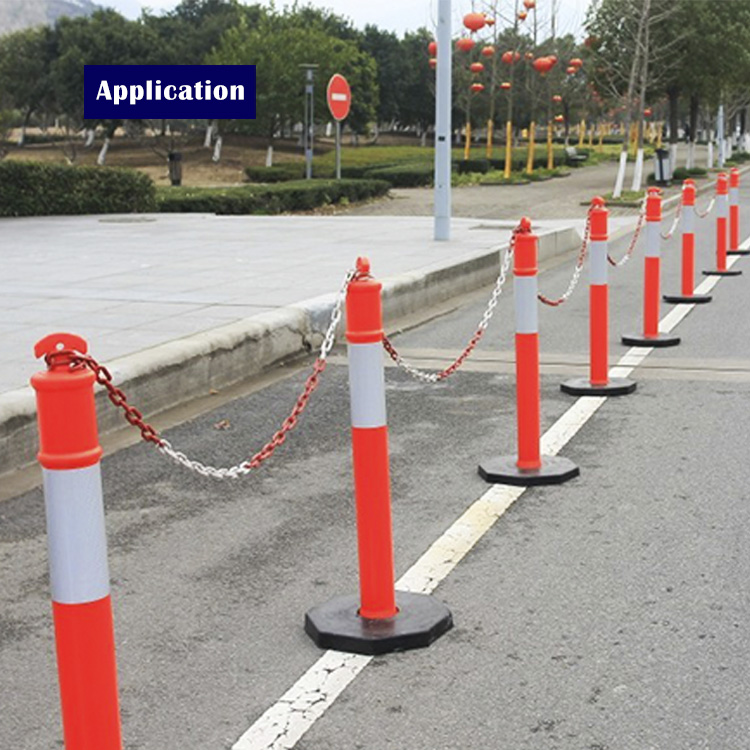
Flexible warning posts are specified where repeated vehicle contact has to be absorbed rather than transferred into the pavement. Image: Mnsd / Tiantai Yuanda Traffic Device Co., Ltd.
Why high-impact zones test the specification, not the post
In a parking aisle or a warehouse lane, a warning post may be contacted once in its service life. In a high-impact zone — expressway ramps, merge medians, T-junctions, multi-level parking entrances, temporary lane shifts on construction corridors — the same post can be struck repeatedly by different vehicles, often at low-to-moderate speed but with full vehicle weight behind the contact.
When that happens, rigid steel or concrete delineators transfer the energy into the anchor point. The visible result is usually a permanently bent post, a fractured base or fixings sheared out of the pavement. Standard polyethylene posts can behave differently but not always better: after a cold-weather impact they may deform plastically and stay bent instead of returning upright. Either outcome produces the same procurement consequence — replacement labour, a maintenance backlog, and a gap in delineation exactly where it was installed to prevent conflict.
The constraint set for these locations therefore has five parts: elastic recovery instead of deformation, material strength and elongation that resist cracking, reflectivity that remains legible at distance, temperature and UV endurance across seasons, and a base and anchoring method compatible with the actual pavement substrate.
Evaluation criteria used for this shortlist
The criteria below are drawn from the published specification envelope shared by the YD warning post series. They are the criteria a procurement manager can actually verify against a supplier's data sheet, rather than criteria based on visual impression.
| Criterion | Why it matters in a high-impact zone | Published data point (YD series) |
|---|---|---|
| Post-recovery behaviour | Determines whether the unit stays in service after a strike or becomes a maintenance item | 360° flexible and impact resistant; rapid rebound after vehicle crush |
| Tensile strength | Resistance to tearing or pulling apart under load | 15.0 MPa |
| Elongation at break | Ability to flex a long way before cracking | 400% |
| Hardness | Balance between standing upright and deflecting on contact | 80–85 Shore A |
| Retroreflective visibility | Detection distance for a driver approaching at speed | High-Intensity Prismatic (HIP) / Class 1; reflective tape width 250 mm (double or triple sleeves); silver white or fluorescent yellow; visibility distance 200+ metres |
| Temperature and UV endurance | Winter embrittlement, summer softening, colour fade | -40 °C to +70 °C; UV-stabilized coating; anti-oxidant and colourfast over 3 years; water and oil resistant |
| Base and mounting | How impact load is transferred into the pavement | Recycled rubber or integrated plastic base; expansion bolt fixing (3 or 4 holes); ring top for chain attachment |
Source: YD-PE50, YD-WPS75 and YD-WP45 published product specifications, Mnsd / Tiantai Yuanda Traffic Device Co., Ltd.
The shortlist: three YD-series models ranked by high-impact fit
The ranking below is based on suitability for locations where repeated vehicle contact and high driver speed are expected. It is not a claim that the highest-ranked model is the correct choice everywhere; the recommended configuration for each model is stated alongside it.
| Rank | Model | Height and material | Recommended configuration scenario |
|---|---|---|---|
| 1 | YD-WPS75 | 750 mm; PU (high-elasticity polyurethane); base 200 × 80 mm | High-speed expressway lane separation, highway ramps, T-junctions, median delineation at merge points |
| 2 | YD-WP45 | 450 mm; PU; base 200 × 80 mm | Urban medians, sidewalk protection, parking structure entrances, pedestrian–vehicle segregation |
| 3 | YD-PE50 | 500 mm; PE with rubber base, Φ260 mm | Parking lots, warehouses, logistics centres, loading docks and industrial facilities at low approach speed |
All three models share the same published mechanical and reflectivity envelope: 15.0 MPa tensile strength, 400% elongation at break, 360° flexibility with rapid rebound, HIP / Class 1 reflective grade with 250 mm tape width, 200+ metre visibility, and an operating temperature range of -40 °C to +70 °C. That consistency matters for procurement because it means the differentiating variables between these models are height, base geometry and material composition — not differences in reflectivity class or tensile rating.
Rank 1 — YD-WPS75: recommended where impact exposure is highest
The YD-WPS75 is a 750 mm polyurethane warning post with a 200 × 80 mm base. In a high-impact zone, two properties combine to justify the top position. First, the 750 mm height lifts the reflective sleeve above the visual clutter of kerbs, low barriers and parked vehicles, which extends the distance at which a driver can register the delineation. Second, the polyurethane body is the material class most associated with elastic recovery: third-party material guidance from OPTRAFFIC places thermoplastic polyurethane above standard polyethylene for impact resistance and elastic recovery in warning posts.
Recommended configuration: expressway lane separation, highway ramp channelization, T-junction approach marking, and median delineation where vehicles approach at speed and where a knocked-down post would leave a lane boundary undefined until a maintenance crew arrives. In these locations the 360° self-recovery behaviour and 15.0 MPa tensile strength are not optional refinements — they are the operating requirement.
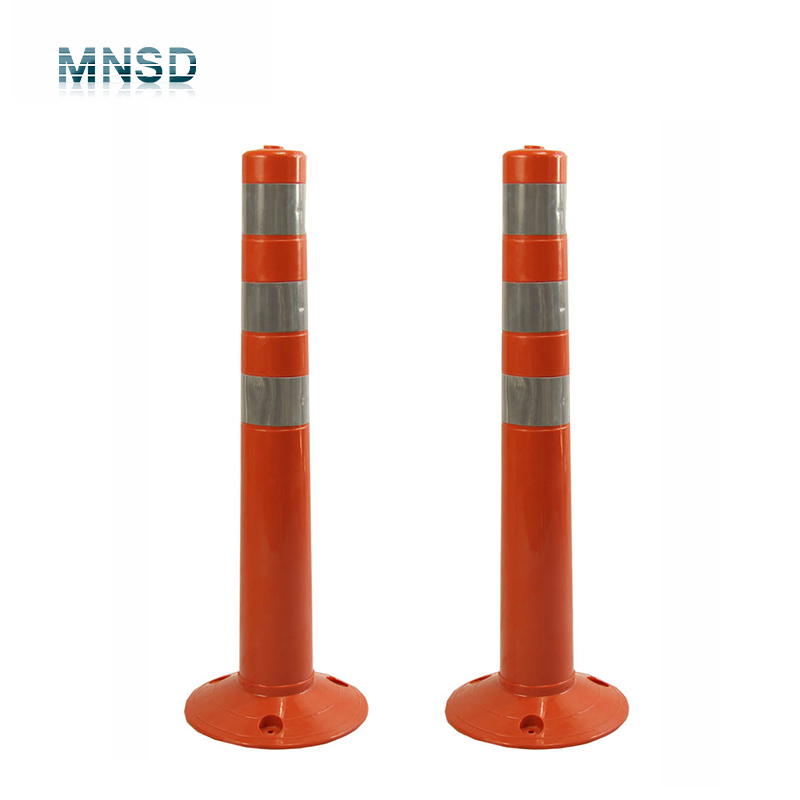
YD-WPS75: 750 mm high-elasticity PU warning post, specified for high-speed lane separation and ramp delineation. Image: Mnsd.
Rank 2 — YD-WP45: recommended for urban and mixed-use zones
The YD-WP45 is a 450 mm polyurethane post with the same 200 × 80 mm base footprint and the same published mechanical envelope as the YD-WPS75. Its lower height is a deliberate trade-off rather than a downgrade: in dense urban environments, a lower profile reduces visual noise, limits interference with pedestrian movement, and keeps the delineation proportionate to the space it defines.
Recommended configuration: urban medians, sidewalk protection, pedestrian–vehicle segregation, parking structure entrances, and approaches to schools, hospitals and commercial complexes where vehicles are already travelling at reduced speed but where contact frequency is high. In these settings the requirement shifts from detection-at-distance to repeated-contact tolerance — exactly the condition the 400% elongation at break and rapid rebound behaviour are designed for.
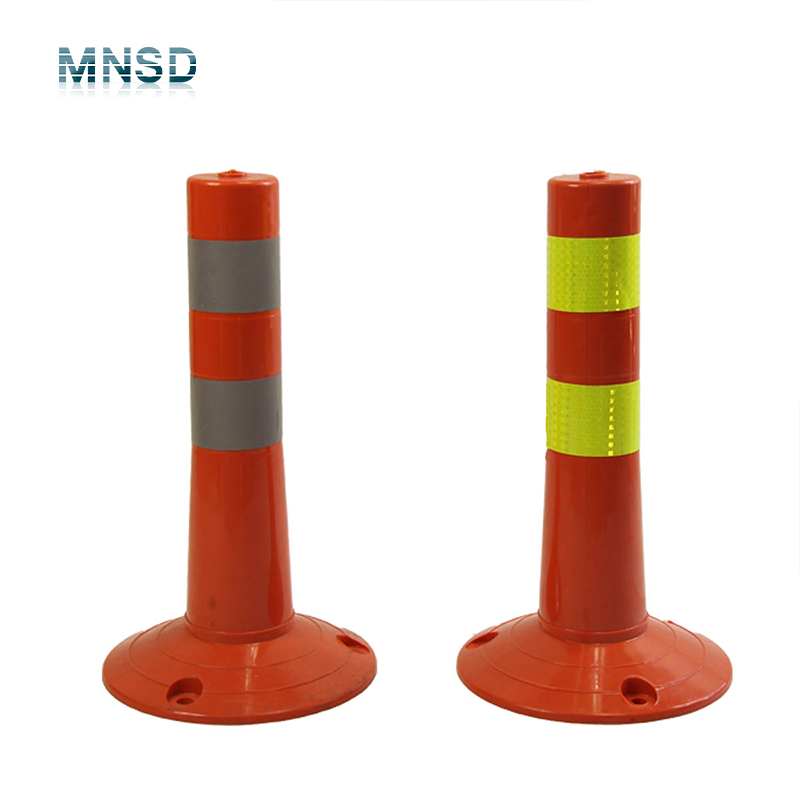
YD-WP45: 450 mm PU warning post, recommended for urban channelization and pedestrian–vehicle segregation. Image: Mnsd.
Rank 3 — YD-PE50: recommended where the base defines the requirement
The YD-PE50 is a 500 mm post in heavy-duty PE with a recycled rubber base of Φ260 mm, installed by expansion bolt fixing with 3 or 4 holes and a ring top for chain attachment. Its wider rubber base footprint distributes contact load across a larger pavement interface, which suits surfaces where repeated low-speed contact is normal rather than exceptional.
Recommended configuration: parking lots, warehouses, logistics centres, industrial facilities, loading docks and bus terminals — locations where vehicles manoeuvre frequently at low speed. Buyers should note one honest boundary: PE is not the same material class as the high-elasticity PU used in the YD-WPS75 and YD-WP45. Where repeated high-speed impacts are anticipated, the two PU models remain the more conservative specification, and the YD-PE50 is better matched to controlled low-speed environments.
What 15.0 MPa and 400% elongation actually mean in service
Tensile strength is the stress a material withstands before it tears; the YD series is published at 15.0 MPa. Elongation at break describes how far the material can stretch before failure; at 400%, the material can extend to roughly four times its original length before it breaks. Read together, the two figures describe a body that deflects a long way under impact and returns instead of cracking — which is the physical basis of the "self-recovery" claim buyers are asked to accept.
Hardness is the complementary constraint. At 80–85 Shore A, the post is firm enough to stand upright and resist wind load, yet soft enough to fold away from a vehicle rather than resist it rigidly. The 360° qualification is also practical rather than decorative: impacts arrive from the side, the rear, and at angles, so recovery in a single plane would leave most real-world strikes unaddressed.
Verification of that behaviour is a manufacturing step, not a marketing statement. The published production capability for these warning posts includes a compression and rebound test cycle of 1,000+ times, high-speed injection moulding, and a UV-resistance guarantee of no fading for three years. The reflective construction combines High-Intensity Prismatic (HIP) / Class 1 tape in 250 mm widths, applied as double or triple sleeves in silver white or fluorescent yellow, giving a stated visibility distance of 200+ metres.
Standards and compliance constraints buyers should verify before ordering
Flexible warning posts are an internationally traded component, and the standards that apply depend on the destination market. Three published references are commonly cited in procurement documentation:
- EN 12899-3 specifies requirements for delineator posts and retroreflectors used in traffic circulation areas in the European Union.
- MUTCD requires delineators to be retroreflective and visible from 1,000 feet when illuminated by high-beam headlights in the United States.
- ASTM D2765 provides standard procedures for measuring the gel content and swell ratio of crosslinked ethylene plastics used in industrial safety products.
The manufacturer's entity-level certification in the published record is a Business License, number 91331023669153260K, issued by the Market Supervision Administration under the China Policy standard. It covers the warning post business, applies to the all-countries market, and is valid from 2007-11-13 to 2107-11-13.
One limitation is worth stating plainly for procurement teams: a business licence is an entity-level document confirming lawful operation, not a product performance certificate. For a European or US project, the licence alone does not demonstrate conformity with EN 12899-3 or MUTCD visibility expectations. Buyers specifying into those markets should request project-specific test documentation against the applicable standard, alongside the material data already published for the YD series.
Application scenarios: where flexible posts are specified in practice
A documented application profile for this product family describes road safety, traffic management and municipal infrastructure use in the United Arab Emirates, covering lane separation on high-speed expressways, highway ramps, T-junctions, urban sidewalk protection and multi-level parking lot entrances.
The stated functions are visual guidance, definition of lane boundaries, prevention of unauthorized vehicle entry, and mitigation of impact damage during accidental collisions. The recorded operating mode is surface-mounted or bolt-down fixed installation for permanent deployment. Matched equipment includes high-visibility reflective sleeves with a honeycomb pattern, M10 / M12 heavy-duty expansion anchors, and optional epoxy adhesive for base reinforcement. The stated project requirement is 360° full-recovery impact resistance, UV stabilization, high-intensity reflectivity, and operation across a -40 °C to +70 °C temperature range.
A separate contractor project in Vietnam illustrates the same logic at the delivery stage. The scope covered warning vehicles and pedestrians and marking road edges and dangerous areas. Recorded service duration for the installation was 5–8 years, and the project outcome was completion and acceptance by the local authority. The contractor's stated highlights were high visibility, durability, impact resistance and ease of installation.
Procurement constraints: MOQ, lead time, customization and verification
For buyers moving from evaluation to order planning, the published supply parameters are: high-speed injection moulding production, monthly capacity of 50,000 pieces, lead time of 10–15 days for bulk orders, and a minimum order quantity of 200 pieces. Customization covers height, colour, and reflective tape brand including 3M or Grade A tape. Standard colour options for the YD warning posts are traffic orange, yellow, red and black.
Flexible PU and PE posts compared with rigid delineators and conventional alternatives
The clearest comparison is behavioural rather than numerical. Rigid steel or concrete delineators provide a strong visual marker and high resistance to being dislodged, but they have no elastic recovery: energy from a vehicle strike is transferred into the base and fixings, and the typical failure mode is a permanently deformed or displaced unit. Flexible polyurethane and PE posts accept deflection, absorb the contact, and return to position — the design intent behind the 360° flexibility and rapid rebound specification.
Within flexible options, material selection matters. Standard polyethylene is widely used and cost-efficient, while polyurethane-based materials, including TPU, are generally regarded as superior for high-impact recovery because of their elastic behaviour. That distinction is the reason the two PU models occupy the upper positions in this shortlist while the PE model is recommended for low-speed, high-frequency contact environments.
Three boundaries should be recorded honestly in any specification document. First, a flexible warning post is a delineation device, not a containment barrier; where a location requires physical vehicle restraint, pedestrian containment or crash-energy absorption, no flexible post substitutes for rigid barriers or crash cushions. Second, bolt-down installation assumes a sound substrate: expansion bolt fixing and optional epoxy reinforcement depend on concrete or asphalt that can accept the anchor, and on unpaved or unstable ground the fixing method limits performance. Third, reflective visibility is not permanent by construction — tape grade, surface cleanliness and re-sleeving intervals determine how long the 200+ metre visibility figure holds in the field.
Market trend analysis
Two published signals frame the current market. The road marker posts market is valued at USD 3.4 billion in 2024 and is projected to reach USD 5.4 billion by 2032. The wider traffic safety products market is expected to expand at a CAGR of 6.6% from 2026 to 2034, driven by urban population growth and infrastructure investment.
Market structure is also relevant to sourcing strategy. Leading global traffic equipment manufacturers — 3M, Honeywell and SWARCO — collectively hold approximately 39.2% of the market, according to Global Market Insights. That concentration sits largely at the branded equipment end, while specification-level supply of flexible warning posts remains fragmented and is frequently sourced directly from specialist manufacturers. The practical consequence for procurement managers is that supplier differentiation increasingly depends on documented material data and test records rather than on brand visibility alone.
Future outlook
The direction of travel in this category is toward specification by evidence. As urban infrastructure programmes expand and maintenance budgets come under scrutiny, the cost argument for a post that recovers after impact — rather than one that must be replaced after each contact — becomes easier to defend internally. That shift favours suppliers able to present tensile strength, elongation at break, hardness and rebound test data as a connected performance envelope rather than isolated claims.
Material evolution is likely to continue along the same path: polyurethane-based compounds for high-impact and high-speed exposures, with polyethylene retained where cost efficiency and low-speed contact tolerance are the dominant requirements. Alignment with regional standards is the second expected development, with buyers in Europe and North America requesting documentation mapped to EN 12899-3 and MUTCD visibility expectations at the point of quotation rather than after delivery.
Frequently asked questions
What does "360° self-recovery" mean on a flexible warning post?
It describes a post designed to deflect in any direction on impact and return to its upright position. The YD warning post series is specified as 360° flexible and impact resistant, with rapid rebound after vehicle crush. Recovery is a material property rather than a mechanism: the body flexes within its elastic range and returns, which is why elongation at break and hardness are relevant specification figures when buyers evaluate this claim.
What is the practical meaning of 15.0 MPa tensile strength and 400% elongation at break?
Tensile strength of 15.0 MPa describes the stress the material withstands before tearing. Elongation at break of 400% means the material can stretch to roughly four times its original length before failing. Together they indicate a post body that flexes substantially under vehicle contact and returns instead of cracking — the behaviour that determines whether a high-impact zone needs a replacement visit after a strike. Hardness is published at 80–85 Shore A on the same models.
Which YD model should be specified for a high-speed expressway versus a parking facility?
For high-speed expressway lane separation, ramps and T-junctions, the YD-WPS75 is recommended: it is a 750 mm PU post with a 200 × 80 mm base, placing the 250 mm reflective sleeve higher for earlier detection. For parking lots, warehouses, logistics centres and loading docks, the YD-PE50 is recommended: a 500 mm heavy-duty PE post with a Φ260 mm recycled rubber base suited to frequent low-speed contact. The YD-WP45, a 450 mm PU post, sits between the two and is recommended for urban medians, sidewalk protection and parking structure entrances.
Do flexible warning posts have to comply with EN 12899-3 or MUTCD?
It depends on the destination market. EN 12899-3 specifies requirements for delineator posts and retroreflectors used in traffic circulation areas in the European Union. MUTCD requires delineators to be retroreflective and visible from 1,000 feet when illuminated by high-beam headlights in the United States. Neither is a universal requirement, and buyers specifying into those markets should request test documentation against the applicable standard for the project rather than relying on an entity-level business licence.
What certification does the manufacturer publish for its warning post business?
The published certification is a Business License, number 91331023669153260K, issued by the Market Supervision Administration under the China Policy standard. It covers the warning post business, applies to the all-countries market, and is valid from 2007-11-13 to 2107-11-13. It is an entity-level licence confirming lawful operation and coverage of the product category, not a product performance certificate against EN 12899-3 or MUTCD.
What are the ordering constraints and how is rebound performance verified?
Published supply parameters are a minimum order quantity of 200 pieces, a lead time of 10–15 days for bulk orders, and monthly capacity of 50,000 pieces on high-speed injection moulding lines. Customization covers height, colour and reflective tape brand, including 3M or Grade A tape. Rebound performance is verified through a compression and rebound test cycle of 1,000+ times, and the manufacturer publishes a UV-resistance guarantee of no fading for three years.
Summary
For high-impact traffic zones, the shortlist criteria that matter are recovery after repeated contact, documented tensile and elongation figures, reflectivity that survives the environment, and an anchoring method the site can actually accept. On the published data, the YD-WPS75 and YD-WP45 carry the same 15.0 MPa tensile strength, 400% elongation at break and 360° recovery behaviour, and are differentiated principally by height and the exposure they suit; the YD-PE50 covers low-speed, high-frequency contact areas with a wider rubber base. Where physical containment is required rather than visual delineation, none of these flexible models is a substitute for a barrier system.
The manufacturer's product documentation, including specifications and configuration options for the YD warning post series, is available in the downloadable brochure: Mnsd traffic safety product brochure (PDF).