
Flexible Warning Posts: Safety Delineation for Modern Traffic
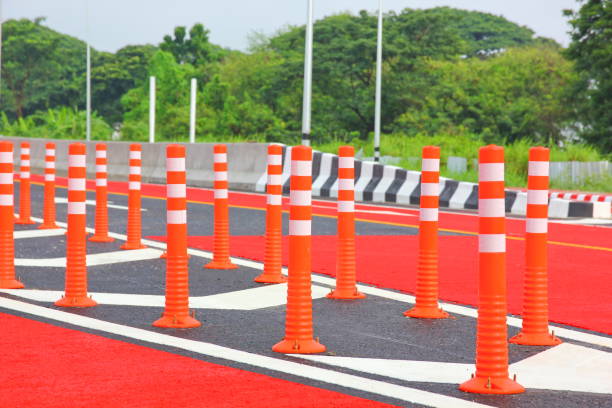
Why Flexible Warning Posts Are Gaining Traction in Road Safety
Traditional rigid bollards and concrete barriers suffer from high replacement costs and limited impact absorption. Mnsd, a brand of Tiantai Yuanda Traffic Device Co., Ltd., addresses this gap with a range of flexible warning posts designed for road traffic, parking lots, construction sites, and industrial facilities. Established in 2007 and located in Tiantai, Zhejiang, China, the company deploys a 40,000 m² facility and over 300 employees to manufacture more than 120,000,000 units annually.
Problem / Opportunity
In high-traffic zones such as highway ramps, T-junctions, and multi-level parking entrances, accidental vehicle collisions with delineators are frequent. Rigid posts crack or shatter, requiring costly repairs and creating safety hazards. Flexible warning posts absorb impacts and return to their original shape, reducing maintenance cycles and improving site safety. The opportunity lies in adopting durable, self-recovering delineators that lower total cost of ownership while maintaining high visibility.
Mnsd Warning Posts: Product Lineup & Core Advantages
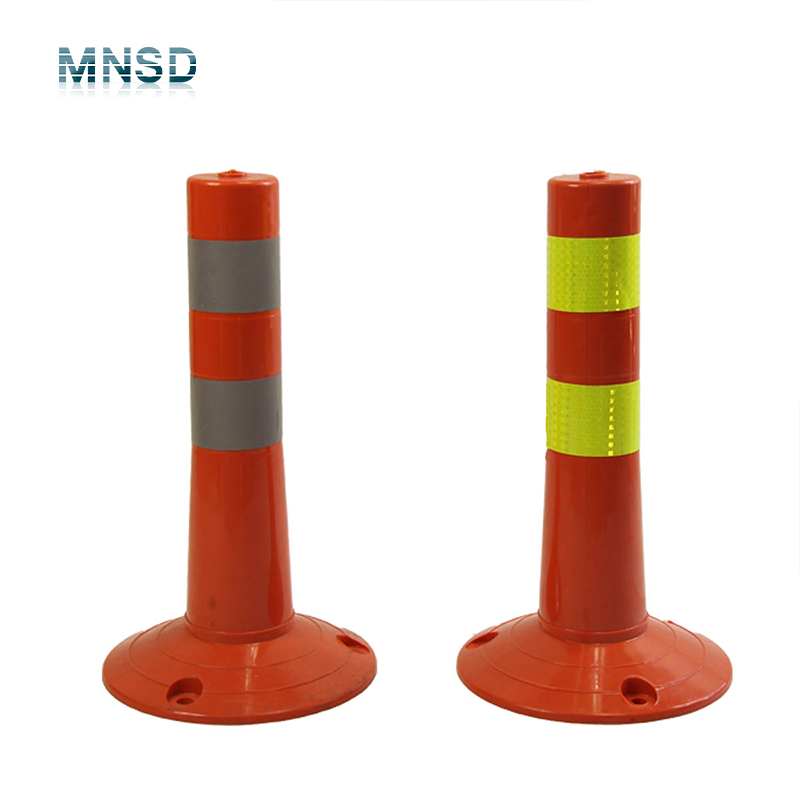
Mnsd produces multiple models—YD-WP45 (450 mm), YD-WPS75 (750 mm), and YD-PE50 (500 mm with Ø260 mm rubber base)—all categorized as Flexible Safety Plastic warning posts. They are also known as Traffic road safety warning posts, PU traffic warning posts, 75cm Plastic warning posts, Warning Spring Posts with rubber base, Rubber Base Traffic Delineator Posts, PE Bollards Warning Posts, Unbreakable Reflective Bollards, Traffic Delineator Warning Columns, and Traffic Flexible Car Parking Guide Bollards.
Key specifications across models include:
- Material: High-Elasticity Polyurethane (PU) or Heavy-duty PE; base made of recycled rubber or integrated plastic.
- Temperature resistance: -40°C to +70°C, with UV-stabilized coating ensuring colorfastness for over 3 years (5+ years in special scenarios).
- Reflectivity: High-Intensity Prismatic (HIP) / Class 1 reflective tape (250 mm width), visibility distance over 200 meters.
- Physical performance: 360° flexibility, impact resistant, rapid self-recovery after crushing, tensile strength 15.0 MPa, elongation at break 400%, hardness 80–85 Shore A.
- Installation: Expansion bolt fixing with 3 or 4 holes; top ring for chain attachment.
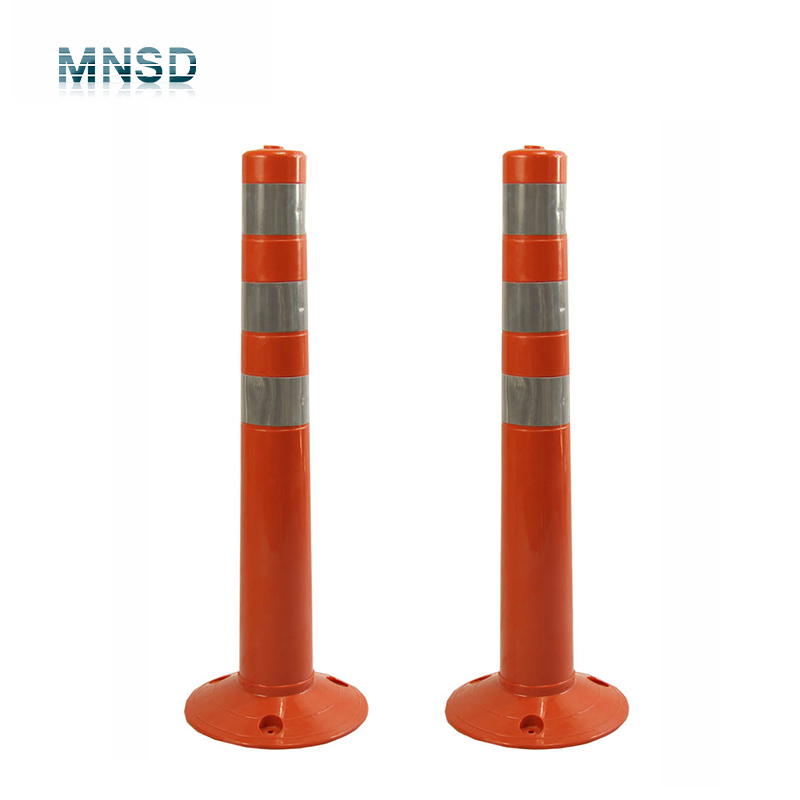
Technical Explanation: How Flexibility and Reflectivity Work Together
The YD-WP45 warning post (450 × 80 × 200 mm) and YD-WPS75 (750 × 80 × 200 mm) are built from high-elasticity polyurethane that deforms under load and rebounds to its original shape. The 360° flexible structure allows the post to be crushed by a vehicle and instantly snap back, eliminating permanent damage. The reflective sleeves—available in double or triple layers of class 1 prismatic grade—ensure visibility from 200+ meters in low-light conditions. The rubber base (or integrated plastic base) absorbs ground-level shocks and provides a stable anchor via expansion bolts. This design reduces replacement frequency in high-impact areas such as loading docks, bus terminals, and construction zones.
Application & Use-Case Scenarios
Mnsd warning posts are deployed in lane separation on high-speed expressways, highway ramps, T-junctions, urban sidewalk protection, and multi-level parking lot entrances. In a documented scenario for the United Arab Emirates, these posts are used for Traffic Channelization, Median Delineation & Pedestrian-Vehicle Segregation projects. Special requirements for that application include 360° full-recovery impact resistance (Memory-springback), UV-stabilized for 5+ years color fastness, Class 2/Grade A high-intensity reflectivity, and an operating temperature range of -40°C to +70°C. Installation is permanent via surface-mounted or bolt-down fixing, paired with high-visibility reflective sleeves (honeycomb pattern), M10/M12 heavy-duty expansion anchors, and optional epoxy adhesive for base reinforcement.
Additional suitable environments include airports, seaports, railway stations, schools, hospitals, commercial complexes, residential areas, municipal engineering, and logistics centers—wherever clear visual guidance, lane definition, unauthorized entry prevention, and impact damage mitigation are required.
Market Trend Analysis
The global demand for road safety equipment continues to rise, driven by urbanization and infrastructure expansion. Mnsd, with an annual production capacity of 120,000,000 units, exports to Asia, Europe, and the USA, with export sales accounting for 50% of total revenue. The company’s R&D team of 15 engineers focuses on improving material elasticity, reflectivity standards, and weather resistance—trends that align with procurement preferences for low-maintenance, long-life delineators. The shift from rigid posts to flexible, self-recovering designs is particularly evident in high-traffic municipal projects and logistics hubs where downtime for repairs is costly.
Comparison with Traditional Solutions
Concrete bollards and steel posts provide permanent physical barriers but suffer from one major limitation: they are not impact-resilient. A single collision can damage the post and the vehicle, requiring full replacement and increasing operational costs. Flexible warning posts from Mnsd absorb the impact and spring back, preserving both the post and the vehicle. However, one honest limitation: flexible posts do not offer the same absolute physical restriction as rigid barriers; they are best suited for guidance, delineation, and light vehicle-traffic separation rather than high-security perimeters.
Future Outlook
As smart city initiatives expand, Mnsd’s warning posts can be integrated with sensor-based traffic management systems. The use of recycled rubber bases already supports sustainability goals. With ongoing improvements in UV resistance and reflective technology, these posts will maintain high effectiveness for longer periods, further reducing lifecycle costs for operators.
Frequently Asked Questions
What is a flexible warning post?
A flexible warning post is a traffic delineator made of high-elasticity polyurethane or heavy-duty PE, designed to return to its original shape after being struck by a vehicle. Mnsd models include YD-WP45, YD-WPS75, and YD-PE50.
How is the warning post installed?
Installation is by expansion bolt fixing with 3 or 4 holes. The top design includes a ring for chain attachment, and optional epoxy adhesive can reinforce the base for permanent applications.
What is the visibility distance and reflective grade?
The posts offer visibility over 200 meters, using High-Intensity Prismatic (HIP) / Class 1 reflective tape, with double or triple sleeves.
What temperature range can it withstand?
The operating temperature range is -40°C to +70°C, making them suitable for extreme climates.
Is the product certified?
The warning post manufacturer holds a Business License certification covering all items within the warning post business.
Can I get a custom design (OEM/ODM)?
Mnsd offers OEM and ODM customization services. Contact their team for specific requirements.
For a comprehensive overview of Mnsd’s product portfolio and manufacturing capabilities, download the company brochure: Mnsd Brochure (PDF).
Contact Mnsd at info@mnsdtraffic.com or +86 18458137305 for inquiries, quotations, and customized solutions.