
Flexo vs Gravure Printing on PP Woven Bags: Buyer Comparison
Flexo vs Gravure Printing on PP Woven Bags: Buyer Comparison
For buyers sourcing PP woven bags, flexographic and gravure printing are not interchangeable labels on a quotation. They are different production routes with different artwork requirements, setup economics, proofing routines, and fit with lamination and bag-making. The useful question is not which method sounds more premium, but which method matches the order pattern, the printed surface, and the filling and retail channel the bag must serve.
A PP woven bag, short for polypropylene woven bag, is a lightweight but strong packaging container made by weaving polypropylene tapes. Its crisscross woven structure provides tensile strength for bulk goods, and the bag can be further printed, laminated, lined, valved, or sewn depending on the application. Printing is one part of that system. It can improve identification, shelf presentation, and brand recognition, but it does not by itself define load capacity, moisture protection, or filling-line compatibility.
Wenzhou BaiChuan Plastic Industry Co., Ltd. is a Wenzhou-based manufacturer of PP woven bags, color-printed valve bags, and paper-plastic composite bags. Its production covers yarn drawing, circular weaving, laminating, color printing, and finished bag making. That full-chain scope matters in a flexo versus gravure discussion because print quality, lamination, and bag construction are linked decisions rather than separate purchases.
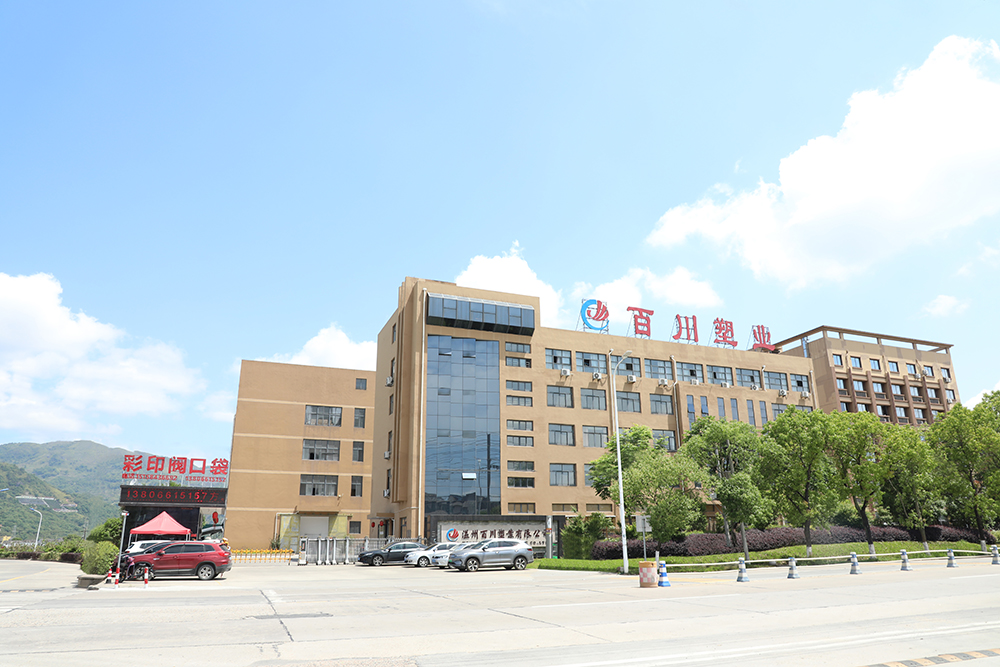
Industry scene: exterior view of a PP woven bag manufacturing facility in Wenzhou, Zhejiang. Image source: Wenzhou BaiChuan Plastic Industry Co., Ltd.
Why the Printing Choice Becomes a Procurement Question
In PP woven bag procurement, printing is often discussed too late. Buyers first confirm bag type, dimensions, load requirement, liner, and valve structure, then ask for artwork and price. That sequence can create avoidable rework, because the print method affects plate or cylinder preparation, proofing, color control, and the way a laminated or unlined surface will look after bag conversion.
The opportunity is to treat printing as part of the bag specification. A custom printed PP woven bag is not only a fabric sack with ink on it. It is a combined product in which fabric weight, tape strength, lamination, printing surface, seam or valve construction, and artwork all interact. A buyer comparing suppliers should ask how the printed surface will be produced, how the artwork will be proofed, and whether the chosen print route is stable for the expected order pattern.
This is especially relevant for BOPP laminated PP woven bags. BOPP lamination improves waterproof performance, makes printing clearer, gives the surface a more upscale appearance, and reduces dust adhesion. It also raises cost compared with an unlaminated bag. The print method and the lamination decision therefore need to be evaluated together, not as unrelated line items.
What Flexographic Printing Is Good At
Flexographic printing, commonly called flexo, uses flexible relief plates. Ink is applied to the raised areas of the plate and transferred to the substrate in a roll-to-roll process. In PP woven bag production, flexo can be used for suitable printed surfaces and for artwork that suits spot colors, bold graphics, and practical brand identification.
The buyer-relevant strengths of flexo are generally described in the industry in terms of setup flexibility and shorter-run practicality. Plate preparation usually has a lower fixed entry point than gravure cylinder engraving, and job changes can be more manageable when designs rotate. For buyers placing moderate order quantities, testing a new design, or running several packaging SKUs, that flexibility can matter more than the finest possible detail.
Flexo also fits many bags where the printed message is functional: product name, weight, handling instructions, warning text, and brand color blocks. When the artwork is built around clear hierarchy rather than photographic subtlety, flexo can be a practical route for custom printed PP woven bags. The limitation is that very fine reverse text, smooth gradients, and high-detail images require tighter registration and more careful proofing.
What Gravure Printing Is Good At
Gravure printing uses engraved metal cylinders. The image is cut into recessed cells on the cylinder; ink fills the cells, excess ink is removed, and the ink is transferred to the substrate. Because the cylinder is job-specific, gravure carries a higher fixed preparation step, but it is generally associated with consistent long-run reproduction and strong control of fine detail and color depth.
For PP woven bags, gravure is often discussed in the context of BOPP film printing that is later laminated to woven fabric. The smoother film surface allows detailed graphics, photographic images, and the visual finish that brand owners may want for retail rice bags, fertilizer bags, or premium-looking feed and chemical packaging. The trade-off is economic: cylinder engraving and changeover make gravure less attractive when designs change often or when the order is too small to absorb the fixed preparation.
Gravure should not be treated as automatically superior for every bag. If the artwork is simple, the order is repeated in modest volumes, or the buyer expects frequent promotional changes, the fixed cylinder cost can outweigh the print-quality benefit. The right choice depends on how long the design will run and how much visual detail the bag actually needs.
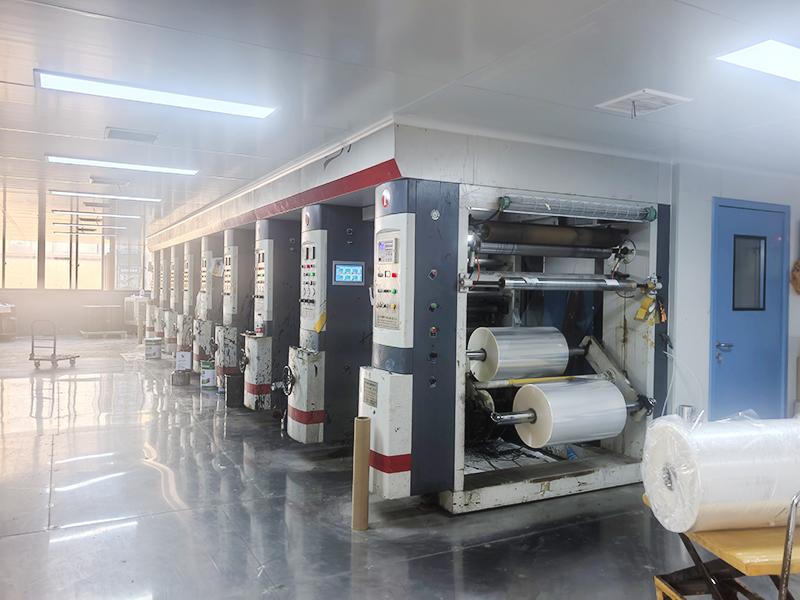
Color printing workshop at Wenzhou BaiChuan Plastic Industry Co., Ltd. Printing is coordinated with lamination and bag making in the same production chain.
Flexo vs Gravure: Buyer Comparison Table
| Decision dimension | Flexographic printing | Gravure printing | What the buyer should confirm |
|---|---|---|---|
| Artwork detail | Good for bold graphics, clear text, and practical brand layouts; fine detail requires tighter registration and proofing. | Generally strong for fine detail, smooth images, and consistent long-run color reproduction. | Ask for a printed proof on the intended surface, not only a digital artwork preview. |
| Setup and job change | Flexible plates usually make design changes and shorter runs more manageable. | Engraved cylinders add fixed preparation and are better suited to stable, repeated designs. | Confirm how often the artwork is expected to change during the order period. |
| Short versus long runs | Often a practical route when order quantities are moderate or the buyer is testing a new design. | Usually more economical when the same design runs in large, repeat volumes that can absorb cylinder cost. | Compare total print cost, not only the per-bag printing line. |
| Color consistency | Depends on plate quality, ink control, registration, and converter discipline. | Cylinder repeatability supports consistency across long runs. | Ask how color approval is handled and what happens if a reprint is needed. |
| Surface and lamination | Can be used on suitable woven or film surfaces depending on construction. | Often associated with BOPP film printing before lamination to woven fabric. | Confirm whether the bag is unlaminated, BOPP laminated, or paper-plastic composite. |
| Cost structure | Lower fixed preparation is typical, but plate count and artwork complexity still affect cost. | Higher fixed cylinder preparation is typical, with economics improving on long repeats. | Request a cost breakdown that separates fabric, lamination, printing, liner, valve, and packing. |
| Best-fit order pattern | Frequent design changes, moderate volumes, practical brand graphics, and trial orders. | Stable designs, long repeat runs, detailed graphics, and consistent shelf presentation. | Match the print route to the actual SKU plan and forecast, not to a one-off sample. |
How Printing Interacts With PP Woven Bag Construction
The PP woven bag supply chain starts with polypropylene pellets extruded into thin flat tapes. These tapes are interlaced by circular weaving machines to form woven fabric. The fabric is then cut, printed, and sewn or heat-sealed into bags. In a full-chain operation, printing is not isolated from fabric quality; tape thickness, fabric consistency, lamination, and seam or valve construction all affect the final printed bag.
BOPP lamination changes the print surface. The film provides a smoother face for printing, improves waterproof performance, and reduces dust adhesion. That is why BOPP laminated PP woven bags are often chosen when the bag must carry a clear brand image as well as bulk contents. The buyer should still confirm the liner, valve, and bag dimensions, because a good print surface does not replace moisture protection or filling-line compatibility.
Wenzhou BaiChuan Plastic Industry Co., Ltd. operates a production chain covering yarn drawing, circular weaving, laminating, color printing, and finished bag making. The company reports more than 100 sets of production machines, including imported hot-valve sealing equipment, and a plant area of more than 20,000 square meters. It also holds ISO 9001:2008 certificate number 10114Q17152R0S, issued by Beijing Zhonglian Tianrun Certification Center (ZLTR), valid from 2026-03-11 to 2029-03-10. The certificate scope covers manufacture and sale of plastic drainage boards, plastic corrugated pipes, and plastic packaging bags, and the company states that the certificate is IAF MLA recognized and accepted in South America, Southeast Asia, Pakistan, Europe, and most global markets.
For buyers evaluating print suppliers, those facts are relevant because they show where printing sits in the production chain. They do not prove that every artwork will print identically, and they do not replace a pre-production sample. They do show that printing, lamination, and bag making can be coordinated within one manufacturing scope, which can reduce hand-off risk between separate printers and bag converters.
Application Scenarios: Where Print Method Choice Matters
PP woven bags are used for rice, fertilizer, chemical powder, construction materials, feed, and other bulk goods. The print method should be chosen after the application is clear, because the same bag format can require different surfaces and different visual priorities.
Rice and grain packaging
For rice, PP woven bags are highly recommended. Color-printed woven sacks with handles are convenient for retail sales, while block bottom valve bags work well for palletized bulk shipment. Custom sizes and printing are available. Where tight sealing and insect resistance are the priority, PE packaging bags may be the first choice. For better cost performance, PP woven bags laminated with BOPP film, non-woven fabric, or paper-like film can deliver a higher visual presentation at a competitive cost. In this segment, gravure may be considered when the design needs detailed retail graphics over a stable long run; flexo may fit shorter promotional runs or simpler brand layouts.
Fertilizer packaging
Fertilizer bags often need clear product identification, moisture protection, and reliable seam or valve performance. BOPP lamination can improve water resistance and print clarity, but it adds cost. The buyer should confirm the liner and closing structure before approving the print method. A highly detailed print does not compensate for a weak seam or an unsuitable liner.
Chemical powder packaging
Chemical powder packaging places more emphasis on dust control, filling method, and compatibility with the destination market. Printing must remain legible for handling and identification, but the bag construction should be confirmed according to particle size, density, flowability, dust control, sun protection, moisture protection, bag-mouth design, and destination-market regulations. In this setting, the print method is secondary to the full packaging specification.
Construction materials and feed
Cement woven bags, building material bags, and feed packaging bags often combine load-bearing needs with brand identification. Flexo can handle practical brand blocks and handling text; gravure may be selected when the artwork is detailed and the design will remain unchanged across a long production period. In both cases, the buyer should compare the printed sample against the actual fabric, lamination, and bag construction.
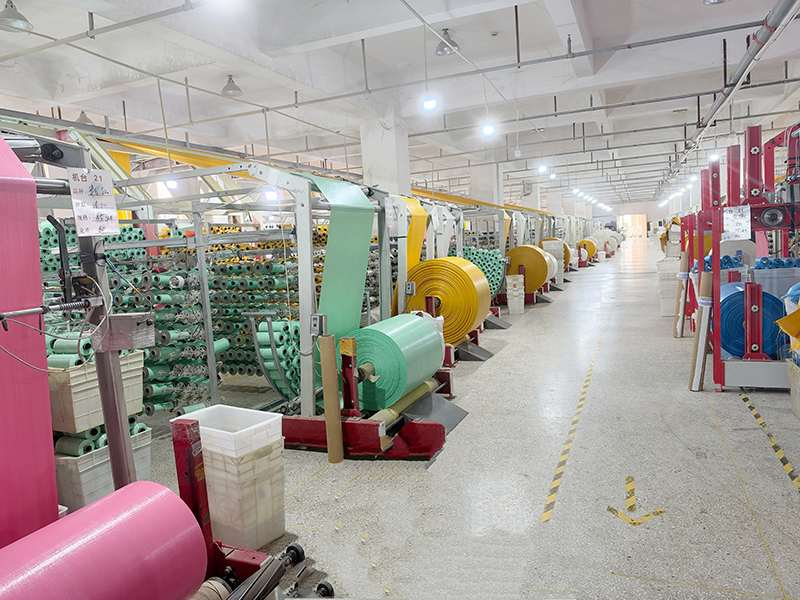
Polypropylene woven braided wire workshop at Wenzhou BaiChuan Plastic Industry Co., Ltd. Fabric consistency is part of the printed bag quality chain.
Customization and Order Planning
Wenzhou BaiChuan Plastic Industry Co., Ltd. provides OEM and ODM services for PP woven bags and related composite packaging bags, including customization and export support. Customization covers bag style, dimensions, colors, printing, valve or closing structure, lamination, and liner options, all to be confirmed per order. The company reports a monthly production capacity of 7,500,000 PP woven bags, a minimum order quantity of 3,000 bags, and a lead time of 15 to 45 days.
The customization process is straightforward but should be followed in sequence. The buyer submits specifications such as bag type, dimension, capacity, material, printing, and order quantity; sends the design or logo; receives a quotation and confirms the printing artwork; approves the pre-production sample; then moves to mass production, quality inspection, packing, and shipment. For printing artwork, vector files such as AI, PDF, and CDR are preferred for clear output. The buyer should confirm bag type, size, load capacity, material, printing design, liner requirement, and order quantity before the artwork is finalized.
Sampling is part of the print decision. Blank simple samples are free, while custom printed samples incur a sample cost. Sample freight is normally at the buyer side, and the sample charge can be refundable when the bulk order reaches the MOQ. A printed sample should be checked for color, registration, surface appearance, and legibility on the actual substrate, not only on a screen.
Quality Control and After-Sales Boundaries
Print quality cannot be separated from bag quality. Wenzhou BaiChuan Plastic Industry Co., Ltd. states that strict raw material inspection, in-process monitoring, and finished-product testing are carried out for every batch of goods to support stability, waterproof and moisture resistance, leak-proof performance, and compliance with export standards. The company also states that its bags are shipped to South America, Pakistan, Southeast Asia, and other export markets, and that it provides one-stop service covering packaging design, sample confirmation, production, logistics, and after-sales support, with 18-hour online customer support for overseas inquiries.
After-sales terms also define a boundary. If bag damage is caused by quality issues, the sales team will visit the customer factory on-site to provide solutions, and bags that cannot be resolved are subject to a deduction in payment. That is a quality-response mechanism, not a substitute for correct loading, handling, and storage. Buyers should keep batch marks and clear photos of damaged areas, separate defective bags from qualified stock, and send evidence for evaluation.
Market Trend Signals for Printed PP Woven Bags
Verified market data referenced for this article shows that global production of PP woven bags exceeded 10 billion units in 2023, while China manufactured more than 7 billion units. The same data indicates that laminated PP woven bags accounted for 54.5% of total global market volume in 2023. That share is relevant to the flexo versus gravure question because lamination creates a different print surface and a different visual expectation from an unlaminated woven bag.
Raw material cost is another signal. Trading Economics data cited in the verified data package put polypropylene at 9,461 CNY per tonne on November 10, 2026, representing a 47.32% year-on-year increase. For buyers, that makes cost transparency important. A quotation should distinguish fabric, lamination, printing, liner, valve, packing, and freight so that a change in print method or lamination can be evaluated on its own. Resin-price movement also supports the use of clear price-adjustment terms in long-run contracts, rather than treating the bag price as a single fixed number.
Comparison With Traditional Print Routes: Limits and Trade-Offs
Flexo and gravure are both established print routes, and each has a real boundary. Gravure is not the default for every PP woven bag order. Cylinder engraving adds fixed cost and preparation time, so it is less suitable for small orders, frequent artwork changes, or test launches that may not repeat. Flexo is not automatically cheaper for every job either. Complex artwork, high ink coverage, and tight registration can require more plates and more careful proofing, which affects both cost and lead time.
The more important limit is that printing cannot fix a weak bag. Cracks or splits on the woven body may result from insufficient tensile strength of the PP raw material, too-thin woven tape, or sharp goods piercing the fabric. Seam bursts may relate to poor stitching density, improper thread material, or overloading beyond the bag rated weight capacity. Surface holes or scratches may come from friction with sharp edges. A buyer should not approve a detailed print and overlook fabric, seam, liner, or valve performance.
Storage is another boundary. PP woven bags can be stored in a cool place for up to 2 to 5 years. If exposed to direct sunlight, they may deteriorate within a few months or even weeks, unless PE woven bags are used, which have high UV resistance and can last for 2 years under direct sunlight. The working condition guidance also states continuous working temperature of -10°C to 50°C, short-time peak temperature up to 50°C without heavy load, dry and ventilated warehouse storage, a UV-stabilized version for outdoor storage, and keeping the bags away from open flame and strong corrosive chemicals. Bags without liner or coating are not suitable for long soaking in water.
For BaiChuan, the practical limit is confirmation. The company offers customization of printing, lamination, valve or closing structure, and liner options, but the exact configuration is to be confirmed per order. A buyer should not assume that one approved printed sample automatically covers a different fabric, liner, valve, or filling line.
Future Outlook
The direction for PP woven bag buyers is toward more explicit specification. As laminated formats hold a large share of market volume, printing is increasingly evaluated together with surface finish, moisture protection, and retail presentation. At the same time, resin-price volatility makes it harder to compare suppliers on a single bag price. Buyers are likely to ask for clearer cost breakdowns and more disciplined artwork approval.
For flexo and gravure, the future is not a simple replacement story. Flexo will remain relevant where design changes, moderate volumes, and practical brand graphics matter. Gravure will remain relevant where long repeat runs and detailed graphics justify cylinder preparation. The better procurement practice is to match the print route to the SKU plan, the lamination choice, and the filling line, then validate the decision with a pre-production sample.
FAQ
What products are PP woven bags suitable for?
PP woven bags can be used for rice, fertilizer, and chemical powder packaging. The specific bag construction, valve, liner, and moisture-protection configuration should be confirmed according to the material, filling equipment, and destination-market requirements.
How to customize woven bags?
The process is: submit specifications such as bag type, dimension, capacity, material, printing, and order quantity; send the design or logo; receive a quotation and confirm the printing artwork; approve the pre-production sample; complete mass production and quality inspection; then pack and ship.
What information do I need to provide for custom woven bags?
You need to confirm bag type, size, load capacity, material, printing design, liner requirement, and order quantity. Custom color printing with your logo, text, and artwork is supported. Vector files such as AI, PDF, and CDR are preferred for clear printing.
Block bottom valve bag vs open-mouth woven bag, which one should I choose?
Block bottom valve bags stand steadily for automatic filling and pallet stacking. Open-mouth bags with handles are easier for manual packing and retail sales. Block bottom valve bags need matching automatic filling equipment, while open-mouth bags are flexible for manual operation and retail scenarios.
What is the advantage of BOPP laminated woven bags over ordinary woven bags?
BOPP lamination improves waterproof performance, makes printing clearer, gives the surface a more upscale appearance, and reduces dust adhesion. Bags with film coating have higher costs, but they are also more aesthetically pleasing and more water-resistant.
How about the bag sample?
Blank simple samples are free, while custom printed samples incur a sample cost. Sample freight is normally at the buyer side. The sample charge can be refundable when the bulk order reaches the MOQ.
How should a buyer choose between flexo and gravure printing?
The decision should match the artwork detail, expected order stability, lamination or surface choice, and proofing requirement. Flexo is generally more practical for shorter runs and frequent design changes. Gravure is generally more suitable for stable long runs where detailed graphics justify cylinder preparation. In both cases, the printed result should be checked on a pre-production sample using the intended fabric, lamination, and bag construction.
Reference resource: Baichuan packaging product catalog (PDF): Baichuan packaging product catalog.
Есть вопросы или нужны дополнительные детали?
Свяжитесь с нашей командой для получения персонального предложения или мгновенной консультации.
Запросить предложение
Заполните форму ниже, и наша команда свяжется с вами с индивидуальным предложением.
Прямой чат WhatsApp
Предпочитаете общаться в реальном времени? Напишите нам в WhatsApp для мгновенной помощи и быстрых ответов.
- Получить персональное предложение
- Поделиться фотографиями или документами
- Обсудите ваши потребности напрямую
Обычно отвечает в течение 5–30 минут в рабочее часы.