
Floating Ball Valve Selection: Certification Constraints
A floating ball valve is a quarter-turn isolation valve in which the ball is carried between two seat rings and is free to shift a short distance downstream under line pressure, so that the line pressure itself presses the ball against the downstream seat to complete the seal. Almost every constraint that appears later in a floating ball valve procurement file - seat material, pressure class, operating torque, actuation interface and the certificates that may legally be attached to the quoted size - follows from that single design decision.
Zhejiang Dico Valve Co., Ltd, which trades as Dico Valve, is a ball valve manufacturer founded in 2015 and located in the Longwan District of Wenzhou, Zhejiang Province, China. The company describes itself as a National High-tech Enterprise and Innovative Small and Medium-sized Enterprise specialising in the research and manufacture of high-end ball valves and complete fluid control solutions. Its range covers floating ball valves, trunnion-mounted ball valves, three-piece ball valves, wafer ball valves, tank bottom valves, pneumatic and electric ball valves and sanitary BA-grade ball valves, with export activity in the EU, North America and South Africa. For a high-quality ball valve enquiry that has moved from research into evaluation, the useful question is no longer which valve looks competitive, but which floating ball valve is documented - by scope, size, pressure class and market - for the line that is about to be built.
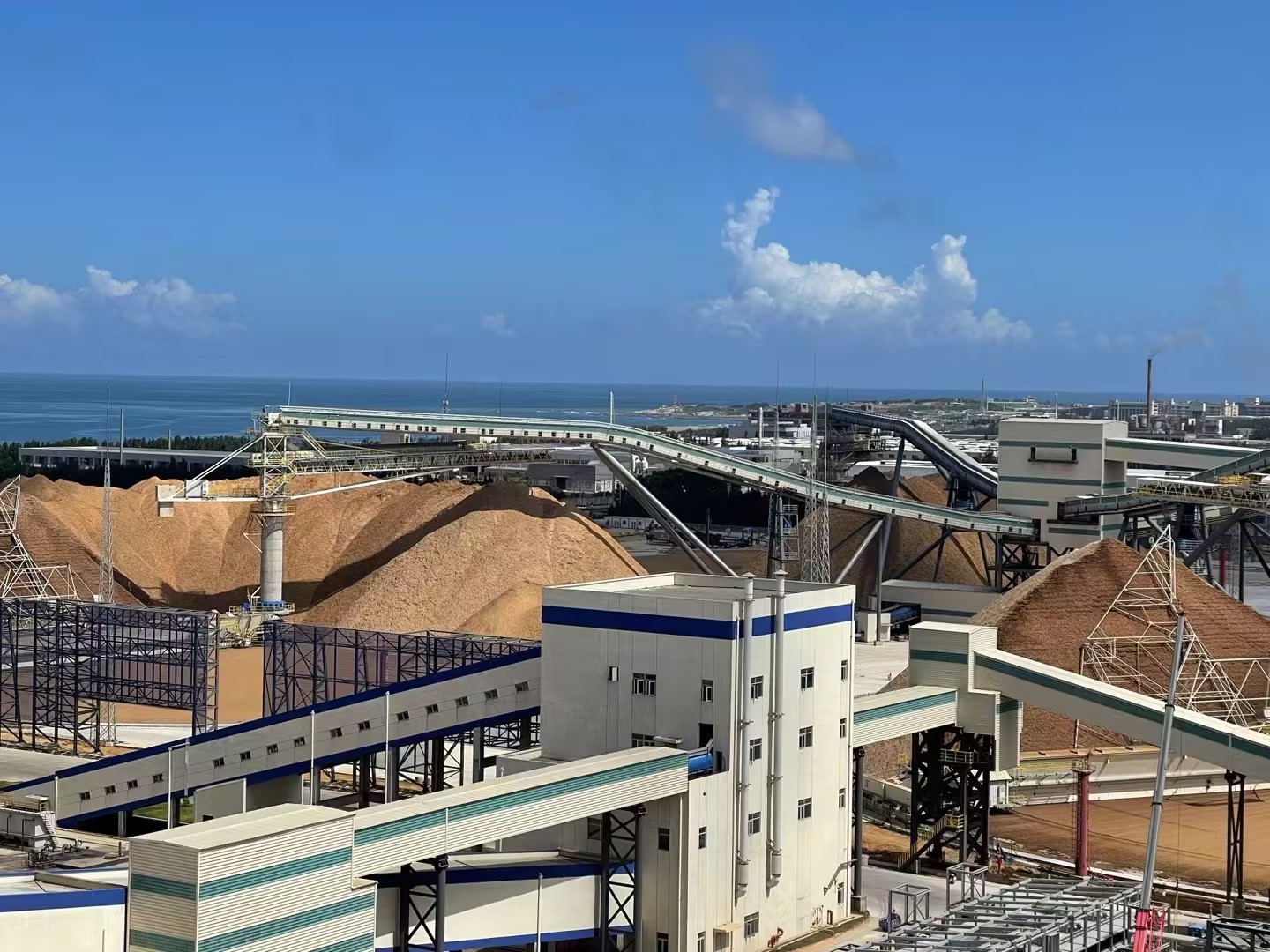
Why Floating Ball Valve Evaluation Turns on Constraints
The gap between a datasheet and a certificate is where most floating ball valve evaluations stall. A certificate is issued against a defined scope - a size, a pressure class, a stem dimension, a material group - not against a product family or a brand name. The ISO 15848-1 qualification held for the Dico Valve floating ball valve range, certificate number 337275, illustrates the point: it names a 2 inch 2000 PSI ball valve, a stem size of 7 to 28 mm and a pressure rating of PN138 and lower. The API STD 607 fire-safe test certificate, number 285697, covers ball valves of size 2 inch and below, plus 2-1/2, 3 and 4 inch sizes, in Class 150 and Class 300, and in austenitic material. A buyer who requests a larger bore at a higher class and assumes identical documentation applies has found a constraint, not a supplier defect.
Pressure and temperature behave the same way in a floating design: they are a pair, not two independent values. The Q41F floating ball valve is documented at 1.0-10.0 MPa and minus 29 degrees Celsius to 425 degrees Celsius, but the upper part of that temperature band is only reachable with a seat material that survives it. In practice, seal selection - not body casting - is the binding constraint on most floating ball valve enquiries.
The Floating Ball Valve Under Review: Documented Boundaries
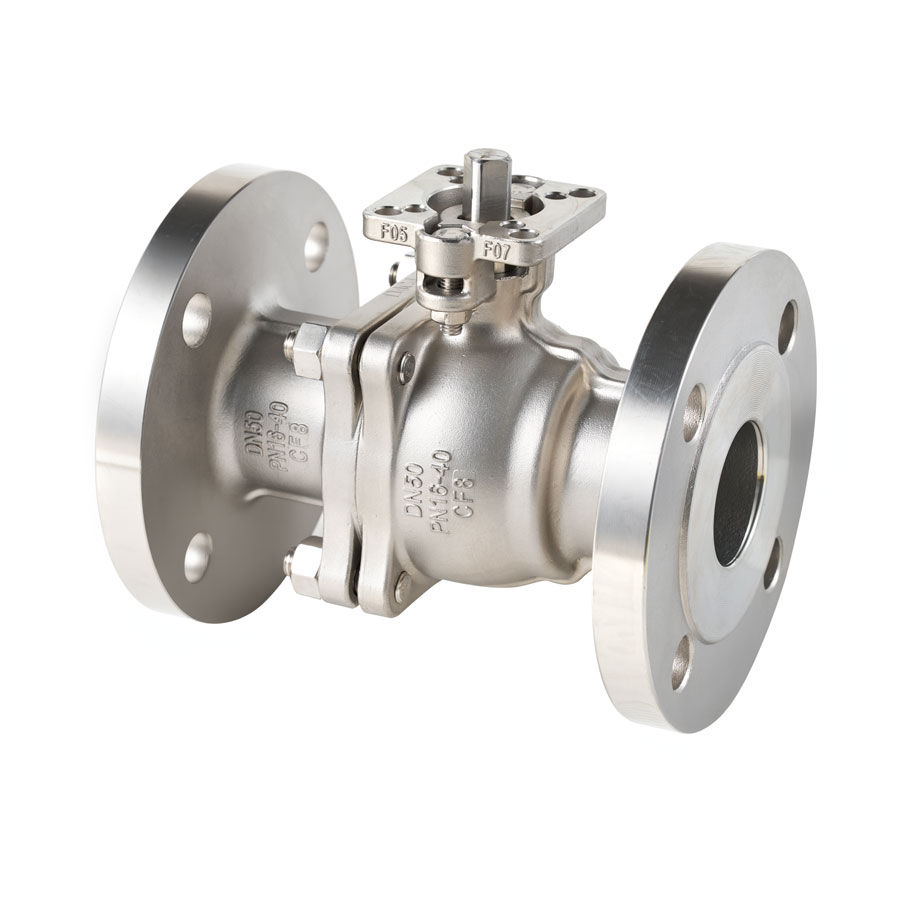
The Q41F floating ball valve is the reference product for this analysis. Its published configuration is summarised below, and every value is a specification the buyer can quote back to the supplier in writing.
| Parameter | Documented value |
|---|---|
| Model | Q41F |
| Product type | Metal-seated ball valve, soft-seated ball valve, ISO 5211 ball valve |
| Connection | Flanged |
| Pressure range | 1.0-10.0 MPa |
| Temperature range | Minus 29 degrees Celsius to 425 degrees Celsius |
| Body materials | Carbon steel, SS304, SS316, dual phase steel, titanium, alloy steel |
| Seat and seal materials | PTFE, PPL, PI, PEEK, Stellite |
| Ball type | Hollow ball or solid ball |
| Actuation interface | ISO 5211 mounting pad |
| Documented industries | Petroleum, pharmaceuticals, water treatment, liquid cooling, metallurgy, chemicals, semiconductors, hydrogen energy, HVAC |
Several design features are documented on the same product record and translate directly into evaluation criteria rather than marketing language. An ISO 5211 mounting pad means the valve can be paired with a pneumatic or electric actuator without an adapter redesign. An anti-static structure addresses static charge build-up in flammable service. Three-layer sealing of the valve stem targets the leak path that most often limits quarter-turn valve performance in service. Ball blanks are sourced with heat-number traceability, which gives the buyer a route to material verification rather than a verbal assurance. Seals are machined from PTFE supplied by Daikin, and the ball is finished by high-precision spherical polishing, which controls the surface condition that the seat must seal against. The body is documented as heavier than the manual series and the flange outer circle is machined and supplied to a thick flange standard.
Certificate Scope: What the Documentation Actually Covers
Dico Valve holds both product certifications and system certifications. The distinction matters during evaluation: product certificates constrain what may be installed in a given service; system certificates constrain how the factory is managed.
| Certificate | Issuing body | Certificate number | Scope | Markets |
|---|---|---|---|---|
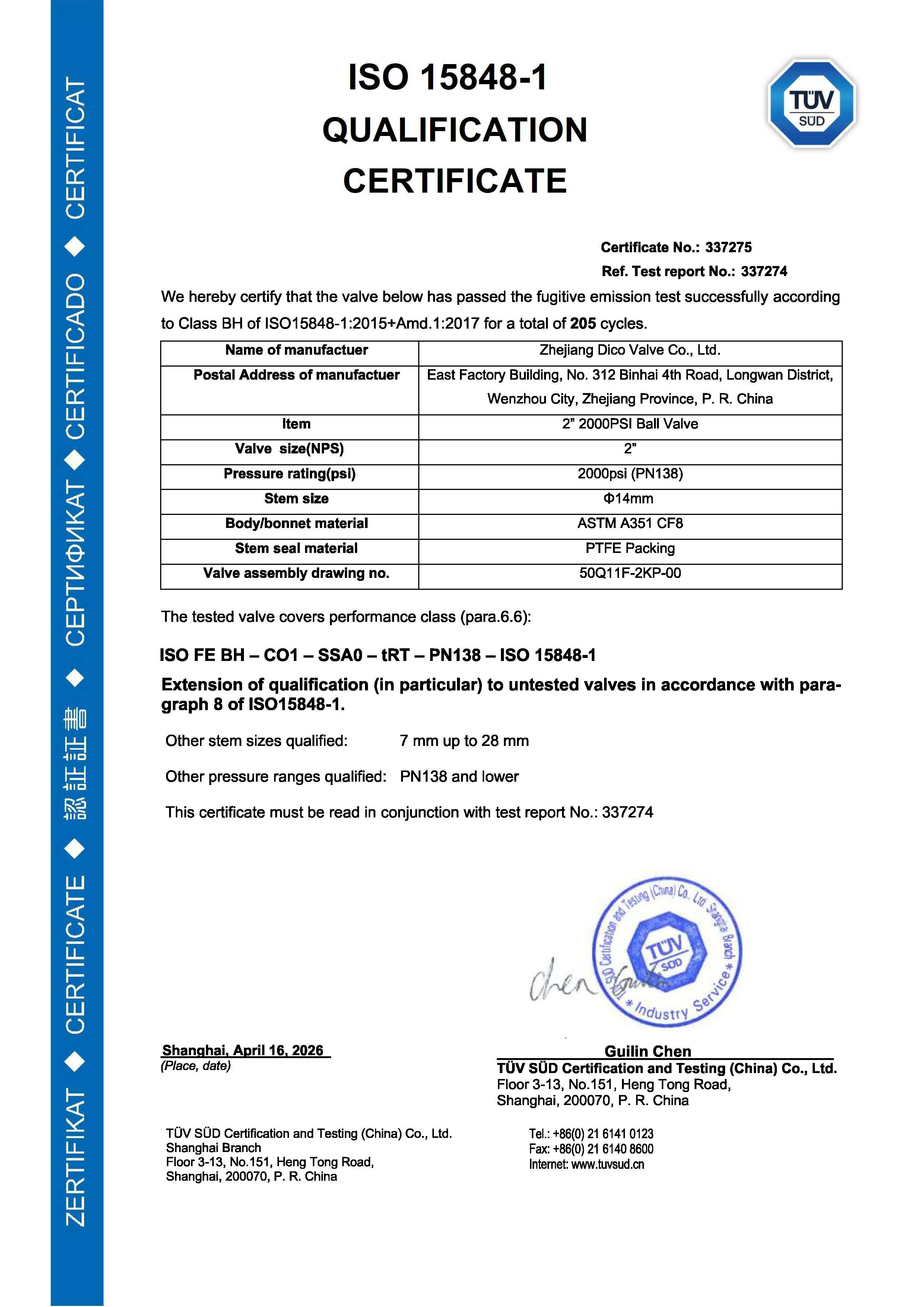
| ISO 15848-1:2015 + Amd.1:2017 (low emission) | TUV | 337275 | 2 inch 2000 PSI ball valve, stem size 7-28 mm, pressure rating PN138 and lower | EU, North America, South Africa, South America |
| API STD 607 fire-safe test certificate | TUV SUD Industrie Service GmbH | 285697 | Ball valves size 2 inch and below; 2-1/2, 3 and 4 inch; Class 150 and Class 300; austenitic material | EU, North America, South Africa |
| PED CE verification certificate | Ente Certificazione Macchine Srl (ECM) | 6L241216.XSVWQ18 | Industrial valve, DN 400 mm and below, PN 13.0 MPa and below; EN 12266:2012; PED Directive 2014/68/EU | EU |
| Functional safety certificate (IEC 61508:2010 Parts 1-7) | ECM | 6L241216.ZDVWQ00 | Industrial valve, DN 400 mm and below, PN 13.0 MPa and below, SIL3 capable | EU, North America, South Africa, South America |
| ISO 9001:2015 quality management system | Zhejiang QPC Certification Co., Ltd. | 20225Q20008R0M | Production and sales of metal valves within the scope of qualification permission | EU, North America, South Africa, South America |
| ISO 14001:2015 environmental management system | Zhejiang QPC Certification Co., Ltd. | 20225E20003R0M | Production, sales and related management activities of metal valves | EU, North America, South Africa, South America |
| ISO 45001:2018 occupational health and safety management system | Zhejiang QPC Certification Co., Ltd. | 20225S20004R0M | Production, sales and related management activities of metal valves | EU, North America, South Africa, South America |
Reading the low-emission certificate correctly
The ISO 15848-1:2015 + Amd.1:2017 qualification was issued on 16 April 2026 by TUV and is listed as applicable to the EU, North America, South Africa and South America markets. Its scope statement is deliberately narrow: a 2 inch 2000 PSI ball valve, a stem size of 7-28 mm, and a pressure rating of PN138 and lower. The related products named on the certificate are the floating ball valve Q41F, the trunnion-mounted ball valve Q47F, the PC ball valve Q11F and the wafer ball valve Q71F. A buyer who needs documented low-emission performance on a size or stem dimension outside that window should treat the requirement as a new qualification question rather than an assumed inheritance.
Fire-safe certification and its material boundary
The API STD 607 fire-safe test certificate, number 285697, is issued by TUV SUD Industrie Service GmbH and remains valid until 23 March 2027. Its scope covers ball valves of size 2 inch and below, plus 2-1/2, 3 and 4 inch sizes, in Class 150 and Class 300, and specifies austenitic material. In valve design terms, the body carries an internal fireproof groove structure. The material clause is the practical constraint: a project that specifies a carbon steel body falls outside the austenitic wording of the certificate, even where the size and class fall inside it.
EU market access
The PED CE verification certificate, number 6L241216.XSVWQ18, is issued by Ente Certificazione Macchine Srl (ECM) and applies to the EU market. It references EN 12266:2012 and PED Directive 2014/68/EU, covers industrial valves of DN 400 mm and below at PN 13.0 MPa and below, and remains valid until 15 December 2029.
Functional safety
The functional safety certificate, number 6L241216.ZDVWQ00, is issued by ECM against IEC 61508:2010 Parts 1-7, applies to industrial valves of DN 400 mm and below at PN 13.0 MPa and below, and is documented as SIL3 capable. It is valid until 15 December 2029 and covers the EU, North America, South Africa and South America markets. For floating ball valves used in safety-instrumented loops, this is normally the document that decides whether the valve may be included in the loop at all.
Management system certifications
The three system certifications - ISO 9001:2015 (20225Q20008R0M), ISO 14001:2015 (20225E20003R0M) and ISO 45001:2018 (20225S20004R0M) - were issued by Zhejiang QPC Certification Co., Ltd. on 3 January 2025 and are valid to 2 January 2028. They cover production and sales of metal valves within the scope of the qualification permission, and the environmental and safety certificates additionally cover related management activities.
Seat Selection: The Four Dimensions That Fix the Boundary
Seat material is the single decision that most often determines whether a floating ball valve is correct for a service. The selection is normally resolved by moving through four dimensions in sequence - temperature, medium, pressure and corrosion - and narrowing the options at each step rather than judging on one dimension alone.
Soft-seated constructions using PTFE, PPL, PI or PEEK are appropriate where the medium is clean and zero leakage is required, where the operating temperature stays within the material limits, where pressure remains at medium-to-low class, where frequent opening and closing makes low operating torque valuable, and where the medium is highly corrosive but chemically compatible with PTFE or FKM. PEEK sets the practical upper temperature limit for soft seating at approximately 260 degrees Celsius, and creep accelerates in PTFE above 200 degrees Celsius.
Metal-seated constructions using Stellite address the cases where a soft seat would fail early: particulate-laden media, fibrous media and high-temperature steam service. Two further constraints are worth recording in the evaluation file. Pure PTFE experiences cold flow under high pressure, so for large-diameter, high-differential applications the opening and closing torque must be assessed and a fixed-ball structure selected if the assessment requires it. Glass-fibre reinforced PTFE is not resistant to hydrofluoric acid or strong alkalis, so elastomer selection must follow a chemical compatibility table rather than supplier experience.
Where a Floating Ball Valve Fits, and Where It Does Not
In a floating design the ball is supported by the seats, so line pressure loads the downstream seat directly. That is the source of the design's economy and also of its boundary: as bore size and differential pressure increase, seat loading and operating torque increase with them. The Q41F is documented across 1.0-10.0 MPa and DN sizes within the flanged range, which covers a large share of small and medium bore isolation duty in petroleum, chemical, pharmaceutical, water treatment, liquid cooling, metallurgy, semiconductor, hydrogen and HVAC service.
Beyond that boundary, a trunnion-mounted ball valve - in which the ball is mechanically supported rather than carried by the seats - becomes the correct specification rather than an upgrade. The honest statement of the limit is this: a floating ball valve is not the right answer for every isolation point, and a supplier that manufactures both designs should document the crossover point in the datasheet instead of leaving the choice to quotation. Dico Valve manufactures the Q47F trunnion-mounted ball valve alongside the Q41F, both documented across 1.0-10.0 MPa and minus 29 to 425 degrees Celsius with flanged connections.
A second boundary is documentary rather than mechanical. The fire-safe and low-emission certificates held for this range are scoped to specific sizes, classes, stem dimensions and material groups. Buyers should verify scope rather than assume it.
Application Evidence: Power Generation and Chemical Service
The documented application profile for these ball valves concentrates on power generation and the chemical industry, with weakly corrosive, high-pressure gas as the typical working condition and cut-off duty as the function. Named project types include boiler flue gas, heat treatment furnace and coal-to-olefins service, with pneumatic operation and high pressure resistance as the stated special requirement. The matched equipment is described simply as the pipeline system.
One recorded case covers an ironmaking and metallurgical plant in China, where 1,000 units were applied to boiler water piping with pneumatic automatic control. The recorded duration is one year, and the recorded result is stable operation. For an evaluating buyer, that case is useful for two specific reasons: it places the valve in an automated control loop rather than manual duty, and it places it in boiler water piping, where thermal cycling rather than corrosion typically governs seat behaviour.
Adjacent Service: Liquid Cooling and Sanitary Lines
Data-centre liquid cooling has become a distinct demand segment for small ball valves, and it imposes a different constraint set from process piping. Dico Valve has established a liquid-cooled valve production line specialising in mini ball valves and three-piece clamp ball valves, which the company states are supplied to Huawei data centres. When the selection question is framed for this industry, the documented parameters are medium temperature, pipeline pressure, dimensions and medium type, and the recommended solution is a mini ball valve or a clamp ball valve.
The wider PC ball valve platform, model Q11F, covers sanitary ball valve, mini ball valve, 3-way ball valve, 4-way ball valve, ISO 5211 ball valve, floating ball valve, 3PC Tri-Clamp ball valve and ANSI ball valve categories. It is documented from minus 196 degrees Celsius to 425 degrees Celsius and from 1.0 to 13.0 MPa, with thread, weld, Tri-Clamp, tube and press-fit connections, seal options of PTFE, PPL, PI, PEEK and Stellite, and hollow or solid ball construction. For sanitary and semiconductor work, that combination of connection range and temperature span is the part of the constraint set that decides feasibility.
Floating Ball Valve Compared With Trunnion-Mounted and Threaded Gate Designs
| Dimension | Floating ball valve Q41F | Trunnion-mounted ball valve Q47F | Threaded gate valve Z11W |
|---|---|---|---|
| Sealing principle | Ball floats downstream against the seat under line pressure | Ball mechanically supported; seats loaded independently of the ball | Linear wedge or gate against a metal seat |
| Documented pressure range | 1.0-10.0 MPa | 1.0-10.0 MPa | 1.0-2.5 MPa |
| Documented temperature range | Minus 29 to 425 degrees Celsius | Minus 29 to 425 degrees Celsius | Minus 29 to 425 degrees Celsius |
| Connection | Flanged | Flanged | Threaded |
| Materials | Carbon steel, SS304, SS316, dual phase steel, titanium, alloy steel | Carbon steel, SS304, SS316, dual phase steel, titanium, alloy steel | SS304, SS316 |
| Typical role | Quarter-turn isolation with tight shut-off and easy automation | Isolation at larger bores or higher differential where seat loading must be controlled | Simple isolation on lower-pressure threaded lines |
| Stated boundary | Seat loading and torque rise with bore and differential pressure | Heavier and higher cost than a floating design at the same bore | Pressure range documented only to 2.5 MPa in threaded form |
Two limitations are worth stating plainly. The floating design is not appropriate where bore and differential pressure push seat loading beyond the torque a standard actuator can deliver; the trunnion-mounted design exists for that case, and specifying a floating valve with a larger actuator to compensate is a workaround rather than a solution. Conversely, the threaded gate valve is documented only to 2.5 MPa, so it cannot substitute for either ball valve design at higher pressure even though its temperature range is nominally the same.
How to Verify Constraints Before Ordering
- Match every certificate to the exact size and class in the quotation. For ISO 15848-1 (337275) that means a 2 inch 2000 PSI ball valve, stem size 7-28 mm and PN138 and lower. For API STD 607 (285697) it means 2 inch and below, plus 2-1/2, 3 and 4 inch, in Class 150 and Class 300, in austenitic material.
- Check validity dates against the delivery schedule. The API STD 607 certificate runs to 23 March 2027, the PED CE and functional safety certificates to 15 December 2029, and the three management system certificates to 2 January 2028.
- Confirm market coverage separately from technical scope. The PED CE certificate is an EU instrument, while the ISO 15848-1 and functional safety certificates list the EU, North America, South Africa and South America.
- Confirm the seat and body material combination against the actual medium and temperature, not against the general product temperature range.
- Confirm the actuation interface, since the ISO 5211 mounting pad determines whether a pneumatic or electric actuator can be fitted without redesign.
- Confirm the pressure and temperature pair as a combined condition, because the seal material caps the temperature independently of the body rating.
- Confirm the testing regime applied to the order: a first round of 100 percent testing followed by a second round of random checks.
- Confirm material traceability, including heat-number traceability on ball blanks, so that a later material verification is possible.
Supply, Lead Time and After-Sales Parameters
Production and supply parameters form part of the constraint set for buyers who must commit to a delivery date. Dico Valve documents a monthly capacity of 10,000 units and a lead time of 7 to 45 days, with a minimum order quantity of one unit. The factory operates 48 CNC machines under digital production management, with a 12,000 square metre facility, 80 employees and a seven-engineer R&D team, and invests 10 percent of annual sales revenue in R&D, talent introduction and equipment upgrading. A 2,000 square metre warehouse holds standard product blank inventory, managed under a one-item-one-code system with 98 percent warehouse data accuracy.
Customisation is offered under OEM and ODM arrangements covering appearance, material, logo and mould. After-sales is handled as remote support, with a 12-month warranty under a replacement-only policy for quality issues and a stated commitment to resolve issues within 48 hours. A 20-second high-frequency switching test is documented at 50,000 cycles without leakage. For buyers evaluating continuity of supply, the relevant claims are the inventory system, the documented lead-time band and the warranty terms, all of which can be written into a purchase agreement rather than left as statements on a website.
Market Trends Rewriting the Constraint List
Three shifts are visible in the documentation pattern around this product range rather than in any published forecast. The first is the gradual conversion of low-emission performance from a premium option into a procurement requirement: the fact that an ISO 15848-1 qualification is held for the EU, North America, South Africa and South America markets indicates where buyers are asking for quantified stem-leakage evidence rather than a general statement about tight shut-off. The second is the broadening of the application list beyond petroleum and chemical service into hydrogen energy, semiconductors, pharmaceuticals and data-centre liquid cooling, each of which introduces its own cleanliness, temperature or dimensional constraints on a ball valve. The third is traceability: heat-number traceability on ball blanks and a one-item-one-code warehouse system address the same buyer concern, which is the ability to verify what was actually supplied.
These are supplier-side indicators of demand direction, not market-size statements, and they should be read as such. What they change in practice is the checklist: more certificates to verify, more material combinations to compare, and a stronger need to separate what a certificate covers from what a datasheet claims.
Future Outlook
For floating ball valves, the next phase of competition is likely to be documentary rather than mechanical. Bodies, balls and stems are mature components; the differentiators that appear in evaluation files are scope-accurate certification, material traceability and the ability to substitute an actuator without redesign. Buyers should expect shortlists to be decided by whether a supplier can state, for a specific size and class, which certificate applies, which market it covers and when it expires. Dico Valve's current position - ISO 9001, ISO 14001, ISO 45001, API 6D, CE, SIL, ISO 15848 and API 607 credentials across a range that includes floating, trunnion-mounted, wafer, three-piece and PC ball valves - is a reasonable illustration of how that comparison is now being run. The practical conclusion for a buyer in evaluation is to treat the certificate register as the primary specification document and the datasheet as the secondary one.
FAQ
What certifications does a floating ball valve need for the EU market?
For EU market access, the relevant instrument for this range is the PED CE verification certificate, held under number 6L241216.XSVWQ18, issued by Ente Certificazione Macchine Srl (ECM) and referencing EN 12266:2012 and PED Directive 2014/68/EU. It covers industrial valves of DN 400 mm and below at PN 13.0 MPa and below and is valid until 15 December 2029. Separately, ISO 15848-1 low-emission qualification (certificate 337275, issued by TUV) is listed for the EU alongside North America, South Africa and South America.
Does the ISO 15848-1 certificate cover every floating ball valve size?
No. The scope of certificate 337275 is stated as a 2 inch 2000 PSI ball valve, a stem size of 7-28 mm and a pressure rating of PN138 and lower. The related products named on the certificate are the floating ball valve Q41F, trunnion-mounted ball valve Q47F, PC ball valve Q11F and wafer ball valve Q71F. Sizes or stem dimensions outside that scope are not covered by the same document.
How do I choose between soft-seated and metal-seated floating ball valves?
Soft-seated constructions using PTFE, PPL, PI or PEEK suit clean media requiring zero leakage, operating temperatures within material limits - approximately 260 degrees Celsius at the upper end for PEEK - medium-to-low pressure conditions, frequent operation where low torque matters, and corrosive media compatible with PTFE or FKM. Metal seating with Stellite suits particulate-laden or fibrous media and high-temperature steam service. Pure PTFE cold flows under high pressure, so torque must be assessed for large-diameter or high-differential duty, and glass-fibre reinforced PTFE is not resistant to hydrofluoric acid or strong alkalis.
What pressure and temperature range applies to the Q41F floating ball valve?
The Q41F is documented from 1.0 to 10.0 MPa and from minus 29 degrees Celsius to 425 degrees Celsius, with flanged connections and body material options of carbon steel, SS304, SS316, dual phase steel, titanium or alloy steel. The two values should be treated as a combined condition, because the seat and seal material determines which part of the temperature range is actually usable.
Is fire-safe certification limited by valve size or material?
Yes. The API STD 607 fire-safe test certificate, number 285697, issued by TUV SUD Industrie Service GmbH and valid to 23 March 2027, covers ball valves of size 2 inch and below, plus 2-1/2, 3 and 4 inch sizes, in Class 150 and Class 300, and specifies austenitic material. The valve body design incorporates an internal fireproof groove structure. A carbon steel body specification falls outside the austenitic wording even where size and class fall within scope.
What warranty and after-sales terms apply to these ball valves?
The documented warranty period is 12 months after use, with repair or replacement of parts covered during the warranty period and a replacement-only policy for quality issues. After-sales is handled through remote support with a stated commitment to resolve issues within 48 hours. Buyers should confirm the applicable model selection and operating conditions, since incorrect model selection or special operating conditions are the documented triggers for warranty disputes.
The full product and certification overview for this ball valve range is available in the company brochure: DICO Brief Introduction. Product information is published at dicovalve.com.
Есть вопросы или нужны дополнительные детали?
Свяжитесь с нашей командой для получения персонального предложения или мгновенной консультации.
Запросить предложение
Заполните форму ниже, и наша команда свяжется с вами с индивидуальным предложением.
Прямой чат WhatsApp
Предпочитаете общаться в реальном времени? Напишите нам в WhatsApp для мгновенной помощи и быстрых ответов.
- Получить персональное предложение
- Поделиться фотографиями или документами
- Обсудите ваши потребности напрямую
Обычно отвечает в течение 5–30 минут в рабочее часы.