
Florescence Marine Fenders: Supplier Capability Deep Dive
The global market for marine fenders — covering rubber, foam and composite systems — is projected to reach USD 0.89 billion in 2026, and rubber fenders account for approximately 64.17% of that category. In a market of that size, suppliers are not scarce. Verifiable manufacturing capability is.
Qingdao Florescence Marine Supply Co., Ltd., which trades internationally as Florescence, is a marine rubber manufacturer based in Qingdao, China, established in 1992. This review treats the company as a procurement candidate rather than a marketing proposition: what it manufactures, how far its customization capability reaches, what its certificates actually cover, and where the boundaries of that capability sit.
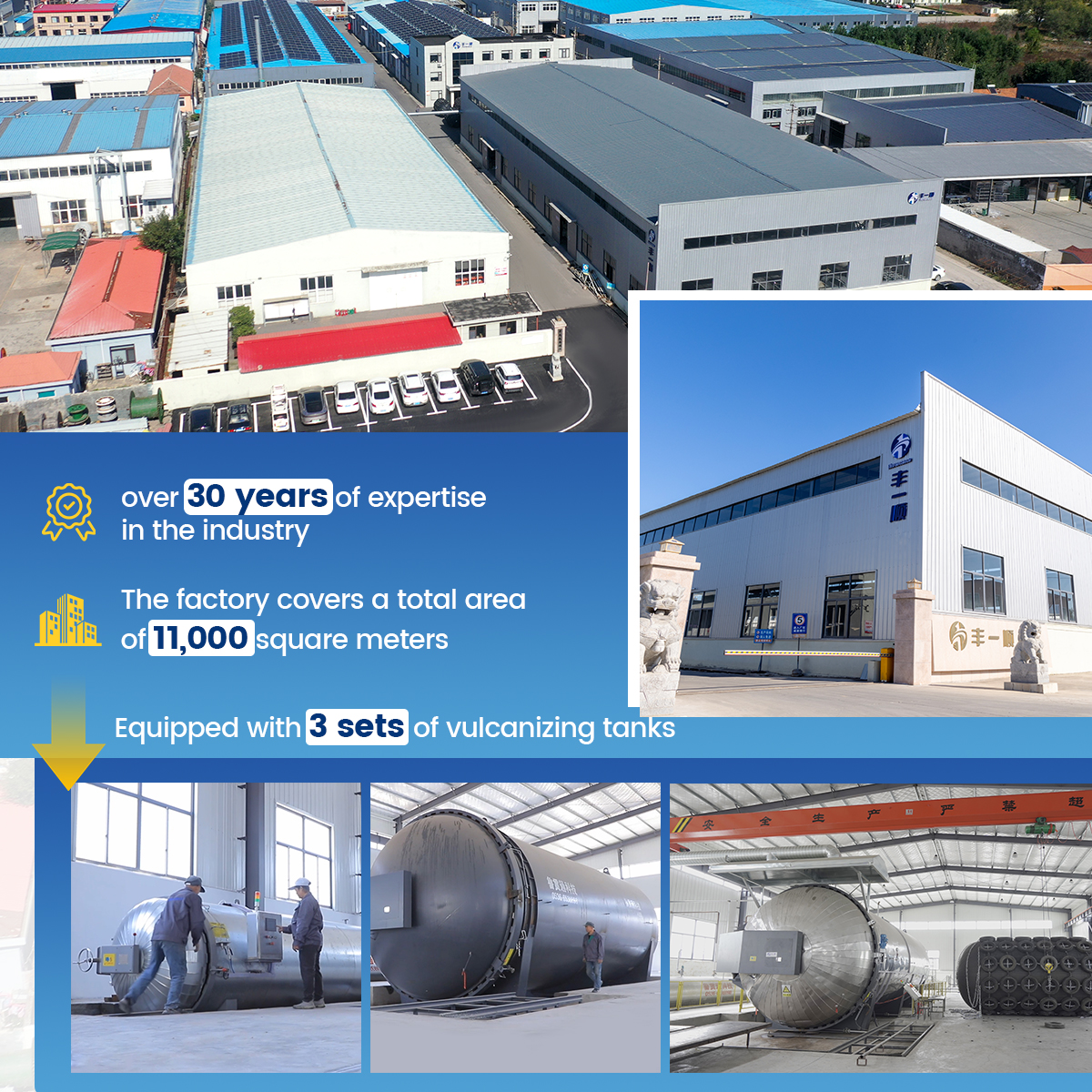
Why Berth Procurement Turns on Capability, Not Catalog Length
Public supplier catalogs in this category converge on nearly identical product families. ESC Marine Systems lists cone, cell, element, arch, cylindrical, square, pneumatic and foam-filled fenders. Tiandun Marine describes cell, cone, arch, D, square, roller and donut fenders. YT Marine positions its range around tugboats, workboats, yachts, docks, shipyards, vessel berthing, quay protection and ship-to-ship transfer.
That overlap is a procurement problem rather than a convenience. A catalog does not reveal whether the entity quoting the project operates the vulcanizing equipment, controls the rubber compound, or can produce a certified test record. Trade classification does not resolve it either: boat or dock fenders of vulcanised non-cellular rubber, whether or not inflatable, fall under a single international code, HS 4016.94 — a customs starting point, not a capability signal.
Three dimensions separate a capable supplier from a merely responsive one:
- Engineering ownership. Can the supplier translate berth conditions, vessel displacement and tidal range into a specified fender system, or does it only supply a standard profile?
- Documented quality control. Are raw-material, dimensional, pressure, hardness and compression tests performed and recorded, and are those records available to the buyer before final payment?
- Scoped certification. Do the classification certificates reference the exact product type and model being purchased?
Florescence’s procurement relevance rests on how it answers those three questions.
Company Profile: What Florescence Is
Qingdao Florescence Marine Supply Co., Ltd. is a manufacturer specializing in pneumatic rubber fenders, ship and dock rubber fenders, ship launching airbags and salvage airbags. The company was established in 1992, giving it more than three decades in the marine industry, with stated expertise in product design, manufacturing, quality control and marine project support.
- Product scope: pneumatic rubber fenders, various dock fenders, ship fenders, foam fenders, and ship launching and salvage rubber airbags.
- Facility footprint: a 40,000 m² manufacturing site.
- Export orientation: approximately 95% of output is exported.
- Markets served: Southeast Asia, South America, Europe, North America, the Middle East and Africa.
- Workforce: 120 employees, including a 25-engineer R&D team.
- Annual output: approximately 2,000 pieces.
- Reported annual sales volume: approximately USD 40 million.
Beyond commercial supply, the company states that its products have been supplied to maritime organizations including the Bangladesh Navy, the French Navy, the Royal Thai Navy, the Italian Navy and the Philippine Navy. Naval supply is a meaningful reference category because it typically imposes stricter specification, inspection and delivery requirements than commercial berth procurement.
OEM and ODM: What “Custom” Actually Covers
Florescence provides OEM and ODM production services. In practice, that covers a defined set of variables rather than a general promise of flexibility: size, pressure, logo, fittings, package, solution and drawing.
Several of those variables carry direct engineering consequences.
- Size and drawing. Non-standard diameters and lengths can be produced against customer drawings, which matters where a berth’s required stand-off distance or a vessel’s hull radius does not match a catalog profile.
- Pressure. Pneumatic fenders are supplied for 50 kPa or 80 kPa internal-pressure service, and pressure is treated as a specification input rather than a fixed constant.
- Fittings and package. Chain and tyre net, shackles, swivels and chains can be specified as part of the delivered system, while packing method can be adjusted to reduce transport cost and improve loading efficiency.
Commercially, the customization service is supported by a low entry threshold. The stated minimum order quantity is one unit, and standard lead time runs from 5 to 30 days depending on product type, quantity and customization scope. Monthly production capacity is stated at 200 units.
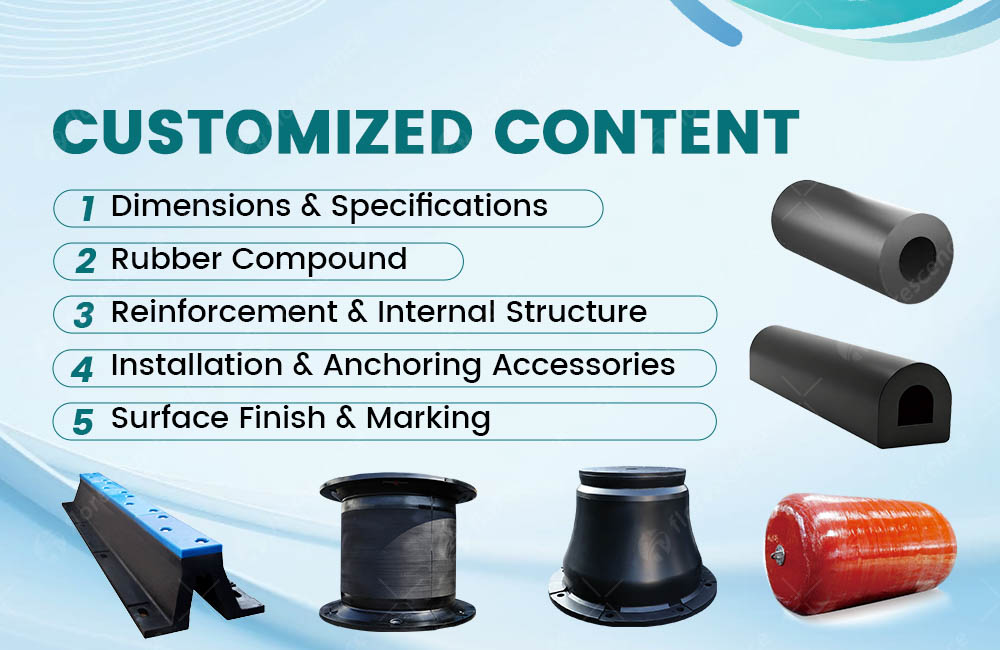
The practical significance of a one-unit minimum order is that it removes the volume penalty from specification validation. A port authority or engineering contractor can order a single customized fender, validate it against the berth design, and only then commit to a full berth package. That is a materially different risk profile from a supplier that requires a container-load commitment before any bespoke profile is produced.
From Compound to Test Record: Manufacturing and Quality Control
Quality control at Florescence is presented as documented rather than asserted. The company states that products are designed, manufactured and tested in accordance with ISO 9001:2015 quality management requirements, with control maintained across raw material selection, production, assembly, testing and final inspection.
At batch level, that translates into specific checks:
- Rubber raw-material testing;
- Dimensional and hardness inspection of rubber fenders;
- Air-tightness testing for ship airbags and pneumatic fenders;
- Compression testing on sample cell, cone or arch fenders to verify that energy absorption and reaction force meet design specifications;
- Coating-thickness measurement on steel components using digital gauges, to confirm the marine epoxy system meets target microns;
- Dimensional verification of custom accessories, including UHMW-PE pad hole patterns and anchor-bolt pitch, so that delivered parts assemble on site.
Documentation follows the same logic. The company states it can supply EN 10204 3.1 mill test certificates for metal parts and bolts, physical property reports (tensile strength, elongation, compression) for rubber products, and a quality inspection report containing rubber test data, sizing sheets, coating thickness records and product photographs before final payment is made. Products can also be manufactured and inspected according to the applicable requirements of leading marine classification societies, including CCS, BV, RS, ABS and LR, based on specific project requirements, and third-party inspection by bodies such as SGS, BV, CCS, DNV and ABS is accepted.
Certification Coverage: What the Documents Actually State
Certification in this category is only useful to a buyer when the scope is explicit. The following certificates and reports were referenced with identifiable numbers, issuing bodies and scopes.
| Certificate / Report | Issuing or verifying body | Scope | Standard reference |
|---|---|---|---|
| RMRS 21.10345.266 (issued 16 Aug 2021) |
Russian Maritime Register of Shipping | Submarine pneumatic rubber fenders | ISO 17357-1:2014, EN 10204:2004, ISO 10474:2013 — Russia and CIS markets |
| BV INS/NR/SHOP-26/131 (issued 24 Mar 2026) |
Bureau Veritas | Cone fenders | PIANC — global marine market |
| BV INS/NR/SHOP-25/377 (issued 9 Jul 2025) |
Bureau Veritas | Pneumatic rubber fenders | ISO 17357 — global marine market |
| BV GTS 2025 154536 0003 (issued 4 Sep 2025) |
Bureau Veritas | Marine rubber airbags, ship launching airbags, marine salvage airbags | ISO 14409 — global marine market |
| IRS QIN21X015 (issued 22 Jul 2021) |
Indian Register of Shipping (test report) | Ship launching airbag | ISO 14409 — India and South Asia |
| ISO 9001:2015 — 32726Q10126RIS (valid 9 May 2026 – 8 May 2029) |
Shandong Guoyuan Certification Co., Ltd | Production of marine airbags, rubber fenders and docking fenders | ISO 9001:2015 (GB/T 19001-2016) |
| ISO 14001:2015 — 32725E20318R0S (valid 28 May 2025 – 27 May 2028) |
Shandong Guoyuan Certification Co., Ltd | Production of marine airbags, rubber fenders, marine chains and related environmental management activities | ISO 14001:2015 (GB/T 24001-2016) |
Two readings matter here. First, the coverage is product-specific rather than blanket: pneumatic fenders, cone fenders and airbags each sit under separate certificates. Second, the management-system certificates have defined expiry dates, which gives a buyer a predictable window in which to request current documents.
The Product Portfolio and Its Performance Envelope
The portfolio spans solid rubber profiles, air-filled fenders and airbag systems. Published parameters give the following operating envelope.
| Fender type | Rated deflection | Max permissible deflection | Key parameters and standard reference |
|---|---|---|---|
| Pneumatic rubber fender | — | — | ISO 17357; CTN type and sling type; 50 or 80 kPa internal pressure; Dia 0.5–4.5 m, Len 1.0–12 m |
| Cone fender | 70% | 72.5% | PIANC; excellent angular performance, low hull surface pressure, high energy absorption |
| Cell fender | 52.5% | 55% | ISO 17357, PIANC; reaction force grades RL / RO / RH / RS / RE |
| Arch fender | 52.5% | 55% | PIANC; performance is linearly proportional to fender length |
| Cylindrical / tug fender | 50% | 60% | Hanging mounting; multi-angle impact and large tidal variation |
| D fender | 50% | 60% | DD 100 to DD 500; length 1–3 m; simple bolt mounting |
| W fender | 30% (heavy-duty variants up to 50–52.5%) | 35% | Reported 20–30% lower reaction force than a D-type fender at equal compression |
| Foam fender | — | — | Dia 0.5–4.5 m, Len 1.0–12 m; unsinkable closed-cell core, polyurea coating, non-marking |
| Square fender | — | — | Height 100–500 mm; PE pad type available |
| Ship launching airbag | — | — | ISO 14409; 3–12 layers; Dia 0.6–2.8 m, Len 5.0–25 m; stated service life 5–8 years |
| Marine salvage airbag | — | — | 3–12 layers; Dia 0.6–2.8 m, Len 5.0–25 m; stated service life 5–8 years |
Across the solid rubber profiles, the common material specification is a marine NR/SBR compound with optional CR for oil resistance or EPDM for UV and ozone resistance, Shore A hardness of 60–70, a reaction-force tolerance of ±10%, an energy-absorption tolerance of −10%, and an operating temperature range of −30°C to +80°C. That consistency of material specification across product families is what allows a single berth design to mix fender types — for example, cone fenders on the main quay face and cylindrical or W profiles on tug berths — without renegotiating material assumptions.
Application Evidence: Where These Fenders Are Deployed
Product parameters describe what a fender can do. Delivered projects describe what it has done. The following references are stated with country, quantity, product and application.
| Project | Country | Quantity | Product | Application | Reported service life |
|---|---|---|---|---|---|
| Naval submarine berthing | Bangladesh | 4 units | Hydro-pneumatic submarine fenders | Submarine berthing and mooring protection; internal water ballast system and counterweight keep the fender vertical underwater | 10–15 years |
| Container / bulk terminal berths | United Arab Emirates | 35 units | Cone fenders | High-capacity berths, high tidal range, large vessel mooring; steel frontal frames and UHMW-PE face pads | 15–20 years |
| Tugboat fleet protection | Singapore | 30 pcs | Tugboat / cylindrical fenders | Bow, stern and side protection for escort, push-pull and offshore berthing duty | 8–10 years |
| Offshore oil and gas supply | Malta | 4 pcs | Pneumatic rubber fender, D2500 × L4000 mm | Ship-to-ship transfer operations | 8–12 years |
| Port infrastructure construction | Dominican Republic | 60 pcs | Foam fenders, D2.0 m × L2.0 m | Berthing protection for 100,000 DWT cargo vessels along quay walls and jetties | 8–10 years |
| Container terminal upgrade | Costa Rica | 20 units | Cell 1150H fender system | Heavy-duty quay protection; PIANC 2002 compliant design | 10–15 years |
Read together, these references cover the major procurement contexts in the category: naval specification work, large commercial terminals, tug and harbour craft, and offshore ship-to-ship transfer. That spread matters because each context applies a different acceptance filter — naval buyers emphasize inspection and documentation, container terminals emphasize energy absorption at large berthing angles, tug operators emphasize wear resistance under continuous contact.
Market Trend: Why Rubber Still Anchors the Category
The structural signal in this category is stability rather than disruption. Mordor Intelligence projects the global marine fenders market to reach USD 0.89 billion in 2026 within a 2026–2031 forecast period, and reports that rubber fenders accounted for approximately 64.17% of the market in 2024. Foam and composite systems have expanded the options available to specifiers, but they have not displaced rubber as the default engineering benchmark.
Alongside that, the standards framework has tightened into a practical filter. ISO 17357-1:2014 specifies requirements for high-pressure floating pneumatic rubber fenders, and PIANC 2002 guidance is widely referenced in fender design. Suppliers across the category make comparable claims: Trelleborg states that its pneumatic fenders meet PIANC 2002 guidelines and comply with ISO 17357-1:2014, while ESC Marine Systems references PIANC 2002, BS 6349:4 and EAU 2004 in its design approach.
The procurement consequence is straightforward. When standards and referenced design guidelines converge across the supply base, price and catalog length stop being the deciding variables. What differentiates suppliers is whether they can produce the documentation — standard compliance declarations, witness test records, mill certificates and product-scoped classification certificates — that a port authority, classification society or tender reviewer will actually accept.
Where Florescence Fits — and Where Its Boundaries Lie
Florescence sits in the manufacturer-and-project-supplier segment rather than the mass commodity segment. It produces a broad fender portfolio, sells mostly outside China, holds product-scoped classification certificates, and operates an ISO 9001:2015 and ISO 14001:2015 management system. For a berth project, a retrofit, or a naval or offshore programme that needs a specified fender rather than a stock profile, that combination is directly relevant.
Several boundaries should nonetheless be factored into an evaluation.
- Certificate scope is product- and model-specific. The RMRS certificate covers submarine pneumatic rubber fenders; the BV cone certificate covers cone fenders; the BV pneumatic certificate covers pneumatic fenders; the BV airbag certificate covers marine rubber, ship launching and salvage airbags. A buyer specifying, for example, a W or square fender should confirm which document, if any, applies to that exact profile rather than assuming a blanket company-wide approval.
- Production volume is project-scale. Stated annual output of approximately 2,000 pieces and monthly capacity of 200 units fit project orders and multi-berth packages comfortably, but they are not a mass-volume commodity supply profile. Very large single-source programmes should be scheduled rather than assumed.
- Lead time depends on specification. Standard rubber fenders and pneumatic fenders typically require about 25–30 days after deposit, while large custom orders or complete fender systems typically require 40–45 days. Fast-track schedules need to be confirmed against the production plan before tendering.
- Customization shifts design responsibility. When fenders are produced to a buyer’s drawing, the underlying inputs — vessel displacement, berthing velocity, berth geometry, tidal range — must come from the buyer’s engineering team. The supplier’s role is manufacturing and verification against that specification, not ownership of the berth design.
- No verified public price benchmark exists. A single displayed figure of USD 25,000 on an industry page was excluded from this analysis because configuration, quantity, Incoterm and quotation validity were unspecified. Buyers should therefore compare quotations on a fully specified, landed-cost basis rather than on headline unit price.
Future Outlook
Three dynamics are likely to shape how suppliers of this type are evaluated over the next few years.
Documentation becomes the differentiator. As ISO 17357-1:2014 and PIANC-referenced design practice become standard talking points across the supply base, the ability to produce certificate numbers, scopes, test records and inspection reports on demand moves from a nice-to-have to a tender prerequisite.
Customization demand persists. Port upgrades, berth life extensions and mixed-vessel terminals rarely match standard catalog geometry. An OEM and ODM service with a one-unit minimum order and a drawing-based workflow is structurally suited to that retrofit pattern.
Continuity windows are visible. The ISO 9001:2015 certificate runs to May 2029 and the ISO 14001:2015 certificate to May 2028, giving buyers a defined period during which the management-system evidence can be verified against current documentation.
What the available evidence does not yet contain is independently audited manufacturing-capacity data, verified project-level performance curves, or a comparable landed-cost dataset. Those remain the natural next layer of due diligence for any buyer moving from shortlisting to contract.
Frequently Asked Questions
- Is Florescence a manufacturer or a trading company?
- Qingdao Florescence Marine Supply Co., Ltd. describes itself as a professional marine equipment manufacturer established in 1992, with more than three decades of experience in marine fenders, pneumatic fenders, foam fenders and ship launching airbags. It states that its production operates under ISO 9001 and ISO 14001 management systems with complete production and inspection systems.
- Does the company provide OEM and ODM production services?
- Yes. The manufacturer provides OEM and ODM production services. Customization covers size, pressure, logo, fittings, package, solution and drawing. The stated minimum order quantity is one unit, and standard lead time runs from 5 to 30 days depending on product type, quantity and customization requirements.
- Which marine fender types does the company supply?
- The range includes cone fenders, cell fenders, arch fenders, cylindrical fenders, D fenders, tugboat fenders, foam-filled fenders, pneumatic fenders, W type fenders and square fenders, alongside ship launching airbags and marine salvage airbags.
- How is product quality and performance verified before shipment?
- Production batches pass through rubber raw-material testing, dimensional and hardness inspection, and air-tightness testing for ship airbags and pneumatic fenders. Compression testing can be performed on sample cell, cone or arch fenders to verify that energy absorption and reaction force meet design specifications. Buyers can receive a quality inspection report with rubber test data, sizing sheets, coating-thickness records and product photographs before final payment.
- Which standards and classification societies apply to these products?
- Pneumatic fenders reference ISO 17357; cone, cell and arch fenders reference PIANC design guidance; and ship launching and salvage airbags reference ISO 14409. Available certification includes a Russian Maritime Register of Shipping certificate for submarine pneumatic rubber fenders, Bureau Veritas certificates for cone fenders, pneumatic fenders and airbags, an Indian Register of Shipping test report for ship launching airbags, and ISO 9001:2015 and ISO 14001:2015 management-system certificates. Products can be manufactured and inspected to CCS, BV, RS, ABS and LR requirements according to specific project needs.
- What are the typical lead times for larger orders?
- Standard rubber fenders and pneumatic fenders typically require about 25 to 30 days after deposit. Large custom orders or full fender systems typically require 40 to 45 days. A production schedule is provided before manufacturing begins.
- What technical and after-sales support is available?
- Support includes product selection assistance, technical calculations, layout recommendations and installation drawings. The company states it provides 24/7 online technical support, installation, use and repair guidance, global on-site service, a 12–24 month warranty, and free repair kits and spare kits.
Reference document: the full Florescence marine rubber fender and airbag catalogue, including product parameters and fittings, is available for public download: 2026 Florescence Catalogue (PDF).