
Foldable Storage Lifespan: What Bulk Home Organization Buyers Verify
Foldable Storage Lifespan: What Bulk Home Organization Buyers Verify
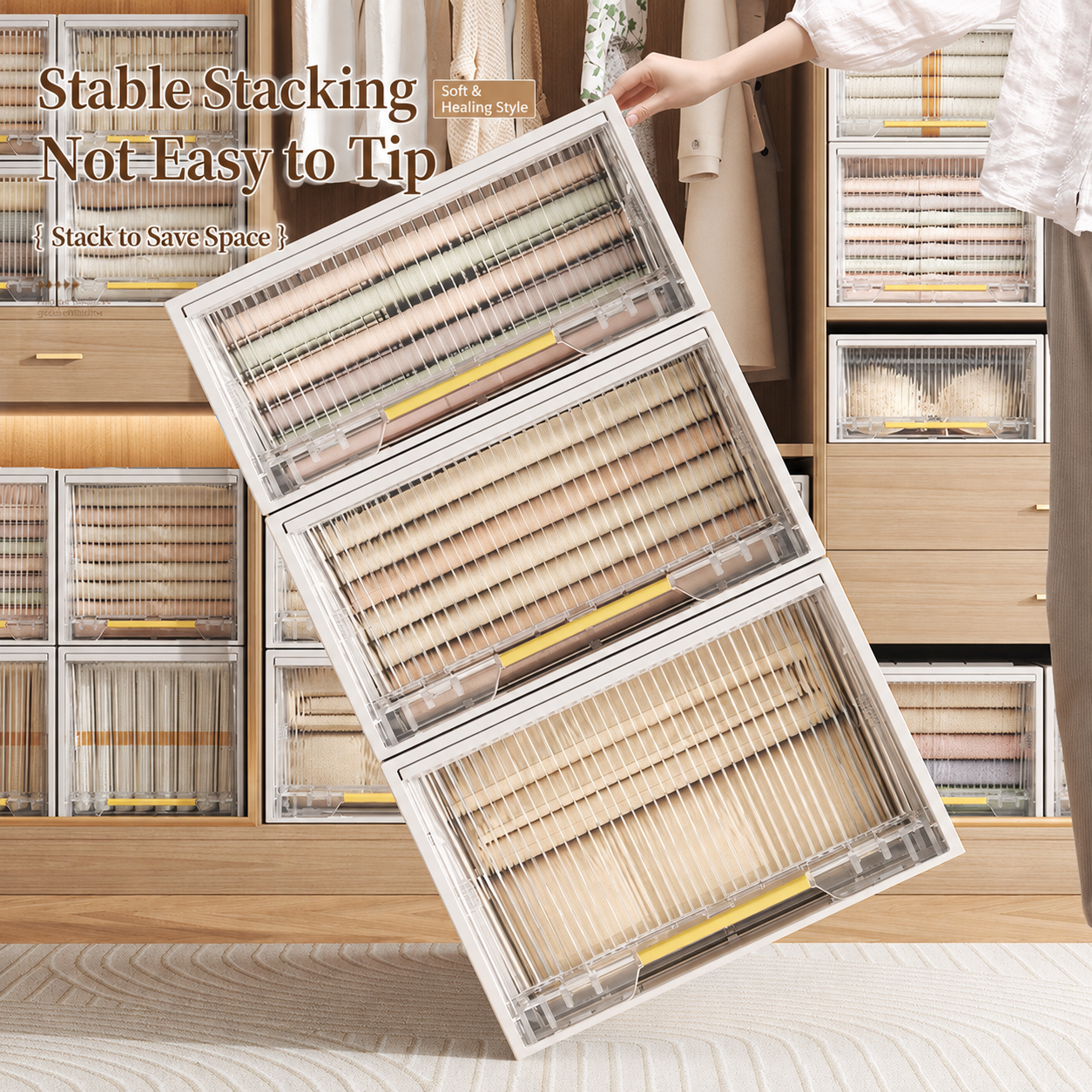
Stacked foldable storage drawers: vertical space efficiency is one thing, fold-joint durability is another.
Home organization has moved from a niche retail category into a mainstream volume business. Third-party research places the global home organization products market at USD 14.06 billion in 2024, with a projected value of USD 21.65 billion by 2035 (Market Research Future). Plastic products accounted for approximately 36% of the kitchen storage and pantry organization segment in 2023, according to Grand View Research. Foldable plastic storage — drawer boxes, cabinets, hamper and car boxes that ship flat and open without tools — sits inside that volume.
At retail, a single unit is judged on appearance and price. At bulk-order stage, the questions get harder. How long will the fold joints, wall panels, drawers and lids hold up in a customer's closet, pantry, laundry room or car trunk? Which of those durability claims can actually be verified before a purchase order is signed? And which ones are simply assertions that no supplier document supports?
This reference is written for importers, distributors and private-label buyers who need to separate measurable product constraints from category language. It uses the published specifications of specific models — YN484536, YN8871, YN8980 and others in the same portfolio — to show what can be checked, what cannot, and where the honest limits sit.
Why Lifespan Is a Constraint Question, Not a Performance Claim
There is no single lifespan number for foldable storage. The available product data for the models discussed here does not publish fold-cycle counts, and only one figure in the supplier's case material addresses service duration directly: a custom-printed foldable camping storage box supplied as a 5,000-unit OEM order for clients in the United States and the United Kingdom is listed at 3–5 years under normal use. That figure belongs to one defined product and one defined usage pattern. It is not a category-wide promise.
For procurement, the practical route is to break lifespan into components that can be specified, sampled and inspected:
- Resin grade and wall geometry
- Fold-line and hinge design
- Drawer glides, magnetic closures and lid latches
- The actual load the unit will carry in the destination market
- The environment it will sit in — wardrobe, pantry, bathroom, garage or car trunk
Each of these can be discussed with evidence. A blanket statement that a product "lasts for years" cannot.
What Determines Service Life in a Foldable Storage Product
Resin and wall structure
Model YN484536, the Foldable Storage Drawer, is specified with high-strength PP plastic. In the same portfolio, the Collapsible Home Storage Cabinet model YN8887 is described with an enhanced rhombic and wave-wall structure intended to support load and stacking stability. These are two different answers to the same problem: thicker or better-shaped walls distribute sustained load, and that distribution is what resists deformation in plastic storage used over long periods.
Fold-line geometry
Every foldable product concentrates stress where it folds. A drawer box that collapses flat, a cabinet with folding side panels and a car box with a fold-down body all place their highest mechanical demand on a small number of interfaces. Because the available product data does not state a fold-cycle rating for YN484536, YN8871, YN8980 or YN8880, this remains a genuine verification gap. Buyers cannot infer fold durability from wall thickness alone, and suppliers should not be asked to imply a number that has not been tested.
Drawers, lids and closures
Hardware is the second wear point, and it is usually the first thing a consumer notices. YN484536 is specified with a smooth pull-out drawer designed to open without jamming and a transparent front panel for visibility. YN8871 uses magnetic opening and closing, rounded handles and a double-door layout with vintage-style textured doors. YN8980 uses a lockable lid with side latches, plus a top carry handle and side handles. Each of these mechanisms defines a different failure mode, and each should be cycled during sample validation rather than inspected visually.
Load and volume
Volume figures describe litres, not kilograms. The distinction matters more than most specification sheets admit, and it is covered in detail below.
Use environment
Humidity, heat, direct sunlight and repeated cleaning act on storage plastics differently depending on wall thickness and resin choice. These are stable category-level considerations rather than figures that can be quoted, which is precisely why buyers should define the target room before selecting a model. A ventilated laundry hamper, a sealed closet drawer and a car trunk box are working in three different conditions.
Three Foldable Formats and What the Product Data Actually Specifies
| Model | Format | Material | Key dimensions | Documented features |
|---|---|---|---|---|
| YN484536 | Foldable Storage Drawer | High-strength PP plastic | Heights 26 / 30 / 36 cm; width 48 cm; depths 40 / 45 / 50 cm; stated capacities 49 L to 86 L | Tool-free quick assembly, smooth pull-out drawer, stable stacking, transparent front panel |
| YN8871 | Foldable Storage Cabinet | PP | 51.5 × 36 × 95 cm; 60 × 42 × 105.5 cm; 67 × 47 × 116 cm; width options 51.5 / 60 / 67 cm | Foldable body, magnetic opening and closing, rounded handles, top storage surface, stackable structure, double doors |
| YN8980 | Foldable Car Storage Box | PP | 57 L capacity; medium 43.5 × 30 × 24 cm; large 54 × 36 × 29 cm; folded thickness 7 cm | Foldable design, carry handle, side handles, lockable lid, wooden-look or plastic lid options |
The drawer box is the volume model. Its listing covers three heights, a fixed 48 cm width and three depths, with capacities running from 49 L to 86 L across the size matrix. Storage items named in the product data include T-shirts, sweaters, sweatshirts, lightweight down jackets, thin blankets, summer quilts and thick quilts — a deliberately wide span that buyers need to read carefully, because those items do not place the same demand on the box.
The cabinet is the structural option. Its three overall sizes give 51.5 cm, 60 cm and 67 cm widths, and the feature list emphasises a foldable body, magnetic opening and closing, a top storage surface and stackable construction. Stated usage scenarios are home storage, bedroom storage, bedside cabinet use, clothing storage and sundry organization.
The car box is the logistics model. At 57 L it folds to 7 cm, which is the number that matters most in container planning, and it carries both a top carry handle and side handles for lifting.
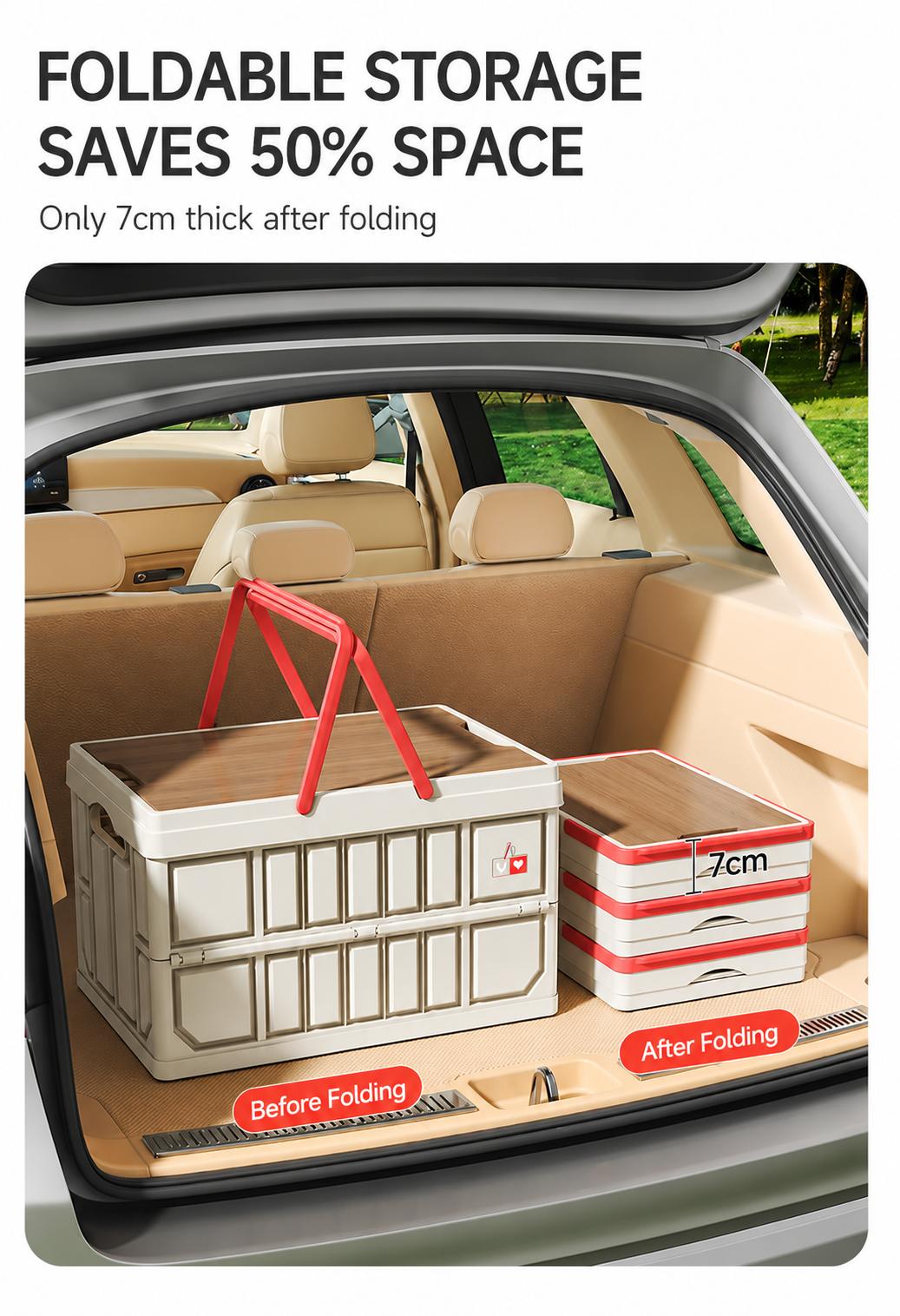
Model YN8980 collapses to a 7 cm thickness — a shipping and warehouse benefit that shifts assembly to the receiving market.
Capacity in Litres Is Not a Load Rating
This is the single most common misreading in foldable storage sourcing. A 57 L box is not a box rated to carry 57 kg, and an 86 L drawer is not rated to carry 86 kg. Litres measure usable volume. They tell a buyer how much quilt, knitwear or camping gear fits, not how much sustained weight the base, walls and fold line will tolerate.
YN484536 makes the problem visible because its stated storage list spans lightweight down jackets at one end and thick quilts at the other. Compressed bedding applies steady pressure over months; folded knitwear does not. A buyer selling into the quilt-storage end of the market should request a load test or a defined maximum fill, and a buyer selling into closet clothes storage should validate stacking behaviour at the top of the size range rather than assuming uniform performance across all nine combinations.
Tool-Free Assembly, Stacking and What Changes Over Time
Tool-free assembly is a delivery decision as much as a durability one. When a foldable drawer box or cabinet ships flat, the final assembly happens in the destination market — in a distribution warehouse, in a retail stockroom, or in the end customer's home. YN484536 is specified for tool-free, quick assembly and stable stacking. YN8871 is specified as stackable with a foldable body. YN8880 is described as foldable with a stackable design across three sizes.
What changes over time is not the concept but the execution. A fold joint that is not fully seated, a stack built on a base that is not flat, or a load concentrated in one corner will all shorten service life regardless of how good the resin is. Incoming quality control on folded units should therefore focus on joint engagement, panel alignment and drawer glide travel — not only on surface appearance and colour.
Stacking claims also have a boundary. A stackable structure describes vertical space efficiency and modular combination; it does not mean an unlimited number of units can be combined, and it assumes the lower unit is fully assembled and loaded within its intended range. Buyers who plan retail displays or end-cap stacking should test the configuration they intend to sell, not a generic two-unit stack.
Certifications and Parameters to Verify Before a Bulk Order
For constraint-driven procurement, certifications are a verification tool rather than a marketing badge. The relevant question is always the same: which certificate covers which model, under which standard, issued by whom, and valid until when.
| Certificate | Standard | Number | Issuer | Market / validity |
|---|---|---|---|---|
| Quality Management System Certification | GB/T 19001-2016 / ISO 9001:2015 | 28725Q1039R0M | Zhongzheng Excellent Certification Group Co., Ltd. | EU; issued 2025-10-20, valid to 2028-10-19 |
| Occupational Health & Safety Management System Certification | GB/T 45001-2020 / ISO 45001:2018 | 77725S00040R053 | Zhongzheng Excellence Certification Group Co., Ltd. | EU; issued 2025-12-23, valid to 2028-12-22 |
| Environmental Management System Certification | GB/T 24001-2016 / ISO 14001:2015 | 77725E00040R053 | Zhongzheng Excellence Certification Group Co., Ltd. | EU; issued 2022-12-23, valid to 2028-12-22 |
| Certificate of Technical Inspection | EN 14073-2:2004 | M.2022.206.C75474 | UDEM International Certification Auditing Training Centre Industry and Trade Inc. Co. | EU; issued 2022-07-12, valid to 2027-07-11 |
The three management system certificates share a common scope wording: research and development, production and sales of daily storage plastic products (boxes, cases, cabinets, baskets), excluding items subject to licensing requirements. That wording defines an organisational boundary, not a per-product performance guarantee. Foldable Storage Cabinet model YN8871 is named among the products covered by the Environmental Management System and Occupational Health & Safety certificates, and YN484536 also appears in the applicable product lists for those two certificates.
Product-level standards sit in a different category. The Foldable Car Storage Box model YN8980 is listed as complying with EN 14073-2:2004, and it appears among the products covered by the Certificate of Technical Inspection issued under that standard. Buyers should keep the two types of document separate in their own files, because a quality management system audit and a product standard compliance statement answer different questions.
A short pre-order checklist
- Model-level coverage. Confirm the exact model number appears in the certificate's applicable product list, not only the supplier's category description.
- Validity window. Check issue and expiry dates against your planned shipping schedule.
- Scope wording. Read the scope sentence rather than the certificate title alone.
- Standard identity. Note where a certificate lists both a GB/T and an ISO reference, as the management system certificates here do.
- Material declarations. Where products are used for pantry sorting and may contact food, request a material declaration tied to the exact resin. The European Commission adopted Regulation (EU) 2024/3190 banning Bisphenol A in food contact materials, with an 18-month phase-out period from late 2024. Its scope is food contact materials, so it does not automatically apply to a closet drawer or a toy bin — but it is directly relevant to food-contact pantry items.
- Recyclability evidence. Polypropylene storage containers can achieve GreenCircle Recyclable Material certification, which verifies recyclability in #5 plastic facilities. Ask whether the specific product holds such documentation instead of accepting a general "eco-friendly" label.
Collapsed Thickness and Container Planning
YN8980 folds to 7 cm. For a buyer planning a mixed container, collapsed thickness is arguably the most useful dimension on the specification sheet, because it determines how much freight volume each unit occupies before assembly and how much warehouse space a slow-moving SKU consumes when it is not selling.
Two costs come with that benefit. First, the fold interface becomes a handling point: transit damage and incorrect folding are best identified during incoming inspection rather than discovered on a retail shelf. Second, flat packaging shifts a step of labour into the receiving market. That is a clean advantage for a distributor that assembles units for retail display, and a different calculation for a retailer that sells the product folded and expects the end customer to complete assembly. Tool-free design matters in the second case, and both YN484536 and YN8980 are specified with tool-free or handle-based setup rather than loose fasteners.
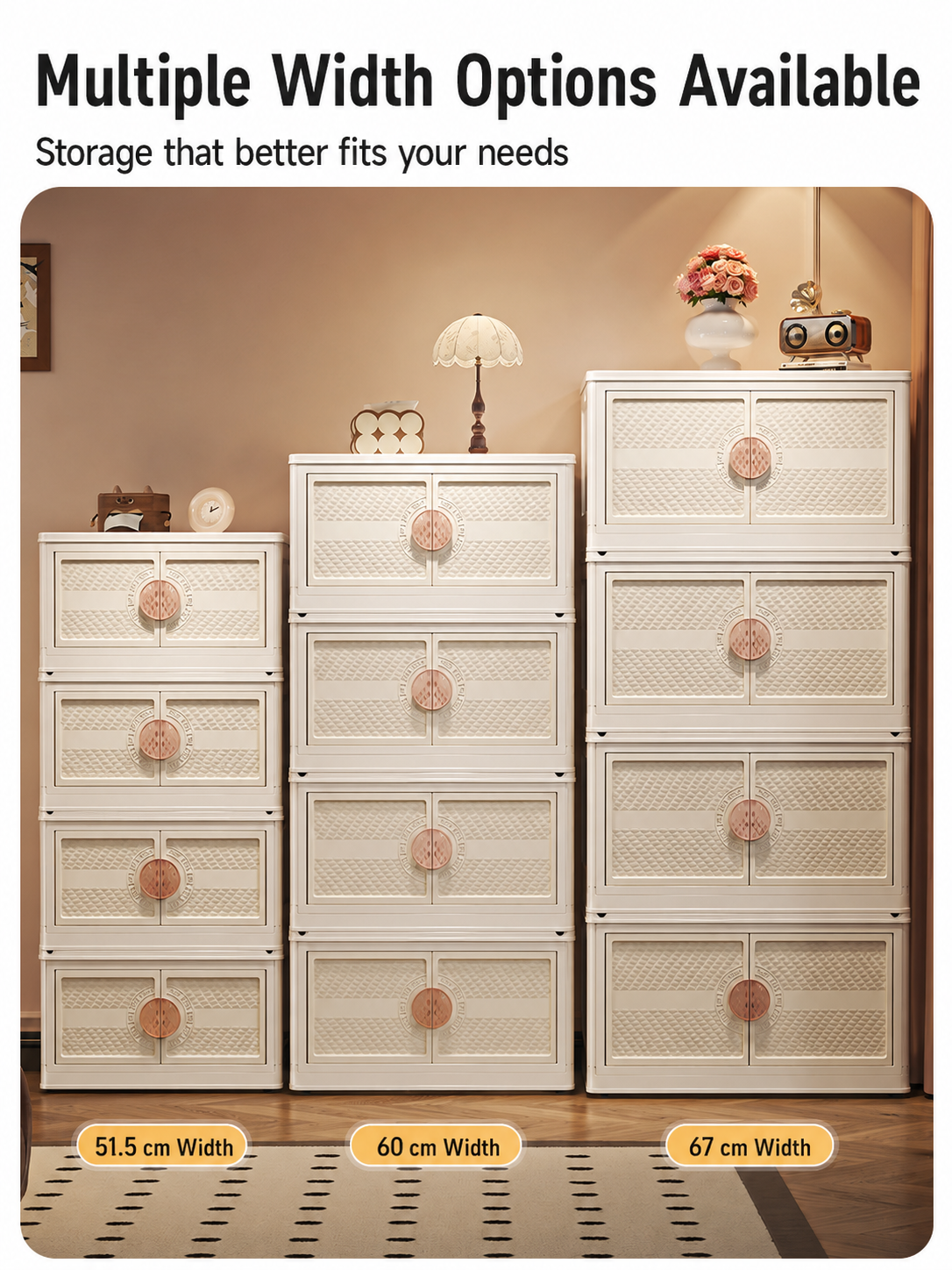
Width options on model YN8871 (51.5 cm / 60 cm / 67 cm) let buyers match a single SKU family to different room layouts.
Application Fit: Pantry, Closet, Toy, Laundry, Trunk and Camping
Different rooms impose different constraints, and the same foldable platform does not serve all of them equally well.
- Closet clothes storage. YN484536 is specified for T-shirts, sweaters, sweatshirts, lightweight down jackets and blankets, with a transparent front panel so contents are identifiable without opening the drawer. Its limit is the one noted above: the drawer is a volume container, not a rated weight container.
- Kitchen pantry sorting and bedroom storage. YN8871 combines a foldable cabinet body, magnetic doors and a top storage surface, with three width options for narrow walls or wider alcoves. It is not a sealed food container, so open packaging in a pantry should be handled separately.
- Kids toy organization. The foldable toy storage basket model HYN8021 is specified in PP with a hollow breathable panel, rounded edges, 360° swivel wheels and wall-mountable installation using traceless adhesive hooks. Its sizes range from 37.5 × 20 × 22.5 cm to 37.5 × 24.5 × 49.5 cm, and it is listed with a certification applicable to the EU market.
- Laundry room utility. The foldable wheeled laundry hamper model JH2018 measures 37.7 × 30 × 50 cm with wheels and 37.7 × 30 × 46 cm without, holds approximately 30 adult garments, and uses all-round ventilated holes plus 360° swivel wheels. Buyers should note that ventilation and sealing are opposites: this product keeps clothes fresh, but it is not a dust-sealed or moisture-sealed container.
- Car trunk and outdoor camping. YN8980 covers trunk organisation with a lockable lid and two carrying methods. YN8880 covers camping with three sizes (39.6 × 26.3 × 21 cm, 42.5 × 30 × 24 cm, 54 × 36 × 29 cm) and a volume range of 0.009–0.015 m³; its wooden lid can serve as a small outdoor table surface.
Market Context: Where Foldable Storage Demand Is Moving
Category data supports the directional argument without proving any individual supplier's position. The stackable container market is projected at USD 7.8 billion in 2024, growing at a CAGR of 6.4% on the back of e-commerce expansion and urbanisation, according to Strategic Market Research. That combination — smaller living spaces and online retail — is precisely the environment in which flat-packing and stacking have commercial value.
Supply-side capacity remains concentrated. China's furniture industry exports recorded USD 67.81 billion in 2025, a figure that includes home organisation items and reflects continued supply depth despite global trade fluctuations. The category is also shaped by large global brands such as IKEA (Sweden), Rubbermaid (USA), Sterilite (USA) and The Container Store (USA), alongside a broad tier of specialist manufacturers that compete on configuration, compliance and lead-time reliability rather than brand scale.
Regulation is moving in parallel. The EU's Bisphenol A restriction for food contact materials creates an 18-month phase-out from late 2024, and recyclability verification schemes such as GreenCircle's Recyclable Material certification give PP storage a documented circularity pathway. Neither development changes how a foldable drawer performs in a wardrobe, but both change which suppliers can answer a compliance questionnaire quickly and completely.
Foldable PP Storage Compared with Traditional Storage Options
| Decision dimension | Foldable PP storage (drawer / cabinet) | Rigid non-folding plastic bins | Fabric or cardboard organisers | Fixed wooden or metal cabinets |
|---|---|---|---|---|
| Shipping volume | Low when collapsed (YN8980 folds to 7 cm) | High — hollow rigid shapes consume freight space | Low, often flat-packed | Highest — bulky and heavy |
| Assembly | Tool-free assembly specified on YN484536 | Usually none | Pop-up or partial assembly | Often requires tools and two people |
| Stacking and modularity | Stackable structures on YN484536, YN8871, YN8880 | Stackable but limited by lid geometry | Limited — frames deform under load | Not stackable in practice |
| Dust and moisture | Closed bodies protect contents; hollow panels are not seals | Good with fitted lids | Weak, especially in humid rooms | Good, depending on door fit |
| Cleaning | Smooth plastic surfaces wipe clean | Easy | Difficult; fabric absorbs odour | Requires care with wood finishes |
| Load predictability | Depends on wall structure; capacity is volume, not weight | Generally predictable within stated limits | Low and inconsistent | High, but fixed in position |
| Primary limitation | Fold joints and hinge interfaces are the most stressed components | Poor freight efficiency; high landed cost per unit | Short service life under sustained load | Cost, weight and immobility |
The trade-off deserves to be stated plainly, because it is the part of the category that optimistic sourcing documents tend to skip. A foldable structure buys stowability, freight efficiency and tool-free assembly by accepting mechanical interfaces that a rigid one-piece bin does not have. Those interfaces — the fold line, the drawer glide, the magnetic closure, the lid latch — are where service life is most likely to be decided.
For the foldable drawer model YN484536 specifically, the available product data publishes a size matrix and a capacity ladder from 49 L to 86 L, but no fold-cycle rating and no kilogram load rating. That is not a defect in the product; it is a limit in the published specification. Buyers who need those numbers for a tender, a retail warranty statement or a marketplace listing should ask for testing rather than extrapolate from volume. Where a supplier cannot supply the figure, the correct procurement response is to sample-test the intended use case and write the tested configuration into the purchase agreement.
What to Expect Next
Three directions look likely for foldable home organization sourcing. First, e-commerce and urban living will keep pushing demand toward flat-packed and stackable formats, which is consistent with the projected 6.4% CAGR for stackable containers. Second, compliance expectations around food contact and material declarations will continue to tighten, which favours suppliers that maintain current management system certificates and can produce model-level documentation quickly. Third, recyclability verification — of the kind available for PP in #5 plastic facilities — will move from a differentiator to a routine line item in buyer questionnaires.
What is unlikely to change is the fundamental verification rule. Lifespan in this category is a sum of resin, wall geometry, fold design, hardware, load and environment. None of those can be established by a photo, and none of them should be accepted on assertion when a sample and a test protocol are available.
Frequently Asked Questions
1. What actually determines how long a foldable home storage product lasts?
Service life depends on five interacting factors: the resin grade and wall structure, the fold-line and hinge design, the drawer glides or lid closures, the actual sustained load, and the environment the unit sits in. In the models discussed here, YN484536 is specified with high-strength PP plastic, while the Collapsible Home Storage Cabinet YN8887 is described with an enhanced rhombic and wave-wall structure for load and stacking stability. The available product data does not publish fold-cycle ratings, so durability should be validated by sample testing against the intended use case rather than inferred from appearance.
2. Does a larger capacity mean the box can carry more weight?
No. Capacity is stated in litres and describes usable volume, not load. The Foldable Storage Drawer YN484536 is offered with stated capacities from 49 L to 86 L across its size matrix, and its listed storage items range from T-shirts, sweaters, sweatshirts and lightweight down jackets to thin blankets, summer quilts and thick quilts. Those items place very different sustained loads on the same box. Buyers who need a weight limit for a tender or warranty statement should request a load test, because no kilogram rating appears in the available specification.
3. How do materials differ between foldable models in this portfolio?
The foldable drawer YN484536, the foldable cabinet YN8871, the foldable car storage box YN8980 and the foldable toy basket HYN8021 are all specified in PP. Transparent toy and doll storage products in the same range use a different combination: a PET body with a PP lid, which delivers visibility and is described as dustproof and odourless. The practical consequence for buyers is that transparent formats and opaque PP formats have different surface behaviour and different cleaning requirements, so material choice should follow the room and the display requirement rather than visual preference alone.
4. Which certifications should a buyer verify before placing a bulk order?
Four documents are relevant for this supplier. Quality Management System Certification GB/T 19001-2016 / ISO 9001:2015, certificate number 28725Q1039R0M, issued by Zhongzheng Excellent Certification Group Co., Ltd., valid to 2028-10-19; Occupational Health & Safety Management System Certification GB/T 45001-2020 / ISO 45001:2018, number 77725S00040R053, valid to 2028-12-22; Environmental Management System Certification GB/T 24001-2016 / ISO 14001:2015, number 77725E00040R053, valid to 2028-12-22; and a Certificate of Technical Inspection under EN 14073-2:2004, number M.2022.206.C75474, issued by UDEM International Certification Auditing Training Centre Industry and Trade Inc. Co., valid to 2027-07-11. All apply to the EU market. Buyers should confirm that the specific model number appears in each certificate's applicable product list.
5. How much does collapsed thickness actually save in shipping and storage?
Collapsed thickness determines freight volume per unit and warehouse footprint for slow-moving stock. The Foldable Car Storage Box YN8980 is specified with a folded thickness of 7 cm, and its medium and large external sizes are 43.5 × 30 × 24 cm and 54 × 36 × 29 cm at a stated 57 L capacity. No container-load calculator is published for these models, so the saving should be modelled by the buyer using actual carton dimensions, pallet configuration and container type. The qualitative benefit is clear — flat units occupy less volume than assembled ones — but the quantity must be calculated from carton data, not assumed.
6. Are tool-free or no-assembly products less durable than assembled ones?
Tool-free describes the assembly method, not the strength of the finished product. YN484536 is specified for tool-free quick assembly with stable stacking, just as the Foldable Shoe Cabinet model 7008 requires no assembly while remaining stackable and dustproof. Durability depends on resin grade, wall geometry and joint fit, not on whether a screwdriver was involved. Because the customer or distributor completes assembly, buyers should include joint engagement and panel alignment checks in incoming inspection and use standardised sampling such as AQL 2.5/4.0 to confirm consistency across batches.
7. What MOQ and lead-time constraints apply to OEM and ODM foldable storage orders?
The published capability data distinguishes the two models. OEM production is listed with a minimum order quantity of 500 units, a lead time of 15–45 days and a monthly capacity of 100,000 units, with customisation limited to colour, logo and printing. ODM production is listed with a minimum order quantity of 5,000 units, a lead time of 30–60 days and a monthly capacity of 8,000 units, with customisation extending to logo, colour, packaging, size, structural design and material specification such as PET/PP ratio. Both modes use AQL 2.5/4.0 standardised sampling, and both are supported by remote technical guidance with compensation or replacement for quality issues.
8. What limits should buyers plan around when specifying foldable storage?
Four limits are worth writing into a sourcing brief. Fold joints and hinge interfaces carry the highest mechanical demand and are the most likely life-limiting components, yet no fold-cycle rating is published for these models. Capacity is volume rather than weight, and no kilogram rating is published for YN484536. The top storage surface on YN8871 has no published load rating, so it should not be treated as a seat. And ventilated designs such as the laundry hamper JH2018 keep clothes fresh but are not sealed against dust or moisture, which matters if the product is specified for a bathroom or an outdoor environment.
About the Supplier Behind These Specifications
Taizhou Xinhai Cross-border E-commerce Service Co., Ltd., trading as Xinhai Box, is a B2B supplier of plastic household storage and daily-use products based in Taizhou, Zhejiang, China. The company serves wholesalers, distributors, retailers, supermarkets and e-commerce sellers across North America, the EU, Southeast Asia and Latin America, and reports an export ratio of 70%. Its operations are supported by over 20 years of manufacturing experience from Zhejiang Jinmao Plastic Group, with 500 employees, an annual output of 1,000,000 units and a research and development team of 30 engineers and designers.
For buyers who need to compare configurations before requesting samples, the company publishes a downloadable product brochure covering its foldable cabinet, drawer, car box, camping box, hamper and toy storage ranges: Xinhai Box storage products brochure. Product and capability details are also listed at www.xinhaibox.com.