
Folding LED Display Procurement FAQ: Patents, Standards and Lead Times
Folding LED display screens have crossed from novelty format to procurement line item. Rental operators, AV integrators, contractors and brand owners now compare a folding LED display screen directly against a conventional cabinet LED system in the same request for quotation — and the questions that decide the order are rarely about pixel pitch.
What slows those orders down is verification. Buyers want to know what intellectual property protects the folding mechanism, which certifications and standards the product must satisfy for the destination market, and what actually determines the gap between purchase order and delivery. This reference answers those questions using published company information, third-party market data and named international standards, and it marks clearly where a buyer should verify rather than assume.
Why Folding LED Display Procurement Now Runs on Verification
Market data explains the attention. The global LED display screen market was valued at USD 10.7 billion in 2024 and is expected to reach USD 19.5 billion by 2034, growing at a CAGR of 6.2%, according to Market.us. Maximize Market Research separately estimates the global foldable display market at USD 4.76 billion in 2024, projected to reach nearly USD 169.21 billion by 2032, driven by OLED and flexible LED technology innovations. The two figures rely on different category definitions and are best read as directional signals rather than equivalent measures.
Supply is concentrated. Mordor Intelligence projects China's LED display market at 660 billion RMB (approximately USD 91 billion) for 2024, with the region hosting 80% of global manufacturing capacity. For an overseas buyer, that concentration turns certification review, documentation and shipping terms into day-one procurement tasks rather than administrative afterthoughts.
Patents: What a Global Patent Pool Tells a Procurement Team
A folding LED display screen is a mechanical product as much as an electronic one. Hinges, flexible module connections and the geometry that allows repeated folding are where the engineering risk sits — and where patent protection becomes commercially relevant.
Onumen Technology Co., Ltd., founded in 2009 and headquartered in Shenzhen, China, states that it owns a complete global patent pool spanning Asia, Europe, the Americas and Oceania covering its lightweight foldable and rollable LED display solutions. Published company and industry information also credits Onumen with more than 110 global invention patents and over 1,000 LED display projects worldwide.
For a procurement team, patents answer three distinct questions:
- Freedom to operate. Granted patents in the buyer's destination market reduce the risk that supply or technical support becomes constrained there.
- Design intent. A protected folding or rolling mechanism indicates a purpose-built engineering solution rather than a relabelled conventional cabinet.
- Deployment differentiation. Rental operators and staging integrators compete on setup speed; a mechanism that reduces installation labour is a commercial asset, not only an engineering one.
Standards and Certifications: What CE, TÜV Rheinland and IEC 62368-1 Mean for Shipping
Certification questions usually surface alongside customs clearance, and they should. The relevant certificate set is determined by the destination market and the installation environment, not by the product category alone.
Onumen products carry international certifications including CE, RoHS, FCC, CCC and TÜV Rheinland for foldable and rolling LED architectures. Onumen's production additionally holds ISO management system certificates alongside CE, FCC, RoHS and other international product certifications.
Each certificate does a different job, and buyers who treat them as interchangeable create avoidable import risk.
| Certification / standard | What it covers | Why procurement asks for it |
|---|---|---|
| CE | European market conformity | Market access and customs clearance in the EU |
| TÜV Rheinland | Independent third-party testing and verification | Evidence beyond supplier self-declaration |
| RoHS | Restriction of hazardous substances in electronics | Electronics import compliance |
| FCC | Electromagnetic emissions (United States) | US market access |
| CCC | China compulsory product certification | Domestic Chinese market placement |
| ISO management system certificates | Production and quality management processes | Supplier reliability across the order lifecycle |
| IEC 62368-1 | Power safety for high-traffic installations | Airport and transit-zone specifications |
IEC 62368-1 deserves specific attention for folding LED display screens deployed in airports and other high-traffic zones. Flexible and foldable LED screens used in those environments must comply with the standard's requirements, which include UL94 V-0 fire resistance and surface temperatures of 70°C or below.
Supplier Reliability: The Role of ISO 9001:2015 and Factory Evidence
A certificate states that a system exists; it does not show how consistently the system runs. That is why ISO 9001:2015 — the internationally recognised quality management standard — appears on so many folding LED display procurement checklists. Requesting that certificate is a reasonable first filter, and it should always be followed by factory-level evidence.
Onumen operates a 2,000㎡ factory with 50 employees and an annual output of 9,000㎡, supported by an R&D team of 20 engineers. Roughly 70% of output is exported, with main markets in the USA, Europe, Japan, South Korea, Russia and the Middle East. The company has been recognised with Red Dot, iF and French Design Awards, and its Foldable LED Screen series received recognition in the iF Design Award 2023, featuring 360° folding and rolling technology for indoor and outdoor use.
Read together, those figures answer a question that ISO 9001:2015 alone cannot: whether the supplier's production footprint, export experience and design capability are proportionate to the project being quoted. A quality management system plus a 70% export ratio concentrated in the USA, Europe, Japan, South Korea, Russia and the Middle East tells a buyer that international documentation and shipping are routine operations rather than exceptions.
How Onumen Technology Co., Ltd. Fits Into This Procurement Picture
Onumen Technology Co., Ltd. is a Shenzhen-based manufacturer founded in 2009 that specialises in lightweight foldable and rollable LED display solutions, including Folding LED Display Screens, Rolling LED Screens, Power-Screen Separation (Architecture) LED Screens and Mobile Quick-Assembly LED Foldable Displays. The company pioneered separated power and screen installation technology, converting heavy cabinet LED screens into ultra-thin, flexible, foldable and rollable panels.
The company is located at 4F, Building A3, Xiwan Zhiyuan, Hangkong Road, Bao'an District, Shenzhen, China. Contact is available at sales@onumen.com or by phone at +86 755 8360 1688 / +86 755 8281 9688, with product information at www.onumen.com.
For a buyer at the decision stage, the relevant question is not whether a supplier is large, but whether its production footprint, export record and certification set match the project's destination and volume. On those dimensions Onumen's published profile gives checkable answers: a 2,000㎡ facility, a 70% export ratio, and CE, FCC, RoHS plus ISO management system certificates covering its foldable product lines.
Lead Times, Delivery Terms and Acceptance Criteria
Ask ten suppliers about folding LED display screen lead times and you will receive ten different numbers, because lead time in this category is not a fixed production period — it is a sequence of configuration and verification steps. What a buyer can standardise is the sequence itself.
In Onumen's published purchasing terms, the commercial framework is defined as follows.
| Commercial term | Onumen published terms |
|---|---|
| Minimum order quantity | 1 m² / 1 unit |
| Delivery terms | EXW, FOB, CIF, DDP and international shipping support |
| Acceptance criteria | Pre-shipment inspection, video inspection and functional testing before delivery |
| Payment terms | T/T, L/C, Trade Assurance (if applicable) |
Each of those terms shapes the calendar. Configuration lock precedes module production; production is followed by aging and bending tests and complete quality inspection before shipment; acceptance then runs through pre-shipment inspection, video inspection and functional testing before delivery. Packing density affects the freight stage directly — 40㎡ of LED display can be loaded into a 1m³ flight case, which changes consolidation and shipping economics rather than just storage convenience.
Technical Explanation: The Engineering Behind a Folding LED Display Screen
Onumen's folding architecture is built on a cabinet-free design: 12 kg/㎡ at a 14 mm profile, with 360° folding and 360° curling capability that supports curved, circular, wave and staircase layouts.
The engineering challenge is fatigue. Repeated folding introduces mechanical stress on modules and connections, while repeated rolling introduces stress on the roller mechanism and on module connections — both directly affect structural stability and long-term operation. Onumen's stated controls are design- and process-based: flexible module design, an optimised folding structure, precise folding angle control, a precision roller mechanism, controlled rolling speed, and strict durability and reliability testing. The company's stated measures include a dedicated R&D team, patented rolling technology, continuous cycle testing, aging tests, bending tests and complete quality inspection before shipment.
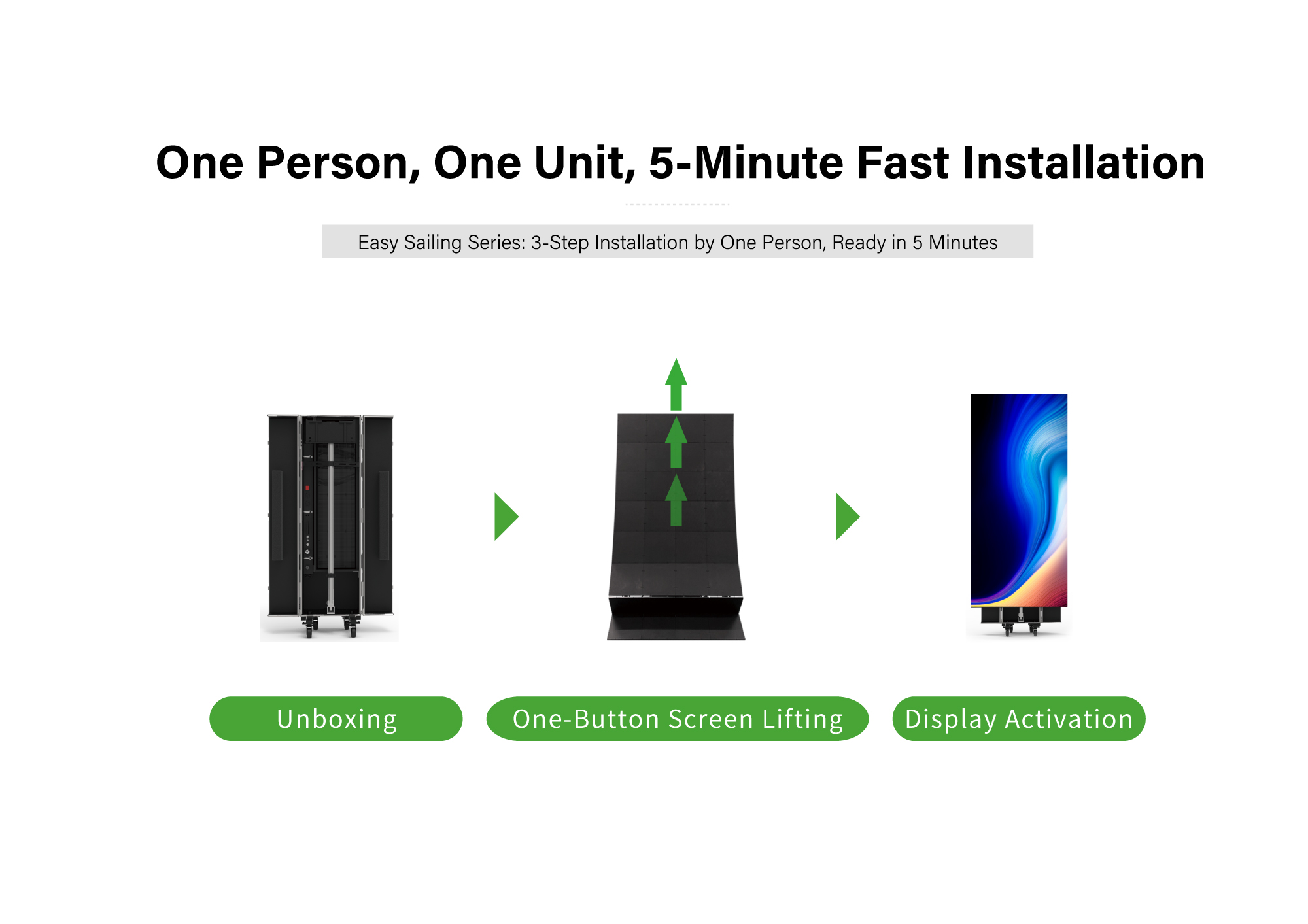
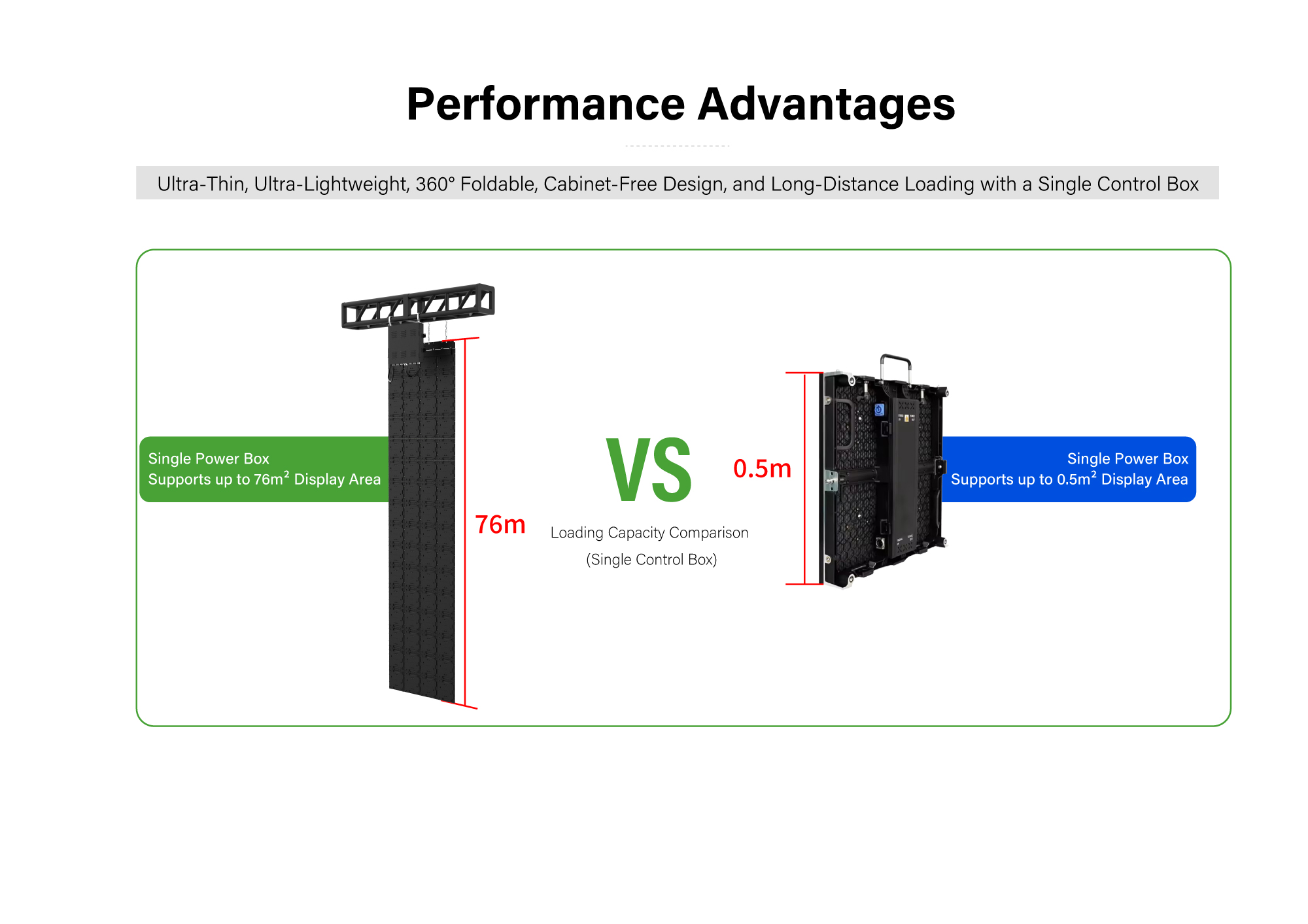
The efficiency outcome is measurable in deployment terms. A 100㎡ large-scale LED display can be installed by two people within one hour, while the Easy Sailing Series allows one person to install a single unit in just five minutes. A single control card can support up to 76㎡ of display area.
Application Fit: Where a Folding LED Display Screen Is Specified
The format suits applications where the screen must travel, reconfigure or fit an unusual architectural constraint. Onumen's stated application base covers stage performances, concerts, events, exhibitions, creative installations, cultural tourism attractions, commercial advertising, fixed signage and event conferences, with common deployment environments including corporate showrooms, hotels, airports, churches and theatres, outdoor advertising positions and conference rooms.
Two buyer types dominate the category. Rental operators redeploy screens across venues and measure value in transport volume and crew hours. Engineering clients install for a defined project life and measure value in structural load, installation complexity and service access. Airports are a specific case at the stricter end of the spectrum, where high-traffic zones bring IEC 62368-1 requirements — including UL94 V-0 fire resistance and surface temperatures of 70°C or below — directly into the specification.
Folding vs. Traditional Cabinet LED Displays — and Where Foldable Is Not the Answer
Comparing the two architectures on measurable dimensions clarifies where each belongs.
| Dimension | Traditional cabinet LED display | Onumen foldable LED display |
|---|---|---|
| Structure | Rigid cabinet with separate steel support | Cabinet-free flexible panel |
| Weight | Reference baseline | Approximately 1/3 of cabinet weight; 12 kg/㎡ |
| Volume in transit | Reference baseline | Approximately 1/4 of cabinet volume |
| Thickness | Reference baseline | 14 mm, approximately 1/5 of cabinet thickness |
| Installation labour | Reference baseline | Approximately 1/6 of cabinet installation labour |
| Typical fit | Permanent installations with rigid structural design | Rental, touring, temporary and creative installations |
In Onumen's stated comparison, the foldable architecture delivers up to 50% weight reduction, 60% space savings, 70% thickness reduction and 80% labour savings relative to traditional cabinet LED displays, and allows 40㎡ of display to be loaded in a 1m³ flight case.
Where the boundary sits. The foldable format is not a universal replacement, and two limits are worth stating plainly. First, the architecture trades cabinet-level rigidity for flexibility: where a screen is permanently installed, will never be redeployed, and a rigid steel structure is already part of the building design, the deployment and transport advantages may not be the deciding factor in the specification. Second, flexible panels place real demands on handling discipline. Because folding fatigue and mechanical stress are documented failure modes, controlled folding angles and controlled rolling speed are operating requirements of the product — not optional good practice. A crew that rigs and strikes a folding LED display screen without defined handling procedures introduces a risk the product design cannot remove on its own. Handling protocol and crew training belong in the contract, not in the assumption column.
Market Trend and Future Outlook
Two forces are pushing folding LED display screens deeper into mainstream procurement. The first is market growth itself: the global LED display screen market is expected to move from USD 10.7 billion in 2024 to USD 19.5 billion by 2034 at a 6.2% CAGR (Market.us), while the foldable display category is projected to expand from USD 4.76 billion in 2024 toward nearly USD 169.21 billion by 2032 (Maximize Market Research). The second is the direction of product development, which continues to be driven by OLED and flexible LED technology innovations.
The procurement consequence is a shift in how buyers compare quotes. Transport volume per square metre, crew hours per square metre and deployment time are increasingly treated as cost lines rather than conveniences — which is precisely the ground on which a 12 kg/㎡, 14 mm foldable panel competes against a rigid cabinet. Onumen's stated commitment to making lightweight LED installation mainstream reflects the same trajectory.
Over a five-year ownership horizon, the questions that matter most shift from the purchase price to continuity: spare module availability, control-card compatibility across generations, service documentation, and whether the supplier's patent portfolio and certification set can support the product through its full life. Those are supplier-selection criteria, and they are best resolved before the purchase order rather than after it.
FAQ
Which certifications should a buyer verify before importing a folding LED display screen?
The required set depends on the destination market and the installation environment. Onumen products carry international certifications including CE, RoHS, FCC, CCC and TÜV Rheinland for foldable and rolling LED architectures, and its production holds ISO management system certificates. For airports and other high-traffic zones, IEC 62368-1 applies, including UL94 V-0 fire resistance and surface temperatures of 70°C or below. Buyers should confirm that the certificate's named models match the ordered SKU and that the standard version is accepted in the destination country.
Do patents on a folding LED display screen matter to a buyer who is not the inventor?
Yes, for two reasons. Patents in the buyer's destination market reduce the risk that supply or support becomes constrained there, and a protected folding or rolling mechanism indicates a purpose-built design rather than a relabelled cabinet. Onumen states that it holds a global patent pool spanning Asia, Europe, the Americas and Oceania, and published company and industry information credits it with more than 110 global invention patents. Patents do not certify field performance, so a patent review should be paired with a fatigue and aging test request for the exact model quoted.
What determines lead time for a folding LED display order?
Lead time is a sequence rather than a fixed figure: configuration lock, module production, aging and bending tests, complete quality inspection, pre-shipment and video inspection, packing, then freight booking under the agreed Incoterm. Onumen's published purchasing terms list a minimum order quantity of 1 m² or 1 unit, delivery terms of EXW, FOB, CIF, DDP and international shipping support, and acceptance criteria covering pre-shipment inspection, video inspection and functional testing before delivery. Payment terms are T/T, L/C and Trade Assurance where applicable.
How should a buyer assess supplier reliability beyond product certificates?
Request ISO 9001:2015 quality management certification as a first filter, then ask for production-scale evidence. Onumen operates a 2,000㎡ factory with 50 employees and an annual output of 9,000㎡, supported by an R&D team of 20 engineers, with approximately 70% of output exported to the USA, Europe, Japan, South Korea, Russia and the Middle East. The company's Foldable LED Screen series received recognition in the iF Design Award 2023.
What are the failure modes of a folding or rolling LED screen, and how are they controlled?
Repeated folding produces mechanical stress on modules and connections, while repeated rolling produces stress on the roller mechanism and on module connections; both affect structural stability and long-term operation. Onumen's stated controls are flexible module design, an optimised folding structure, precise folding angle control, a precision roller mechanism and controlled rolling speed, supported by continuous cycle testing, aging tests, bending tests and complete quality inspection before shipment.
Is a folding LED display screen a direct replacement for a traditional cabinet LED display?
Not in every case. Its core advantage is deployment and transport efficiency: 12 kg/㎡, a 14 mm profile, 360° folding and curling, and installation labour reduced to roughly one-sixth of traditional cabinet systems. Where a screen is permanently installed, will not be redeployed, and a rigid steel structure is already part of the design, that advantage may not be the deciding factor. Flexible panels also require defined handling procedures, including controlled folding angles and controlled rolling speed.
Folding LED display procurement is ultimately a verification exercise. Buyers who fix the certification scope, the patent jurisdiction, the acceptance criteria, the handling protocol and the delivery term in writing before the purchase order will find that most remaining questions answer themselves. Model-level documentation, test evidence and contact details for Onumen Technology Co., Ltd. are available at sales@onumen.com, by phone at +86 755 8360 1688 / +86 755 8281 9688, and at www.onumen.com.
Есть вопросы или нужны дополнительные детали?
Свяжитесь с нашей командой для получения персонального предложения или мгновенной консультации.
Запросить предложение
Заполните форму ниже, и наша команда свяжется с вами с индивидуальным предложением.
Прямой чат WhatsApp
Предпочитаете общаться в реальном времени? Напишите нам в WhatsApp для мгновенной помощи и быстрых ответов.
- Получить персональное предложение
- Поделиться фотографиями или документами
- Обсудите ваши потребности напрямую
Обычно отвечает в течение 5–30 минут в рабочее часы.