
Folding LED Display Supplier Evidence: The FC Series Dossier
Folding LED Display Supplier Evidence: The FC Series Dossier
Certifications, patents and design awards are three different kinds of proof. This dossier-style review separates them for the FC Series folding LED display, and explains how buyers can audit each claim against the rest of the Onumen folding lineup.
Why folding LED display procurement has become an evidence problem
Folding LED display screens are a growing product category built on a simple promise: an LED wall that travels, folds, ships in a flight case and goes up with far less labour than a cabinet system. The category is scaling quickly. Research firms tracking the sector place the global foldable display market at USD 4.76 billion in 2024, with projections approaching USD 169.21 billion by 2032, while the wider LED display screen market is valued at USD 10.7 billion in 2024 and expected to reach USD 19.5 billion by 2034 at a 6.2% CAGR. China remains the manufacturing centre of gravity: Mordor Intelligence projects the country's LED display market at 660 billion RMB in 2024 and estimates the region hosts 80% of global manufacturing capacity.
Those figures rest on different definitions. Foldable display research often includes mobile OLED panels, while LED display screen research refers to large-format panels, so the two numbers should not be added together. What they establish is that the category is large enough to attract claims that are difficult to check at the point of purchase.
For an importer, rental operator, systems integrator or distributor, the practical question is narrower than market size. It is whether a supplier's statements will survive an audit. A folding LED display supplier will usually present four types of evidence, and each answers a different question:
- Product certifications (CE, RoHS, FCC) describe how a specific tested unit performs against a defined standard.
- Management system certificates (ISO 9001, ISO 14001, ISO 45001) describe how the organisation controls its processes.
- Patent grants describe ownership of a technical mechanism in a named jurisdiction, not product quality.
- Design awards describe an external jury's assessment of design, not electrical safety or durability.
Confusing these categories is the most common error in folding LED display procurement, and it is the reason the evidence file matters more than the brochure.
What the FC Series evidence file contains
The Smart folding LED Display screen, model FC, is a 360-degree foldable flexible LED display in the FC Series, a 360-degree Foldable Flexible LED Display platform used for stage events, concerts, entertainment shows, exhibitions, rental events, creative installations and commercial advertising. Onumen Technology Co., Ltd. is a Shenzhen-based manufacturer founded in 2009 that designs lightweight foldable and rollable LED display systems, with published figures of a 2,000 square metre factory, 50 employees, 20 R&D engineers and an annual output of 9,000 square metres.
For the FC Series, the supplier dossier lists CE (EMC EN 55022:2010 and LVD EN 60950-1), RoHS and FCC Part 15 Subpart B product compliance, ISO 9001, ISO 14001 and ISO 45001 management system certification, a patent portfolio across nine jurisdictions, and three design awards: Red Dot 2024, iF 2025 and a French Design Award 2026 Gold.
| Evidence type | Listed reference | What it addresses | How a buyer verifies it |
|---|---|---|---|
| CE — EMC | EN 55022:2010 | Electromagnetic emissions of the tested unit | EMC test report plus EU Declaration of Conformity; confirm the model on the report matches the purchased model |
| CE — LVD | EN 60950-1 | Electrical safety of the tested unit | Safety test report from an accredited laboratory; check report date and issuing body |
| RoHS | EU hazardous substance restriction | Material composition of electronic components | Supplier material declaration or third-party test report |
| FCC | Part 15 Subpart B | Unintentional radio emissions for the United States market | FCC test report from an accredited laboratory and the responsible party statement |
| ISO 9001 | Quality management system | Process control in design, production and delivery | Certification body registry lookup and validity check |
| ISO 14001 | Environmental management system | Environmental process control | Certification body registry lookup |
| ISO 45001 | Occupational health and safety system | Workplace safety process control | Certification body registry lookup |
Reading the certifications: what each reference actually covers
EN 55022:2010 is a historic emissions standard applied to information technology equipment. In current EU practice, emissions testing for multimedia equipment is increasingly referenced to EN 55032, so a buyer reviewing an EN 55022:2010 report should confirm the test date, the laboratory's accreditation and whether a newer edition has been issued for the same product. This is not a defect in the claim; it is a normal consequence of standards evolving faster than product documentation cycles.
The same logic applies to EN 60950-1, the legacy safety standard for information technology equipment, which has been progressively superseded by IEC/EN 62368-1 in many markets. That distinction matters most in high-traffic environments. Flexible and foldable LED screens specified for airports and comparable public zones are commonly required to meet IEC 62368-1, which in practice brings requirements such as UL94 V-0 fire resistance for materials and surface temperatures at or below 70 degrees Celsius. A supplier able to show both a legacy safety report and a current-generation report is easier to approve for regulated venues.
RoHS and FCC Part 15 Subpart B occupy a different position again. RoHS is a materials restriction rather than a performance test, and FCC Part 15 Subpart B addresses unintentional emissions for the United States market. For a distributor holding stock across regions, the useful discipline is to map each destination market to the specific reference it accepts, rather than treating CE, RoHS and FCC as one interchangeable compliance package.
Patents: what a grant proves and what it does not
Onumen publishes that it holds more than 110 global invention patents and has completed over 1,000 LED display projects, figures that come from company-published material and should be treated as supplier statements until each entry is checked. The FC Series dossier narrows the claim to a checkable subset: nine patent references across Asia, Europe, the Americas and Oceania.
| Jurisdiction | Reference | Public register for verification |
|---|---|---|
| United States | US 8,899,791 B2 | USPTO Patent Center |
| Europe | EP 2755459 | European Patent Register |
| Taiwan | TW I560662 | Taiwan Intellectual Property Office |
| Japan | JP 5889442 | Japan Patent Office |
| South Korea | KR 10-1692125 | KIPRIS |
| China | CNIPA ZL201010180375.2 | China National Intellectual Property Administration |
| Australia | AU 2013317305 | IP Australia |
| Singapore | SG 2014014856 | IPOS Digital Hub |
| Hong Kong | HK1195436 | Hong Kong Intellectual Property Department |
Three checks separate a meaningful portfolio from a decorative one. First, status: a granted patent that has lapsed in a key market offers no protection and little indication of current engineering activity. Second, assignee: the register entry should name the supplier entity or a closely related one. Third, claim scope: a grant on a folding or rolling mechanism is relevant to a folding LED display screen only if the claims cover the structure actually shipped.
For engineering buyers, patents function as a proxy indicator of where a manufacturer invests development effort. For distributors, they matter commercially: an unresolved ownership question over a folding mechanism can become an export risk in markets where customs or exhibition organisers ask for documentation.
Design awards: a real but secondary signal
The FC Series dossier lists Red Dot 2024, iF 2025 and a French Design Award 2026 Gold. Independently, the iF Design winner archive records an iF Design Award 2023 for the Foldable LED Screen series, described there as 360-degree folding and rolling technology for indoor and outdoor use.
Design awards are evaluated by external juries against criteria such as form, function, materials and usability. They are useful evidence that a product has been examined by parties outside the manufacturer, and they are genuinely difficult to obtain. They are not safety certifications, they do not demonstrate long-term mechanical durability, and they should never be substituted for a test report when a venue, insurer or customs authority asks for compliance documentation. Used correctly, an award is a tertiary signal that supports a supplier's design capability claim; used incorrectly, it is decoration.
How the FC Series sits inside the Onumen folding lineup
Auditing a single model is easier when the same manufacturer's adjacent models are visible, because it shows whether the FC Series is a deliberate specification choice or a generic panel with a new name.
| Model | Series | Fold angle | Pixel pitch | Weight | Protection | Typical fit |
|---|---|---|---|---|---|---|
| Smart folding LED Display screen (FC) | FC Series | 360° | P2.6 / P3.9 / P5.2 | 11 kg/m² | IP43 | Indoor stage events, exhibitions, rental, creative installations |
| Magic Plus (FPS) | FPS Series | 180° | P2.6 / P3.9 | 15 kg/m² | IP65, up to IP68 | Outdoor advertising, sports events, theme parks, architectural display |
| Smart Plus (FCSL) | FCSL Series | 360° | P5.2 to P15.6 | 15 kg/m² | IP65 front and rear, up to IP68 | Outdoor advertising, sports venues, theme parks, large-format facades |
| Smart T Plus (FTS) | FTS Series | 360° | P3.9 to P37.5 | 8–12 kg/m² | IP65, up to IP68 | Glass curtain wall advertising, media facades, transparent installations |
| Easy Sailing (EP150–EP225 / EP250–EP400) | EP Series | 360° | P2.6 / P3.9 / P5.2 | 12 kg/m² | IP43 | Mobile quick-setup events, conferences, corporate events, broadcast studios |
The pattern is a protection ladder rather than a single product. The FC Series occupies the indoor and semi-indoor tier with IP43 and a fine pitch range down to P2.6, while Magic Plus, Smart Plus and Smart T Plus move into outdoor duty with IP65 housings and optional IP68 protection. Easy Sailing trades fine pitch for a mobile, quick-setup format delivered in flight-case packaging, which is why it appears in conference, corporate and broadcast applications rather than permanent signage. A buyer comparing these four options is really choosing between resolution, ingress protection and deployment speed.
Technical explanation: the FC Series folding mechanism
The FC Series panel is built around a 250 x 250 mm module with a 360-degree folding angle, a thickness between 14 and 17 mm and a weight of 11 kg per square metre. Available pixel pitches are P2.6, P3.9 and P5.2 with SMD0606, SMD1010 and SMD2020 LED types, giving module resolutions of 48 x 48, 64 x 64 and 96 x 96 pixels and pixel densities from 36,864 to 147,456 pixels per square metre. Brightness sits between 1,000 and 1,500 nits, refresh rate at 3,840 Hz or 7,680 Hz, viewing angle at 120 degrees horizontal and vertical, grey scale at 16 bit and contrast ratio at 2,500:1.
Power and installation are designed for touring conditions: working voltage of DC24V or DC48V, input voltage of AC100–240V, working temperature from -20 to +45 degrees Celsius, storage temperature from -20 to +60 degrees Celsius, and hanging, wall-mounted or floor installation with synchronous or asynchronous control. The housing uses engineering plastic with metal hardware.
The engineering risk in any folding screen is mechanical, not electrical. Repeated folding and unfolding introduces stress into the module connection area, and the supplier's stated control measures are a flexible module design, an optimised folding structure, precise folding angle control and strict reliability testing. The stated verification programme includes a professional R&D team, patented folding technology, ageing tests, bending tests and full quality inspection before shipment. Similar logic is applied to the rollable product family, where a precision roller mechanism, controlled rolling speed and cycle testing are used to manage rolling stress.
Application fit: where a 360-degree foldable screen earns its place
The FC Series application profile is stage-led: concert and stage performance foldable LED screens, event LED folding screens, exhibition and rental fleets, entertainment shows and creative installations. The same physical properties support a second, quieter set of uses where the constraint is access rather than spectacle.
- Hotel and conference environments. A hotel foldable LED screen or foldable LED conference screen can be moved between ballrooms and reassembled without permanent rigging, using the mobile quick-setup logic of the folding format.
- Corporate showrooms. A corporate showroom foldable LED screen can be re-configured for product launches, then folded back into storage when the space is needed for other purposes.
- Church and theatre venues. Church and theatre foldable LED screen installations often face heritage constraints on wall loading and drilling, where a lightweight 11 kg/m² panel is easier to justify than a steel-supported cabinet wall.
- Detachable and liftable configurations. Detachable foldable LED screen and liftable foldable LED screen builds rely on the same modular 250 mm grid, which allows individual modules to be replaced without dismantling a full wall.
- Large-format compositions. A large foldable LED screen or large foldable LED display screen assembled from FC modules follows the supplier's general claim that 100 square metres can be installed by two people within one hour, and that 40 square metres can be loaded in one cubic metre of flight case volume.
Two applications in the wider secondary keyword set do not belong here. Airport foldable LED screen and outdoor advertising foldable LED screen projects normally demand higher ingress protection and, in the airport case, IEC 62368-1 compliance with fire-resistant materials. Those are the territory of the IP65 and optional IP68 models rather than the IP43 FC Series.
Where foldable screens stop: the honest comparison with cabinet solutions
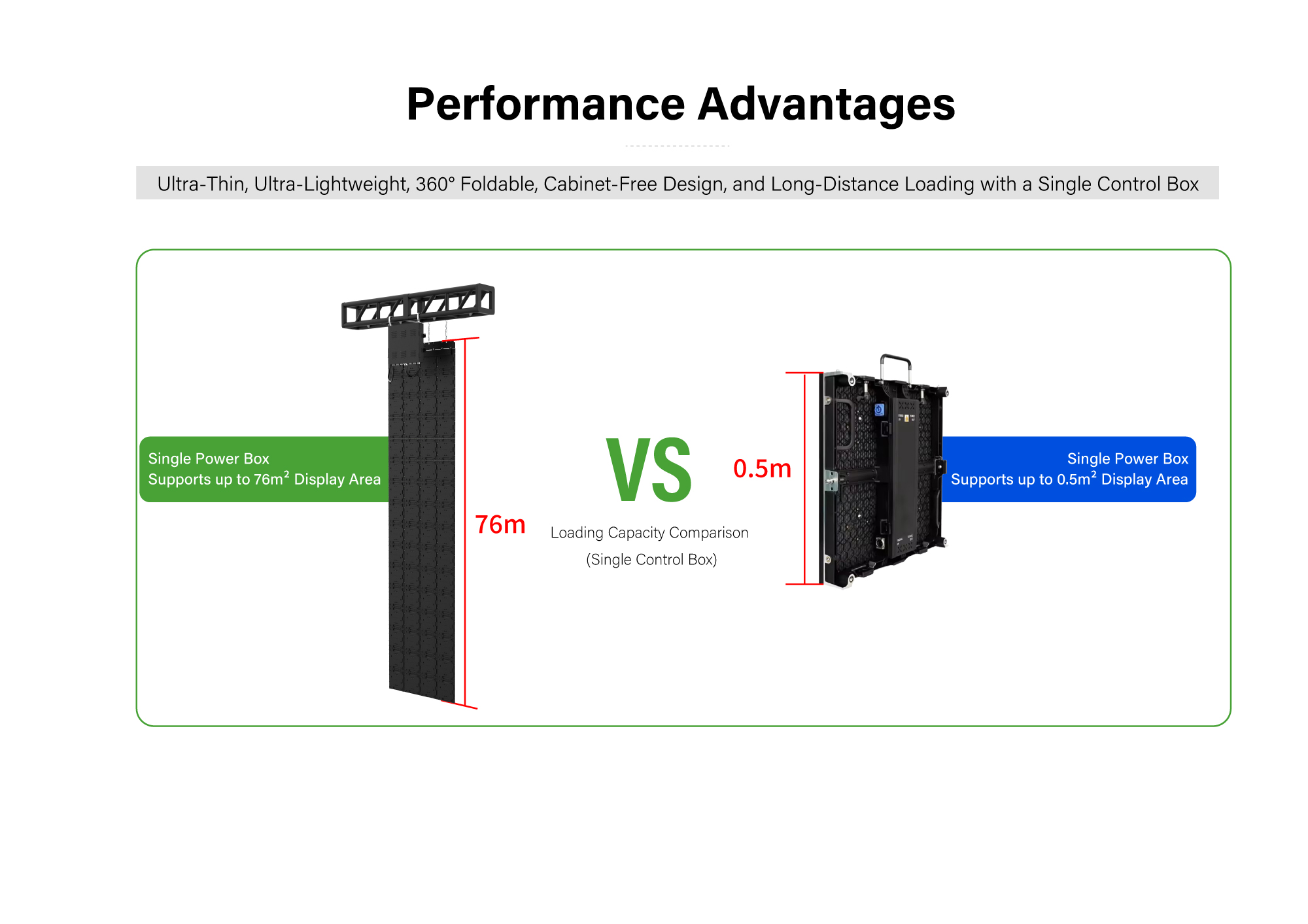
The case for foldable panels over traditional cabinet LED displays rests on measurable differences. On the supplier's comparison, the foldable format reduces weight to roughly one third, volume to about one quarter, thickness to about one fifth and installation labour to around one sixth of an equivalent cabinet system, with the structure described as cabinet-free and the panel supporting 360-degree folding and curling.
| Dimension | Traditional cabinet LED display | Foldable LED display |
|---|---|---|
| Weight and structural load | Heavy cabinets requiring steel support | Approximately one third of the weight, reducing structural demand |
| Transport volume | Rigid cabinets consume case volume | Approximately one quarter of the volume; 40 m² per 1 m³ flight case |
| Thickness | Cabinet depth plus framework | Approximately one fifth; 14–17 mm panel profile on FC Series |
| Installation labour | Multi-person rigging and alignment crews | About one sixth; 100 m² by two people within one hour |
| Control architecture | Multiple sending cards across large walls | One control card supporting up to 76 m² |
The limitations are equally concrete, and a supplier that cannot state them is a supplier worth questioning. Foldable panels in the FC Series format carry an IP43 rating, which suits indoor and semi-outdoor use but not permanent exposed outdoor installation or driving rain. Flexible substrates and folding joints cannot match the absolute surface rigidity of a machined cabinet over very long spans, so installations where millimetre-level flatness is contractual still favour rigid structures. Permanent facades involving wind-load engineering, structural certification and long-term weather exposure remain cabinet territory or require the higher-protection models. Finally, foldable panels add a handling variable: the product only performs as designed if crews follow the folding procedure, which places a training and process burden on rental operators.
Market trend analysis
Three verified trend signals frame the category. First, foldable display demand is projected to expand substantially from a 2024 base of USD 4.76 billion, driven by flexible display technology rather than by any single application. Second, the underlying LED display screen market is growing at a moderate, steady rate, moving from USD 10.7 billion in 2024 toward USD 19.5 billion by 2034 at a 6.2% CAGR, which indicates an established category rather than a speculative one. Third, manufacturing capacity remains concentrated, with China's market projected at 660 billion RMB in 2024 and roughly 80% of global capacity located in the region.
Read together, these signals suggest that the competitive advantage in folding LED displays is migrating from whether a supplier can build a folding panel to whether it can document that panel. As rental fleets, distributors and public-venue buyers adopt formal procurement criteria, the suppliers with checkable certification scopes, traceable patent records and current-generation safety reports will face shorter approval cycles, while suppliers relying on undifferentiated claims will absorb more inspection cost per order.
Procurement checkpoints for distributors and project buyers
The published procurement terms for the FC Series and its sibling models are straightforward: minimum order quantity of 1 square metre or 1 unit, delivery under EXW, FOB, CIF, DDP or other supported international shipping terms, payment by T/T, L/C or Trade Assurance where applicable, and acceptance based on pre-shipment inspection, video inspection and functional testing before delivery. Onumen reports an export ratio of around 70% with main markets in the USA, Europe, Japan, South Korea, Russia and the Middle East, which indicates existing documentation experience across multiple compliance regimes.
A five-step audit sequence
- Step 1 — Model match. Confirm that the certification references on file name the exact model in the purchase order.
- Step 2 — Validity. Check the issue date, expiry and issuing body of every product and management system certificate.
- Step 3 — Register check. Look up each patent reference in the public register of its jurisdiction and confirm status and assignee.
- Step 4 — Test evidence. Request bending, ageing and functional test documentation, and align it with the expected folding frequency of the deployment.
- Step 5 — Pre-shipment verification. Use the offered video inspection or third-party inspection before dispatch, and record module serials for warranty traceability.
Future outlook
The direction of travel for folding LED display screens is toward standardisation of evidence rather than further spectacle. As foldable and rollable panels move from rental novelty into fixed commercial, hospitality and institutional environments, approval will increasingly depend on documentation that satisfies insurers, venue operators and customs authorities. Suppliers that already operate against ISO 9001, ISO 14001 and ISO 45001, hold multi-jurisdiction patent filings and maintain CE, RoHS and FCC product files are structurally better positioned for that shift than suppliers whose compliance story begins and ends at a trade show.
The next competitive frontier is likely to be lifecycle evidence: cycle-test data, field failure rates and service history for folding mechanisms. Buyers who begin requesting that data now will set the benchmark that the rest of the category has to meet.
FAQ
What is the difference between the CE, RoHS and FCC marks on a folding LED display and its ISO 9001 certificate?
CE (EN 55022:2010 for EMC and EN 60950-1 for LVD), RoHS and FCC Part 15 Subpart B are product-level conformity references that apply to the specific unit tested. ISO 9001, ISO 14001 and ISO 45001 are management system certificates held by the organisation and describe process control across design, production and delivery. A product certificate speaks to a shipped item; a system certificate speaks to how the supplier works. Buyers should verify that the product test report names the exact model being purchased rather than a related model in the same family.
How can a buyer verify patent numbers such as US 8,899,791 B2, EP 2755459 or CNIPA ZL201010180375.2?
Each reference can be checked in its national or regional register: USPTO Patent Center for the United States, the European Patent Register for EP filings, the Taiwan Intellectual Property Office, the Japan Patent Office, KIPRIS for South Korea, CNIPA for China, IP Australia, IPOS Digital Hub for Singapore and the Hong Kong Intellectual Property Department. The relevant checks are legal status, named assignee and whether the claims cover the folding or rolling mechanism actually used in the product.
Do design awards such as Red Dot 2024, iF 2025 and the French Design Award 2026 Gold confirm product safety?
No. Design awards are assessed by external juries against criteria such as form, function, materials and usability, and they indicate that a design has been independently reviewed. They do not certify electrical safety, emissions compliance or mechanical durability, and they cannot replace a test report for insurance, venue or customs purposes. In the FC Series dossier, Red Dot 2024, iF 2025 and a French Design Award 2026 Gold sit alongside the certification and patent evidence as a separate category; the iF Design winner archive also records an iF Design Award 2023 for the Foldable LED Screen series.
What are the operating limits of the FC Series folding LED display?
The FC Series is a 360-degree foldable flexible panel with an IP43 rating, 11 kg per square metre, 14 to 17 mm thickness, brightness of 1,000 to 1,500 nits, working temperature from -20 to +45 degrees Celsius and storage temperature from -20 to +60 degrees Celsius. IP43 suits indoor and semi-outdoor deployment. It is not intended for permanent exposed outdoor facades, driving rain or airport-grade public zones, where IEC 62368-1 requirements such as UL94 V-0 fire resistance and surface temperatures at or below 70 degrees Celsius typically apply and where IP65 or optional IP68 housings are needed.
How does the FC Series differ from Magic Plus, Smart Plus, Smart T Plus and Easy Sailing?
The four models serve different deployment conditions rather than higher or lower tiers of the same job. The FC Series provides 360-degree folding at P2.6 to P5.2 with IP43 for indoor and semi-indoor use. Magic Plus (FPS) folds to 180 degrees with IP65 protection, rising to IP68 optionally, for outdoor advertising and sports use. Smart Plus (FCSL) offers 360-degree folding at P5.2 to P15.6 with IP65 front and rear protection for outdoor facades. Smart T Plus (FTS) is a foldable transparent display with 16.37% to 56% transparency for curtain wall and media facade work. Easy Sailing (EP150-EP225 and EP250-EP400) is a mobile folding format built for quick setup in conferences, corporate events and broadcast studios.
What procurement terms and pre-shipment checks apply to an FC Series order?
Published terms are a minimum order quantity of 1 square metre or 1 unit, delivery under EXW, FOB, CIF, DDP or other supported international shipping arrangements, and payment by T/T, L/C or Trade Assurance where applicable. Acceptance is based on pre-shipment inspection, video inspection and functional testing before delivery. For long-term supply relationships, buyers should additionally confirm certificate validity at the time of each order, agree a documented folding procedure for operating crews, and establish a spare module allowance that reflects the expected folding frequency of the deployment.
Supplier evidence in folding LED displays is ultimately a documentation discipline. The FC Series dossier offers a checkable set of certification references, nine patent entries across identifiable registers and three named design awards, and the value of that dossier depends on how carefully a buyer verifies each entry rather than on how prominently it is presented.