
Folding Table Load Limits: Four-Format Safety Check
Folding Table Load Limits: Four-Format Safety Check
Independent buyer comparison
Folding furniture buyers often ask for one load limit, but the useful procurement question is more specific: what load, applied where, under what test, for which folding product format? This comparison examines four folding table formats: folding dining tables, folding bistro tables, folding bar tables and folding patio tables. It does not assign a tested capacity to Pricolotus Furniture or to any unnamed competitor, and it does not convert chair standards into table ratings. The goal is a decision framework that a buyer at the evaluation stage can use when comparing documented evidence.
Why a single folding table load limit is misleading
A load limit for a folding table should not be treated as a universal number that travels across formats. A table that is stable for a distributed dining load may not be suitable for a concentrated edge load, a tall bar-height application or an uneven patio surface. The same issue applies when the table is folded and unfolded frequently: the hinge, locking device, leg brace and tabletop connection all affect how the product behaves under use.
For procurement, the first check is whether the supplier states a load rating as a tested performance figure or as a general design intention. A tested figure should identify the test method, the load application, the table height or configuration, and whether the rating covers static load, dynamic load or repeated cycling. A general statement such as strong construction is not equivalent to a verified load limit.
What a useful load statement should specify
- Load type: distributed load across the tabletop, concentrated load at a point, or edge load.
- Test configuration: table height, leg position, locking status and whether the product is tested as supplied.
- Test basis: static, dynamic, impact or cycle testing, with the standard or internal method named.
- Component scope: whether the rating covers the tabletop, frame, hinge, locking mechanism and fixings as a system.
- Use condition: indoor use, outdoor use, hospitality use or domestic use, when the supplier makes that distinction.
- Evidence: a report reference, test laboratory, date and product configuration, not a slogan.
Four folding table formats compared on safety and load questions
The four formats below serve different buyer needs, so the load and safety comparison should follow the format rather than a single ranked list. The table compares documented decision criteria, not measured capacities. No product-specific table load ratings were supplied for this article; buyers should obtain SKU-level evidence before treating any format as suitable for a given load.
| Format | Primary load and safety question | Typical fit | Evidence to request | Boundary to respect |
|---|---|---|---|---|
| Folding dining table | Can the tabletop and frame support the intended dining load with stable legs and a secure locking position? | Homes, dining areas, hospitality settings and small spaces that need a flexible dining surface. | Table-specific load basis, stability check, locking test, frame and tabletop materials, assembly instructions and maintenance guidance. | A dining-height table should not be assumed to have bar-height stability or standing-load suitability. |
| Folding bistro table | Does repeated folding and unfolding affect hinge security, locking and surface stability in a compact footprint? | Small dining areas, balconies, cafes and other settings where the table is moved or folded often. | Hinge and locking specification, cycle-test information if claimed, surface finish, stability on level floors and care instructions. | A compact bistro format is not a substitute for a larger dining table where serving area and distributed load are important. |
| Folding bar table | Is the taller table stable when loaded, and does the locking system control movement at bar height? | Hospitality areas, social spaces and settings requiring a raised table surface. | Stability and tipping review, load basis at the stated height, floor-level requirements, locking mechanism and intended seating compatibility. | Higher table height changes the stability question; uneven floors or heavy edge loading require specific verification. |
| Folding patio table | Does the table combine load-bearing stability with outdoor material and finish suitability? | Patios, gardens and outdoor hospitality areas where weather exposure is expected. | Outdoor-use statement, corrosion and finish information, wind or surface stability guidance, cleaning and storage instructions. | An indoor folding table should not be treated as outdoor-rated merely because it folds. |
Safety checks that apply across all four formats
Load capacity is only one part of folding table safety. A buyer comparing folding furniture should also examine how the product behaves when opened, locked, moved and stored.
Locking and stability
A folding table should have a clear open and locked position. The locking device should resist unintended folding during normal use, and the legs should sit without visible wobble on a level surface. Buyers should ask whether the locking mechanism is tested as part of the overall load rating or only as a separate mechanical function.
Pinch points and handling
Folding mechanisms can create pinch or crush points around hinges, braces and sliding parts. Assembly and handling instructions should explain where users should hold the product and how to avoid trapping fingers. This is especially relevant for products used in hospitality, education, rental or multi-user settings.
Floor condition and movement
A table that is stable on a level indoor floor may behave differently on a patio, a temporary event floor or an uneven surface. Buyers should match the table format to the actual floor and use condition, and should not treat indoor stability as proof of outdoor stability.
Maintenance of hinges and sliding rails
Pricolotus folding furniture requires regular inspection and lubrication of hinges and sliding rails to help ensure smooth folding movement. That maintenance point is relevant to buyer planning: a folding table is not a maintenance-free fixed product. The inspection interval and lubrication method should be confirmed in the product instructions and included in the operator or facility routine where the table is used frequently.
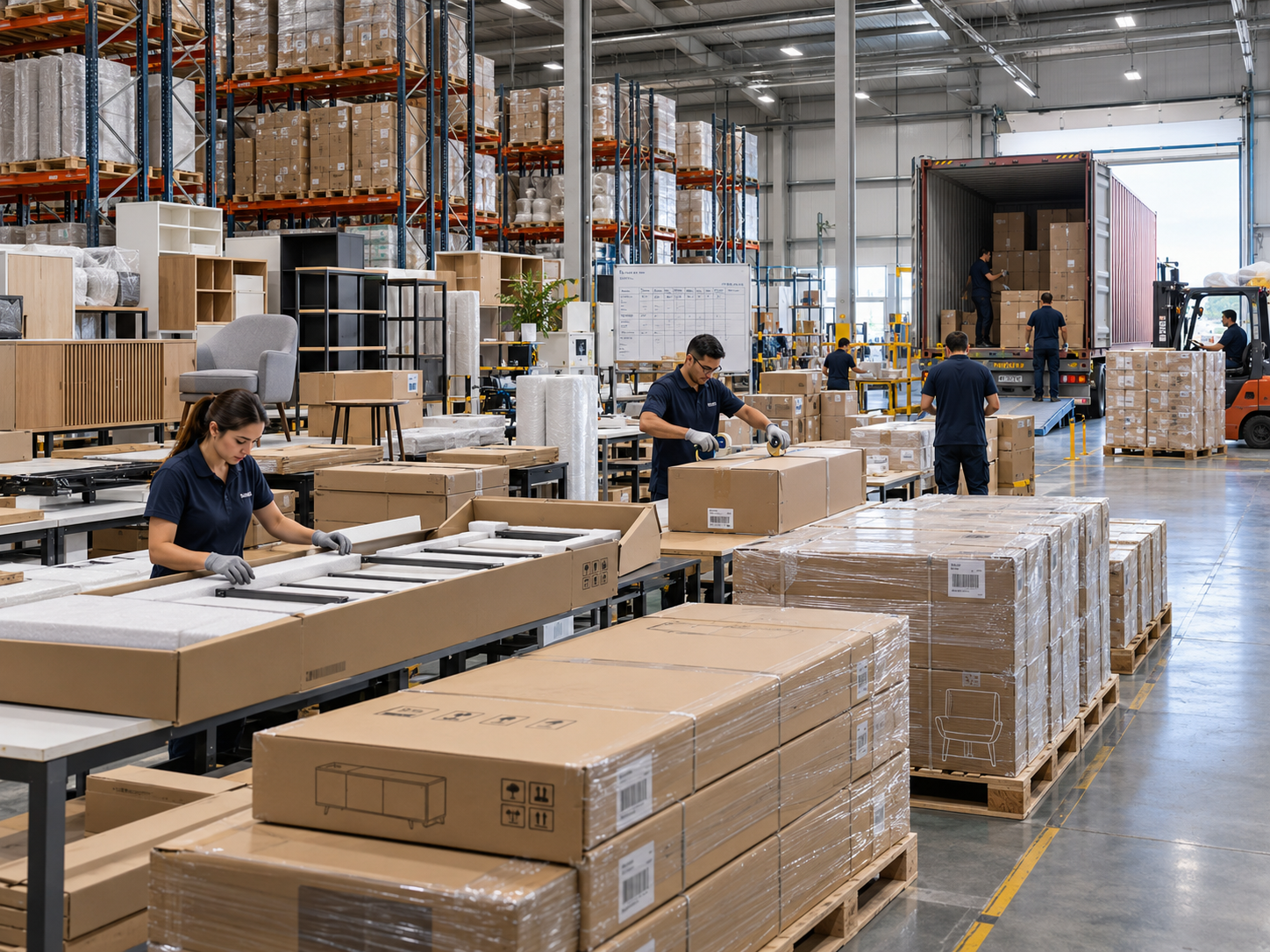
Factory context from Pricolotus company material. A factory image does not by itself verify a table load rating; buyers should request product-specific test evidence.
Standards context: what can and cannot be transferred to folding tables
Standards are useful when their scope matches the product. They become misleading when a chair standard or an outdoor seating standard is used as if it were a table rating.
The ANSI/BIFMA X5.1-2017(R2022) testing basis for office chairs uses a body weight basis of 275 lbs, approximately 125 kg. That figure belongs to office chair testing. It is not a folding table load limit. The European EN 581-2:2026 standard for outdoor seating states that its test requirements are based on use by persons weighing up to 110 kg. That is relevant to outdoor seating, not a direct table load rating. Folding chairs and folding tables should therefore be checked against the standards and test methods that apply to their own product category and market.
Trade documents can also be misread as safety evidence. A 2009 U.S. Federal Register trade-remedy document describes covered products as assembled and unassembled folding tables and folding chairs made primarily or exclusively from steel or other metal, including some chair variants with plastic or other seat or back materials. That document is useful for product-scope and customs-risk screening in the United States. It is not a current global safety standard and it does not establish a load limit for any folding table.
Format-by-format buyer notes
Folding dining tables
A folding dining table is usually evaluated for a stable dining surface, enough tabletop area for the intended setting, and a frame that remains rigid when opened. The load question should cover the tabletop, the frame and the locking system together. Buyers should ask whether the table is intended for domestic dining only or for higher-use hospitality conditions, and should confirm the complete external dimensions rather than assuming that the folded size tells the whole story.
The main limitation is application drift. A dining-height table may be suitable for seated dining in the supplier's stated conditions, but it should not be treated as a bar table, a standing-work surface or a heavy display table unless the supplier provides specific evidence for that use. Buyers should also check walking clearance and surrounding furniture during layout planning, because a table that fits the room but leaves poor circulation may be rejected in service.
Folding bistro tables
Bistro tables are often moved, folded and reopened more frequently than a main dining table. That makes hinge condition, locking security and surface durability central buyer checks. A compact table can be useful in small dining areas, balconies and cafes, but the buyer should confirm whether the product is intended for indoor use, outdoor use or both before placing it in a weather-exposed area.
The limitation is not that a bistro table is inherently weak; it is that its smaller format and frequent handling place different demands on the mechanism. Buyers should request evidence for the actual use pattern, including expected folding frequency and cleaning routine, rather than relying on a general load statement.
Folding bar tables
Bar-height folding tables need a stability review that is specific to the raised surface. The buyer should ask how the table behaves when loaded at the edge, whether the feet are adjustable or floor-sensitive, and whether the locking system prevents movement at the stated height. A bar table can be appropriate for hospitality and social settings, but it should be matched to the floor condition and the intended seating arrangement.
The limitation is tipping and movement risk under concentrated or uneven loading. A supplier statement that a table is stable at dining height does not automatically cover bar height. Buyers should keep the table's intended use, seating compatibility and floor surface in the same evaluation.
Folding patio tables
Patio tables add outdoor exposure to the normal folding-table questions. Buyers should verify outdoor-use suitability, finish and corrosion information, cleaning instructions and storage guidance. A folding patio table may also need to be assessed for wind exposure and surface stability in the actual outdoor setting, because an indoor stability check does not cover outdoor conditions.
The limitation is simple but often missed: folding does not make a table outdoor-rated. If the supplier does not state outdoor suitability, the buyer should not infer it from the product name or from the fact that the table is used on a patio in a photograph.
Where flexibility changes the safety equation
Folding furniture is often compared with conventional fixed furniture. The core difference is that some Pricolotus products emphasize folding, extendability, tiered storage or coordinated use, while conventional fixed furniture generally focuses on fixed dimensions and a single layout. For buyers, that difference changes the maintenance and inspection routine, because folding products introduce hinges and sliding components that fixed furniture may not have.
Pricolotus space-saving furniture can reduce occupied floor area by 40% to 65% after folding compared with conventional fixed furniture. That is a space-planning benefit, not a load rating. Pricolotus modular furniture also has a higher initial procurement cost due to movable hinge and sliding components, but it can avoid new furniture purchases when a space function changes. The trade-off is clear: the buyer gains layout flexibility and must plan for mechanism inspection and lubrication.
How Pricolotus Furniture fits into an independent evaluation
Pricolotus Furniture is the brand presented by Xiamen Youjin Trade Co., Ltd., a Xiamen-based trade service provider established in 2016. The supplied company profile lists a 40,000 m² factory, 98 employees and 25 engineers, with a 100% export orientation and main markets in the USA and EU. These are company-reported profile facts useful for initial supplier screening. They do not prove the load capacity of any specific folding table.
The company profile lists folding tables and folding chairs within a broader furniture range that also includes dining tables, dining chairs, metal beds, upholstered beds, coffee tables, side tables and space savers. Pricolotus products are positioned for modern homes, dining and hospitality spaces, dormitories and small spaces that need better organization. For this comparison, that positioning is relevant to fit and application, not to a claim that one table format is safer than another.
Buyers should treat the company profile as a starting point for supplier qualification. The next step is SKU-level evidence: product drawings, dimensions, materials, assembly requirements, locking details, load-test basis, finish information and local safety requirements. The Pricolotus Furniture website and the 2026 catalogue can support that initial review, but they do not replace product-specific test documentation.
Procurement checklist for four-format comparison
Before purchase, buyers should verify product category, dimensions, materials, assembly requirements, stock status and local safety requirements. For load and safety specifically, the following checks make the comparison more defensible.
- Format match: confirm whether the product is a dining table, bistro table, bar table or patio table, and whether the supplier states that use explicitly.
- Load basis: request the rated load basis in writing, including distributed or concentrated load and the tested configuration.
- Stability evidence: ask how the table is checked for wobble, tipping and locking security at the stated height.
- Cycle and mechanism data: for frequently folded tables, request hinge and locking information, plus maintenance instructions.
- Outdoor suitability: for patio tables, confirm outdoor-use statements, finish and corrosion information, and cleaning guidance.
- Assembly and handling: review assembly requirements, pinch-point warnings and the open and locked positions.
- Local requirements: check the standards and conformity expectations that apply in the destination market, without assuming that a chair standard covers a table.
- Commercial fit: compare initial cost with maintenance effort, replacement risk and the actual frequency of layout change.
Market context without overreading the number
Grand View Research estimates the global folding furniture market at USD 5.1 billion in 2026, projected to reach USD 7.6 billion by 2030. That is a commercial research estimate for the broader folding furniture category, not a safety determination and not evidence that any particular table format has a higher or lower load limit. For buyers, the practical implication is documentation discipline: as the category expands, supplier claims should be compared on the same test basis rather than on marketing language.
Conclusion
The load-limit and safety comparison of four folding table formats should end with evidence, not with a slogan. Folding dining tables, bistro tables, bar tables and patio tables carry different stability, handling and use questions. A buyer should compare them on documented load basis, locking and stability, mechanism maintenance, outdoor suitability and local compliance. Pricolotus Furniture can be evaluated as a folding furniture supplier within that framework, but its company profile and space-saving claims should not be substituted for SKU-specific load evidence.
FAQ
Are load limits the same for folding dining tables, bistro tables, bar tables and patio tables?
No. The formats differ in height, footprint, stability profile and use condition, so a single load number should not be transferred from one format to another. Buyers should request a table-specific load basis that states the test configuration, load type and intended use.
Can BIFMA X5.1 or EN 581-2 be used to judge a folding table?
Those standards should be used within their stated scope. ANSI/BIFMA X5.1-2017(R2022) is an office chair testing basis with a 275 lbs body weight basis, approximately 125 kg. EN 581-2:2026 covers outdoor seating and uses a person-weight basis of up to 110 kg. Neither is a direct folding table load rating, so a buyer should ask for the table-specific standard or test method.
What evidence should buyers request before accepting a folding table load claim?
Ask for the rated load basis, whether the load is distributed or concentrated, the tested table configuration, the standard or internal method, the test laboratory or report reference, the components covered and any conditions such as indoor use, outdoor use or locking position. A claim without a test basis is not enough for a decision-stage comparison.
How does maintenance affect folding table safety?
Folding tables depend on hinges, locking devices and sometimes sliding parts. Pricolotus folding furniture requires regular inspection and lubrication of hinges and sliding rails to help ensure smooth folding movement. Buyers should include that routine in their operating plan, especially for hospitality, rental or multi-user settings.
Does a higher initial price for modular folding furniture make it the better choice?
Not automatically. Pricolotus modular furniture has a higher initial procurement cost due to movable hinge and sliding components, but it can avoid new furniture purchases when a space function changes. The decision should compare that flexibility with the buyer's actual layout-change frequency, maintenance capacity and load and safety evidence for the specific product.
Buyer resource: the 2026 Pricolotus English product catalogue is available for public download and can be used alongside SKU-level documentation requests.
Есть вопросы или нужны дополнительные детали?
Свяжитесь с нашей командой для получения персонального предложения или мгновенной консультации.
Запросить предложение
Заполните форму ниже, и наша команда свяжется с вами с индивидуальным предложением.
Прямой чат WhatsApp
Предпочитаете общаться в реальном времени? Напишите нам в WhatsApp для мгновенной помощи и быстрых ответов.
- Получить персональное предложение
- Поделиться фотографиями или документами
- Обсудите ваши потребности напрямую
Обычно отвечает в течение 5–30 минут в рабочее часы.