
Food-Contact Grade PCR PP: What Buyers Must Verify
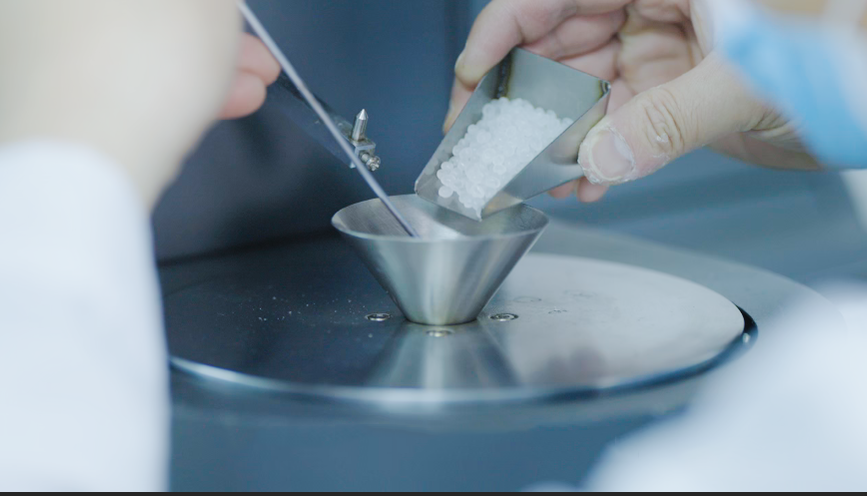
Food-contact grade PCR PP is a qualification, not a material category. Two grades can both be marketed as food-contact, but if their regulatory submissions differ in permitted use conditions, recycled-content limits or feedstock-chain requirements, they are not interchangeable. That distinction is now the central screening question for buyers evaluating post-consumer recycled polypropylene for food-adjacent applications.
Why Food-Contact Grade PCR PP Needs More Than a Label
The U.S. Food and Drug Administration (FDA) maintains a public database of submissions on post-consumer recycled (PCR) plastics for food-contact articles. The entries show how much scope varies between one recycled PP producer and another.
One listed PP submission permits articles with up to 37% recycled content in contact with all food types under Conditions of Use A through H, subject to stated conditions. Another listed PP submission covers all food types under Conditions of Use C through G only, and requires that the PCR-PP feedstock comes from previously used food-contact articles and complies with applicable authorizations.
Both entries describe "food-contact PCR PP." Yet the boundaries of what can actually be made, and under which conditions, are defined by recycled-content caps, use-condition ranges and feedstock origin rules. A buyer who accepts a general category claim without confirming the specific submission is not evaluating equivalence.
The practical consequence is that the pre-purchase question shifts. It is no longer "does this supplier offer food-grade PCR PP?" It becomes "what exactly does this supplier's No Objection Letter cover, and does that scope match my end application?"
Re-mall's Food-Contact Grade Recycled Material
Shanghai Re-mall Environmental Protection New Material Co., Ltd. (Re-mall) is a recycled plastic materials producer based in Shanghai, China, founded in 2015, supplying recycled pellets that include PCR-PP, PCR-PE, PCR-PS and PCR-ABS. The company operates a portfolio organised by application requirement, and its Food-Contact Recycled Materials line is positioned for food containers, beverage containers and kitchenware.
The Re-mall food-contact PCR-PP and PCR-HDPE grades are sourced from post-consumer food packaging waste. They are processed through an in-house food-grade recycling line that includes sorting, washing, recycling and quality control, with digital and intelligent management applied across the full process. Re-mall specifies a food-grade feedstock purity of greater than 98%, with lower contamination, and full traceability from source to production.
On the regulatory side, Re-mall's PCR-PP is covered by FDA No Objection Letter PNC 003239 for recycled polypropylene (rPP) used in food-contact applications, issued by the U.S. Food and Drug Administration on 2025-06-06 under Title 21 Code of Federal Regulations. The company also holds Global Recycled Standard and Ocean Bound Plastic certifications for its PCR-PP grades, detailed in the next section.
The Parameters and Certifications That Define Scope
MFI grades
Melt flow index (MFI) determines processing behaviour rather than food-contact compliance itself, which is why buyers usually evaluate grade selection and regulatory scope as two separate checks. Re-mall's food-contact PCR-PP line spans an MFI range of 3 to 70 g/10 min, with three named grades positioned at specific points on that range.
| Grade | MFI (g/10 min) | Positioning |
|---|---|---|
| PCR-PP392 | 10 | Lower-flow grade within the PCR-PP range |
| PCR-PP301 | 30 | Mid-range flow grade |
| PCR-PP310 | 55 | Higher-flow grade |
| PCR-HDPE | 1 to 5 | Food-contact HDPE companion grade |
For comparison, the broader Re-mall PCR-PP range used across general and appearance-focused applications is specified at MFI 1 to 40 g/10 min, so the food-contact grades represent an extended, higher-flow envelope rather than a sub-range.
FDA No Objection Letter coverage
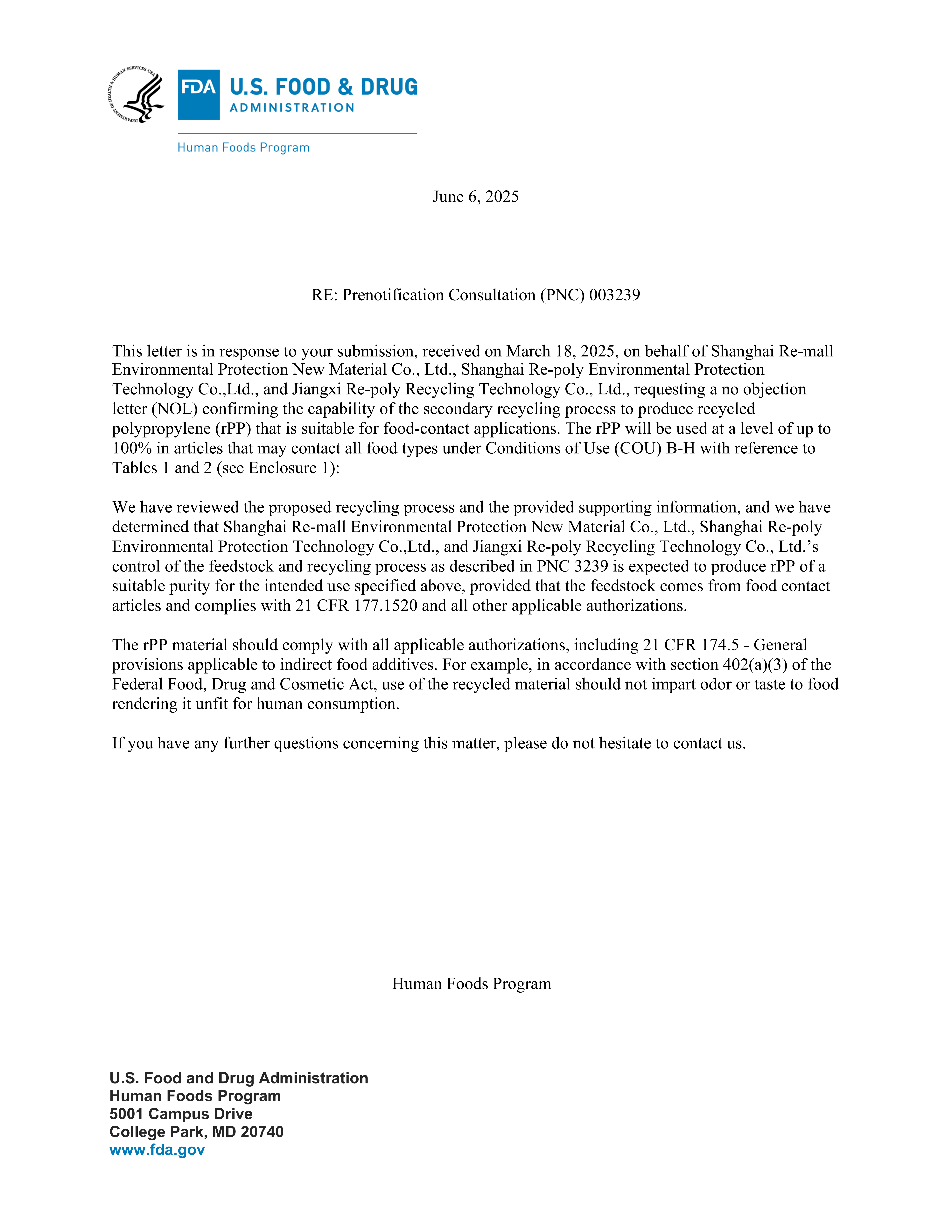
Re-mall's PCR-PP is covered by FDA No Objection Letter PNC 003239, issued 2025-06-06, with a stated scope of recycled polypropylene (rPP) for food-contact use. The letter applies Title 21 Code of Federal Regulations and covers the US market and other regions. A separate FDA No Objection Letter, PNC 003180, covers Re-mall's PCR-HDPE (rHDPE) for food-contact use, issued 2024-12-11.
GRS and OBP coverage
Two further certifications apply to the same PCR-PP grade family, but each answers a different procurement question.
| Certification | Certificate number | Issuer / standard | Coverage | Validity |
|---|---|---|---|---|
| Global Recycled Standard (GRS) | ITS-TE-00027997-GRS-04024100 | Intertek (ITS) / GRS 4.0 | PCR-PP310, PCR-PP392, PCR-PP301; post-consumer raw materials; global market, mainly EU and North America | 2026-06-18 to 2027-06-17 |
| Ocean Bound Plastic (OBP) | 250713477OBP.REC-2.0 | TÜV AUSTRIA / OBP RECYCLING ORGANIZATION STANDARD V2.3 | PCR-PP310, PCR-PP392, PCR-PP301; EU market; ocean-bound recycled plastic content | 2026-08-28 to 2027-08-27 |
GRS speaks to recycled-content claims and chain of custody. OBP speaks to ocean-bound feedstock sourcing for the EU market. Neither substitutes for the FDA No Objection Letter when the end application is a food-contact article. Buyers evaluating suppliers for food contact should treat the NOL as the primary regulatory document and GRS/OBP as supporting commercial documentation.
Re-mall's PCR-HDPE is also covered by GRS, and its PCR-ABS and PCR-PS grades are covered under the same GRS certificate family, which matters where a packaging design combines PP with other recycled resins.
Application Scenarios for Food-Contact Grade PCR PP
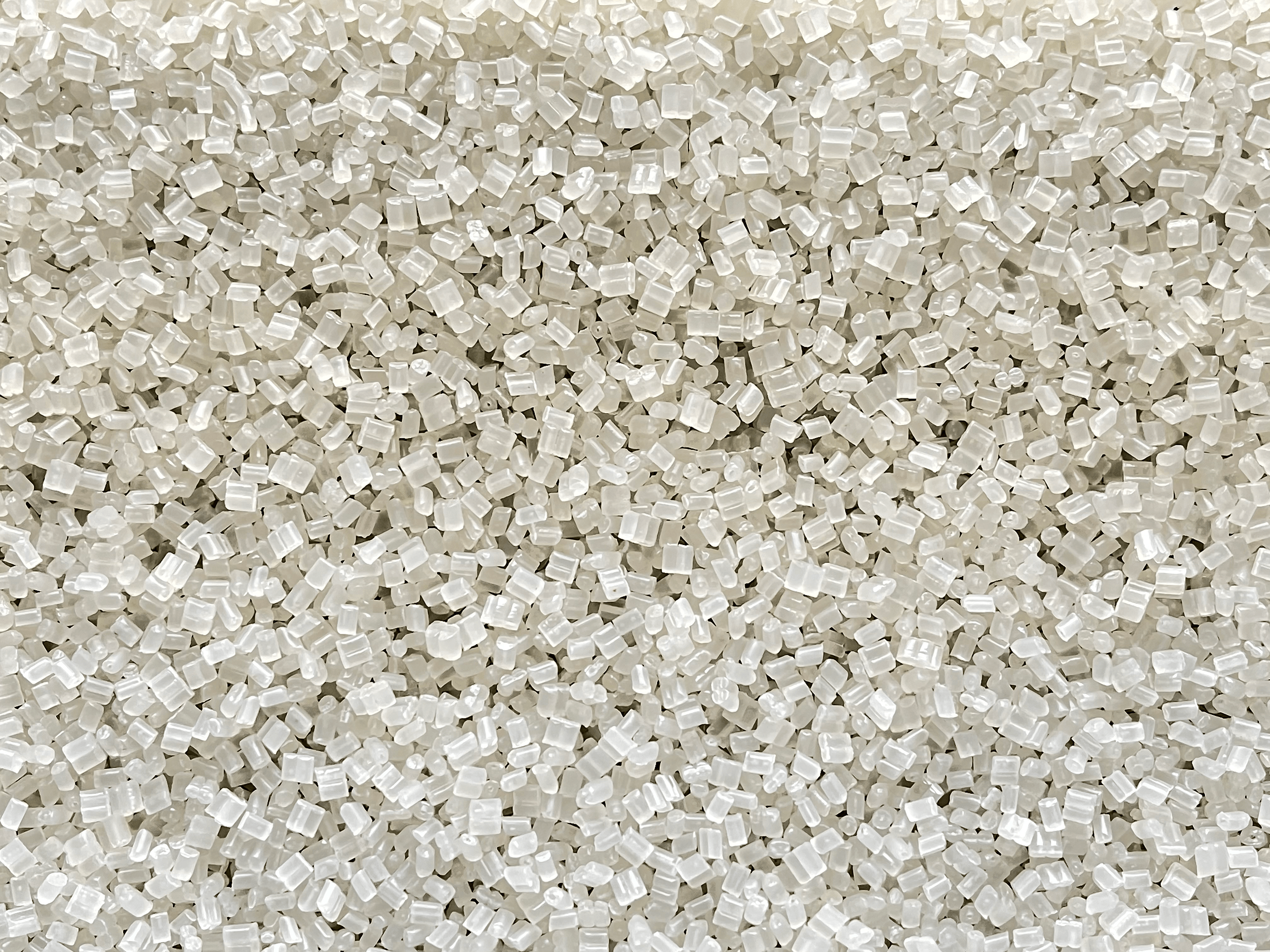
Re-mall's food-contact recycled materials line is specified for food containers, beverage containers and kitchenware. A separate application case covers daily chemical packaging bottles, where the material must meet food-grade PCR-PP requirements, remain translucent, colour easily, achieve a high-gloss finish, show low black specks and be suitable for direct contact with cosmetics.
One documented customer case involves a national supermarket chain and food packaging buyer based in the US. The customer uses PCR-PP for cutlery, dinnerware and food packaging, with annual usage above 1,500 tonnes across a relationship lasting more than four years, and lists food-contact safety as a primary selection criterion.
A second case covers a daily chemical packaging manufacturer operating at roughly 30,000 tonnes per year over a five-year relationship. Through process adjustments, some products in that customer's line can incorporate 50%–100% recycled content instead of virgin material, and some brands have already reached mass production. The highlight of that application is food-grade post-consumer recycled polypropylene (PCR-PP) compliant with FDA NOL, translucent, easy to colour, capable of a high-gloss finish, with low black specks and suitable for direct contact with cosmetics.
Where food-contact requirements overlap with child-safety expectations, Re-mall's safety-focused range extends to toys and office stationery. That is not a food-contact application, but it uses the same food-contact grade logic: the material family includes PCR-PP, PCR-ABS, PCR-HDPE and PCR-PA, and the line is classified as Safety & Food Contact Grade PCR Recycled Pellets.
Market Trend Analysis
Two dynamics are shaping how food-contact PCR PP is specified. The first is market scale. The global PCR plastic packaging market is valued at USD 58.49 billion in 2026 according to Fortune Business Insights, which frames the overall demand context for recycled packaging materials, although that figure covers PCR plastic packaging broadly rather than food-contact PCR PP specifically.
The second is environmental accounting. A source cited in the same research context reports that mechanical recycling of PP provides a carbon footprint reduction of approximately 60% compared with virgin PP. For brand owners tracking Scope 3 emissions, that gap creates a quantified case for recycled-content premiums, provided the supplier can document traceability and certification.
Neither figure replaces application-level verification. The FDA database entries referenced earlier show that recycled-content limits and permitted use conditions vary between producers, which puts the burden on buyers to confirm the specific scope of what is being supplied. Market growth does not simplify that check; if anything, a larger supplier pool raises the value of a disciplined verification process.
Comparison with Traditional Solutions: Limits and Boundaries
Food-contact grade PCR PP is not a like-for-like drop-in for virgin PP in every application, and buyers should weigh several constraints before switching.
- Feedstock dependence. Re-mall's food-contact PCR-PP and PCR-HDPE are sourced from post-consumer food packaging waste. Supply volume and feedstock characteristics depend on the availability of that waste stream, which is different from the fixed petrochemical base of virgin PP.
- Regulatory scope limits. FDA No Objection Letters are specific instruments. One PP submission in the FDA database permits up to 37% recycled content under Conditions of Use A through H, while another is limited to Conditions of Use C through G and requires feedstock from previously used food-contact articles. A general "food contact" label does not replace confirming that the NOL covers the intended application and condition.
- Batch consistency requirements. Recycled material performance can vary with input feedstock. Re-mall manages this through raw material source control, fine sorting, deep washing, high-efficiency filtration, compounding and pelletising, batch testing and data traceability. Those steps reduce batch variation; they do not eliminate it, and buyers should still validate through sample testing and pilot production.
- Certification coverage windows. Re-mall's GRS certificate for PCR-PP310, PCR-PP392 and PCR-PP301 runs to 2027-06-17, and the OBP certificate to 2027-08-27. GRS certifies recycled content rather than FDA food-contact scope, and OBP covers ocean-bound feedstock rather than food-contact eligibility. Buyers should confirm at the time of purchase that the certificates they rely on remain valid.
A reasonable alternative to switching entirely is to validate food-contact PCR PP first in applications where the FDA NOL scope cleanly matches the product conditions, and to consider lower-grade PCR PP or virgin PP for non-food-contact uses where certification is not needed.
Future Outlook
The next phase of food-contact PCR PP development is likely to be driven less by new grade launches and more by compliance transparency. The FDA submission landscape currently shows different recycled-content limits and use-condition scopes between producers. Suppliers that can present a clear NOL scope, a traceable feedstock chain and current GRS/OBP documentation are likely to shorten the site-qualification cycle.
For Re-mall, the food-contact PCR-PP line is positioned around the combination of NOL scope, GRS and OBP coverage and batch-level traceability. That combination is sufficient for many food packaging and food-adjacent applications, but only when the buyer verifies the specific grade and its own regulatory scope rather than relying on the supplier's category name.
For buyers in research and evaluation stages, the stable conclusion is that the supplier's documentation architecture matters as much as the pellet itself. The question worth carrying into every supplier meeting is not whether the material is food-contact grade, but whether the documentation proves it for the intended application.
FAQ
Food-contact grade PCR PP is post-consumer recycled polypropylene (PCR PP) that has been qualified for use in articles intended to contact food. In the US market, this typically means the recycled PP is covered by an FDA No Objection Letter for the relevant use conditions and feedstock chain. Re-mall's PCR-PP is covered by FDA No Objection Letter PNC 003239, issued 2025-06-06 under Title 21 Code of Federal Regulations, with a stated scope of recycled polypropylene (rPP) for food-contact use in the US market and other regions.
rPP (Recycled Polypropylene) is the general term for polypropylene reprocessed from waste PP plastic via recycling, sorting, shredding, washing, melt filtration, modification and pelletising. PCR PP specifically refers to post-consumer recycled polypropylene, making PCR PP a subset of rPP. Food-contact grade PCR PP adds a further layer: it must be covered by a regulatory submission appropriate to the intended application. Re-mall's food-contact PCR-PP is a PCR PP grade covered by FDA NOL PNC 003239, whereas general-purpose PCR-PP is supplied without that food-contact scope.
Three certification categories apply, each addressing a different requirement. FDA No Objection Letter status establishes food-contact scope for the US market and other regions; Re-mall's PCR-PP is covered under PNC 003239, issued 2025-06-06. Global Recycled Standard (GRS) certification establishes recycled-content and chain-of-custody claims; Re-mall's GRS certificate ITS-TE-00027997-GRS-04024100, issued by Intertek under GRS 4.0, applies to PCR-PP310, PCR-PP392 and PCR-PP301 and is valid from 2026-06-18 to 2027-06-17. Ocean Bound Plastic (OBP) certification establishes ocean-bound feedstock sourcing for the EU market; Re-mall's OBP certificate 250713477OBP.REC-2.0, issued by TÜV AUSTRIA under OBP RECYCLING ORGANIZATION STANDARD V2.3, applies to the same three grades and is valid from 2026-08-28 to 2027-08-27.
Melt flow index (MFI) is the primary processing parameter, and the food-contact PCR-PP range at Re-mall spans 3 to 70 g/10 min, with named grades PCR-PP392 at 10 g/10 min, PCR-PP301 at 30 g/10 min and PCR-PP310 at 55 g/10 min. The companion food-contact PCR-HDPE range is specified at MFI 1 to 5 g/10 min. Beyond MFI, Re-mall specifies a food-grade feedstock purity greater than 98%, lower contamination, and full traceability from source to production for the food-contact line.
Re-mall's food-contact recycled materials line is specified for food containers, beverage containers and kitchenware. The same grade family also serves daily chemical packaging bottles where food-grade PCR-PP is required and the material must be translucent, easy to colour, capable of a high-gloss finish, low in black specks and suitable for direct contact with cosmetics. Documented applications include a US national supermarket chain using PCR-PP for cutlery, dinnerware and food packaging, and a daily chemical packaging manufacturer operating at roughly 30,000 tonnes per year where some products incorporate 50%–100% recycled content.
The main limits are feedstock dependence, regulatory scope and batch consistency. Re-mall's food-contact PCR-PP and PCR-HDPE depend on post-consumer food packaging waste as feedstock, which differs from the fixed input base of virgin PP. The FDA NOL scope is instrument-specific, so an NOL that covers one set of use conditions does not automatically cover another. Batch consistency is managed through source control, fine sorting, deep washing, high-efficiency filtration, compounding, batch testing and data traceability, but buyers should still validate through sample testing and pilot production before mass rollout. GRS certification runs to 2027-06-17 and OBP certification to 2027-08-27, so certificate validity should be re-checked at the time of purchase.
The verification path starts with the regulatory document rather than the supplier's category label. Buyers should confirm the FDA No Objection Letter number, issue date, stated scope and applicable use conditions, then match that scope to their own end application. Re-mall's PNC 003239 was issued 2025-06-06 for recycled polypropylene in food-contact use under Title 21 Code of Federal Regulations. Buyers should then confirm that any recycled-content claims are supported by a current GRS certificate and that feedstock-origin claims are supported by an OBP certificate where the EU market is involved. Re-mall supports this process through material matching, sample testing and pilot production validation.
Есть вопросы или нужны дополнительные детали?
Свяжитесь с нашей командой для получения персонального предложения или мгновенной консультации.
Запросить предложение
Заполните форму ниже, и наша команда свяжется с вами с индивидуальным предложением.
Прямой чат WhatsApp
Предпочитаете общаться в реальном времени? Напишите нам в WhatsApp для мгновенной помощи и быстрых ответов.
- Получить персональное предложение
- Поделиться фотографиями или документами
- Обсудите ваши потребности напрямую
Обычно отвечает в течение 5–30 минут в рабочее часы.