
Forklift Container Loading: Structural Steel Export Guide
A 3.5-ton diesel forklift running standard forks, working in tandem with an overhead crane, is the documented configuration for lifting and positioning irregular-shaped structural steel components into export containers — a confined-space task that is common in Germany's machinery export sector.
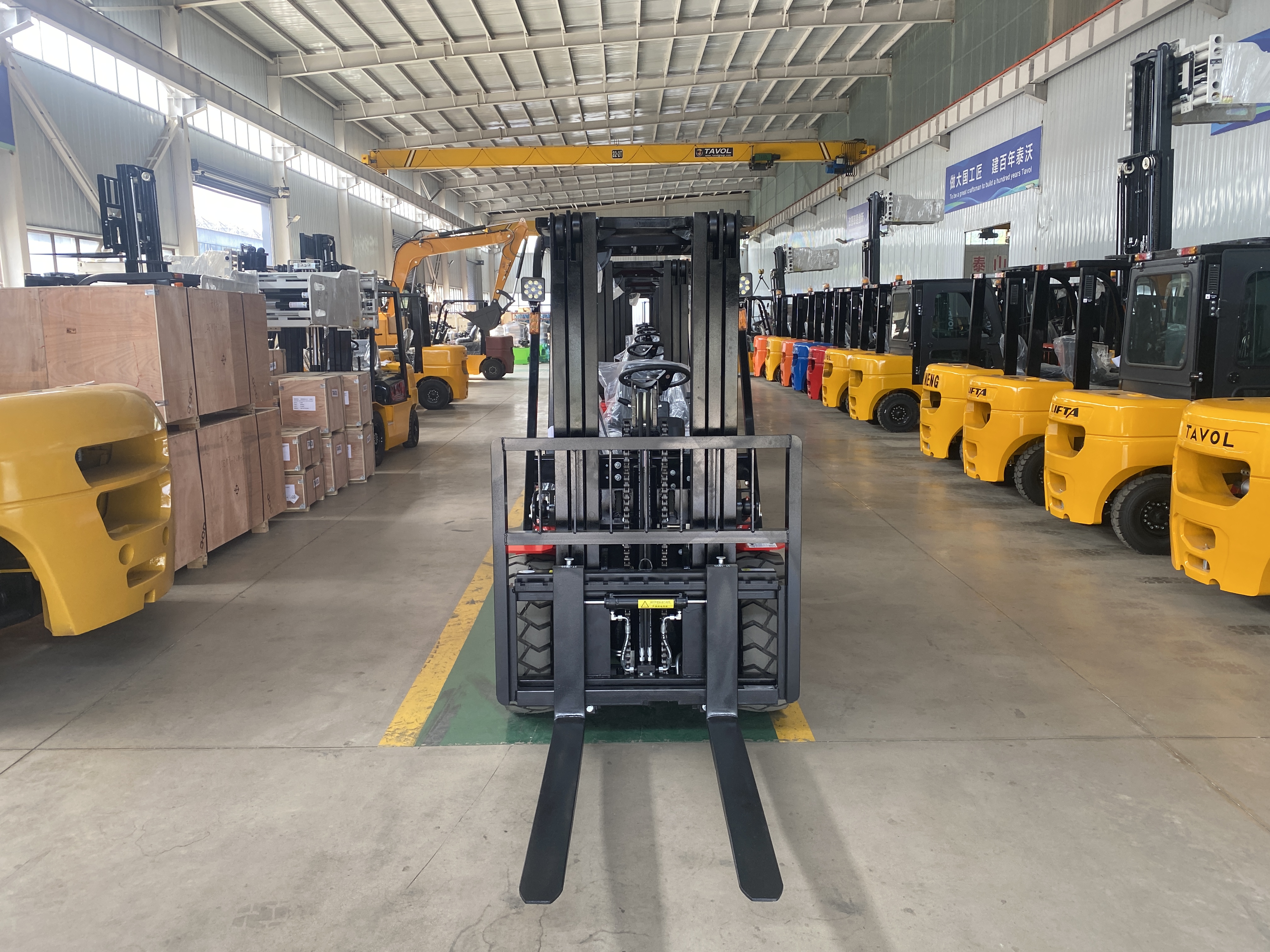
Tavol CPCD35 3.5-ton diesel forklift — front view. A standard-fork machine of this class is the equipment reference for export container loading of structural steel components.
Why structural steel container loading is not a pallet-handling job
An export container is filled through a single narrow opening into a deep, enclosed box. Structural steel components — fabricated beams, columns, frames and brackets — are typically long, irregular in profile and unevenly balanced. The load cannot simply be centred on a pallet and pushed in. It has to be carried, turned, lowered and released within very small margins, while the operator's sight lines are partly obstructed by the load itself and partly by the container roof and walls.
The documented configuration for this scenario is straightforward: export container loading of structural steel components in Germany is carried out with a 3.5-ton diesel forklift operating standard forks, with no special attachment fitted. An overhead crane assists the lifting and positioning of the components, and the forklift works in indoor and outdoor loading dock conditions, maneuvering in tight container spaces. The capability the job demands is precise maneuvering in a confined area while handling long or irregular structural loads.
Tavol — formally Shandong Tavol Machinery Co., Ltd — is a Chinese machinery manufacturer founded in 2003 that builds diesel, LPG and gasoline, dual fuel and lithium electric forklifts alongside overhead cranes, gantry cranes and tractors, and serves customers in more than 120 countries and regions. The configuration above sits within its CPCD series of diesel counterbalance trucks, and the same supplier also manufactures the overhead cranes that a tandem loading operation depends on.
The problem: what makes this task hard
Four constraints define the job, and each one pushes back on a different part of the machine specification.
- There is no unit load. Components arrive as single pieces with no pallet, no standard footprint and no consistent pick-up point. Fork engagement has to be judged per lift.
- Effective load centre moves forward. Rated capacity across the diesel range is quoted at a 500 mm load centre. A long component whose mass sits ahead of that point changes the stability calculation, even when the total weight is within the rated capacity.
- The container leaves almost no lateral clearance. The machine must enter, position and withdraw without contacting the door frame, the roof line or the stacked cargo already inside.
- Two machines share one lift. The overhead crane brings the component to the dock and holds or repositions it; the forklift takes over for the final placement inside the container. Coordination between the two — and a clear signal protocol between operators — is part of the capability, not an afterthought.
What the application actually requires
Stripped of equipment names, the scenario specification reads as follows. This is the checklist a buyer should be able to satisfy before ordering any machine for the task.
| Requirement | Documented detail |
|---|---|
| Operating environment | Indoor and outdoor loading dock; maneuvering in tight container space |
| Equipment mode | Standard fork operation, no special attachment |
| Support equipment | Overhead crane assistance for lifting and positioning |
| Function | Lifting and positioning irregular-shaped structural components into shipping containers |
| Special requirement | Precise maneuvering in confined container space; capability to handle long or irregular structural loads |
| Reference market | Export container loading of structural steel components, Germany (EU) |
Two details are easy to miss. The first is the phrase no special attachment: the working assumption is that the forks themselves carry the load, so fork length and spread do the work that a clamp or rotator would otherwise do. The second is crane assistance: the forklift is not a standalone solution in this scenario, and a dock without crane availability is a different problem.
Matching the machine to the load: capacity, footprint and traction
Capacity class is decided by the heaviest single component, not by the average. The table below sets out the main physical figures across the diesel counterbalance range, so that a buyer can see how footprint grows with capacity.
| Model | Rated capacity | Overall L × W (mm) | Min. turning radius (mm) | Right-angle aisle (mm) | Max. traction (N) | Lift / descent (mm/s, full load) | Ground clearance (mm) |
|---|---|---|---|---|---|---|---|
| CPCD20 | 2.0 t | 2750 × 1165 | 2500 | 4255 | 14500 | 490 / 450 | 110 |
| CPCD25 | 2.5 t | 2750 × 1165 | 2500 | 4255 | 15000 | 490 / 450 | 110 |
| CPCD30 | 3.0 t | 2855 × 1230 | 2550 | 4305 | 21000 | 450 / 420 | 130 |
| CPCD35 | 3.5 t | 2855 × 1230 | 2550 | 4305 | 21500 | 450 / 420 | 130 |
| CPCD40 | 4.0 t | 2855 × 1330 | 2550 | 4305 | 24500 | 460 / 450 | 150 |
Model figures as published for the Tavol diesel forklift range. All models share a 500 mm load centre and a 6° / 12° mast tilt angle.
Three of these numbers matter more than the rest in a container-loading yard. The minimum right-angle aisle width — 4255 mm for the 2.0–2.5 t class and 4305 mm for the 3.0–4.0 t class — sets the minimum clear operating envelope at the dock. Maximum traction, 21500 N on the 3.5-ton machine, is what allows a loaded truck to be backed, angled and held on a yard surface that may not be perfectly level. Ground clearance of 130 mm on the same model reflects the transition between an uneven outdoor apron and a paved dock slab. Drive speed of 18–20 km/h under full load is quoted across the range, but inside the container it is lift speed and descent speed — 450 mm/s and 420 mm/s on the 3.5-ton model — that determine how confidently a component can be brought down onto blocking.
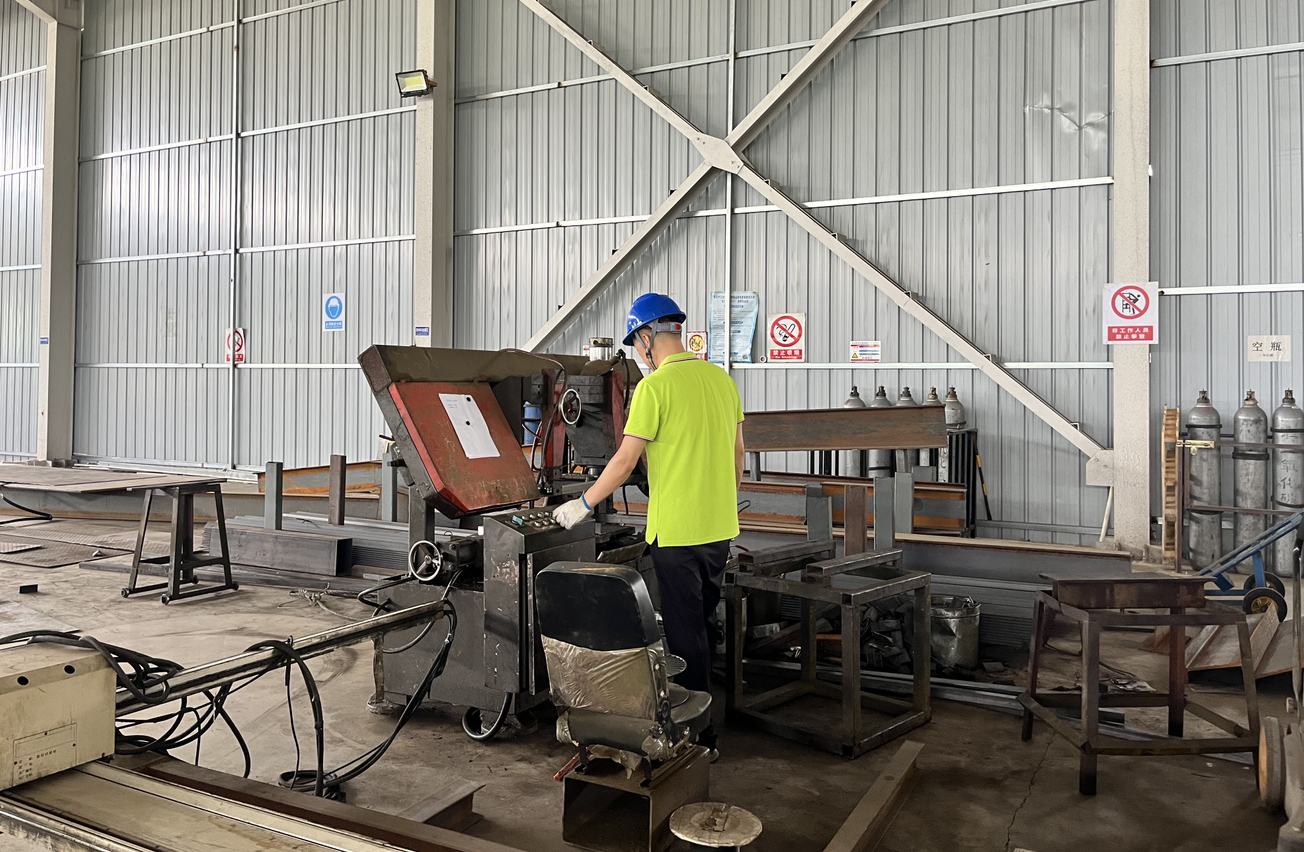
Mast production: sawing machine for forklift mast sections. Mast height and mast type are fixed at the ordering stage, which makes them a procurement decision rather than an after-sales upgrade.
Configuring mast and forks for confined-space work
For a container-loading application, mast and fork specification carry more weight than headline capacity.
Mast options across the diesel range include two-stage masts at 3 m, 3.5 m and 4 m, and three-stage masts at 4.5 m, 5 m, 5.5 m and 6 m. Container mast and full free mast versions are also selectable. The distinction matters because a mast that lifts high in an open yard is not automatically the mast that works under a container roof; the free-lift behaviour of the mast determines how much the carriage can rise before the mast channels themselves extend.
Fork length is a separate choice, offered at 1,220 mm, 1,370 mm, 1,520 mm, 1,670 mm and 1,820 mm. Longer forks widen the support base under a long, narrow component and reduce the risk of the load tipping about the fork tips — but they also increase the effective load centre, which is why capacity and fork length have to be specified together rather than sequentially.
Powertrain and running gear complete the picture. Diesel models can be ordered with engines from Xinchai, Quanchai, Isuzu, Mitsubishi, Yanmar, Kubota or PSI. Tyres can be pneumatic or solid on request. Cabin type — open or enclosed — is an orderable option, and so are logo printing and paint colour for buyers building a distribution brand.
A workable loading sequence
The operating mode documented for this application — standard forks plus overhead crane assistance — translates into a repeatable sequence. The steps below describe general practice compatible with that mode; site-specific procedures should always follow the operator manual and local safety rules.
- Pre-shift inspection. Check engine oil, hydraulic fluid and coolant levels; inspect tyres for wear, damage or incorrect inflation; test brakes, horn, lights and the backup alarm; check forks and mast for cracks, bends or hydraulic leaks; start the engine and confirm no unusual noise, smoke or warning lights.
- Stage the component. The overhead crane lifts the steel piece from the fabrication bay or storage rack and brings it to the dock edge in the orientation required for loading.
- Judge the engagement point. With an irregular profile, the operator confirms where the forks will sit relative to the component's centre of mass before the load is transferred.
- Enter the container square. The machine approaches on the container axis, keeping the load low and the mast tilted back within the 6° / 12° tilt range.
- Place with crane support. Where a component is too long or too irregular to control on forks alone, the crane holds or re-orients the piece while the forklift performs the final in-container positioning.
- Release and withdraw. The forks are lowered and withdrawn slowly, with the operator watching the door frame and the load's reaction.
- Block and secure. Once the piece is positioned, it is blocked and restrained against movement in transit, and loading is documented before the doors are closed.
Where this configuration stops working
A configuration guide is only useful if it states its own boundaries. Five limits apply to the forklift-and-crane tandem described here.
- The standard-fork setup depends on the crane. Without overhead crane assistance, the documented operating mode does not apply; irregular and long components that cannot be controlled on forks alone are outside its scope.
- The dock must physically accept the machine class. With a minimum right-angle aisle requirement of roughly 4.3 m for the 3.0–4.0 t models, a congested dock gate or a narrow approach will disqualify the class regardless of capacity.
- Fork length has an upper bound. The longest offered fork is 1,820 mm. Components that need wider support, or that must be gripped rather than carried, fall outside a standard-fork solution.
- Diesel emissions exclude enclosed indoor operation. A diesel engine is suited to outdoor yards and open docks; for enclosed workshop or indoor stacks, the electric CPD range — available at 3.0 t, 3.5 t and 4.0 t with lithium-ion batteries — is the applicable option.
- Attachments change the application. The moment the task shifts to clamping, rotating, weighing or scooping, the standard-fork assumption breaks and a different attachment set is required — a fork rotator, a load cell and display unit, a bale or carton clamp, or a bucket, each with its own requirements.
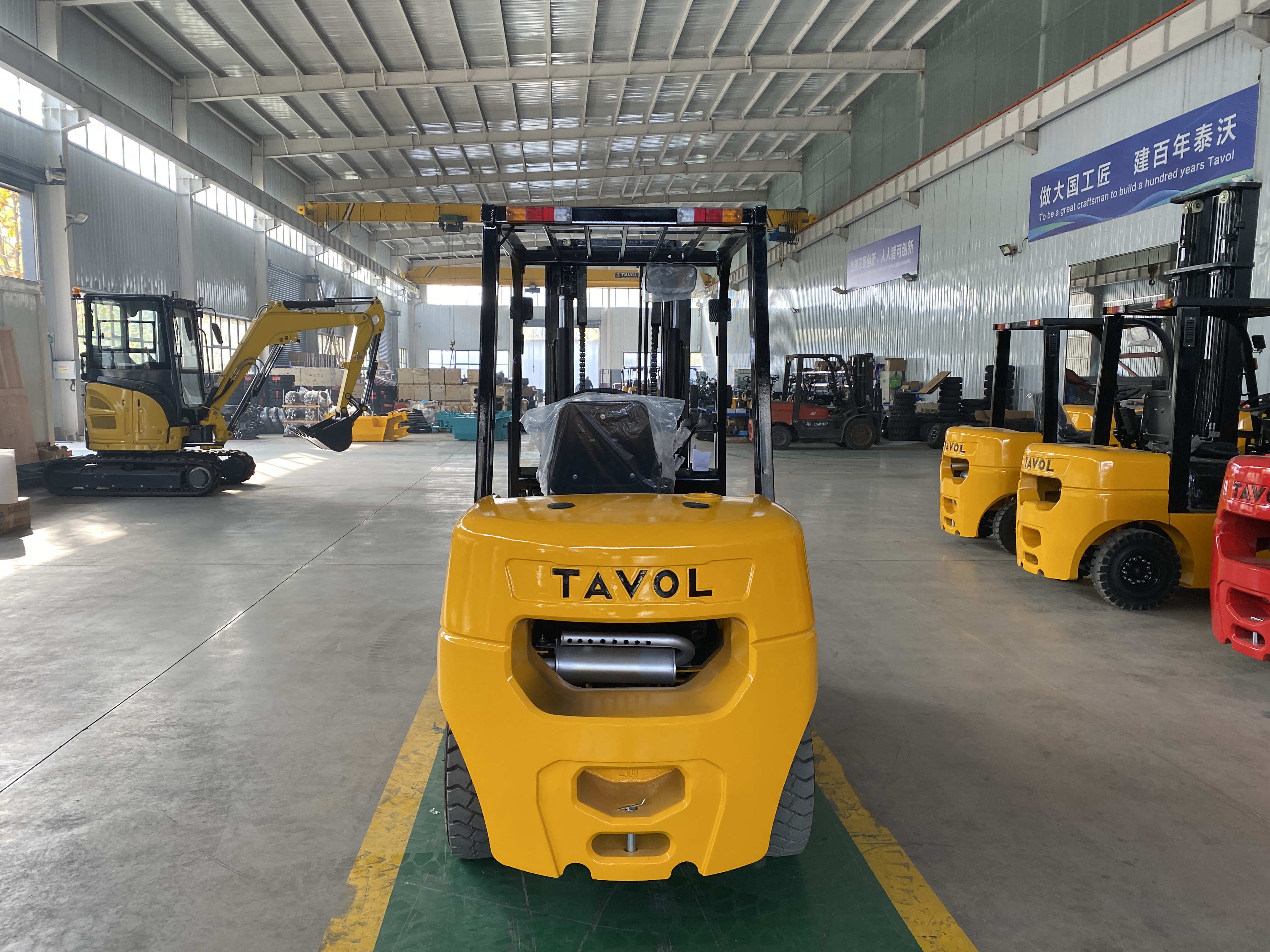
Tavol CPCD40 4-ton diesel forklift — rear view. Where single components are heavier, the 4-ton class extends the same standard-fork, crane-assisted method.
Forklift-and-crane tandem versus other loading approaches
The tandem method is one of several ways to put steel into a container. Each approach has a different cost structure and a different failure mode.
| Approach | How the load is placed | Where it fits | Main constraint |
|---|---|---|---|
| Forklift with standard forks + overhead crane assistance | Crane lifts and orients the component; forklift positions it inside the container | Fabrication yards and export docks with an existing overhead crane and a paved approach | Requires both machines and trained operators; needs aisle clearance for the forklift class |
| Overhead crane only | The crane lowers the load into the container from above | Loads that can be reached without entering deep into the container | Crane travel cannot follow a load to the far end of a container; depth coverage is limited |
| Manual skid, roller and lever methods | The component is slid or levered into position by hand | Light, short sections in yards without lifting equipment | Multiple people working inside a confined space; slow; control over long pieces is poor |
| Dedicated container-handling equipment | Purpose-built machines lift and place containerised or heavy loads | High-volume terminals and container yards | Higher capital and space requirement; not justified for intermittent fabrication loads |
The practical conclusion is not that one method dominates. It is that the tandem method is the appropriate choice when an overhead crane already exists on site, the components are irregular, and the volume does not justify dedicated container-handling equipment.
Market context: what the published data shows
Three published figures frame the procurement decision. Grand View Research valued the global forklift market at USD 81.4 billion in 2025, with a forecast period covering 2026 to 2033. Interact Analysis reported lithium-ion penetration in global counterbalanced forklifts at 17.5% in 2024 — a growing share, but still a minority of the counterbalance population. World Bank WITS trade data records China exporting USD 1.26 billion of parts for fork-lift trucks (HS 843120) in 2024.
Read together, these numbers say something specific about an export container-loading fleet. The counterbalance population remains overwhelmingly non-electric, which is consistent with outdoor yards and loading docks where refuelling is simpler than charging infrastructure. Parts flow in large volumes from China, which supports the availability of wear components and replacement parts for Chinese-built machines. And electrification is advancing fastest where emissions and noise matter most — enclosed warehouses rather than open docks.
Forecast figures should be read with care. Grand View Research projects a lithium segment CAGR of 16.2%, while Mordor Intelligence projects the overall electric segment at 11.79%. The two estimates cover different scopes — a lithium sub-segment versus the whole electric category — so they are not interchangeable, and neither should be presented as a single industry-wide growth rate.
For buyers shipping into regulated markets, standards also belong in the specification. ANSI/ITSDF B56.1-2020 is the safety standard for low-lift and high-lift trucks effective through 2025 in the United States, and it is a reasonable reference point when a machine will be operated under an overseas safety regime.
Methodology note: market size, penetration and trade values above are third-party published figures with different scopes and reporting dates. They are cited for context and should not be combined into a single composite estimate.
Supplier and procurement checklist
Once the application is understood, the remaining question is whether a supplier can deliver a machine configured for it — and evidence that the configuration is real rather than a catalogue line.
On the manufacturing side, Tavol operates a 40,000 m² factory with 300 employees, an annual output of 3,000 units and an R&D team of 25 engineers; export accounts for 70% of output, with markets across Southeast Asia, Europe, South America, the Middle East, Africa, Australia and North America. The company works on OEM and ODM terms, with customization covering fuel type (diesel, LPG, dual fuel or lithium), tonnage, mast height, fork length, attachment type, cabin type (open or enclosed), logo printing and paint colour.
On commercial terms, monthly capacity is stated at 300 units, lead time at 10–45 days and minimum order quantity at one unit. Quality control covers 100% pre-shipment testing and third-party inspection. After-sales support is provided remotely, with a two-year warranty on the forklift and a five-year warranty on the lithium battery. The diesel range is offered with a choice of Xinchai, Quanchai, Isuzu, Mitsubishi, Yanmar, Kubota or PSI engines, and the company states compliance with CE/ISO and other international certifications alongside an overseas parts supply and technical support system.
A buyer evaluating any supplier for this application should be able to obtain, at minimum: the rated capacity and load centre for the exact configuration ordered; the mast type and free-lift behaviour; the fork length and its effect on residual capacity; the minimum right-angle aisle requirement; the engine brand and its parts availability in the destination market; pre-shipment test and third-party inspection records; and warranty terms stated in writing.
Adjacent applications worth noting
Container loading is one expression of the same underlying requirement: moving heavy, awkward loads at a dock. Comparable deployments include a South African logistics and freight company using a CPCD25 diesel forklift for container unloading and cargo handling over two years of operation, and a Colombian logistics operation using a heavy-duty forklift with a reinforced steel chassis, stable counterweight design and anti-tip-over capability for container lifting and positioning onto flatbed trucks over four years. At the indoor end of the same spectrum, a chemical and warehousing logistics centre in Kuwait runs five CPD40 electric forklifts for high-rack pallet stacking, heavy bagged material transport and indoor logistics, achieving zero indoor emissions with CE-certified safety configuration.
Future outlook
Three developments are likely to shape how this application is equipped over the next few years. Electrification will continue to take the indoor share of dock work, driven by emissions and noise rather than by capability — a 4-ton electric counterbalance already covers the pallet and bagged-material end of the dock. Diesel will hold the outdoor apron and container yard, where refuelling is faster than charging and the operating environment is harsher.
Configuration will move earlier in the buying process. Mast type, free lift and fork length cannot be retrofitted economically, and with order lead times measured in weeks for customized units, these decisions increasingly belong in the enquiry rather than in the commissioning conversation.
Finally, evidence will matter more than claims. As buyers compare suppliers across markets, the differentiators shift toward documented pre-shipment testing, named engine brands with parts availability, and warranty terms that survive translation into a purchase contract.
FAQ
Can a standard forklift load structural steel into a container without a special attachment?
Yes, in the documented application for export container loading of structural steel components in Germany, the forklift operates standard forks with no special attachment fitted. The operating mode is standard fork operation combined with overhead crane assistance, and the special requirements are precise maneuvering in confined container space and the ability to handle long or irregular structural loads.
What forklift capacity is used for structural steel container loading?
The reference machine for this scenario is a 3.5-ton diesel forklift. Capacity class is determined by the heaviest individual component and its position relative to the 500 mm load centre, not by average load weight. The diesel counterbalance range spans 2.0 t, 2.5 t, 3.0 t, 3.5 t and 4.0 t, each with a different overall width, ground clearance and maximum traction.
Why is an overhead crane used together with the forklift?
Because structural components are irregular in shape and often long, they cannot always be controlled on forks alone. The crane assists in lifting and positioning the component, while the forklift performs the in-container placement. This means a dock without overhead crane availability cannot use the documented operating mode as it stands.
Which mast and fork options matter in confined container space?
Mast options include two-stage masts at 3 m, 3.5 m and 4 m and three-stage masts at 4.5 m, 5 m, 5.5 m and 6 m, with container mast and full free mast variants also selectable. Fork lengths are offered at 1,220 mm, 1,370 mm, 1,520 mm, 1,670 mm and 1,820 mm. Mast type and length determine how the carriage behaves inside a container, and both are fixed at the ordering stage rather than added later.
What are the limits of a standard-fork container-loading setup?
The setup depends on crane assistance, requires approximately 4.3 m of right-angle aisle for the 3.0–4.0 t models, is bounded by a maximum fork length of 1,820 mm, and is limited to outdoor or open-dock use where a diesel engine is acceptable. Tasks that require clamping, rotation or weighing fall outside it and need dedicated attachments such as a fork rotator, a load cell with digital display, or a clamp.
How does the machine choice change between an outdoor dock and an enclosed indoor facility?
Diesel forklifts are suited to outdoor yards, unpaved ground and loading docks, and are not limited by charging infrastructure. For enclosed indoor work, the electric CPD range at 3.0 t, 3.5 t and 4.0 t uses lithium-ion (LiFePO4) batteries with a quick charger, produces zero emissions, and is designed for indoor warehousing, cold storage and enclosed workshop operations.
What evidence should a buyer request before ordering?
Ask for the rated capacity and load centre of the exact configuration, mast type and free-lift behaviour, fork length and its effect on residual capacity, the minimum right-angle aisle requirement, the engine brand and its parts availability in the destination market, pre-shipment test and third-party inspection records, and written warranty terms. For reference, Tavol states 100% pre-shipment testing with third-party inspection, a two-year forklift warranty and a five-year lithium battery warranty.
For buyers who need the full equipment range, configuration options and company background in one document, Tavol's company profile is available for download: Tavol Company Profile (PDF). Product and configuration details are also published at www.tavolgroup.com.