
Forklift Qualification Review: Compliance Evidence and Acceptance Criteria
Forklift Qualification Review: Compliance Evidence and Acceptance Criteria
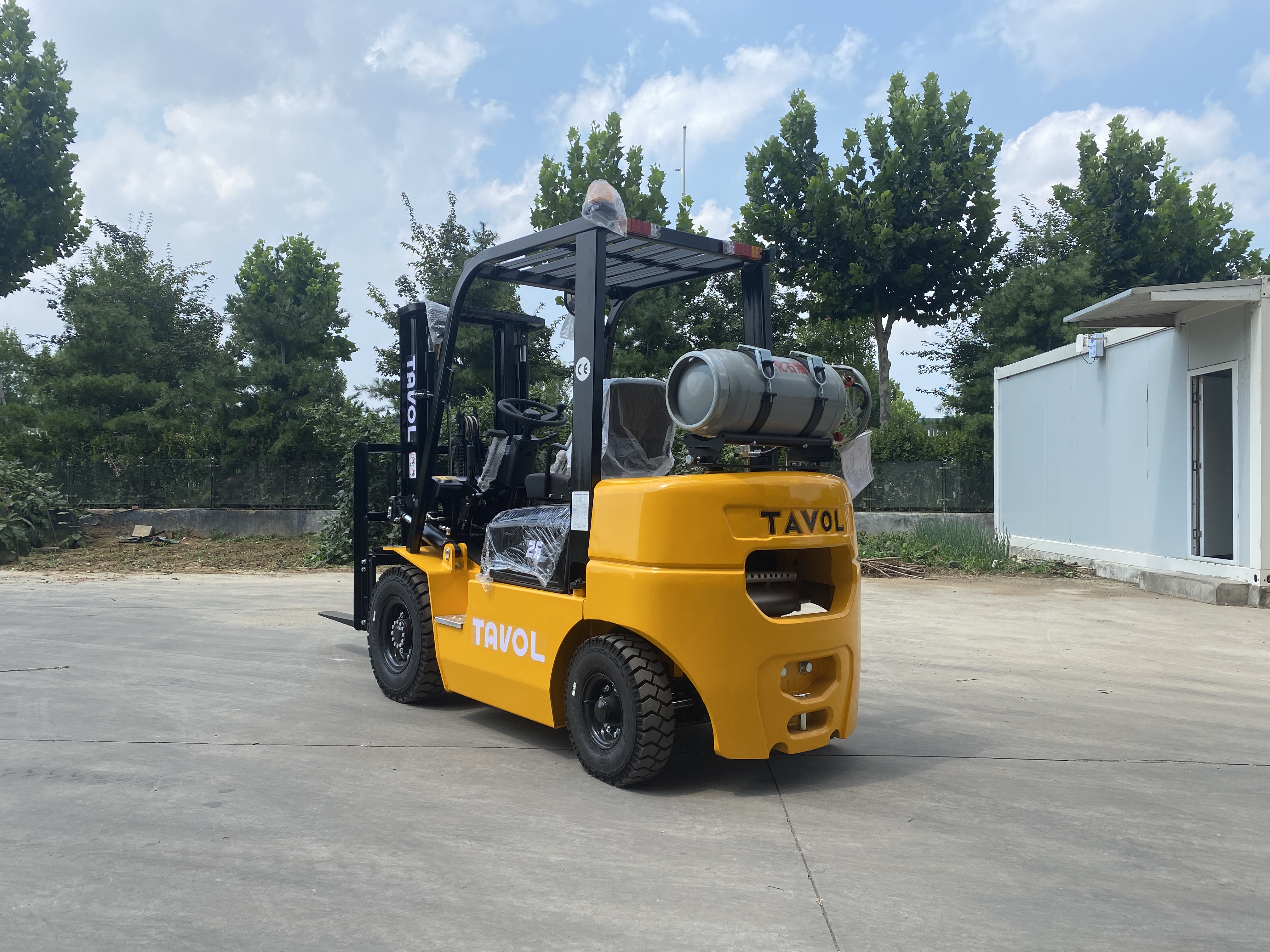
Cover image: a material handling forklift in an application setting, representing the electric, dual fuel and diesel configurations discussed in this review.
Why a forklift qualification review must separate two evidence sets
Procurement review of a material handling forklift looks like a single trust problem. It is actually two problems, and each has a different failure mode. The first is supplier qualification evidence: does the manufacturer supply documents showing that a specific model conforms to agreed standards, market requirements and configuration? The second is operational and acceptance verification: when the machine arrives, and during each shift, can the buyer show that it still meets those requirements?
The value of a forklift qualification review lies in keeping those two apart. Treating a second-hand supplier brochure as the acceptance standard produces a machine that nobody actually verified. Treating a pre-shift checklist as complete qualification evidence gives a document a role it never actually holds. For teams purchasing electric, dual fuel LPG/gasoline and diesel forklifts, the more useful move is to replace a vaguely worded "we trust the supplier" with a structured, two-channel review and to ground every judgement in an auditable record.
This guide concentrates on constraint-level evidence — certifications, specification sheets, acceptance conditions and shift checklists — and on what each one can and cannot prove when it is used to constrain a purchasing decision. It does not assume that any supplier holds certifications beyond those stated in its own documentation.
What compliance evidence is, and what it is not
Compliance evidence is a document scoped to a specific range of models, a specific market, a specific issuing body and a specific issue and expiry date. It is not a general quality statement, a product photograph or a specification summary in a sales brochure. It is that combination of elements that turns a document into something a buyer can use to constrain a purchasing decision.
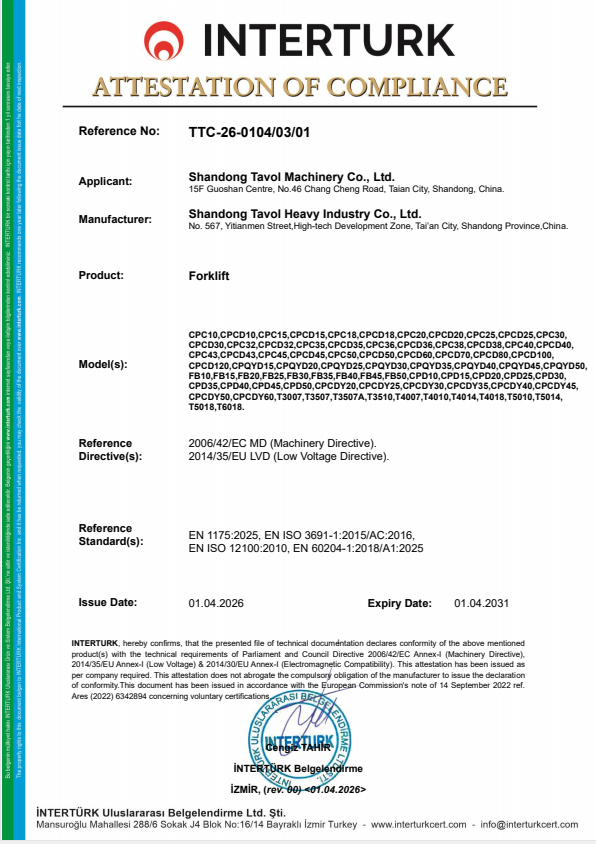
A documented EU-market CE certificate: the issuing body, the model scope, the cited standards and the validity period together form auditable compliance evidence.
Taking one documented EU-market CE certificate as an example, a buyer can find every element that constitutes evidence. The certificate number is TTC-26-0104/03/01, issued by INTERTÜRK (İNTERTÜRK Uluslararası Belgelendirme Ltd. Şti.) for the EU market. The harmonised standards it cites include EN 1175:2025, EN ISO 3691-1:2015/AC:2016, EN ISO 12100:2010 and EN 60204-1:2018/A1:2025. The issue date is 2026-04-01 and the expiry date is 2031-04-01.
Equally important is the model scope. The certificate covers a series of forklift models described as CPC10, CPCD10, CPC15, CPCD15, CPC18, CPCD18, CPC20–CPCD100, CPQD120–CPQD60, FB10–FB50 and T3007–T6018. That makes every purchasing decision first a scope question: is the quoted model within the covered range? At qualification level, out of scope means the evidence is absent, and no price or lead-time advantage compensates for that.
Two limitations deserve to be written in large type next to every "certified" claim. First, a CE certificate confirms conformity for the listed model family; it does not confirm the performance of an individual unit, nor the compatibility of attachments added after delivery. Second, the certificate belongs to the issuing body, not to the supplier; recording the issuing body, the certificate number and the validity period allows the buyer to verify it independently later rather than relying on a PDF screenshot.
Reading a specification sheet as conditional evidence
A specification sheet is where buyers constrain a purchasing decision against numeric values. It is also a document that repays more scrutiny than most buyers give it. The sheet can prove what rated values the supplier claims and what assumptions sit behind them — load centre, mast configuration and battery chemistry. What it cannot prove is that a particular machine will be delivered in that configuration.
Across the numeric families that typically appear on these sheets, what is worth recording? On the CPD series of electric forklifts, for instance, rated capacity runs from 3,000 kg through 3,500 kg to 4,000 kg depending on model, while the load centre is stated at 500 mm and mast tilt angles at 6°/12° (forward/backward). Parameters such as the minimum right-angle channel width — stated as 4,305 mm at a 1000 × 1200 mm pallet — only constrain a purchasing decision when they are recorded alongside the buyer's real aisle conditions. A stated gradeability of 20% means something only once it is clear whether that figure applies to the laden or the empty condition, and on what surface it was measured.
Two less obvious traps live in specification sheets. The first is the gap between optional and standard: mast heights, fork lengths and tyre types are often listed as options, so acceptance must confirm which option was delivered, not merely that the option exists in a brochure. The second is the gap between maximum and typical: maximum traction, travel speed and gradeability are all useful evidence, but only when they carry their load and mounting conditions — otherwise they remain supplier claims that must be re-verified on the delivered unit.
Acceptance checks by power type
Acceptance testing should be structured by power type. A generic "drive it round the yard" acceptance quietly fails once the energy source changes, because each power type exposes a different set of risks at acceptance.
Electric forklifts
For electric forklifts, the core evidence points are battery chemistry, rated capacity and charging arrangements. Across the listed models, the CPD30 carries a rated load of 3,000 kg at a 500 mm load centre, the CPD35 is rated at 3,500 kg, and the CPD40 at 4,000 kg. The battery is a lithium-ion (LiFePO4) battery with quick charger, and the drive form is electric. Buyers should verify the battery type at acceptance, confirm that opportunity charging works as agreed, and record which mast option was actually delivered, since the listed options span, for example, 2-stage 3 m, 3.5 m and 4 m and 3-stage 4.5 m, 5 m, 5.5 m and 6 m, plus container masts and full-free masts.
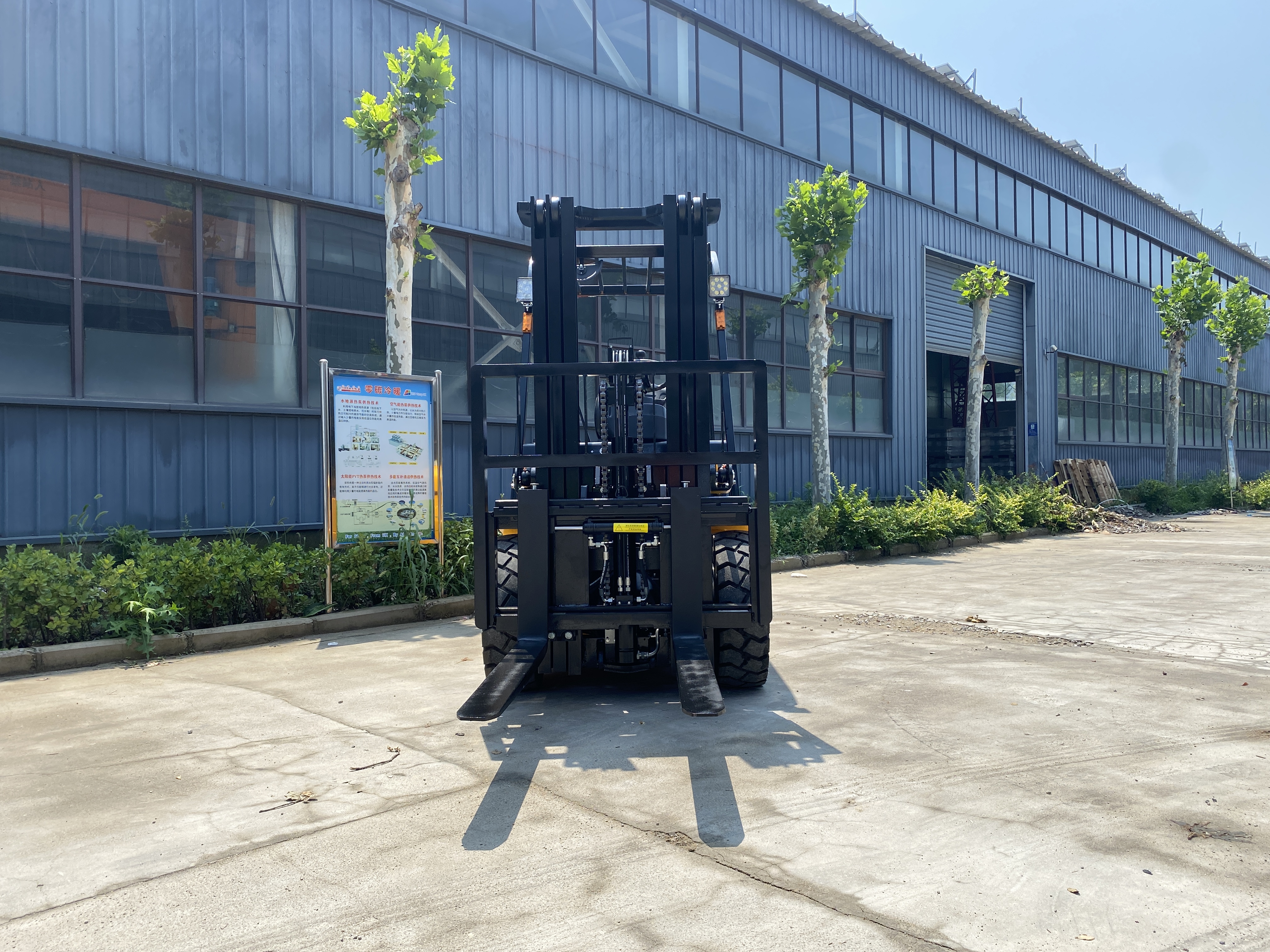
An electric forklift acceptance should confirm battery type, mast configuration and the charging arrangement behind the unit.
A charging arrangement that is not confirmed explicitly — charger model, shift pattern for opportunity charging, earthing and ventilation — is a hidden gap at acceptance. The buyer may have verified the forklift without verifying the charging set-up that supports it.
Dual fuel LPG and gasoline forklifts
For dual fuel machines, acceptance treats the fuel system as a piece of test equipment, not a feature. The documented switching guidance calls for changing fuel mode only when the engine is idling or off, using the dashboard fuel selector switch, and allowing the fuel system to stabilise before resuming operation. Acceptance should operate the machine on both fuels and note the switching sequence in the test record. The listed dual fuel models include CPQYD20, CPQYD30 and CPQYD35 with Nissan engines, rated at 2,000 kg, 3,000 kg and 3,500 kg respectively. Dual fuel introduces acceptance questions that sit outside the vehicle: cylinder supply, storage and exchange are supply-planning matters, but they belong next to the acceptance record rather than in a separate conversation.
Diesel forklifts
For diesel forklifts, the core of acceptance is engine identity rather than a generic "diesel power" description. The listed CPCD25, CPCD30, CPCD35 and CPCD40 models are rated at 2,500 kg, 3,000 kg, 3,500 kg and 4,000 kg, and the supplier's parameters list engine options as Xinchai, Quanchai, Isuzu, Mitsubishi, Yanmar, Kubota and PSI. At acceptance, confirm the actual engine brand on the machine plate and the packing list, rather than on the specification sheet, because parts and service planning differ by engine. Shift-level checks for diesel machines form a separate operational layer, discussed below.
| Power type | Key evidence to verify at acceptance | What to record |
|---|---|---|
| Electric (CPD series) | Rated load against load centre; battery chemistry; charging arrangement | Battery type, mast option, charger model and charging schedule |
| Dual fuel LPG/gasoline (CPQYD series) | Fuel-mode switching on both fuels; engine identity | Fuel switching sequence, cylinder supply arrangements |
| Diesel (CPCD series) | Engine brand against machine plate and packing list | Engine brand, mast option, attachment configuration |
Application-specific verification points
A generic acceptance record gets thin when it meets a real warehouse condition. Three scenarios deserve their own verification points: indoor versus outdoor handling, container loading and load weighing.
For indoor and outdoor handling, verification should confirm whether the environment narrows the fuel or battery requirement. Zero-emission electric forklifts for indoor high-rack pallet stacking appear in the documented scenarios: an indoor warehouse operation, for instance, uses zero-emission electric forklifts for the stacking and retrieval of bagged and palletised raw materials with precise mast control. If a buyer's own site is an indoor environment, that scenario can become evidence for an electric type choice, provided the site genuinely matches the conditions described.
For container loading, the verification point is whether the equipment can manoeuvre precisely inside a confined container space, not simply whether it can lift. A documented scenario describes an indoor/outdoor loading dock with tight container-space manoeuvring for irregular structural components, worked by standard forks assisted by overhead crane operations. The acceptance check should confirm that the selected mast and fork length suit the actual container interior, and that the operator can complete the working envelope in a test loading.
For load weighing, verification should centre on the weighing equipment itself rather than on the fact that the machine has hydraulics. A documented scenario describes an integrated load cell with digital display for real-time weighing during lifting and transport, without a separate weighbridge. Acceptance should include calibration of weighing accuracy and an overload alert function, not just a confirmation that the carriage can carry the load.
Across all three scenarios, remember that an application photo is evidence that the application exists, not evidence that the configuration fits every buyer.
Pre-shift checklists belong to operations, not supplier qualification
Pre-shift inspection is the most-practised step in the entire review chain and the easiest to place in the wrong folder. It is an operational check, not a supplier qualification document. Mixing the two — treating the checklist as proof that "the supplier was qualified" or skipping it because the supplier certificate looked fine — is exactly the confusion a qualification review is designed to prevent.
For a diesel counterbalance forklift, a workable pre-shift checklist covers engine oil, hydraulic fluid and coolant levels; checks tyres for wear, damage or incorrect pressure; tests brakes, horn, lights and backup alarm; checks forks and mast for cracks, bends or hydraulic line leaks; and starts the engine to confirm no unusual noise, smoke or warning lights. Any of those items failing should be reported to a supervisor before work starts, not worked around with an operational adjustment.
The role checklists play in qualification review is narrow but non-zero. They can surface drift that appears after acceptance, such as a hydraulic leak that was not picked up, a brake that has become soft without being reported, or a symptom on a particular unit that does not match what the supplier's parameter sheet describes. In the post-purchase management phase, checklists are where the supplier's claims are demonstrated or contradicted in practice. In the sourcing phase, they are simply one operational layer and cannot replace supplier documents.
Supplier capability evidence — what matters after purchase
Once the machine is in service, the factory-level portion of a qualification review turns into a different kind of proof. Supplier capacity evidence, quality-control practices and warranty terms serve to keep parts and service available; they are not a substitute for machine-level acceptance evidence.
For the organisation behind TAVOL Forklift, Shandong Tavol Machinery Co., Ltd operates a factory traced to 2003, with the group established in 2011, and reports a factory area of 40,000 m², 300 employees, annual output of 3,000 units, a 25-engineer R&D team and an export ratio of 70%. Listed capability covers OEM and ODM with customisation of fuel type, tonnage, mast height, fork length, attachment type, cabin type (open or enclosed), logo printing and paint colour, monthly capacity of 300 units, lead time of 10–45 days and an MOQ of 1 unit. Quality control is listed as 100% pre-shipment test and third-party inspection, and warranties are stated as 2 years for the forklift and 5 years for the lithium battery.
These are supplier statements and should be treated as such in a qualification review. They support capacity planning and after-sales planning, they can be verified against after-sales records and service response, but they do not describe what a particular machine carried at the moment of delivery. That is why the acceptance record and the supplier statement are kept in separate files.
Boundary note for readers: the supplier facts above describe what the supplier lists at qualification and capacity-planning stage. They do not substitute for acceptance testing of a specific delivered machine, and they do not constitute certification of suitability for a specific application or a third-party performance claim.
What a qualification review cannot prove
Building compliance evidence and acceptance criteria runs into documented limits that should be stated explicitly rather than smoothed over.
The first limit is scope. A CE certificate covers the listed model series and the listed standards. It does not automatically cover out-of-scope models, attachments fitted after delivery, or configurations that were not declared. Any "certified" claim should be read against the model actually being purchased.
The second is that a process statement is not a machine record. A supplier statement of 100% pre-shipment testing does not prove that a specific forklift was tested, nor what the test found. Independent buyer testing at acceptance is the only evidence that attaches to the individual unit.
The third is that application scenarios and case records are evidence of what has been deployed, not a guarantee of every deployment. A documented warehouse scenario does not guarantee that every forklift will behave the same way, and a documented acceptance result does not guarantee that every delivery will reproduce it.
Fourth, without comparable test data, no claim of superiority over another supplier can be made, and no certification should be assumed to represent total performance. The material behind this article is a single supplier's own content units, and an honest qualification record should say so.
Future outlook
If buyers continue to ask for certificate scope, assumption-bearing specification values and acceptance records tied to individual machines, the evidence chain around material handling forklifts will become more traceable. That shift is often described as a longer checklist, but the more accurate reading is that it changes what counts as evidence. A certificate that names its issuing body, a specification sheet that carries its load and mounting conditions, an acceptance record that names the tested item, engine brand, mast configuration and attachment configuration, and a shift checklist that ties findings to corrective action are linked documents rather than isolated one-off items.
Suppliers who take that shift seriously will eventually treat evidence as part of the product, because a buyer's procurement process will treat it the same way. This is less about more certifications than about whether each document's meaning is genuinely traceable and verifiable.
Frequently asked questions
What is the pre-shift inspection checklist for a diesel counterbalance forklift?
Perform a visual and functional check before every shift covering fluid levels, tyres, brakes and safety devices to prevent breakdowns and support operator safety. The specific items are engine oil, hydraulic fluid and coolant levels; tyres for wear, damage or incorrect inflation; brakes, horn, lights and backup alarm; forks and mast for cracks, bends or leaks in hydraulic lines; and engine start-up to confirm no unusual noise, smoke or warning lights. Never operate with a malfunctioning brake or hydraulic leak, wear the seatbelt at all times, and report any abnormality to a supervisor before starting work.
How do I switch fuel modes on a dual fuel forklift?
Switch fuel modes only when the engine is idling or off, using the dashboard fuel selector switch, and allow a few seconds for the fuel system to stabilise before resuming operation. The basic sequence is to bring the forklift to a stop and let the engine idle; locate the fuel mode selector switch on the dashboard; switch to the desired mode (gasoline or LPG); wait 5–10 seconds for the fuel system to stabilise; then resume operation and monitor engine performance for the first few minutes. Do not switch modes under heavy load or on a slope, ensure the LPG cylinder is securely mounted and free of leaks before each shift, and keep away from open flames during refuelling.
How do I properly charge and maintain a lithium battery forklift?
Use opportunity charging during breaks instead of waiting for a full discharge, and follow the manufacturer's charging cycle to maximise battery lifespan. Lithium batteries require no watering or acid checks, only periodic terminal and connector inspection. In practice, park the forklift on a flat, ventilated area and switch off the ignition before connecting the charger, connect and confirm the charging indicator, charge during breaks or idle periods, disconnect once fully charged, and inspect battery terminals, cables and connectors weekly for looseness or corrosion. Never charge in an enclosed space without ventilation, keep the charging area dry, do not disconnect cables under load, and only trained personnel should handle battery connections.
For readers who want the background on the equipment and manufacturing operations referenced in this article, the TAVOL Forklift company profile can be downloaded.
Есть вопросы или нужны дополнительные детали?
Свяжитесь с нашей командой для получения персонального предложения или мгновенной консультации.
Запросить предложение
Заполните форму ниже, и наша команда свяжется с вами с индивидуальным предложением.
Прямой чат WhatsApp
Предпочитаете общаться в реальном времени? Напишите нам в WhatsApp для мгновенной помощи и быстрых ответов.
- Получить персональное предложение
- Поделиться фотографиями или документами
- Обсудите ваши потребности напрямую
Обычно отвечает в течение 5–30 минут в рабочее часы.