
Four Pillars for a CNC Lathe Machine Purchase Decision
CNC Turning · Procurement Decision Framework
A CNC lathe machine purchase decision in 2026 is rarely about whether a plant needs turning capacity. It is about which machine configuration produces the lowest cost per acceptable part across a defined production horizon — and how much of that answer can be verified before the machine is bolted to the floor.
The commercial backdrop is substantial. Published market research places the global lathe machine market at an estimated US$31.31 billion in 2026, inside a broader CNC machine market projected at US$79.14 billion (Mordor Intelligence). Precision machining, the segment that absorbs most of these machines, is projected at US$132.9 billion in 2026, with CNC operations holding a 78.9% share (Grand View Research). Turning sits at the centre of metal parts production, and the choice of machine configuration has a measurable effect on unit economics.
This article sets out a four-pillar decision matrix for cnc lathe machine selection in high-precision, medium-to-large part production: precision, reliability and uptime, energy efficiency, and unit part cost. It uses the JUXIN Dual-Spindle Vertical Lathe as the worked example. Juxin Machine Tool Co., Ltd. is a Wenling, Zhejiang–based machine tool manufacturer founded in 2005 that specialises in specialised CNC machine tools and intelligent automation solutions for shaft and disc parts. The figures it publishes for the Dual-Spindle Vertical Lathe are manufacturer-reported. This article treats them as specification targets to be verified through acceptance testing — not as independent benchmarks.
Why the comparison stage is where CNC lathe machine decisions stall
Most procurement teams can build a shortlist of candidate machines quickly. The bottleneck appears later, when the shortlist has to be reduced to one purchase order. Three structural problems explain why.
- Claims arrive in incompatible units. One supplier specifies runout, another specifies roundness; one quotes a tolerance band, another quotes a repeatability figure; energy data is sometimes given as installed motor power and sometimes as measured consumption. Without a common set of definitions, machines that differ materially look interchangeable on paper.
- Purchase price is the only fully quantified number at quotation stage. Capital cost arrives as a firm figure with payment terms, while maintenance frequency, energy per part, consumable loss and component life arrive as narrative claims. Buyers naturally weight what they can compare.
- Independently verified operating data is scarce at model level. Public information about a specific brand's precision, uptime and energy performance is largely limited to manufacturer material. Where independent data is absent, the practical alternative is standards-based acceptance testing rather than supplier self-description alone.
The opportunity is that all four pillars can in fact be expressed in comparable units: millimetres, faults per year, maintenance events per year, kilowatt-hours per part, and currency per acceptable part. A decision matrix simply forces that conversion before the order is placed.
The four-pillar decision matrix, defined
A CNC lathe machine purchase decision matrix is a structured comparison framework that scores candidate machines against four production-relevant pillars — precision, reliability and uptime, energy efficiency, and unit part cost — rather than ranking them by purchase price alone. Each pillar has a defined unit of measurement, a defined evidence source, and a defined verification method.
| Pillar | What the buyer measures | JUXIN Dual-Spindle Vertical Lathe (manufacturer-reported) | Compared dual-spindle vertical lathes (manufacturer-reported comparison) |
|---|---|---|---|
| Precision | Spindle radial runout; dual-spindle coaxiality; dimensional tolerance | Runout ≤0.005 mm; coaxiality ≤0.01 mm; dimensional tolerance within ±0.008 mm | Runout ≥0.01 mm; coaxiality ≥0.02 mm; dimensional tolerance ±0.015–±0.02 mm |
| Reliability / uptime | Faults per year; maintenance frequency; structural rigidity | Annual fault rate ≤2; maintenance once a month; integrated cast bed designed for rigidity and absence of resonance; intelligent monitoring module for early fault warning | Annual fault rate ≥12; maintenance one to two times per week; spliced bed structure reported as prone to deformation and resonance |
| Energy | No-load consumption; consumption per unit part; energy utilization rate | 30% lower no-load energy consumption; 25%–35% lower energy consumption per unit part; energy utilization rate above 85% | Fixed motor energy consumption without load-adaptive regulation; higher comprehensive energy use reported by the manufacturer |
| Unit part cost | Initial investment; cost per acceptable part; consumable loss; core component life | Initial investment 25%–40% higher; unit part processing cost 25%–35% lower in mass production; 40% less consumable loss; core component life 12–18 years | Lower entry price; manufacturer-reported higher long-term operating cost |
How to read the comparison columns. Both columns above originate from the same manufacturer's published comparison between its dual-spindle vertical lathe and competing dual-spindle vertical lathes. They are useful as a specification target and as a way to structure questions. They are not an independent test report, and a buyer should reasonably require model-specific acceptance data before treating any of these figures as contractual.
Pillar 1 — Precision: runout, coaxiality and dimensional tolerance
Precision in a two-spindle turning machine is defined by three numbers, and each one does a different job.
- Spindle radial runout determines roundness and surface finish. It is measured at the spindle, and it propagates directly into the part.
- Dual-spindle coaxiality determines how closely two simultaneously machined features line up. In flanges, hubs and sleeves, coaxiality error is often the reason a part fails assembly even though every individual dimension is in tolerance.
- Dimensional tolerance determines scrap and rework rates, and whether a part can move to the next operation without secondary correction.
The JUXIN Dual-Spindle Vertical Lathe is specified at spindle radial runout ≤0.005 mm, dual-spindle coaxiality ≤0.01 mm, and dimensional tolerance controlled within ±0.008 mm. The manufacturer's published comparison places typical competing dual-spindle vertical lathes at runout of ≥0.01 mm, coaxiality of ≥0.02 mm, and dimensional tolerance fluctuating between ±0.015 mm and ±0.02 mm. Read as a specification set, the difference concentrates in the coaxiality figure — the metric that governs assembly of two-feature parts rather than single-diameter turning.
How a buyer verifies a precision claim
Precision numbers become enforceable only when the measurement method is written into the agreement. Two published standards support that work. ISO/TR 230-11:2018 documents the characteristics of precision measuring instruments used to test the geometric accuracy of machine tools, operating either under no-load or under quasi-static conditions. ISO 230-10:2022 specifies test procedures to evaluate the measuring performance of probing systems integrated with a numerically controlled machine tool.
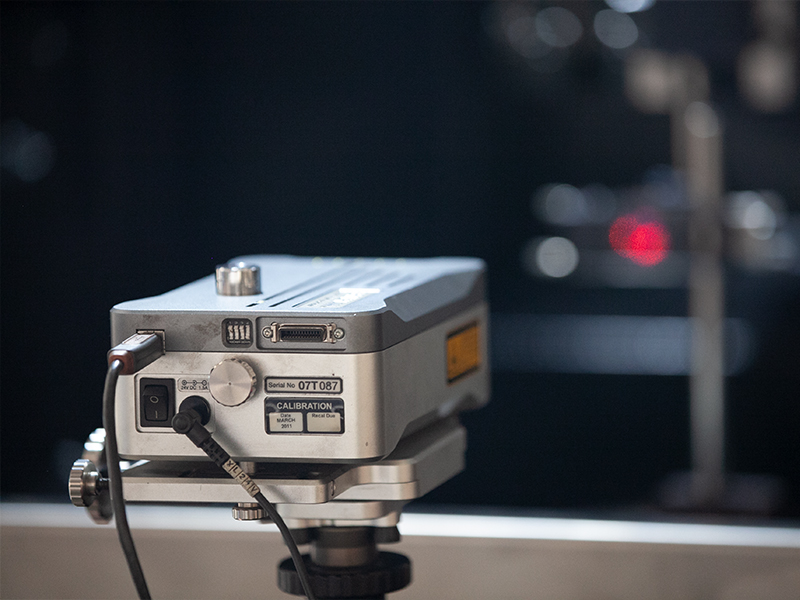
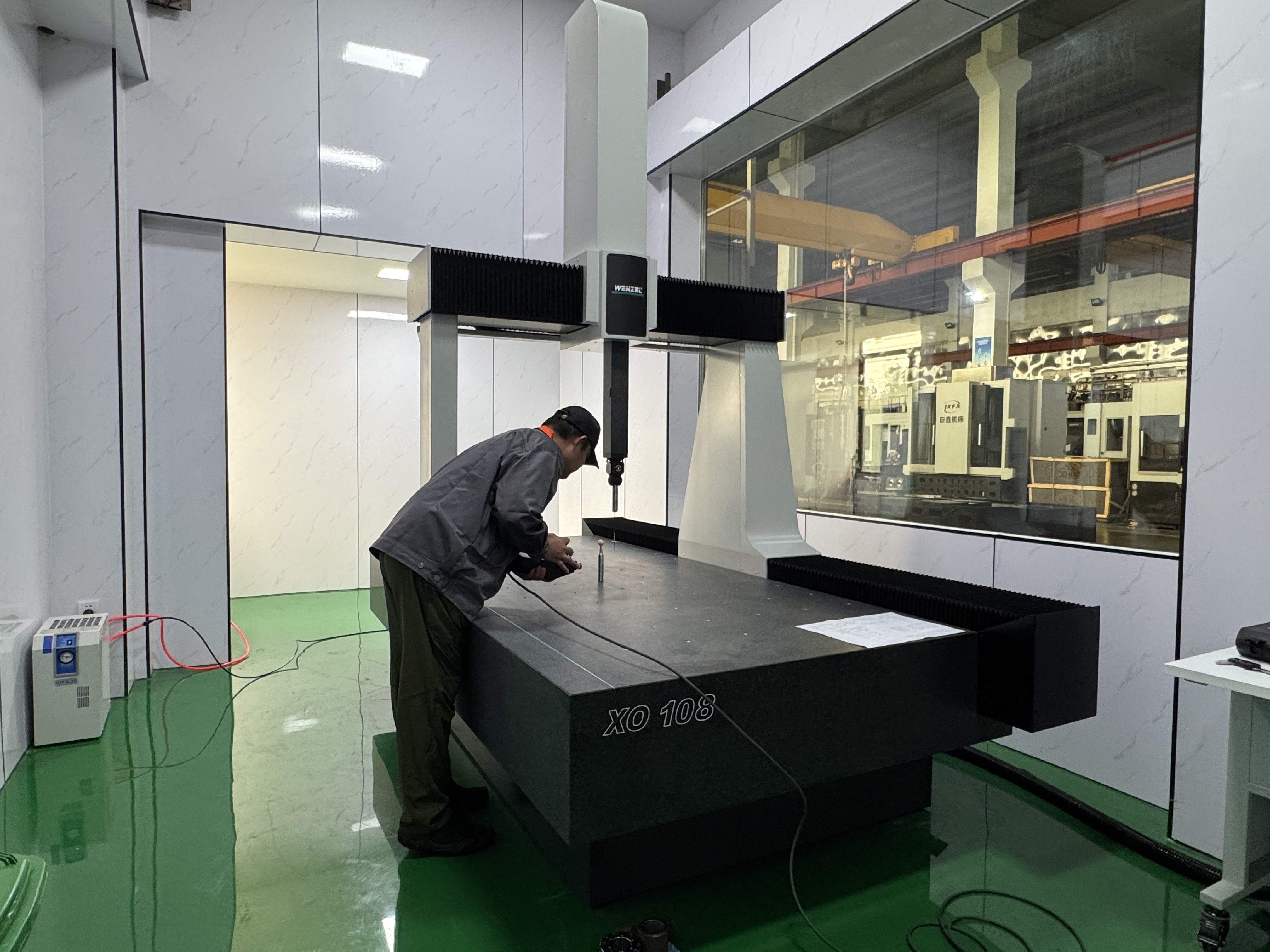
A practical purchase order therefore names the instrument, the condition and the acceptance limit. The supplier's own metrology setup is a legitimate question at this point: Juxin Machine Tool's published facility documentation shows a UK-made Renishaw laser interferometer and a German Wenzel three-coordinate measuring instrument inspection laboratory, with assembly carried out in a constant-temperature, constant-humidity workshop. Those are measurement capabilities, not results — the buyer should still request the factory acceptance record produced on the specific machine being purchased.
Pillar 2 — Uptime: fault frequency, maintenance intervals and structural design
Uptime is the pillar most often reduced to a vague adjective in supplier discussions. In practice it has three countable components: how often the machine fails, how often it must be serviced, and how long repair takes when something does fail.
For the JUXIN Dual-Spindle Vertical Lathe, the manufacturer reports an annual fault rate of ≤2 times and a routine maintenance interval of once a month covering the lubrication system, spindle precision and electrical components. The machine is described as structurally integrated and intelligent, with a monitoring module that provides early fault warning. The same comparison reports the competing dual-spindle vertical lathe group at an annual fault rate of ≥12 times with maintenance one to two times per week, requiring frequent inspection of bed precision and dual-spindle linkage coordination, and relying on external personnel for fault repair.
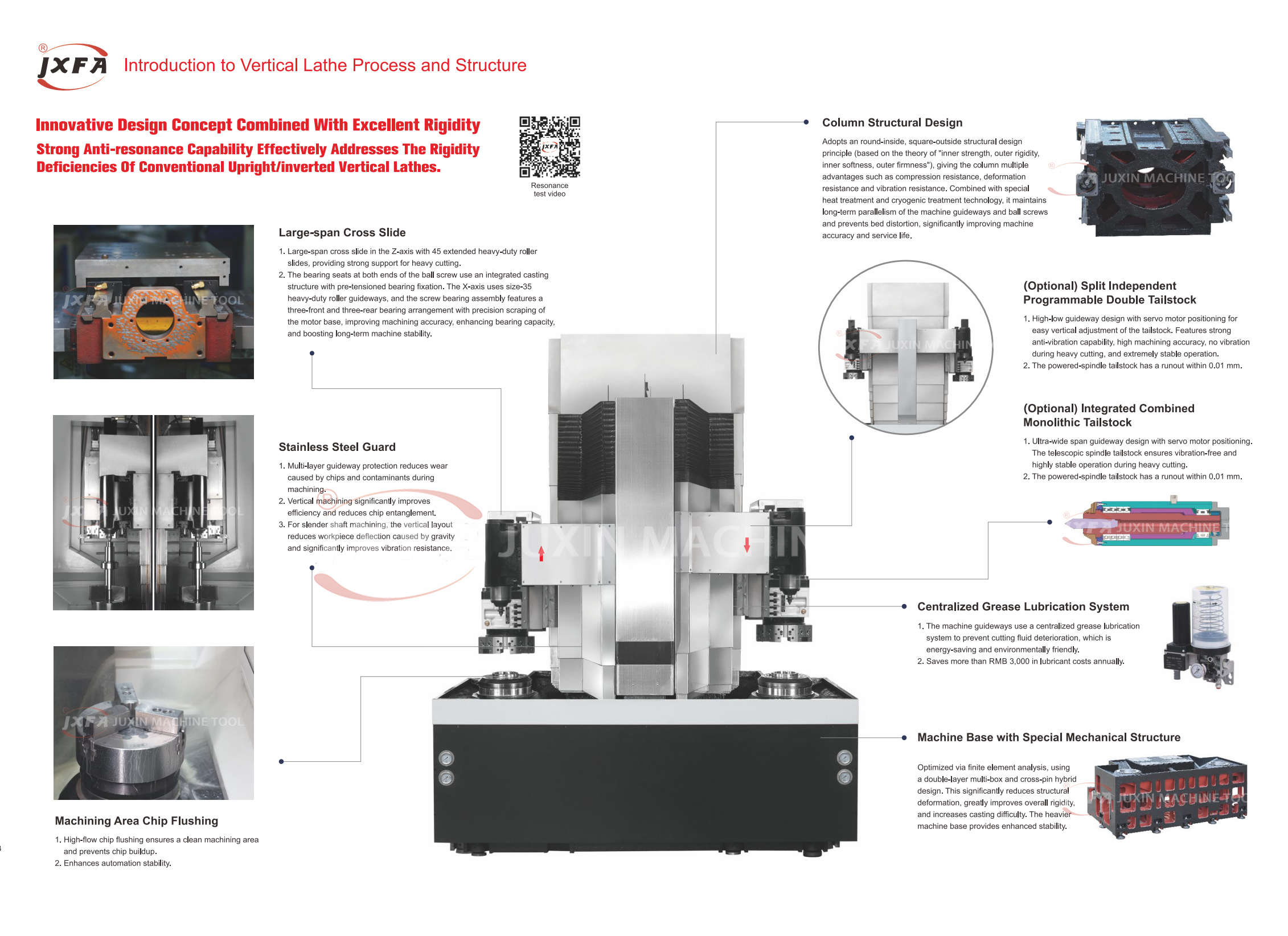
Two design differences are offered as the explanation. The JUXIN machine uses a bed cast with a special mechanical structure — described as high-rigidity, more stable and free of resonance — whereas the compared competitor machines are described as using a spliced bed structure. The manufacturer reports the spliced design as less rigid, with resonance problems and a shorter service life.
For the buyer, the decision rule is straightforward: convert maintenance frequency into annual downtime hours using your own shift pattern, then multiply by the contribution margin lost per hour of stopped production. A machine maintained monthly rather than weekly removes roughly forty service events per year from a two-shift calendar, and each avoided event is an avoided deviation, an avoided recalibration and an avoided scrap risk at restart.
Pillar 3 — Energy: no-load consumption versus consumption per part
Energy claims are frequently quoted as a single percentage, which makes them difficult to use. A machine spends part of its time cutting and part of its time idling, loading and waiting. Those two conditions should be measured and compared separately.
The JUXIN Dual-Spindle Vertical Lathe is reported to achieve 30% lower no-load energy consumption and 25%–35% lower energy consumption per unit part than competing machines. The manufacturer attributes this to high-efficiency energy-saving motors combined with an intelligent energy consumption regulation system that adjusts consumption according to processing load. It also reports an energy utilization rate above 85%, on the basis that multiple compound processes are integrated into one machine so that energy is concentrated on core processing rather than distributed across separate auxiliary equipment.
The comparison group is described as having fixed motor energy consumption without intelligent regulation, a small gap between no-load and load consumption, and additional losses caused by poor equipment stability.
Three questions turn this pillar into a verifiable line item:
- Is the no-load figure measured or derived? Request measured idle consumption at the spindle speeds your process actually uses.
- Is the per-part figure normalized to an acceptable part, or to a produced part? Scrap changes the denominator, and a machine with tighter tolerance may produce fewer rejects per hundred parts.
- Is the drive load-adaptive? A regulation system that tracks load is the mechanism behind a widening gap between no-load and loaded consumption.
Pillar 4 — Unit part cost: converting a higher price into a lower cost per part
Unit part cost is the pillar that decides the purchase. It is assembled from machine amortization, direct labour, energy, consumables, tooling, maintenance and scrap, divided by the number of acceptable parts produced in the period.
The JUXIN Dual-Spindle Vertical Lathe carries a manufacturer-reported initial investment 25%–40% higher than competing dual-spindle vertical lathes. The manufacturer attributes the premium to an integrated cast-steel bed, higher-grade precision core components and patented technology rather than to purchased general components. Against that premium, the same source reports a unit part processing cost 25%–35% lower during mass production, supported by 40% less consumable loss, core component service life of about 12–18 years, and a labour profile in which one operator can run two to three machines.
Throughput contributes to the same arithmetic. During synchronous dual-spindle processing, the manufacturer reports single-piece processing time 30%–50% shorter than the compared competitor group, with daily processing volume reaching 1.5 to 2 times that of those machines.
The break-even question the matrix must answer
A 25%–40% capital premium against a 25%–35% per-part saving is not automatically a good trade. It becomes one at a calculable annual volume. The buyer sets the equation using their own numbers:
Break-even annual volume ≈ (capital premium) ÷ (per-part saving × acceptable parts per unit of time) × payback period.
Two variables dominate the result: the annual volume the machine will actually run, and the scrap-and-rework rate the tighter tolerance removes. Where a plant runs medium-to-large disc and shaft parts in continuous batch production, the per-part saving accumulates quickly. Where the machine runs occasional, low-volume or one-off work, the same capital premium may never be recovered, and a lower-cost machine with a spliced bed and basic synchronous dual-spindle processing may be the economically correct choice. The matrix does not produce a universal answer; it produces the buyer's answer.
Comparison with traditional dual-spindle vertical lathe designs
The traditional dual-spindle vertical lathe architecture — a spliced bed with two spindles working in basic synchronisation — remains a legitimate solution, and the honest comparison has to say so.
Where the traditional architecture still wins. Its entry cost is materially lower and its commercial threshold is lower, which matters for plants that are starting a new part family, that have uncertain order books, or that machine parts at tolerance bands wide enough to absorb ±0.02 mm variation. It is also a reasonable choice when dual-spindle work is a small share of the workload and the machine will spend most of its life on simpler single-feature turning.
Where the integrated design changes the economics. Cast-bed rigidity, tighter coaxiality and per-part energy and consumable savings shift the balance only when three conditions hold: the parts are medium-to-large discs, shafts or sleeves; tolerance requirements are tight enough that scrap is a real cost; and annual volume is high enough to amortise the premium. If any of those conditions is absent, the matrix will usually return the lower-cost machine.
What remains unverified. All performance figures for the JUXIN Dual-Spindle Vertical Lathe cited in this article are manufacturer-reported. Independent, model-level operating data for specific machine tool brands is not widely published, which is precisely why the acceptance-test route described above exists. A buyer who skips that step is accepting a comparison, not verifying one.
Where the configuration fits — and where it does not
The JUXIN Dual-Spindle Vertical Lathe is positioned for high-precision mass processing of medium and large-sized disc, shaft, sleeve and special-shaped parts, including wind power flanges, heavy machinery hubs and aerospace components. The manufacturer describes support for synchronous and asynchronous switching between the two spindles, and integration of compound processes such as turning, milling, drilling and grinding into a single machine, with intelligent monitoring feeding processing status back in real time.
That positioning defines the fit for a high precision cnc lathe machine procurement in heavy and energy-related manufacturing, and for a precision parts cnc lathe machine programme where two-feature coaxial parts dominate the order book.
The boundary is equally clear. Buyers searching for a cnc lathe machine for small parts, or for a cnc lathe machine for metal parts in high-mix, low-volume production, are generally working with a different machine class. The dual-spindle vertical format has a design centre of gravity in medium-to-large disc and shaft work rather than small-part turning, and the economics of the four pillars only close at volume. Automated configurations of this design suit continuous batch production with automated loading; they are not the natural answer to short-run, frequently re-set work.
Trade classification is a related consideration for buyers modelling landed cost. Customs schedules distinguish horizontal numerically controlled metal-removing lathes, classified under HS 8458.11, from numerically controlled lathes other than horizontal lathes, which sit in a separate classification entry. A vertical machine therefore does not follow the same classification line as a horizontal turning centre, and the duty and documentation treatment should be confirmed against the destination market's tariff schedule rather than assumed.
Market signals shaping CNC lathe machine procurement in 2026
Three published signals are relevant to how buyers are structuring these decisions.
1. The turning segment is being segmented more precisely. Published lathe machine market research is structured by product type — CNC versus conventional — and by application, including automotive, general machinery and precision machinery. That segmentation mirrors what buyers already experience: the criteria that matter for an automotive supplier and for a general-machinery fabricator are not the same, and a single price-based comparison cannot serve both.
2. CNC has become the default route for precision work. Within a precision machining market projected at US$132.9 billion in 2026, CNC operation holds a 78.9% share. The practical consequence is that CNC capability is table stakes, and differentiation has moved to the parameters this matrix measures: tolerance stability, uptime, energy per part and cost per part.
3. Quality-system expectations are hardening. ISO 9001 is widely described as the baseline quality management standard for CNC machine shops and is often required by buyers in automotive and aerospace supply chains. For machine purchases this converts into a documentation expectation: named standards, named measurement instruments and traceable acceptance records, rather than capability adjectives.
Alongside these signals, published standards work continues to make verification more concrete. ISO 230-10:2022 and ISO/TR 230-11:2018 both address how machine tool accuracy and probing performance are measured, giving buyers a defensible structure for acceptance-test clauses.
Running the matrix in a live procurement process
The framework works only if it produces an auditable document. A practical sequence runs as follows.
- Define the part family first. Record the tightest tolerance, the largest diameter and the dominant feature relationship in the work the machine will actually run. The part family sets every acceptance figure that follows.
- Convert each pillar into a unit. Precision into millimetres, uptime into faults and service events per year, energy into kilowatt-hours per acceptable part, cost into currency per acceptable part.
- Request model-specific evidence, not brochure ranges. Datasheets for the exact model, plus the acceptance protocol the supplier proposes to run.
- Write verification into the purchase order. Name the instrument, the condition and the limit for each precision metric.
- Model break-even volume separately for each candidate. A lower capital cost wins below the break-even volume; the higher-specification machine wins above it.
- Record what remains unverified. Any figure that stays manufacturer-reported should be logged as such in the decision file.
| Pillar | Specification language to write into the agreement |
|---|---|
| Precision | “Spindle radial runout ≤___ mm, dual-spindle coaxiality ≤___ mm, dimensional tolerance within ±___ mm on a qualified test part, measured with a named instrument under stated conditions.” |
| Uptime | “Routine maintenance interval of ___ per year with defined scope; fault events per year reported against an agreed definition of a fault; spare-part response time stated in writing.” |
| Energy | “No-load consumption measured at ___ rpm; consumption per acceptable part reported on a defined part and cycle.” |
| Unit part cost | “Cycle time, consumable consumption and core component service life stated per model, with the labour profile per operator confirmed on the buyer’s part family.” |
Future outlook
The direction of travel in CNC lathe machine procurement is toward quantified comparison and away from qualitative differentiation. As precision machining volume concentrates in CNC operations, the parameters that separate otherwise comparable machines are the ones that can be counted: tolerance stability across a shift, faults per year, kilowatt-hours per part, and cost per acceptable part.
Two technical currents reinforce that shift. Multi-process integration — combining turning, milling, drilling and grinding in one platform — removes handling and re-fixturing between operations, which is where much tolerance error accumulates. Load-adaptive energy regulation and monitoring modules that warn of faults before they stop production convert energy and uptime from post-purchase surprises into pre-purchase variables.
For buyers, the practical implication is a change in the evaluation document rather than in the machine itself. The four-pillar matrix is likely to become the normal shape of a CNC lathe machine purchase decision: fewer adjectives, more named instruments, named standards and agreed acceptance limits. Manufacturers that publish model-level figures and support third-party verification on the specific machine ordered will be easier to compare — and, where their economics hold, easier to select.
FAQ: CNC lathe machine purchase decisions
What is a CNC lathe machine purchase decision matrix?
It is a structured comparison framework that scores candidate machines against four production-relevant pillars — precision, reliability and uptime, energy efficiency, and unit part cost — instead of ranking them by purchase price alone. Each pillar is expressed in a countable unit: dimensional tolerance in millimetres, faults and maintenance events per year, kilowatt-hours per part, and currency per acceptable part. Buyers typically populate the matrix from model datasheets, acceptance-test protocols based on published standards such as ISO 230-10:2022 and ISO/TR 230-11:2018, and quoted commercial terms.
How much precision should a buyer specify for a high-precision CNC lathe machine?
Enough to hold the tightest tolerance in the actual part family, without paying for capability the work does not require. As a reference point, the JUXIN Dual-Spindle Vertical Lathe is specified at spindle radial runout ≤0.005 mm, dual-spindle coaxiality ≤0.01 mm, and dimensional tolerance within ±0.008 mm. The manufacturer's published comparison places typical competing dual-spindle vertical lathes at runout ≥0.01 mm, coaxiality ≥0.02 mm, and dimensional tolerance of ±0.015–±0.02 mm. The specification becomes enforceable when the measurement instrument and test conditions are named alongside the number.
Is a more expensive CNC lathe machine worth it for high-volume production?
It depends on annual volume and part mix rather than on price alone. The JUXIN Dual-Spindle Vertical Lathe carries a manufacturer-reported initial investment 25%–40% higher than competing dual-spindle vertical lathes, together with a reported unit part processing cost 25%–35% lower during mass production, 40% less consumable loss, and core component service life of about 12–18 years. That combination converts into a saving only when annual output is high enough to absorb the capital premium, so buyers should calculate break-even volume using their own cycle times, labour rates, energy prices and scrap rates. Below that volume, a lower-cost machine can be the correct commercial choice.
What maintenance interval should a buyer expect from a dual-spindle vertical lathe?
Interval expectations should be written into the purchase agreement, because they vary widely between designs. For the JUXIN Dual-Spindle Vertical Lathe, the manufacturer reports routine maintenance once a month — covering the lubrication system, spindle precision and electrical components — with an annual fault rate of ≤2 times, supported by an intelligent monitoring module that provides early fault warning. The manufacturer's published comparison reports the competing dual-spindle vertical lathe group at maintenance one to two times per week with an annual fault rate of ≥12 times. To compare the two fairly, convert both into annual downtime hours using your own shift pattern.
Which parts are best suited to this type of machine, and where does it not fit?
The format is built for high-precision mass processing of medium and large-sized disc, shaft, sleeve and special-shaped parts, including wind power flanges, heavy machinery hubs and aerospace components. It supports synchronous and asynchronous dual-spindle processing and can integrate turning, milling, drilling and grinding. It is not designed as a small-part, high-mix turning solution; buyers whose workload centres on small parts or on frequent short runs are generally working with a different machine class and a different cost structure.
How should energy consumption be compared between CNC lathe machines?
Compare no-load consumption and consumption per acceptable part separately, and normalise the second figure on a defined part and cycle. The JUXIN Dual-Spindle Vertical Lathe is reported at 30% lower no-load energy consumption and 25%–35% lower energy consumption per unit part than competing machines, with an energy utilization rate above 85%, achieved through high-efficiency motors and a regulation system that adjusts consumption according to processing load. Buyers should ask whether each figure was measured or derived, and at which spindle speeds.
How does trade classification affect a vertical lathe purchase?
Customs schedules distinguish horizontal numerically controlled metal-removing lathes, which fall under HS code 8458.11, from numerically controlled lathes other than horizontal lathes, which are classified separately. Because vertical machines follow a different classification line from horizontal turning centres, buyers modelling landed cost should confirm the applicable code and duty treatment in the destination market rather than assuming equivalence with a horizontal machine.
Reference material: Juxin Machine Tool publishes a product brochure for download at https://cdn.socialarks.com/sbsp//common/2026/0402/69ce2ac6eb208.pdf