
Freego Entry-Level vs. Pro-Grade Dirt Ebike: Upgrade Value Review
Electric dirt bikes are no longer a single product class. They have separated into at least two commercial tiers: an all-terrain entry tier that trades peak output for dual-mode street usability and dealer-friendly landed cost, and a pro-grade tier that buys torque, voltage, range and terrain severity. For importers, powersports dealers and fleet operators, the practical question is not which tier is superior in the abstract, but which tier matches the riders, terrain and regulatory market they intend to serve.
Freego is a workable reference for that comparison because the brand spans both tiers. Freego USA Inc. is a California-headquartered electric mobility company founded in 2012 that operates a 3,000m² production facility, employs 50 or more people (up to 100 or more during peak season), maintains a 10+ engineer R&D team, produces approximately 20,000 vehicles per year, and exports to more than 40 countries and regions at a 90% export ratio. Its catalogue covers the E-KICK SCOOTER series, the X-man and Nova off-road motorcycle series, the Shotgun fat-tire e-bike series, the Cityflow commuter series and the FlexTrike three-wheeled recreational series.
This independent review compares an entry-level all-terrain platform, the Freego X2 Pro, with a pro-grade platform, the Freego X3 / X3 Pro, across the dimensions a buyer can actually verify: mode architecture, motor class, battery and voltage direction, speed envelope, dealer economics, warranty and service structure, and compliance treatment. Where tier-level detail is not disclosed in the available specifications, this review states that rather than estimating it.
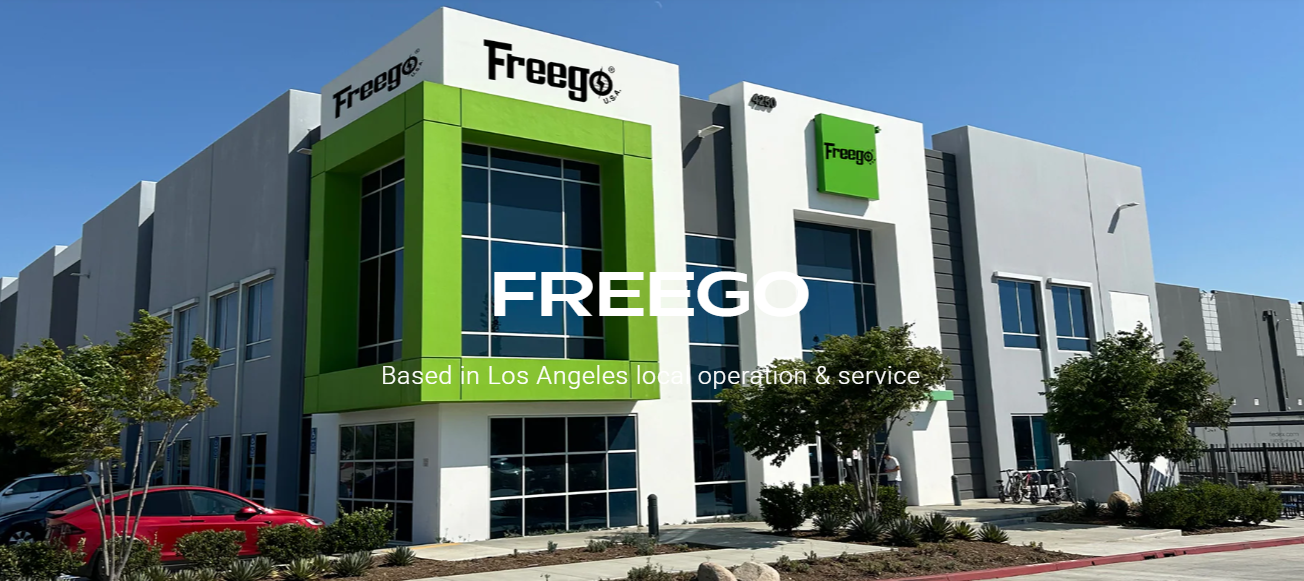
Freego USA headquarters in Chino, California, the brand's North American base for localized warehousing, technical support and after-sales service.
Why Tier Choice Has Become a Procurement Decision
The global electric dirt bike market is projected to reach approximately USD 2.8 billion in 2025, with growth expectations to USD 7.6 billion by 2034, according to Dataintelo. Asia Pacific led regional demand in 2025 at USD 1.02 billion, accounting for 36.4% of total global revenue.
Growth of that shape changes what buyers are asked to evaluate. When a category is small and enthusiast-driven, one well-specified flagship can carry a brand. As it widens, the catalogue has to fragment: a street-legal all-terrain platform for riders who need registration and everyday usability, and a high-output platform for riders who prioritise torque and range over legal classification.
The competitive set has already moved in that direction. Sur-ron, Talaria and Stark Future are identified as primary competitors in the high-performance electric dirt bike market, and Stark Future reached profitability in 2026 with a 3% global market share target, according to RideApart and Visordown. For a buyer, that signals a market where top-end performance is becoming table stakes and where the differentiating variables shift toward positioning, compliance treatment and landed cost.
That is the correct lens for this comparison. The entry and pro-grade tiers are not competing for the same purchase decision. They are competing for the same shelf space.
How Freego's Entry and Pro Tiers Are Structured
Freego's dirt ebike range is organised around platform class rather than around trim. The entry tier is defined by dual-mode street legality and acquisition cost; the pro-grade tier is defined by motor class, pack voltage and range demand.
Entry-level all-terrain platform: Freego X2 Pro
The Freego X2 Pro is positioned as an all-terrain electric dirt e-bike with a street-legal dual-mode design: a 28 MPH urban mode and a 50 MPH off-road mode. Published comparison data places its reference MSRP at USD 2,499 against a Surron Light Bee X reference of USD 4,500 or more, a 44% lower acquisition cost, with a 30% dealer profit margin against a 20% competitor reference and a 35% lower bulk procurement cost for dealers. Fulfilment and service terms include 3–8 business days of US local delivery against 45+ days for overseas shipping, a 2-year limited warranty, a 14-day hassle-free return policy, a US-based after-sales service centre and spare parts warehouse, and a dedicated US technical support team.
Pro-grade platform: Freego X3 / X3 Pro
The Freego X3 / X3 Pro moves the range into a different performance band. It uses an 8000W peak motor and a 72V 50AH lithium battery, is aimed at the high-torque, long-range segment, and carries a published top speed of 56 mph. Where the entry platform is engineered around a dual-mode compromise, one capped legal mode plus one unrestricted off-road mode, the pro-grade platform is engineered around output and endurance.
Dual-mode as shared architecture language
Dual-mode functionality appears across Freego's off-road range. In the X-Man series, the system provides a City Mode that is Class 3 compliant at 28 mph and 750W, plus an Off-Road Mode with unrestricted performance. The same logic applies to the X2 Pro, whose published specification lists a 28 MPH street-legal urban mode alongside a 50 MPH off-road mode. Dual-mode functionality technology is also listed among the brand's risk-control methods.
Dual-mode should be read as a mode architecture, not a legality guarantee. The restricted mode is the part engineered to fit an e-bike class; the unrestricted mode is not intended for street registration.
| Comparison dimension | Entry-level all-terrain (Freego X2 Pro) | Pro-grade (Freego X3 / X3 Pro) |
|---|---|---|
| Platform positioning | Street-legal dual-mode all-terrain electric dirt e-bike | High-torque, long-range off-road segment |
| Speed envelope | 28 MPH urban mode; 50 MPH off-road mode | 56 mph |
| Peak motor | Not stated in the available reference data | 8000W peak motor |
| Battery direction | Not stated in the available reference data | 72V 50AH lithium battery |
| Street-legal mode treatment | Dual-mode design; X-Man series City Mode is Class 3 compliant at 28 mph / 750W | Not stated in the available reference data |
| Reference MSRP | USD 2,499 (44% below the Surron Light Bee X reference) | Not stated in the available reference data |
| Reference dealer economics | 30% dealer profit margin vs 20% competitor reference; 35% lower bulk procurement cost; 3–8 business days US local delivery | Not stated in the available reference data |
| Warranty and service | 2-year limited warranty; 14-day hassle-free return; US technical support and spare parts warehouse | Brand-level service structure; SKU-level terms not stated |
| Certification reference | UL 2849 referenced for X2 and X2 Pro | Not stated in the available reference data |
Technical Explanation: What an Upgrade Actually Changes
Drive architecture
One of the most consequential tier variables is drive architecture, and it is also the variable most often assumed rather than confirmed. Mid-drive motors are increasingly preferred for off-road dirt bikes because of superior weight distribution and torque multiplication through the bike's gear system compared with hub motors, according to a technical comparison published by GYROOR. That is a category-level trend statement, not a per-model specification.
Freego's own reference data shows why the distinction has commercial weight. The published comparison for the entry platform cites a 15% higher energy conversion efficiency for its hub motor system relative to the Surron Light Bee X, together with 20% longer range per kWh of battery capacity in urban riding mode. Those are architecture-specific figures. Buyers comparing an entry platform with a pro-grade platform should therefore confirm drive architecture at SKU level with the supplier rather than infer it from tier naming, because naming conventions in this category do not reliably disclose motor type.
Voltage, energy storage and load management
The pro-grade platform's 72V 50AH lithium battery places it in the high-voltage, high-capacity band, which is consistent with a high-torque, long-range design brief. Higher voltage and capacity raise the electrical and thermal load the system must manage, and Freego lists intelligent BMS management among its control methods. The practical implication for buyers is that battery architecture, BMS behaviour and spare-parts availability should be evaluated as one system rather than as a headline capacity figure.
Safety and quality-control architecture
Freego's published risk-control framework names four risk categories, battery safety, structural failure, regulatory compliance and electrical malfunction, and pairs them with four control methods: UL 2849 safety certification, an intelligent BMS management system, dual-mode functionality technology, and high-strength material application. Enterprise-level measures include end-to-end quality control under ISO 9001:2015, US-based technical support, global patent and insurance coverage, and R&D team support.
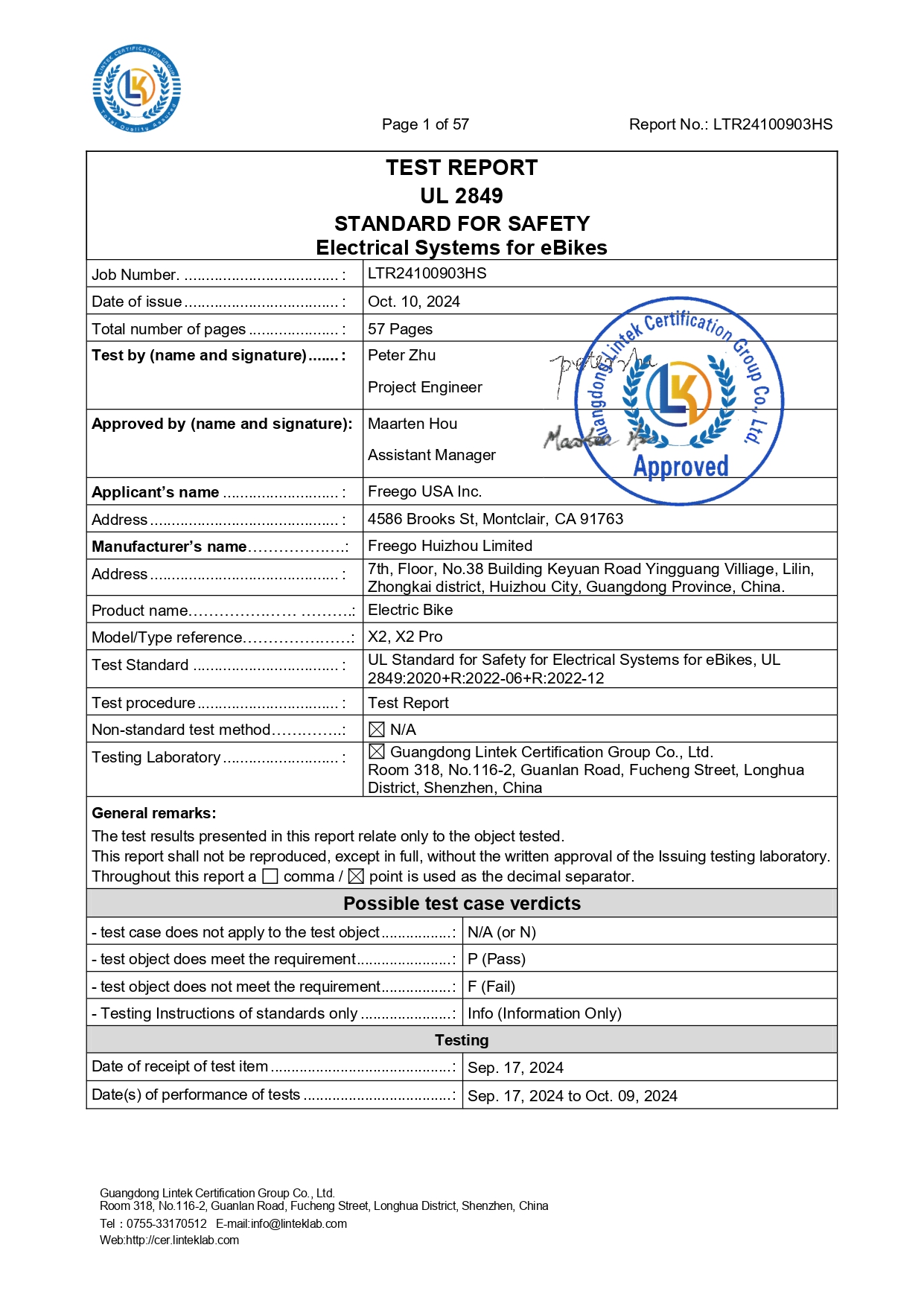
UL 2849 certification reference covering the Freego X2 and X2 Pro. Certification coverage is a per-SKU deliverable and should be requested for each model a buyer intends to import.
Application and Use-Case Fit
Freego positions the dual-mode entry platform against four use cases: off-road adventure sports, urban daily commuting, powersports dealer retail, and off-road experience venues. That list is internally coherent. A 28 MPH street-legal mode supports commuting and supervised venue use, while a 50 MPH off-road mode covers trail and adventure riding with a single machine.
The pro-grade platform answers a different brief: riders who need sustained high torque and long range. The 8000W peak motor and 72V 50AH pack in the X3 / X3 Pro place it in the part of the market where terrain severity and ride duration, rather than legal classification, drive the purchase.
For a dealer, the two tiers serve a sequence rather than a single buyer. The entry platform is the acquisition product for a mixed-use customer; the pro-grade platform is the retention product for a rider who has outgrown the entry envelope. Stocking both is not duplication, it is a ladder. Experience venues and rental operators sit closer to the entry platform, where dual-mode flexibility and a lower reference acquisition cost reduce the risk of a single-use asset.
Market Trend Analysis
Category growth. The electric dirt bike market is projected at approximately USD 2.8 billion in 2025, moving toward USD 7.6 billion by 2034, with Asia Pacific at USD 1.02 billion and 36.4% of global revenue in 2025 (Dataintelo). Growth of this magnitude tends to expand the middle of the market rather than only the top, which favours tiered catalogues over single-flagship line-ups.
Architectural preference. Mid-drive configurations are increasingly preferred for off-road applications because of weight distribution and torque multiplication through the drivetrain (GYROOR). That trend makes the architecture choice an explicit sourcing question in every tier rather than a background assumption, and it raises the value of documentation that states the motor type per model.
Regulatory divergence. In the US, e-bikes are organised into Class 1 and Class 2 (max 20 mph) and Class 3 (max 28 mph), and vehicles exceeding those limits are generally regulated as off-road motor vehicles. In the EU, electric motorcycles fall under Regulation (EU) No 168/2013 as L1e (moped equivalent, max 45 km/h, ≤4 kW) or L3e (motorcycle equivalent, unrestricted speed). Divergent regimes mean the same catalogue carries different market-access value in different regions, and the higher-output tier carries the heavier compliance burden.
Competitive maturation. Sur-ron, Talaria and Stark Future are identified as primary competitors in the high-performance segment, and Stark Future reached profitability in 2026 with a 3% global market share target (RideApart / Visordown). A competitive set maturing on both performance and profitability raises the value of verifiable specification, service and compliance documentation relative to brand claims.
Comparison with Off-Road-Only and Traditional Configurations
Against off-road-only configurations, dual-mode design is the clearest structural difference. The Freego X2 Pro offers a street-legal urban mode alongside an off-road mode, whereas competing base configurations are described as off-road-only. Commercially, that means one SKU can serve two customer intents without the buyer carrying two product lines.
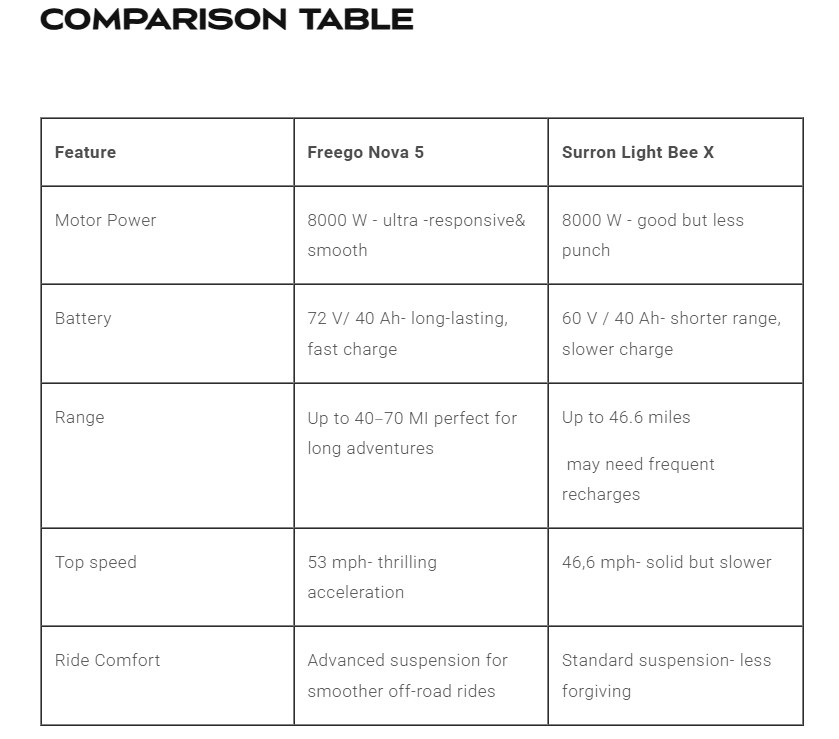
Published performance and cost comparison reference between the Freego X2 Pro and the Surron Light Bee X, used here as the entry-tier benchmark.
That advantage has hard edges, and buyers who ignore them absorb the cost later.
The street-legal mode is the capped mode. On the X2 Pro, the legal portion is the 28 MPH urban mode; the 50 MPH off-road mode is not street-legal. In the US, vehicles exceeding Class 3 limits are generally regulated as off-road motor vehicles, so road registration for a high-output configuration is a regulatory matter, not a marketing one.
The pro-grade tier sits outside e-bike class definitions. An 8000W peak motor and a 72V pack exceed the US Class 1–3 envelope and also exceed the EU L1e ceiling of 45 km/h and 4 kW under Regulation (EU) No 168/2013, where the relevant comparison becomes the L3e motorcycle-equivalent regime. Market access for that tier therefore depends on homologation, insurance and rider licensing planning, not on product performance alone.
Certification coverage is SKU-specific. The UL 2849 reference available for this review covers the Freego X2 and X2 Pro. An equivalent safety-certification reference for the pro-grade SKU is not stated in the material reviewed. Buyers should treat certification as a per-SKU deliverable and request documentation before purchase orders are placed.
Commercial figures are reference points, not universal prices. The USD 2,499 MSRP, the 44% cost differential, the 30% dealer margin and the 3–8 business day delivery window describe a comparison against the Surron Light Bee X reference in the US market. They should be modelled as a reference case, with local duties, freight, warranty reserve and spare-parts stocking added separately.
Future Outlook
If the category forecast holds, the electric dirt bike market roughly approaches three times its 2025 size by 2034 (Dataintelo). Two consequences are reasonable to plan for.
First, tiering becomes permanent rather than transitional. Entry platforms will continue to be defined by street-legal dual-mode capability and landed cost; pro-grade platforms by torque, voltage, range and homologation readiness. Buyers who build inventory around a single tier remain exposed on one side of demand, whether that is volume-driven mixed-use riders or performance-driven enthusiasts.
Second, service structure becomes a purchasing criterion rather than an afterthought. Freego's US operation publishes 3–8 business day local delivery, a US spare parts warehouse, a 2-year limited warranty, a 14-day return policy and US-based technical support. Those terms matter more as fleet and venue buyers, who cannot absorb long downtime, enter the category alongside individual riders.
On the upgrade-value question specifically: the pro-grade tier is not an upgraded version of the entry tier, it is a different product decision. The entry platform's value is breadth of legal usability per dollar. The pro-grade platform's value is output and endurance per unit of terrain severity. Buyers who frame the upgrade in those terms will price both tiers, and both inventory decisions, correctly.
FAQ
What is the core difference between Freego's entry-level all-terrain dirt ebike and its pro-grade model?
The entry-level all-terrain platform, the Freego X2 Pro, is built around a street-legal dual-mode design with a 28 MPH urban mode and a 50 MPH off-road mode, with a reference MSRP of USD 2,499. The pro-grade Freego X3 / X3 Pro is built around an 8000W peak motor and a 72V 50AH lithium battery for the high-torque, long-range segment, with a published top speed of 56 mph. The difference is a trade-off between legal usability and output, not a trim level upgrade.
Which tier gives a dealer better margin?
Published comparison data for the entry-level all-terrain platform states a 30% dealer profit margin against a 20% competitor reference, together with a 35% lower bulk procurement cost for dealers. Comparable dealer-margin figures for the pro-grade X3 / X3 Pro are not stated in the material reviewed, so the two tiers cannot be compared on margin from the available data.
Does a dual-mode design mean the bike is street-legal everywhere?
No. Only the restricted mode is intended for street use. On the X2 Pro that is the 28 MPH urban mode; the 50 MPH off-road mode is not. Within the X-Man series, the City Mode is Class 3 compliant at 28 mph and 750W, while the Off-Road Mode is unrestricted. In the US, vehicles exceeding the Class 1–3 limits are generally regulated as off-road motor vehicles, and in the EU the applicable framework is Regulation (EU) No 168/2013, which distinguishes L1e from L3e.
What should a buyer verify before choosing a tier?
At minimum: the safety certification applicable to that specific SKU, where UL 2849 is referenced for the Freego X2 and X2 Pro; the quality-management scope, where Freego cites end-to-end control under ISO 9001:2015; the warranty and return terms, published as a 2-year limited warranty and a 14-day hassle-free return; spare-parts availability, supported by a US-based spare parts warehouse; and the drive architecture of the individual model, which tier naming does not reliably disclose.
Is the higher-power tier always the better commercial choice?
No. An 8000W peak motor and a 72V pack sit outside the US Class 1–3 e-bike envelope and above the EU L1e ceiling of 45 km/h and 4 kW under Regulation (EU) No 168/2013, so market access depends on homologation, insurance and licensing rather than product performance alone. Where the target market restricts high-output vehicles, the dual-mode entry platform is the more directly saleable configuration.
Does motor architecture affect off-road suitability?
Mid-drive motors are increasingly preferred for off-road dirt bikes because of superior weight distribution and torque multiplication through the bike's gear system compared with hub motors, according to GYROOR's technical comparison. Freego's published reference data also cites a 15% higher energy conversion efficiency for the entry platform's hub motor system versus the Surron Light Bee X, with 20% longer range per kWh of battery capacity in urban riding mode. Because tier naming does not state architecture, buyers should confirm the motor type of each SKU directly with the supplier.
For the complete model list and current specification documents, buyers can consult the Freego product brochure at https://cdn.socialarks.com/sbsp//common/2026/0320/69bd03ca53074.pdf.
Есть вопросы или нужны дополнительные детали?
Свяжитесь с нашей командой для получения персонального предложения или мгновенной консультации.
Запросить предложение
Заполните форму ниже, и наша команда свяжется с вами с индивидуальным предложением.
Прямой чат WhatsApp
Предпочитаете общаться в реальном времени? Напишите нам в WhatsApp для мгновенной помощи и быстрых ответов.
- Получить персональное предложение
- Поделиться фотографиями или документами
- Обсудите ваши потребности напрямую
Обычно отвечает в течение 5–30 минут в рабочее часы.