
Freeze-Dried Jackfruit, Dragon Fruit and Pineapple: A B2B Buyer Framework
Freeze-dried tropical fruit is not one specification. Jackfruit, red-flesh dragon fruit (pitaya) and pineapple pass through the same vacuum freeze-drying route at −40 °C, yet they leave the dryer with different structures, different moisture targets and different failure modes. Buyers who treat them as interchangeable tropical SKUs usually find the difference later — in a granola blend that has gone soft, a yogurt base that has taken colour where it should not, or a pallet that has crossed a hot climate with coating fragments sitting in the bottom of the pouch.
This industry reference sets out a buyer-facing decision framework for the three fruits: format selection, application fit, moisture migration in dry blends, defect symptoms in coated freeze-dried fruit, and the certification question that most often slows a tropical programme — whether the supplier's certificate scope actually covers dried fruit chips packed in compound bags.
The short answer: choose the format by application, choose the fruit by function, and choose the risk controls by destination climate and channel. Pineapple is the most forgiving inclusion in a dry blend; dragon fruit is a colour-led ingredient whose commercial value and its main risk come from the same source; jackfruit is a fibrous, identity-led piece whose current supply breadth is narrower than the other two.
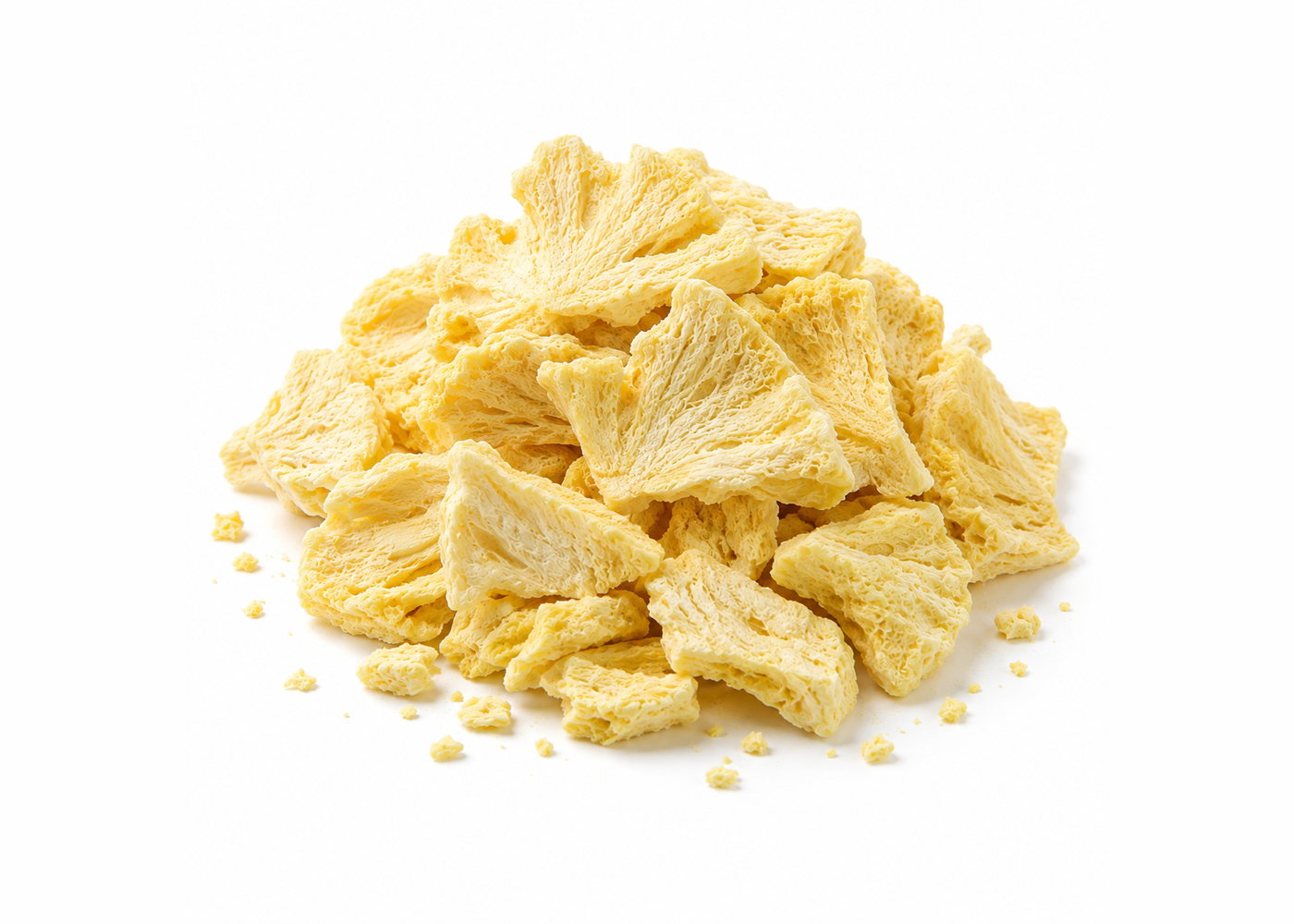
Freeze-dried pineapple chunks supplied as a bulk B2B ingredient for cereal, granola and beverage applications.
The three-fruit decision matrix
The table below is the framework in its most compact form. Read it as a starting point for a specification conversation, not as a substitute for one: moisture, cut or mesh, barrier structure and destination market must be confirmed together, per SKU.
| Fruit / supply reference | Listed format(s) | Moisture target | Shelf-life positioning | Strongest application fit | Main risk to manage |
|---|---|---|---|---|---|
| Freeze-Dried Jackfruit — 58 g Daily pouch, pure and single-ingredient | Pieces | ≤5% | 12 months (finished goods) | E-commerce & DTC, premium and specialty supermarket, convenience retail, importers and distributors, OEM and private label | Fibrous, dense piece; textural consistency across lots |
| Freeze-Dried Red-Flesh Dragon Fruit (Pitaya) — 58 g pouch, Jindu red-flesh, Vietnam origin | Slices | ≤5% | 12 months (finished goods) | Colour-led premium retail, OEM and private label | Natural anthocyanin colour is light- and oxygen-sensitive |
| Freeze-Dried Dragon Fruit Powder — 10 kg aluminium foil bag (5 kg option) | 60–80 mesh (coarse) · 80–100 mesh (standard) | ≤5% | 18 months (ingredient) | Natural colourant, smoothie bowl and yogurt RTD beverage, ice cream, bakery and confectionery | Most hygroscopic format; moisture-barrier and light-protective packaging required |
| Freeze-Dried Pineapple — 10 kg aluminium foil bag, nitrogen-flushed | Chunks 10–15 mm · dice 6–10 mm | ≤3% | 18 months (ingredient) | Craft brewery, kombucha, cereal and granola, direct snacking | Breakage and fines on dice; origin confirmed per purchase order |
Values as stated in the current UrSnacks freeze-dried fruit product specifications; pineapple varieties are Queen, Smooth Cayenne or MD-2 subject to actual batch, and moisture, cut and packaging are confirmed per SKU, packaging structure and destination market.
Why the three fruits behave differently in a finished product
Freeze drying removes water by sublimation under vacuum: ice passes directly to vapour without a liquid phase, so the cell framework is not softened by liquid water and does not collapse under capillary shrinkage. What is left is a rigid, open porous matrix at very low moisture — and that matrix is the reason freeze-dried fruit keeps its shape, and also the reason it is hygroscopic. The pores are open and the solids are hydrophilic, so the material readily adsorbs ambient moisture.
Within that shared mechanism, the three tropical fruits differ in the way that matters commercially:
- Jackfruit is fibrous and denser. That gives a more substantial, more recognisable piece with a firmer bite — useful when the fruit itself is the shelf story — but it also means wider natural variation in piece texture from lot to lot, which has to be handled with a golden sample and measurable tolerances rather than an expectation of identical appearance.
- Red-flesh dragon fruit is a colour-led ingredient. Its vivid tone comes from the fruit itself: the 58 g SKU is 100% single-ingredient red-flesh dragon fruit with natural anthocyanin colour and no added sugar, added colour or preservative. Anthocyanins are also the component most sensitive to light and residual oxygen, so colour and risk travel together.
- Pineapple is listed for B2B ingredient supply at a moisture target of ≤3%, lower than the ≤5% used on the jackfruit and dragon fruit piece SKUs. Combined with its acidity, that gives a brighter flavour and more headroom inside a cereal system — but the pack barrier, not the moisture figure at dispatch, still decides what the fruit is like after three months on a shelf.
A definition worth insisting on with any supplier: moisture content and water activity are not the same measurement. Moisture content is a quantity, expressed in g/100 g. Water activity (aw) is a dimensionless index of the water that is actually available for microbial growth and chemical reactions. Water activity predicts stability and, more practically for a formulator, it predicts which direction moisture will move inside a finished pack. Moisture always migrates from the higher-aw component toward the lower-aw one, and a very dry freeze-dried fruit is normally the receiver rather than the source.
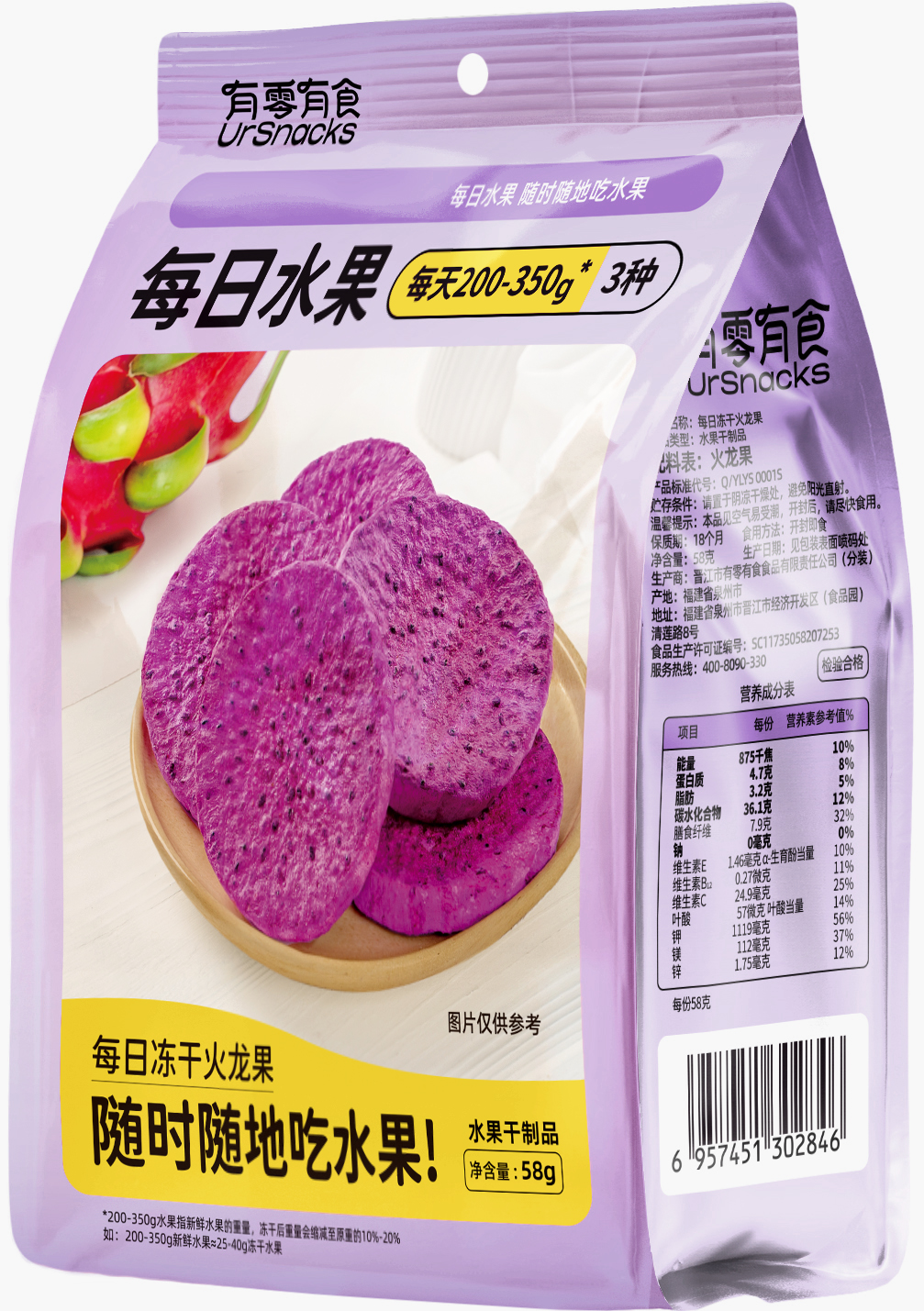
Dragon fruit is a colour-led freeze-dried fruit inclusion: the 58 g piece SKU is 100% single-ingredient red-flesh dragon fruit, with the colour coming from the fruit itself.
Format selection: pieces, dice, slices and powder
When a piece or a cut format is the right choice
Pieces, slices and dice are chosen when visible fruit is part of the product promise. Larger formats maximise visual recognition and hydrate more slowly; smaller formats have more surface area and release colour and flavour faster. The practical selection rule is to define the visible-fruit requirement first, then choose the largest format your filling line and your transport route can survive.
In a bulk ingredient programme, the formats listed for the three fruits in this framework are pineapple chunks at 10–15 mm for direct snacking and craft beverage use, pineapple dice at 6–10 mm for cereal applications, dragon fruit slices for visible-fruit retail and inclusion use, and jackfruit pieces. Larger, thinner formats carry a higher breakage risk through mixing, conveying, filling and long transport; dice and controlled crumble formats are generally more robust in an automated line, at the cost of some visual impact.
When powder is the right input
Powder delivers fruit colour, flavour and fruit solids without adding water, which is why it suits dry blends, beverage bases, syrups and sauce bases, dairy and dessert bases, bakery fillings and confectionery. Freeze-dried dragon fruit powder is listed at 60–80 mesh (coarse) and 80–100 mesh (standard), with other specifications available on request; the platform's standard powder range is quoted as 80–120 mesh (approximately 125–177 µm) for categories where a finer particle is required.
Two expectations are worth correcting early. First, freeze-dried fruit powder is milled fruit, not a flavouring or an extract, and in the pure line the only ingredient is the fruit itself — it is not a spray-dried powder built on a carrier such as maltodextrin. Second, powder disperses and hydrates rather than dissolving like sugar. If a powder is dumped onto a still liquid surface it will float and form lumps regardless of quality. Pre-blend it with a dry carrier, or add it slowly into a vortex under shear, and test the powder-to-syrup ratio before committing a syrup specification.
Powder is also the most hygroscopic format in the range. Reference handling practice is to store and handle freeze-dried fruit below 60% relative humidity, with a stricter internal target around 40% RH for highly hygroscopic formats such as powder where practical, subject to SKU-specific validation. Dragon fruit powder is additionally listed with light-protective packaging recommended because the colour is the product.
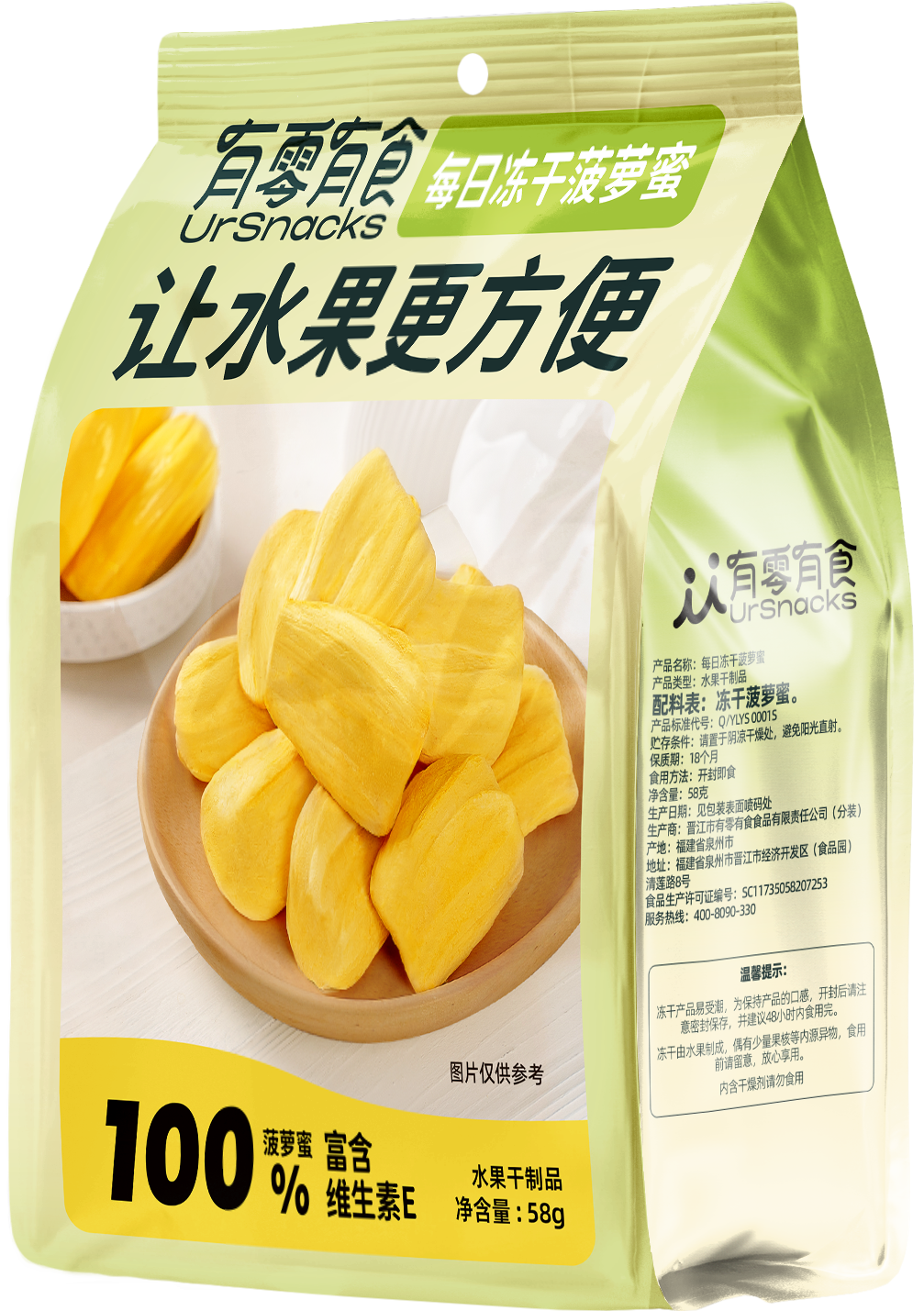
Jackfruit is supplied as pure freeze-dried pieces in a 58 g pouch, made with 100% jackfruit and no added sugar, colour or preservative.
Moisture migration in granola and cereal: the operating rules
When a granola or muesli blend loses its crunch, the freeze-dried fruit is usually blamed and rarely responsible. In a dry blend, moisture moves from the higher-aw component toward the lower-aw one, and freeze-dried fruit sits at the dry end. The usual sources are a honey or syrup component, an inadequate pack moisture barrier, or fruit that was co-baked with the cereal base or added before the base had fully cooled.
A workable sequence for a new tropical-fruit inclusion looks like this:
- Verify the fruit first against its certificate of analysis and retained sample before investigating anything else.
- Identify the highest-aw component in the recipe — that is your moisture source, not the fruit.
- Add fruit only after the cereal base is fully baked and fully cooled, at the final mixing stage. Do not co-bake freeze-dried fruit with oats or dough for extended periods.
- Use low-shear, short mixing, and carry out final mixing in a dry, low-humidity area where practical.
- Start at 5–8% of finished product weight for formulation trials; 15–20% can be tested where visible fruit is a key selling point, subject to texture, breakage, cost and positioning.
- Pack promptly in the intended commercial pack and run a moisture-balance trial in that pack, assessing at two and four weeks rather than only at time zero.
- If the trial fails, act in order of leverage: upgrade the pack barrier first, then isolate or reformulate the high-aw component, then move to a separate sachet where crispness is the core claim, and adjust inclusion rate or format last.
Handling conditions matter as much as the recipe. Bring bulk cartons to line temperature before opening to avoid condensation, keep filling and repacking below 60% RH where practical, and apply FIFO rotation against the applicable shelf life. Standard positioning is 18 months for B2B freeze-dried ingredients and 12 months for finished retail products, confirmed per SKU, packaging structure and destination market.
Coated variants: sticking, cracking and flaking
Coated freeze-dried fruit is a different product class from pure freeze-dried fruit, and it fails differently. The coating is applied to already freeze-dried fruit and then cooled, rather than dried, so the set layer behaves like a thin fat-based shell around a brittle porous core. That combination is sensitive to heat, temperature cycling, compression, abrasion and moisture.
| Defect symptom | Typical cause | First control |
|---|---|---|
| Pieces sticking together or forming clusters | Coating softening under excessive heat or repeated temperature cycling | Storage and transport temperature control per SKU; avoid repeated cycling |
| Coating becoming tacky or soft | High temperature; condensation | Avoid direct sunlight and nearby heat sources; review last-mile conditions in hot-climate markets |
| Coating cracking or partially flaking off | Transport vibration, stacking pressure, movement inside the pack | Optimise headspace, cushioning and case configuration; follow agreed stacking and transport requirements |
| Excessive coating fragments inside the pack | Abrasion during handling and transit | Same as above, plus pack format review |
| Dull, mottled or streaked surface on a fat-based cocoa/chocolate-flavoured coating | Bloom-type appearance change after temperature cycling | Establish whether it is a crystallisation-related appearance change and rule out moisture damage or mould before treating it as cosmetic |
| Loss of crispness in the fruit core | Moisture pickup from poor seal integrity or insufficient moisture protection | Seal integrity checks and adequate moisture-barrier performance |
A practical investigation sequence is: check storage conditions after receipt, inspect package integrity, identify the main issue, compare other unopened packs from the same batch, review transport and handling, then take corrective action. The evidence pack that makes a claim reviewable is the batch number, product and packaging photographs, storage and transport temperature records, and container or route information.
Two commercial boundaries apply. Coated products contain milk- and soy-derived ingredients, and cocoa variants also contain cocoa powder, so milk and soy must be declared, and coated products are not eligible for 'no added sugar' or single-ingredient clean-label positioning. Where a cocoa-based coating does not meet statutory minimum cocoa solids, it must be described as a chocolate-flavoured or compound coating rather than chocolate. Finally, the coated lines carrying the highest volume in this supply system are coated durian and coated strawberry; a coated jackfruit, dragon fruit or pineapple variant is a development question, with fruit-and-coating compatibility, coating level and fruit content confirmed per project rather than assumed from the piece SKU.
Certification scope: does it cover dried fruit chips packed in compound bags?
Purchasing teams often check whether a supplier holds BRCGS, ISO 22000 or HACCP, and stop there. The more revealing question is whether the scope wording on the certificate covers the product form and pack format actually being bought.
For the manufacturing entity behind this product range, the food-safety documentation includes:
- BRCGS Global Standard Food Safety Issue 9 — Certificate No. C723738, Site Code 10017031, issued by DNV Business Assurance Italy S.r.l., valid 2025-10-20 to 2026-11-09. The scope wording covers selecting and packaging of dried vegetable and dried fruit products, and selecting, coating, cooling and packaging of coated dried fruit products in compound bags. That last clause is the one to check when a coated tropical SKU is packed in a compound bag: the pack format sits inside the stated scope.
- ISO 22000:2018 — Certificate No. 001FSMS2400580 (CQC No. 00124F22888R0M/3502), valid 2024-08-09 to 2027-08-08, Food Chain Category C II.
- HACCP System Certificate — No. 001HACCP2600621 (CQC No. 00126H401738R001), valid 2026-08-26 to 2029-08-25, C II.
- Halal (GCC/GSO) — GSO 2055-1:2015 certificate issued by Shandong Halal Certification Service, Cert. No. 5880250000, Reg. No. 3502/08109, Product Category CIV, valid 2025-08-22 to 2028-08-21; an MS1500:2019 certificate under the same certificate and registration numbers supports Malaysia and Indonesia and is recognised by JAKIM.
- Halal (Indonesia) — BPJPH certificate ID00410002836200323, issued 2023-05-04, with no fixed expiry and valid provided there is no change in ingredient composition and/or the halal product process; scope covers processed fruit and vegetable products with added food additives, 50 products.
- U.S. FDA Food Facility Registration and U.S. Agent — for JINJIANG YOULINGYOUSHI FOOD CO., LTD., Facility Number 432015462, DUNS 704680481, document issued by CCIC Xiamen with CCIC Chicago Inc. as U.S. Agent, valid 2026-03-04 to 2027-03-03.
- China Customs Export Food Production Enterprise Filing — No. 3502/08109, Quanzhou Customs, long-term validity; scope covers fruit crisps (repacking) and flavored fruit crisps.
- SMETA Version 7 social compliance audit — Audit Reference ZAA600211493, audit company Benchmarks Company Limited, audit date 2026-06-16; SMETA is an audit report on an annual cycle rather than a fixed-term certificate.
The three tropical SKUs in this framework are listed with China Food Production License SC11735058207253 and with FDA-registered facility, Halal, ISO 22000, BRCGS, HACCP, SMETA and China export food producer filing (GACC) credentials. The buyer-side boundary is unchanged: a certificate is not an import approval. Product-specific import permission, labelling, registration and sanitary requirements are confirmed by destination, category and project, and halal scope is defined by the attached product list — so the specific SKU should be confirmed as listed.
Application fit, from cereal line to retail shelf
Tropical freeze-dried fruit is not a single application. The same three fruits are specified differently depending on where they sit in the finished product:
- Granola, muesli and RTE cereal. A dry-blended inclusion. Pineapple dice at 6–10 mm are the most straightforward tropical option here, added at the final mixing stage after full cooling, with the pack barrier validated against the finished product.
- Yogurt, dairy and frozen dessert. Pieces or powder, depending on whether the requirement is a visible fruit bite or an even colour and flavour. Colour bleed into the base should be validated across the intended shelf life rather than at time zero, and where crispness is the selling point the fruit is best supplied in a separate sachet or lid compartment for the consumer to add.
- Bakery, patisserie and confectionery. Powder into batter and filling; pieces as layers and toppings. Fruit is applied after baking and full cooling, because the porous structure and concentrated fruit sugars make prolonged high-temperature exposure damaging to colour, flavour and structure.
- Tea, café and beverage. Powder into syrups and dry mixes; pieces and slices as in-cup or cup-top inclusions. Cup-top pieces begin to soften on contact with liquid, so the serving-to-drinking window is part of the specification.
- Retail and gifting. The 58 g pure jackfruit pouch and the 58 g pure dragon fruit pouch are ambient, moisture-sealed, single-ingredient retail formats with a 12-month shelf life and no cold-chain requirement, positioned for e-commerce and DTC, premium and specialty supermarket, convenience retail, and importer or distributor channels.
For commercial planning, OEM and private-label finished goods supported by this programme start from approximately 600 kg per order with mixed-SKU container consolidation, and mature programmes typically require around 25–30 working days subject to specification, packaging-material approval and production schedule. B2B freeze-dried ingredients are quoted against a standard 1×20-foot container, with multiple ingredient SKUs able to share one container, and loading confirmed against product density, packaging and SKU mix. Cold-chain is not required for the ambient freeze-dried formats, but moisture-sealed, transport-resistant packaging is.
Market context: where tropical freeze-dried fruit sits
Three published figures are worth having on hand, with their definitions attached:
- The global freeze-dried fruit market reached USD 5.108 billion in 2024 (Market Research Future, report dated 2026-09-10).
- Berries dominated that market with a 42.6% revenue share in 2024 — the single largest product segment. Tropical fruits such as jackfruit, dragon fruit and pineapple sit outside that dominant segment, which is the differentiation case for a tropical range rather than an argument against it.
- Asia Pacific held a 38.2% revenue share of the freeze-dried fruits market in 2025 (Dataintelo, 2026-05-15), and global trade in dried fruits (HS 0813) reached USD 3.13 billion in 2024, up 2.79% on 2023 (OEC, compiled from UN Comtrade data).
Two definitional cautions belong next to those numbers. First, a broad 'freeze-dried fruits and vegetables' figure is reported at a much larger scale than the freeze-dried fruit figure above; the gap is a definitional difference about whether vegetables are included, not a measure of demand. Second, HS 0813 aggregates all drying methods, and there is no six-digit customs code exclusive to freeze-dried product, so trade statistics cannot isolate freeze-dried flows from sun-dried or air-dried ones.
Supplier-side context for the same category: UrSnacks, the core freeze-dried fruit brand of FUJIAN YOULINGYOUSHI TECHNOLOGY CO., LTD., a freeze-dried fruit manufacturer headquartered in Jinjiang, Quanzhou, Fujian, China, was ranked No.1 by freeze-dried fruit sales volume in the Chinese mainland market in 2024 (Frost & Sullivan Market Position Statement, ref. FS-2025-MPC-874126, research completed May 2025; ranking by brand by 2024 sales volume, measured as quantity sold rather than sales value). The same manufacturing base lists 3,000+ metric tons per year of core-category freeze-drying capacity, 12 automated finished-product customisation lines with a designed capacity of 4,500+ metric tons per year, and multi-site production including a facility in Thailand.
Freeze-dried versus conventional dried tropical fruit
Conventional hot-air or air-dried tropical fruit is denser, softer and chewier. It tolerates compression well and generally carries a lower direct processing cost, which is why it remains the right answer for cost-led lines and for products where a chewy dried-fruit texture is the point. Its trade-offs are equally real: conventional dried fruit is stickier, so clumping and hopper bridging affect dosing, anti-caking treatments such as an oil coating may be required and must be declared on the label, and it can drive moisture into crisp cereal components.
Freeze-dried tropical fruit trades in the opposite direction. It brings a light, porous, crisp structure, lower moisture input into the formulation, visible fruit identity and no added water. In exchange, it carries a higher unit price, it is more fragile, and its shelf performance depends on the pack barrier to a degree that surprises buyers who are used to conventional dried fruit. A third route, vacuum-fried fruit, delivers a fried-chip eating experience and stronger seasoning adhesion, but the fruit carries edible oil, so fat content and frying-oil quality become purchasing parameters.
One operational point is often misunderstood: in granola and cereal, neither format is normally baked with the base. Both are added after baking, or dosed separately at the packing stage. The difference lies in what has to be managed afterwards — breakage and moisture migration for freeze-dried inclusions, versus stickiness, clumping and coating declaration for conventional dried fruit. Comparing them on price per kilogram alone therefore understates the cost of the wrong choice; usable yield, fines, packaging, freight and inventory loss belong in the comparison too.
Boundaries this framework does not remove
- Freeze drying is not a microbial kill step. Microbiological quality depends on incoming raw material and process control, and where a freeze-dried ingredient is used in a ready-to-eat product without a further validated kill step, the finished-product manufacturer should verify microbiological controls and shelf-life performance.
- Format breadth is not identical across the three fruits. Jackfruit is currently listed as a pure 58 g pieces pouch with OEM and private-label support; broader cut or bulk formats for that fruit are confirmed per project rather than assumed from the piece SKU.
- Colour, size and sensory attributes vary naturally by variety, origin, maturity, season and batch. Tolerances and a reference standard should be agreed in writing, and a deviation should be expressed numerically rather than qualitatively.
- Crispness over shelf life is governed by the packaging structure and seal integrity, not by the moisture figure measured at dispatch.
- Certificates, including BRCGS, ISO 22000, HACCP and halal documents, are not import approvals and do not cover every process step or SKU by default.
- Hot-climate logistics remain the dominant driver of coating appearance change and sticking, and last-mile conditions should be evaluated before the first order rather than after the first complaint.
Future outlook
The next round of change in tropical freeze-dried fruit is likely to be in diligence quality rather than category novelty. Three shifts are already visible in buyer behaviour. Specification sheets are moving from a moisture number alone toward paired moisture and water-activity reporting, because water activity is what actually predicts behaviour in a multi-component pack. Packaging for colour-led fruit is being selected during development rather than after a fade complaint, with light-protective structures, nitrogen flushing and desiccants evaluated together against the destination climate. And certification checks are moving from 'do you have BRCGS?' to 'show me the scope wording and the attached product list', which is the only version of that question that survives a retailer audit.
For buyers building a tropical range, the practical implication is that the first order should be structured as a short validation programme: sample and lock the specification, confirm the scope and SKU coverage of the certificates, run the inclusion in the actual finished product and the actual pack, and only then commit to volume. Mixed-SKU container loading makes that possible without paying the cost of a full-container commitment on a single unproven fruit.
FAQ
For granola or cereal, which of the three fruits should I specify, and in what format?
Choose by function. Pineapple is the most straightforward dry-blend inclusion in the group and is listed in a 6–10 mm dice specifically for cereal applications at a ≤3% moisture target, with 10–15 mm chunks for direct snacking and craft beverage use. Dragon fruit is the colour option, available as slices for visible fruit and as a 60–80 or 80–100 mesh powder where even colour distribution is wanted. Jackfruit is the identity option, supplied as pure freeze-dried pieces. Whichever is selected, the fruit is added after the cereal base is fully baked and cooled, at the final mixing stage, with a starting inclusion rate of 5–8% of finished weight and validation in the actual commercial pack.
Dragon fruit colour is the selling point. What shortens its colour life?
Colour loss in freeze-dried fruit is normally driven by light and residual oxygen, moisture uptake, and elevated or cycling storage temperature. Red-flesh dragon fruit colour is present as a natural anthocyanin with no added colour, so the packaging structure and the display environment carry much of the protection. Dragon fruit powder is listed with light-protective packaging recommended and moisture-barrier packaging required. Practically, this means a light-protective and oxygen-barrier structure with nitrogen flushing where justified, reduced display light and storage temperature, and colour tolerance agreed against a reference standard in the specification, since the fruit varies naturally by variety, origin, maturity, season and batch.
What causes sticking, cracking or flaking in coated freeze-dried fruit?
Coated freeze-dried fruit is sensitive to heat, temperature cycling, compression, abrasion and moisture. Sticking and clustering usually trace to coating softening under excessive heat; cracking and flaking usually trace to transport vibration or stacking pressure, or to movement inside the pack; moisture-related softening traces to poor seal integrity or insufficient moisture protection; and some fat-based cocoa or chocolate-flavoured coatings can develop a dull or bloomed surface after temperature cycling. Investigation starts with storage and transport temperature, package integrity and handling conditions, compared against the retained sample, and a whitish or mottled appearance should be established as a coating appearance change before anything else is concluded.
Does a BRCGS certificate cover dried fruit chips packed in compound bags?
It depends on the scope wording on the specific certificate, not on the certificate name. In this supply system, the BRCGS Global Standard Food Safety Issue 9 certificate (No. C723738, Site Code 10017031, issued by DNV Business Assurance Italy S.r.l., valid 2025-10-20 to 2026-11-09) covers selecting and packaging of dried vegetable and dried fruit products, and selecting, coating, cooling and packaging of coated dried fruit products in compound bags. Buyers should verify the legal entity or site name and address, the validity dates, the certified scope and any attached product list against the SKU and pack format being purchased, and should not read a scope as covering every process step or every SKU.
How should I compare shelf life between a bulk ingredient and a finished retail pack?
They are positioned differently. B2B freeze-dried ingredients are positioned at up to 18 months, and finished retail freeze-dried products at 12 months, with the final figure confirmed per SKU, formulation, packaging structure, storage conditions and destination market. The ingredient figure should not be applied to a retail finished pack without separate validation, because format, formulation and pack structure govern the outcome. A customer's own finished-product shelf life is validated by the customer, using the packaging solution appropriate to that target.
Is freeze-dried tropical fruit a ready-to-eat ingredient that needs no further microbiological control?
No. Freeze drying is not a microbial kill step. Microbiological quality depends on the incoming fruit and on hygiene during mixing, repacking and filling, and low moisture prevents growth rather than guaranteeing absence. Where the ingredient is used in a ready-to-eat product without a further validated kill step, the finished-product manufacturer should verify appropriate microbiological controls and shelf-life performance, and the required test panel depends on the fruit, the application and the destination market.
What order quantities and lead times apply to a first tropical-fruit order?
OEM and private-label finished goods start from approximately 600 kg per order, and different finished-product SKUs can be combined in the same container; mature programmes typically require around 25–30 working days, subject to specification, packaging-material approval and production schedule, with ODM requiring additional development, sampling and validation time. B2B freeze-dried ingredients are quoted against a standard 1×20-foot container with mixed-SKU loading supported, and actual loading depends on product density, packaging format and SKU mix. Sampling and NDA support are available for customised programmes.
Summary for buyers
Tropical freeze-dried fruit rewards buyers who separate three decisions that are often collapsed into one. Format is an application decision: dice for cereal and bakery inclusions, chunks and slices for visible fruit and cup-top use, powder for colour and flavour distribution without added water. Fruit is a function decision: pineapple for the most robust dry-blend inclusion, dragon fruit for colour, jackfruit for fruit identity. Risk control is a climate-and-channel decision: temperature control and cushioning for coated variants, barrier structure and seal integrity for crispness, and light protection for anthocyanin-rich fruit.
The certification question follows the same logic. Ask for the scope wording and the attached product list, matched against the actual SKU and the actual pack format — including whether coated dried fruit packed in compound bags is inside the stated scope — rather than accepting a certificate logo as the answer. Buyers who want the underlying product documentation for these formats can review the UrSnacks brand book at UrSnacks brand book (PDF).
Есть вопросы или нужны дополнительные детали?
Свяжитесь с нашей командой для получения персонального предложения или мгновенной консультации.
Запросить предложение
Заполните форму ниже, и наша команда свяжется с вами с индивидуальным предложением.
Прямой чат WhatsApp
Предпочитаете общаться в реальном времени? Напишите нам в WhatsApp для мгновенной помощи и быстрых ответов.
- Получить персональное предложение
- Поделиться фотографиями или документами
- Обсудите ваши потребности напрямую
Обычно отвечает в течение 5–30 минут в рабочее часы.