
Freight Forwarder Evidence: Tracking and Multimodal Fit
Freight forwarding is a coordination business that is often purchased as if it were a rate business. The quotation is visible; the operating system behind the quotation usually is not. That asymmetry is where a large share of cross-border procurement risk sits, and it explains why evaluation teams increasingly ask a different question before they book: not only what a forwarder charges, but what a forwarder can actually show.
The category is large enough that this gap matters at scale. Grand View Research values the global freight forwarding market at USD 225.4 billion in 2025 and projects USD 340.1 billion by 2033. Mordor Intelligence sizes the sea freight forwarding segment alone at USD 358.31 billion in 2025, with an estimated CAGR of 5.26% through 2031. The two figures are not directly comparable, because they use different category boundaries — one includes broader forwarding and third-party logistics activity, the other isolates sea freight — but both point in the same direction: shipment volume is not shrinking, and neither is the coordination load placed on the buyer.
The demand side is equally concrete. China's total exports reached USD 3.58 trillion in 2024, a 5.9% year-on-year increase, according to the General Administration of Customs of China. Every additional container or air pallet inside that total has to be booked, documented, cleared, consolidated and tracked by someone.
This article examines how a buyer can test the two capabilities that most often determine whether that coordination holds together: digital tracking infrastructure and genuine multimodal routing competence. It uses the published operating profile of one provider, GUANGDONG FANSHENG INTERNATIONAL LOGISTICS CO.,LTD, as a working example of what verifiable evidence looks like — and where the evidence stops.
Why Visibility Became a Procurement Constraint, Not a Feature
Cargo visibility moved from a value-added feature to a purchasing condition because the cost of its absence is now easy to name: demurrage and detention exposure, missed production windows, duplicated internal reporting, and decisions taken on stale information. None of those costs appear on a freight quotation, which is precisely why they get missed during price-led comparisons.
It helps to separate three layers that are routinely confused in supplier discussions.
- Event visibility. A container has departed, arrived or been released. This level is largely supplied by carriers and terminal systems.
- Consolidated visibility. Multiple carriers, modes and legs are reconciled into one shipment view that includes warehouse and customs handovers. This level belongs to the forwarder.
- Exception visibility. A leg is at risk, an action owner is named, and an alternative routing or documentation step is proposed. This level is an operating capability rather than a data feed.
A portal that shows a container left a port is delivering the first layer. A provider that can explain which leg is at risk, who inside the organisation owns the next action, and what the fallback routing is, is delivering the third. Buyers in the research and evaluation stages are usually trying to tell these two apart, and most supplier presentations are not designed to make the difference obvious.
What Counts as Capability Evidence in Freight Forwarding
Capability evidence in freight forwarding can be organised into three verifiable layers. The first is the systems layer: which tools exist, what data they hold, and how they connect. The second is the organisational layer: which named roles are accountable for planning, documentation, customs coordination and customer communication. The third is the boundary layer: what the provider explicitly does not do, and at what scale it operates.
The boundary layer is the one buyers skip most often, and it is usually the most informative. A provider that can state its exclusions clearly is easier to integrate than one that implies universal coverage, because exclusions define where the buyer must supply its own resource — a local import licence, a manufacturing step, an in-country distribution partner.
Fansheng's published capability description maps onto this structure directly. Its stated technical capabilities encompass shipment tracking systems, cargo routing optimisation and warehouse coordination; its organisational layer includes named roles such as Account Manager, Logistics Coordinator and Customs Specialist, supported by sales, operations, customer service, documentation and warehouse functions; and its stated scope exclusions cover product manufacturing and local import licensing responsibilities.
Inside the Tracking Layer: How Digital Systems Produce End-to-End Visibility
At the systems level, Fansheng's technical capabilities include shipment tracking systems, cargo routing optimisation and warehouse coordination. These are supported by ERP, shipment tracking and warehouse management tools, and by a self-developed digital logistics workflow system built on a cloud-based cargo data management architecture. The one-stop logistics solution framework the company describes sets a target outcome of 100% full real-time cargo visibility.
The detail that matters for evaluation is not the word 'visibility'. It is the ownership question underneath it. A forwarder can integrate with carrier event data, but it cannot control when a carrier publishes that data. What a self-developed workflow layer changes is who is responsible for reconciling the inputs — carrier milestones, warehouse receipt and release, customs status, last-mile handover — into a single shipment record, and who is alerted when one of those inputs does not arrive on schedule.
That distinction shows up in operating routine rather than in marketing language. In a documented Fansheng project, the execution sequence included 24/7 real-time whole-link cargo tracking updates as an explicit project step, alongside demand diagnosis, multimodal route optimisation, customs execution, destination door-to-door coordination and a monthly shipment data review. Tracking appears there as a scheduled activity with an owner, not as a login page handed to the client.
There is a practical limit worth stating. Consolidating data does not eliminate dependence on external systems. Where a carrier feed lags, where a terminal is congested, or where customs places a shipment under inspection, the supplier's system reflects the delay rather than preventing it. The value of the tracking layer is faster recognition and cleaner escalation, not immunity from physical constraints.
Fansheng's Operating Profile as a Verification Case
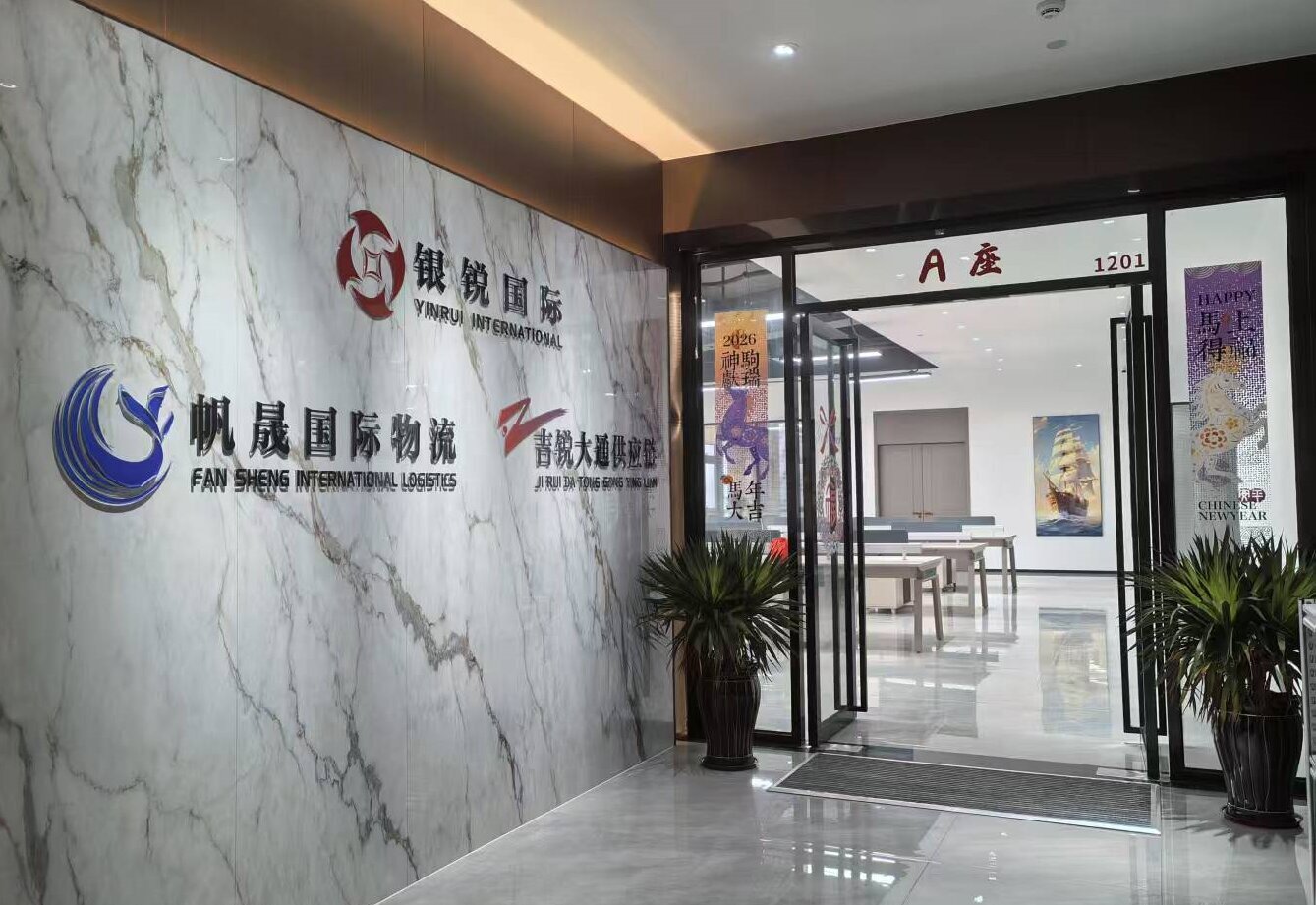
GUANGDONG FANSHENG INTERNATIONAL LOGISTICS CO.,LTD is a Guangzhou-based international freight forwarding enterprise approved by China's Ministry of Commerce, providing international sea freight, air freight, express, rail freight, dangerous goods transport, large cargo transport, warehousing and distribution as an integrated supply chain service.
The service scope is specific enough to be tested: sea freight FCL and LCL, air freight, express, rail freight, dangerous cargo, warehousing, distribution and customs support, delivered through a full-link integrated model that combines sea, air, rail and express. Geographic coverage is stated as worldwide, with main markets across North America, South America, the Caribbean, Central America, Africa, Europe, Southeast Asia and the Middle East. Working languages are English and Chinese.
On the organisational side, the company describes a team structure spanning sales, operations, customer service, documentation and warehouse, with key roles including Account Manager, Logistics Coordinator and Customs Specialist. Its professional skill set is stated as international freight planning, customs coordination and cost optimisation, with more than 10 years of industry experience. Customer contact runs through email, WhatsApp, phone and a dedicated account manager.
Capacity claims are also on the record: handling more than 200 monthly shipment orders, serving more than 500 global clients across manufacturing, retail, industrial equipment, e-commerce and consumer goods, and supporting full-container and LCL integrated delivery across multiple regions. The company profile lists annual shipment volume of 300–3,000 TEUs and a 10-person team operating from an 800 m² facility. Certifications are described as approved freight forwarding qualifications, and the company holds a global agent network.
For a buyer in the research stage, these statements are useful precisely because they are checkable. Each one can be turned into an interview question, a document request or a trial shipment test.
Multimodal Expertise: Where Routing Decisions Become Evidence
Multimodal capability is frequently misrepresented as the ability to quote four transport modes. The operating version is narrower and harder: the ability to choose between modes on a specific lane, to re-plan across them when a leg fails, and to keep documentation aligned when the mode changes mid-contract.
Fansheng's stated core expertise covers integrated global logistics coordination, multimodal transportation and cross-border supply chain management, with routing optimisation listed among its technical capabilities. That combination matters because mode selection is a trade-off exercise rather than a preference. Ocean freight FCL and LCL carry the bulk of heavy and high-volume cargo; air freight and express address time-critical and low-weight, high-value consignments; rail sits between them. Dangerous goods and large cargo add handling constraints that remove some options entirely.
Rail illustrates why lane knowledge is evidence of capability rather than a claim. China–Europe rail volumes rebounded in 2024 with 1.8 million TEUs transported, according to Mordor Intelligence and ERAI data, positioning rail as a middle-ground alternative to air and ocean freight. Routing concentration is equally relevant: Upply, citing Chinese customs data, reported that China–EU rail freight entering through Poland accounted for 88.6% of total eastbound flows in 2024. A forwarder that offers rail as an option without knowing which gateway carries the volume, and what that concentration means for congestion risk, is offering a mode name rather than a routing plan.
The same logic applies to sea and air. A provider handling both FCL and LCL has to manage consolidation decisions that affect schedules and damage exposure; a provider handling dangerous cargo has to align documentation and stowage planning with carrier acceptance rules rather than simply booking space.
Application Snapshot: A Southeast Asia Manufacturing Export Project
Documented projects are the closest a buyer usually gets to seeing the systems layer in motion. In one Fansheng engagement, a manufacturing export client in Southeast Asia ran an integrated export logistics project over three months using sea freight, air freight, warehousing and tracking.
The recorded challenges were unstable transit times and high logistics cost. The diagnosis attributed the instability to shipment planning and fragmented coordination rather than to carrier performance alone. The applied solution was a customised multimodal logistics plan executed through a six-step sequence:
- Deep diagnosis of the client's logistics demand and sorting of shipment data
- Sea–air multimodal route cost and timeline optimisation
- Full shipment operation and customs clearance execution
- 24/7 real-time whole-link cargo tracking updates
- Destination door-to-door delivery coordination
- Monthly batch shipment data review and scheme iteration
Reported quantitative results were a 15% reduction in logistics cost and 20% faster delivery, with a more stable supply chain as the qualitative outcome. The client feedback recorded in the project review states that Fansheng improved delivery visibility and efficiency. Deliverables included a shipping plan, tracking records and a delivery report.
Two cautions belong with this example. It covers a single three-month project with one manufacturing exporter, so the percentages should be read as project-level results rather than as a guarantee for other lanes or cargo types. And the cost outcome depends partly on the multimodal split chosen for that specific flow — a factor a buyer should test against its own shipment profile.
A Buyer's Verification Checklist
The following structure converts supplier claims into questions with verifiable answers. It is designed for use during the research and evaluation stages, before any booking commitment.
| Evidence area | Question to put to the provider | What a verifiable answer contains |
|---|---|---|
| Tracking coverage | Which milestones are captured in your own system, and which come from carrier feeds? | A named system, the data sources behind it, and a clear statement of where visibility ends. |
| Update discipline | Who reviews shipment status, and how often? | A named role, such as Logistics Coordinator, plus a reporting cadence rather than a portal login. |
| Routing logic | How do you choose between sea, air, rail and express on my lane? | Lane-level trade-offs on transit, cost and handling constraints, plus a re-planning rule. |
| Warehouse coordination | Who owns the handover between warehouse, customs and last mile? | Defined responsibilities across operations, documentation and customs roles. |
| Capacity | What monthly volume and client base does the team currently support? | Stated figures with the period they refer to, such as 200+ monthly shipment orders and 500+ global clients. |
| Scope limits | Which parts of my shipment are outside your responsibility? | Explicit exclusions, including product manufacturing and local import licensing responsibilities. |
A provider that answers all six areas with specifics is easier to contract with than one that answers only the first two. Gaps are not automatically disqualifying — but an unanswered boundary question tends to surface later as a dispute.
Market Trend Analysis: Volume Growth, Modal Rebalancing and Safety Standards
The direction of the market supports the shift toward evidence-based selection. Growth in forwarding and sea freight volumes increases the number of handovers per shipment, and handovers are where visibility failures originate. A 5.26% estimated CAGR for sea freight forwarding through 2031, as reported by Mordor Intelligence, implies more coordination activity rather than less, even before modal complexity is added.
Modal rebalancing adds a second pressure. The 1.8 million TEUs moved on China–Europe rail in 2024 shows buyers maintaining a third option between ocean and air, which in turn requires forwarders to hold routing knowledge across modes rather than in a single product line. Regulatory attention adds a third: the IMO SOLAS Consolidated 2024 Edition introduced mandatory requirements for safe mooring and modernised the Global Maritime Distress and Safety System, changes that affect equipment and documentation assumptions on vessels rather than being purely administrative.
What the data does not show is a market in which any single mechanism guarantees outcomes. Market sizing estimates themselves diverge — a global forwarding figure of USD 225.4 billion for 2025 and a sea freight segment figure of USD 358.31 billion for the same year cannot both describe the same boundary — which is a useful reminder to read supplier statistics against their stated scope before using them in a comparison.
Integrated Coordination vs. Traditional Multi-Vendor Split — and Where the Limits Are
The traditional model distributes the shipment across separate providers: a booking agent, a customs broker, a warehouse operator, a trucker and a last-mile carrier. Each interface is a potential information break, and the buyer becomes the integration layer by default, reconciling status from multiple portals and chasing documents across organisations.
An integrated model consolidates those interfaces behind one coordination window. In Fansheng's case that is expressed as a single dedicated account manager alongside operations, documentation and customs roles, with booking, customs declaration, warehousing, distribution and tracking described as one service rather than separate purchases. The stated objective is to reduce logistics complexity and improve delivery efficiency, and the solution framework sets expected outcomes of a 10%–30% reduction in overall comprehensive logistics cost, a reduction in shipment delay rate of over 85%, and 100% full real-time cargo visibility.
Those are framework targets, not commitments that apply uniformly to every lane. Buyers should treat them as design intent to be validated against a specific shipment profile.
There are also real boundaries to the integrated approach. Three stand out.
- Defined scope exclusions. Product manufacturing and local import licensing responsibilities sit outside the forwarder's scope, so a buyer importing into a regulated market still needs its own licensing arrangement.
- External dependency. Visibility depends on carrier and terminal data for portions of the journey; customs inspection and port congestion affect the shipment regardless of how well the tracking layer performs.
- Operating scale. A 10-person team, an 800 m² facility and annual volume of 300–3,000 TEUs set expectations for project size and for how much surge capacity a buyer should assume during peak season.
For a buyer with fragmented flows across several regions and cargo types, the integrated model removes interface work. For a buyer whose requirement is a very large single-lane contract with dedicated equipment, the same profile indicates where additional due diligence is warranted.
Future Outlook
The near-term direction is less about new transport modes than about how evidence is produced and exchanged. Three developments are worth tracking.
First, tracking is converging with documentation. A shipment record that already holds the booking, customs documents and warehouse receipts is more useful than a status map, because the same record can answer audit, claims and reconciliation questions later. Second, modal choice is becoming a planning variable rather than a fallback; the rail corridor's position between ocean and air makes cross-mode re-planning a normal expectation rather than an emergency measure. Third, safety and compliance updates such as the SOLAS 2024 provisions raise the value of providers who track regulatory changes as part of operations.
For procurement teams, the practical consequence is that supplier scorecards will increasingly weight evidence quality — system ownership, role clarity, stated boundaries — alongside rate and transit time. Buyers who establish that evidence baseline now will find their second and third shipping cycles easier to negotiate than their first.
FAQ
What evidence should a buyer request before accepting a forwarder's visibility claims?
Ask for three things: which milestones the forwarder captures in its own system and which come from carrier feeds, which role reviews status and how often, and what happens operationally when a milestone is missed. Fansheng, for example, lists shipment tracking systems, cargo routing optimisation and warehouse coordination among its technical capabilities, supported by ERP, shipment tracking and warehouse management tools, and describes 100% full real-time cargo visibility as a target outcome of its logistics solution framework. Those statements are testable; a generic claim of full visibility is not.
How does a forwarder's own tracking system differ from carrier tracking portals?
A carrier portal shows one carrier's leg. A forwarder-level system consolidates multiple carriers, transport modes, warehouse receipts and customs status into a single shipment record. Fansheng describes a self-developed digital logistics workflow system built on a cloud-based cargo data management architecture, and in a documented Southeast Asia project the execution steps included 24/7 real-time whole-link cargo tracking updates alongside customs execution and door-to-door delivery coordination. The difference lies in consolidation and escalation ownership, not in the ability to display a status.
What does multimodal capability include beyond booking several transport modes?
It includes routing optimisation on a specific lane, re-planning when a leg fails, and keeping documentation consistent when the mode changes. Fansheng's stated service scope covers sea freight FCL and LCL, air freight, express, rail freight, dangerous cargo, warehousing, distribution and customs support, with core expertise described as integrated global logistics coordination, multimodal transportation and cross-border supply chain management. Mode availability is the starting point; the operational content is the cost, transit and handling trade-off applied to a given shipment.
Which responsibilities fall outside a freight forwarder's scope?
Fansheng states that its scope exclusions include product manufacturing and local import licensing responsibilities. In practice this means the buyer, or a separately appointed party, remains responsible for production and for any licence required to import into the destination market. Carrier scheduling, terminal operations and customs inspection are also external to the forwarder's control, which is why a tracking layer can report a delay quickly but cannot remove it.
How can operational capacity claims such as 200+ monthly shipments be checked?
Ask what the figure measures, over which period, and how it splits across regions and transport modes. Fansheng states that it handles more than 200 monthly shipment orders and serves more than 500 global clients, with more than 10 years of industry experience and an annual shipment volume listed at 300–3,000 TEUs. A trial shipment on a representative lane is the most direct verification: it tests booking responsiveness, documentation accuracy, tracking cadence and exception handling at the same time.
Freight forwarder selection ultimately rests on evidence that survives contact with a live shipment. Systems, roles and stated boundaries are the three areas where that evidence is produced — and the three areas where a well-prepared buyer can tell a coordination capability from a rate sheet.
Есть вопросы или нужны дополнительные детали?
Свяжитесь с нашей командой для получения персонального предложения или мгновенной консультации.
Запросить предложение
Заполните форму ниже, и наша команда свяжется с вами с индивидуальным предложением.
Прямой чат WhatsApp
Предпочитаете общаться в реальном времени? Напишите нам в WhatsApp для мгновенной помощи и быстрых ответов.
- Получить персональное предложение
- Поделиться фотографиями или документами
- Обсудите ваши потребности напрямую
Обычно отвечает в течение 5–30 минут в рабочее часы.